Share |
Showing posts with label World. Show all posts

Thursday, 8 November 2012

Burma: Trouble Brewing for China

(Asia Sentinel) Government tolerates freedom of expression, and the Burmese target Chinese investments
Monya protesters
Monya protesters
Following the Burmese government’s suspension of a controversial joint-venture hydroelectric dam project with China in the far north of the country, another flashpoint has emerged in relations between the two countries – a massive copper mine at Latpadaung, a mountain near Monywa northwest of Mandalay in Upper Burma.

The Myitsone hydroelectric project, being built to supply power to China, was cancelled in the face of strong local resistance. This time, local residents are protesting against a Chinese company. Wanbao Mining, a joint venture with the Burmese military’s main commercial enterprise, Union of Myanmar Economic Holdings, or UMEH. Wanbao has been accused of destroying cultivated fields, polluting nearby water sources and desecrating Buddhist shrines. No less than 3,150 hectares of land from 26 surrounding villages were confiscated for the project.

The public outcry could also force China to rethink its often insensitive – some would say aggressive – policies towards smaller countries in the region.

UMEH’s involvement is merely as a recipient of fees from Wanbao, a subsidiary of the North Industries Corporation, or Norinco, China’s main weapons manufacturer which is also involved in other business activities.

When the agreement between Norinco and the government of Burma was signed 10 June 2010, the Chinese company said on its website that Monywa is “abundant in copper mine resources with excellent mineral quality, which is of great significance to strengthening the strategic reserve of copper resources in our country, and to enhancing the influence of our country in Myanmar (Burma).”

That influence is now on the wane as Burma tries hard to distance itself from China - which for more than two decades has exerted considerable economic, political and even military influence over this Southeast Asian country - while improving political relations with the United States, the European Union and Japan. But after last year’s suspension of the US$3.6 billion joint venture Myitsone dam project in the northern Kachin State, which shocked the Chinese, Burma must tread carefully in dealing with Wanbao Mining. For the country’s new leaders, it is a dilemma: They cannot crack down on the movement in Monywa without risking its still tenuous relationship with the West. But a continuing struggle could impact relations with Burma’s powerful northern neighbor.

The campaign against the Chinese company is led by two unlikely local heroes: Thwe Thwe Win, 29, and Aye Net, 34. Neither of the two young women has more than the compulsory five-year primary education behind her, and more than a year ago, both were selling vegetables in the local market in Monywa.

“The Chinese company came and bulldozed our fields and the Chinese officials made rude gestures at us when we came to complain,” says Thwe Thwe Win in an interview in Monywa.

The police did nothing, except arrest the two women and some of their comrades. That ignited a mass movement, at a time when freedom of expression is becoming tolerated in Burma after decades of iron-fisted military rule and when anti-Chinese sentiment is rising across the country. Student and labor activists from the old capital Rangoon and elsewhere traveled to Monywa to show support. On 26 October, more than 1,000 local miners, Buddhist monks and members of the general public defied an order by local authorities restricting access to the mine and marched past roadblocks to make merit at a pagoda inside the mining area.

The two women vow not to give up until the project is scrapped and the Chinese company leaves Monywa.

Elsewhere in Burma, people are also complaining about how China treats their country. For more than 20 years, Chinese companies have stripped large swathes of the north of trees, denuding ecologically crucial watershed areas. Chinese merchants have also flooded Burma with cheap consumer goods and fake medicines, explains a local businessman in Rangoon. “China does produce goods of good quality, but only for export to the West,” he said. “Here, they sell only junk. This is an almost racial attitude towards us.”

Even within the ruling military, anti-Chinese feelings run high. Already in 2004, a document was compiled by Lieutenant Colonel Aung Kyaw Hla, a researcher at Burma’s Defence Services Academy located in Pyin Oo Lwin, an old hill station in the highlands northeast of Mandalay.

The 346-page top-secret, thesis, titled “A Study of Myanmar [Burma]-U.S. Relations,” outlines in Burmese the policies now being implemented to improve relations with Washington and lessen dependence on Beijing. The establishment of a more acceptable regime than the old junta after the November 2010 election has made it easier for the Burmese military to launch new policies and have those taken seriously by the international community.

The thesis bluntly states that having China as a diplomatic ally and economic patron has created a “national emergency” that threatens the country’s independence. Aung Kyaw Hla, probably a committee of army strategists rather than a single person, goes on to argue that although human rights are a concern in the West, the US would be willing to modify its policy to suit “strategic interests.” Although the author does not specify those interests, the thesis makes it clear that includes common ground with the US vis-à-vis China. The author cites Vietnam and Indonesia under former dictator Suharto as examples of US foreign-policy flexibility in weighing strategic interests against democratization.

If bilateral relations with the US were improved, the master plan suggests, Burma would also gain access to badly needed funds from the World Bank, the International Monetary Fund and other global financial institutions. The country would then emerge from “regionalism,” where it currently depends on the goodwill and trade of immediate neighbors, including China, and “enter a new era of globalization.”

At the same time, China is clearly taking the new signals from Burma seriously. In February and March this year, the Beijing-based, Chinese-language weekly Economic Observer ran a series of articles about the suspension of the Myitsone dam trying to analyze what went wrong with China’s relations with Burma. “How could something like this happen?” columnist Qin Hui asked. The 14 October Global Times, a daily tabloid published under the auspices of The People’s Daily newspaper, said in a commentary that Chinese companies need to “attach more importance to grassroots voices” in carrying out investment projects such as the Monywa copper mine. According to Burmese journalists, reporters from The Global Times are calling them with questions about pro-democracy leader Aung San Suu Kyi, which never happened before.

It’s too early to say whether Myitsone, and now Monywa, will become a turning point in China’s relations with Southeast Asia, paving the way for a more tactful relationship with countries such as Burma. But popular struggles against two Chinese megaprojects here have no doubt been wake-up calls for the leaders in Beijing. Even smaller countries – and a movement led by two former vegetable vendors in a town in the Burmese outback – are now brave enough to challenge the region’s most powerful economic and political player.

(Bertil Lintner is a Swedish journalist based in Thailand and the author of several works on Asia. He can be reached at lintner@asiapacificms.com. This is published with permission from the Yale Center for the Study of Globalization.)

Tuesday, 23 October 2012

Malaysia, China Strengthen Cooperation In Combating Transboundary Crime

KUALA LUMPUR, Oct 22 (Bernama) -- Malaysia and China are strengthening cooperation in combating transboundary crime due to the expected entry of five million China nationals including tourists and students each year into this country.

Home Minister Datuk Seri Hishammuddin Tun Hussein said there were about three million China nationals in Malaysia at the moment as tourists, students or workers, while some had entered this country illegally.

"Therefore, a detailed discussion will be held between the Immigration authorities of the two countries, focusing on the visa arrangement in finding a mechanism to address the issue," he said after chairing the first meeting of the Malaysia-China working group to combat transnational crime, here, Monday.

Also present at the meeting was Hishammuddin's counterpart, China's Public Security Minister Meng Jianzu, who arrived here Sunday for a three-day working visit to Malaysia.

The formation of the working group had been agreed upon through a cooperation agreement signed together with Meng on Aug 2 this year in Beijing, China to fight the crime.

Through the agreement, Malaysia and China will focus on efforts to combat transboundary crime including terrorism, cyber crime, human trafficking, smuggling of migrants, drug trafficking and economic crime, as well as on border control and public order.

He said the signing of the agreement was an apt move as the status of China's nationals in Malaysia had often been doubted.

"The signing of the cooperation agreement also shows Malaysia's continuous commitment to establishing close cooperation with foreign enforcement agencies in fighting transboundary crime, which is on the rise."

The agreement with China is the fourth security cooperation document signed by Malaysia with its strategic partners after Saudi Arabia, the United Kingdom and United States.

Today's meeting focused on strengthening cooperation between the enforcement agencies of the two countries, sharing of information and intelligence, conducting joint investigations and sharing of findings, exchange visits by personnel and repatriation of suspects.

Thursday, 8 March 2012

Asia Must Talk Sense on Israel and Iran


Image
Not what we need in the Middle East right now
India, China, need to slow those who want to go to war in the Middle East
If major Asian countries headed by Chin and India want a common cause, they could usefully make plain their concern at the way US policy is being pushed towards war by the Christian and Jewish extremists who set the agenda for public discussion of policy towards Iran and Syria.

Not content with having started two useless wars against predominantly Muslim countries, now the US is being urged, by no less than former Presidential candidate John McCain to bomb Syria, and by most of the current Republican contenders for the top office (Ron Paul is the only exception) to help Israel bomb Iran back to the pre-nuclear age.

All this is doubtless encouraging to Israel’s extreme right-wing prime minister Benjamin Netanyahu, who could well take the opportunity to start a war prior to the US election and force a reluctant US President Barack Obama to offer support. The Israeli lobby, backed by Christian fundamentalists, has long been the tail that wags the dog of US Mideast foreign policy.

Is it not in the Bible that the Jews were chosen by God as his instrument on earth? Is it the Bible that makes the US contemplate war to stop an ancient and major nation acquiring nuclear capability when it never did so with North Korea or Pakistan and earlier encouraged the imposed state of Israel to develop the only nuclear bomb in the region?

There are several issues of great importance here to Asia which need to be spelled out before worse befalls the world. Most immediately is the issue of the shock to oil supplies and prices that an attack on Iran would bring. India and China as huge oil importers have a legitimate interest in energy security. Both have already indicated that they have no intention of joining the boycott of Iran’s oil exports but they need to go a lot further to make it plain just how dangerous US unconditional support for Israel has become to the world.

Secondly they should make it plain to the US that they view negatively its pronouncements on human rights and its denunciations of Muslim and other religious extremism when the US itself is beholden to Christian religious radicalism. At this moment challengers for the presidency compete not just to show off their beliefs but to try to outbid each other on the importance of Christianity to American life and policy. So much for the doctrine of the secular state and the rights of the non-Christians, who probably total 100 million in the US alone.

American anti-Muslim sentiment has exacerbated the global problems initiated by extremists in Saudi Arabia, Iran etc. It also keeps America’s Muslims quiet. Jews flaunt their voting power and money in the interests of US protection for Israel and its illegal settlements while Muslims, who probably now outnumber Jews in the US, are required to keep a low profile for fear of social isolation and worse. The US should start by practicing what it preaches before speaking up in support for non-Muslims in countries such as Malaysia and Indonesia.

Thirdly, Asia should make it plain that nothing helps the mullahs in Iran sustain their brutal rule more than the hostility towards Tehran drummed up by the west. This was the same arrogant and ignorant West which encouraged Saddam Hussein’s 1980 invasion of Iran in the hope of toppling the mullahs.

In fact it did quite the opposite, making them into nationalist heroes in a war which cost half a million Iranian lives. Almost all Iranians, whatever their political position, believe that their nation has as much right as China or India, let alone Pakistan, North Korea, India and Israel, to nuclear capability and with or without Israeli or US bombs will get to that point quite soon.

Turnout at the recent admittedly rigged parliamentary election in Iran showed that the mullahs can still use foreign hostility to rally the country despite the regime’s abysmal record of social oppression and economic failure.

Finally Asia could make it plain that Europe’s last colony in Asia, created by British imperialism and sustained by US money, domestic politics and strategic interests, can only survive if it conforms to the norms that are expected of other nations.

Israel’s settlements in Palestinian lands and refusal to make any meaningful progress in achieving a two-state solution is surely bringing forward the day when Jews will be a minority in this land and it will be ever more difficult for them to pursue the racist, apartheid-type policies which now prevail. It will be forced to become a plural state, not one based on religious fervor and racial and historical mythology in which non-Jews are second class citizens

Unfortunately for Israel the enthusiasm of ignorant and religion-driven US politicians has given its own nastier politicians an almost blank check – money, advanced weapons, Security Council vetoes etc etc.

With US power now beginning to wane, and its focus beginning to shift towards the Pacific, now is a good time for major Asian nations to speak up in their own interests, in the interests of Muslim and plural Asia – and ultimately for the interests of Israel’s own survival.

Monday, 24 October 2011

The Trouble Brewing Inside Tibet

Image
Repression increases

An unprecedented series of suicides erodes Beijing’s repressive policies, hinting at a new wave of unrest

What is responsible for the unprecedented recent spate of Tibetans setting themselves afire? Over the past eight months, nine monks, former monks and a nun have immolated themselves. At least five have died, in what they have said is an attempt to send a message about dramatically deteriorating relations between Beijing and Tibetans.

Tibetan Buddhists say growing religious repression has gripped the Ngaba (sometimes called Aba) prefecture of China’s eastern Sichuan Province. The most recent incidents have occurred inKirti Gompa, one of the largest Tibetan Buddhist monasteries and the site of frequent unrest over the past three years. Ngaba County is in a state of siege, activists say.

China accuses the Dalai Lama of encouraging separatism, saying that the self-immolations are part of a plan to violently overthrow Chinese rule in Tibet. Beijing has angrily rejected any foreign interference in regard to Tibet, insisting that Tibet is an integral part of the People’s Republic of China. Authorities have imposed a news blackout and restricted access to the region, making it difficult to independently verify any information coming out of the Tibetan areas.

“In the wake of the incidents, overseas Tibet independence forces and the Dalai Lama group did not criticize the cases but on the contrary glorified such cases and incited more people to follow suit," a Chinese government spokeswoman, Jiang Yu, said at a daily news briefing in Beijing. "As we know, such splittist activity at the cost of human life is violence and terrorism in disguise."

The latest self-immolation came on Oct. 17 when Tenzin Wangmo died outside the Dechen Chokorling nunnery. The 20-year-old nun before setting herself ablaze called for religious freedom, an independent Tibet and the return of their exiled spiritual head, the 14th Dalai Lama, the leader of Tibetan Buddhism.

“That Tibetans feel they must resort to such a form of protest is illustrative of their desperation in the face of China’s brutal and oppressive policies,” said Stephanie Bridgen, director of Free Tibet, a London-based protest NGO. “These young Tibetans (all are under the age of 30, and many are teenagers) are willing to give their lives in order to draw international attention to China’s occupation of Tibet, one of the world’s greatest and longest-standing human rights crises.”

Observers believe the deadly pattern is linked to Chinese authorities’ strict policies and in particular the imposition of regulations in the Kirti monasteries to force ‘patriotic education” onto Tibetan monks. The monks are being urged to sign declarations supporting the Chinese Communist Party. Reports suggest the authorities have made it all but impossible for the monks to go about their normal religious lives. They have reportedly been told to slander the Dalai Lama, which has triggered fresh debate over human rights inside Tibet itself.

The other likely reason is the impasse since January 2010 over talks between the Dalai Lama’s envoys and Beijing authorities. There is also fear over the succession of the current Dalai Lama. Beijing has announced its intention to choose its own reincarnation of the religious leader. In recent months a verbal war between the exiled Dalai Lama and the Communist regime has entered a new high.

At that, it is unsure if the reincarnation tradition will continue. Last month, the 76-year-old religious leader said that when he is ‘about 90’ he will consult the ‘high Lamas of the Tibetan Buddhist traditions, the Tibetan public, and other concerned people who follow Tibetan Buddhism, and re-evaluate whether the institution of the Dalai Lama should continue or not.’

“Bear in mind that, apart from the reincarnation recognized through such legitimate methods, no recognition or acceptance should be given to a candidate chosen for political ends by anyone, including those in the People’s Republic of China,” the Buddhist prelate’s statement added.

“There …may be frustration contributing to the self-immolations: the inability of the Tibetan government in exile to attain negotiations with the Chinese government and therefore the lack of significant changes in the relationship between the state and monasteries, such as Kirti, where protest has been prevalent,” said Tibet expert Barry Sautman, an associate professor of social science from the Hong Kong University of Science & Technology.

Although there is no general suppression of religion in China, Sautman said, there is interference with religious practices where there is state concern about separatism, particularly in Tibet and Xinjiang.

“There is a heavy security presence in most Tibetan areas, but the self-immolations have been largely confined to monks at one large monastery, Kirti Gompa, and associated small monasteries and nunneries,” he said.

“China’s policies in Tibet are aimed at cementing China’s occupation of Tibet,” the Free Tibet group told Asia Sentinel. “The Chinese Communist Party’s ruthless determination to integrate Tibet and Tibetans into the ‘Motherland’ is the root of the human rights violations, from arbitrary detentions, torture, lengthy imprisonment for ‘splittism,’ to violations of freedom of religion – including the imposition of patriotic re-education campaigns in monasteries such as Kirti, violations of freedom of expression, the systematic erosion of Tibetan as a language for public life. The Chinese regime works relentlessly to enforce loyalty to the Motherland and to eradicate loyalty to a distinct Tibetan identity which is seen as a threat to the State.”

The first reported self-immolation came of March 16, just after the third anniversary of 2008 riots when Phuntsok, a 21-year-old monk from Kirti monastery, set himself afire outside a hotel and died of his injuries. The pace began to pick up in August, with the death of another monk. In September, two young monks, both from Kirti monastery, were hospitalized in critical condition. Their whereabouts and condition are unknown. Five have immolated themselves in October, with three dying. The whereabouts and condition of the other two are unknown.

“Most Tibetans live in fear because of suppressive and unfair government policies but they dare not speak up," Tibetan writer and activist Tsering Woeser was quoted as saying. “Tibetan Buddhists can't use violence to protest; therefore they can only do violence to themselves, such as self-immolation, to make people pay attention to their situation. This is not suicide; this is sacrifice in order to draw the world's attention.”

In Dharamsala, the exile capital of Tibetans, the Dalai Lama led prayers for the victims on Oct. 19 as Tibetans tended butter lamps. Top lamas and other Tibetan settlements in exile also commemorated the self-immolations. After the prayers, young Tibetans took to the streets shouting anti-China slogans and burning China’s flag. The exiled head of one of the Kirti monastery’s sister complexes, established in Dharamsala, has described the situation in the monastery as a “virtual prison.” Elsewhere hunger strikes, candlelight vigils and protests were reported. Social networking websites are buzzing, calling for a free Tibet and trashing Beijing’s policies.

The elected political head of Tibetan exiles, Lobsang Sangay also paid tribute to the lives lost and expressed solidarity during the prayer service in which he urged China to loosen its control on Tibetan religious freedom and called on the United Nations to send fact-finding teams to the Himalayan region.

"We would like to appeal to the Chinese government to immediately stop its repressive policies in Tibet, and to resolve the issue of Tibet through peaceful means," Sangay said in a prepared statement. “Through its propaganda, Beijing shows a different image, but in reality China practices colonialism and systematic destruction of the unique Tibetan culture, religion, language, and environment because of which Tibetans have peacefully demonstrated time and again.”

China has invested heavily in developing Tibet and other areas with large Tibetan populations in the recent years, including rebuilding monasteries damaged during the Cultural Revolution. China on Oct.20 also opened a Tibet Buddhist Theological Institute, which aims to promote the study of Tibetan Buddhism, in the Tibet autonomous region. More than 600 people, including 150 newly-enrolled students as well as Buddhist delegates and government officials, attended a grand opening ceremony held in the regional capital of Lhasa, according to the state-owned news service Xinhua.

However major world powers and human right have shown serious concerns to the recent incidents believing the tension have reached a critical state. The US State Department in an Oct. 20 press briefing said that: “These acts clearly represent anger and frustration with regard to Tibetan human rights, including religious freedom, inside China. We urge Chinese leaders to address counterproductive policies in Tibetan areas that have created tensions; and to protect Tibet’s unique religious, cultural and linguistic identity,” it said.

A German Foreign Ministry spokesman said on Oct. 21 that China should ‘shape its policies to reduce the existing tension’ and also urged the exiled Tibetan spiritual leader to use his influence to stop the young nuns and monks from killing themselves.

The New York based Human Rights Watch indicates from its latest report that the conflict is partly a result of heavy-handed tactics by the security forces. Beijing’s spending on ‘public security’ in Ngaba region is 4.5 times higher the amount spent on keeping the peace in other parts of Sichuan.

Tseten Peldon Zöchbauer, an exiled Tibetan living in Vienna, says: “If the bravest (those self-immolated Tibetans inside Tibet) leave, who'll resist? I think by now most Tibetans prefer to die than to become Chinese but it is time to unite and bring the democratic world to take responsibility by urging a fact finding delegation entering most urgently to Tibet.

And while the more the Dalai Lama and Beijing are at odds given the impasse over Tibet talks and over the incarnation, the more will remain fear among the Tibetans whose fidelity for their religious head is unquestionable. Their responses of support by such demonstrations and actions appeal to the world to understand the gravity of situation inside Tibet.

(Saransh Sehgal is based in the Tibetan exile community of Dharamsala, India. He can be reached atsaranshsehgal@gmail.com)

Friday, 12 August 2011

Britain’s ‘broom army’ sweeps away vandalism

Using social networks, Britain's new local heroes got together to sweep away the piles of rubble and broken glass left behind in the trouble-hit inner cities.
FEATURE
by Anna Tomforde
LONDON: The broom, a sign of order and tidiness, has become the symbol of British opposition to the current wave of rioting, vandalism and destruction.

Middle-class housewives, equipped with dust-pans and rubber gloves, march fearlessly into the piles of rubble and broken glass left behind in the trouble spots of Britain’s inner cities.

Amidst the depressing sequence of violence and destruction, the emergence of the “broom army” has been universally welcomed as a positive by-product of chaos, anger and grief.

Ironically, the new local heroes – like the rioters – use social networks like Twitter to gather supporters.
They have gained praise from the highest places.

“We have seen the worst of Britain but I also believe we have seen some of the best of Britain: the million people who have signed up on Facebook to support the police; communities coming together in the clean-up operations,” said Prime Minister David Cameron.

“We have more broomsticks than Hogwarts,” is a phrase often heard in the upmarket London district of Clapham, which was hit by large-scale rioting and looting earlier this week.

When London Mayor Boris Johnson went to inspect the damage in Clapham, the crowd berated him for alleged police failures to “protect” their homes and businesses.

“Where’s your broom?” they shouted, pushing one into his hand.

Their example has been copied up and down the country, where the helpers, also known as the Riot Wombles, flood in at dawn to clean the streets.

Britain still Britain

The movement was – partly – born out of public anger with a perceived lack of police protection during the peak of rioting on Monday.

Campaign founders Dan Thompson and Sophie Collard said they were spurred into action by the fires and looting in Croydon, south London, where a large furniture store went up in flames.

“The most shocking thing was the TV footage of fires spreading across London,” said Thompson, a 37-year-old artist.

“The pictures of the furniture warehouse in Croydon burning was like something out of the Blitz,” he said, in a reference to the 1940-41 Nazi Luftwaffe attacks on London.

The response to the call had been amazing, Thompson told London’s Evening Standard. “I originally thought we might get 10 to 20, then photos came in of hundreds.”

Peter Dobson, whose cafe was vandalised, said: “Everyone is getting together, it’s not just a few people – it’s the whole community.”

In Liverpool, 16-year-old Anna Mason swept the streets. “I was sick of the senseless smashing up of our communities. It’s good to see there’s a real sense of community with people from all over
Liverpool – a vicar, mums and students – coming to help,” she told the BBC.

Lucy Inglis, a 34-year-old London-based historian, said she felt the broom was the “perfect symbol for the civilised majority”.

“It’s great to see so many people with brooms. It’s really ordinary and domestic and conjures up the sanctity of the home. A new broom sweeps clean what has gone before,” she said.

Times journalist Caitlin Moran says there’s something very British about the clean-up movement.
“We’ve gone from being terrified to being united. It’s a lovely sign that Britain is still Britain. People are making the best of it.”
dpa

Thursday, 11 August 2011

Mengapa rusuhan berlaku di Britain?

The riots in the UK have prompted many to look closer at what is happening over there.
Yang penting ialah untuk memahami latar belakang socio-ekonomi di negara tersebut. Terdapat jurang pendapatan yang luas di antara golongan kaya dengan kaum miskin.

This income inequality is compounded by a sense of deprivation, racism and distrust of the police. Consumerism has heightened the sense of relative deprivation and prompted some to take short-cuts to achieve the usual, superficial trappings of youthful yearning – hence the looting of high-street shops selling merchandise much coveted by the youth.

Nina Power cuba memberi konteks untuk apa yang sedang berlaku di Britain dalam akhbar The Guardian:
One journalist wrote that he was surprised how many people in Tottenham knew of and were critical of the IPCC, but there should be nothing surprising about this. When you look at the figures for deaths in police custody (at least 333 since 1998 and not a single conviction of any police officer for any of them), then the IPCC and the courts are seen by many, quite reasonably, to be protecting the police rather than the people.
Combine understandable suspicion of and resentment towards the police based on experience and memory with high poverty and large unemployment and the reasons why people are taking to the streets become clear. (Haringey, the borough that includes Tottenham, has the fourth highest level of child poverty in London and an unemployment rate of 8.8%, double the national average, with one vacancy for every 54 seeking work in the borough.)
Those condemning the events of the past couple of nights in north London and elsewhere would do well to take a step back and consider the bigger picture: a country in which the richest 10% are now 100 times better off than the poorest, where consumerism predicated on personal debt has been pushed for years as the solution to a faltering economy, and where, according to the OECD, social mobility is worse than any other developed country.

As Richard Wilkinson and Kate Pickett point out in The Spirit Level: Why Equality is Better for Everyone, phenomena usually described as “social problems” (crime, ill-health, imprisonment rates, mental illness) are far more common in unequal societies than ones with better economic distribution and less gap between the richest and the poorest. Decades of individualism, competition and state-encouraged selfishness – combined with a systematic crushing of unions and the ever-increasing criminalisation of dissent – have made Britain one of the most unequal countries in the developed world.

Wednesday, 10 August 2011

Iranians Use London Riots As Propaganda

Lisa Holland, foreign affairs correspondent

The shocking violence and looting in England have been seen by people all over the world - even in Iran, where the scenes were being used as propaganda.

Mahmoud Ahmadinejad and a London riot policeman
Iran reportedly wants to send a human rights delegation to Britain

:: London Riots: All The Stories, Video And Images From Sky News
Criticised internationally for the brutal crackdown on human rights protesters during the so-called 'Green Revolution' a few years ago, the Iranians have issued a stark warning to the British authorities.
Foreign ministry spokesman Ramin Mehman-Parast urged the police to exercise restraint against "the protesters", according to the Fars news agency.
Mr Mehman-Parast called on the British government to open a dialogue with rioters and listen to their demands in order to calm the situation.
Clapham
Damage caused by looters in London on Monday night
He also urged independent human rights organisations to investigate the killing of Mark Duggan, who was shot dead by police last week.
His death set off a chain reaction of events that began with rioting in Tottenham on Saturday night.
Copycat violence and looting has since plagued London, Birmingham, Bristol and Liverpool.
Attempting to put their own spin on the situation, Tehran was apparently keen to send its own representatives to the UK, Fars reported.
Volunteer cleaners in Clapham Junction
Volunteers help clean up the mess left behind by looters in south London
"The Islamic Consultative Assembly (Iranian parliament) announces its readiness to send a human rights delegation to Britain to study human rights violations in the country," said Hossein Ebrahimi, deputy head of the country's national security and foreign policy commission.
"We urge the British government and the regime's embassy in Tehran to provide the ground for the presence of the Iranian human rights rapporteurs in Britain and avoid making unreal excuses."
Iran's warning to the British authorities is a classic piece of vintage Iranian theatre.
The country has frequently been condemned for its ruthless suppression of free speech - so it's a great irony it should presents itself as a protector of human rights.

Malaysians Planning To Travel To London Advised To Inform High Commission

KOTA KINABALU, Aug 9 (Bernama) -- Malaysians intending to visit Britain, particularly London, should inform the High Commission in London of their travel plans, Foreign Minister Datuk Seri Anifah Aman said.

He said this was a precaution as the situation was escalating with rioting reported to be spreading to other areas of London.

At a press conference here, Anifah gave the telephone numbers for families concerned about the wellbeing of relatives in London to dial for information as the rioting entered its fourth day Tuesday.

The families in Malaysia could call the Foreign Ministry at 03-88874353, 88874570 and 88892746.

They can also call the High Commission in London at ++44 020 7919 0242.

Earlier, Rural and Regional Development Minister Datuk Seri Mohd Shafie Apdal said in Bangi that Selangor-born student Asyraf Hazlan sustained a jaw injury and was treated at the Royal London Hospital.

He said the accountancy student, who is in his 20s, was attacked by a group of rioters while on his way to meet a friend.

Tuesday, 2 August 2011

Estrada slams Malaysian envoy’s wife over anti-Rizal, Ibrahim tweet


Dato' Seri Dr Ibrahim Saad and Datin Seri Zainab
(Inquirer) - MANILA, Philippines—Former president Joseph Ejercito Estrada on Monday chided a Malaysian diplomat’s wife over her message on microblogging site Twitter calling Philippine national hero Dr. Jose Rizal an “infidel Malay.”

Former President Joseph Ejercito Estrada
Estrada said that Dato Zainab, wife of Malaysian ambassador to Manila Dr. Ibrahim Saad, insulted Rizal and sowed religious hatred as she lashed out at Malaysian opposition leader Anwar Ibrahim, an ally of the ousted Philippine leader.

“It appears that in her desire to insult Anwar, she also effectively insulted our national hero Jose Rizal and the Filipino people who regard him with reverence,” Estrada said in a statement posted on his website.
Dato Zainab, in her tweet originally written in Bahasa on July 16, said: “Anwar Ibrahim is clearly pro-Christian, an admirer of Jose Rizal the infidel Malay! Oh yes, don’t forget…”

Ibrahim, who was jailed on charges of corruption and sodomy but was acquitted in 2004, is visiting Manila to hold a lecture on Friday at the University of the Philippines in Diliman, Quezon City on the influences of Rizal and Benigno Aquino Jr. on the Southeast Asian leadership.

While in prison, Ibrahim was said to have been inspired by Rizal’s novels Noli Me Tangere and El Filibusterismo, two of the hero’s searing social commentary against the oppressive Spanish colonial rule.
Estrada likened the former Malaysian deputy prime minister to former president Corazon Aquino, calling him  “a fighter for real democracy.”

“Let us do what we can do to join him in this cause of bringing genuine democracy to the Malaysian people,” he said.

At the same time, Estrada reminded Dato Zainab to be respectful of other cultures and religions.
“We must remember that regardless of religion, we are all Asian brothers. Our attitude must be towards strengthening our Malay ties and building our Asian community instead of using religious diversities to sow hatred among nations or ostracize political adversaries,” Estrada said.

Sunday, 10 July 2011

TURKEY: TWO DEPUTIES PROPOSE TROUSERS FOR WOMEN MPs

(ANSAmed) - ANKARA, JULY 8 - Two Turkish parliamentarians proposed amendment to parliamentary bylaw to allow women deputies to wear trousers during Parliamentary General Assembly meetings, as Anatolia news agency reports. Justice & Development (AK) Party deputies Ihsan Sener and Sibel Gonul presented the proposal to Parliament Speaker's Office on Thursday. Under the proposal, women deputies can wear trousers and jackets besides suits. It amends Article 56 of the bylaw, which states ''women deputies wear suits'', as ''women deputies wear suits or jacket and trousers''. The reason for the proposal is to let women deputies wear more comfortable clothes during long and exhausting General Assembly meetings.

Tuesday, 5 July 2011

Neeraj Grover Murder Case : 300 Pieces of Humanity and Bizarre Anti Hindu Press.


300 PIECES OF HUMANITY AND BIZARRE PRESS.


Can god drag a murderer closer to him after he or she commits a brutal murder? The first answer to this question that I got is 1300 years old. Mohammed brainwashed the Muslims in IBN E MAJAH (vol-1, page- 697) that “when one murders another, property of the murdered becomes the property of the murderer.” Here the Islamic god is teaching the faithful the benefits of murder. The second answer I got was just one day ago. From Maria Susairaj, a modern, educated and gorgeous women. Islam is born in the womb of desert tribal illiteracy by the offspring of Arabian  fanaticism. That’s why even as a major sect of xtianity welcomed renaissance, muslims strategically avoided it. But alas, even after being xtian, maria was untouched by the renaissance.
Yes, I am talking about Maria Susairaj, the infamous Kannad actress. She was engaged in love with a Hindu boy Neeraj Grover who was killed by Emili Jerome, the fiancé of her decided by her parents. Neeraj’s body was found in a 300 split. But neeraj’s biggest misfortune is his Hindu identity. For last 3 years this brutal killing was suppressed by media.
Now Maria is happy to be released, struggling to hide her smile. She has passed her time in jail “by painting and praying to god.” She said, “MY DAYS INSIDE JAIL WAS BLESSED. In these 3 years I came closer to my god. He knows what I have done is not a sin.” She visited church on the pretext, “I need to visit who got me out of here”. All these drama was going on in a bizarre press conference.
Meanwhile many things have been tracked by me that my radar carefully caught from passing away.
Actually, Hindu Neeraj lost his Love Equation with his Christian Lover Maria Susairaj (an infamous Kannad Actress) and eventually murdered by her family approved fiancé Emili Jerome. May I request my liberal friends to find some truth from it.
  • Firstly, whenever someone is brutally killed in delhi, there is a huge hue and cry. We have seen in the case of Priyadarshini Mattu, Jessica Laal etc. but are the non metro people less important?
  • Neeraj was killed and then cut into 300 pieces, but what about the Hindu lovers like CHANCHAL SADHUKHAN, ARKA BANNERJEE, SAIBAL MANDAL, SAILENDRA PRASAD , RAJNEESH SHARMA. The last was killed by Kashmir police for loving Amina Yusuf @ Anchal Sharma, a Muslim lady. All others were beheaded into two pieces alive and then made numerous pieces. Why there are no hues? The answer is these poor Hindus didn’t have any friend like film maker ASHOK PANDIT who could launch silent protest that would be bizarrely spotted by media that could be posted in facebook.
    Same Media : Two Treatments
    Same Media : Two Treatments
  • All coverage hungry crocodiles barked for RIZWANUR, but none for these people? Why??????? Don’t these Hindu men have hearts?
  • In the media coverage in times now a footnote comes as, “Sharif Sheikh says, Maria will not join Bollywood.”  That means certainly the media questioned about her plans for Bollywood . Is this the media ethics, to make a murderer a celebrity ? Is it? So is it believable when media glorifies one person ?
  • Ramgopal verma now is making a film on the story as “NOT A LOVE STORY”. Generally if any Hindu organization come in support of the slain, media calls it “politicizing” but when Bollywood is doing so, why not they are maligned for encasing a tragedy?
  • Live India tv telecasted a show, “murder karo…heroine bano”. Here the controversial film maker Kamal Khan was the guest. The debate was that has it been the key to get into bollywood, the wrong deeds ? Kamal Khan got a scope to blame Baba Ramdev. As the anchors were exemplifying how reality shows glorified, Abbas Kaazhmee, Poonam Pandey, Rahul Bhatt.. All known for wrong reasons. Then Kamal Khan said, “Baba Ramdev for example, he is a product of controversy. None knew him before his frauds.” The male Muslim anchor was silent but the female Hindu anchor retaliated in angry mood, “what he has done for yoga is a milestone and he is fighting for a good cause.” Kamal said, “at least I did not know him”. This joker is not any encyclopedia or Wikipedia that his grey cells would contain all information. He looks like moron, and when he does hip hop he achieves more perfection in moron-ness. In fact, Kamal was famous for his controversies, neither ago, nor after. But how come live India did not show Kamal’s controversies? Don’t they have guts?
I am eager to know that how far people and media would take to count all people as equal, regardless of Rizwanoor Rehaman or Rajneesh Sharma? Why Hindus have been rejected rights in their own homeland under state sponsored strategy to oil Islamic fanaticism?
When far we would get our answers? How far humanity would be split into 300 pieces?

Monday, 4 July 2011

Thai prime minister concedes, congratulates first female premier


Bangkok (CNN) -- Thai Prime Minister Abhisit Vejjajiva conceded Sunday that Yingluck Shinawatra had won the nation's election.

"Congratulations to Thailand's first female prime minister," he said.

Authorities were still counting votes, but Yingluck said her Pheu Thai party already appeared to have garnered a majority of votes based on the existing tally.

"I would like to take this opportunity to thank all the people and thank you for every vote you have given to us," Yingluck told reporters at her campaign headquarters Sunday night.

Yingluck's brother, Thaksin Shinawatra, was ousted as prime minister in a 2006 military coup.

With about 47 million eligible voters in Thailand, the balloting was held to decide Thailand's first general election since 2007, an election that many hope will bring an end to years of unrest between two political factions that climaxed last year with protests that turned deadly.

"There is a lot more hard work to do in the future for the well-being of our sisters and brothers, the people of Thailand," Yingluck said Sunday. "There are many things to accomplish to make reconciliation possible, paving the way for a solid foundation for a flourishing nation."

Tensions between the Democratic Party and the Pheu Thai party, which reflect deep divisions within Thai society, erupted last year, with protests against Abhisit's government leading to a military crackdown. More than 90 people were killed and hundreds were injured.

After the riots, the Thai government pledged to work toward a process of national reconciliation to heal class and political divisions, though the divide between the two groups remains wide.

Early exit polling Sunday in Thailand showed Yingluck with a wide lead over Abhisit of the Democratic Party.

It also showed Yingluck's party may take more than 300 of the 500 seats in the House of Representatives up for grabs in the election, according to data collected by the Suan Dusit Poll. It would be one of the few times in recent decades, if the polling is correct, that a party won a majority, allowing it to form its own administration without having to build a coalition.

The Suan Dusit Poll is conducted by Suan Dusit Rajabhat University, a well-respected institution that conducts a number of polls and surveys.

The Pheu Thai party led by a narrow margin in pre-election polls.

Bangkot Maneemarn, a street vendor working outside one of Bangkok's polling stations, said most Thais were thinking about the economy when they cast ballots.

"I want him or her to improve the economic situation. The cost of living is very high," Maneemarn told CNN. He did not say who he voted for in the race.

Forty parties competed to fill the office of prime minister and 500 seats in the House of Representatives, according to the Thai Election Commission website.

The commission said 1.2 million election workers were at hand at more than 94,000 polling stations for the country's estimated 47 million eligible voters to cast ballots.

Who wins Sunday's vote is far less important geopolitically than whether or not the results are accepted, according to Ernest Bower, Southeast Asia program director for the Center for Strategic & International Studies.

The main regional players -- the United States, China and Thailand's neighbors from the Association of Southeast Asian Nations (ASEAN) -- will be watching the outcome closely, knowing that further unrest in what has historically been one of the most stable countries in southeast Asia could affect the balance of power.

"The best outcome for the U.S. and the region as a whole is that there is an election, that the Thai people agree that it was run fairly and that all parties accept the results," Bower told CNN, before voting began.
The fear, or "unhappy scenario," as Bower put it, is if a party wins, and the other side does not accept the result, either by rejecting the election results or the process itself.

Abhisit was put in office in 2008 by a parliamentary vote after the courts dissolved the previous ruling party.

Abhisit draws his support from the south, the urban elite and the military, while Yingluck is liked by the poor.

But there are concerns about what a victory for Yingluck would mean for her brother, who faces a warrant for his arrest on terrorism charges related to last year's protests. He lives in self-imposed exile.

Yingluck's critics worry she is simply a puppet for her brother especially after his recent comment that she is his "clone." But she told CNN before Sunday's elections that she was "not a puppet."

"The cloning means the logical thinking and the management style because I work with him since like (my) first job. So I learned a style from him. But I can do (things) on my own. I can make decision with the leadership of the company or the party," Yingluck said during a recent interview.

Abhisit has said Thaksin's fingerprints are all over her campaign.

"He's got a lot of money. He's got his own network political and other in other circles. So he continues to exert and influence but the issue is that influence is now being exerted for his own interest at the cost of the country and we want to move the country beyond that," the current prime minister said.

The biggest worry he and his party supporters have is that Yingluck will make a move to try and bring her brother back to Thailand by offering special concessions to keep him out of jail.

Yingluck has denied the accusation. "I can't do anything special for my brother," she has said.

Saturday, 2 July 2011

Bangladeshi Hindus and other minorities denounced the Islamic Constitution.


Big protest in Bangladesh against Islamic Constitution

Sambuddha Gupta | Dhaka

Dhaka stirs with Big Protests. Thousands of protesters marched in capital Dhaka on Thursday against Bangladesh parliament adopted an Islamic constitution, steering away from a secular political culture, which was enshrined in 1972 constitution.
A half a mile long rally organized by a conglomerate of Hindu and other ethnic groups, left parties and pro-secular groups, chanting anti-government slogans and waving red flags marched towards the parliament, where the ruling party and her alliance lawmakers hastily adopted several amendments to the constitution on Thursday noon.
……………………………
Hindus and other religious minorities in Bangladesh clearly slammed the approval of the 15th constitutional amendment bill to retain Islam as the state religion as it was against the secular character of the constitution granted and accepted by the new bornBangladesh Republic in 1972. Quashing that National spirit of equality and secularism, Bangladesh’s Parliament approved the 15th Amendment Bill 2011 recently that scraps the controversial nonpartisan caretaker system to conduct general elections and also retains Islam as the state religion. The free thinkers society and a small section in Muslim Community consiting eminent scholars, writers, human rightists also raised their humble voice in the cause of retention of the Secular Constitution of Bangladesh as it was adopted in 1972.
………..
Rana Dasgupta, General Secretary of Hindu Boudhha Christian Oikya Parishad (HBCOP), a key organisation of religious minorities in Bangladesh, said the entire nation wanted the restoration of the spirit of secularism.”We are deeply disappointed…this has violated our fundamental rights and that is why we are rejecting the amendment,” Dasgupta told the news agency PTI. The HBCOP claimed that it deprived the country’s nearly 2.5 crore religious and ethnic minorities from their rights of Hinduism and other religious beliefs. Amongst them, Hindus are the second largest religious affiliation in Bangladesh. There are over 150 million Hindus in the country, according to the 2001 census. Dasgupta said that the HBCOP, headed by former army general CR Datta (Veer Uttam), has called a nationwide day-long hunger strike on Friday on 1st July.
………………..
The organisation would also stage a black flag protest in front of the National Press Club in the heart of the capital tomorrow. Dasgupta said.”We fear that the development has pushed us to a situation where the followers of different religious faiths will abstain from casting their votes in next elections or wage a campaign demanding separate election in reserve seats..”  He said. “Bangladesh’s 1972 constitution contained four state principles, including secularism that was scrapped under the government of military ruler Ziaur Rahman. Former military ruler Hussain Muhammad Ershad declared Islam the state religion in 1988 by amending the constitution. Currently HM Ershad the chief of Jatiya Party which is aligned with the Awami League-led ruling coalition Government in Bangladesh, is again playing his vital role to retain his Islamic amendments in the present 15th amendment in constitution to abolish the basic principles of original constitution”.

The irritations and the agitations in BD minority groups has no impact perhaps in theCultural Citadel of Asia at Kolkata due to an inertia of Bengal Intellects absorbed with pity secularism equates there not to speak anything about Islamic nuisance and a great PM of Bangladesh, Sheikh Hassina. However, Basudev Dhar, Dhaka correspondent of Dainik Statesman, a flourishing Bengali Daily published from Kolkata regularly reports the persecutions upon the BD minorities and Hindus by the majority Muslims as a most regular feature there.
……………….
The onslaught upon the BD Hindus and other minorities are so reckoning, this may be presented in a form of social appeal and deputation to the all Indian High Commissionand embassies including the United Nation forums, so the rights of minorities in Bangladesh cannot be tampered any more. The status of BD minorities are now clearly in  a level of existential threat facing a process of ethnic cleansing now so promoted  through the softness of constitution amendments with a ensuing hard dome of complete Talibalization of Bangladesh.
…………………..
And there is a very little difference between Ziaur Rahman, Hussain Muhammad Ershad, Khaleda Zia and Sheikh Hassina in the question to accept Islam as a State religion of Bangladesh. They are all pro Islamic and the majority of Muslim people can never be a liberal society to accept the practices of others in open mind in its habit, homes and state politics. Bangladesh is telling this truth once again.

Friday, 24 June 2011

Demi Moore sees plight of sex slaves

Actress Demi Moore partners with CNN Freedom Project for a compelling documentary. A passionate advocate for victims of human trafficking herself, Moore travels to Nepal to meet 2010 CNN Hero of the Year Anuradha Koirala and some of the thousands of women and girls Koirala’s organization has rescued from forced prostitution. Premieres Sunday, June 26 MORE DETAILS & TIMES

Kathmandu, Nepal (CNN) - Dawn breaks in Nepal, a nation whose natural beauty brings tourists from across the globe.

Sun glints off the Himalayas and in the ancient capital, Kathmandu, trekkers gear up for a day of sightseeing and adventure.

Amid the beauty is devastating poverty which provides fertile ground for one of man’s horrors – human trafficking and sexual slavery.

Nepal is a major hub for traffickers luring girls into brothels in India with promises of well-paid - or at least better paid - jobs.

Fighting the traffickers is a small, dedicated band whose limited resources are stretched.
They work with border guards trying to stop women being taken across the border, and in India’s red light districts rescuing women from prostitution, and in Nepal’s villages educating girls about the dangers.

Today is one of hope. Tulli is returning to her home village after being abducted into sexual slavery for several weeks and another six months at a halfway house after her rescue.

She is excited but nervous at how the villagers will treat her because sometimes the shame is directed at the trafficked, not the trafficker.

She was rescued by the Maiti Nepal organization and has spent time readjusting in the group’s halfway house while efforts were made to bring her traffickers to justice.

Maiti Nepal - which translates roughly to mean Mother’s Home - is run by CNN Hero winner Anuradha Koirala, who has made it her mission to help thousands of rescued women.

For this report movie star Demi Moore traveled from Hollywood to Nepal with CNN to see how the group works and how it can help her own organization The DNA Foundation, which works with girls forced to work in the U.S. as prostitutes.

At the Maiti Nepal complex Tulli is packing her bag as other girls pray or eat breakfast while others are busy sweeping.

Tulli gets to say goodbye to her best friend in the facility and jumps into a minivan for the six-hour drive into the mountains to her home village.

For parts of the journey, the road is the same one where she first met the man who trafficked her into India. It’s also the same road that has her favorite tea restaurant.

Koirala said the town was particularly bad for trafficking because it's a key stopping point for buses heading to Kathmandu. She explained traffickers are able to lure girls with promises, drug them and spirit them away.

Koirala said: "Tulli was looking after her brother's shop in the village and one day she met a man who said it's better in a bigger place and he said I will find you a better job.”

She went into town to buy supplies for the shop and did not return.

"At first they (her family) thought she was in the relative's house and they looked there and could not find her.

"Then afterwards they knew she had disappeared somewhere. They didn't tell anyone, they just waited and then later they got the message that she had been trafficked."

Despite knowing where Tulli was, it took the help of two volunteer groups and would be months before she was ready to make the return home.

Maiti Nepal also operates at 10 of the 26 border crossings with India, trying to identify suspicious travelers and stopping girls from being trafficked out of the country, which is about the size of Greece or the U.S. state of Tennessee.

Its uniformed border guards work with, but separate from, the border police and Koirala says every day, on average, they intercept 20 girls at risk of being trafficked. All of the Maiti Nepal guards are rescued sex slaves.

Koirala said: "They watch every girl and they watch the men as well and every vehicle. As soon as they catch someone, (one) takes the boy and (another) takes the girl and they cross-question them. If after questioning they find what they are saying is not true they hand over the boy to the police station and they take the girl to the transit home."

But the odds are stacked in favor of the traffickers. Maiti Nepal estimates it has rescued more than 12,000 women in its 20-year history. That's about the same number of Nepalese women and girls believed to be trafficked to India each year.

The Maiti Nepal guards interrogate travelers looking for inconsistencies - is that old man really the young girl's grandfather; is that woman really taking her daughter for a family reunion? - and suspicious signs that could identify a trafficker.

The police officers who largely take a back seat during the questioning will respond when Maiti Nepal guards believe they have found a trafficker but police Inspector Birenda Godra said they simply don't have the resources themselves to actively look for offenders.

Koirala said: "Cooperation between the police and Maiti Nepal has always been very good ever since 1994. Officially there are 26 borders between Indian and Nepal. Sometimes we have problems with police but you can't put them all in the same basket."

Godra said the biggest problem was not having the manpower to properly work the 2,500-kilometer (1,700-mile) border which Nepalis and Indians can cross without a passport or ID card.
Tulli was one of those shipped across the border and taken to Kolkata. Delhi and Mumbai are other popular destinations for traffickers.

She spent about six weeks at the brothel and says was forced to have sex with up to 20 men a day, before getting up the courage and the chance to try to escape.

Knowing she was taking a huge risk, Tulli asked a Nepalese client to help get word to her brother in Nepal. He agreed to make the phone call and then the brother, with Maiti Nepal's help, traveled to Kolkata to help rescue her.

Maiti Nepal put the family in touch with an Indian group called Rescue Foundation, which joined Indian police in an operation to free Tulli.

Almost every rescued woman spends time, like Tulli has, at Maiti Nepal's Kathmandu facility, receiving counseling and training.

It also helps build legal cases against the traffickers and has a school for about 300 children – some of whom were trafficked with their mothers, some of whom were rescued from living rough on the streets.
And there's a separate hospice building, about 12km north of Kathmandu, which looks after survivors with HIV.

Gita's story is depressingly familiar. She was an orphan lured to India by the false hope of finding her parents.

Koirala said Gita spent two years in a brothel before being rescued and she's been at Maiti Nepal for the seven years since her rescue - living with HIV because condoms were not allowed in the brothel.
Gita said: "Sometimes I think it's just hopeless. Then at other times I think Maiti Nepal is there and they are teaching me a craft then I think I can survive with."
Women in both centers also have to learn to live with the mental scars left by their ordeals.
Now Tulli is ready to return home. She says she knows her family will treat her kindly but she does not know about the wider community.

At 3,500 meters (11,500 feet) above sea level the view from the cluster of metal-roofed shacks is breathtaking.

Although emotions run high, Tulli's reunion with her parents maintains the traditional, respectful formality of her culture, and her brother thanks Koirala for bringing Tulli home.

But among those waiting is a small girl - Tulli's daughter - who has not seen her mom for several months.
Tulli no longer holds back and the tears flow as she holds her daughter.

Tulli is one of the lucky ones - rescued and now home with her family - but Koirala's crusade is to protect the thousands of other girls who will fall prey to the traffickers every year. Her work never stops.

The Netherlands to Abandon Multiculturalism

The Dutch government says it will abandon the long-standing model of multiculturalism that has encouraged Muslim immigrants to create a parallel society within the Netherlands.

A new integration bill (covering letter and 15-page action plan), which Dutch Interior Minister Piet Hein Donner presented to parliament on June 16, reads: "The government shares the social dissatisfaction over the multicultural society model and plans to shift priority to the values of the Dutch people. In the new integration system, the values of the Dutch society play a central role. With this change, the government steps away from the model of a multicultural society."

The letter continues: "A more obligatory integration is justified because the government also demands that from its own citizens. It is necessary because otherwise the society gradually grows apart and eventually no one feels at home anymore in the Netherlands. The integration will not be tailored to different groups."

The new integration policy will place more demands on immigrants. For example, immigrants will be required to learn the Dutch language, and the government will take a tougher approach to immigrants to ignore Dutch values or disobey Dutch law.

The government will also stop offering special subsidies for Muslim immigrants because, according to Donner, "it is not the government's job to integrate immigrants." The government will introduce new legislation that outlaws forced marriages and will also impose tougher measures against Muslim immigrants who lower their chances of employment by the way they dress. More specifically, the government will impose a ban on face-covering Islamic burqas as of January 1, 2013.

If necessary, the government will introduce extra measures to allow the removal of residence permits from immigrants who fail their integration course.

The measures are being imposed by the new center-right government of Conservatives (VVD) and Christian Democrats (CDA), with parliamentary support from the anti-Islam Freedom Party (PVV), whose leader, Geert Wilders, is currently on trial in Amsterdam for "inciting hatred" against Muslims.

As expected, Muslim organizations in Holland have been quick to criticize the proposals. The Moroccan-Dutch organization Samenwerkingsverband van Marokkaanse Nederlanders, which advises the government on integration matters, argues that Muslim immigrants need extra support to find a job. The umbrella Muslim group Contactorgaan Moslims en Overheid says that although it agrees that immigrants should be better integrated into Dutch society, it is opposed to a ban on burqas.

But polls show that a majority of Dutch voters support the government's skepticism about multiculturalism. According to a Maurice de Hond poll published by the center-right newspaper Trouw on June 19, 74 percent of Dutch voters say immigrants should conform to Dutch values. Moreover, 83 percent of those polled support a ban on burqas in public spaces.

The proper integration of the more than one million Muslims now living in Holland has been a major political issue ever since 2002, when Dutch politician Pim Fortuyn was assassinated for his views on Muslim immigration, and since 2004, when Dutch filmmaker Theo van Gogh was stabbed to death for producing a movie that criticized Islam.

Muslim immigration to the Netherlands can be traced back to the 1960s and 1970s, when a blue collar labor shortage prompted the Dutch government to conclude recruitment agreements with countries like Algeria, Morocco, Tunisia and Turkey. In the 1980s and 1990s, Muslims also arrived in the Netherlands as asylum seekers and refugees, mainly from Afghanistan, Bosnia, Iran, Iraq, Pakistan and Somalia.

There are now an estimated 1.2 million Muslims in the Netherlands, which is equivalent to about 6 percent of the country's overall population. Moroccans and Turks comprise nearly two-thirds of all Muslims in the Netherlands. Most Muslims live in the four major cities of the country: Amsterdam, Rotterdam, The Hague and Utrecht.

As their numbers grow, Muslim immigrants have become increasingly more assertive in carving out a role for Islam within Dutch society. For example, a documentary aired by the television program Netwerk in June 2009 reported that Dutch law was being systematically undermined by the growth of Sharia justice in the Netherlands.

In December 2004, the Dutch Ministry of the Interior published a 60-page report titled From Dawa to Jihad. Prepared by the Dutch intelligence agency AIVD, the report says that the Netherlands is home to up to 50,000 radical Muslims whose key ideological aim is to target the Western way of life and to confront Western political, economic, and cultural domination.

The report concludes that Dutch society is poorly equipped to resist the threat of radical Islam because of "a culture of permissiveness" that has become synonymous with "closing one's eyes" to multiple transgressions of the law.

As for Interior Minister Donner, he has undergone a late-in-life conversion on the issue of Muslim immigration. In September 2006, while serving as justice minister, Donner provoked an outcry after saying that he welcomed the introduction of Islamic Sharia law in the Netherlands if the majority wants it. He also said Holland should give Muslims more freedoms to behave according to their traditions.

After applauding Queen Beatrix for respecting Islam by not insisting that a Muslim leader shake hands with her during a visit to the Mobarak Mosque in The Hague, Donner said: "A tone that I do not like has crept into the political debate on integration. A tone of: 'Thou shalt assimilate. Thou shalt adopt our values in public. Be reasonable, do it our way.' That is not my approach."

Fast forward to 2011 and Donner now says his government "will distance itself from the relativism contained in the model of a multicultural society." Although society changes, he says, it must not be "interchangeable with any other form of society."

Thursday, 2 June 2011

‘Manila feared Misuari would flee once deported’

A leaked US cable from 2001 highlighted the tug-of-war between Malaysia and the Philippines to wash their hands off Mindanao rebel Mur Misuari.
KUALA LUMPUR: The Philippines had hoped that it could force Malaysia to incarcerate former Muslim Mindanao governor Nur Misuari here in 2001 by linking him with terrorist group Abu Sayyaf and the kidnapping of 21 people from Sipadan island a year before.

To achieve this, Manila had shared intelligence on Misuari with Kuala Lumpur.

“A (Malaysian) foreign ministry contact said that Manila was now alerting Malaysian authorities to Misuari’s connections to Abu Sayyaf and the Sipadan kidnappings,” said a confidential US embassy cable to the US State Department in Washington on Nov 28, 2001.

The cable was leaked by whistleblower site WikiLeaks exclusively to FMT today.
US diplomats based in the US embassy here had named the Malaysian foreign embassy contact in the cable, stating that he was from the Southeast Asia Division of the ministry.

According to the cable, quoting the ministry official, Manila was feeding information to Malaysia “perhaps as a convenient way to keep Misuari incarcerated in Malaysia while the Malaysian police carry out what is sure to be a complex terrorism investigation”.

Misuari and six of his Moro Islamic Liberation Front (MILF) followers were arrested by the Malaysian authorities on Nov 24, 2001 for trying to enter Sabah illegally.

They were fleeing southern Philippines after instigating a war between Manila and his armed supporters, resulting in as many as 200 people dead.

It was reported at that time that Malaysia was looking forward to send back Misuari to the Philippines as it did not want to handle Misuari and get involved in a complicated affair.

The Malaysian government had previously given refuge to Misuari and his followers during the Mindanao war in the 1970s. However, this time around prime minister Dr Mahathir Mohamad ruled out political asylum.

“This is an internal matter of the Philippines and Malaysia should not interfere by providing refuge to rebels from other countries,” he was quoted as saying in Bernama then.

Manila not confident of getting conviction

The Phlippines, however, was keen to let Malaysia handle Misuari. The then Philippine president Gloria Macapagal-Arroyo was quick to point out Misuari’s alliance with Abu Sayyaf and the Sipadan kidnapping, hoping that this would prompt Malaysia to take action against Misuari.

“It’s not right to identify Misuari (with the) MNLF anymore. It’s better to identify him with the Abu Sayyaf,” she was quoted as saying in newspapers.

The confidential US cable noted that Malaysian officials were aware that the Philippine government was “talking out of both sides of its mouth”.

The cable noted that while Arroyo was hoping for Malaysia to handle the Misuari problem, her foreign ministry, however, was sending a different message to Malaysia – that his deportation would be requested following the completion of Mindanao elections where Misuari’s successor as governor is to be elected.
“The Philippine government fears that putting Misuari on trial for rebellion will not only cause a popular backlash, but may not result in conviction,” added the cable, quoting the Malaysian foreign ministry source.

“The Philippine government was not confident it could secure a conviction, and worried that Misuari may ultimately slip away,” it added.

Arroyo had hoped that a conviction in a Malaysian court would be a “safer and more effective method of keeping Misuari group behind bars”, the cable stated.

“Personally, I want him to stay in (a) Malaysian jail,” CNN had quoted Arroyo just days after Misuari’s arrest in Sabah.

Deported after 44 days
 
The Malaysian police at that time had acknowledged that Misuari and his followers were investigated for links with Abu Sayyaf and the Sipadan kidnapping, which included the abduction of two Malaysians in the group of 21.

However, Malaysian politicians, including the then deputy prime minister Abdullah Ahmad Badawi, then Sabah chief minister Chong Kah Kiat and then Umno Youth chief Hishammuddin Hussein had all called for Misuari to be deported immediately to the Philippines.

The cable also noted that Hishammuddin had admitted being a friend of Misuari.

The ping-pong battle over Misuari between Malaysia and the Philippines finally ended when he was deported on Jan 7, 2002 – 44 days after he was arrested off the coast of Sabah.
He was charged and jailed for rebellion in the Philippines and was released in 2009.

Wednesday, 1 June 2011

A Nepali Woman's Horrific Birth Ordeal

Image'What can I do? My Husband Needs A Son Anyhow'

Hem Kumari Chepang, 42, has conceived 26 children during the last 30 years of her life in rural Nepal. "Have as many children as you can," she says her husband, Hari Chepang, 50, told her. "I will feed you [and the children] and [if you die in the process] I will take care of your cremation."

Chepang says that when she got married at age 12 she believed that frequent births were natural. "Some died in the womb, some within a few days of their birth and some after six months," she says. Only two of Chepang's 26 infants - a son and a daughter - are alive today. Chepang says that she often had no help during labor.

"One of my sons was positioned ectopically in the womb," she recalls. "His hands came out first, and I tugged him out myself. The placenta followed, and I almost died with the pain."

After her 23rd child, she suffered from uterine prolapse, which caused regular bleeding, dizziness and pain. But she continued to give birth. Eventually, her ability to move became limited to dragging herself to the toilet.

Chepang's ordeal fortunately may be consigned to the past ion much of Nepal. The country 's fertility rate has fallen to 3.1 births per woman in 2006 from 6.3 in 1976 thanks to family-planning promotion, according to a 2009 report by the nongovernmental organization Family Planning Association of Nepal. The percentage of women or their partners using contraception rose to 44 percent in 2006 from 26 percent in 1996, according to the government's latest health survey.

But those changes are less apparent in the countryside.

"It is still a big challenge to effectively spread awareness of family planning in the rural, remote and socially backward societies of Nepal," says Aswini Rana, a counselor with the Family Planning Association of Nepal. "There is a dearth of family planning services, methods and devices at the health posts."

Chepang's village in the Dhading district is less than three hours by car to Kathmandu, where family planning and maternal care services are abundant. But she says her husband once had to carry her for more than an hour to reach a health post.

Dr Kiran Regmi, director of the Family Health Division under the Department of Health Services, says Chepang's story is an exception and that family planning awareness is increasing in Nepal. "We have started to promote appropriate methods of family planning targeted towards those who do not understand and are hence averse to surgical measures of family planning," she says.

Family planning services used to be available only in the Kathmandu Valley, according to the government's health survey. But since 1968, the government has expanded the Nepal Family Planning and Maternal Child Health Project to all districts.

Sagar Dahal, the Family Health Division's senior public health administrator, says the government has initiated guidelines to further expand family planning services in rural areas. "This will take about six to seven months," he says.

The government believes that the radio is the most popular way to transmit family planning messages in rural areas, but women say they still can meet cultural resistance. Sarita Tamang, 27, from Chepang's district, says her body is tired after giving birth to three daughters. But she says that women in her village, who usually deliver at home, are too shy and embarrassed to go to the local health post to obtain contraceptives, which she learned about on the radio.

"What can I do?" she asks. "My husband has said that he needs a son anyhow."

Chepang says she also learned about an operation to prevent future pregnancies on the radio but that her husband told her that showing her private parts to others was shameful.

But then Kiran Gautam, assistant inspector general of the police, heard Chepang's story on the radio, thanks to a youth in Chepang's village, and offered to pay for the operation.

"Seeing a woman, who is barely 50, in such a state and knowing how she was compelled to lead this life of pain, I realised that the status of women in Nepal is still very lamentable," he says.

Chepang's uterus was surgically removed last year. "I had given myself up for dead and never believed that I could lead a normal life ever again," Chepang says, smiling. "I feel like I have been given a new lease to life by God himself."

Chepang now promotes family planning. "Sasu-aama [mother-in-law] has advised me not to have more than two children," Chepang's daughter-in-law, Sharmila, says shyly.

© Women's Feature Service.  This article is an adaptation of content published by the Global Press Institute. For original story, log on to: http://www.womensenews.org/story/reproductive-health/110519/family-planning-hits-culture-gap-in-rural-nepal )

Sunday, 22 May 2011

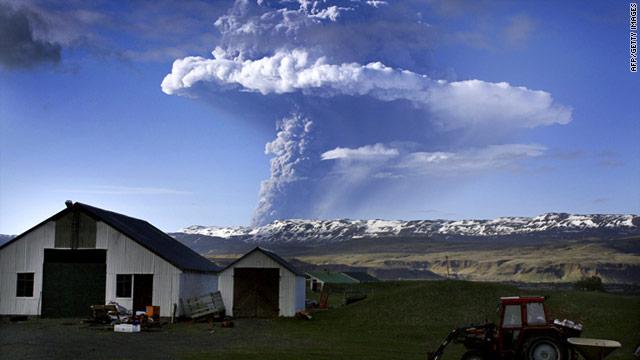
Volcano erupts beneath glacier in Iceland

A cloud of smoke and ash rises over the Grimsvotn volcano in Iceland on Saturday.(CNN) -- The Grimsvotn volcano under the Vatnajokull glacier in Iceland was erupting Saturday, according to the Icelandic Meteorological Office.

A dark cloud of smoke was rising from the glacier, and scientists were flying over the scene to evaluate the event, according to CNN affiliate TV2 Iceland.

The last eruption of the volcano was in 2004, TV2 Iceland reported.

Last year, another Icelandic eruption, of the volcano Eyjafjallajokull, attracted worldwide attention after its ash cloud disrupted air travel across Europe.

Sitrun Kapitola, manager of the Islandia Hotel Nupar, which is close to Saturday's eruption, said she could see a cloud of smoke over the mountains, and ash was falling around the hotel.

Police were telling her and others that there was no need to evacuate and there was nothing to fear, Kapitola said.

"We see it very well," she said.

"It's nothing compared to the other one," she added, referring to last year's dramatic Eyjafjallajokull eruption.

Tourists at the hotel were excited to see the eruption, watching the events unfold while eating dinner, she said.

"It happens every 10 years," she said. "It mostly produces water."

Grimsvotn is Iceland's most frequently active volcano. In 1783, a 16.7-mile fissure system from the volcano produced the world's largest known historical lava flow over a seven-month period, damaging crops and livestock, according to the Smithsonian National Museum of Natural History. A resulting famine led to the loss of one-fifth of Iceland's population, according to the Smithsonian website.

Another Fairy Tale Wedding ... In Bhutan

Image(Asia Sentinel) King Jigme tells parliament he is to marry

There will be another royal wedding later this year to rival the colour and pageantry of Britain’s Prince William and Kate Middleton’s a marriage a few weeks ago. Bhutan’s 31 year-old King Jigme Khesar Namgyel Wangchuck Friday told his country’s parliament that he would be getting married "later this year".  
Like Kate, his wife-to be, Jetsun Prema, is a commoner, the daughter of an airline pilot but with distant royal connections, who was educated in India and the UK as well as Bhutan.
The wedding will take place in October when this tiny remote Himalayan kingdom of just 700,000 people, squeezed between India and China, will celebrate the marriage of a young man who combines the revered status of a monarch with informality, modesty and active concern for his country’s development.
King Jigme – known in Bhutan as K5, the fifth king – is steering his country into a developed democracy which also meets the goals of Gross National Happiness (GNH). The happiness aims – focussing on goals such as good governance and protecting the environment as well as economic growth, was set some 30 years ago by his father – King Jigme Singye Wangchuck – who told me about them in a 1987 interview
The wedding announcement came at the opening of the parliament’s seventh session – parliamentary democracy was only introduced in 2008 when Bhutan took the huge step of moving from an absolute to a constitutional monarchy.
The king, who was crowned in November 2008, arrived in a procession (chibdrel) to the tune of long trumpets or horns. He knelt and kissed the parliament’s floor three times, then ascended his large golden throne. To the accompaniment of deep-throated slow chanting, a welcome ceremony (Zhugdrel Phuensum Tshogpai) was conducted with the members of parliament being given food, drink and token envelopes of money.
The programme said that at 11am "His Majesty the Druk Gyalpo [Dragon King] addresses the Parliament", adding curiously in brackets: "If it pleases His Majesty to address the Parliament" – a remnant of an absolute monarchy, I imagine, where the King cannot be commanded!
Speaking without notes, the king dealt with issues such a tourism, industry, agriculture and hydro-power, adding that traditional values needed to be strengthened and combined with democracy to protect "our small society".
He then had a "small announcement" for the people – it was, he said, "time for me to marry". He had chosen Jetsun Prema (together left, in an official photo), who was in his eyes "beautiful, humble, kind and compassionate" as well as "warm and kind in heart and character".
Later he told me that he had felt quite nervous announcing his planned marriage – it was easier to talk about matters of state that such a personal event, he said.
Jetsun Pema was not in the ornate parliament building, but watched the ceremony on television from her home, waiting for her fiancé’s mobile phone call after the deed was done. Later, in the evening, she made her first appearance as her future husband’s fiancé, at a dinner to open Mountain Echoes, an annual India–Bhutan literary festival that starts tomorrow under the patronage of the Queen Mother, Ashi Dorji Wangmo Wangchuck.
The wedding, the king said, should not be a "grand celebration" but would be "simple in keeping with our age old traditions". He was urged however by Tshering Tobgay, the leader of the parliamentary opposition, to have a large ceremony that could be enjoyed by people from all over the country. William and Kate’s wedding was also billed as being modest and not grand, in keeping with Britain’s economic constraints, but that did not stop it being a spectacular event watched by hundreds of millions of people on television around the world.
King Jigme‘s wedding will not however capture the same television audience, but the setting of Bhutan and the elegance of its Buddhist buildings and national costumes and traditions, ensure that it will have grandeur and style, plus the king’s instinctive informality.
John Elliott blogs at Riding the Elephant. His blog appears on Asia Sentinel.