Share |

Wednesday, 21 September 2011

Google's social network opens to everyone


A Google+ feature called
(CNN) -- Google's answer to Facebook went public on Tuesday afternoon.

For the past three months, Google+, the company's social network, was available only to users who had been invited by the company or by friends who already had access to the site.

"For the past 12 weeks we've been in field trial, and during that time we've listened and learned a great deal," Google's Vic Gundotra, a senior vice president for engineering, said in a blog post. "We're nowhere near done, but with the improvements we've made so far we're ready to move from field trial to beta, and introduce our 100th feature: open sign-ups.

"This way anyone can visit google.com/+, join the project and connect with the people they care about."

The update comes as many people who use the site are questioning its value.

"My Google+ home page is worse than a ghost town. It doesn't even feel haunted," wrote Rainbow Rowell, a columnist at the Omaha World-Herald.

Writing on the PBS blog Mediashift, Dan Reimold adds: "The stream of updates has basically run dry -- reduced to one buddy who regularly writes. My initial excitement about signing on and inviting people to join me has waned. Nowadays, I apparently get tired just thinking about it."

Others disagree.

"I must be doing something wrong on Google+," Harry McCracken, founder of the blog Technologizer, wrote on his Google+ page. "It isn't 'worse than a ghost town' for me. It's active and pleasant, albeit lacking some of the initial rush."

Introduced in late June, Google Plus gained an estimated 25 million users by early August, although the company has released no recent figures on its membership. By contrast, Facebook has more than 750 million users, and Twitter has more than 175 million.

Google continues to add features to its social network in an apparent effort to spur growth and further differentiate itself from Facebook and Twitter. On Tuesday, the company announced a few more, including:

Better search for topics and personalities on the site: "Google+ search results include items that only you can see, so family updates are just as easy to find as international news," the company says.

"On-air" Hangouts: Google's group video-chat feature, called Hangouts, has helped it stand out from Facebook, which does not have a similar tool. Now users can broadcast these group chats to the public: "The setup is simple enough: just start a normal hangout, and you'll have the option to broadcast and record your session. Once you're 'On Air,' up to nine others can join your hangout (as usual), and anyone can watch your live broadcast," Google's blog post says.

Mobile Hangouts: These video chats now work on smartphones running Google's Android 2.3 operating systems. Support for the iPhone is coming soon, Google says.

To promote the new Hangouts features, Google will host an On-Air Hangout with rapper will.i.am on Wednesday.

What do you think? Now that Google+ is public, will you join? Or is yet another social network too many?

Let us know in the comments, or, if you're so inclined, join a conversation about this on my Google+ page.

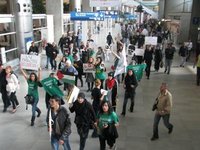
“Death to Jews” did they chant on Sunday in Paris

“About 30 pro-Palestinean activists invaded the embark lobby of the Israeli airline El-Al at Roissy, crying “Death to Israel” “Death to the jews” and preventing the checkin of passengers.”


According to witnesses on the spot”a wild horde terrorized, threatened, intimidated passengers.” They were responding to a call from the extremist organization EuroPalestine. Some wore t-shirts calling for a boycott of Israel.

The National Bureau of Vigilance Against Anti-Semitism (BNVCA) condemned “the attack” and appealed to the Prefect of Seine Saint Denis “to stop this aggression and discrimination that those responsible are arrested and brought to justice for disturbing the public order and incitement to hatred “.

The police and security service from the airport intervened and asked the reinforcements to disperse the demonstrators.

New security laws to focus on terrorism, race and religion

Nazri said speculation that the new laws would be more repressive than the ISA or that they would merely be a mere repackaging of it was “ridiculous”. — file pic
KUALA LUMPUR, Sept 20 — One of the two new security laws will focus on terrorism while the other will regulate race and religious issues, Datuk Seri Nazri Aziz said today.

But the de facto law minister pledged that the two new laws to replace the Internal Security Act (ISA) would not be as repressive as the controversial law being repealed.

He stressed that the two replacement laws “cannot” be more repressive in nature as the prime minister had promised meaningful reforms to the country’s preventive laws.

The minister said that one of the laws would tackle terrorism while the second would specifically deal with safeguarding public peace and order, and touch on racial and religious relations.

“But these laws, as the PM said last week, must comply with two fundamental issues — one, no one can be arrested on the basis of differences in political ideologies and two, extended detention can only be approve through the courts. These are the two safeguards,” he told reporters after meeting with representatives from the Federation of Chinese Associations Malaysia here this evening.

Prime Minister Datuk Seri Najib Razak announced last Thursday the repeal of the ISA, the three Emergency Declarations and also the need for annual printing and publishing permits when both Dewan Negara and Dewan Rakyat have their next sitting.

The Umno president said two new laws would be enacted in place of the ISA to protect the peace, harmony and security of the country but admitted that they were “risky but necessary for our survival.”

Just days after Najib’s announcement, resistance began to surface, with political hardliners like Perkasa’s Datuk Ibrahim Ali calling on the prime minister to preserve the spirit of the ISA in the two new laws.

Those across the political divide remained cautiously optimistic of the reforms, expressing fears that the enactment of two new laws meant the ISA was merely being repackaged.

Nazri, however, reminded Malaysians that both laws would still be subject to lengthy parliamentary debates and public consultation before they are enacted.

He rubbished criticisms that the laws could be more repressive than the ISA or that they would merely be a repackaging of the ISA, saying such statements were “ridiculous”.

“If they are that repressive and yet are passed in Parliament, then the opposition must be sleeping,” said the outspoken minister.

Nazri also revealed that the Attorney-General (A-G) is scheduled to brief the Cabinet tomorrow on the abolition of the ISA and issues surrounding the two new laws to be drafted.

He said the laws should be ready to be tabled by the March Parliamentary sitting after the A-G gathers feedback and consults with all relevant stakeholders.

On proposals to repeal and make further amendments to other security and press laws in the country, Nazri expressed confidence that if the ISA, the “mother of all laws”, could be repealed, the government would likely have no qualms doing the same to other pieces of legislation in the future.

The minister also said there was no need for the government to apologise or compensate former ISA detainees, insisting that they had been lawfully detained.

“Anything that was done in the past was done according to the law.

“Similarly, if we decide one day that it is no longer illegal to steal, should we then apologise or compensate all the thieves who were punished under the law in the past?” he reasoned.

What if it was Najib in the sex video?

Some NGOs want to know why Pakatan Rakyat leaders are remaining silent on Anwar being implicated in a sex scandal and would they keep quiet if it was Najib Tun Razak.

PETALING JAYA: Would Pakatan Rakyat leaders remain silent if there was a video implicating Prime Minister Najib Tun Razak in a sex scandal?

This was a question an NGO popped up when referring to the latest video on Opposition Leader Anwar Ibrahim.

The video snippet allegedly showed Anwar entering a hotel with businessman Shazryl Eskay Abdullah.

Commenting on the video, Coalition of Malay Students in Peninsular Malaysia (GPMS) secretary-general Zambri Mohd Isa criticised opposition supporters for practising double standard.

“When Kelana Jaya MP Low Gwo Burne recorded a video of a lawyer allegedly trying to fix judicial appointments, the opposition leaders went to town with it prompting a Royal Commission of Inquiry to be established to investigate the matter.

“But when it comes to Anwar’s case, not even a squeak is heard from his supporters,” Zambri said.

Last week, pro-Umno blogger Papagomo posted the new video snippet purportedly linking Anwar to the sex video released in April.

Early this year, a trio calling themselves “Datuk Trio” released a video allegedly showing Anwar engaged in sex with a prostitute.

In an extension to the video, Papagomo released the latest snippet last week showing “Anwar” entering a hotel lift with Shazryl. Shazryl is one of trio that released the sex video early this year.

Impeachment in Parliament

Zambri hailed former health minister Dr Chua Soi Lek’s decision to resign from office in 2008 after he was implicated in a sex scandal.

He said that even Selangor opposition leader, Dr Mohd Khir Toyo, resigned from office last year when implicated in a corruption scandal.

“But Anwar refuses to even swear in the mosque to prove his innocence,” he added.

As a people’s representative, Zambri said Anwar should answer all the allegations against him.
.
“He is not a common man in the street. Anwar is a parliamentarian. If we want to be a great nation, we must be brave to face this,” he said.

Selangor Coalition of NGOs against Corruption (GAPS) chairman Hamidzun Khairuddin said that Parliament should impeach Anwar over the allegations.

“If Anwar is not investigated, it will make a mockery of our august house,” Hamidzun said.

With Anwar’s moral standing under a cloud, he said it was time for someone from DAP or PAS to take over Pakatan’s helm.

“We have to address this moral decay. In my view, (PAS president) Hadi Awang and (DAP secretary-general) Lim Guan Eng are morally superior to Anwar,” he added.

Best to ignore

However, PAS vice-president Salahuddin Ayub dismissed the NGOs’ arguments and reiterated their support for Anwar.

“In principle, we stick to qazaf where an accuser must provide four witnesses to prove their allegation. In Anwar’s case, no witnesses have come forward,” Salahuddin said.

On whether Anwar’s indifference over the matter would hurt Pakatan, Salahuddin dismissed the notion outright.

“For decades the government had accused Anwar of many things but the people are still with us as they know the truth,” he said.

On why Anwar refused to comment on the recent allegation, the PAS leader said that probably Anwar was tired responding to the accusation.

“I think he is just fed up with it. It’s best for him to ignore it,” he said.

Echoing Salahuddin’s sentiments, DAP Youth leader Anthony Loke also said Anwar’s alleged sexual misconduct issue is just being played up to confuse the public.

“Let’s just ignore the matter and move forward, “ said Loke.

MIC man asks party treasurer to quit

Jaspal Singh is accused of giving confusing answers about a plot of land near party headquarters.

PETALING JAYA: A local MIC leader today called for the resignation of the party’s treasurer-general, Jaspal Singh, accusing him of confusing members about the status of a piece of land adjacent to the party headquarters in Kuala Lumpur.

The government granted the land to Maika Holdings Bhd some time in the mid-1980s. It is not clear whether Maika, MIC’s investment arm, still owns it.

Jaspal has been giving “contradictory replies” to party members asking about the land, according to V Thiagarajen, who heads the Taman Mujur MIC branch here.

He recalled that at the party’s annual general meeting last July, Jaspal responded to a delegate’s question by saying that the land no longer belonged to MIC or any of its agencies.

“However, at a recent Selangor MIC meeting, he said he did not know anything about the status of the land,” Thiagarajen added.

He said party members were confused and called on Jaspal to either “clear the air immediately” or give up his position to make way for “someone more credible”.

When it acquired the land, Maika had planned to build a 32-storey multipurpose tower on it, but financial problems forced it to abandon the idea. It turned the plot into a car park instead.

Mano: I didn’t condemn Jalur Gemilang

Kota Alam Shah assemblyman Manoharan says the suggestion that the Malaysian flag be changed was his personal opinion and had nothing to do with Pakatan Rakyat.

PETALING JAYA: DAP’s embattled Kota Alam Shah assemblyman M Manoharan was made to eat humble pie when his “demeaning” comments on the Malaysian flag on his Facebook went viral.

Today, he said he has apologised and removed the suggestion to modify the national flag from his Facebook. He also said the suggestion was his personal stand and had nothing to do with Pakatan Rakyat.

“It is my personal stand, not Pakatan’s. I don’t know about Pakatan’s stand,” said the first-term state assemblyman.

On Malaysia Day last Thursday, Manoharan wrote in his Facebook that the flag – Jalur Gemilang – should be modified as its current design resembled Barisan Nasional’s flag and did not reflect Malaysia.

He added that he had distributed DAP flags in his constituency on Malaysia Day as “he did not have the heart” to wave the national flag.

Since then, Manoharan has come under heavy criticism from BN politicians, including from Deputy Prime Minister Muhyiddin Yassin and Home Minister Hishammuddin Hussein.

Apart from urging the police to take action against the DAP assemblyman, many BN politicians have also tied Manoharan’s comment as being Pakatan’s official stand. Pakatan leaders have insisted that Manaoharan only made a personal remark.

“I only suggested, not condemned, the national flag,” Manoharan said today when contacted.

Sink or swim with DAP

On another development, Manoharan expressed his wish to be retained as a candidate for the Kota Alam Shah seat.

“I am working hard to be retained in this seat. I don’t see any reason why I should be dropped,” he said.

When asked whether he would stand as an independent candidate if dropped, he said: “I will sink or swim with the DAP.”

There are rumours that he will not be retained for the general election as he is seen more as a Hindraf representative than a DAP man.

“I hope that the central leadership would understand my predicament,” said Manoharan who shot to fame via the Hindraf movement in 2008.

He also denied rumours that he would be joining the MIC which he called a sinking ship.

Mat Sabu arrested over alleged Bukit Kepong remarks


(The Star) - PAS deputy president Mohamad Sabu has been arrested by police in connection with his alleged remarks on the Bukit Kepong incident.

Mohamad, or Mat Sabu, had voluntarily gone to the state police headquarters at 8.30pm before he was detained.
He was released on bail at 9.05pm.

Mat Sabu is expected to be charged for criminal defamation under Section 500 of the Penal Code on Wednesday.

The Netherlands to Abandon Multiculturalism


The Dutch government says it will abandon the long-standing model of multiculturalism that has encouraged Muslim immigrants to create a parallel society within the Netherlands.

A new integration bill (covering letter and 15-page action plan), which Dutch Interior Minister Piet Hein Donner presented to parliament on June 16, reads: “The government shares the social dissatisfaction over the multicultural society model and plans to shift priority to the values of the Dutch people. In the new integration system, the values of the Dutch society play a central role. With this change, the government steps away from the model of a multicultural society.”

The letter continues: “A more obligatory integration is justified because the government also demands that from its own citizens. It is necessary because otherwise the society gradually grows apart and eventually no one feels at home anymore in the Netherlands. The integration will not be tailored to different groups.”

The new integration policy will place more demands on immigrants. For example, immigrants will be required to learn the Dutch language, and the government will take a tougher approach to immigrants to ignore Dutch values or disobey Dutch law.

The government will also stop offering special subsidies for Muslim immigrants because, according to Donner, “it is not the government’s job to integrate immigrants.” The government will introduce new legislation that outlaws forced marriages and will also impose tougher measures against Muslim immigrants who lower their chances of employment by the way they dress. More specifically, the government will impose a ban on face-covering Islamic burqas as of January 1, 2013.

If necessary, the government will introduce extra measures to allow the removal of residence permits from immigrants who fail their integration course.

The measures are being imposed by the new center-right government of Conservatives (VVD) and Christian Democrats (CDA), with parliamentary support from the anti-Islam Freedom Party (PVV), whose leader, Geert Wilders, is currently on trial in Amsterdam for “inciting hatred” against Muslims.

As expected, Muslim organizations in Holland have been quick to criticize the proposals. The Moroccan-Dutch organization Samenwerkingsverband van Marokkaanse Nederlanders, which advises the government on integration matters, argues that Muslim immigrants need extra support to find a job. The umbrella Muslim group Contactorgaan Moslims en Overheid says that although it agrees that immigrants should be better integrated into Dutch society, it is opposed to a ban on burqas.

But polls show that a majority of Dutch voters support the government’s skepticism about multiculturalism. According to a Maurice de Hond poll published by the center-right newspaper Trouw on June 19, 74 percent of Dutch voters say immigrants should conform to Dutch values. Moreover, 83 percent of those polled support a ban on burqas in public spaces.

The proper integration of the more than one million Muslims now living in Holland has been a major political issue ever since 2002, when Dutch politician Pim Fortuyn was assassinated for his views on Muslim immigration, and since 2004, when Dutch filmmaker Theo van Gogh was stabbed to death for producing a movie that criticized Islam.

Muslim immigration to the Netherlands can be traced back to the 1960s and 1970s, when a blue collar labor shortage prompted the Dutch government to conclude recruitment agreements with countries like Algeria, Morocco, Tunisia and Turkey. In the 1980s and 1990s, Muslims also arrived in the Netherlands as asylum seekers and refugees, mainly from Afghanistan, Bosnia, Iran, Iraq, Pakistan and Somalia.

There are now an estimated 1.2 million Muslims in the Netherlands, which is equivalent to about 6 percent of the country’s overall population. Moroccans and Turks comprise nearly two-thirds of all Muslims in the Netherlands. Most Muslims live in the four major cities of the country: Amsterdam, Rotterdam, The Hague and Utrecht.

As their numbers grow, Muslim immigrants have become increasingly more assertive in carving out a role for Islam within Dutch society. For example, a documentary aired by the television program Netwerk in June 2009 reported that Dutch law was being systematically undermined by the growth of Sharia justice in the Netherlands.

In December 2004, the Dutch Ministry of the Interior published a 60-page report titled From Dawa to Jihad. Prepared by the Dutch intelligence agency AIVD, the report says that the Netherlands is home to up to 50,000 radical Muslims whose key ideological aim is to target the Western way of life and to confront Western political, economic, and cultural domination.

The report concludes that Dutch society is poorly equipped to resist the threat of radical Islam because of “a culture of permissiveness” that has become synonymous with “closing one’s eyes” to multiple transgressions of the law.

As for Interior Minister Donner, he has undergone a late-in-life conversion on the issue of Muslim immigration. In September 2006, while serving as justice minister, Donner provoked an outcry after saying that he welcomed the introduction of Islamic Sharia law in the Netherlands if the majority wants it. He also said Holland should give Muslims more freedoms to behave according to their traditions.

After applauding Queen Beatrix for respecting Islam by not insisting that a Muslim leader shake hands with her during a visit to the Mobarak Mosque in The Hague, Donner said: “A tone that I do not like has crept into the political debate on integration. A tone of: ‘Thou shalt assimilate. Thou shalt adopt our values in public. Be reasonable, do it our way.’ That is not my approach.”

Fast forward to 2011 and Donner now says his government “will distance itself from the relativism contained in the model of a multicultural society.” Although society changes, he says, it must not be “interchangeable with any other form of society.”

'Gaddafi evading capture in a Mercedes 4x4 bristling with anti-tracking systems... and it was given to him by Nicolas Sarkozy'

Muammar Gaddafi has escaped in a state-of-the-art armoured vehicle provided by Nicolas Sarkozy, it emerged today. 


In the latest extraordinary twist to the Libyan rebellion, it emerged that the French President gave the ‘green light’ to the Arab dictator receiving the £3.5 million converted Mercedes 4x4 in 2008. 


Not only is it filled with communications systems capable of keeping Gaddafi in touch with his forces, but it can foil the kind of tracking systems used by the military as they try to hunt him down. 


Stealthy and bulletproof: A road-going Mercedes ML, the type which has been modified with armour plating and jamming technology, and allegedly given to Muammar Gaddafi by France

It was Mr Sarkozy who ordered French jets to start bombing Gaddafi’s forces back in March, and last week he and Prime Minister David Cameron enjoyed a triumphant trip to the newly liberated Tripoli. 


But investigative news site Mediapart has found documents proving that French technology firm Amesys was allowed to provide Gaddafi with the command vehicle. 


The revelation comes on the day that pro-Gaddafi fighters fired anti-aircraft guns at revolutionary forces holding the northern gate of Bani Walid for a second day, as frustration with weeks of halting advances grows among the former rebel ranks. 


Launching an attack: Libyan rebel fighters fire rockets as they press forward near Ouagadougou Conference Center in the outskirts of Sirte. A second front has reportedly opened up in the city's east

Weapons salvage: Anti-Gaddafi forces sift through the abandoned weapons in Sirte, taking what they can use and destroying everything left behind. Fighting remains fierce in Gaddafi's remaining strongholds

Ragtag front line: Revolutionary forces have pulled back from Bani Walid, leaving a thin front of mainly young fighters with little experience or support

Forces - no longer rebels but the military of the National Transitional Council, Libya's interim government - have been massed outside Bani Walid since shortly after Libya's new rulers gained control of Tripoli and other parts of the country in August.

Block-by-block fighting continues in Gaddafi's home town of Sirte, with revolutionary forces claiming to have opened a second front in the east of the city.


Of Sarkozy's armoured 4x4, Mediapart says: ‘In 2007 the sale was approved by the then Interior Minister, Nicolas Sarkozy, and his chief of staff Claude Gueant.

'BRITISH MERCENARIES CAPTURED'


Gadhafi spokesman Moussa Ibrahim has told the Syrian Al-Rai TV station, the Gaddafi media mouthpiece, that 17 mercenaries from Britain, France and Qatar had been captured near Bani Walid. 

Britain's Foreign Office said it was aware of Mr Ibrahim's claims, but had no evidence that they were correct. 

Mr Ibrahim said: 'A group was captured in Bani Walid consisting of 17 mercenaries. They are technical experts and they include consultative officers.

Most of them are French, one of them is from an Asian country that has not been identified, two English people and one Qatari.'

The French foreign ministry said it had no information about the report. Qatari officials were not immediately available for comment.

‘The vehicle was eventually delivered in 2008 - this time with the green light from the President.’
The site goes on to give details of the armoured 4X4 Mercedes ML - equipped with a protection cage made by Faraday, which prevents all electronic fields from affecting the vehicle. 


It also comes with an electronic device capable of knocking out all radio frequencies within some 300ft of the vehicle. This would make the kind of targeted bombing, which has seen hundreds of Libyan Army vehicles destroyed over the past six months, almost impossible. 


A military source in Paris said: ‘Gaddafi has almost certainly used the vehicle to get away. It is a product of superb French engineering, and an obvious means of escape.


‘Gaddafi would be able to stay out sight of military targeters, and be extremely well protected if he met enemy forces on the ground.’ 


In a further disastrous revelation for Mr Sarkozy, it emerged that the 4X4 was part of a £25million-plus deal that also saw the French provide Libya with the means to conduct email surveillance over their own people. 


The deal was put together by the French-Lebanese arms dealer Ziad Takieddine, which is at the centre of a party-funding scandal involving Mr Sarkozy.

The scandal, known in France as ‘Karachigate’, is linked to the selling of submarines to Pakistan.
The unidentified military source added: ‘All of this is disastrous for Mr Sarkozy. On one hand he is presenting himself as the saviour of Libya, while in reality he did more to keep Gaddafi in arms than almost anybody else.’ 


PR disaster: Revelations that Nicolas Sarkozy essentially gave Muammar Gaddafi the means of his escape from capture will be a major embarrassment for the French President. Both men are seen here in a 2007 photo

Sherpa, a French Internet watchdog group, last week filed a complaint against Amesys for selling equipment to Gaddafi designed ‘to track rebel forces’.

An Elysee Palace spokesman said: ‘We have no comment to make on any of this.’
Today trained fighters pulled away from Bani Walid to regroup and reinforce for a new assault, after they were heavily beaten in the city Friday.

Gaddafi forces opened up on the bands of ragtag, undisciplined fighters left on on the front line.
These include fighters as young as 18 who spend hours smoking hash, shooting at plastic bottles, arguing with one another and sometimes just firing wildly into the streets out of apparent boredom.


Slow but steady progress: Anti-Gaddafi fighters advance to bomb an area where they exchange fire with Gaddafi loyalists near Herawa, 32 miles east of Sirte
Victory is in the air: As Libyan fighters chant slogans, after taking control of Gaddafi strongholds in the desert south of Tripoli, there remains the feeling that revolutionary forces will slowly but surely triumph
Fighting is raging at Sirte, Gaddafi's hometown on the Mediterranean coast. The regime stronghold of Sabha lies hundreds of miles away in the southern deserts, and there are others deep in the central deserts like the cities of Houn and Zallah. 


Revolutionaries involved in the battle at Sirte are more organised but have have made slow progress.
Today revolutionary forces shelled the city with Grad rockets and the sound of gunfights echoed through the streets.

White smoke wafted over the city, and civilians continued to flee. Gaddafi forces answered back with occasional Katyusha rockets. 


Regular truckloads of fuel and food arrive from Misrata to keep the fighters supplied outside Sirte.
In the past three days, they have battled block-by-block into the western side of Sirte, along the beach and along a eucalyptus tree-lined main avenue parallel to the coast.

Tuesday, 20 September 2011

The human cost of chocolate

The human cost of chocolate
A planter in Ivory Coast holds cocoa beans, the No. 1 export for the west African country which supplies 40% of the world's cocoa beans.

It may be unthinkable that the chocolate we enjoy could come from the hands of children working as slaves. In Ivory Coast and other cocoa-producing countries, there are an estimated 100,000 children working the fields, many against their will, to create the chocolate delicacies enjoyed by Western countries.

Ten years ago, two U.S. lawmakers took action to put a stop to child labor in the cocoa industry. Despite pushback from the industry, the Harkin-Engel Protocol, also known as the Cocoa Protocol, was signed into law on September 19, 2001.

On the 10th anniversary of the legislation, CNN takes a look at what effect this protocol has had on the cocoa industry. Here's a primer on some of the major issues surrounding the issue of slave labor in the cocoa industry:

Where does cocoa come from?

Some 70 to 75 percent of the world's cocoa beans are grown on small farms in West Africa, including the Ivory Coast, according to the World Cocoa Foundation and the International Cocoa Initiative.

Does Ivory Coast allow children to work on these farms?

No, child labor is illegal and since the implementation of the Cocoa Protocol in 2001, the chocolate industry along with governments and human rights groups have worked to end the practice. Yet, the U.S. State Department estimates more than 100,000 children are involved in the worst forms of child labor on cocoa farms throughout Ivory Coast. Some are the children of cocoa farmers but many other youths are smuggled into Ivory Coast from Mali and Burkina Faso to work on cocoa plantations, according to the International Labor Rights Forum.

What exactly is the "Cocoa Protocol"?

Ten years ago, U.S. Rep. Eliot Engel, D-New York, and Sen. Tom Harkin, D-Iowa, introduced legislation mandating a labeling system for chocolate. After the industry raised concerns, a compromise was reached that required chocolate companies to voluntarily certify they had stopped the practice of child labor. The certification process would not involve labeling products "child-labor-free," as initially proposed.

Instead, it calls for public reporting by African governments, establishment of an audit system and poverty remediation by 2005. The deadline had to be extended to 2008 (read Fortune Magazine's report on the state of the protocol in 2008) and again to 2010. Today, many aid groups say some of the provisions have still not been met.

So has the Cocoa Protocol had any success in ending child labor in the cocoa industry in the past 10 years?

It's hard to say. Ivory Coast has had further economic problems following its civil war from 2002 to 2004. Chocolate exporters and manufacturers say the war and its aftermath have hampered their efforts to eradicate child labor.

"Honestly, it's hard to see anybody saying that this protocol has attained the goals that were set out in it," said Judy Gearhart, executive director of the International Labor rights forum

Chris Bayer, a Tulane University researcher, spent five years in the Ivory Coast and Ghana monitoring the protocol's plan and studying the scope of the problem.

"Unfortunately, over the last 10 years we have seen very little implementation of the actual commitments," he said. "Industry did not live up to the Harkin-Engel protocol. The issues are systemic. Children are still working."

The International Cocoa Initiative was set up by the protocol to bring all parties together to address the worst forms of child labor in the supply chain. The ICI board has representatives from the major cocoa processors and chocolate manufacturers. It says progress is being made.

"Five of the six commitments made in the protocol have been completed," the group said in an e-mail statement. "And governments of cocoa producing countries, ILO, the OECD, independent foundations, members of the cocoa supply chain and ICI itself are ACTIVELY working on the sixth commitment - to improve the livelihoods of cocoa growers the infrastructure in cocoa communities farmers organizations, educational facilities etc. Substantial funds are being expended on these activities."

Bumis ‘typically’ sold government contracts for cars, houses, leaked study reveals

KUALA LUMPUR, Sept 20 — An unpublished Works Ministry study found that Bumiputera contractors as a rule sold their government contracts to buy luxury cars and houses apart from misusing payments received from the Treasury, according to a leaked US diplomatic cable.

The cable, revealed by whistleblower website WikiLeaks, comes just after Putrajaya agreed to allocate RM8 billion worth of contracts in the country’s most expensive infrastructure project, the Klang Valley Mass Rapid Transit (MRT), which initially set strict rules for its contractors.

The US diplomatic cable quoted a Works Ministry source as saying the “Study on Bumiputera Contractor Leakage” was the result of feedback from various industry sources on failed and successful projects. The report was used by then-Prime Minister Tun Abdullah Ahmad Badawi (picture) to castigate failing Bumiputera businessmen in February 2007.

“The current system of awarding lucrative government contracts to Bumis provides them with a strong economic incentive to simply act as agents, turning over as many projects as possible and taking a cut before handing each one off to a competent non-Bumi implementer.

“This ‘Bumi agent’ system is firmly entrenched in Malaysia. Any effort to make reforms is likely to be resisted not only by well-established Bumis, but also by the non-Bumi implementers who have built up a network of well-oiled agent partnership,” the US Embassy concluded in the report published by the Malaysia-Today news portal.

The US and European Union have called for more transparency and equality in government procurement by Malaysia as part of the free trade agreement talks which have yet to be concluded.

In the leaked cable, the US embassy reported: “The source said the study, which has not been released to the public, revealed that many Bumi contractors typically sold off their tenders for quick money, often to finance expensive cars and houses. The report also found Bumiputera contractors had misused payments received from the government to pay off creditors and that they often sought additional government tenders prior to completing the ones already awarded to them.”

“The official said contractors were irresponsible and had abused the trust given to them by the government which was meant to help Bumiputeras progress,” it added.

The US cable noted that then-Finance Ministry secretary-general Tan Sri Izzudin Dali had disclosed new regulations that Bumiputera contractors seeking government tenders will soon be required to sign an official declaration promising not to sell or subcontract their tender to other races.

“Violators will have their contracts and registrations terminated. Izzudin added that under the new rules contractors undertaking public infrastructure contracts will now be awarded only one project at a time and that projects will be distributed evenly among contractors in the same area or district,” the cable said, quoting Izzudin’s speech on February 16, 2007.

Incidentally, Izzudin recently completed one term as chairman of Syarikat Prasarana Negara Bhd (Prasarana), the original project owners of the MRT which is now owned by a new Finance Ministry unit called MRT Co. Sources said his strictness in selecting successful contractors had delayed the massive infrastructure project.

The cable also quoted then-executive chairman Datuk Moehamad Izat Emir of the Malay Entrepreneurs and Merchants Association as saying payment was the main issue facing the contractors.

“He said that while Abdullah had directed the disbursing agency to pay the contractors within two weeks after completing the work, this often does not happen,” the cable reported, saying Moehamad suggested Bumiputera contractors be trained to upgrade their skills and suggested government-linked companies (GLCs) be required to support these contractors.

It noted that Roslan Awang Chik, of the Malay Contractors Association, shared Moehamad’s view that “competency comes from exposure”.

“He is puzzled why many well-known and qualified Bumiputera contractors were not being awarded government contracts while several unknown ones were. He suggested the government blacklist any contractors found to be selling their tenders,” the cable said, quoting Roslan as saying “they can be considered traitors.”

The US cable was sent to Washington after Abdullah had publicly expressed frustration and disappointment over findings from a recently released Works Ministry report showing 85 per cent of government contracts awarded to Bumiputera contractors.

“They (Bumiputera) do not want to work, do not want to learn, and give little importance to the opportunities provided by the government...

“This approach will only make us hope and wait for aid and subsidies. Such a mentality thrives among the people, including Bumiputera petty traders and contractors,” the report quoted Abdullah as making the comments at a dinner speech on February 13, 2007.

Utusan wants ‘spirit of ISA’ retained in new anti-terror laws

KUALA LUMPUR, Sept 20 — Utusan Malaysia today joined political hardliners in pressing to preserve the “spirit of the Internal Security Act (ISA)” in the country’s two new anti-terrorism laws as the push back began against Putrajaya’s plans to repeal security laws.

The Umno-owned daily reasoned that such preventive laws were now considered “universal practice”, citing terrorism activities across the globe like the September 11, 2001 attacks on the World Trade Center in New York.

The attacks, said senior news editor Zulkefli Hamzah in his column, had fuelled the international community’s fears towards terrorism and subversive threats and made such preventive laws a necessity in any part of the world.

“Surely, if the United States had to resort to enforcing laws allowing detention without trial, (Malaysia’s) new (anti-terrorism) laws to be enacted soon should also play the role of the ISA, which is to protect the peace and security of the country,” he wrote.

He pointed out that former US President George W. Bush, who once reportedly criticised the ISA, had to “eat his own words” after the 2001 terrorist attacks and was forced to enact the Patriot Act to prevent further acts of terrorism in the country.

“And after Prime Minister Datuk Seri Najib Razak announced the repeal of the ISA, in conjunction with Malaysia Day — 54 years after Merdeka — what would Bush’s reaction have been if he were still in power?” he asked.

Zulkefli then attributed Malaysia’s peace and prosperity to the 40-year existence of the ISA, saying that in comparison with other countries Malaysians were now mature enough and ready for the country to achieve developed nation status.

“Do not deny that the ISA played a role in what we enjoy today,” he said.

With the ISA, he added, Malaysia and her neighbours Singapore and Brunei, both of which had also inherited the law, could successfully thwart terrorism and violent extremism to maintain public order.

“Surely we all do not want parties to interfere with the country’s transformation process,” said Zulkefli.

It has been barely a week since Najib caused ripples in the political landscape when he announced plans to repeal the ISA and reforms to several security and press laws but already signs of resistance have begun to surface.

On Sunday, Datuk Ibrahim Ali, president of Malay rights group Perkasa, declared that his organisation would reject the two new anti-terrorism laws that would replace the ISA if they do not keep to the “preventive spirit” of the Act.

The former ISA detainee said it was necessary to preserve or even improve upon the preventive aspects of the ISA to ensure security forces have a viable “instrument” with which to quickly stamp out subversive activities and keep the nation safe.

Tun Dr Mahathir Mohamad, Malaysia’s still-influential former prime minister who had famously used the ISA on hundreds of individuals during his time, lauded Najib’s move to repeal the Act but warned that it could give rise to “extremists” who would take advantage of the new space for their own agendas.

Across the political divide, Najib’s announcement was met with caution instead of celebration as Pakatan Rakyat (PR) lawmakers and other civil society groups expressed fear that the enactment of two new laws merely meant a rebranding of the ISA.

To be a statesman or to remain a politician?

Critics can be silenced only if Najib shows that he is genuine in making political reforms. For that, he has to start the ball rolling now, not next year, not after the general election.
COMMENT
It’s not surprising that there are so many sceptics to Prime Minister Najib Tun Razak’s proposed political reforms as announced by him on Malaysia Day.

It has been about a week now and we are yet to be shown any outlines or details of the mechanism under which Najib proposes to revoke the three Emergency proclamations, do away with the draconian Internal Security Act and on what form would the two replacement Acts be.

Neither have we seen any fine print on how the other Emergency Ordinance-related laws such as the Banishment Act and the Restricted Residence Act 1993 will be replaced.

More importantly, there has not been a timeline set for these proposed reforms to take effect, apart from de facto law minister Nazri Aziz stating that any move to repeal the ISA could only be done during a parliamentary seating next March. His reason is that the October seating would be busy with budget issues.

Najib meanwhile has been busy justifying his proposed reforms by saying that it was time to make Malaysia the best democracy in the world.

Hardly a stuff that would make Malaysians jump with joy simply because Malaysians had wanted such reforms to have taken place yesterday, not at an unknown date tomorrow.

The lack of any credible follow-up is why many are wondering if Najib is genuine in his decision to free up civil liberties or if it is just a political gimmick with an eye on the coming general election.

The BN crowd’s argument is that Najib would not have announced such ground-breaking proposals if he had no intention to implement them.

Fine, agreed. While it would not do Najib any good to backtrack or inordinately delay his reforms, his administration must also realise that promises of important reforms should be fulfilled quickly. He should strike while it’s hot.

Election goodies

The lack of any visible action from Najib’s administration brings about other important questions – were the proposed reforms a well-thought initiative, or were they made at the last minute, to shore up Najib’s popularity and to coincide with the Malaysia Day celebrations in an attempt to give an euphoric uplifting sensation to the rakyat?

Words were carefully leaked out about impending reforms some days before Najib’s Sept 16 speech but no major details have been released since then.

Maybe, work is being done behind the scene, but if it was a properly planned initiative, backed by a proper thought-process, Najib could have at least outlined the timeline for his proposals.

If he had no time to say much during his Sept 16 speech, he could have given media interviews to put out in the open his road map for a better democracy for Malaysia.

He could have said that he was calling for an emergency Parliament sitting immediately so that the ISA could be repealed.

If the government law drafters are not ready, Najib could have at least started discussions with the various stakeholders on how to move forward. He could have taken feedback on what other obsolete laws that should be repealed.

He didn’t do any of these, and that is why the sceptics and his critics are having a go at him now.

It is increasingly looking like these reforms were a personal venture undertaken by the prime minister without taking proper consultation from the people that matter. Even his ministers looked surprised when he made the announcements!

There is no doubt the general election is imminent, perhaps in the next six months. Perhaps, even before the March parliamentary sitting.

These political reforms are just part of goodies promised by Najib. His next set of goodies will come during his budget speech in October. And then there will be more pledges to help the rakyat to ease their financial burden.

Reveal the details
Najib seems to have a two-pronged strategy with his proposed reforms – in the long run, as he specifically said, it is to tell the world that Malaysia was opening up to become a better democracy.

In the short term, as he will never reveal publicly, the reforms look like targeted at keeping him and BN politically relevant, to lure the rakyat to back him in the coming general election.

Najib will definitely keep true to his words on the proposed reforms, of that I am sure, but whether it is in the exact form as he had said or a watered-down version will depend on the outcome of the general election.

Of course Najib can prove that his intentions are genuine – he only has to set out the fine print of his proposed reforms now, along with a timeline of their deliveries.

And if he wants to become a true statesman, he should immediately start talking to all stakeholders – the civil society movements, the opposition and even the man on the street – on other necessary reforms.

These reforms are long overdue. It is now up to Najib to show that he is not playing a political game and is only doing his duty as a responsible prime minister.

K Kabilan is FMT’s chief editor.

Mampukah BN rampas Selangor?

Selangor telah mencetuskan pelbagai kontroversi sepanjang Pakatan Rakyat memerintah negeri itu sejak tiga tahun lalu.

PETALING JAYA: Sama ada pilihan raya umum akan diadakan tahun ini atau tahun 2012, tidak syak lagi tumpuan BN dan Pakatan Rakyat akan tertumpu kepada Selangor.

Tarikan Selangor melebihi Pulau Pinang, Kelantan dan Kedah walaupun kesemuanya diperintah Pakatan Rakyat sejak pilihan raya umum 2008.

Konvensyen BN Selangor Sabtu lalu semata-mata untuk menunjukkan kepada umum bahawa parti itu sudah bersedia merampas semula tampuk pemerintahan kerajaan negeri dalam pilihan raya umum akan datang.

Selangor telah mencetuskan pelbagai kontroversi sepanjang Pakatan Rakyat memerintah negeri itu sejak tiga tahun lalu.

Kontroversi bermula dengan arahan kerajaan negeri memindah kuil dari Seksyen 19 ke Seksyen 23 di Shah Alam yang menyebabkan bantahan besar penduduk beragama Islam.

Mereka berarak membawa kepala lembu di depan pejabat menteri besar di Shah Alam sebagai tanda protes.

Serbuan JJAIS

Kerajaan negeri terus mencipta kontroversi apabila Majlis Bandar Raya Petaling Jaya (MBPJ) melarang penjualan arak di kedai kawasan ramai kediaman umat Islam. Beberapa wakil rakyat bukan Islam membantah menyebabkan arahan itu dibatalkan.

Namun isu yang paling mengemparkan ialah serbuan Jabatan Agama Islam Selangor (Jais) ke atas sebuah gereja di Petaling Jaya bulan lalu.

PAS menuduh Umno negeri mendalangi serbuah tersebut dan seperti dijangka Umno menafikan dan memfailkan saman terhadap pimpinan utama PAS.

“Rakyat sudah muak dengan kerajaan Pakatan rakyat yang tidak habis-habis dengan pelbagai kontroversi. Mana kredibiliti Menteri Besar.

“Mana janji kononnya menjadikan Selangor negeri terbaik. Tan Sri Khalid Ibrahim gagal memerintah Selangor,” kata Pengerusi Gabungan Anti Penyelewengan Selangor (Gaps), Hamidzun Khairuddin.

“Saya rasa Pakatan Rakyat akan lingkup (tumbang) di Selangor kali ini. Terlalu banyak skandal dan kontroversi yang berlaku.

Orang Melayu marah

“Yang paling marah tentu orang Melayu. Lihat apa yang berlaku kepada mereka sejak PKR memerintah.”

Bagaimanapun, pemimpin muda PKR Petaling Jaya, Halimey Abu Bakar berkata, sokongan pengundi kepada kerajaan negeri tidak berubah.

Menurutnya, sebahagian besar janji kerajaan negeri kepada rakyat ditunaikan seperti pemberian air percuma kepada golongan miskin.

“Isu gereja tidak akan mempengaruhi pengundi.

“Rakat masih bersama Pakatan Rakyat walaupun sokongan pengundi India menurun 10 peratus berbanding 2008 ” tegasnya yang juga ahli majlis MBPJ.

Kita leaders unsettled by trio’s sacking

State leaders say they were in the dark over their dismissal, and back up allegations of Zaid's arrogance and disrespect for protocol.

PETALING JAYA: The sacking of three top leaders in Kita has set the wheels in motion for a chorus of dissent against the leadership of party chief, Zaid Ibrahim.

Three months ago treasurer, Rashid Azad Khan, was sacked via text message. Last Wednesday central secretary, Abdul Latif Thambi, and central committee member, Muhammad Firdaus Christopher, were given the boot.

In an immediate response Firdaus unleashed a tirade against Zaid for bypassing party constitution, registering state branches through dubious means and his overall high-handedness in running the party.

Latif, meanwhile, cried foul for his sacking over a website password and blasted Zaid for leading Kita astray from its original mission. And now voices from within the party’s state leadership have expressed similar dissatisfactions.

Penang state chief, Tan Tee Beng, acknowleged that the allegations of a fund shortage, sacking over minor issues and a lack of party protocol were all true. According to him, the talk has long been circulating within the party and was a ticking timebomb.

“Zaid had a right to sack the three for airing dirty linen in public but he should have used a different approach,” he said. “He could have always held private talks with them to try to resolve the issue.

“Unhappiness and struggle will plague every political party but when a new party is gearing up for a general election such incidences are never good.”

The Nibong Tebal MP said that Zaid probably regarded Kita as his personal party when it was first launched but that perception had to change as must Zaid’s tendency to make decisions alone.

“Zaid has to decide whether he wants to be a team player,” Tan said. “If you’re like (Gerakan president) Koh Tsu Koon who listens to everyone then you can’t make a decision. But if you’re like Zaid then you’re at the other extreme.”

While Tan may have been mildly reproachful of Zaid’s conduct, Malacca state chief, Colonel Hashim Putih, blasted him outright.

Zaid’s arrogance

He said that the sacking of the three was in poor taste as no reasons were given for their dismissal either to the party leadership or even to the trio themselves.

“They should have been given a chance to defend themselves,” he said. “The decision is unfair to them and to party members who are in the dark over the sacking. But this is true of his dictatorship style and non-compliance with the party constitution.”

Hashim also admitted that “shortcuts” were taken to register the Malacca branch with the Registrar of Societies.

Meanwhile, his secretary-general, Yahya Mohd Idris, bemoaned Zaid’s “hasty and drastic” decisions over “trivial issues” and agreed that Zaid’s arrogance had cast a shadow over a party that was still on the brink of development.

“He released the news to the media before even informing the party leadership which he shouldn’t have done,” added Yahya, which confirmed Firdaus’ earlier claim that he had found out about his sacking through media reports.

This sentiment was loudly echoed by Negeri Sembilan state chief, R Sri Sanjeevan, who pointed out that they should have been shown due respect as state chiefs by being informed ahead of the media.

He said he shocked at the reasons for the dismissal, especially over the website password, and called it “extremely childish”.

Sanjeevan, however, declined to comment on the other allegations saying that it wouldn’t be fair as he had neither experienced nor heard it first hand.

“But Kita is still an infant and needs a proper upbringing,” he said. “If there is already in-fighting now, people will lose faith in us. I call on all parties to keep and work out their disputes internally from hereon.”

Ipoh Hindus demand exclusive crematorium

A temple EGM decides to reject the state proposal for a multi-religious one in Buntong.

IPOH: The administrators of Ipoh’s largest Hindu cemetery have unanimously resolved to demand an exclusively Hindu crematorium at the site, rejecting the state’s proposal to build a multi-religious one.

They made the decision on Sunday at an extraordinary general meeting of the Hindu Devastana Paripalana Sabha, the management committee of the Sri Maha Mariamman Devastanam temple in Buntong as well as the cemetery associated with it.

The cemetery sits on a 2.8ha site at the heart of Buntong, an Ipoh hamlet dominated by Tamil Hindus. Altogether, about 200,000 Hindus live in the state capital.

In a letter dated last May 3, the Perak executive councillor in charge of non-Islamic affairs, Dr Mah Hang Soon, directed the Sabha to surrender 0.2ha of the land to the state for it to build a modern crematorium for use by all non-Muslim communities.

The plan triggered a major controversy. Hindraf Makkal Sakti, the Hindu rights group, said the proposal was unconstitutional and criminal, going against both the constitutional guarantee of religious freedom and the Penal Code’s prohibition of trespassing on burial places.

Sunday’s meeting of the Sabha considered two resolutions – one to reject the state proposal and the other to demand the Hindu crematorium. “Not a single member opposed them,” the chairman of the Sabha, M Dhamodaran, told FMT.

He said the Sabha would inform the state government of the EGM decision. “We will make concrete proposals for the construction of the Hindu crematorium.”

The Sabha became the caretaker of the cemetery in 1919 by virtue of a gazette issued by the then colonial government.

The gazette states: “In exercise of the powers vested in him by Section 9 of the Land Enactment, 1911, the Resident of Perak proclaims that parcel of land situated in Mukim Ulu Kinta, Ipoh, described in the schedule hereto, and delineated upon revenue survey plan No. 12,718, deposited in the office of the Deputy Superintendent of Revenue Surveyor, Batu Gajah, to be a reserve for the purpose of a place of interment for the dead, to wit, a burial ground for the Tamil community of Ipoh.”

Lawyer-activist P Uthayakumar, who heads the Hindraf-affiliated Human Rights Party (HRP), welcomed the EGM resolutions.

He said the state government and Ipoh City Council had the statutory duty to “preserve, maintain and develop” the Hindu cemetery under the National Land Code and Section 94 of the Local Government Act.

“The state authorities must build the modern crematorium in Buntong to cater to the needs of the city’s Hindu community,” he added.

HRP is expected to pressure Prime Minister Najib Tun Razak and Perak Menteri Besar Zambry Abdul Kadir to ensure that the crematorium be constructed before the next general election.

Uthayakumar said the state should encounter no problem finding suitable idle land elsewhere in Perak for the proposed multi-religious crematorium.

Govt will not apologise to ISA detainees, says Nazri

The Sun
by KONG SEE HOH


MINISTER in the Prime Minister’s Department Datuk Seri Mohamed Nazri Abdul Aziz says the government will not apologise to or compensate those who have been held under the Internal Security Act (ISA) as their detention is lawful.

The government has acted within the ambit of the law, and the police were authorised to use the ISA against these individuals, he told Sin Chew Daily in an interview at his home in Kuala Kangsar on Sunday.

“For example, if theft is no longer a criminal act, does it mean the government will have to apologise to all the thieves and compensate them (for punishment meted out to them)? Of course it doesn’t work that way, because at the material time, stealing was still against the law. If (the government) has acted against the law, it is a different matter.”

He told the daily the cabinet will discuss the release of ISA and Emergency Ordinance detainees who are not involved in terrorism at a coming meeting.

He said for some of the ISA detainees, who had been involved in terror activities or had posed a threat to national security, the government would seriously considerwhether they should be freed.

“Those who had not been involved in terror activities, the cabinet will discuss(their case) at the meeting, as well as seek the advice of the police and the attorney-general. The government may consider releasing them,” he said.

Nazri said he agreed that ISA detainees who have not been involved in terrorism or who are not a threat to the country’s security should be released.

“The government will treat them on case by case basis. If there is enough evidence 
against them, the government will bring them to courts, otherwise they would be released,” he said.

Repeal of ISA a victory for civil society, rakyat: Ambiga

The Sun
by PAULINE WONG


KUALA LUMPUR: The repeal of the Internal Security Act (ISA) is the victory for civil society and the rakyat, and not any one organisation.

The Coalition for Clean and Fair Elections (Bersih) steering committee chairperson Datuk Ambiga Sreenevasan yesterday said the legislative reforms have been the work of civil society for many years. 

“The rakyat should also take credit, because the rakyat never gave up,” said Ambiga.

She was commenting on Prime Minister Datuk Seri Najib Razak’s announcement last 
week that the ISA would be repealed, to be replaced by two new laws that would provide for shorter detention periods. 

“The repeal of ISA doesn’t come as a surprise to me because the prime minister has mentioned it since 2009. What I was pleasantly surprised about was the revocation of the emergency declarations, which I think is a very significant step,” said the former Bar Council president. 

She said that the two new legislation to replace ISA must be carefully studied, and that the Human Rights Commission of Malaysia (Suhakam) must be consultants to the new laws. 

“Suhakam have actually come up with a draft legislation to replace ISA. So the work is done. I believe these changes can come as quickly as the next parliamentary meeting,” she said. 

Najib also announced the review of the Printing Presses and Publications Act and Section 27 of the Police Act with regard to public demonstrations.

“The review to the PPPA is not satisfactory, because as long as the power still remains with the home minister to revoke the printing licence, it makes no difference whether it is a yearly licence or a licence which can be revoked. For greater freedom of press, they should do away with licensing entirely,” she said.

Libya conflict: Black African migrants caught in backlash

Hundreds of African migrant workers in Libya have been imprisoned by fighters allied to the new interim authorities, accused of being mercenaries for Col Muammar Gaddafi, and there are claims that homes have been looted, and women and girls beaten and raped, as the BBC's Ian Pannell reports.

It was a visit the Nigerian family had been dreading.

They had been hiding in their tiny slum home in a Tripoli suburb since Col Gaddafi had been swept from power, fearing the knock at the door. Earlier this month 20 rebel fighters came, demanding to be let in, shouting "murtazaka".

It is the word every black African in Libya knows too well. Murtazaka is Arabic for "mercenary", the armed men allegedly employed by the former regime to carry out some of the worst excesses of the conflict.

The fighters forced their way into the Nigerian family's home. They beat the couple living there. They stole their possessions and money, abducted the father of the house and turned on his 16-year-old daughter. She told us what happened:

"A group of armed men came to our house. They started knocking, they came in saying 'murtazaka'. They locked my mother inside a toilet. Six of them raped me. They took our belongings and money. My father tried to stop them but they hit him and carried him away."

That was nearly three weeks ago and she has not seen or heard of her father since.
Violent campaign

“Start Quote

This is the African continent, I am an African, this is my land - is it because of my colour, because I am a black man?”
Alleged victim
 
When rebel fighters moved into Tripoli last month, an immediate hunt began for former regime loyalists and African mercenaries accused of working for Col Gaddafi. 

Evidence has emerged in a series of interviews that suggests that some engaged in a violent campaign of abuse and intimidation against the black immigrant community in Tripoli.

Hundreds of men have been arrested with little or no evidence, homes have been pillaged and people beaten up. Most victims are too afraid to be identified but they contacted the BBC to air their grievances.

One man showed us around another home that had been ransacked. A thick iron bar in the corner of the dark room had been used to beat the men and the women there as the rebels made off with their money and few possessions.

He told us he was glad when Col Gaddafi was overthrown, expecting a better life. Instead he and hundreds of others black Africans have become victims, a soft target.

"This is the African continent, I am an African, this is my land. Is it because of my colour, because I am a black man? We don't have a voice. Who would you to turn to?"

On the outskirts of the city we were invited to film a truck-load of men from Niger who had just been picked up. They too were accused of being mercenaries while being made to chant anti-Gaddafi slogans by leering fighters before being put to work hauling boxes of documents and weapons found in the woods.

Casual manual labour
Alleged victim shows instrument apparently used by attackers This man said 20 men raided his house
There are no figures for how many foreign mercenaries Col Gaddafi employed.

It is almost certainly far fewer than the rebel fighters suspected. Most black Africans in Libya have been living here for years doing casual manual labour.

But just as it was easier to suspect foreigners (rather than Libyans) of doing the Colonel's bidding throughout the course of battles for cities like Benghazi and Misrata, so it is now easier to round up those who can be easily distinguished by the colour of their skin.

The transitional council has told its fighters to avoid revenge attacks and there has been far less violence than many had feared. But the city's jails are still full of men detained with little or no evidence, with no access to lawyers or even their families. One woman showed us the black eye she received for arguing with the fighters as they dragged her husband away:

"There has been no communication. I am scared of everything happening in this country. I am now begging them to just leave my husband, he's innocent, he's very quiet, he couldn't even fight me," she said.
The leadership of the National Transitional Council has repeatedly called for restraint from its fighters, urging them to avoid revenge attacks. But it is clear that some appear to have ignored this.

Libya's new leaders will have to distinguish themselves in many ways, not least how they guarantee the freedom, dignity and justice that so many have fought and died for.
But if it is to mean anything it must apply to all.

Mob Destroys Four Wayang Statues

Bandung. Four statues depicting characters from traditional Javanese puppetry were vandalized and burned on Sunday in Purwakarta, West Java.

Local police chief Adj. Sr. Comr. Bachtiar Ujang Purnama said police were still investigating the case. “The Purwakarta police dete ctives are in the process of identifying the people involved in the vandalism,” Bachtiar told the Jakarta Globe.

“We want the public to know that this kind of damage is against the law and these actions should not be repeated. We encourage everyone to keep Purwakarta peaceful.”

Television station Metro TV reported that a mob coming from a post-Idul Fitri prayer at the city’s Grand Mosque was responsible for the damage. Thousands of people descended on the Comro area of the city, where they tied ropes to the statue of puppet character Gatot Kaca before trying to pull it off of its foundation. The statue finally collapsed after the rope was tied to a moving van.

The crowd then targeted the statue of Semar, another puppet character situated in the Bunder area. The mob threw rocks and pulled it to the ground before hitting it with sticks and metal rods then setting it on fire.

The statue of puppet character Bima in the Ciwareng area was also targeted, as was the “Welcome” statue on Jalan Gandanegara, where the Purwakarta District office is located. Both statues were also destroyed and set on fire.

The mob then moved to statues depicting the twin brothers Nakula and Sadewa. Hundreds of police and army officers were already there guarding the final two statues. The mob dispersed when it started raining.

Bachtiar said police questioned the organizers of the post-Idul Fitri celebration to find out how participants came to valdalize the four statues.

Although it is still unknown if the hard-line Islamic People’s Forum (FUI) are responsible for the damage, FUI was opposed to the statues when the project was announced by the city administration last year.

FUI had said the statues were “against the Islamic identity of the city” and claimed the statues would encourage people to have “superstitious beliefs.”

Hard-line Muslim groups have vandalized statues and monuments — considered a form of idolatry by some conservative Muslims — in the past.

Members of the Islamic Defenders Front (FPI) in Bekasi last year pushed for the dismantling of the “Tiga Mojang” statue, which they deemed offensive while hard-line groups in North Sumatra rallied for the removal of a Buddhist statue at a temple, which the groups deemed “offended Muslims” in the area.

Orang Asli: Don't treat us like animals

Solve your problems first, Anwar told

Anwar Ibrahim has no right to criticise the repeal of the ISA when he has his own problems to worry about, says Nazri Abdul Aziz.

PETALING JAYA: Opposition Leader Anwar Ibrahim has been told to resolve his own problems before poking his nose inro national issues.

Minister in the Prime Minister’s Department Nazri Aziz rapped Anwar for criticising Prime Minister Najib Tun Razak’s plan to scrap the Internal Security Act (ISA).

“He should go resolve his own personal problems first, such as… his sodomy case… the sex videos, before talking about national issues,” he told FMT.
“I don’t think he can be trusted to handle national issues,” he added.

Nazri was referring to Anwar’s claim today that the spirit of the ISA would be retained under different laws, and that Barisan Nasional leaders were secretly assured of this.

This was rubbished by Nazri, who also acts as the government’s de facto law minister.

“Why is he panicking? Why is he making negative remarks about all this? How can he know the laws before the seeing the draft?” he asked.

Nazri said that Anwar was in a state of panic, and alleged that Najib’s announcement to repeal the ISA last Thursday caught the Pakatan Rakyat supremo by surprise.

“All these new laws will have to be debated and talked about in Parliament. Do you think it’s going to be easy for us, if our intention is to bring two new, more repressive laws?” he said irritatedly.

“You think we are prepared to cheat and lie to Parliament? …If he is serious about repealing the ISA, he should work with us,” said the minisrer.

Najib had said that two new laws would be introduced once the ISA was repealed, but did not elaborate on the specifics of these proposed Acts.

These laws, the PM said, would be designed to combat terrorism, especially in the aftermath of the Sept 11 attacks.

According to a media report, Nazri had said that there was not enough time to repeal the ISA in the next Parliamentary sitting next month.

He added that the new laws to replace the ISA would only be introduced next year, and be tabled when Dewan Rakyat sits in March 2012.

‘Pelantikan penyelaras bidang kuasa negeri’

Manikavasagam gesa ahli cabang terima keputusan kepimpinan negeri

PETALING JAYA: Ahli Parlimen Kapar S Manikavasagam hari ini menjelaskan bahawa pelantikan penyelaras adalah bidang kuasa kepimpinan parti negeri.

“Semua pihak perlu menerima pelantikan yang dibuat oleh kepimpinan negeri,” kata Manikavasagam ketika mengulas laporan penolakan Mohd Bakir Wahab sebagai penyelas Dun Sementa oleh ahli jawatankuasa PKR cabang Kapar.

Akhbar Sinar Harian memetik kenyataan bahawa pengarah pilihan raya umum PKR cabang Kapar Norkhalim Mohamed bahawa penyelaras Sementa Azizi Ayob tidak diberikan surat penamatan  jawatan.

Azizi Ayob adalah ketua cabang PKR Kapar.

Norkhalim juga dilaporkan mengatakan bahawa Mohd Bakir Wahab tidak layak dan mendapatkan bantuan orang dalam untuk menjawat jawatan penyelaras.

DUN angkat

“Ketua cabang tidak semestinya jadi penyelaras.

“Ahli Exco Rodziah Ismail pernah menjadkan Sementa sebagai DUN angkatnya (sejak 2009) sebelum pemilihan parti,” tambah Manikavasagam lagi.

Beliau berpendapat bahawa penentangan terhadap pelantikan mungkin berpunca daripada faktor peruntukan yang disalurkan kepada penyelaras DUN.

Sementa merupakan satu-satunya DUN dikuasai Umno BN di kawasan parlimen Kapar menerusi Datuk Abdul Rahman Palil.

Charges against 30 PSM activists dropped

Following the intended abolition of ISA, the police have dropped charges against 30 activists of Parti Sosialis Malaysia (PSM), including the six who had been detained under the Emergency Ordinance (EO).

According to PSM secretary-general S Arutchelvan, they were given a discharge not amounting to an acquittal.
NONE"The decision of the AG simply means that the charges are currently dropped, but does not amount to acquittal - which means that they can be charged with the same offence in the future," he said in a statement issued this afternoon.

"This latest AG's decision to drop the charges is due to the efforts of many people who dared to fight oppression and who wanted to see justice and democracy prevail in Malaysia.
"PSM salutes all these great warriors, for without them, this release would not be possible," Arutchelvan added.
NONEAll 30 were first arrested in Sungai Dua, Penang, while they were on the PSM-organised 'Udahlah, Bersara' roadshow on June 25, on suspicion of planning to 'wage war against the Agong'.

Then, the police detained the six activists, dubbed the EO6, for 28 days under the EO over their 'key role' in the July 9 Bersih 2.0 rally.

After the EO6 were released, they were charged in a Butterworth sessions court on Aug 3 under two separate laws - the Societies Act and the Internal Security Act - for allegedly possessing subversive documents.

psm thanksgiving dinner 060811 01The six included Sungai Siput MP Dr Jeyakumar Devaraj and PSM activists Choo Chon Kai, Sarat Babu, M Sarasvathy, M Sukumaran, and A Letchumanan.

The same charges were slapped against the remaining 24 activists.

All 30 were supposed to go on trial on Oct 10.
Arutchelvan also expressed the party's appreciation to all those who had contributed towards putting up the bail money for the 30 following their arrest.
"While PSM is happy with this decision, we seek justice and answers. The AG's office had merely given a DNAA.
NONE"Let us not forget that the 30 were initially remanded for waging a war against the Agong under section 122 of Penal Code. That law remains and can be used arbitrarily against any other activist or movement in the future," he said.
Arutchelvan demanded that the authorities provide answers as to why the PSM activists were forced to undergo the ordeal in the first place.
"Who is responsible for that and will they be charged? What about the two foreign guests who were arrested, detained and humiliated in the media? Who is responsible for that?
"What about the news that PSM supporters planned to bomb the police station in Sungai Siput?
"Who made these allegations and will they be charged?
"What about the many more slanders and slurs thrown at us by some mainstream media?" he asked.
In addition to demanding that the prime minister, home minister and inspector-general of police "clarify and apologise" for all that has happened, PSM will also seek a meeting with the home minister to highlight and seek clarification on the gross violations suffered by the activists.
"The authorities must be held responsible for all the unfounded allegations, slanders and unlawful arrests and detention.
PSM, in the meantime, vowed to fight on and to continue to seek justice over the events since the June 25 arrest.
"The march for change and democracy will continue," Arutchelvan added.

Foreign sell-off, economy top concerns despite reforms push

Najib’s political reforms do not have a bearing on the stock market, said one analyst. — File pic

KUALA LUMPUR, Sept 19 — Despite the Najib administration’s political reforms, a Bloomberg report today said foreign funds may continue paring down local share stakes in an indication that the world economy will remain the government’s biggest headache ahead of an expected general election.

Terence Wong, head of research at Kuala Lumpur-based CIMB, was reported as saying that worsening global economic turmoil may cause investors to keep unloading the nation’s equities.

Wong also said that promises made last week by Prime Minister Datuk Seri Najib Razak to burnish Malaysia’s democratic credentials and abolish the controversial security and media laws will not be enough to boost confidence.

The Bloomberg report said that KLSE data showed that foreign funds sold RM3.8 billion worth of Malaysian shares last month, the most since at least October 2009 after four consecutive months of inflows.

A continued outflow of funds could damage economic confidence during the crucial months ahead, as the prime minister is expected to call for a general election by the first half of next year.

The latest survey from local pollster Merdeka Center, which was done before the recent reform announcements, showed that Najib’s popularity slid to 59 per cent this August from the highest of 72 per cent in May 2010, fuelled by rising concerns over the surge in living costs and his government’s handling of the July 9 Bersih 2.0 rally.

Mark Matthews, head of research for Asia at Bank Julius Baer & Co in Singapore said that the repeal of repressive laws such as the ISA will unlikely boost share investor sentiment in Malaysia.

“It doesn’t have anything to do with the stock market; it’s already a fairly advanced economy and I’m not sure if anything political would be a huge catalyst,” said Matthews.

“It certainly won’t change perceptions of Malaysia in and of itself, but if it is part of an overall trend of a more open-minded stance in politics, maybe it is meaningful in some way.”

A report by HwangDBS Vickers Research, meanwhile, said today that Malaysian equities would continue to slump unless action is taken to raise investors’ confidence.

The research house said the benchmark FBMKLCI index is still on a declining course, and beyond any short-term relief rebound, the index would probably dip below the psychological 1,400 level soon.

It added that foreign funds would continue to withdraw from emerging markets across the region if risk-averse investors believe the unstable economic and monetary conditions in the United States and Europe was poised to deteriorate further.

Bersih book launch – Thanks / Availability


A big thank you to all who came for the Bersih book launch on Sunday – it truly meant a lot to me and to us to see you there :D
Special thanks to my sister Bel and Rahul who helped carry very heavy books (as did Amito on the way back), handle sales, and provide pivotal support. Thanks to Beat and Joon who kept me company most of the evening. Thanks to mum and dad who came and bought me lunch :)
Thanks to our special guests Dato’ Ambiga, Pak Samad and Chin Huat, who shared really fun insight and stories :) Thank you as well to all the others (like Aunty Bersih!) who shared their own Bersih stories that day :)
Thank you Pang, Lee Kwang and their gallant team for the professionalism we’ve come to rely on at the Annexe.
Thank you to those who covered the event: Malaysiakini, The Malaysian Insider, LoyarBurok and too many tweeples and Facebookers to mention here :)
Thank you all of you who were kind enough to buy a copy of the book :)
Final thanks once again to the great team that helped put together the book :) I think special mention must be made of Pandi and AL, who did much of the work towards the end. For an even longer list of acknowledgements, do pick up the book! :)
Many have been kind enough to enquire as to availability. The very first batch of books arrived only the day before, and are slowly trickling in. We may need at least a week or so to get our distribution networks in place, so we thank your for your indulgent patience – all availability details will be updated on the Bersih book page, and I’ll be sure to send updates on Twitter & FB as well :)