Share |

Monday, 13 December 2010

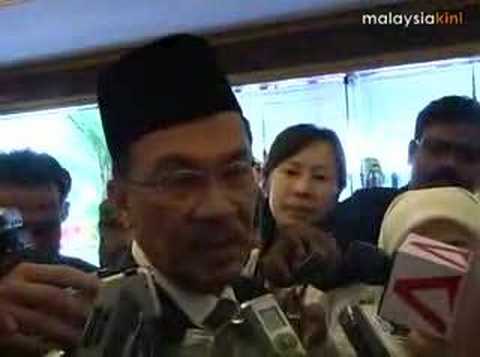
Anwar acts to stem WikiLeak effect on sodomy case

KUALA LUMPUR: Opposition Leader Anwar Ibrahim today moved to stem the impact on his sodomy trial of US cables released by WikiLeaks claiming he had sex with a male aide in a honey trap set by enemies.

Anwar's lawyer Sankara Nair told AFP he will file a complaint with the court hearing Anwar's sodomy case over articles in the local media which could affect the former deputy premier's ongoing trial.

Most newspapers in the country carried the allegations on their front page with influential Malay daily Utusan running a headline stating: "Singapore spy agency verifies sodomy act".

"Clearly it's a case of sub-judice, it's hearsay and conjecture, intelligence reports are not based on facts generally, they are based on rumours and I have served in the security services before so I know that the last thing you do is to trust such a report," said Nair.

"The judge must call up the newspapers and ask them to explain why they wrote the piece and to show their proof. If they can't do this then they will be cited for contempt," he added.

"If this is not sinister then it is totally unethical reporting. I have advised my client to file a lawsuit against these papers as well."

The leaked US state department cables from November 2008 were given to Australia's Fairfax media group, which reported Sunday the Australian and Singapore intelligence agencies' assessment of Anwar's ongoing case.

"The Australians said that Singapore's intelligence services and (former prime minister) Lee Kuan Yew have told ONA (Office of National Assessments) in their exchanges that opposition leader Anwar 'did indeed commit the acts for which he is currently indicted'," the cable read.

"ONA assessed, and their Singapore counterparts concurred, 'it was a set-up job and he probably knew that, but walked into it anyway'," according to the cable.

Anwar, 63, has vehemently denied sodomising his aide, 25-year-old Mohamad Saiful Bukhari Azlan, claiming he was the victim of a political conspiracy.

He faces 20 years in prison if found guilty of sodomy, a serious crime in Muslim-dominated Malaysia.

Human Rights Watch has urged Malaysia to drop the charges against Anwar, condemning the case as a "charade of justice".

- AFP

Penang DAP polls: Outsiders now insiders

By Hawkeye - Free Malaysia Today

GEORGE TOWN: Delegates who walked into the hall in Komtar would have noticed an imposing banner which spelled out that they were gathered for an ordinary Penang DAP convention.

The words on the banner essentially captured Sunday's event as just a normal process - nothing out of the ordinary occurred. The 400 plus delegates voted in most of the incumbents during the bi-annual party election, while some personalities who lost were reappointed promptly as part of the process to close ranks.

Penang is now firmly a DAP bastion as its veteran chairman Karpal Singh put it, a "frontline state."

Although perceived to be parochial, Penang had accepted outside DAP leaders who were delicately planted in the state political lanscape.

Chief Minister Lim Guan Eng whose previous political base was Malacca, Johorean strategist Liew Chin Tong and Kuala Lumpur-based Jelutong MP Jeff Ooi were seen as "outsiders" before.

Today, they are firmly entrenched in the state, especially Guan Eng who played a behind the scene role to ensure the party election here was calmer and orderly compared to Perak and Selangor.

Yet, the rumblings on the ground by some quarters was how could the party reconcile between government and party posts since DAP was now a party in government and no longer just an opposition force per se.

Notable loser

The notable loser during the Penang DAP election was veteran member Phee Boon Poh who is a two-term Sungai Puyu assemblyman.

Phee is an affable state executive councillor and had held the party's torch during the "down" times in Penang.

He also played a key role in arranging for last month's state funeral of former chief minister Dr Lim Chong Eu.

After being edged out, Phee wondered aloud about how he went wrong.

"Is it because I was too busy performing the role of a state exco member! Perhaps, I had neglected my party grassroots," he said.

Political observers credit him for his good governing skills such as his move to preserve the environment, his attention to detail on public health and his caring society activities.

Yet, Phee lost. His bitterness was apparent when he declined to give a firm commitment on whether he would accept an offer to be an appointed committee member.

Phee's political circumtances could be similar to a certain degree with another DAP state exco member, Ronnie Liu from Selangor.

Both are hardworking state government representatives but somehow got detached from the DAP grassroots with Liu probably paying the price by earlier axing his strongest grassroots ally, Tee Boon Hock.

DAP now needs to manage both government and party roles best, said newly appointed Penang DAP treasurer Wong Hon Wai.

'Collateral damage'

They were also several assemblymen out of the 73 candidates who were "collateral damage” after the state election outcome was known.

Among them were state DAP Youth head Yeoh Soon Hin who is the Paya Terubong state assemblyman, local councillor Tan Hoon Wooi, Bagan Dalam state assemblyman A Tanasekharan, Padang Lalang assemblyman Tan Cheong Heng and Pengkalan Kota state assemblymen Lau Keng Ee.

Others who lost included Sungai Pinang state assemblyman Koid Teng Guan and observers said that some of them were actually performing well as assemblymen and government actvists but when it came to the party, they were left out or outright booted out.

Pulau Tikus assemblyman Koay Teng Hai barely made it but it came at the expense of him being removed from holding the state secretary post which was now held by Guan Eng's political secretary Ng Wei Aik.

The political comeback of Bukit Mertajam MP Chong Eng and Batu Lanchang assemblyman Danny Law Heng Kiang were good sentiments for the senior ranks but it came at the expense of younger leaders.

Meanwhile, Karpal openly declared that he would not support the concept of DAP leaders holding too many posts.

He wanted them to hold either a state or a parliament seat while government duties must be balanced to avoid an overload of responsibilities.

Karpal, however, said that an exception should be given to the Penang chief minister post, meaning the individual could hold both a state and parliamentary seat, as it can help improve the state's governance.

Although the dust had settled, the record number of 88 candidates seeking just 15 slots, was an indication that more members were now clamouring for posts because they presume that DAP had much to offer since it is in government.

In the meantime, Guan Eng is repeating the the word “united” over and over at all party gatherings in view of speculations that the general election is around the corner.

By the people, for the people

The Write Way by Tiberius Kerk - Free Malaysia Today

(BOOK REVIEW March 8: Time For Real Change by Kee Thuan Chye and Fellow Malaysians) Back in the 1960s, the general election campaign was an exciting time for children. In Ipoh where I was growing up at that time, political party campaigners would send cars with loudspeakers announcing their arrival on certain dates at specific venues.

Children like me were thrilled because we knew we were in for a great time. It meant free cinema shows out there in the neighbourhood field. A big screen would be put up and enthusiastic young viewers would be treated to a Hollywood film, invariably a Western.

If we were lucky, it would be John Wayne, all in magnificent black and white. Before the movie began, the campaigners would pass out free Consulate cigarettes. Naturally, they bypassed us eager beavers even though we thought we could tolerate a puff or two and feel “cool as the mountain spring”.

But that was two generations ago. These days, politics has become much more complicated. What were simple issues had been made complex.

In the days of old when Internet had yet to surface and television was still in its black and white splendour, it was a simple case of voting for “the Ship” (Alliance Party) or the other side with the “Buffalo head” symbol.

Fast forward to the 21st century, there are now more political groups thann we care to remember. Information has long been on the overload mode. The Internet super highway, 3G mobiles and other wired devices are utilised to tug at the ears of the masses

Unfortunately for Malaysia, written materials like books are still being shunned by the majority. At last count, official statistics put the number habit of Malaysians at eight to 12 books a year.

However, I suspect somebody at the Statistics Department was being over-generous. It is more like one to two books per person annually.

Thought-provoking essays

So it is a safe bet that one of the latest additions to the book market, “March 8: Time For Real Change” by Kee Thuan Chye and Fellow Malaysians will find a limited audience.

It is an upgraded and revised edition of the 2008 original. Still hot from the printing press, as they say, this book has some of the most thought-provoking essays and interviews about the current Malaysian political situation seen in recent years.

Kee has lit a beacon and its light is drawing fellow Malaysians who share his concern about the nation’s state of affairs to his corner.

In total, there are 42 articles spread over three sections, aptly labelled “Where We Are Now, Back To The Beginning” and “Where Do We Go From Here”.

It is heartening to learn that Malaysians of all races, creeds and professions have voiced their aspirations, good wishes and grievances about this country which they love so much.

Young and old, professionals and students have argued eloquently on the burning issues of the day. And these issues which are debated incessantly in coffeeshops, boardrooms and within the sanctity of one’s own home are about corruption, justice and education system and the rule of law.

Kee himself has contributed seven of the 42 articles in the book. One of the most interesting was his interview with Lim Guan Eng, the Chief Minister of Penang.

In that chapter, Guan Eng says “this victory of ours can be ephemeral. And time and tide waits for no man, so we do whatever we can. I prefer to fail trying than failing to try”.

Guan Eng was replying to the question: “In order for you to realise your plans for Penang, which could take a long time, do you foresee you need to stay more than five years in office?”

Outrageous comments

But some of the most outrageous and hilarious comments must surely belong to Raja Petra Kamarudin. RPK, as he is more commonly known, is famous for his outspoken views.

Reading what he has to say about some of the more sensitive issues that seem to persistently knock at our doors will tickle the reader’s funny bones.

At the same time, RPK thinks nothing of figuratively slapping you around to knock some sense into your head. The thought of the day, according to RPK’s book of quotations, is that even in our darkest political hour, we must learn to laugh at ourselves.

If we can do it at other people’s expense, that’s even better!

RPK is always great fun. He expresses opinions like Mount Merapi spewing ashes over Java. Most of his views are succinct and sharp as an arrow. He won’t beat around the bush when he could just conk you on the head.

The good thing is we often end up laughing with him.

On the other end of the political spectrum is people like Dr Lim Teck Ghee, the CEO and director of the Centre for Policy Initiatives Bhd. Lim was the director of the Centre for Public Policy Studies at the Asian Strategic and Leadership Institute.

He resigned from the institute in 2006 after an official disagreement over his findings about some vital issues.

Lim’s dispassionate and clinical opinions on the NEP demand attention from all thinking individuals and close scrutiny from those who are in position to shape the future of Malaysia.

Malaysia is now at a crossroads. From the quiet town of Kangar, Perlis, to the tantalising plains of Tamparuli, Sabah, Malaysians striving or thriving in the melting pot of diversity must ask themselves: what do we want for our grandchildren and great grandchildren?

As citizens of this blessed country, we have listened to the radio, seen on TV, read the mainstream newspapers and attended talks, now we owe it to ourselves and others who will come after us, to lend our ear to the other voice.

“March 8: Time For Real Change” is the other voice. It shouts with great passion from across the wide gulf that separates some of us but nevertheless it wants to be heard. We will be doing ourselves a disservice, if we turn a deaf ear to our own people.

From 1957 to 2010, it has always been one person, one vote – your call.

The book is available in all major bookstores. FMT's interview with Kee Thuan Chye will be published tomorrow.

We have to speak up

By P. Ramakrishnan


We have every reason to be concerned. We wonder where this nation is heading for and what is in store for us. From the civil servant to the Umno politician, it is the same story: the non-Malays are “pendatang” and don’t have any citizenship rights. The rights conferred by Article 8 of the Federal Constitution are not respected or protected.

When an extreme group like Perkasa questions the citizenship rights of the non-Malays, the national leadership does not take them to task. When extreme elements in Umno berate and denigrate the non-Malays, the top Umno leadership does not chastise them. When one Umno delegate at the recently concluded general assembly had the temerity to suggest that the non-Malays be given the right to do business but should be denied the right to vote, nobody pointed out that it was against the constitution and that he should not be talking through his nose!

It is this disturbing silence when atrocious things are said which affect our unity that is worrying. It is this unbecoming conduct that encourages the extreme elements amongst us to be outrageous in their conduct and prompts them to continue with their seditious remarks.

It is this vocal minority that is predominant in our society and influences the trend of policy. Our political leaders dare not condemn them outright.

Utusan Malaysia fans the race baiting and gives the widest publicity without bothering to be responsible or sensible. When the powers-that-be that own and control this press do not force it to fall in line, what do we make of this?

A nation can make or break depending on the unity of its citizens. Today our unity is threatened. And if concerned voices and responsible leaders and caring Malaysians do not rise up and speak up, we will be a fragmented nation. By our silence, we will contribute to the chaos that may ensue. — Aliran

P. Ramakrishnan is president of Aliran.

Better protection for whistleblowers under Act

The Star
KUALA LUMPUR: The Whistle blower Protection Act 2010, which will come into force on Dec 15, 2010, is formulated to provide protection to people reporting improper conduct.

The Act is part of efforts under the GTP’s NKRA to curb corruption.

Senator Datuk Seri Idris Jala, Minister in the Prime Minister’s Department said the Act, which was approved by Parliament in May, was developed based on the best practices of the same act in other developed countries.

“We observed that corruption in Europe and the US began to decline after the implementation of a Whistleblower Protection Act due to its effectiveness as a big deterrent,” he said. According to the Act, if a person has evidence on someone who is involved in corrupt practices, he or she can file a report with the appropriate enforcement agency.

“The whistleblower will be protected in terms of confidentiality,” said Idris, who is also the CEO of Performance Management and Delivery Unit (PEMANDU).

When tabling the Budget 2010 in Parliament in October 2009, Prime Minister Datuk Seri Najib Tun Razak announced the Whistleblower Protection Act would be formulated to encourage informers to expose corrupt practices and other misconduct while providing them immunity from civil or criminal charges at the same time.

BREAKING NEWS: Janji Azmin kepada Sarawak (Azmin's promise to Sarawak)


On Sunday, 12th December 2010, at a PKR Pre-Christmas Dinner held in Bintulu, PKR's recently elected Deputy President YB Mohd. Azmin Ali, spoke to a large dinner crowd consisting of about 300 party members and supporters. Present were DAP's YB Chiew Chin Sing, Sarawak PKR leader Baru Bian and several other party stalwarts.

In his speech, which he lambasted the Sarawak BN and its leadership for its corruption and cronyism, YB Azmin challenged the Chief Minister Abdul Taib Mahmud to dissolve the Sarawak state assembly immediately if BN is so confident of its showing in the coming state polls.

In his rousing and fiery speech, YB Azmin also made a promise that got the 300-strong crowd onto its feet that turned into a five minute long standing ovation and applause. “Pakatan Rakyat akan memberi kuasa autonomi sepenuhnya kepada Sarawak sekiranya Pakatan Rakyat memenangi PRU13.” (Pakatan Rakyat will give full autonomy to Sarawak if we win at the 13th General Elections.)

YB Azmin went on to elaborate that “PR akan menghormati Perjanjian Malaysia semasa penubuhan Malaysia pada tahun 1963,” (PR will respect the Malaysia Agreement that was entered into at the formation of Malaysia in 1963) in reference to the 18 Point Agreement. Clearly YB Azmin had tapped into the very issue that resonates with all Sarawakians, regardless of colour or creed.

“Sabah dan Sarawak tidak masuk Malaysia. Sabah dan Sarawak menubuhkan Malaysia bersama Persekutuan Tanah Tanah Melayu,” (Sabah and Sarawak did not enter Malaysia. Sabah and Sarawak formed Malaysia together with the Federated States of Malaya) he added, to even more boisterous applause.

He ended his speech with a further promise, “Saya, Azmin, akan mempertahankan Sarawak dan membela orang orang Sarawak. 'Agi idup agi ngelaban!'” (I, Azmin, will defend Sarawak and be an advocate of the peoples of Sarawak. "While I breathe, I hope!") YB Azmin's use of the famous Sarawakian quote, which is derived from the Latin 'Dum spiro spero' that was the family motto of the Brooke Rajahs, was nothing less than genius that fired the crowd.


After the dinner, PKR leader Baru Bian, when met, said “This is a very clear message and commitment from our national leaders and Pakatan Rakyat to the people of Sarawak. It is a resolute promise from PKR to right the wrong suffered by Sarawak due to the neglect and failure of the BN government and to restore and honour the agreement made by our forefathers 47 years ago.”

“All this while, local Sarawak parties have been harping on the point that only they can deliver what Sarawak and Sarawakians need. Let me reiterate our stance: it is not whether a party is locally based that matters but what the party is fighting for. This is paramount and crucial. PKR, although a national party, is concerned with local issues. YB Azmin's declaration and promise very clearly shows that PKR at the national level understands local issues and will act on them and deliver to Sarawakians their greatest wish: full autonomy,” elaborated Bian.

“We urge all Sarawakians to unite and support Pakatan Rakyat because we are determined to redeem our rights that have been stolen from us for the last 47 years,” said Bian.

YB Mohd. Azmin Ali is on an East Malaysian tour, his first visit as PKR's Deputy President.

Sweden probes 'terrorist crime'

Swedish police have announced that they are treating bomb blasts in Stockholm, the capital, as a "terrorist crime".

Two people received minor injuries in the explosions on Saturday, the first of which came from a car that blew up near Drottninggatan, a busy shopping street in the centre of the city, Ulf Goransson, a spokesman for the Swedish police, told Al Jazeera.

Shortly afterwards, a second explosion was heard further up the same street and the body of a man was found on the ground.

"There was series of minor explosions, causing a fire in one of the cars in the street. Some minutes later, we found a man seriously injured 300 metres away from the scene of the first explosion. This man died," Goransson said.

Media in Sweden have named a 28-year-old man of Iraqi origin, who they say died in the attack, as the suspected bomber but Swedish police have refused to confirm the details.

"We are opening an investigation into a terrorist crime under Swedish laws," Anders Thornberg, of the National Security Service, told a news conference on Sunday.

Thornberg told the AFP news agency that his investigators were trying to find out if the blasts were part of a broader threat to Sweden or an isolated attack.

"We are trying to find out if something similar is going on [elsewhere in Sweden]. We don't have any indication about that, but we will try to make sure this was a single action," he said.

But he said it was too early to say if the blasts, about 15 minutes of each other, were linked. "We think so but we are still investigating," he said.

Linda Nyborg, a freelance journalist in Stockholm, said there was information saying that Britain's MI6 security agencies had information on the suspected perpetrator of the attack.

"The family has made comments on his death even though his name hasn't been made public or confirmed by police," she said.

"There is also information about a second man who was seen next to presumed suicide bomber. This is not official police information. So far police don't want to make any comment on the investigation."

Email warning

Fredrik Reinfeldt, Sweden's prime minister, said it was too early to reach any conclusions and warned that speculation could lead to tensions.

"Sweden is an open society which has expressed a desire that people of different backgrounds, who believe in different gods or or no god at all, should be able to live side by side," he said.

"Our democracy is well-functioning. Anyone who feels frustration or anger has the possibility to express this in a non-violent way ... This is a society worth defending."

About ten minutes before the blasts, the Swedish news agency TT and the country's security services received an email warning with a threat to Sweden and its people ahead of the explosions.

It said the threat was linked to Sweden's presence in Afghanistan, where it has a force of 500 soldiers, and referred to caricatures of the Prophet Mohammed by Lars Vilks, a Swedish artist.

"Our acts will speak for themselves," TT quoted the message as saying. "Now your children, your daughters and your sisters will die as our brothers, our sisters and our children are dying."

The message concluded by urging "mujahidin" to rise up in Sweden and in Europe, the news agency said.

TT said the email was not sent anonymously but the news agency refused to say who the sender was.

The newspaper Aftonbladet cited sources saying the sender was a 28-year-old who had been expressing "extreme views" on the social networking website Facebook.

Police would not comment on a report in the paper which quoted a source as saying the man was carrying six pipebombs, of which one exploded, and a rucksack full of nails and suspected explosive material.

Vilks, who depicted the Prophet Mohammed with the body of a dog in a cartoon in 2007, has been the target of previous attacks.

Source: Al Jazeera and agencies

Police to study SOP on accidental cabbie shooting

Investigations into the accidental shooting of a cab driver by a policeman in Jalan Pudu will determine whether the Standard Operating Procedure (SOP) was adhered to, including how the shot was fired.

NONEDismissing claims that the police are not caring, Kuala Lumpur Police chief Zulkifli Abdullah (right) said the police met the victim shortly after the incident and would see him again.
Speaking to reporters after attending a dialogue with Seri Perak Public Housing Scheme's residents in Kuala Lumpur today, Zulkifli said action would be against the policeman concerned if there was negligence on his part.
Taxi driver Yeow Leong Kang, 42, who was hit in his legs by a stray bullet, said the incident occurred on Sept 23 while he was resting inside his vehicle.
Last Friday, Yeow lodged a police report at the Cheras district headquarters here, claiming that his case was not given the due attention by the police.
According to Yeow, he was awakened from his sleep by a shot which pierced through the door of the driver's side that hit his right calf and grazed his left foot, causing him to be bedridden for two months.
He is seeking a compensation as he could not work for two months and had yet to pay the rent for his taxi.

Further slashing down on Malaysian Indian Doctors. Racist UMNO/BN orders five year stop on all medical courses locally and overseas.

http://www.humanrightspartymalaysia.com/wp-content/uploads/2010/12/onemalaysia31.jpg

(The Star Headlines 12/12/10)

UMNO started on this racist and religious extremist and supremacist policies led by the Secretary General of the Health Ministry Dato Dr.Ismail Merican who in 2002 onwards derecognized the world renowned Crimea State Medical University (CSMU) etc simply because hundreds of Malaysian Indian students were studying there and elsewhere in Ukraine and Russia.

And today the final clamp down on the 12 local private medical schools and 50 overseas. But UMNO would never agree to a Common Exams for all local University and foreign medical students with foreign external examiners to produce the best doctors. Why not? The UMNO fear factor?

This is the very same methodology UMNO used to “ethnically cleanse” Kill, stop and hamper thousands of Malaysian Indian students from becoming lawyers through the racially motivated CLP exams. Why not all Malaysian students including from all local Universities sit for this CLP exams also with foreign external examiners.

A medical lecturer who declined to be named said that the criteria of the qualifying examination should be made known in advance so that students know what was required of them.

Highlighting the case of a top student from a Ukrainian university who failed the exam, the lecturer said that the different methods of training was an obstacle too big for some.“No matter how diligent and conscientious students are, the chances of them passing the exam seem next to impossible, he said. (The Star 12/12/10 at page E13).

Welcome to UMNO Prime Minister Najib Razak’s One Malay-sia and Anwar Ibrahim, Lim Kit Siang and Hadi Awang all not questioning this UMNO racism and religious extremism simply because almost all the victims are the Indian poor (wanting a better life for their children by even spending their lifelong savings, EPF, gratuity selling their houses and land and life savings.

HRP’s Project 15/38 is the only way forward.

Would you still vote for UMNO/BN?

Karunai Nithi @ Compassionate Justice


New Scan-20101212162341-00001
New Scan-20101212164814-00001

Samy Vellu's Tell-All Biography Launched

KUALA LUMPUR, Dec 12 (Bernama) -- In a "tell-all" biography, former MIC president Datuk Seri Samy Vellu revealed how he tried in vain to stop the demolition of a Hindu temple in 2007, which the author describes sowed the seeds of a revolt against the party.

"A Life. A Legend. A Legacy" written by award-winning author Bernice Narayanan reveals Samy Vellu's greatest achievements and setbacks as well as "behind-the-scenes" events in his almost 50 years of active politics.

The biography, which was launched by Prime Minister Datuk Seri Najib Tun Razak here Sunday, reveals how Samy Vellu had pleaded with the "powers that be" at that time to stop the demolition of the Sri Maha Mariamman temple in Padang Jawa, Shah Alam, just three days before Deepavali.

"That incident paved the way for an uprising of the Indian community," the author said in the book, referring to the now banned Hindraf movement, which some political observers believe had led to many Indians voting against the Barisan Nasional in the 2008 general election.

Samy Vellu also explained about the controversial Maika Holdings Berhad, the MIC's investment arm which became unsuccessful many years after its launch, and has since been taken over by another company with shareholders getting back their investment.

He said among his greatest achievements were to build the Asian Institute of Medicine, Science and Technology (Aimst) in Kedah and the Tafe College in Negeri Sembilan.

The 200-page book traces the remarkable life journey of Samy Vellu, who rose through the years from being a rubber tapper's son and who started work as an ice cream seller and later bus conductor to Malaysia's longest serving Cabinet minister until his election defeat in 2008.

With every story of his life told in graphic detail, many never-before published pictures of the 74-year-old "legend" with kings, presidents and prime ministers adorn the book.

The author in the concluding paragraphs of the book writes: "Samy Vellu is MIC and MIC is Samy Vellu. There's no running away from this.

"He has no hidden agenda, no cloak-and-dagger political manoeuvres and certainly no masquerades. His life is an open book. This is the book".

The book will be sold at a leading book stores throughout the country soon. Some 5,000 copies of the book were distributed free to the guests at the launching ceremony.

Meanwhile, in his speech at the launching of the book, Samy Vellu said he was proud of achieving what he had set out to do when he took over the MIC leadership from the late Tan Sri V.Manickavasagam in 1979.

"Today, I am happy to see a more vibrant and dynamic community of Malaysian Indians who have carved a name for themselves and the nation.

"I am glad to have been part of the great transformation of the Malaysian Indian community. I am confident that they will continue to move forward as the country progresses, and achieve Vision 2020," he said.

Samy Vellu conluded his speech by saying: "Politics may be my past, but my interest is in the future. After all, as the old saying goes I am going to spend the rest of my life there".

Najib names Samy Vellu as special envoy to India

KUALA LUMPUR, Dec 12 — Prime Minister Datuk Seri Najib Razak today formally announced retired MIC president Datuk Seri S. Samy Vellu is Malaysia’s new special envoy of infrastructure for India and the South Asian region.

“I will like to announce the appointment of Datuk Seri Samy Vellu (picture) as the special envoy of infrastructure for India and South Asia.

“We don’t want to lose his talents and I am sure many Malaysian companies will benefit,” he told a packed hall at the launch of Samy Vellu’s biography titled “A Life. A Legend. A Legacy” here this evening.

The 74-year-old was the longest-serving president of the Indian party in the ruling Barisan Nasional coalition.

He voluntarily stepped down from office earlier this month and is replaced by Datuk G Palanivel.

Najib’s press secretary told reporters later the infrastructure post is new and is the same rank as a minister.

The former works minister’s new role takes effect from January 1, 2011.

S'pore believes sodomy charge, Anwar blames SB


By A Sam Lini - Free Malaysia Today

FULL REPORT PETALING JAYA: Singapore government, including its senior minister Lee Kuan Yew, believes that Malaysian Opposition Leader Anwar Ibrahim “did indeed commit the acts for which he is currently indicted”.

This was revealed by WikiLeaks through a release of a US state department cable issued in November 2008. The cable was exclusively released to Australian daily The Sun-Herald and widely reported by other Australian newspapers today.

The cable, which quoted exchanges between the Singaporean intelligence services and an Australian agency, stated: ''The Australians said that Singapore's intelligences services and [Singaporean elder statesman] Lee Kuan Yew have told ONA in their exchanges that opposition leader Anwar 'did indeed commit the acts for which he is currently indicted'.''

ONA stands for Australia’s Office of National Assessments

The document further stated the Singaporeans told ONA they made this assessment on the basis of ''technical intelligence'', which is likely to relate to intercepted communications.

According to a Sydney Morning Herald report today, the ONA also recorded as saying that Anwar's political enemies engineered the circumstances from which the sodomy charges arose.

''ONA assessed, and their Singapore counterparts concurred, 'it was a set-up job and he probably knew that, but walked into it anyway','' the cable stated, according to Sydney Morning Herald.

Anwar has always denied accusations that he sodomised anyone. He also blamed the BN-led government's conspiracy to topply him by making the sodomy accusations against him.

He once again threw accusations against the Malaysian police over the cable leaks as reported by the Australian media.

Anwar blames special branch

Responding through his twitter account, Anwar said there was no proof to pin him as a person involved in sodomy and claimed that the original source of the claims was Malaysia’s Special Branch police.

“Source? Polis SB Msia. Bukti tak ada (Who is the source? Malaysian police special branch. There is no proof whatsoever)” Anwar replied.

In his earlier tweet, he merely laughed off the matter by stating: “Source? Msian SB ha ha”

Anwar is presently facing his second sodomy charge after being convinced and jailed in 1999 on charges of corruption and sodomy after a falling out with then prime minister Dr Mahathir Mohamad.

The sodomy conviction was later overturned and was freed from jail in 2004.

He was however charged again in 2008 with committing sodomy on his former aid. Anwar has maintained the case against him was fabricated and trumped up by his political enemies who fear his political resurgence.

The trial in presently underway.

DAP, PAS leaders fooled?

The disclosure that the Singaporea government believes that Anwar was guilty as charged will only increase the attacks on the opposition leader by BN leaders.

“Anwar will have to respond to this fresh claims to clear his name. He can't just blame the special branch by accusing them of leaking false information to the Singaporeans,” said a political observer.

“The Singapore intellengence agency is not stupid to blindly accept every rumour. Anwar will have to come clean.

“This will also mean DAP and PAS leaders will have to ask Anwar to come clean with them. Or are they pretending not to know anything for the sake of politics? Or have they been fooled?” he asked.

So far opposition leaders like DAP's Lim Kit Siang and PAS' Abdul Hadi Awang have not commented on this new leak.

Meanwhile, PKR vice-president Tian Chua was quoted by AFP sa dismissing the revelations as "hearsay".

"There is no doubt that this is a trumped-up charge," he said. "If the claim is true... it would have been relatively easy for the government to prove it."

"We cannot depend on what the foreign intelligence officials say. The question is whether the government has evidence to convict Anwar in court."

PKR sec-gen: Just a series of tirade

Meanwhile PKR's secretary-general Saifuddin Nasution Ismail said the leaked cable contained a high degree of personal opinions on not just Anwar but also on other Malaysian leaders, including Prime Minister Najib Tun Razak, former premier Dr Mahathir Mohamad and Umno Youth chief Khairy Jamaludin.

He added that the cable should be “viewed in the context of the broad criticism of its (Singapore's) foreign officials against Malaysia, with nobody being spared.

“PKR maintains that those views and assessments are their own personal views that do not contain any facts – otherwise Najib will have a tough time explaining similarly damaging allegations against him made by the same Singaporean officials and leaked by the same set of cables,” he added.

He also pointed out that the leaked cable was “nothing but a series of tirades against anyone or anything that is not Singapore that continues a long history of vituperation against Malaysia coming from the Singaporean establishment”.

Confused and dangerous politicians

Meanwhile, Sydney Morning Herald also said that the cable also revealed some of the inner thoughts of senior Singaporean officials, including claims that:

* Malaysia is in a ''confused and dangerous'' state due to its incompetent politicians;

* Thailand's political elite are dogged by ''corruption'' and the country's crown prince is ''very erratic and easily subject to influence'';

* Japan and India were struggling to deal with China's influence due to their ''stupid'' behaviour;

* and some Asian leaders wanted the junta to retain power in Burma to ensure the country's stability.

Just cocktail talk

In another development, Singapore said the leaked reports by WikiLeaks should not be taken out of context.

"Any communication must not be taken out of context," Foreign Affairs Minister George Yeo was quoted by local media as saying to reporters who asked him on private comments made by his senior ministry officials on foreign leaders in the region.

Yeo added that diplomatic relations could not be done "on the basis that there is a camera in the room recording everything", and that when that happened, "we lose something".

He also said that sometimes it was in the nature of "cocktail talk" where "people say things in a blunt forthright way, and we should not divorce, even if true, what is said from the context".

‘People-friendly’ halfway house back to Pakatan

By Joe Fernandez

COMMENT Now we have heard it all. Malim Nawar state assemblyman, Keshvinder Singh, whose days in the seat are apparently numbered, has re-branded himself in a bold move as “people- friendly”. This is taking a distance from the Barisan Nasional and the brink. It’s just a short hop, skip and jump from “BN-friendly” to “people friendly”.

He had declared himself as “BN friendly” in the wake of his June 15 defection from the DAP amidst allegations of money problems which he has since denied as “bulls..t”.

If Keshvinder is to be believed, there’s now some stigma of sorts attached to being “BN-friendly”, a euphemism for getting the Malaysian Anti-Corruption Commission (MACC) to look the other way as is the case with Umno and BN legislators. Keshvinder’s re-branding may yet persuade other defectors from Pakatan Rakyat to similarly declare themselves as “people-friendly”. It would be a halfway house of sorts on their way back to Pakatan since the question of BN fielding them at the next general election does not arise. The unkind would label it as “reverse frogging”.

If that’s the case, it’s unlikely that the People’s Progressive Party (PPP) would be very interested in Keshvinder. Also, it’s not the done thing to invite political lepers into the party especially if, as in this case, it will incur the people’s wrath. Besides, there’s no guarantee that Malim Nawar will be handed over to PPP by BN for the next outing.

The bottomline for Keshvinder is that he’s still friendly to all, including the opposition alliance, except some in the DAP. He thinks that his political foes in the DAP are spreading the rumours that he has been neglecting the people in his constituency. Hence no doubt his re-branding purportedly in preparation for his entry into the PPP where he does not mind being treated as a nobody. He won’t be demanding any posts in PPP unlike in DAP which he left because he was “marginalised and treated as a nobody”. Why accept from PPP what he was not willing to tolerate in DAP?

There seems to be some truth in the DAP’s allegations against Keshvinder. There’s no smoke without fire. Of course, the DAP has a more colourful way of describing Keshvinder since his defection but it would be kinder not to mention the venom reserved for him by not only the party but by the people as well. They swear that they are just waiting to punish him at the next general election.

A hung Parliament

Keshvinder isn’t the first frog in politics in the country. He won’t be the last either if the next general election produces, as expected, a hung Parliament. But that’s a different story.

Sabah is a precedent of what’s likely to happen to Keshvinder and the other “BN-friendly” legislators at the next general election if they don’t return soon to Pakatan. Those who jumped ship from the Parti Bersatu Sabah (PBS) in 1994 were rejected by the voters at the subsequent general election.

Among those punished was Jeffrey Kitingan, the younger brother of PBS president Joseph Pairin Kitingan. In fact, as it subsequently emerged, it was Pairin himself who instructed Jeffrey to sacrifice himself for a while and be the eyes and ears of the PBS in other political parties.

Unless Keshvinder and the other “BN friendly” ex-Pakatan legislators are into politics in the abstract, complex and sophisticated mould of the Kitingans, it’s unlikely that they would remain relevant and last the pace as Jeffrey has done especially if they veer towards the BN.

Even today, the suspicion lingers that the Kitingan brothers are working hand-in-glove and that “Jeffrey’s politics is all about protecting PBS”, a party he co-founded with his elder brother in 1985.

Much water has flowed under the bridge since 1994. Even then the speculation in the grapevine continues that Jeffrey would return to PBS in a jiffy if he can take over from Pairin as party president. That would require Prime Minister Najib Tun Razak’s blessings as Pairin is reported to have advised Jeffrey recently amidst rumours that the elder Kitingan was not exactly in the pink of health.

Political lifeline

Jeffrey is more inclined to remain, as at present, the de facto PKR chief in Sabah and Sarawak, according to his inner circle.

Jeffrey has dismissed the speculation as “sheer nonsense” when it was levelled at him in public not so long ago by PKR Batu Sapi division chief Hassnar Ebrahim based on the “blood is thicker than water” link.

Pakatan co-ordinator Zaid Ibrahim might offer the “BN- or people-friendly” defectors a more modest political lifeline of sorts when he launches his new party, dubbed “PKR Baru” or Parti Keadilan Baru, next month. There’s space here for all those who defected from PKR and DAP to become “BN-friendly”. Apparently, they had been having second thoughts since then on their haste to jump from the frying pan (Pakatan) into the fire (BN).

Zaid’s new outfit is likely to seek and obtain membership in Pakatan with the backing of DAP and PAS, if not de facto PKR chief Anwar Ibrahim. The majority of PKR members can be expected to welcome Zaid in Pakatan since the alternative would be his reluctant defection to BN. The mood in the opposition alliance is for a closing of ranks. This calls for the return of the prodigal sons, Keshvinder and Zaid & Co, since BN remains as from before the common enemy.

With friends like RPK, Haris Ibrahim, PKR doesn't need enemies


The knives are out for Anwar - Umno offers big money for his scalp
I recently wrote an article thinking aloud why Raja Petra Kamarudin (RPK) the blogger now-in-exile in Britain has been writing some articles highly critical of Parti Keadilan Rakyat, especially regarding its de facto leader Datuk Seri Anwar Ibrahim, but I tempered my concern with giving benefit of the doubt to the blogger now resident abroad that he might have been misinformed or disinformed by his cronies back home including civil rights lawyer-cum-blogger Haris Ibrahim.

My main criticism was that RPK had always written promoting Reformasi from 1998, marked by his outstanding role of director of FreeAnwarCampaign (FAC), and generally working in concert with opposition parties and non-governmental organisations(NGOs) towards change in government at the federal level. But recent writings had given rise to concern he was giving lots of ammunition to the ruling BN regime, especialy UMNO, to attack the Pakatan Rakyat. And today's New Sunday Times proves again my point -- its page 9 report shows that following the departure of former PKR deputy presidential candidate Zaid Ibrahim, RPK has become the "flavour of the month" of the MSM.

In fact, most Malaysians long to see the birth of a two-party/coalition system in this country -- surely a central message sent by the March 8, 2008 General Elections (GE12)? My contention is that PR consisting of PKR, DAP and PAS, now form the only viable alternative coalition able to topple the BN government in Putrajaya, and hence must be given a chance to prove themselves. I add that any third force, however well-intentioned, would only become a new impediment to PR's march on Putrajaya.

I have mentioned Haris in tandem with RPK because their efforts in moving civil society often are inter-connected in timing, and objectives, but whether by design or in revision of stands, the duo are caught flat footed in their contradictions when promoting their preferred candidate to take over PKR Zaid Ibrahim, and curently The Third Force in Malaysian politics.

I clearly recall that RPK, in elaborating on the third force, had stressed that it's NEVER meant to field any canidates in the forthcoming general elections, especially the GE13. Using the public-listed companies as an analogy, he said the third force would act like an auditor, to check the listed company's accounts and watch out for discrepancies, or waywardness by its directors and management chiefs. One point I would ask: The listed companies always appoint their own auditors who are qualified for this role, but whose mandate are this third force using to self-appoint themselves as auditors to the three components of the PR?

In fact, in my earlier article I had quoted Haris as saying the third force -- now birthing as Malaysian Civil Liberties Movement (MCLM) in London -- had identified some 30 men/women of integrity to stand as candidates in GE13, and some 20 had agreed to stand, and they would want DAP and PKR to allow these candiadtes to stand under their party banner, according to a Star report dated Nov 17, 2010. I had questioned why would these well established parties with their own selection criteria privatise such an important role to outside parties. This stance was also restated by leaders like PKR strategy director Tian Chua besides Dr Syed Husin.

This Third Force is neither third nor force, according to just retired PKR deputy president Dr Syed Husin Ali. In fact he sarcastically shared at a mew conference in conjunction with recent party Congress a "revealing" episode, relating that preceding the March 2008 elections, a representation was made to him to allow a Third Force candidate to stand under PKR banner. Syed Husin knew of this "guy" candidate quite well, so he told off the backers that they should have done a thorough background check and would have found that their nominee was a regular pub-goer who often ended up drunk.

Let me now reproduce the NST report dated December 12, 2010 in full, and I reiterate that the headline itself again proved my point that RPK is providing grist to the MSM to attack PKR and PR frontally, with banner headlines likely to be used by the UMNO campaigners cometh GE13.

'Some PR reps not fit to walk a dog'
2010/12/12

KUALA LUMPUR: Raja Petra Kamaruddin has reiterated his disappointment at what he views as the lack of commitment to reforms by Pakatan Rakyat.

After virtually reprimanding his most recognisable political ally Datuk Seri Anwar Ibrahim at a London political forum on Oct 2 for not honouring campaign promises, the fugitive blogger wrote in his latest blog posting: "But what is Pakatan Rakyat's excuse? Pakatan Rakyat talks about reforms. But what reforms are they themselves introducing?

"They demand that Barisan Nasional reform. Should not Pakatan Rakyat demonstrate what it means by reforms by first of all reforming itself?

"In a nutshell, this is what I mean when I say that the Malaysian Civil Liberties Movement (MCLM) seeks to reform the political environment of Malaysia. Note that our target to push for reforms is not just Barisan Nasional but also Pakatan Rakyat.

"And I will continuously write about how things are done elsewhere and ask why we can't also do the same in Malaysia.

"And I will not accept the argument that we can't also do that because our skin is black, brown, cocoa or yellow and not white.

"It is not the external colour of our skin that determines advancement. It is our brain and how we utilise it that will."

At the Oct 2 Friends of Pakatan Rakyat Forum in London with Anwar, and now Parti Keadilan Rakyat vice-president Tian Chua, Raja Petra launched an attack on Pakatan's failure to implement "not a single one of the reform agenda contained in the People's Declaration".

He said this was an improved version of the Agenda of Change authored by Anwar in 1998.

According to Raja Petra, the People's Declaration was drawn up by what he termed as the civil society movement and was adopted by Pakatan parties as their manifesto for the March 2008 general election.

Three other non-Pakatan parties, too, embraced the People's Declaration, Raja Petra said.

He argued that the move and the spirited efforts of activists and bloggers like him had helped Pakatan gain seats. And now some 21/2 years after the election, not a single one of the reforms had been implemented.

As seen from the video recording of the event, Anwar had smiled approvingly when Raja Petra started addressing the forum but no longer smiled as the speech wore on.

Raja Petra offered not himself, but credible personalities from the civil society movement to be fielded as Pakatan candidates in the next general election.

As for some of the candidates fielded by Pakatan in 2008, Raja Petra, quoting his wife had said, "some of them, I can't even trust to walk my dog".

Raja Petra described them as an embarrassment.

(NST report ends here)


RPK asked in a reaction article to my piece titled "Why RPK is acting out (of character)" asked "Have I really changed?", and in a partial reply, I just said we all as individuals "grow up" with passing years, and that only the person himself or herself (including this writer!) would be able to answer truthfully if he/she has changed characterwise or with respect to the causes he/she once championed. But today, a month later, I conclude that RPK, your struggle has indeed changed direction, and you are treating PKR, and Anwar, as the enemy bigger than BN-UMNO. WHY?

So today when I opened up the New Straits Times, I wasn't surprised by the page 9 lead item headline; totally in character with his previous Oct 13's header: "Umno is Beginning to Look Better Than PKR"


So Pakatan Rakyat be forewarned that you would have to "review" your election strategies with the probable entry of MCLM or Third Force candidates, however you call them, now or revised because the promoters don't seem to know their directions and mandate. Maybe they will be strengthened by their well-linked ally Zaid Ibrahim-- in the next general elections?

The Rakyat/electorate must stay focused and united in rejecting a third, or fourth or fifth force; by contesting, they will only become "spoilers", siphoning off votes from the PR, hence benefiting the BN. Foremost on our mind must be to question where these sudden new forces get their monies from? Whose agenda are they really fighting for ?

Who are you to act like a SUPRA-GOVERNMENT BODY just because you have drawn up a People's Declaration via the People's Parliament via harisibrahim.com? Can an elite group meeting outside the country -- be it in London, Paris or Timbuktu, I care not -- totally a crowd of some 50 to 100 Malaysians carry the Malaysian fight for "A better Malaysia"? If you remain a cyber-voice writing pieces of concern for the homeland, I can live with that. But shortlisting candidates of impeccable character,playing a demi-god role? No, a BIG resounding No!

I end with a recollection of my criticism when it was made known that more than a decade ago, MCA leader Ng Yen Yen was a permanent resident of Australia when she was made a Senator. My stand then was,and still is, that I hold nothing against Malaysians having PR overseas, but I am firm that Yen Yen should NOT remain a Senator and continue to play active role in the country's politics as her loyalties were/are split. In fact, in passing, I too wrote a letter to the PM's Department too objecting to an Aussie PR being appointed as Editor-in-Chief of the Star, more or less on the same principle that one must not have any "conflict-of-interest" situation that often arises with high profile posts.

I too wish that Malaysians abroad who wish to play any significant role such as taking part in the country's elections by initiating or becoming Third Force candidates, or serving as a Cabinet minister, to return home to fight the battles. And help sincerely PR and the people's efforts to win the war for Putrajaya.

Why launch an MCLM in London, and announcing candidates to shove down the PR component parties throats? Maybe the BN regime under Najib Tun Razak will be more accomodating absorbing them -- hence the direct Barisan Nasional membership?

The UMNO leaders seem suddenly to become reform-minded, and so willing to co-opt Taiwan-returned graduate-rapper "Namewee" aka Wee Meng Chee -- why not also co-opt the 20 men of integrity nominated by Haris Ibrahim? I wonder if indeed we are seeing the emergence of The Third Force or The Third Farce?

- YL Chong is a reader and contributor to Malaysia Chronicle 

Muhyiddin, you have lost the plot


Using your own logic, what are those people who voted for your party in the last elections going to feel because they are caught in a constituency in which the opposition candidate got more votes and because of that they are being left out?

THE CORRIDORS OF POWER

Americk Sidhu

“Development funds are being channeled to Barisan Nasional MPs constituencies only. There is no intention to channel any funds to those constituencies represented by opposition MPs.”

This is what our very own Deputy Prime Minister has categorically stated. I have read and reread the report appearing in The Star on Friday December 10th. There is no mistake. He repeated himself a few times. This man ‘shot down a request that the Federal Government extend development funds to opposition MPs’.

I must confess I am flabbergasted by this infantile attitude which reflects the immaturity of the ‘leaders’ of this nation. These people are not fit to hold office. They obviously do not understand basic concepts.

We are not in primary school Mr. Muhyiddin. We are not supposed to be punished because the headmaster doesn’t like our faces. You are supposed to be running a country. You are a servant of the people who pay you to administer THEIR country. You have no right to discriminate against those you do not like. That is not your job.

Let me explain this to you simply lest you become confused by technicalities.

You see, a government is formed by the party with the most number of seats in Federal Parliament. That’s your party. There are other seats occupied by Malaysians representing other Malaysians who did not vote for your party but nevertheless are entitled to the same benefits of those Malaysians who did.

This is what a ‘democracy’ is all about. This means you get elected by a majority of the people to run the country for everyone. You are an employee of the people and I mean ALL the people and not just the ones who voted for you.

Do you follow so far?

Part of your job is to be entrusted with the country’s coffers. Everyone contributes to these coffers, not just the people who voted for you.

If you represented only those people who contributed to these coffers, you would never have been elected because most people would probably choose to use their money more wisely. Therefore you are running a government whose funds come from both your supporters and the supporters of the opposition. This is because everyone, unfortunately, has to pay taxes irrespective of whether they are members of Barisan Nasional or not.

Are you still following me?

Good. Then you will now begin to appreciate that the money you have been entrusted with belongs not to you or your mates but to everyone in the country. It is not your personal money. It is the rakyat's money. It belongs to every Malaysian, even those who chose not to vote for your gang.

Are things becoming clearer now?

Therefore when you spend OUR money, you cannot be selective. If you feel you are able to allocate some funds for the betterment of the average citizen’s welfare, you must consider all citizens. You cannot select a few citizens to benefit from your misguided generosity based not on need but on your own whims and fancies. That is not the way things are supposed to work.

Otherwise it would be called ‘discrimination’, (or even bribery).

Yes, I know they are long words but let me try and explain by drawing you a simple analogy.

Just suppose you had, instead, said you were going to give out government ‘ang pows’ to only those Malaysians who agree to attend your eldest son’s wedding. What do you imagine the reaction to that decision would be?

Don’t you think all those people who declined the invitation to attend the wedding would feel a little disgruntled?

Do you get my drift?

Can you now see that what you have said is really inappropriate?

Using your own logic, what are those people who voted for your party in the last elections going to feel because they are caught in a constituency in which the opposition candidate got more votes and because of that they are being left out?

Do you think by ‘punishing’ those who voted for the opposition (and in so doing punishing your own supporters), will necessarily mean more votes for you next time around? Is that your logic?

Well, try this. Give everyone the benefit of development funds and perhaps everyone will vote for you next time. Or are you just simply unable to think outside the box?

Caught in political sex trap

"The Australians said that Singapore's intelligence services and [Singaporean elder statesman] Lee Kuan Yew have told ONA in their exchanges that opposition leader Anwar 'did indeed commit the acts for which he is currently indicted'."

Philip Dorling and Nick McKenzie, The Sydney Morning Herald

MALAYSIAN opposition leader Anwar Ibrahim's sodomy charges are the result of a "set up job" that the politician "walked into", according to an assessment by Australia's peak intelligence agency.

A leaked US State Department cable reveals that Singaporean intelligence officials told their Australian counterparts that Mr Anwar engaged in the conduct of which he is accused, a claim he has steadfastly denied.

Australia's Office of National Assessments (ONA) also states the conduct was the result of apparent entrapment by Mr Anwar's enemies.

The cable is one of several that deals with the explosive private views of senior Singaporean officials, including claims that:

■ Malaysia is in a "confused and dangerous" state due to incompetent politicians.

■ Thailand's political elite are dogged by corruption and the country's crown prince is "very erratic and easily subject to influence".

■ Japan is a ''big fat loser'' and Tokyo and Delhi were struggling to deal with China's influence due to their "stupid" behaviour.

The cable that deals with Mr Anwar's sodomy case, dated November 2008 and released to The Sunday Age by WikiLeaks, says: "The Australians said that Singapore's intelligence services and [Singaporean elder statesman] Lee Kuan Yew have told ONA in their exchanges that opposition leader Anwar 'did indeed commit the acts for which he is currently indicted'."

The document says the Singaporeans told ONA they made this assessment on the basis of "technical intelligence", which is likely to relate to intercepted communications.

The ONA is also recorded as saying that Mr Anwar's political enemies engineered the circumstances from which the sodomy charges arose.

"ONA assessed, and their Singapore counterparts concurred, 'it was a set up job and he probably knew that, but walked into it anyway','' the cable states.

Sodomy is illegal in Malaysia and carries a jail sentence of up to 20 years.

Mr Anwar, a former Malaysian deputy prime minister, was jailed in 1999 on charges of corruption and sodomy after a falling out with then prime minister Mahathir Mohamad.

He later had his sodomy conviction overturned and was freed in 2004. In 2008 he was charged again with sodomy. Mr Anwar has maintained the case against him is fabricated and trumped up by political enemies who fear his political resurgence.

The case against him, which is continuing, has drawn widespread international criticism and has included bizarre twists.

Earlier this year, a prosecutor in the sodomy trial was dropped after she was accused of having an affair with the star witness.

The witness, 25-year-old Mohamad Saiful Bukhari Azlan, worked as an aide in Mr Anwar's office. He has accused the 62-year-old of sodomising him in an apartment in Malaysia.

In December 2009 Mr Anwar criticised then prime minister Kevin Rudd for not meeting him during a visit to Australia.

Mr Anwar accused Mr Rudd of appeasing Malaysia's ''corrupt leaders'' by snubbing him.

Live telecast of the MCLM Forum in London

The forum kicks off at 1pm London time today ( 9pm KL time )
You can view the live streaming of the forum at the MCLM website by clicking on the ‘live video streaming’ on the right-hand side of the page or clicking on ‘live streaming’ that appears below the VOICE OF PEOPLE banner on the left.
Happy viewing.

Singapore's WikiLeaks Gaffes


Image
In the jungle, the mighty jungle, the Merlion sleeps tonight/wimoweh, wimoweh, wimoweh
(Asia Sentinel) Oz papers find top Foreign Affairs ministry officials trashing the neighbors

Some of Singapore's top Foreign Affairs Ministry officials made devastating assessments of Malaysia and its leaders to senior US officials in 2008 and 2009, according to leaked US State Department cables that the WikiLeaks website made available to Australian papers.

In exclusive stories over the weekend, the trio also trashed Japan, India and Thailand, according The Sunday Age and the Sydney Morning Herald, which reported separately that Singaporean officials believed opposition leader Anwar Ibrahim had been set up by the Malaysian government over the charges of sexual perversion that he is on trial for now, but that he was probably guilty.

The Sunday Age reported that Malaysia is in "dangerous decline," fueled by incompetent politicians, that Prime Minister Najib Tun Razak could be prosecuted over the gruesome 2006 murder of Mongolian translator Altantuya Shaaribuu if the ruling national coalition were to lose power, and that the situation in the country is "confused and dangerous," fueled by the distinct possibility of racial conflict that could see ethnic Chinese fleeing Malaysia to "overwhelm" Singapore.

The officials who made the comments in separate meetings with senior US officials were foreign affairs chiefs Peter Ho, Bilahari Kausikan and Tommy Koh, according to the Age article. The trio at the time occupied some of the most senior positions in Singapore's Foreign Affairs Ministry. They all gave US officials damning assessments of Malaysia, according to the stories.

Moreover, the trio said, Thailand is dogged by corruption and a ''very erratic'' crown prince, Japan is a ''big fat loser'' and India is ''stupid."

Although the newspapers speculated that the reports would raise a storm among Singapore's neighbors, Singapore's neighbors have long known of the island country's superior attitude. The quotes in the story merely ratify what is already known. It should be pointed out that Singapore, predominantly made up of ethnic Chinese, has always privately held the view that the surrounding countries have been ruled by hostile, often crooked incompetents who are mostly inferior to the technocrats who run the island republic.

Singaporean authorities have been perennially worried about a Muslim threat to their island country from both Indonesia and Malaysia, formulating the famed "poisoned shrimp" strategy that in a phrase means "swallow us and we will kill you." Singapore thus has a bigger, more modern and more competent air force than Malaysia and Indonesia combined.

''A lack of competent leadership is a real problem for Malaysia,'' Kausikan told US Deputy Secretary of Defence for East Asia David Sedney in one cable, according to the story, citing the need for Najib Razak - now Malaysia's Prime Minister - to ''prevail politically in order to avoid prosecution'' in connection with a 2006 murder investigation linked to one of Mr Razak's aides.

''Najib Razak has his neck on the line in connection with a high-profile murder case,'' Kausikan said, according to the story.

As Asia Sentinel has reported in a long series of stories since Altantuya's murder in October of 2006, Malaysia placed a US$1 billion order for two Scorpènes in a deal engineered by then-defense minister and Deputy Prime Minister Najib. In exchange, a company wholly owned by Najib's close friend, Abdul Razak Baginda, was paid €114 million in "commissions," according to testimony in the Malaysian parliament.

Caught up in it, besides Najib and Razak Baginda, was Altantuya, who was shot in the head and whose body was blown up with military grade explosives. Razak Baginda, her jilted lover, was charged along with two of Najib's bodyguards but was acquitted under unusual circumstances without having to put on a defense. Before she was murdered, Altantuya told witnesses she was to be paid US$500,000 for her role in the submarine deal.

After his release Razak Baginda immediately decamped for Oxford University and apparently hasn't set foot in Malaysia since.

The case, however, remains alive in France. In April, three French lawyers, William Bourdon, Renaud Semerdjian and Joseph Breham filed a case with prosecutors in Paris on behalf of the Malaysian human rights organization Suaram, which supports good-governance causes. In an email, Breham said he and Bourdon are expected to be in Southeast Asia to ask more questions this week. It is unclear if they will visit the Singaporean authorities.

In the Sydney Morning Herald's story on Anwar, ''The Australians said that Singapore's intelligences services and [Singaporean elder statesman] Lee Kuan Yew have told (Australia's Office of National Assessments) in their exchanges that opposition leader Anwar 'did indeed commit the acts for which he is currently indicted'.''

"The document states the Singaporeans told ONA they made this assessment on the basis of ''technical intelligence,' which is likely to relate to intercepted communications. The ONA is also recorded as saying that Anwar's political enemies engineered the circumstances from which the sodomy charges arose. "ONA assessed, and their Singapore counterparts concurred, 'it was a set-up job and he probably knew that, but walked into it anyway','' the cable states.

In Malaysian media Sunday, Anwar charged he was not guilty and that Malaysia's Special Branch was behind the story and had fed it to the Singaporeans.

In Kausikan's September 2008 meeting with Sedney, according to the story, "Kausikan savages Thailand's political elite, labelling Thaksin Shinawatra as ''corrupt'' along with ''everyone else, including the opposition." Kausikan is also critical of Thaksin's relationship with the Thai crown prince, stating that Thaksin ''made a mistake in pursuing a relationship with the crown prince by paying off the crown prince's gambling debts''.

"Kausikan said the crown prince was 'very erratic, and easily subject to influence','' the cable states, while also saying that Kausikan warned of continued instability in Thailand. The statement by Kausikan about Thailand's prince and heir apparent, Vajiralongkorn, could open him to charges of lese majeste if he were to visit the Thai kingdom.

According to the story, "in a September 2009 meeting with US officials, senior Singaporean foreign affairs official Tommy Koh savages Japan and India in relation to the impact on both countries of China's increasing regional might."

'''Koh described Japan as 'the big fat loser' in the context of improving ties between China and Asean. He attributed the relative decline of Japan's stature in the region to Japan's 'stupidity, bad leadership, and lack of vision','' the cable says, according to the story. ''He was equally merciless towards India, describing his 'stupid Indian friends' as 'half in, half out' of Asean.''

Other notable comments about regional affairs made by Kausikan in September 2008, according to the story, include his reported claims that:
  • Burma's neighbors, including China and India, are ''more concerned with stability than justice'' and they feared the Burmese junta's demise could produce ''an Asian reprise of the breakup of Yugoslavia''.
  • He would be ''more comfortable with a nuclear-capable North Korea than a nuclear-capable Iran''.
  • Russia's economy is ''Third World'', its health system a shambles and its demographic challenges almost insurmountable.
  • Koh is recorded praising China's ''investment and intelligent diplomacy in the region''. ''I don't fear China. I don't fear being assimilated by China.'' The story quotes the cable as stating that he pointed to China's decision to invest in Africa ''without lecturing them about human rights and democracy as the West does''.

Umno Should Be Open To Criticism From BN Components - Ahmad Zahid

BAGAN DATOH, Dec 12 (Bernama) -- Umno vice-president Datuk Seri Dr Ahmad Zahid Hamidi said Umno, as the main pillar of Barisan Nasional (BN), should be open to criticism from component party leaders.

He said criticism was part of the maturing process in politics, but the best channel would be discussions behind closed doors and not through the media.

"Doing it through the media would provide the best ammunition for the opposition to threaten BN's position," he told reporters after visiting the Bagan Pasir Laut fishing village, here, Sunday.

Ahmad Zahid, who is also Bagan Datoh Member of Parliament, also said that BN component party leaders should also focus on getting as much feedback from the grassroots to gauge public support for BN.

"They should start working hard from now instead of waiting until near the next general election. "The people now are smart in judging elected representatives and BN leaders by their willingness and frequency of going to the ground to attend to their problems."

He said public support would be affected if the party leaders failed to provide services to the grassroots.

"We need to put the people first as suggested by Prime Minister Datuk Seri Najib Tun Razak," he said.

Ahmad Zahid, however, regretted that many BN component party members had yet to register as voters, and as such the party leaders needed to do more to create awareness on the importance of voting.

Learn from BN’s mistakes, Guan Eng tells DAP

The Malaysian Insider

GEORGE TOWN, Dec 12 — Penang Chief Minister Lim Guan Eng said today the Pakatan Rakyat (PR) pact can only retain power if its state governments show policies carried out have helped and not harmed the public, in sounding the rallying cry ahead of the next big fight at the polls against the rival Barisan Nasional (BN) coalition.

“If we are to retain power at the next general elections, then PR must be a people’s government trusted by the people to help and not harm them,” the DAP secretary-general told party members at its state convention here today.

“PR can be trusted by the people not only by showing competency and honesty, but that we are a people’s government that listens to the people, does the people’s work and gives hope to the people,” he added.

Lim noted that the DAP-PKR-PAS administrations had their work cut out for them as years of BN’s “misrule” had hardened the public’s attitude towards government and must work doubly hard to show they are a reliable alternative to the ruling federal coalition.

“After BN’s misrule, the people have learnt not to trust the government. BN’s was not only seen as incompetent and corrupt, its governance was seen as an institution that harms rather than helps the people.

“However showing what we are not is not enough. We must show what we are,” Lim (picture) stressed.

The first-term CM said Penang had taken great strides forward in the two years since the DAP came into power and proudly listed several milestones, including drawing in more direct foreign investments that have open up more jobs than could be filled and putting the Seberang Perai local council’s books back into the black.

But the ambitious Lim said such measures were not enough.

“No genius wants to work for a fool,” he remarked.

“A stupid government or private sector will only drive the best and brightest away.”

Lim cautioned DAP members from falling into the complacency, which he attributed to the BN’s downfall in Election 2008.

“We must boldly lead Penang’s future by embracing moderation, rule of law and a government trusted by the people.

“Whatever our individual abilities and capabilities, we are only as good as the combined intelligence of our team,” he advised.

He called on party members to pit their strength together, reminding them that the ruling coalition owned several established media channels and would use them to break the DAP’s “team spirit”.

“BN’s efforts will fail if we stand united.

“But if we fall into BN’s trap and publicly diminish our own selves without first discussing such issues internally, then we risk losing the people’s trust we have worked so hard to earn,” Lim said, in what may have been a veiled reminder of the political turmoil that befell its alliance partner in Selangor following PKR’s recent party elections.

The reform party helmed by Datuk Seri Dr Wan Azizah Wan Ismail appeared to have lost much support, especially among its urban base, following highly publicised allegations of vote-buying.

The DAP leader stressed that “integrity in leadership is crucial towards fighting corruption.”

The 12-year-old party – the youngest in the PR pact – has been repeatedly hauled up over the integrity of the candidates it fielded in Election 2008 who won but later defected after being embroiled in sex and corruption scandals.

PKR has lost five MPs and DAP, one.

MACC and the prosecution issue

The Star 
COMMENT By DATUK K.C. VOHRAH

Should the MACC be given the power to prosecute cases of corrupt practices?

IT is best that the investigators investigate, prosecutors prosecute and the trying and sentencing be left to the courts,” said Bertrand de Speville, former head of Hong Kong’s well-respected Independent Commission Against Corruption (1993 to 1996).

He made the comments in relation to the Malaysian Anti-Corruption Commission (MACC) during a question-and-answer session while on a visit in Kuala Lumpur recently to promote his book Governing Corruption – The Essentials.

The fact is the MACC does not have the power to initiate prosecution for offences of corrupt practice.

But many believe that it has and there is a perception that it has been selective in the prosecution of cases, especially those involving politicians, in that those who should be prosecuted are not.

There is also the perception that the Public Prosecutor interferes in directing the prosecution of cases by MACC where there should not be any prosecution. And clearly there is much disquiet over the MACC losing a number of cases over the years.

The implicit blame is on the Attorney-General (A-G) where, it is believed, the residual power to prosecute is vested.

And over the years there have been calls from politicians from both sides of the political divide, lawyers and concerned citizens for the power to prosecute to be wholly vested in the MACC in respect of corrupt practice cases.

Power to prosecute solely with A-G (PP)

Under the Constitution, the person who holds office as A-G is the Chief Legal Adviser of the Federal Government (Article 145(2)).

Though not so named in the Constitution as Public Prosecutor, he is concurrently the person who has the power, exercisable at his discretion, to institute, conduct or discontinue any proceedings for an offence other than proceedings before a Syariah Court, a native court or court martial (Article 145 (3)).

In many laws and the Criminal Procedure Code (CPC), there are provisions where officials may institute or conduct proceedings for offences committed under such laws, but it has been held (see Repco Holdings Bhd v PP [1997] 3 MLJ 681) that as the Constitution exclusively authorises the A-G to institute, conduct or discontinue proceedings for an offence, it must follow that no other authority may be lawfully empowered with that function.

Although there are other High Court decisions expressing reservations on Repco, it appears to hold sway in the criminal justice system.

Thus, to say the MACC is selective in its prosecution is to ignore that it has no power to initiate prosecution.

The PP and DPPs

Under s376(1) of the CPC, it is stated that the A-G shall be the Public Prosecutor (PP) and the PP shall have the control and direction of all criminal prosecutions and proceedings under the CPC.

To put the blame on the A-G as PP for interfering in the prosecution of cases is to misunderstand how prosecution is carried out by that office.

Obviously, neither he nor his second in command, the Solicitor-General, can carry out all the PP’s powers under the CPC or other laws.

Thus, the CPC provides for him to appoint Deputy Public Prosecutors (DPPs), who will be under his general control and direction.

These DPPs may exercise all or any of the powers vested in and exercisable by the PP under the Code or any written law except any rights or power expressed to be exercisable by the PP personally (s376 (3)).

DPPs have been attached to the predecessor bodies of the MACC, i.e. the Anti-Corruption Agency (ACA), the National Investigation Bureau and then the ACA.

These DPPs were sent to the ACA where a legal division was set up.

There they functioned not as officers of the ACA but as delegates of the PP and had no contact with the officers and staff of the ACA in their legal work.

The duty of a DPP, even now where investigation papers on corrupt practice against someone reach his desk, is to decide whether to initiate criminal proceedings in court.

It is only then that he meets the investigating officer or officers to discuss the case in order to conduct his prosecution in court.

Ordinarily, before the DPP decides on the investigation papers to initiate criminal proceedings, the investigating officer would have sent the papers to his immediate superior officer with his recommendation.

The papers would then be sent to succeeding superior officers until they reach the head of the institution for his final say.

They then go to the DPP who might minute back to the head for more investigations to be carried out.

The DPP keeps his distance from staff of the institution so that his decision is not coloured by extraneous factors.

In the good old days, you had renowned DPPs like Hassan Ishak, Datuk Shaik Daud Ismail and Datuk Kadir Sulaiman who were objective and highly professional in the execution of their duties in the ACA.

Hassan passed on while in service but Shaik Daud became head of the Criminal Prosecution in the A-G’s Chambers and ended as a no-nonsense and objective Judge of the High Court and the Appeal Court.

Kadir became legal adviser of a state and eventually ended as a Federal Judge.

These clean men set high standards in the ACA.

Check-and-balance

Perhaps the best reason for keeping investigation powers separate from prosecution powers has been given by Minister in the Prime Minister’s Department Datuk Seri Nazri Aziz.

Recently, he stressed that there was the need for a check-and-balance between the investigation side and the prosecution when he dismissed calls for such power to be vested in the MACC.

A lawyer who is employed as a career officer in a department, and is the prosecutor (although not a DPP) in that department, would find a certain sense of familiarity with other non-lawyer officers and their views which might cloud his objectivity in assessing the evidence for a case to be prosecuted.

The forensic environment with unorthodox methodology, where the “evidence” uncovered may be inadmissible in a court of law for a whole number of reasons, may again cause loss of objectivity in the prosecutor.

His view of the case may be coloured by irrelevant considerations that a case has been made out for prosecution.

This loss of objectivity can even happen to DPPs and Federal Counsel who are attached to government departments, what more to counsel who are recruited as career officers in the department.

I remember an incident, though it has nothing to do with a prosecutor’s powers.

A legal adviser from the A-G’s office attached to a ministry gave an opinion that a statutory body which had express powers to do something under the provisions of the law could not in law do so because that was not in accordance with the policy of the ministry!

Policy had become law! The legal adviser had become so immersed in the policies and environment of the ministry he worked in that policy had become law.

It is not permissible for a lawyer, let alone a government lawyer, to cloud his interpretation of the law with personal views and factors extraneous to the issues at hand.

The further detached he is from the biases, prejudices, colourable views and policies in relation to the matter referred to him or the matter investigated, the better he is able to see the issues and the law applicable to them.

The overriding principle must be to give legal advice and take decisions based on a scrupulous approach to the law.

As a matter of prudence and common sense, an investigation body should not be allowed to be tempted by blind adherence to the interest of the body’s mission to fight crime, whatever type it may be, to discard objectivity or to take unsavoury methods to secure a conviction.

Loss of MACC cases

As for putting the blame for the loss of cases in court on the PP and his coterie of DPPs, to be fair, look at the reasons that might explain what actually happened.

With DPPs in the MACC, not all cases go to Public Prosecutor for advice.

The DPPs in the MACC would have evaluated the cases without reference to the Public Prosecutor which, under the law, they can do as they have been given the power by the PP.

The PP always has the final say.

Could it be that their assessment of the cases were clouded by their being in the midst of the MACC investigators?

Or were they given instruction from the MACC which acts on external influence?

That the MACC acts on external influence should, of course, be unthinkable.

Could the DPPs have been misled and lulled by the recommendations of the investigating officer and the approval routinely given by the hierarchy of superior officers?

As an aside, how many persons have been let off due to shoddy and flawed investigations?

On the other hand, could it be that the evidence was stale or the witnesses had turned hostile?

Yet another factor to look into is whether the DPPs in the MACC have enough experience in prosecution to do the trials.

Then there are the cases that are referred to the Public Prosecutor.

Usually, cases that go up to the Public Prosecutor or his office would be difficult, sensitive or high-profile ones that would have the recommendation of the DPPs in MACC either for prosecution or for no further action.

Or the PP may call up certain cases.

If the instructions are to proceed with them, these cases would go back to the DPPs in the MACC to prosecute.

If the cases are lost, it could be for the various reasons already mentioned and also the fact that the DPPs attached to the MACC could have recommended no further action be taken and that was ignored.

The way forward

We can see that the MACC suffers from a perception problem with regard to its role and its ability to bring wrongdoers to book.

The way forward is to hold the A-G accountable to Parliament and to create a separate and independent office for the Public Prosecutor.

Since independence in 1957, except for the period of Tan Sri Abdul Kadir Yusuf’s tenure as ministerial A-G in the 1970s, the A-G has come from the ranks of the Judicial and Legal Service.

In other words, only for a brief period during Abdul Kadir’s tenure was the A-G (and concurrently the PP) accountable to Parliament as a member of the Executive, he having been made a Minister.

In Britain, Australia, Canada, New Zealand and Scotland, there is a common feature that the A-G is a member of the Executive and is, therefore, accountable to the legislature in respect of the office of PP.

When Abdul Kadir was the ministerial A-G, he fielded all questions relating to the work of the A-G and the PP in and outside of Parliament.

During that period, in fact, the work of prosecution was almost entirely in the hands of Tun Salleh Abas, the Solicitor-General who was the de facto PP. It was a good arrangement which ran very well.

Abdul Kadir engaged Parliament and the public on the work of the prosecution. As A-G, he in fact exercised superintendence on big matters of public interest and the powers under various laws mandated only to the A-G. This accountability to Parliament should be revived as the A-G in his capacity as PP under Article 145 has absolute power which the courts will not question.

As for a separate and independent office of the PP, I believe it is time for this position to be created under the Constitution to deal solely with prosecutions.

There should be the right of the A-G to be consulted and informed about difficult, sensitive and high-profile cases provided the decision to prosecute rests with the PP, except for cases where the consent of the A-G is required under laws relating to consent by him and the power to terminate criminal proceedings on charges by issuing a nolle prosequi.

There are many issues that need to be sorted out with regard to these two measures.

But to the question of whether the MACC should be vested with prosecution powers, I would give it an unequivocal “no”.

Power to prosecute should not be vested in the MACC.

If that is done, it would not be long before the police, immigration and various departments would demand for power to prosecute to be vested on them in their laws.

The power should be vested in an entity that works independently and is answerable to Parliament through a ministerial A-G.


Datuk K. C. Vohrah was called to the Bar in 1964. He joined the Judicial and Legal Service in late 1965. He was Treasury Solicitor, then head of the Advisory Division, A-G’s Chambers. Appointed High Court Judge in 1986, he retired as Court of Appeal Judge in 2002. He co-authored the fifth edition of Sheridan and Groves “The Constitution of Malaysia” (2004) and Vohrah and Hamid’s “On The Malaysian Penal Code” (2005). He is a consultant with a legal firm and is adjunct professor in Universiti Utara.