Share |

Monday, 13 June 2011

Perkasa vows counter-protest against Bersih rally

KUALA LUMPUR, June 13 — Perkasa will mobilise its members along with other non-governmental organisations to protest against the planned Bersih rally on July 9 because national security is at stake, its president Datuk Ibrahim Ali said today.

The Pasir Mas MP predicted chaos if the rally organised by elections watchdog Bersih 2.0 were to continue, and recommended that the rally should be held in a stadium instead of “the streets.”
“Perkasa will stop this from happening... I will be there myself on that day.

“Perkasa will launch a counter-demonstration, to show that there are people who do not agree with this rally, I am stopping this on the principle of democracy,” Ibrahim (picture) told reporters today.

He said Perkasa will be organising a roundtable discussion tomorrow night with 70 NGOs, where they will deliberate on all aspects concerning the Bersih rally — safety concerns, and how the rally could affect the country’s tourism sector.
“I cannot imagine if there is a rally that day and there is a big crowd, anything can happen,” he added.

Ibrahim, together with members of the Independent Caucus (Konsensus Bebas) — Datuk Seri Zahrain Hashim (Bayan Baru MP), Zulkifli Noordin (Kulim-Bandar Baharu MP) and Mohsin Samsuri (Bagan Serai MP) — submitted an emergency motion on the matter to Dewan Rakyat Speaker Tan Sri Pandikar Amin Mulia.

“We submitted it at 10am today... why must you go on the streets? We don’t want any chaos, democracy to be hijacked by the opposition.

“This is a pre-emptive decision to make sure there is no chaos,” said Zahrain, who left PKR last year to be an independent lawmaker although his statements have been supportive of Umno.
Zulkifli claimed that there was no reason or justification for the rally, and stressed that democracy was still “alive” since Pakatan Rakyat (PR) was able to govern five states as a result of the last general election.

Bersih’s first rally in 2007, where up to 50,000 were reported to have gathered in the city, was said to have played a major role in bringing record gains for the opposition electoral pact in Election 2008, where it swept five state governments and won 82 parliamentary seats.

Umno daily Utusan Malaysia has urged Malaysians to boycott the protest and quoted Home Minister Datuk Seri Hishammuddin Hussein’s warning that “it will be chaotic when those for and against the street demonstration clash”.

Protesters during the first Bersih rally in 2007 were dispersed by water cannons and tear gas launched by the police.

PAS has promised to bring hundreds of thousands of supporters to the rally in the city, ahead of speculation that a general election will be called within a year.

Malaysia trails in religious freedom and other rights, says new survey

The World Justice Project Rule of Law Index 2011 says Malaysia lags behind the rest of the world in protecting freedom of religion. — File pic
KUALA LUMPUR, June 13 — Malaysia lags behind the rest of the world in protecting freedom of religion, expression and other basic rights, managing only to place 59th out of 66 countries surveyed by the World Justice Project (WJP) for its Rule of Law Index 2011.


Low scores for freedom of religion, expression, assembly and privacy also meant that Malaysia placed second to last in its income group, which includes other upper-middle-income countries like Russia, Brazil, Mexico and Iran.

The report noted, however, that Malaysia ranked first among 19 income peers in terms of security, on par with countries such as France and Belgium, despite the prevalence of police abuse.

Malaysia scored higher for absence of crime, strong labour rights, and lack of civil conflict — which the survey said was “effectively limited” — almost matching or exceeding the average score for other East Asia and Pacific countries.

“As with many other countries in the region, Malaysia presents a contrasting view,” WJP said in a statement today.

“In comparison with upper-middle-income group standards, the government is reasonably accountable, although corruption, political interference, and impunity still exist.”

Other areas of concern highlighted by the report include corruption in the judicial branch and the low proportion of government officials cautioned for misconduct.

The efficiency and transparency of government agencies can also be improved upon, as well as access to justice due to weaknesses in the effectiveness of criminal investigation system, the correctional system and, to a lesser extent, due process of law.

The Rule of Law Index, created last year, measures how laws are implemented and enforced in practice and its effect on people’s lives.

Data for the index was collected via a poll of 66,000 members of the public as well as questionnaires administered to 2,000 local legal experts from around the world.

This is the first time Malaysia has been included in the survey. - The Malaysian Insider

Scholarship row: No need to act against officers

Minister Nazri says there is no concrete proof that the officers misused their powers with regard to allocating PSD scholarships.
KUALA LUMPUR: The government will not act against its officers pertaining to the allocation of Public Service Department (PSD) scholarships.

Responding to a question in Parliament, Minister in the Prime Minister’s Department Mohd Nazri Abdul Aziz said there is “no proof that the civil servants misused their powers” in the allocation of PSD scholarships.

“There isn’t any concrete proof of misuse of power in awarding the scholarships, looking at the fact that the implementation was done transparently and as dictated by the Cabinet decision on Jan 14, 2009,” he added.

PSD officers have been accused of being unfair and racist with regard to the allocation of scholarships.
Meanwhile, Nazri also said that the list of scholarship recipients will not be revealed as demanded by several parties for greater transparency.

He said this in answering Batu Gajah-DAP parliamentarian Fong Po Kuan’s additional question on the scholarship issue.

“Even if we reveal the full list in the newspapers there will still be contention by some parties,” he said, adding that not all parties will be satisfied.

“Just because we don’t reveal the list does not mean that we are not sincere,” he said, adding that it is also a question of protecting the privacy of the recipients.

Dual quakes rock Christchurch, New Zealand

The quake comes nearly four months after a 6.3-magnitude quake struck the same area, killing more than 150 people.(CNN) -- A pair of earthquakes struck within 90 minutes of each near Christchurch, New Zealand, on Monday, the U.S. Geological Survey reported, reviving vivid memories of a deadly quake that killed more than 150 people in February.

"It was quite an exciting ride," Christchurch Police Acting Inspector Murray Hurst told CNN after the first quake, adding that there was some damage caused by the quake and a few injuries that were not life-threatening.

Police evacuated sections of the city's central business district after reports of a possible gas leak, police said. Several bridges in the city was closed as a precaution.

The first quake -- a magnitude 5.2 -- was centered 9 kilometers (5 miles) east-southeast of Christchurch at a depth of 11 kilometers (6.8 miles), according to USGS.

The second quake -- a more powerful 6.0 -- hit about 13 kilometers (8 miles) north-northeast of the city at a depth of 9 kilometers (5.6 miles).

The quakes came nearly four months after a 6.3-magnitude temblor struck the same area, killing more than 180 people.

Should Indonesia be a 'BRIC'?

'Pakatan got buku jingga, Umno got sex, sex, sex...'

Judiciary: Show us you are more than Umno agents

http://www.xtimeline.com/__UserPic_Large/1800/ELT200711111159239058643.JPGBy Disgusted,

Everyone wants confirmation that the judiciary in Malaysia is nothing more than an agent for Umno/BN. Now you have it.

"Malaysiakini sounds like electronic media, seems like electronic media BUT it is not electronic media" said the learned judge who presided over the case where Nazri was alleged to have called Thai pathologist Pornthip a liar.

Frankly the judge must stop mocking the respectable professions of lawyer and judge with his unintelligent arguments.
I wonder how these judges got to where they are today. Apple polishing, or scratching their bosses' itch?
Those who did that will know who they are. 'Siapa makan cili dia-lah yang pedas'.

Malaysia has somewhat become the clown and causing people all over the world to roll over with laughter over the fact that that we can call ourselves civilised. Yet even a simple judgement of whether a minister has wrongly accused someone, cannot be made intelligently.

So, how do we expect a true criminal who has murdered, plundered, and robbed be brought to justice?
This just lends support to the notion of that judges in Malaysia can be bought. Prove us wrong!

We have so many cases still being investigated and until today only the small fry have been netted while the big fishes are still happily swimming in their pool and continually enjoying impunity from the law.
Malaysia, wants to become a developed nation by 2020? Developed in what sense?

To develope more effective methods of oppressing the people? To be more developed in methods of racism? To be developed in better methods of unfairness?
To be developed in more ways to cheat the rakyat? To be developed in more ways for the so called leaders to plunder Malaysia?

Deny all the Umno/BN politicians want, but, Malaysia is definitely headed that way. Everything starts and is governed by The Rule of Law.

If the law cannot even be upheld and practised diligently, how can anything else progress? So, isn't this judicial mockery?

Seriously, has MACC opened a file on Taib?

Ipoh Timor MP Lim Kit Siang questions MACC's probe on Sarawak Chief Minister and also proposes the setting up of a Dayak Brain Trust
KUCHING: Has the Malaysian Anti-Corruption Commission (MACC) really opened a file on Sarawak Chief Minister Taib Mahmud or is its recent

announcement that the commission is “gathering more information” under MACC Act 2009 merely a farce?
Posing the question, DAP adviser Lim Kit Siang also asked if MACC had “outsourced” the “gathering of information” to “any research organisation”.

“What (MACC chief commissioner) Abu Kassim (Mohamad) said is a great improvement to his stony silence just two months ago.

“But Sarawakians and Malaysians are entitled to know clearly and definitively whether MACC has opened the files to investigate the ‘grand corruption’ allegations against Taib.

“In any event, shouldn’t Taib go on leave until MACC has cleared him of grave grand corruption allegations?” asked Lim.

He said it would be embarrassing to Sarawakians and Malaysians to have a chief minister actively under MACC investigations following international pressures.

Lim, speaking at a DAP workshop for its state assemblymen on Saturday, was referring to reports that the Swiss Federation president Micheline Calmy-Rey had forwarded information about Taib’s assets in Switzerland to its regulatory body Finma (the Swiss Financial Market Supervisory Authority) for investigation.

It was reported last month that Finma was investigating claims of illegal assets linked to Taib which were kept in Swiss bank accounts.

The probe was based on a letter to the Calmy-Rey from the Swiss-based NGO Bruno Manser Fund (BMF).
Calmy-Rel had reportedly said that Swiss laws allow assets from criminal origins to be restituted to the country of origin.

She also said that Swiss Government could take the initiative to freeze the assets on its own accord to assist in trials against the stealing of assets.

“However, such a procedure might not achieve its intended purpose as long as the persons concerned are in power, the necessary requests for judicial assistance are hardly likely to be submitted.

“Without any prospect of a judicial examination of the potential criminal origin of such assets, it makes little sense to freeze them,” she said.

BMF had put Finma on alert over a US$350 million transaction by the Sarawak state-owned Sarawak Corporate Sukuk in Labuan, Malaysia’s offshore financial centre via Swiss bank UBS.

Dayak Brain Trust


Meanwhile, on a separate issue, Lim proposed that the Sarawak DAP form a “Dayak Brain Trust”.
He said the aim of the trust would be to advise DAP Sarawak and DAP Malaysia on strategy to end Dayak marginalisation.

“It would also spur Dayak awakening as an integral part of a Malaysian renaissance. Members of the Dayak Brain Trust need not be confined to DAP members.

“In fact, I envisage that the overwhelming majority of the Dayak Brain Trust will comprise outstanding Dayak personalities in different fields.

“The trust should craft a strategy for Dayak political revival and regeneration so that they can play a full part in the political, economic, cultural and intellectual renaissance of Malaysia, ” he said.

Earlier, Lim had told the 12 state assemblymen attending the workshop in Sibu that DAP must continue to reach out to all communities to help Pakatan Rakyat achieve its objective of winning 15 parliamentary seats in the 13th general election.

“Sarawak and Sabah will play critical roles in the 13th general election in the country. They will decide whether Umno and Barisan Nasional continues to be in power in Putrajaya.

“Pakatan Rakyat must aim to win 30 parliamentary seats in Sarawak and Sabah to effect a change of government in Putrajaya.

“The 12 DAP state assembly representatives (in Sarawak) must have this goal as their  guiding objective,” he said.

‘Divide and rule making BN obsolete’

The BN has been practising this policy for decades but now it is working against them, says a Gerakan leader.
TAIPING: Over the years the Barisan Nasional’s (BN) only political model was divide and rule. But that model is now making the BN an obsolete party.

Said former Gerakan Youth vice-chief S Paranjothy: “BN is obsolete now and its outmoded political strategy of divide and rule along racial lines is no longer marketable to the Malaysian voters who have woken up to a new era of thinking after the 2008 political tsunami.”

“Most Malaysians are sickened by the perpetual harping on racial politics by all the BN component parties and they have had enough of this.

“The over-used old record of racial politics by the BN for the past 50 years has now been shattered  by the awakening of voters who want political change,” he said.

Paranjothy said in the past the leaders were more dedicated and committed to the principled political agenda of giving equal rights and benefits to all Malaysians.

“The economic imbalance is widening between the rich and the poor, as the rich are getting richer while the poor are getting poorer as BN is more concerned with the personal interests of its cronies rather than the welfare of the people,” he said.

He also accused the BN politicians of taking the voters for a ride at every election with empty promises and not giving proper attention to the needs and demands of the voters after being duly elected.

“The majority of the (BN) politicians only fill their elected posts to safeguard their own personal political agendas and tend to be self-centred and neglect the interests of their voters,” he alleged.

Paranjothy, who is also the party’s Taman Ehsan branch chief praised, Prime Minister Najib Tun Razak for his 1Malaysia concept of trying to unite the various races as Malaysians.

However, Paranjothy noted that the 1Malaysia concept is not taking off the ground because there is no mutual cooperation among the BN component party leaders who feel in order to survive politically they have to harp along racial lines.

“The little Napoleons, both in Umno and the civil service, are sabotaging Najib’s 1Malaysia project,” he said.

He said BN must stop the current trend of appointing political rejects as senators to fill ministerial and deputy posts, which is back-firing on BN leaders as such appointees are not answerable to the voters and hence tend to under-perform in their appointed jobs.

Anwar Ups The Ante On Bersih 2.0

From Malaysiakini
Opposition Leader Anwar Ibrahim, whose travel and speaking engagements these days remind observers of the self-punishing regimen of marathon runners, will take part in the Bersih 2.0 rally scheduled for July 9.

Speaking to about 1,200 people who had gathered at the Girl Guides’ Hall in Brickfields to hear a briefing on the Bersih march by its chairperson, Ambiga Seenivasan, Anwar, who was the final speaker at the gathering, disclosed that he would be present at the rally, called to push the cause of electoral reform.

NONEThe crowd cheered and although Anwar had taken part in the first Bersih rally in November 2007, these days his crisscrossing the country and frequent court appearances in connection with Sodomy II seem to preclude a repeat participation in Bersih’s second edition.
The first Bersih rally, which drew a crowd that was estimated at 40,000, was held on Nov 10, 2007. It was a gathering whose size foreshadowed the sizeable turnout for the Hindraf rally held 15 days later.

Together, the rallies in late 2007 heralded the electoral swing that saw the opposition coalition of PKR, DAP and PAS deny BN a two-thirds majority in the general election of March 2008.

The way the government-controlled mainstream media is fulminating against Bersih 2.0 betrays anxiety that it would turn out to be as ominous for BN’s electoral fortunes as its predecessor was.

Thus Anwar’s intended participation will be interpreted by the opposition Pakatan Rakyat’s supporters as an encouragement to turn out in numbers for event.

If Turkey can do it, why not us?

Anwar let drop the news of his participation after giving the crowd an inkling of his punishing schedule these days.

“Four days ago, I was in Kuwait just for a day to deliver a speech at a seminar on finance,” he said in his speech.

“In the course of the day, I was contacted by the representative of the prime minister of Turkey who extended an invitation for PKR officials to observe the elections in that country scheduled for today,” continued Anwar.

“PKR sent a few of its MPs, including Nurul Izzah, who was invited to monitor the elections in a part of the country where the contest would be intense,” Anwar elaborated. Nurul is MP for Lembah Pantai which counts Brickfields as one of its wards. 

“If Turkey can invite representatives from something like 16 countries, I don’t see why the authorities here cannot allow the Bersih rally to take place peacefully because it a demonstration of the right of our people to clean and fair elections,” Anwar asserted.

Anwar claimed Umno-BN these days were motivated by “the fear of losing” besides displaying sundry symptoms of “the arrogance of power” towards the opposition.

Earlier, Anwar, as explanation of his seeming indefatigability in the teeth of a punishing schedule of travel and speaking engagements, said he took heart from the rousing crowds that regularly turn up at his functions.

“I have a wonderful wife, good children and a circle of loyal friends who give me the strength to carry on,” he said to cheers from the crowd, which besieged him when he ended his speech and made his way to his car.

Malaysia's Anti-Corruption Cops Go After Sarawak Chief Minister


Image
Abdul Taib Mahmud
(Asia Sentinel) Finally, embarrassed that the Swiss are investigating Abdul Taib Mahmud, the MACC acts

The Malaysian Anti-Corruption Commission's decision to go after Abdul Taib Mahmud over allegations that he had stashed millions in Swiss banks probably was out of embarrassment over Swiss financial authorities' earlier decision to look into the Sarawak Chief Minister's tangled fortune, sources in Kuala Lumpur say .
"We are investigating Taib," commission head Abu Kassim Mohamed told the state news agency Bernama, although the agency refused to give further details.

Although Transparency International Malaysia and other NGOs including the Kuching-based Sarawak Report and opposition political parties for months have lodged detailed reports of Taib's holdings with the Malaysian Anti-Corruption Commission and the extent of his riches have been the stuff of legend in Malaysia if not the world, the agency has long been silent about the complaints.

"The MACC was compelled to do so after Swiss authorities had done so," a well-placed political source in Kuala Lumpur told Asia Sentinel.  "It would be weird if the Swiss produced evidence while the MACC says nothing." 
Taib's holdings have been the subject of a devastating and detailed series of disclosures by the Sarawak Report and the Switzerland-based Bruno Manser Fund, minutely describing a vast, allegedly illegal empire stretching from the UK to Canada to the United States to Australia and beyond that is believed to be worth in excess of US$1 billion. 
The Bruno Manser Fund is named for a Swiss activist who disappeared in Sarawak's jungles while campaigning against deforestation and its effects on the Penan tribal community. The fund claims that Taib is "the main culprit behind the destruction of Sarawak's tropical rainforests" and is "believed to have acquired billions of dollars of ill-gotten assets, most of which have been sent overseas."
Both Prime Minister Najib Tun Razak and former Prime Minister Mahathir Mohamad attempted to talk the 75-year-old Taib into quitting as chief minister prior to the April state election that the Barisan Nasional won, the source said, although the national ruling coalition was largely abandoned by ethnic Chinese and urban dwellers in the state.  
The Barisan Nasional pulled out all the stops to aid in the reelection campaign, criss-crossing the state to campaign along with a flock of other Barisan stalwarts to aid the chief minister's party's reelection campaign.

"In the last elections, Najib had to personally campaign in Sarawak for one week to attempt to quell the discontent over Taib," the source said. "Tun Dr M (Mahathir) also addressed a mass rally, mostly bumis (indigenous tribes), of course. Najib was running all up and down Sarawak trying to get votes. Taib's machinery was more than happy to accommodate the PM, knowing that Chinese votes would go the other way anyway."
That left the premier and the Malaysian political leadership campaigning frantically to try to rescue a man who demonstrably has amassed a huge fortune by allegedly illegally awarding timber harvesting licenses to companies that have denuded vast tracts of the North Borneo state.  Environmental activists complain bitterly that flying over Sarawak shows the state's topography is virtually barren up to the border of the Indonesian state of Kalimantan, which makes up the rest of the island. In the 30 years of Taib's reign as chief minister, they say, timber companies have cut more than 90 percent of the tropical rainforest, leaving forest-dwellers like the Penan deprived of their means of subsistence and starving.
Taib "should have done like (former Singapore Prime Minister) Lee Kuan Yew did, and quit," the Kuala Lumpur political source said.  Although Taib has said he would step down after the election, he has so far refused to reveal any detailed succession plans.   
On May 12, Swiss President Micheline Calmy-Ray announced that she was asking Swiss financial authorities to investigate the chief minister's assets held in Swiss financial institutions. In a letter to the Bruno Manser Fund, Calmy-Ray indicated that if the probe finds evidence of corruption from timber sales, Taib's Swiss assets could be frozen.  
The Fund alleged that Elia Geneid, a Swiss national who married into the Taib family, has profited from the use of lands held by native Sarawakian tribes. In February 2010, the Fund alleged that 49 companies connected to Taib in eight countries are thought to be worth hundreds of millions, if not billions of US dollars. 
"Taib is believed to have invested a great deal in the once secretive Swiss banks over past decades, although, following recent reforms, he has more recently focused his attention on Monaco which remains famously lax on the matter of money-laundering," the Sarawak Report said.

The question that arises immediately is who the Swiss authorities would return the funds to if they were discovered to be gained from the illegal sale of timber or other government assets. The Taib-led Barisan Nasional coalition was returned to office with 54.5 percent of the votes but holds 55 of the state assembly's 71 seats. If the Swiss were to indeed freeze Taib's Swiss-based assets, returning them to the Malaysian government would presumably put them back into the hands of the state leadership, his surrogate at the moment even ifhe quits..

In addition to the Bruno Manser Fund, the Sarawak report, in a long series of reports prior to the election, showed, for instance, that family members and corporations connected to Taib have properties in Canada worth in excess of US$100 million. Taib's children are the shareholders and directors of numerous companies controlling residential and commercial buildings in Australia, Britain and the United States worth additional hundreds of millions of dollars.

Sakti International Corp. in the United States manages properties totaling an estimated US$80 million including the Abraham Lincoln Building, which houses the FBI's offices in Seattle, Washington. Records made public by the Sarawak Report showed that a Taib family dwelling in Seattle was purchased for US$1 from a company to which the Sarawak government granted a timber concession. 

A re-branded PAS?

By Tan Siok Choo - The Sun


TAKEN collectively, three developments at PAS’s recent muktamar or general assembly have the potential to re-define Malaysian politics.

For the first time since 1983, an ulama (or religious leader) wasn’t retained or elected as deputy president, the second highest-ranked party official. The ulama also lost all three vice-presidential contests and reportedly won only six out of 18 central committee positions, which underscored the extent of the party’s makeover.

Equally notable, in his keynote speech at the muktamar, PAS president Datuk Seri Abdul Hadi Awang Hadi announced that the party now aspired to create a welfare state while maintaining it wasn’t abandoning its quest for an Islamic state.


Additionally in the same speech, Hadi rejected in the strongest terms the prospect of unity talks with Umno – a call which he described as “narrow communalism” – while reaffirming the party’s commitment to the opposition coalition, Pakatan Rakyat (PR). This suggests PAS is positioning itself for the possibility PR adviser Datuk Seri Anwar Ibrahim may be found guilty of sodomy and his political activity curtailed.

That PAS’s newly-elected deputy president Mohamad Sabu forged a close relationship with DAP secretary-general Lim Guan Eng while both were detained under the Internal Security Act in 1987 will enable both parties to work together without the need for Anwar as an intermediary.

All three developments are part of PAS’s

on-going efforts to broaden its electoral appeal. To date, its charm offensive includes its view the word “Allah” can be used by Christians and that Christians shouldn’t be denied their right to use bibles printed in Bahasa Malaysia – a stance at variance with some militant Muslim groups.

One indicator that reflects PAS’s attempts to woo Malaysian Chinese voters is former Perak mentri besar Datuk Nizar Jamaluddin singing Teresa Teng’s iconic song The moon represents my heart at ceramah. Although his singing may be off-key, Nizar’s brilliant gesture makes it easier for Malaysian Chinese to connect with PAS while reminding listeners the moon is also the party’s symbol.

Furthermore, in soliciting Malaysian Chinese support, PAS enjoys a singular advantage, because it has no business interests to protect or promote. PAS could be especially appealing to a significant segment of the Malaysian Chinese community.

Moreover, religion rather than language is PAS’s preferred priority. This gives it the option of adopting a more relaxed stand on Chinese schools and the use of Mandarin – yet another heartland issue for the Malaysian Chinese.

To be sure, PAS’s attempts to solicit greater support from non-Muslims could backfire. The opposition party could alienate Muslims who are a bigger voting bloc and are the majority in a majority of parliamentary constituencies.

Cynics may claim PAS’s charm offensive is a public relations exercise and that it could revert to its restrictive Islam-centric persona after the next general election. Even if PAS’s attempt to re-brand itself as a moderate Muslim party is opportunistic, its shift to the middle ground has been facilitated by Umno’s apparent willingness to cede this space.

One example – last month, Utusan Malaysia published a blogger’s claim that DAP together with Christian leaders were plotting to make Christianity this country’s official religion. This in turn prompted Perkasa chief Datuk Ibrahim Ali to announce a crusade against Christians if they continued to challenge Islam’s position in Malaysia.

PAS leader Datuk Husam Musa immediately rebuked Perkasa, pointing out that using racial and religious issues for political interest showed the pressure group wasn’t upholding the true teachings of Islam. By taking up cudgels against Perkasa, Husam prevented the issue from degenerating into a religious conflict while burnishing PAS’s credentials as a moderate Islamic party.

Another example – a pressure group, Gaps, recently suggested only Malays and bumiputra have the right to receive Public Services Department (PSD) scholarships, a right it asserts is enshrined in the Malaysian constitution. While Prof Abdul Aziz Bari challenged this claim, no one from Umno appeared to do so.

Some Umno politicians suggest responding to Gaps and Perkasa will give them undue publicity and boost their stature. Nevertheless, allowing these groups to speak with impunity and without being sanctioned reinforces the perception, possibly mistaken, that their views are shared by Umno.

PAS’s strategic shift at the muktamar could alter the political contest between the party and Umno. In the past, Umno responded to PAS’s call for an Islamic state by successfully establishing Islamic banks and insurance companies within the country while achieving dominance in the global sukuk (or Islamic bond) market.

How will Umno respond to PAS’s strategic shift? Will it try to outbid PAS for the non-Malay, non-Muslim vote? Or will Umno persist in believing that to retain its hold on Putrajaya, securing the Malay-Muslim vote must be an overriding priority?

Violence, deaths continue in Libya

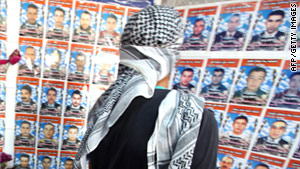
A man at a shop in Misrata, Libya, looks at photos of those killed in fighting.Misrata, Libya (CNN) -- Seven people died Sunday in fighting in the town of Dafniya, Libya, near the besieged city of Misrata, according to a hospital spokesman.

The deaths include a woman who died when a Grad rocket landed in her home, said Khaled Abu Falgha of Misrata's Hekma hospital.

Elsewhere, 15 rebels and about 100 Gadhafi forces were killed Sunday in fighting in Zawiya, according to Ahmed al-Hawary, rebel spokesman in Zawiya.

Dafniya was quiet Sunday evening, said Ibrahim Beit-elmal, a spokesman for the Misrata military committee. On the southern front of Abdul Rauf, the rebels were able to capture 10 Gadhafi forces and a few vehicles after an ambush was set for them, he said.

Also Sunday, rebels in Misrata released a document they claim is a battle plan confiscated last month from forces loyal to longtime Libyan leader Moammar Gadhafi.

CNN obtained the 15-page document -- titled, in part: "Battle plan to cleanse the city of Misrata from militant gangs" from rebels in the city Sunday. The words "top secret" is written at the top of every page. The name of Gadhafi's son, Khamis Moammar Gadhafi, appears on page 10 as commander of the theater.

CNN could not independently verify the authenticity of the document. The rebels said it was confiscated from a high-ranking official near Misrata between May 18 and May 20.

"This document was very useful but only for a short period of time because as soon as Gadhafi brigades found out that we confiscated them, they tried to change their plans," said Abdallah al-Kabeir, a rebel spokesman.

The documents says Misrata is to be "attacked from six different directions with 11,350 fighters, 4,000 of whom are organized troops, (the rest volunteers). The six directions cover the east and the south."

The "mission" is stated as: "To destroy mercenary elements and deceive youth in Misrata using nine brigades. ..."

Al-Kabeir called portions of the document "exaggerated."

"I think the number of troops and equipment mentioned in the document are definitely exaggerated because they wanted to lift their soldiers' low morale. Also, our intelligence on the ground indicated that Gadhafi forces have a lot less people than what this document says."

The Libyan government has not acknowledged the document.

Government spokesman Musa Ibrahim told reporters Sunday that reports rebels were gaining control of some areas were incorrect, although he said "pockets of violence" remain.

About 130 miles (209 kilometers) east of Tripoli, Misrata has been the scene of some of the bloodiest fighting in Libya's civil war.

Since the conflict began in early February, the death toll is believed to be more than 1,000 people in Misrata, including hundreds of civilians, Dr. Khaled Abu Falgha, a spokesman at Misrata's Hekma hospital, said earlier this month. In April, Oscar-nominated filmmaker Tim Hetherington and photojournalist Chris Hondros were killed in Misrata.

The town has been under siege for months from Gadhafi's forces, who have cut off all land acesss, leaving the sea as the only escape route. On May 11, rebels said they seized the Misrata airport. Heavy shelling has been reported in Misrata in recent days as Gadhafi's forces wage a campaign to seize the town back.

Ibrahim said Sunday that bombardment from the sea and air were the only things preventing Gadhafi forces from declaring victory in Misrata.

NATO said in a statement Sunday that precision-guided weapons were used to strike "a technical vehicle, a tank, a multiple rocket launcher and an armored vehicle" in Misrata.

The organization said anti-Gadhafi sentiment "is increasing in Libya as a growing number of Libyans demand the right to choose their own future." Citizens were openly challenging Gadhafi's legitimacy along the nation's northwest coast between Tripoli and the Tunisian border, it said. NATO said it was "monitoring the situation closely and is taking necessary action to protect civilians."

Earlier Sunday, east of Tripoli, an armored vehicle with anti-aircraft guns was struck "as it moved to threaten civilians," NATO said.

The United Arab Emirates on Sunday became the latest nation to recognize the Libyan Transitional National Council "as the sole representative of the LIbya people," the state-run WAM news agency said.
There have been numerous calls for Gadhafi to step down, but Ibrahim said Sunday, "No one has the right to ask any citizen, much less the honorable leader, to leave. Libyans should ask the leader to leave. A foreign diplomat asking is immoral."

Anwar vows fuel price cuts if Pakatan wins Putrajaya

Anwar said he was not promising the impossible. — file pic
KUALA LUMPUR, June 12 — Datuk Seri Anwar Ibrahim has promised to drop fuel prices within 24 hours of Pakatan Rakyat (PR) taking federal power.


“Umno leaders can say whatever (they) like,” said Anwar at a ceramah in Brickfields here today, referring to criticisms that such a move could affect the economy.

“I used to be a finance minister. I don’t want to promise impossible things,” added the fiery opposition leader.

Prime Minister Datuk Seri Najib Razak recently removed diesel subsidies for deep-sea fishing vessels and nine classes of commercial vehicles.

But the Cabinet opted to raise electricity tariffs in order to stave off a hike in pump prices for consumer fuels.

The Najib administration maintains the price of RON95 petrol, diesel and liquefied petroleum gas (LPG) will not be increased for now, but Deputy Finance Minister Datuk Donald Lim has said fuel prices will be reviewed if oil price hits US$110 –120 (RM330 – RM360) per barrel.

Brent crude is currently hovering near the US$120 mark.

Anwar also slammed the Najib administration for wielding the knife on consumer subsidies while leaving gas subsidies to power producers — to the tune of RM19 billion this year — largely untouched.

“When the rich get it, it’s incentives. When the poor fishermen get it, it’s subsidies,” he told the 500-strong crowd to rousing applause.

Fishermen and trawler boat operators in Kuantan have gone on strike for three days since yesterday over the diesel subsidy cuts.

Anwar said he had visited Bahrain and Kuwait recently, and pointed out that no “oil-producing country in the world raises prices like Malaysia.”

He stressed that global fuel price movements were “immaterial” as Malaysia remains a net oil exporter.
“What do we have to offer? The Orange Book,” said Anwar.

The Orange Book is a manifesto of reforms that the opposition pact promises to implement within the first 100 days of taking federal power.

It proposes, among others, an increase in teachers’ incentives, the abolishment of the tolled highway system, and an annulment of the Internal Security Act.

BN faces uphill battle in Penang

While the state BN chairman is encouraged by the strong spirit shown by state leaders, taking back the state, he concedes, will not be an easy task.

GEORGE TOWN: Barisan Nasional admitted today that it will face an uphill battle to unseat the Penang Pakatan Rakyat administration in the next state election.

In expressing a rational view of the state political undercurrents, BN state chairman Koh Tsu Koon predicted that the coalition has the mobility and capacity to perform better in Penang than in the 2008 general election.

He also said that BN was ever ready to face either an early or late state election in Penang.

Koh said he has been encouraged by the strong spirit shown by BN state leaders and members to bounce back from the electoral debacle three years ago.

The Minister in the Prime Minister’s Department in charge of Unity and Performance, however, refused to be drawn into measuring BN’s chances to regain the lost state government.

“I don’t want to predict our chances in the state election. I must admit BN faces a tough and uphill task in Penang.

“Although signs are encouraging, but generally the voters’ mood is not really favouring BN,” he told a press conference during a break at the BN state convention here.

Also present were state BN deputy chairman and Umno chairman Zainal Abidin Osman, MIC chairman Senator PK Subbaiyah, Gerakan and BN working committee chairman Dr Teng Hock Nan, PPP chairman Loga Bala Mohan and MCA secretary Lau Chiek Tuan.

‘Encouraged by fighting spirit’

However, Koh is optimistic that BN could perform better than three years ago.
“I am encouraged by the fighting spirit and cohesiveness shown by state leaders and grassroots members,” he said.

In the 2008 general election, Pakatan won 29 of the 40 state seats to displace BN as the new state government, helmed by DAP secretary-general Lim Guan Eng as chief minister.

Other 11 seats were all won by Umno, leaving Gerakan, MCA and MIC without a single seat.
Gerakan president Koh, the out-going chief minister then, was trounced by a 9,485-vote margin in his parliamentary duel with newcomer P Ramasamy in Batu Kawan.

This time though, BN believes that it has a good chance of winning back seats that were lost by less than 1,500-vote majority in 2008.

But on the cautionary note, local leaders are concerned that BN could also lose seats it won with less than 500 votes.

All seats in Balik Pulau constituency, Batu Uban, Seberang Jaya and Sungai Acheh state seats come under this equation.

Koh said currently BN plans to reach out to grassroots voters to understand and address their needs and demands.

Asked whether BN was ready to face an earlier than expected state election before the parliamentary election, he said: “From what I have read and observed, Pakatan’s strategy is to delay the state polls after the parliamentary election.”

“But we are ready for the state election, either before or after the parliamentary election,” he added.

The Bagan MIC dilemma

The sacking of Bagan MIC chief Henry Benedict may further frustrate BN and MIC's plan of winning back the Bagan Dalam state seat.

GEORGE TOWN: The sacking of Bagan MIC division chairman Henry Benedict Asirvatham is set to trigger an exodus of members and closure of all branches in the division.

In other words, the Bagan division will be literally defunct, dampening the already slim chances of the party and Barisan Nasional to wrest back the Bagan Dalam state seat in the next general election.

This does not augur well for BN, which aspires to win back between 10 and 15 state seats that it lost to Pakatan Rakyat in the last general election.

Bagan Dalam, which is among those seats, has 17,194 registered voters, with Chinese voters accounting at 52.6%, Malays 24.3% and Indians 22.3%.

MIC contests the Bagan Dalam and Prai state seats under BN’s electoral arrangement in Penang.

If the Bagan division, which has 15 branches and over 2,000 members, were to close shop, party insiders said MIC chances of regaining Bagan Dalam will be “virtually zero.”

Bagan Dalam, which comes under the Bagan parliamentary constituency, is currently being held by DAP’s A Tanasekharan, who defeated incumbent PK Subbaiyah, now state MIC chairman, in the 2008 election.

Political tsunami aside, another reason MIC was defeated in Bagan Dalam then was the four-year suspension of the Bagan division (2006 – 2010).

Now the same danger of not having a local party election machinery in the constituency looms.
“It’s going to be a sure defeat for MIC and BN in Bagan Dalam if the party leadership upholds the termination of Henry’s membership,” said a senior division chief in the state.

The Bagan Dalam effects, they predicted, can also spill over to the neighbouring Prai seat, currently held by DAP’s Deputy Chief Minister II (DCM 2) P Ramasamy.

When contacted, Henry said he has not received any official letter about the membership termination, but only heard the news from party colleagues.

He plans to file an appeal once he receives the letter. Under MIC’s constitution, a sacked member has two weeks to appeal against the decision.

‘Hidden hands behind sacking’

Henry declined to comment when asked whether his expulsion will trigger an exodus of division members from the party.

He was expelled from the party following an internal misconduct inquiry on him last Thursday at the party headquarters in Kuala Lumpur. The three-man inquiry was chaired by KS Nijhar, head of the party disciplinary committee.

Others in the inquiry were R Ganesan, Perak Legislative House Speaker, and J Randhir Singh, a party central working committee member and Social Strategic Foundation (YSS) deputy chairman.

The fourth member of the disciplinary committee, Senator Subbaiyah, who can’t see eye-to-eye with Henry, excused himself from the inquiry to avoid a conflict of interest.

Slapped with a show cause letter on May 18 demanding him to explain why he criticised MIC acting president G Palanivel openly in FMT, the 50-year-old division leader replied on May 28.

Henry claimed that Palanivel was plotting to “politically kill” party deputy president Dr S Subramaniam, the human resources minister.

He also questioned the legality of the party’s decision to re-accept expelled members vis-à-vis Articles 15.4 and 61.5 of the party constitution.

Henry was referring to the re-acceptance of anti-Samy Vellu movement (GAS) activists – V Mugilan, G Kumar Aamaan dan KP Samy.

In his reply to the show-cause letter, Henry claimed that his Bagan division’s earlier suspension was engineered by Palanivel with the tacit support of Subbaiyah.

Insiders accused certain hidden hands of being behind Henry’s sacking, claiming that Nijhar and company were against taking such drastic action.

“Certain leaders have forced Nijhar’s committee to sack Henry,” they said.

Insiders claimed that the sacking was to kill Henry’s chances of becoming the party candidate in Bagan Dalam.

It’s learnt that MIC has short-listed Penang MIC secretary and Bukit Bendera division chief M Karuppanan and youth chief J Dhinagaran as potential candidates for Bagan Dalam.

The party’s shortlisted candidates for Prai are state deputy chairman L Krishnan, who was trounced by Ramasamy in 2008, and Batu Kawan division chief R Muthiah.

Lawyer Karuppanan and Krishnan are said to be Subbaiyah’s favoured candidates.

However, Henry is the pick of party grassroots members, especially from the mainland, and BN component parties as well, for Bagan Dalam.

It’s learnt that Henry was offered a deal, before and after the inquiry, to escape the sack by apologising to Palanivel.

Henry agreed albeit on condition that Palanivel and Subbaiyah also apologise to him for masterminding his division’s earlier suspension.

Since no apologies were forthcoming from either side, the axe inevitably fell on Henry.

MIC insiders said the top leadership should consider imposing lesser punishment against Henry to give the party a glimmer of hope to regain Bagan Dalam.

Or else, the Bagan MIC division will probably close shop leaving the party and BN counting their losses in the next election.

Dasar ekonomi negara ketinggalan 30 tahun

PAS pula menyalahkan dasar Tun Dr Mahatir Mohamad yang menyebabkan pembaziran minyak.

KUALA LUMPUR: Ekonomi negara sudah ketinggalan 30 tahun menyebabkan berlakunya krisis ekonomi termasuk kenaikan harga barangan ekoran peningkatan harga minyak.

Dalam tempoh tersebut membuat kesilapan demi kesilapan sehingga telah menjadi lambakan dan kesan sukar ditangani, kata Pengarah Strategi PKR Rafizi Ramli.

“Kerajaan gagal memandang ke depan termasuk dalam merancang harga minyak pasaran dunia.

“Akibatnya kerajaan gagal mengurus harga minyak dan kesannya rakyat menanggung beban,” katanya dalam satu forum ekonomi di ibu negara hari ini.

Dua lagi ahli panel forum anjuran Pemuda PAS Wilayah Persekutuan itu ialah Exco Pemuda Umno Datuk Ahmad Zaki Zahid dan Exco Pemuda PAS Dr Zuhri Marjuki.

Menurut Rafizi, rakyat terbanyak tidak mendapat subsidi minyak sebaliknya pengeluar tenaga bebas (IPP) memperolehi berbilion ringgit.

Beliau mahu isi penjanjian di antara IPP dengan kerajaan didedah kepada umum dan dikaji supaya tidak membebankan rakyat.

Dasar Dr M

Manakala Dr Zuhri mendakwa dasar pemerintahan mantan Perdana Menteri Tun Dr Mahathir Mohamad menyebabkan Malaysia dilanda krisis ekonomi khususnya berkaitan harga minyak.

Katanya, pembaziran minyak ekoran dasar Dr Mahathir yang mahukan rakyat menggunakan banyak kereta.
“Sektor pengangkutan awam tidak digunakan, hanya kebelakangan ini baru dipandang  semula,” katanya. polisi pengangkutan yang menurutnya menyebabkan penggunaan minyak yang banyak.

Wakil  Pemuda Umno pula menegaskan orang miskin perlu terus mendapat subsidi khususnya minyak.
Bagaimanapun, Ahmad Zahid berkata, kerajaan telah membelanjakan wang terlalu banyak untuk subsidi dan ini tidak baik kepada negara.

Katanya, jumlah subsidi negara pada 2009 ialah RM74 bilion iaitu RM12, 000 setiap isi keluarga.

The Munafiq named Zul Noordin


Zulkifli Noordin, the Kulim Bandar Baharu Member of Parliament, said, “Some Malays are willing to be used by this illegal gathering that is led by former Bar Council president Datuk Ambiga Sreevanasan. This is despite knowing the organisation has fought strongly against Islam.”
NO HOLDS BARRED

Raja Petra Kamarudin Islam has a word for Muslims who talk about defending Islam and yet go against Islamic teachings. Datuk Ambiga is in fact upholding Islamic teachings. She is opposed to election fraud. Zul, on the other hand, wants to uphold election fraud.
In this sense Ambiga is more Islamic than Zul. Zul, according to Islamic teachings, is a hypocrite or Munafiq.
For those Muslims and non-Muslims who may not understand the concept of Munafiq in Islam, allow me to deliver my Sunday sermon.
Munāfiq (n., in Arabic: منافق, plural munāfiqūn) is an Islamic Arabic term used to describe a religious hypocrite, who outwardly practices Islam, while inwardly concealing his disbelief (kafir), perhaps even unknowingly.
The term munāfiq in Arabic, Bengali and Urdu is primarily a non-religious term that refers to a person whose actions are different from and opposite to his thoughts, which he conceals. In the Qur'anic sense the term refers to a person who does not have faith, but pretends to. 
The Qur'an has hundreds of ayāt (verses) discussing munāfiqūn, referring to them as more dangerous to Muslims than the worst non-Muslim enemies of Islam.
The Qur'an states:
The Hypocrites will be in the lowest depths of the Fire: no helper wilt thou find for them;-
    —Sura 4 (An-Nisa), ayah 145, Qur'an[2]
According to the Hadith Sahih al-Bukhari, narrated by 'Abdullah bin 'Amr:
The Prophet said, "Whoever has the following four (characteristics) will be a pure hypocrite and whoever has one of the following four characteristics will have one characteristic of hypocrisy unless and until he gives it up.
1. Whenever he is entrusted, he betrays.
2. Whenever he speaks, he tells a lie.
3. Whenever he makes a covenant, he proves treacherous.
4. Whenever he quarrels, he behaves in a very imprudent, evil and insulting manner."
According to the Hadith Sahih al-Bukhari Book 1 : Volume 2 : Hadith 32, narrated by Abu Huraira:
The Prophet said, "The signs of a hypocrite are three:
1. Whenever he speaks, he tells a lie.
2. Whenever he promises, he always breaks it (his promise ).
3. If you trust him, he proves to be dishonest. (If you keep something as a trust with him, he will not return it.)"
And this is the Quran’s word on hypocrites:

Surat Al-Munāfiqūn (Arabic: سورة المنافقون‎) (The Hypocrites) is the 63rd sura of the Qur'an with 11 ayat.
Surah 63 - Al Munafiqun - Ayat - 001 When the Hypocrites come to thee, they say, "We bear witness that thou art indeed the Apostle of God." Yea, God knoweth that thou art indeed His Apostle, and God beareth witness that the Hypocrites are indeed liars.
Surah 63 - Al Munafiqun - Ayat - 002 They have made their oaths a screen (for their misdeeds): thus they obstruct (men) from the Path of God: truly evil are their deeds.
Surah 63 - Al Munafiqun - Ayat - 003 That is because they believed, then they rejected Faith: So a seal was set on their hearts: therefore they understand not.
Surah 63 - Al Munafiqun - Ayat - 004 When thou lookest at them, their exteriors please thee; and when they speak, thou listenest to their words. They are as (worthless as hollow) pieces of timber propped up, (unable to stand on their own). They think that every cry is against them. They are the enemies; so beware of them. The curse of God be on them! How are they deluded (away from the Truth)!
Surah 63 - Al Munafiqun - Ayat - 005 And when it is said to them, "Come, the Apostle of God will pray for your forgiveness", they turn aside their heads, and thou wouldst see them turning away their faces in arrogance.
Surah 63 - Al Munafiqun - Ayat - 006 It is equal to them whether thou pray for their forgiveness or not. God will not forgive them. Truly God guides not rebellious transgressors.
Surah 63 - Al Munafiqun - Ayat - 007 They are the ones who say, "Spend nothing on those who are with God's Apostle, to the end that they may disperse (and quit Medina)." But to God belong the treasures of the heavens and the earth; but the Hypocrites understand not.
Surah 63 - Al Munafiqun - Ayat - 008 They say, "If we return to Medina, surely the more honourable (element) will expel therefrom the meaner." But honour belongs to God and His Apostle, and to the Believers; but the Hypocrites know not.
Surah 63 - Al Munafiqun - Ayat - 009 O ye who believe! Let not your riches or your children divert you from the remembrance of God. If any act thus, the loss is their own.
Surah 63 - Al Munafiqun - Ayat - 010 and spend something (in charity) out of the substance which We have bestowed on you, before Death should come to any of you and he should say, "O my Lord! why didst Thou not give me respite for a little while? I should then have given (largely) in charity, and I should have been one of the doers of good".
Surah 63 - Al Munafiqun - Ayat - 011 But to no soul will God grant respite when the time appointed (for it) has come; and God is well acquainted with (all) that ye do.
 

WIKILEAKS: Anwar's second sodomy trial begins


Anwar's second sodomy trial is extremely controversial in Malaysia, seen by many as a political ploy to derail him and the opposition, and as a repeat of the 1998 sodomy trial.  In launching the trial -- and there were doubts there would be a trial --  the GOM appears to determined to pursue the charge notwithstanding the potential costs domestically and internationally. 
THE CORRIDORS OF POWER
Raja Petra Kamarudin

UNCLAS KUALA LUMPUR 000064

SENSITIVE
SIPDIS

E.O. 12958: N/A
TAGS: PGOV, PHUM, MY
SUBJECT: OPPOSITION LEADER ANWAR'S "SODOMY II" TRIAL BEGINS

 1. (SBU) Summary:  After months of delay while his defense team submitted motion after motion ranging from a request to see all the evidence to outright dismissal, opposition leader Anwar Ibrahim's trial for alleged consensual sodomy with a former aide began in the Kuala Lumpur High Court on February 3. 

The prosecution immediately called to the stand the alleged victim, 25-year-old former Anwar aide Saiful Bahari, who described his relationship with Anwar and began a detailed account of the events of June 26, 2008 when the alleged sodomy occurred. 

At the defense's request, the judge stopped the testimony when Saiful was on the verge of describing sexual contact.  The testimony will resume in camera (without the public present) on February 4. 

Among the 70 members of the public observing the trial from the small gallery were opposition politicians, local and international Journalists, and diplomats from several embassies.  Polcouns and Pol staff attended the February 2 and 3 sessions.

2. (SBU) Comment: Anwar's second sodomy trial is extremely controversial in Malaysia, seen by many as a political ploy to derail him and the opposition, and as a repeat of the 1998 sodomy trial.  In launching the trial -- and there were doubts there would be a trial --  the GOM appears to determined to pursue the charge notwithstanding the potential costs domestically and internationally. 

While there may be many days and weeks to go before this case concludes, and there is potential for further delays, the GOM has so far allowed Malaysians and foreigners access to the proceedings.

Observers from the International Bar Association and International Council of Justice were seated alongside the attorneys in the front of the courtroom. The proceedings are being prominently covered in both the mainstream government-influenced media and the blogosphere, as well as in the international press.  End Summary and Comment.

3. (SBU) Anwar Ibrahim's trial began at 3:30 pm on February 3 after High Court judge Mohamad Zabidin Mohd Diah rejected lead Anwar attorney (and fellow opposition Parliamentarian) Karpal Singh's request for a stay to allow the Appeals Court to rule on a request to obtain the government's evidence before the trial. 

A clerk read the charges concerning the alleged incident aloud in front of Anwar, standing toward the rear of the courtroom, who said that the charges were "frivolous" and ordered by the prosecution's "political masters" before pleading not guilty.

4. (SBU) The prosecution immediately called 25-year-old former Anwar aide Saiful Bahari to testify, walking methodically through questions about his educational background, first association with Anwar (March 2008), and his job description.  Saiful, testifying in Malaysian, said he was paid RM 1,000 per month (about USD 270) to help with Anwar's schedule, carry his private cellphone, and manage his finances. 

At that point, Anwar leaned over to his wife, PKR politician Wan Azizah, and said "liar" in Malaysian.  The prosecution had Saiful describe in detail how he arrived at Anwar's condominium on June 26, 2008, and what happened next, presenting as evidence a one-page statement that Saiful had signed in front of police when he reported the alleged sodomy. 

The defense succeeded in having a reference to previous sexual contact between Anwar and Saiful expunged from the statement.  When Saiful had described how Anwar had allegedly asked him to have sex and then ordered him to undress in the bathroom, the defense requested that the remainder of Saiful's testimony be heard in camera.  The judge agreed to do so starting at 9:30 a.m. on February 4.

5. (SBU) In parallel with trial, Anwar's legal team continues to pursue motions to have the charges dismissed or to gain reviews of earlier decisions denying the defense access to the government's evidence.  If accepted, those motions could lead to renewed delays in the trial.

 6. (SBU) In the months before the trial, Anwar was careful to keep in touch both with prominent foreigners and Malaysian supporters.  On January 25, his People's Justice Party (PKR) International Bureau held a closed door briefing for diplomats about the trial, arguing that the GOM was determined to convict "the Prime Minister in waiting" to remove him from the political scene.  They also argued that there was clear medical evidence refuting the charges, and that the judiciary was being manipulated to ensure a conviction.

KEITH

After Bhopal, Chernobyl and Fukushima, is Gebeng next?

KITA To Launch Manifesto On June 30 - Zaid Ibrahim

MELAKA, June 12 (Bernama) -- Parti Kesejahteraan Insan Tanah Air (KITA) will launch its manifesto on June 30 explaining its struggles as a responsible and sincere opposition party.

Parti KITA head Datuk Mohd Zaid Ibrahim said the manifesto explained the essence of its struggles and policies, and introduced certain issues that would be accepted by the government.

"The political situation in the country currently gives a picture as though the opposition and the government is in a state of war," he told reporters after opening the party's new office at Taman Gadong Perdana, here.

He said the 'culture of hatred' was not good for the country because the political situation in the country should be conducive and appropriate to discuss issues concerning the people.

On the party's preparation to face the next general election, he said the party would be contesting in one or two constituencies in Melaka but had not decided whether to contest in the state or parliamentary constituencies.

KITA has 3,000 members throughout the country currently.

Sunday, 12 June 2011

Chua wants scholarships system revamped


(Malaysiakini) Come every middle of the year when results of Public Service Department scholarship applications are out, MCA finds itself in the centre of attraction, or in some cases dissatisfaction, as the party handles appeals from dissatisfied students aces.

This year, MCA Youth chief Wee Ka Siong described it as the worse year ever since he begin handling such complaints, as many students cry foul that either the scholarships given were poorly matched to their qualifications, or that than lesser deserving students were given more.

NONEIn a recent interview, MCA president Dr Chua Soi Lek argued that the PSD had performed a large series of mismatches, because too many students were clamouring for scholarships for medical degrees.

He said that there were 1,500 applications to do medical courses overseas and not only can this not be accommodated by the PSD grants, there were insufficient institutions to cater for this volume anyway.

“The mismatch is (because) everybody wants to do medicine. As I told you, there are not enough places to do medicine everywhere in the world. Can you imagine (sending) 1,500 people to do medicine overseas?” said Chua.

Chua, who has practiced medicine for more than a decade, believes that the current PSD scholarship award system is flawed and is proposing a revamp.

He said that the current system which allows for Sijil Pelajaran Malaysia (SPM) top scorers to apply for PSD scholarship for medical courses ought to be mulled over.

Reforms needed

He explained that the PSD scholarship was conceived to ensure placement of students in “critical courses” and he believes that medicine, and some other disciplines, should be struck off that list.

azlan“Malaysia would have a surplus of doctors in five years time. I'm sorry to say that. We are training out more doctors than usual, the same with pharmacy.

“We have said that to the government. We are very worried that a day will come that when doctors come back, they have no place to go. This is something that is a possibility two or three years down the line,” he said.

Moreover, he believes that it was premature to give out grants for SPM leavers to pursue medicine because it doesn't guarantee that they will ace their pre-university exams, such as A-Levels or other matriculation courses.

“But today, if I said this, I will get a lot of scolding... The fact is that if you scored nine A+, it doesn't mean that you will do very well when you do matriculation,” he said.

Chua also argued that it was “not right” to send all top scholars overseas because a whopping 56 percent of PSD scholarship recipients who studied overseas never returned.

“All of them quickly cabut (run away). They specialise and then disappear into thin air,” he said, adding that MCA supports the government's intention to sue absconders.

Miscommunication


For now, MCA's priority in terms of PSD scholarships lies with its special committee, headed for former University Malaysia lecturer Fong Chan Onn, that will draw up suggestions for guidelines to help the department streamline its criteria for scholarships to avoid disputes in the future.

NONEHe said that the public were not properly informed about the current criteria and are unfairly critising the government and MCA after failing to secure the grant.

“A lot of people (think that) an A is an A. They don't know what is the difference between an A, A+ and A-. You see the problem?

“In one particular case, (the complainant's) son had ten A. True: Six A-, two A and two A+. So I told him 'Good results, but way behind (the line)',” he said.

Last year, the Najib administration promised that all students who scored eight A+ and above would be entitled to scholarships locally and abroad.

But of the 1,500 scholarships to study abroad, only 300 were distributed based on merit, while the balance were distributed based on four categories - Sabah bumiputeras (five percent), Sarawak bumiputeras (five percent), social composition or the population's racial composition (60 percent) and socially handicapped (10 percent).

Critics claim that this system was unfair to top performing students and would give the impression that the government does not reward its best brains, leading to an eventual brain drain.

Will Chua stand in GE13?

During the hour long interview with Malaysiakini, Chua dismissed talk that BN's losses in the April 16 Sarawak polls and the unprecedented losses suffered by Singapore's ever-ruling PAP party would threaten BN or MCA's chances in the next general election.

He said that in the case of Sarawak, it was a unique scenerio. He said that there was disenchantment with Chief Minister Abdul Taib Mahmud's long rule while much of the population were poor.

“Sarawak is quite a unique case, where a leader has overstayed too long. And in the state, the poverty (level is high). (Then there is) always this accusation of blatant display of wealth,” he said.

bn candidates announcement pbb hq 030411 rolls royce maroonCiting the example of how Taib likes to be chauffeured in several of his vintage Rolls Royce cars, Chua said such a practice would cost votes.

“How would people feel? If you asked me, personally, I feel it's a bit odd,” he said.

On whether MCA candidates who lost during the 2008 general election would be fielded again, Chua said that this is the general principle held by the party leaders now, but refused to rule out this possibility.

He said that the party would instead try its best to avoid doing so to prevent the perception that the party was fielding “recycled products”.

“If a person who has lost still has the highest chance of winning, he will be fielded. There is no hard and fast rule (on this),” he said.

On whether the party would be fielding him, Chua coyly said: “I really haven't decided”.

“I don't know. I haven't even decided. I don't even know where I'm going to stand. I may not even want to stand. I may even resign (as party president) before the general election.

“Or maybe I may even resign after the general election if I think I'm not doing a good job. And I have no fear of resigning. You all know that.”

Sopore sisters fall to militant bullets. But the angry Valley looks the other way

BY ZAHID RAFIQ

Snuffed out Akhtara (left) and her younger sister Arifa
IN A congested neighbourhood of old decaying houses, mourners arrive quietly through narrow muddy lanes. On the evening of 31 January, suspected militants dragged two teenaged sisters out of their home in Sopore, Jammu & Kashmir, and shot them dead in cold blood. This time, there were no cries of revenge from angry boys on the streets nor demands for investigations. In the silences and whispers, it seems as if something ominous — rather than horrendous — has happened.

In Muslim Peer, where most of the residents are related to each other, the pauses and measured answers of the girls’ relatives are surprising. There is a palpable feeling of fear and also of an overnight alienation. The victims’ family suddenly feels out of place after rumours that the girls were not only “immoral” but also informers for the security forces.

“Why else would militants kill them? Of course, they had a questionable character too for which they had been warned before,” is a common refrain in the town located 35 km northwest of Srinagar.

Akhtara, 18, and Arifa, 16, were beautiful and poor and often it is a tragic mix, more so when they refused to conform to the accepted morality of Sopore, a Jamaat-e- Islami and militant stronghold.

According to locals, the sisters used to roam around the market at dusk, laughing and chatting on their cell phones. “Akhtara was warned in April and asked to mend her ways but she continued to behave improperly,” says a shopkeeper.

Rumour has it that the girls were not only ‘immoral’ but also informers for the security forces
At around 7.45 pm on that fateful day, Arifa was cooking rice in the kitchen of her 8x10 ft single-room home. Akhtara was upstairs at her uncle’s place cleaning fish. Their father Ghulam Nabi Dar, a manual labourer in a ration depot, had gone to the mosque. Their mother Fareeza, a housewife who can no longer walk because of arthritis, was sitting with her 15-year-old son Ghulam Jeelani when the door suddenly opened and three masked men clad in phirans walked in.

“One of them asked my daughter to come out. I knew something was amiss but I had no idea it would go this wrong,” says Fareeza. “We all fell at their feet, begging them to tell us if we had done something wrong. But they said they just wanted to ask a few questions.”

“Outside, it was like a crackdown,” says a neighbour. Almost everyone heard the noises but no one came out. “There were 6-7 armed men who had cordoned off the area. When we tried to open a window, they warned us to stay inside. We were too afraid to go out,” says a relative.

The gunmen locked Fareeza inside and went up to get Akhtara. “Her uncle tried hard to stop them but they hit him and took the girls away. Some of us followed them but they sent us back saying they just want to talk to them alone. They said it was better for us to go home and not make them angry, and we returned,” recalls Shareefa, their aunt, whom Akhtara used to help with the fish.

Jeelani, who is frail and looks younger than his 15 years, hovered around, unable to understand what to do. Sometimes, he hugged his sisters and sometimes begged the gunmen to leave them alone, but his pleas fell on deaf ears.

In mourning Their mother Fareeza (top) and brother Jeelani
Fifteen minutes later, gunshots shattered whatever little hopes the family had left. The bodies were found in Rahim Sahib neighbourhood. One was riddled with six holes, the other with four, including one through the head.

“One of the sisters had a broken arm and another had broken teeth. Their back had been lashed and I couldn’t count the injuries,” says a relative who gave the sisters their final bath before burial. Not many people attended the funeral, as it was almost certain that it was militants who had killed the “immoral girls”.

THE POLICE had given out the names of two local Lashkar-e-Toiba (LET) militants — Muzaffar Naikoo alias Muz Maulvi and Waseem Ganai — within hours of the killings but the United Jehad Council (UJC) refuted the police claim and vowed to conduct its own investigation.

Everyone in Sopore seemed to have known the sisters or maybe their murder increased their “notoriety”. “They used to go out to the market at dusk, talk on cell phones on the street and also roamed around STF (Special Task Force) camps,” was the common refrain. But no one saw them entering an STF camp and the police say that none of their informers dare enter the camp through the bus yard.
There’s nothing to prove that the girls were informers. They haven’t stashed any riches, certainly not in their home. They don’t have a television or a bathroom.

Akhtara cleaned fish for Rs.4 a kg and used to work about four hours a day. “Even when she was dragged out, she had fish scales and stench on her hands,” recalls Shareefa.

Ritual condemnations came from several sides but no real words of anger or outrage were said. After the UJC denied any role in the killing, Hurriyat (G) gave a protest call insinuating that it was the work of State agencies. A day later, LeT posters appeared all over the town claiming responsibility for the killing. “We killed the two girls because their behaviour was improper and they were involved in degraded activities like informing the security agencies,” the poster read. It also threatened to take action against those who had started raising questions about the murders. No proofs and explanations of the girls’ involvement as informers were provided.

As for the mainstream political parties, the People’s Democratic Party, which acts as human right champions in the Valley, didn’t talk about the issue for days. The PDP made a passing reference about it five days later in its angry statement over the killing of Manzoor Ahmad Magray, 21, by the army in Handwara on 5 February.

Chief Minister Omar Abdullah visited Magray’s family a day after his killing, but bypassed a numbed mother, a distraught father and hurt brother. However, he was the first to tweet about the murders but no one from Dar’s house was following him on Twitter.

Not many attended the funeral as it was almost certain it was militants who had killed the two girls
Meanwhile, human rights group Coalition of Civil Society, which sent its volunteers to the family, said that the real task was to work beyond statements and make these acts intolerable in our society.

“If the militants have killed the girls for promiscuity, then we have a huge task ahead of us because it is not the job of militants to decide who is promiscuous among us and give punishments. This is against international human rights principles and is certainly against Islam,” says Khurram Parvez, a human rights activist. “And if the girls were informers, we strongly condemn it because we don’t accept civilian killings and we had got UJC to agree to it,” he says.

Dar is a broken man and it is hard to imagine him carrying a load on his bent back as he has been doing for the past 15 years. Fareeza hasn’t moved from a relative’s home where she wails and sings elegies to her dead daughters. Jeelani roams around the bylanes like a ghost.

Their 8x10 ft room — with wires hanging from its low ceiling and the rough cement walls turned black — suddenly seems to have become big for the family that was always cramped for space.

In a distant corner, Fareeza wails in her elegy. “We were two daughters and a mother, we used to joke and laugh together. Tomorrow when everyone will go, who will I talk to? Without her crutches how will a cripple live, come back my daughter, come back to me!”


zahid@tehelka.com

Reports of Victims of Forced Conversions to Islam, Rapes and Forced Marriages

By Jeremy Reynalds
 
http://www.bosnewslife.com/wp-content/uploads/2010/08/pakistanwomen1.jpgLAHORE -- In Pakistan forced conversions to Islam, rapes and forced marriages are on the rise.

According to a story by Agenzia Fides (the information service of the Pontifical Mission Societies), the victims are mostly Hindu and Christian girls, belonging to religious minorities. The information came from Fides' local sources.

Fides said this has been a worrying phenomenon for the Church in Pakistan for some time, and one that the Church is trying to address. It is looking for institutional cooperation, but the process is an uphill battle.

"The Christian girls are the weakest and most vulnerable, because their communities are poor, defenseless and marginalized, therefore easily exposed to harassment and threats. Often they do not even have the courage to denounce the violence," a sister told Fides.

The sister hides and assists the girls who have managed to escape, Fides said.

The sister said, "But the trend is worrying: There are hundreds of cases a year registered and those that come to light are only a fraction."

Fides said in a society that tolerates discrimination of religious minorities, especially of women, the dominant religion and related social position are used to impose tyranny.

A report sent to Fides by the Center for Legal Assistance and Settlement (CLAAS), which takes care of legal assistance for Christians who are discriminated against and persecuted in Pakistan, confirmed this issue. It reported a number of troubling situations, occurring mainly in the province of Punjab.

Fides said Sidra Bibi, a 14-year-old Christian in the district of Sheikhupura in Punjab, is the daughter of a worker in the cotton industry. A Muslim from the village had his eye on her and began to molest her. He eventually abducted and raped her, before threatening her with death.

Physically and psychologically abused, the girl became pregnant.

Fides said she managed to escape from her captor, and is now back with her family. Police have refused to accept her complaint, Fides said, and now CLAAS lawyers are handling the case.

Fides said Tina Barkat, a 28-year-old-Christian, was approached by a Muslim friend who, after being friends with her for several months, asked her to convert to Islam. Her family began to read her verses of the Koran, kidnaped and threatened her, and then gave her in marriage to a Muslim family member. Her attorneys have filed a motion to dissolve the marriage.

Fides said a similar situation has occurred to Samina Ayub, a 17-year-old Christian, who lives with her family near Lahore. Kidnaped by a Muslim, she was forcibly converted to Islam, renamed Fatima Bibi, and forced to marry in the Muslim tradition.

Fides said her family reported the abduction, but police have not prosecuted those responsible. The case remains unsolved, and her family is asking for help from everyone interested in saving Samina.

Fides said Shazia Bibi, a 19-year-old Christian from Gujranwala, in Punjab, worked as a maid in the house of a Muslim woman, the owner of a grocery store. The Muslim boy from the store was in love with Shazia. In collaboration with the owner, they held a "conversion" and forced her into marriage. Fides said the plan was successful, but now as a result of intervention from Shazia's family the case has ended up in court.

In addition, Fides said, two other Christian girls, Uzma Bibi, 15, and from Gulberg, and Saira Bibi, 20, a nurse from Lahore, were abducted by Muslim neighbors, converted to Islam and then forced to marry in an Islamic ceremony.

Fides said the horrified families of the girls have reclaimed their daughters, and the cases are currently before the High Court of Lahore, represented by lawyers provided by CLAAS.

Police give their take on lock-up row

Malacca police say a bank manager was detained because he refused to produce his IC.
PETALING JAYA: A bank manager was arrested for refusing to produce his identity card and driving licence and not because he was not wearing a seat belt, Malacca police chief SAC I Chua Ghee Lye said today.

He said that police did not abuse their power when they detained the bank manager, Edmund Hiew Kok Ming, who is also a DAP member.

“The incident occurred on Jalan Laksamana Cheng Hong at about 9pm on May 28. The manager together with three other persons were in a Toyota Avanza when a traffic officer noticed that the driver was not wearing a seat-belt,” Chua told FMT.

He said that when the police officer tried to flag down the car, the driver at first refused to halt. He only stopped after some 150 metres down the road.

“When the officer asked the driver for his IC and licence, he refused to give. He even told my officer he had no authority to ask for his licence. The officer explained to the bank manager that he was only doing his duty.

“After several attempts, the man surrendered his IC but still refused to hand over his licence. He only gave a receipt of his renewed licence. He even started scolding my officer in Chinese,” said Chua.

He said the officer then warned Hiew that he was obstructing the law by not producing his document. It was only when the officer called for back-up that the driver relented and produced his licence.

“Yes, he did take a photograph of the policeman but that’s not an issue. There’s nothing wrong with taking a picture; we did not arrest him for that,” said Chua.

He said that Hiew’s case had been submitted to the deputy public prosecutor to decide if there is a case, adding that the police would also be taking down a few more statements.


Sufficient grounds

On the allegation that the police did not inform Hiew of his offence, Chua said it was done as it was part of the standard procedures.

“However, I am told that he was informed of his rights to a lawyer but I cannot confirm it,” he added.
“The DAP wants to bring up this issue and I cannot fault them. It is doing its job as an opposition party,” he said.

“But as far as we’re concerned, the manager had committed an offence by questioning police’s authority… The public should be aware that whenever a policeman asks for your identity card, you are legally bound to hand it over,” he said.

When asked why Hiew was held for three days, Chua said the remand order was sought to record all the necessary statements.

“The magistrate must have been satisfied that there are sufficient grounds to hold him longer… perhaps he was hostile or uncooperative,” said Chua.

Earlier today, Hiew, 26, had reportedly accused the Malacca police of arresting, handcuffing and putting him in the lock-up for three nights for merely not wearing a seat-belt while driving with four friends last month.

Hiew, together with DAP leaders, claimed at a press conference today that the police had abused their powers for detaining him after accusing him of allegedly obstructing them from discharging their duties on the night of May 28.

“I was accused of obstructing a civil servant from carrying out his duties by uttering to the police sergeant, ‘Lu apa kuasa mau ambik gua punya IC dan lesen’ (What powers do you have to take my IC and licence?),” Hiew reportedly said in an online newsportal, but denied saying those words.

Hiew, who admitted he did not wear his seat belt, said he cooperated with the sergeant and had handed over his identity card and driving licence.

But he alleged that the sergeant became angry when he took pictures of the situation. The officer even allegedly threatened to put Hiew in jail and inform his employer so that he would be fired.

The police said Hiew’s offence fell under Section 186 of the Penal Code for trying to obstruct policemen from carrying out their duties.

Hiew was held in the Melaka Tengah police station and then transferred to the traffic station before being released on May 31.

He also alleged that the police did not tell him the grounds for his arrest, which, according to lawyer and DAP’s Segambut MP Lim Lip Eng, was the right of a detained person.

Lim also said that police contravened Section 28A of the Criminal Procedure Code (CPC) by not telling Hiew that he had the right to see a lawyer.