Share |

Friday, 17 June 2011

Parliament condemns Govt on Malaysia asylum deal

ELEANOR HALL: But we go first today to Canberra, where the House of Representatives this morning passed a motion condemning the Federal Government over its plan to send 800 asylum seekers to Malaysia.

Critically, it was the Greens MP Adam Bandt who proposed the motion, which was supported by the Coalition and the independents Andrew Wilkie and Bob Katter. But the Coalition Leader Tony Abbot challenged the Greens to take their objections to the deal one step further, and force the Government to change its policy.

In Canberra, Sabra Lane reports.

SABRA LANE: The Greens two-part motion was put to the House of Representatives this morning. It called for the condemnation of the proposed asylum deal and its immediate abandonment.

HARRY JENKINS: The result of the division is ayes 70, nos 68. The question is therefore resolved in the affirmative.

SABRA LANE: The Senate had previously passed the motion. In this morning's vote, the Opposition voted in favour of it, with the independents Andrew Wilkie and Bob Katter. The Greens MP Adam Bandt introduced the motion into the House of Reps.

ADAM BANDT: Today is a significant day because for the first time in this Parliament, both Houses of Parliament have passed a motion condemning a policy decision taken by the Government. Use of the word condemn is strong and it is not a step that I took lightly to introduce this motion into the House.

SABRA LANE: The Opposition's immigration spokesman, Scott Morrison.

SCOTT MORRISON: Now, you'll have to check your history books but it has been some time I suspect that both Houses of Parliament have condemned a government policy in this way.

SABRA LANE: And he says Government MPs are guilty of hypocrisy.

SCOTT MORRISON: Those Labor members who have protested and condemned the Howard government for a decade, sat in their seats today glued there just not speaking up, not getting up, sitting silent.

SABRA LANE: But it's a non-binding motion, the Government can't be forced to abandon the policy.

The Immigration Minister Chris Bowen.

CHRIS BOWEN: Well, look the Greens and the Liberal Party have very different positions on this. Of course they have joined into a coalition of convenience this morning and that was well known, it was always going to be the case but if you asked the Greens and the Liberals to agree on a way forward or the Parliament to agree on a way forward, of course they wouldn't be able to. They are diametrically opposed.

SABRA LANE: But the Opposition Leader Tony Abbott says Mr Bowen can't brush it off.

TONY ABBOTT: This is a government which if it persists with the Malaysian people swap, is acting in clear defiance of the Parliament. Now, we are in unchartered waters here. I suppose it is then up to Members and Senators to decide what further sanctions they wish to apply against the Government.

SABRA LANE: And he says if the Greens are serious about their Opposition, they should flex their muscles in their alliance with the Government.

TONY ABBOTT: If the Greens want to be taken seriously, it is not enough to move non-binding resolutions in the Parliament. They are going to have to force some changes on their alliance partner in government.

SABRA LANE: Again, Adam Bandt.

ADAM BANDT: Senator Sarah Hanson-Young has already indicated that she intends to introduce a bill into Parliament that will give the Parliament greater oversight of deals like this and would allow the Parliament to say the Malaysia deal was off and would allow the Parliament to say you cannot send people to a third country and so the test is going to be for the Coalition as to whether they are going to support that bill if they are serious about what they're saying.

SABRA LANE: Again the Opposition's immigration spokesman, Scott Morrison.

SCOTT MORRISON: We'll meet with the Greens but that matter yet hasn't been introduced. It hasn't been debated and there is not a schedule yet for it to be considered so when those things are clear, we'll form a view when the matter is considered in the Parliament.

SABRA LANE: And on ABC24, Mr Bowen warned the Coalition if that bill passes Parliament, this and future governments including the Coalition would have to abide by it.

CHRIS BOWEN: Neither would any other arrangement. If a future government tried to do something with Nauru in future for example, that wouldn't get through the Parliament anyway so we would say that we are using the powers given to us by the Parliament legitimately under the Migration Act.

SABRA LANE: Nearly six weeks ago, the Government announced its Malaysia plan, but it's still not signed.

It's been reported that Australian officials have travelled to Geneva to talk with the UNHCR about it. The Government says there's nothing unusual about that with Mr Bowen saying the agreement will be signed in weeks, once oversight measures have been agreed to.

CHRIS BOWEN: I must say, much more transparent and much more robust arrangements than say for example might have been in the case in Nauru where journalists weren't even allowed in and nobody was allowed in to monitor the arrangements and all this nonsense we hear from Mr Abbott and Mr Morrison about Nauru being more humane, I mean give me a break. I mean that is just complete nonsense and total hypocrisy on behalf of the Liberal Party.

ELEANOR HALL: And that is the Immigration Minister Chris Bowen ending that report by Sabra Lane in Canberra.

Thursday, 16 June 2011

Indian community's future is in shelving differences

http://newsimg.bbc.co.uk/media/images/44431000/jpg/_44431647_protestors_ap_416b.jpgWe are an ethnic minority with an immigrant background and today we are enthusiastically accepted as an integral part of the local culture and society. We have successfully gone through a process of internalisation.

Today we discover that we have deep rooted historical relationships with the land and have played a bigger role in the evolution of our national culture.

But there exist glaring divisions and differences within the community. We are continuing to seriously ignore and neglect some of the underlying causes and challenges confronting Indians in Malaysia. For example:
  • the servility and subservience of the poor majority that affects the dignity of the entire community;
  • failure on the part of the community to study Indian culture and philosophy so that the eternal, the universal values that are embedded can be brought to surface and shared;
  • failure to discover common principles and values with the other communities and races thus slowing down dangerously the process of transformation and integration;
  • continuously perpetuating and emphasising, socio-economic issues will fail to provide wholesome benefit;
  • failure to identity analyse and understand current social ills and problems;
  • the ethnic barriers and divisions are becoming ever more strong and creating new solidarities has become somewhat impossible for the moment.
  • differences in ethnic languages and cultural policies;
  • poverty and exploitation, erosion of democratic liberties and corruption.
Moreover no one can derive any wholesome benefit from the perpetuation of ethnic policies and social realities and we must carefully analyse and understand them in the correct perspective.

We must engineer ways to integrate the community in a more meaningful manner with the rest of society and to reverse the present situation there must be a heightening of communal consciousness.

P Thiagarajan, advisor for the non-political movement Malaysian Indian Voice said on Nov 27, 2010 that “while sorrow, happiness, pain suffering and joy are in separable in the journey of ones life we must not ignore and/or forget the greater struggle of the community.

“The many needs of the community must be properly shaped and implemented. Such ideas shaped for the betterment of the community must be free from political influence and pressure. It must be shaped and implemented in the best interest of the community so as to ensure they are not neglected or kept in the dark”.

Thiagarajan is of the view that “there is a future for the community in this country. In the pursuit of the future we must come together collectively permanently shelving our differences”.

On the other hand V Ganabatirau, advisor for Malaysian Indian Voice on the same day said “…that the promotion and protection of the Malaysian Indian rights will result in integration that should create one common place for the minorities and majority with relations between them based on cultural , religion, linguistic and ethnic pluralism”.

He further reiterated that “minorities should not be discriminated within society, victimised by weak political participation and lack of equal access to economics, social and cultural rights”.

However, it is very true to say that many Indians remain blind and oblivious to many truths. V Raidu says “the question of equality and fairness continue to remain a highly debatable issue. Why? He emphasised that the only way to defend and safe guard the community is through the formulation/ formation of a new economic policy which will uplift and upgrade the communities socio economic”.

While these words of encouragements and criticisms (if any) against the community as a whole is necessary, it must never be forgotten that the success of any community must necessarily be through sacrifice, contributions and through collective effort.

It must acquire knowledge and skills to move forward and must gain the competitive edge. The community must dispel and desist the feeling of discontentment and they must completely detach from the deplorable syndrome of dependency.

They must never shy away from the feelings of inefficiency, weakness, disappointment and there is a need to constantly explore ways and means to improve their shortcomings and the community must take drastic and decisive action and the youths in particular must be more vigilant.

Finally, in order to raise the community's political consciousness no one Indian should stand above the other, and instead should immerse himself among them and such engagement will advance the community in the right direction and may enhance the sense of belonging which is currently eroding steadily.

Unless we undertake immediate pro-active steps and measures, formulate cohesive and coherent plans I am sure we will soon disintegrate into losing our identity and belonging in this country.


The writer is an ex ISA detainee.

Hackers make good on threat to cripple govt websites

As many as 51 sites could have been hacked in retaliation against a government decision to block file-sharing sites.
UPDATED
PETALING JAYA: At least 41 Malaysian government websites were hacked into overnight but no personal or financial data were compromised, government officials said on Thursday, as the Southeast nation becomes the latest target of a cyber-war waged by the activists.

In the attacks, 51 websites were hit and at least 41 of these sites were disrupted, industry regulator Malaysian Communications and Multimedia Commission (MCMC) said.

“Our monitoring of the situation showed that there was a reduced level of attacks by 4am this morning and upon further evaluation, so far, we gauge that there has been little impact on Malaysian users as a result,” the communications commission said in a statement.
MCMC also said that most of the affected websites have recovered.

Malaysian police chief Ismail Omar meanwhile told Reuters no personal or financial data had so far been stolen but the authorities were trying to determine the extent of the attacks.

Top of the hacked list was www.malaysia.gov.my. The attacks were launched last night, one day ahead of their threat to carry out the cyber onslaught.

The other sites hacked into belonged to the Information Ministry (kpkk.gov.my), the Fire and Emergency Services Department (bomba.gov.my), the Land Public Transport Commission (spad.gov.my), and Parliament (www.parlimen.gov.my).

Other related agencies sites which are down are Sabah Tourism (www.sabahtourism.com) and Construction Industry Development Board (www.cidb.gov.my).

It also included Asean Connect, Treasury, Jobs Malaysia, and National Sports Council among others. All the sites, except CIDB, are completely inaccessible.

These sites are allegedly experiencing DDoS (Distributed Denial-of-Service) attacks or switched off by website administrator.

Anonymous’ attacks come as a reaction to Malaysian Communication and Multimedia Commission’s decision to block 10 file sharing sites last week.

Anonymous sent a hack threat note on June 14 with details on the times of the web attacks.

Information Communications and Culture Minister Rais Yatim told the media the following day that the government was prepared to face the cyber attacks.

He also said the hackers ‘had got the wrong end of the stick’.

“They have misunderstood the government’s good intentions. There is no cyber censorship in Malaysia unless crimes have been committed,” Rais was quoted as saying.

Sabah Tourism Board warned

Meanwhile, in KOTA KINABALU, the hackers had listed 392 accounts taken from the Sabah Tourism Board website.

They posted this on a website http://pastehtml.com/view/ax3mejiup.html#more, where the group revealed that they had access to 3,456 more accounts.

The list included the details of those with access such as emails, passwords, usernames, first names and last names of those who were stored in the database.

The group had indicated that they had not done any harm to the database.

But they did issue Sabah Tourism Board a warning which read “PEACE NO HARM WAS DONE. To sabahtourism.com Please fix the exploit.”

The posting continues to state: “We are anonymous, We are Legion, We do not forgive, We do not forget. Expect us. WE LOVE MALAYSIA”.

Meanwhile FMT contacted one of those whose details were revealed on the website but she said that it was an old email from a previous place of employment.

She said that she had not receive any suspicious emails following the attack and had not used that email address for five years.

‘What’s the delay, Muhyiddin?’

The Malaysian Indian Students Association, unhappy with the the Education Ministry's lack of urgency in amending the derogatory content of the Interlok novel, now wants the novel removed altogether.
KUALA LUMPUR: A non-governmental organisation has urged Deputy Prime Minister Muhyiddin Yassin to explain the reason behind the delays in amending the controversial novel Interlok.

President of Malaysian Indian Student Association (MISA), G Kishur said that Muhyiddin, who is also Education Minister, must explain why the novel is still being used in schools.

A check by MISA confirmed that the un-edited version of the compulsory reading material for Form Five students was still part of the syllabus.

In fact, recently the Gombak district education department used questions from the controversial novel during the mid-term examination.

“We found that the book is still being used in secondary schools in Selangor and Federal Territories despite the assurance from Muhyiddin that the novel would be removed from schools until amendments are done,” he told FMT.

Interlok, a Malay novel, was authored by Malaysian national laureate Abdullah Hussain. The novel was made a compulsory reading  material for Malay literature for Form Five students.
But the novel was found to contain phrases derogatory to the Malaysian Indian community.
In the ensuing controversy, MIC had initially urged the Education Ministry to remove the book altogether from school, but it later relented after meeting with Muhyiddin.
Kishur said that on Mar 16, the Education Ministry had agreed to a proposal, by an eight-member panel, for some 100 amendments to be made to the book.
“Three months have past and I believe the Education Ministry has still not taken any further action to amend the book,” he said.
Remove Interlok
He said that MISA, which is a grouping under National Interlok Action Team (NIAT), will only be happy if the ministry banned the book.
“We (MISA) is clear with our stand. We want the novel removed altogether.
“Having said that, we are also monitoring the Education Ministry’s efforts in relation to the bok,” he said.
Meanwhile an official from the Selangor Education Department said the ministry had already directed all the schools to return the un-edited version of the novel which is currently in circulation in schools.
Requesting anonymity, the official said all schools have been directed to return the books to the department by the end of June .
The official said Education Ministry was unlikely to re-print a new version of the book.
“I believe the department will just stick the amended versions onto the pages of the book.
“It will save the cost of printing,” the official said.

Transforming wives into whores

The very premise of OWC is shaky, for it emasculates women and turns them into slaves.
COMMENT
From medieval times up to this very day, women have been forced to shoulder the burden of guilt each time a rape occurs or a relationship collapses. Little blame, if any, is put on the man.

In the case of a relationship, the making or breaking of it lies squarely on the shoulders of a woman.

A woman has to do what it takes to always ensure her man is happy. Her life post-marriage becomes the “property” of her husband, with the woman hardly having any say on anything.

How much more oppression must a woman endure to keep her marriage going? History tells us that women have always been held to ransom where marital happiness was concerned.

Take the practice of sati or the burning of the widow bride in India. When the husband died, the wife was dragged to sit on the funeral pyre and immolate herself, in what was called “sati”, supposedly a “till death do us part” misguided notion blindly held by the community.

Meanwhile, foot binding, a custom practised on young girls and women for about 1,000 years in China (from the 10th century to the first half of the 20th century), resulted in young girls and women experiencing immense pain and torture while their feet were bound. And it was all for the sake of pleasing the men who found bound feet intensely erotic. A woman with perfect lotus feet was likely to settle into a more prestigious marriage so much so that the Qing Dynasty sex manuals listed 48 different ways of playing with women’s bound feet.

The men could not care less that the girls had to suffer excruciating pain when binding the feet, which involved breaking the arch of the foot, which ultimately left a crevice about 5cm deep, which was considered most desirable. Or for the matter that foot binding could lead to serious infections including gangrene.
For the men, the primary erotic effect was the lotus gait, the tiny steps and swaying walk of a woman whose feet had been bound. The fact that foot binding resulted in lifelong disabilities for most women hardly perturbed the men of that time.
Pain all for pleasure
Over in Africa, girls as young as four to 10 suffer the pain of female genital mutilation (FGM), a cultural practice that started in the continent about 2,000 years ago. To have sexual intercourse, the women have to be opened up in some fashion and after child birth, some women are re-infibulated to make them (tight) for their husbands.

Some 135 million girls and women are estimated to have undergone FGM and with an additional two million a year at risk. FGM continues in Africa, Middle East, parts of Asia and North America, Latin America and Europe.

For Amnesty International, it is taking up the fight to put an end to FGM which has today become a human rights issue, one that has gained international recognition.

In Malaysia’s case, it is making news of a different kind with regard to women, particularly Muslim wives being urged to “transform” into whores to please their husbands.

This urge – that Muslim wives drop all inhibitions when it comes to sexually satisfying their husbands – comes from Maznah Taufik, founder of the “Obedient Wives Club” (OWC), who said being an obedient wife was all about entertaining the husband, failing which the wife risked losing her husband to another woman.

For Maznah, who is herself involved in a polygamous relationship, and her like-minded club honchos, a Muslim woman could bet on a successful marriage if she regaled in playing prostitute all the way in the bedroom.

Pleasing a husband is a challenge the Muslim woman has to deal with throughout her married life. Unfortunately, many Muslim wives dare not displease their husbands for fear of being “dimadukan” or ending up in polygamous relationship.

A step backward

Maznah’s OWC, a platform to discipline women to kowtow to their husbands, is however a step backward where emancipation of women is concerned.

Why is the wife duty-bound to please her husband under all circumstances, even at the expense of her health? Can Maznah disclose just how many Muslim wives have been raped by their husbands when they refused to engage in sex because of illness or were having menstrual cramps or perhaps stressed out? Does the man respect the wife when she says, “No” and backs off?

When famous golfer Tiger Woods decided that indulging in extramarital affairs was all right, he made the worst mistake – that of taking his wife of five years, Elin Nordegren, for granted. Likewise, when actor-turned-politician Arnold Schwarzenegger continued his philandering ways, he was in for a rude shock when wife Maria Shriver decided she wanted out of the 25-year-old marriage.

Feeling betrayed, was it wrong for both Nordegren and Shriver to divorce their husbands for failing to live up to their marriage vows and ignoring the basic tenets which are the pillars in a marriage, that is, trust and loyalty?

In Shriver’s case, a former journalist, she decided to carry on with the marriage even when her husband controlled what she ate to prevent her from putting on weight. Still, her patience finally reached saturation point after Schwarzenegger admitted to his womanising ways.

For Shriver and Nordegren, the pressure to ensure their marriage survived must have been great, bearing in mind the famous men they were married to. However, the emotional hurt and anguish meted out by their husbands was the straw that broke the camel’s back, forcing both these women to end their respective marriages.

The brave actions of Shriver and Nordegren to take their philandering husbands to task, however, were dismissed back in Malaysia by those wives who ironically try to win respect by defending their politician husbands who unabashedly indulge in extramarital affairs, sexually harass female workers at bars, rape their domestic workers and commit statutory rape.

Does that make both Shriver and Nordegren failures because they were not willing to bend backwards to keep their marriage going? Just how much must women bend backwards and accommodate their husbands’ philandering ways and suffer in silence?

Why must the burden of guilt always end up on the women’s shoulder to keep the marriage afloat while the men conveniently regale in their unbridled freedom?

Conventional belief

It takes a woman of substance to vow to never compromise her dignity and self-esteem for the sake of a man’s happiness. Relationship is a two-way journey and can only flourish if both the woman and man put in the much-needed effort to sustain it.

And it takes a woman who respects and values her dignity to not succumb to the notion that a woman is only as good as her marriage. In other words, she is above the conventional belief that if a marriage breaks down, it is the woman who should be blamed, never the man.

Speaking of dignity, it appears that Maznah had long compromised hers when she decided that the happiness of a man overrides her self-worth.

Maznah, through her ill-conceived club, is going out to espouse to women that they should spare no effort in keeping their men happy. How? By being subservient to the man, by being a paragon of obedience all throughout her married life.

When a man demands that a woman dedicates her existence to pleasing him, that is a male chauvinist taking a woman for granted. But what do you make of someone like Maznah who says that women are “created” to serve their husbands, physically and sexually?

The OWC is aimed at “teaching” Muslim women how to make their husbands happy especially in bed, a move which Maznah believes can prevent the men from straying or misbehaving.

But then, Muslim women in particular have long been living under the dogmatic belief that the purpose of getting married is to please their husbands, no matter the time of the day.

When Maznah says the club will also tackle problems concerning divorce and domestic violence, does that mean that women who suffer abuse at the hands of men will be brainwashed into staying put in the marriage – for that is what an “obedient” wife should do – or will be labelled a “nusyuz” (causing disruption to marital harmony)?

Reverse gear


Pathetically, what Maznah is attempting is to throw women into the deep abyss of subservience, of having no voice to fight for their rights. In other words, Maznah believes that a Muslim woman belongs to a man and betraying her man is the ultimate sin the woman stands to earn.

“Obedient wives means they are trying to entertain their husbands, not only taking care of their food and clothes. They have to obey their husbands. That’s the way Islam also asks,” Maznah had said.

Not only has she painted a negative perception of Islam, Maznah has also added insult to injury by saying: “Some wives, they just want to get married for leisure but they don’t know the responsibility.”

It appears that Maznah has got it all wrong. The opposite of her statement is true: it is the Muslim men who marry for leisure, especially those who take on two, three or four wives.

A 2010 study by a Muslim activist group found that men in polygamous relationships find it difficult to meet the needs of all their wives and children, resulting often in unhappy and cash-strapped families.

The very premise of Maznah’s club is shaky, for it emasculates women and turns them into slaves, who exist solely for the purpose of appeasing the man. Maznah, a supporter of polygamy by virtue of her being the second wife, is far from being empowered in trying to improve the lives of women, in this instance, the Muslim women.

The fact that this country’s divorce rate doubled from 2002 to 2009, with the rates higher among Muslims than non-Muslims, is hardly an excuse for Maznah to turn her fellow “sisters” into hookers. In her eagerness to please her man, Maznah has forgotten that it takes two to make a relationship work, with sex being just one part of it.

The OWC is not the only damage Maznah has done. In 2009, she set up the Ikhwan Polygamy Club to promote polygamy, encouraging Muslim women to never hesitate to end up in a polygamous relationship as Islam allows Muslim men to have up to four wives during the former’s lifetime.

But the headaches and heartaches that a polygamous relationship brings are far too many, with the man often failing to serve each wife fairly, be it emotionally or economically. The absence of a standardised syariah law in Malaysia further oppresses the women, as in some states the men do not have to seek their wives’ consent in taking on another wife.

It is unfortunate that instead of putting her effort at liberating women, Maznah has moved into reverse gear, in the process causing so much irreversible damage.

3 Indian nationals held over lawyer's murder

The New Straits Times

SHAH ALAM: Three Indian nationals have been detained in connection with the murder of lawyer Datuk R. Anpalagan, who was hacked to death on Monday night.

North Klang police chief Superintendent Mohamad Shukor Sulong said one suspect, aged 25, had been remanded for a week.

"Also detained were two other employees of the victim's, who were present at the time of the murder. We are still trying to ascertain the motive," said Shukor.

The 25-year-old suspect was arrested some 12 hours after he allegedly slashed Anbalagan, 58, to death with a machete at a Hindu temple in Kampung Perepat, Kapar, on Monday night.

He was arrested on Tuesday afternoon at an oil palm plantation in Jalan Bukit Kapar.

Meanwhile, some 300 friends and relatives of Anpalagan paid their last respects at the family home in Section 7, here yesterday.

Anpalagan's mother, Valliyammna, in her 70s, wife, Toh Puan A. Thelagam, 48, and daughter A. Sri Anantha Valli, 11, had to be supported by relatives as the hearse left for the crematorium.

The deceased was a self-made man who became a prominent corporate lawyer specialising in land matters. It is also learnt that he sat on the board of several listed companies locally and in Australia.

Pakistan, forced conversions of Hindu girls to Islam. Often unreported out of fear

Hindus “Rights movement" launches a campaign to seek justice and to limit violence and harassment by landlords. The court in Rawalpindi exonerates three Christians of blasphemy, now there are fears of retaliation by Muslim fundamentalists.


Lahore (AsiaNews / Agencies) - Young Hindu girls forced to become Muslim and forced to marry their captors, denounce Pakistani Hindus members of the Rights Movement for "scheduled castes" recently formed in Pakistan. They also call for greater respect for their rights. Hindus belonging to "scheduled castes", ie the protected Hindu minorities, form 6% of the total population of Pakistan, and 10% in the region of Sindh, but are under-represented in both public service and in the elected assemblies. In addition, the movement calls for the creation of a law for the registration of marriages of "scheduled castes" that used the term "Hindu" rather than "scheduled castes" in the column that specifies the religion in the registrar, and that the National Parliament promote a law against religious hatred against them. 

The movement brings together various ethnic Hindu groups such as the Kolhi, Bhel, Bagri, Meghwar and Rawar. They have no permanent homes, living in temporary camps at the mercy of local land lords. Since the creation of Pakistan the number of seats in Parliament reserved for minorities has never gone beyond 10. This is why the Movement for Rights calls for granted lands, where they can establish their residence, that they be allowed to celebrate religious festivals and the application of the 6% quota reserved for them in public services. The leaders of the movement point out that the situation is such that the groups are kept in a state prison by landowners, and that instances of forced conversions of Hindu girls are extremely common, and not reported. They ask that measures are taken against those responsible. 

The Christian minority suffers for similar reasons. A positive development should, however, be noted: a court in Rawalpindi has acquitted three Christians of blasphemy, even though fears that the three may become the target of an act of violence by Islamic radicals. On June 12 court judge Akhter Sarfraz ordered the release of Hector Haleem, Basharat Masih and Robin Masih because the prosecution was not able to provide evidence supporting the charges presented against them last year by a Muslim, Ghufran Sialvi. The accusation was that they had sent blasphemous messages. The court has opened an investigation to prosecute both the Police Commissioner for failure to provide evidence of the charges for the prosecution. Haleem, 55, runs an Pakistani NGO called "Peace Worldwide”. - www.asianews.it

Hisham: Immediate inquiry into Nude Squat II

Slain Datuk in land grab probe

The Malay Mail
Datuk R. Anbalagan's house 
LAWYER'S HOUSE: A bungalow belonging to Anbalagan in Kampung Perepat

KUALA LUMPUR: THE lawyer slashed to death in a temple in Kampung Perepat, Kapar, on Monday has emerged as the central figure behind the Selangor government's probe into land-grab allegations in the area. Datuk R. Anbalagan, 56, was found dead in a Hindu temple at 9.30pm after the lawyer was slashed to death, allegedly by one of his workers.

He sustained injuries on the face, body, right shoulder and left hand.

However, it has emerged Anbalagan is the "Datuk lawyer" in the Kapar land-grab scandal that The Malay Mail had been highlighting since 2005.

The State government had formed a special task force in 2009 to investigate land ownership issues in Kampung Perepat which centered on how land there were allegedly transferred to the Datuk's name and that of his relatives and friends.

Kampung Perepat issue
Kapar Member of Parliament S. Manikavasagam, who has been championing the issue since he was elected in 2008, confirmed Anbalagan was the Datuk lawyer in question.

"Yes, it is the same man," he told The Malay Mail.

The motive of the killing has yet to be ascertained. Manikavasagam, however, was quick to dismiss the possibility it had anything to with the land-grab allegations.

"I believe it has nothing to do with the Kampung Perepat land issue. I was told it could be due to a tiff with one of his workers.”

The temple where the killing took place is believed to be located on the grounds of one of Anbalagan's bungalows.

The suspect, an Indian national, escaped in the victim's four-wheel-drive vehicle with 800 grammes of jewellery but was arrested by police at 10am yesterday.

Manikavasagam, however, maintained the killing would not disrupt the investigation and the task force would proceed to meet tomorrow as scheduled.

The committee is expected to wrap up its findings and make recommendations to the State government for subsequent action.

In 2005, The Paper That Cares reported how 17 families lost their Temporary Occupation Licence (TOL) land to a "Datuk lawyer".

The Datuk had transferred "ownership" of the TOL to his name and then alienated the land to his family members and friends who built bungalows, complete with a lake, places of worship and other facilities.
On May 25, 2005, the previous Selangor government's exco admitted to the error of allocating land titles to the Datuk and had revoked them, agreeing to return the plots to the aggrieved parties.

Checks in 2009, however, revealed some of the land were still under the Datuk's name with some under his wife, siblings and brothers-in-law.

Well-known among the local community, Anbalagan was said to have obtained his law degree in Australia and had an existing practice in Ampang.

Utusan comic strip insulted Islam, say Muslim scholars

Persatuan Ulama Malaysia (PUM) in a statement today said the misleading cartoon had portrayed Islam in a negative light.
KUALA LUMPUR, June 15 — Persatuan Ulama Malaysia (PUM) has accused Umno-owned Utusan Malaysia of insulting Islam with a comic strip published today, which the society said was based on an incorrect reading of the religion’s laws.


The 4,000-strong Muslim scholars’ society demanded the authorities charge the cartoonist and the publisher for insulting Islam, saying the publication of the misleading cartoon had portrayed in a negative light the religion of the majority in multicultural Malaysia at a time when Muslims were seen to lack religious knowledge.

PUM was referring to a two-panel comic strip on page 15 of the Malay daily today titled “Kekeliruan kes rogol” [“Confusion in rape cases”] depicting a tudung-clad woman seeking advice after being raped.
“I only managed to record the incident with a handphone,” the sobbing woman is depicted as saying to her serban-clad village head in the first panel.

“You were raped? Were there four witnesses?” he replies, adding, “The recording device cannot be a witness because it has no ears and eyes. It’s only steel ... enough, it’s better for you to drop the case.”
The woman’s same complaint in the second panel to a figure resembling a police officer draws a different response.

“Superb … the tool can be used as evidence!” the moustachioed man informs her while appearing to type out a report.

PUM secretary-general Mohd Roslan Mohd Nor explained to The Malaysian Insider when contacted that under Islamic laws on adultery, four witnesses are required to prove the offence happened; video recordings are not accepted as evidence.

But in cases of rape, there is no requirement for four witnesses to testify and video recordings can be used as proof, he explained.

“Which means Utusan Malaysia is wrong and has insulted Islam,” said Mohd Roslan.

PUM urged the National Fatwa Council to make a stand on the issue.

It also called on the government to hold more national conventions to resolve issues within the Muslim community at a time when Muslim society is seen to lack solid religious knowledge.

PUM challenged the muftis to condemn the Malay daily for the cartoon, which it said “appears to weaken the views of the scholars and gives a negative impression of Islam.”

“A newspaper should be a tool for unity and the creation of awareness, not add friction and split the community,” the society reminded Utusan in a media statement.

“Such a thing should not happen; they should get the views of the experts on religious matters before releasing such material,” it added.

Cops’ strength? Shhh, it’s top secret

A DAP MP is perplexed why the Speaker rejected his question on the strength of the police force on the grounds of secrecy.

KUALA LUMPUR: Much to the chagrin of a DAP MP, the Dewan Rakyat Speaker rejected a written question on the strength of the police force on the grounds of secrecy.

Bukit Bendera MP Liew Chin Tong had asked the Home Ministry to provide a breakdown of the police’s strength from 2001 to 2010.

The speaker’s decision, made known in a letter dated June 10, was signed by the Secretray of the Dewan Rakyat.

The letter stated that a question cannot enquire on matters which were deemed secret.
Liew, who was dumbfounded by the response, said the statistics for 2005 was made available in the report by the Royal Commission on the Police Force.

“I don’t understand why they can’t reveal the figures now. I am stunned that they are not giving us the numbers,” he told reporters.

In the 2005 statistics that Liew handed to reporters today, there was a graph titled “uniformed police personnel in core policing and non-core policing functions on 16 February 2005″, listing the seven police departments and their respective breakdowns.

The list revealed that the total number of personnel were 92,927. The highest number were from the Internal Security/Public Order Department with 33,214. Commercial Crime/Investigation Department had the lowest number of personnel with 690. The Special Branch had 6,026 personnel.

Contacted later, Liew said that he wanted to know if the police was used to protect the interest of Barisan National or the country.

“We are paying for the police force. The budget allotted for the police is more than RM5 billion in 2011. I just want to know how this money is being spent – is it to protect BN or the country’s interest?” he asked.

Liew also told FMT that he would keep pursuing the matter as the government should allow open debates on these matters.

“I know the numbers (of police personnel) have changed,” he said, adding that the government should make the new numbers known.

RM63.9 mil for GTP, ETP 

In another development, the government revealed that it spent a whopping RM63.9 million to organise open days and hire consultants to implement the Government Transformation Plan (GTP) and Economic Transformation Programme (ETP) initiatives.

Liew had asked the government to state the cost of publicity including the launch, road shows and advertisements for both the GTP and ETP.

Minister in the Prime Minister’s Department Koh Tsu Koon in his written answer zoomed in on two open day events that lasted for three days respectively.

He said that RM15.1 million was spent on the open day for the GTP which went on for three days in Kuala Lumpur, Kuching and Kota Kinabalu. This included the launch and exhibition as well as the subsidy rationalisation exhibition, which came up to RM5.4 million. For communications and publicity, RM9.7million was spent.

Koh also said that the government had allocated RM5.44 billion for GTP efforts last year and the above mentioned expenditure was less than 0.28% of its allocations.

The government had spent RM12.5 million for its ETP initiative – RM5.7million for the launch and open day that went on for three days, as well as RM6.8 miilion for communications.

Koh justified the cost saying the price paid for the 60 projects under the 46 entry point projects (EPP) launched during the open day had the potential to “generate investments of RM94.4 billion and a gross national income of RM137.2 billion as well as 224,358 job opportunities.”

The cost of publicity and communications was less than 0.013% compared to the total investment, he said.

In a response to Liew’s other question on the number of contractual staff under the Performance Management and Delivery Unit (Pemandu) as well as the payment to consultants engaged, Koh said that the government had paid RM36.3 million to consultants for conducting various laboratories.

Batu Kawan residents stage demo over grouses

The protesters fail to present their memorandum to Chief Minister Lim Guan Eng.

GEORGE TOWN: A group of Batu Kawan residents today held a peaceful demonstration here, citing loss of confidence in Deputy Chief Minister II P Ramasamy and state executive councillor Law Choo Kiang.

Ramasamy is Batu Kawan MP while Law is Bukit Tambun state assemblyman.

They want Chief Minister Lim Guan Eng to look into their problems but they dispersed after refusing to submit a 20-point memorandum to a Chief Minister’s representative.

Instead the group demanded for a new date to meet and hand over the memorandum to Lim directly.

The protesters were led by Ladang Batu Kawan Hindu temple, Sri Maha Muthu Mariamman Kovil committee chairman A Nallakumar.

The residents’ 20-point memorandum included demanding the state government to allot a three-acre plot each for Tamil school and the Hindu temple.

They also want the state government to immediately effect ownership transfer of the six-acre Hindu cemetery land from Penang Development Coorporation to the temple committee.

The memorandum also asked the state government to build new houses for 45 Indian families in Batu Kawan.

“All these were promised by both Ramasamy and Law during the 2008 general election campaign.  They have broken their election promises,” alleged Nallakumar.

The memorandum also wants the state government to allot agricultural land for individual entrepreneurship, similar to that given to other ethnic groups in the area.

The residents also want the government to build a Hindu crematorium inside the cemetery.
New IPF acting president MV Mathialagan, who is a local resident, said Batu Kawan people were disappointed with the performance of Ramasamy and Law.

“We are not making unreasonable demands. All these promises were made by both of them during the election campaign,” he said.

Several letters

Nallakumar claimed that Ramasamy and Law have hardly visited the residents and listened to their problems since being elected to public office.

A resident, fisherman A Rajasegar, said Ramasamy promised a year ago to provide RM25,000 to rebuild a fishery platform for boats used by some 30 Indian fishermen in the area.

“But until today, he has not shown up ,” he told reporters.
During the demonstration, police refused to allow Nallakumar and several others to go up to the Chief Minister’s Office (CMO) at level 28 at Komtar to submit the memorandum to Lim.

Instead, a representative, D Bhavanes, was dispatched by the CMO to collect the memorandum from Nallakumar. Bhavanes claimed that Lim was not in his office to collect the memorandum personally.

Nallakumar claimed that he had already written several letters to Lim informing him about today’s protest and memorandum.

“Lim is our elected chief minister and he should have met us face to face and received our memorandum in good faith,” he said.

He added that the residents would proceed to meet Pakatan Rakyat de facto leader and Opposition Leader Anwar Ibrahim if Lim failed to meet them.

When contacted, both Ramasamy and Law could not be reached.

Seek justice at World Court, lawyer urges M’sian govt

Human rights lawyer M Ravi appeals to the Malaysian government to intervene on behalf of convicted drug trafficker Yong Vui Kong on death row in Singapore.

PETALING JAYA: The government was today urged to refer the case of convicted drug trafficker Yong Vui Kong, currently on death row in Singapore, to the International Court of Justice.
Human rights lawyer M Ravi, who is also Yong’s counsel, said this was because there has been a conflict of interest when Singapore’s Chief Justice Chan Sek Keong heard Yong’s case.
“Chan was a former Attorney-General and was an adviser to the president. Clearly, the proceeding did not allow Yong to receive a fair trial,” said Ravi.

In June 2007, the then 18-year-old Sabah-born Yong was convicted for being in possession of 47.27grams of heroin and sentenced to death in January 2009.

He was to be executed on Dec 4 the same year. Yong petitioned for a judicial review of the rules that can potentially allow offenders like him to be spared the gallows.

A three-member Court of Appeal panel comprising Chan, Justice Andrew Phang Boon Leong and Justice VK Rajah threw out his appeal on April 4 this year.

Phang subsequently said that Singapore President SR Nathan could only grant clemency on the advice of the Cabinet.

Ravi, however, dismissed Phang’s statement, saying the president does have discretionary power to grant clemency under the nation’s constitution.

On whether the Malaysian government has responded to his request, Ravi, a Singaporean, said he has yet to receive any feedback from Malaysian authorities.

“I hope Malaysian opposition MPs can pressure the Malaysian government to seek justice for Yong,” he said.

Meanwhile, Lembah Pantai MP Nurul Izzah Anwar said that a memorandum asking the government to take up Yong’s case at International Court of Justice would be submitted to Foreign Minister Anifah Aman and the Prime Minister’s Department today.

“Yong was not given a fair trial. Therefore it is only fair for the Malaysian government to take up the matter at the International Court of Justice,” said Nurul.

Understanding the Malay mind


In the minds of these people, if you whack the government then you are taking money from Anwar and if you whack the opposition then you are taking money from Najib and if you whack both sides: WHO THE FUCK ARE YOU TAKING MONEY FROM? I’M CONFUSED!

NO HOLDS BARRED

Raja Petra Kamarudin Back in the 1960s life was simpler and less complicated. That was of course in the days before May 13, the infamous Umno-engineered race riot of 1969. I was then in the Victoria Institution in Kuala Lumpur, a mixed-race school.

Honestly, I can’t remember whether there were more Malays or non-Malays in that school. It is not because my memory is bad but because we did not stop to think about it. We did not care a damn. That is why I can’t remember whether we had more Malays or non-Malays in that school.

Our jokes back then were very racial. But that did not bother anyone. Never mind whether we were Malay, Chinese or Indian. We would roar with laughter at the jokes even though the brunt of that joke was our own race.

I remember one joke about someone needing a brain transplant and he was asked what brain he wants -- Malay, Chinese or Indian. He was told that the Chinese brain is the cheapest because it was overused -- banyak guna otak memikir macam mana nak tipu orang. The Indian brain was a bit twisted so they would not recommend it. The Malay brain is the most expensive because Malays seldom use their brains.

Back then, in the 1960s, we thought that was very funny. Today, they would make a police report against you if you told that joke in public.

But don’t they say that many a true word is said in jest? Is it really a joke or for real? If you read and hear what Malays say you would imagine that it is not really a joke after all but very true.

I get pro-government Malays asking me how much Anwar Ibrahim is paying me to whack the government. Then I get anti-government Malays asking me how much Najib Razak is paying me to whack the opposition. Then a third group of Malays tell me that they are confused because I whack BOTH the government and the opposition. So which side am I taking money from?

You see, to most Malays, it is all about money. Whatever you are doing in life must be about money and cannot be for any other reason. So they want to know how much you are being paid and who is actually paying you.

Most Malays scream “Allah Akbar!” But that is only what is on their lips. In their hearts it is something else. Their hearts are not synchronised with their lips. In their hearts they scream “Ringgit Akhbar!” They sujud (prostrate) to money.

That is why they always look at things from the aspect of money. And that is why they ask you how much you are being paid. The Umno Malays will ask you how much Anwar is paying you. The opposition Malays will ask how much Najib is paying you.

Most Malays are not capable of looking beyond money. To look beyond money is too complicating and sakit otak nak memikir (it hurts the brain to think). So they simplify it. They conclude that it must be about money and that solves the problem. No need to sakit otak to think beyond that.

That is why the otak Melayu is more expensive than the otak Cina or otak India. The otak Melayu is very seldom used. So goes the joke from the 1960s.

What went wrong with the Malays? In the 1960s and earlier, if you study history and research the Malays of that era, many sacrificed and contributed to society without being motivated by money. They fought for the good of society and died poor. Many could not even afford a tombstone (batu nisan) when they died. That was how poor they were. And these were people who did so much for their race and country.

No one asked them how much they were being paid. The British never asked those Malays who fought for Merdeka how much Umno was paying them.

People like Tunku Abdul Rahman, Bapa Merdeka (the Father of Independence), could not even afford to pay his income tax when he retired. Being a member of the Kedah Royal Family, he was reasonably wealthy in the beginning. But he sold most of his property to finance Umno. So he died a poor man.

No one asked the Tunku how much he was being paid. No one asked him how much money Umno was giving him. In fact, not only was Umno not giving him any money, he was the one who gave Umno money. And he spent all his money in the struggle for independence for his country.

But that has since changed. Today, no Malay would do what Tunku Rahman did. They will only do something if they get paid. They would only act if they were rewarded with money.

And that is why most Malays just can’t believe that you are not motivated by money. If you do something it must be for money. If you whack the government then Anwar must be paying you. If you whack the opposition then Najib must be paying you. And if you whack both the government and the opposition then these Malays would get very confused because they are not sure who is paying you.

To be fair, however, it is not just the Malays who think this way. Even the Chinese and Indians (and ‘lain-lain’) have caught this very contagious Malay disease. I have friends (or those who used to be my friends) in England who also think like Malays. One-time friends of mine (Chinese, Indians and ‘lain-lain’ included) in Malaysia, Australia and many other places have also caught this Malay disease.

In the minds of these people, if you whack the government then you are taking money from Anwar and if you whack the opposition then you are taking money from Najib and if you whack both sides: WHO THE FUCK ARE YOU TAKING MONEY FROM? I’M CONFUSED!

Let’s see who’s bigger, Perkasa dares Bersih

A sea of protesters gathers near Istana Negara during the first Bersih rally in Kuala Lumpur, November 10, 2007. — Reuters pic
KUALA LUMPUR, June 15 — Claiming the support of 36 NGOs, Perkasa threw down the gauntlet last night to organisers of the Bersih gathering to see who could rally more support when the two groups face off in the federal capital on July 9.


The Malay rights group said that it had no choice but to take to the streets to counter election watchdogs Bersih because “if we don’t, then the world will think that they have the support of all Malaysians.”

“Wait for July 9, then we will see who has more,” Perkasa president Datuk Ibrahim Ali told reporters after chairing a roundtable meeting with representatives from various NGOs.

The Pasir Mas MP insisted the 37 NGOs including Perkasa was not trying to “create chaos” as alleged by critics but simply wanting to show that “we are rakyat as well.”

“The Bersih gathering has a hidden political agenda to cause chaos. There is no justification to gather hundreds of thousands simply to ask for free and fair elections when the Election Commission has already answered.

Ibrahim says Perkasa is not out to cause mischief. — file pic
“Please don’t assume we are trying to create chaos. That makes no sense at all. Our stand is simple. They march, we march. They cancel, we cancel. We don’t want them to say they are doing this in the name of the rakyat. We are also the rakyat,” he said.


Pakatan Rakyat (PR) parties and activists are gearing up to march next month in the second such rally by Bersih, the first being in 2007 when up to 50,000 were reported to have gathered in the capital, with many being dispersed by water cannons and tear gas fired by the police.

PAS has promised to bring 300,000 protestors this year in hopes that it will galvanise support for the opposition in the general election expected within the year.

The 2007 rally was said to play a big role in bringing record gains for the opposition electoral pact in Election 2008, where it swept five state governments and won 82 parliamentary seats.

Umno-owned daily Utusan Malaysia has urged Malaysians to boycott the protest and quoted Home Minister Datuk Seri Hishammuddin Hussein’s warning that “it will be chaotic when those for and against the street demonstration clash”.

Ibrahim also echoed Utusan Malaysia’s claim that Bersih was being led by those who are anti-Islam.
Saying that Bersih chief and former Bar Council president Datuk Ambiga Sreevanasan has been pushing for an interfaith council and supported Lina Joy’s apostasy, Ibrahim called for PAS to withdraw its support for the rally.

Perkasa also announced that it will launch the Anti-Bersih Movement on June 19, when it expects more NGOs to join its ranks.

Also present at today’s roundtable were former PKR lawmakers Datuk Seri Zahrain Mohamed Hashim and Datuk Zulkifli Noordin who are now independent MPs.

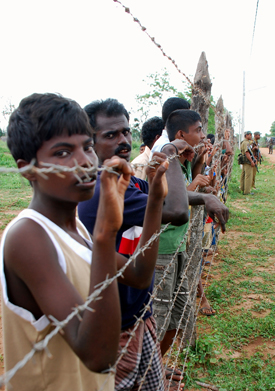
UK urges war crimes probe


David Cameron calls for an investigation into Sri Lanka allegations as the FCO says "convincing evidence of violations of human rights" were aired in the Channel 4 documentary Killing Fields.

Killing Fields video evidence 'builds case for war crimes'

A special one-hour film showing devastating new evidence of war crimes committed during the Sri Lankan civil war is to be broadcast in the UK. 
 
A special one-hour film showing devastating new evidence of war crimes committed during the Sri Lankan civil war is to be broadcast in the UK. The film documents the final bloody weeks of the Sri Lankan civil war and features damning new evidence of war crimes and crimes against humanity.
The film Sri Lanka Killing Fields includes footage of apparent extra-judicial massacres of prisoners by Sri Lankan government forces, the aftermath of targeted shelling of civilian hospitals and the bodies of female Tamil fighters who appear to have been sexually assaulted.

The film does not only focus on the Sri Lankan government troops - it also examines atrocities carried out by the Tamil Tigers, including the use of human shields, and footage depicting the aftermath of a suicide bombing in a government centre for the displaced.

Presented by Jon Snow, Sri Lanka's Killing Fields, was shown to the United Nations Human Rights Council at the end of May.

The UN screening was attended by a number of ambassadors from nations including the US and UK.
Jon Snow says the film is "one of the most important" stories he has ever reported saying:

"It tells the story of the bloody end to Sri Lanka's civil war - in which at least 40,000 Tamil civilians were killed. I have reported civil wars before, not least in Central America in the 1980s but I have never seen such graphic evidence, often at the hands of government soldiers themselves of what have all the hallmarks of war crimes.

"The film is important in that it represents one of the most shocking films ever screened on Channel 4. It has to be so, there are accusations of war crimes by both sides.
Missed the film?
"This film is also vastly important because, it represents the conclusion of two years' worth of courageous journalism by the Channel 4 News team in the face of great adversity including repeated challenges to our integrity by the Sri Lankan authorities.

"It forms a vital part of the evidence of alleged war crimes - crimes, allegations which the UN itself has called "credible". It shows Channel 4 putting a campaign for truth and justice at the very centre of its News and Current Affairs output. And above all, it shines bright unflinching light on a terrible crime - a crime which so far has gone unpunished."

Channel 4 News first broadcast the footage allegedly showing government troops executing Tamil prisoners in August 2009.

Last November, a second video of the same massacre emerged, revealing the naked dead bodies of at least seven women. The faces of some of the government troops could also be seen.

Following an investigation, Channel 4 News identified of one of the female victims in the video as a high profile member of the Tamil Tiger communications team. A potential date and location of the massacre was also determined.

A UN special envoy said the footage appeared to be evidence of "serious international crimes".
The Sri Lankan government has consistently rejected the footage as falsified.

As the UN says it will continue its investigations, pressure has increased on the Sri Lankan authorities to allow an international inquiry into allegations that thousands of civilians were killed at the end of the 26-year war.

Wednesday, 15 June 2011

PRU 13: Tiada jalan mudah buat Najib, BN

Membubarkan Parlimen seawal Julai 2011 juga dilihat tidak memberi banyak kelebihan dan alasan yang konkrit buat Perdana Menteri dan Barisan Nasional yang dikepalainya.

Pilihan Raya Umum ke 13 (PRU-13) dijangkakan tidak akan diadakan seawal bulan Julai ini walaupun muncul spekulasi yang bertiup kencang PRU-13 bakal diadakan Julai tahun ini.

Tindakan Umno menunda pemilihan dalam parti yang sepatutnya diadakan pada tahun ini sehingga 18 bulan juga telah memberi ruang untuk parti itu bersedia untuk menghadapi PRU-13 sekurang-kurangnya sehingga tahun 2013 sebelum pemilihan parti diadakan.

Membubarkan Parlimen seawal Julai 2011 juga dilihat tidak memberi banyak kelebihan dan alasan yang konkrit buat Perdana Menteri, Datuk Seri Najib Tun Razak dan Barisan Nasional (BN) yang dikepalainya.

Jesteru itu, tiada sebab Najib perlu membubarkan Parlimen tahun ini sedangkan mandat yang diperolehi BN ketika diketuai oleh bekas PM, Tun Abdullah Badawi pada Mac 2008 hanya akan luput pada 2013.

Alasan beberapa pemerhati dan ahli politik yang berpendapat ketika ini Najib mahukan mandat pertamanya sebagai PM sekaligus membuktikan kekuatannya sebagai peneraju utama BN juga tidak terpakai sekurang-kurangnya hingga ke hari ini.

Sokongan Melayu meningkat, Cina merosot

Berbanding Najib yang dikatakan dahagakan mandatnya sendiri untuk membuktikan pengaruhnya, beberapa perkara lain yang lebih penting tentunya menjadi perhitungan utama Najib ketika ini.

BN juga tidak boleh terlalu berbangga dengan keputusan beberapa siri pilihan raya kecil (PRK) sebelum ini yang menunjukkan peningkatan sokongan pengundi Melayu kepada BN.

Bagaimanapun keputusan siri PRK tersebut tidak memberi sebarang jaminan yang baik buat BN bagi mengekalkan kuasanya di Putrajaya bahkan kedudukan Najib sendiri sebagai PM sekalipun BN kembali berkuasa.

Keputusan siri-siri PRK yang sama turut memperlihatkan penyusutan sokongan pengundi bukan Melayu yang ketara khususnya golongan kedua terbesar iaitu pengundi di kalangan kaum Cina.

Keputusan yang sama turut berlaku ketika Pilihan Raya Negeri (PRN) Sarawak yang baru diadakan sebelum ini, malah jelas menunjukkan kemerosotan sokongan rakyat negeri itu terhadap BN.

Dalam keputusan PRN Sarawak lalu, undi popular bagi BN merosot walaupun sokongan yang diterima dari pengundi Melayu meningkat gara-gara kehilangan sokongan pengundi bukan Melayu di negeri itu.

Sekurang-kurangnya bagi negeri Sarawak, BN diramalkan akan kehilangan beberapa buah kerusi parlimen dari negeri ini sekiranya PRU-13 diadakan dalam masa terdekat ini.

Mengekalkan pengaruh di Sabah dan Sarawak tentunya dilihat sebagai sesuatu yang penting buat BN sehinggakan dua negeri tersebut dianggap sebagai negeri ‘simpanan tetap’ parti itu.

Disebabkan Sarawak merupakan antara negeri yang terbanyak menyumbangkan kemenangan BN di Parlimen, kedudukan Ketua Menteri Sarawak, Tan Sri Taib Mahmud yang mulai dianggap sebagai liabiliti kepada BN dipercayai turut menjadi perhitungan Najib bagi mendapatkan ilham tarikh PRU-13.

Pengunduran Taib di Sarawak sebelum menjelangnya PRU-13 boleh dianggap sebagai satu kelegaan buat jentera BN negeri itu dalam menghadapi serangan pihak lawan.

Jelas dari segi peratusan undi popular, peningkatan sokongan dari pengundi Melayu itu tidak memberikan impak yang besar terhadap BN kerana diimbangi oleh penyusutan sokongan di kalangan pengundi bukan Melayu.

Ancaman dalaman Umno sendiri terhadap Najib


Najib dan BN bukan sahaja bakal tersungkur sekiranya BN gagal mempertahankan majoriti mudah di parlimen, malah beliau turut bakal berhadapan dengan ancaman timbalannya, Tan Sri Muhyiddin Yassin.

Rata-rata para pemerhati berpendapat, sekalipun BN berjaya memenangi PRU-13 nanti, kedudukan Najib masih terancam sekiranya BN gagal memperolehi majoriti dua pertiga di parlimen.

Tindakan Muhyiddin yang akhirnya mendorong perletakan jawatan PM kelima Malaysia, Tun Abdullah tentunya sentiasa menjadi igauan Najib.

Selain itu, sekalipun BN berjaya memperolehi kemenangan dua pertiga di parlimen, kegagalan merampas negeri-negeri yang dikuasai oleh Pakatan Rakyat (PR) khususnya negeri Selangor ketika ini juga boleh merosakkan parti kemenangan Najib.

Sekiranya PRU-13 diadakan seawal Julai ini, kebanyakan pemerhati politik tanah air menjangkakan BN hampir pasti gagal untuk merampas Pulau Pinang dan Kelantan dari tangan PR.

Manakala di Selangor dan Kedah pula pastinya pertembungan sengit akan berlaku antara kedua-dua belah pihak BN dan PR.

Not a single decent road in oil-rich Sabah

The federal government had failed to build a modern road network in Sabah despite 47 years of nation-building, says a former minister.

KOTA KINABALU: Sabah is clearly not in the nation-building plans of the Barisan Nasional government in the last 47 years. For todate, “not a single decent trunk road or highway” has been built for the state.

A former Sabah minister, Kong Hong Ming, said the federal government had failed to build a modern road network in the state almost half a century since the formation of Malaysia.

He said Sabahans were still begging for infrastructural development despite regularly giving away 95% of the state’s oil and gas resources to the federal government.

Kong, now a PKR leader, has accused the Umno-led BN federal government of taxing Sabahans and treating Sabah as a backwater.

“With all our oil and gas resources, there is not a single decent trunk road or highway in Sabah after 47 years.

“Worse still, almost all the trunk roads linking the major towns in Sabah are in bad shape due to lack of maintenance despite billion of ringgit spent on the task.

“Meanwhile, we watch and admire the modern and expensive communication system and networks in Peninsular Malaysia built and enjoyed by the people there.

“Obviously, what we have in Malaysia is one country with two systems of administration, with Sabah given lower priority in every aspect of development,” Kong said, adding that the BN government had nothing to shout about in so far as development in Sabah was concerned.


Unserviceable roads 

Kong, who is PKR’s Tawau division chief, was commenting on numerous public complaints over the deteriorating condition of the controversial Sapulut-Kalabakan Road, constructed at a cost of RM565 million.

Kong, who happened to be the “whistle-blower” of the controversial project, also warned that the government might end up wasting another RM270 million of taxpayers’ money on the “upgrading” of the road.
“It is almost certain that RM565 million of public funds spent on Sapulut-Kalabakan Road has gone to waste.

“It is also likely that the government will be throwing away another RM270 million for nothing without a proper study of the current resent deplorable conditions of road.

“It appears that the supposedly new road is now already beyond repair and re-construction is necessary,” said Kong, a civil engineer.

He noted that the federal government had pledged in Parliament in April last year, an additional allocation of RM270 million for upgrading the road, which is meant to link Tawau to here.

However, to this day no upgrading has been done.

Kong said that in less than five years after Sapalut-Kalabakan Road had been completed, the gravel road has become unserviceable, unfit and unsafe for road users.

“More than 10 sections of the trunk road meant to serve Tawau and Kota Kinabalu are impassable.
“Major landslides and erosion problems, coupled with the lack of proper maintenance, have caused extensive damage to the road.

“It is a nightmare for the people who have to travel on this road and suffer such inconvenience,” he said.
According to Kong, he had received complaints that the road is “worse than the logging” paths maintained by timber companies.

“It is a scandal as well as a complete waste of public funds,” he said.

He questioned the silence of the Malaysian Anti-Corruption Commission (MACC) over the two reports lodged by him on the matter in 2008.

Recently, a group of 63 tourists from Limbang, Sarawak, highlighted their disturbing journey along the route in their bid to get to the east coast town of Semporna.

The group was forced to turn back after their vehicles risked becoming bogged down in the road that had turned into a quagmire.

Bersih rally: Hindraf opts out

The movement's leader says since Pakatan failed to endorse its 18-point demand, Hindraf will not participate in the rally.

PETALING JAYA: Hindraf Makkal Sakti will not be participating in the July 9 Bersih 2.0 rally, said its leader P Uthayakumar.

“We are not participating because Pakatan Rakyat failed to endorse our 18-point demand made in 2007,” he added in a press statement.

Uthayakumar was responding to a news report that linked the Hindraf rally to the first Bersih rally in 2007 that swung public sentiment against the government during the 2008 general election.

The former Internal Security Act detainee said back then, the movement supported Pakatan because it did not have a choice.

“Hindraf did not have a political choice but to give the unconditional political directions to support Pakatan. But after the 2008 general election, it became more plain and obvious that PKR, DAP and PAS like the Umno-BN regime only wanted Indian votes,” he said.

He added that the situation was different now because Hindraf has a political platform, namely the Human Rights Party (HRP).

However, Uthayakumar said Hindraf will back Opposition Leader Anwar Ibrahim and Pakatan on the condition that HRP is allowed to contest 15 parliamentary and 38 state seats in the next polls.

“We are committed to politically ending Umno’s rule of Putrajaya; we support Pakatan taking over Putrajaya and even Anwar becoming the next prime minister of Malaysia but on condition of HRP’s ‘Project 15/38′ as the internal check and balance mechanism so that the Indian poor are not segregated or excluded from national mainstream development of Malaysia,” he added.

He also indicated that there were proposals for another Hindraf rally to be held on Nov 25.

WIKILEAKS: Syed Mokhtar al Bukhary's foray into Iran


SKS is small operation controlled by Syed Mokhtar al Bukhary, one of Malaysia's wealthiest industrialists with a Forbes Magazine estimated net worth of $2 billion. Much of Syed Mokhtar's personal wealth has been acquired in dealings with the GOM and GOM-linked corporations. He controls Malaysia Mining Corporation, DRB Hicom, Malakoff, and Gas Malaysia among other significant Malaysian operations.
THE CORRIDORS OF POWER
Raja Petra Kamarudin

C O N F I D E N T I A L SECTION 01 OF 03 KUALA LUMPUR 000059

SIPDIS

STATE FOR EEB/ESC THAMMANG
STATE FOR EEB/TFS CBACKEMEYER
STATE FOR NEA/IR RWADHWANI

E.O. 12958: DECL: 01/26/2020
TAGS: ECON, EFIN, ENIV, ENRG, EPET, ETTC, IR, KNNP, MY
SUBJECT: MALAYSIA: SKS VENTURES EXPLAINS ITS IRAN INVESTMENTS

REF: A. 09 STATE 121808
     B. KUALA LUMPUR 0037

Classified By: Econ Counselor Matt Matthews for reasons 1.4 (b) and (d)

1.  (C) Summary: SKS Ventures (SKS) CEO Abang Iskandar Muas (Iskandar) met with Econoff January 19 to discuss SKS plans to develop the Golshan and Ferdowsi gas fields (G&F) in Iran.
Iskandar said that the GOM had initially negotiated the deal with the GOI and handed the project to SKS just prior to signing.  Iskandar told us that development of the G&F fields is going slowly because sanctions impeded National Iranian Oil Company (NIOC) ability to perform basic due diligence functions.  He also stated that NIOC has been extremely difficult to work with and that the initial buyback service contract signed in Dec. 2007 is the only commercial agreement between SKS and NIOC. 
SKS’s only investment over the past two years since the announcement was limited to staff time from their 15 employees and air tickets for meetings with a total value under $1 million, according to Iskandar.  He was pessimistic on prospects for the deal and said that SKS is considering pulling out altogether. 
However, he emphasized SKS would need GOM approval prior to exiting the transaction because Malaysian Trade Ministry and Foreign Ministry officials had encouraged SKS to enter into the deal in the first place and had reconfirmed GOM support for trade cooperation with Iran at a recent meeting. 
Iskandar also denied reports of SKS participation with NIOC in a refinery projects in Syria and Indonesia and downplayed its deal with NIOC which is under review in Malaysia.  End Summary.
2.  (C) Comment:  SKS is small operation controlled by Syed Mokhtar al Bukhary, one of Malaysia's wealthiest industrialists with a Forbes Magazine estimated net worth of $2 billion.  Much of Syed Mokhtar's personal wealth has been acquired in dealings with the GOM and GOM-linked corporations.  He controls Malaysia Mining Corporation, DRB Hicom, Malakoff, and Gas Malaysia among other significant Malaysian operations. 
Post believes Iskandar is a credible interlocutor that provided an important window on the GOM's role in the deal and SKS current thinking on the transaction. Iskandar seemed genuinely frustrated that the G&F deal turned out to be an empty business proposition due to NIOC incompetence and Iran sanctions.  Other oil and gas industry contacts have confirmed the small size and scope of the SKS operation.    End Comment.
SKS Ventures
3.  (C) Econoff met January 19 with SKS Ventures (SKS) CEO Abang Iskandar Muas (Iskandar) to discuss the SKS intentions to develop the Golshan and Ferdowsi gas fields (G&F) in Iran and implications under the Iran Sanctions Act (ISA).
Iskandar mentioned early in our conversation that Ministry of International Trade and Industry (MITI) Senior Director Wong had called him January 15 informing him that the embassy had been trying to contact him and he needed to meet with us. Econoff delivered ref A points and offered additional background on our information request. 
According to Iskandar, SKS has 15 full time employees and works on projects outside of Malaysia for Syed Mokhtar.  Iskandar is an experienced O&G industry professional, having worked for Shell Oil USA (based in Houston) for fifteen years in Sarawak, Saudi Arabia (where he was VP for Finance and Human Resources), and Kuala Lumpur prior to assuming his current position with SKS two and one half years ago. 
Iskandar fondly reminisced of his frequent travel to the U.S. for business and family vacations prior to assuming his position at SKS.
Golshan and Ferdowsi: G2G Agreement
4.  (C) Iskandar said the G&F deal grew out of government-to-government negotiations between Malaysia and Iran during 2007.  The GOM brought SKS to the table late in the negotiations, according to Iskandar, finalizing a buyback service contract between SKS and National Iranian Oil Company (NIOC) in December 2007. 
He added that SKS entered into the agreement based on the GOM’s policy of expanding trade cooperation with Iran and the belief that the business climate for oil and gas (O&G) in Iran was improving during 2005-6. 
Iskandar said that the initial business strategy was for SKS to plan the project, NIOC to perform physical due diligence (appraisals, seismic analysis, feasibility studies, etc.), and, once the project was ready to start, sell controlling interest, at a profit, to an international oil company that could bring resources to develop the fields.
Iskandar commented, "We have no wells, no drilling rigs, no facilities, no experts, and no technology" to implement a project the size of G&F.  His explanation as to why the Iranians would enter in to a transaction the size of G&F with such a small entity was, "in order to be friendly to the government (of Malaysia)."
NIOC Difficulties
5.  (C) Working with NIOC, according to Iskandar had been "extremely difficult."  He added, "we should have taken a lesson from Petronas" claiming that Petronas will not deal with NIOC any longer because NIOC still owed a substantial amount of money to Petronas from its buyback service contract for South Pars Phases 2 and 3. 
Iskandar said that NIOC has made no progress on its due diligence obligations at G&F due to international contractors refusing to work in Iran because of sanctions.  He complained that SKS and NIOC also have not reached any commercial agreements on the project in the last two years. 
Iskandar stated, "We have no idea how we would be paid.  NIOC has not agreed to LNG and we have no interest in selling gas domestically.  Iran uses most of their gas to inject into their oil fields to get more oil or to produce heavily subsidized electricity." 
He listed numerous other problems plaguing the project related to Iran sanctions such as the inability to import LNG technology or hire expat expertise, a low likelihood that Iranian LNG could be consistently sold on the open market, and NIOC's lack of access to financing.
SKS Ready to Walk Away
6.  (C) Iskandar described the SKS agreement with NIOC on G&F as "barely hanging on" and that SKS is currently deciding whether to stay in or pull out, and added, "The decision will come sooner rather than later."  He viewed the buyback service contract as having "no commercial value" at this time. 
He noted though that Syed Mokhtar's close connections to the Malaysian government mean SKS will not move on a G&F decision without policy direction from the GOM.  "We do not want to be on the wrong side of the government and we have not heard from PM Najib", according to Iskandar.  However, he added that SKS has "no money in the ground" in Iran, because the firm did not pay an initial "signing bonus" as the buyback service contract did not carry any vested rights to the gas. 
He also stated that SKS management is aware of the change in the international political environment with regard to Iran and is "not entrenched," implying SKS would quickly drop the transaction if permitted by the GOM.
Another View of the MITI Meeting
7.  (C) Iskandar offered a different account of the recent meeting between MITI and Ministry of Foreign Affairs (MFA) officials and officers from the three Malaysian companies listed in ref A.  Iskandar said that after the companies answered MITI queries on their Iran investments, the companies, especially Petronas, pushed back at MITI and MFA asking "What is the government's stance on trade cooperation with Iran?" and "Should we adjust our investment strategies?"
MITI responded that the GOM still supports trade cooperation with Iran, according to Iskandar.  (Comment: The MFA account of the meeting (ref B) was similar to Iskandar's but omitted the companies' questions and MITI's response.  End Comment.)
Other Announcements Inaccurate
8.  (C) Toward the close of the meeting, Iskandar addressed recent Iranian and Malaysian press announcements of SKS participation in other transactions with NIOC.  He stated that the GOM asked SKS to commission a feasibility study on a project with NIOC. It involved a refinery project in Kedah with a pipeline across the Malaysian Peninsula to Terengganu.
Iskandar commented that the pipeline is economically unwarranted and an Iranian partner likely makes the refinery unfeasible.  He added that recent announcements of SKS participation in a refinery project in Syria with Iranian and Venezuelan partners and SKS participation in an Indonesian refinery project with Pertamina and NIOC are blatantly false.
He said that the first SKS had heard of either project was in press reports.  He explained that SKS never issued denials of participation in the deals in order to avoid embarrassment in case the government was involved.
KEITH

Lawyer hacked to death

Tragic: Anbalagan slashed to death at a temple in Kapar on Monday.The Star
by STEVEN DANIEL

SHAH ALAM: A prominent lawyer and businessman was viciously slashed to death after he performed prayers at a temple in Kampung Perepat, Kapar.

Datuk R. Anbalagan, 56, suffered multiple slash wounds on the back, face, shoulder and left arm in the attack that took place on Monday night. He died on the spot.

Klang Utara OCPD Supt Shukor Sulong said a 26-year-old suspect, an Indian national believed to be an employee of the victim, fled in Anbalagan's four-wheel drive with a handphone and 800gm of gold jewellery. However, it is learnt that police have arrested the suspect and recovered the vehicle and valuables.

The family's Indonesian maid, who was present at the Sri Ramalingesverer temple at the time of the murder, said that she had accompanied Anbalagan to the temple in his oil palm plantation.

“After the prayers ended at 9.30pm, Datuk (Anbalagan) told me to wait in the car while he went to the house built for the workers. Fifteen minutes later, I heard him screaming.

“When I got out of the car, I saw him running out of the house and being chased by a man with a parang,” Siti Aminah Mohd Amran, 24, said.

She said Anbalagan collapsed in the temple and the man slashed him until he became motionless.

“I shouted for help and two workers came rushing out, but they were too terrified to approach the attacker.

“He was slashing Datuk repeatedly for almost three minutes,” she said.

She added that the man stared at her before taking the valuables and driving off in Anbalagan's Mitsubishi Storm.

Siti Aminah said she was puzzled over the motive of the attack, saying the man had worked for Anbalagan for slightly over a year.

It was learnt that Anbalagan had amassed his wealth via property investments as well oil palm plantations

The atmosphere at Anbalagan's home in Shah Alam was sombre as relatives and friends were left stunned by the senseless murder.

They described Anbalagan as a rags-to-riches millionaire, who had worked hard throughout his life.

“He went to the Himalayas twice to perform prayers. He was a religious man,” a relative said.

Anbalagan leaves behind wife Thelagam Arumugam, 48, and daughter Sri Ananthavalli, 11.

The daughter said she last saw her father on Sunday night just before going to bed and he told her to “take care”.

PM Hopes Minimum Wage Policy Can Be In Place By Year End

SUBANG JAYA, June 14 (Bernama) -- Prime Minister Datuk Seri Najib Tun Razak said today he hoped a minimum wage policy could be implemented by year end.

He said that he was informed by the Human Resource Ministry that the National Wage Consultation Council Bill 2011 would be presented to the Cabinet for a decision before it is tabled at the current Parliament sitting.

"If passed (by Parliament), we will set up the council. I hope by year end the minimum wage policy can be in place," he said when addressing Malaysian Trades Union Congress (MTUC) members at a dinner here Tuesday night.

Also present were MTUC president Mohd Khalid Atan, Deputy Human Resource Minister Datuk Maznah Mazlan and Umno Youth head Khairy Jamaluddin.

Najib said besides the policy, several other matters like cost of living allowance (Cola), retirement and foreign workers which were raised by Mohd Khalid in the latter's speech would also be referred to the council to be studied in detail.

"What was raised by the MTUC president has the government's support and needs to be pursued. If the council feels they are justified, they will be brought to the Human Resource Minister for consideration so that the appropriate decisions can be taken for the good of all," he said.

He said the government had taken several initiatives that showed its caring attitude with examples being the salary hikes for postmen and security guards.

Najib also praised the umbrella union for private sector employees for the role it played in helping Malaysia to be where it is today.

"To the 12 million workers in the country, I congratulate you for the success in transforming Malaysia from an agricultural state to a modern industrialised nation within a generation," he said, adding that their next challenge was to join the government in making the country a high income nation by 2020.

He said the days of confrontational positions between unions and employers like in the 60s and 70s were long gone and that today it was symbiotic relationships that produced the best results for everyone.

At the function, Najib also launched a complaints portal for workers that was developed in collaboration with Umno Youth.