Share |

Monday, 13 September 2010

Surprise! Simultaneous polls

By JK Jayan - Free Malaysia Today,
 
COMMENT As the country gears up for the Sarawak state election, speculation is rife that the 13th general election is around the corner as well. There is a possibility that both elections will be held simultaneously.

It will be a master strategy for the Barisan Nasional leadership to have both elections at the same time as it will prevent Peninsular-based Pakatan Rakyat leaders from campaigning in Sarawak.
Pakatan leaders, who are keen on capturing Sarawak to provide a boost to their pursuit of Putrajaya, will be restrained to their respective constituencies.
Given Sarawak’s landscape and the short campaign period usually allocated for general elections, no Pakatan leader from the peninsula will dare waste precious time in Sarawak.
The Sibu by-election has taught some bitter lessons to the BN leadership. It revealed what will happen if key Pakatan leaders are allowed to campaign in Sarawak.
Catch-22 for BN
In Sarawak, BN is now faced with the formidable task of deciding whether to allow current Chief Minister Taib Mahmud to lead the election battle or to find a replacement.
Sources familiar with Sarawak politics say that while Pakatan is heading into Sarawak with some confidence, BN is in a “Catch-22” situation, saddled with problems and issues associated with Taib.
If BN retains Taib as chief minister, then they will be facing a barrage of questions and criticisms from the opposition regarding the corruption allegations against him.
On the other hand, if BN drops Taib, they will be losing one of the most experienced and seasoned leaders in the history of Sarawak politics.
BN will also be faced with the arduous task of naming a capable leader to lead the BN charge in Sarawak. The coalition will be torn between naming a Melanau Malay or a Dayak as the next chief minister and Sarawak BN leader.
BN will be able to turn the tables against Pakatan by dropping Taib and replacing him with a Dayak leader.
With just that one master stroke, BN will be able to drastically change the current political situation in Sarawak by soothing the feelings of the Dayak community and knocking out a key political strategy mooted by the Pakatan leadership -- to name a Dayak leader as chief minister in the event they win the state election.
Three factors favouring Pakatan
Three key factors seem to be favouring Pakatan in Sarawak. The first is their promise that the state will have a Dayak chief minister in the event Pakatan forms the next state government.
This may drive the Dayak community, which forms almost half of Sarawak's population, to support the Pakatan candidates.
The second factor is the promise by Pakatan to increase the oil royalty to Sarawak by a hefty
20% through which more development projects can be initiated. Neutral voters in Sarawak may be swayed by this.
The third factor is the backing of the Chinese community through DAP. The Chinese form 26% of the population in the state and their support can be the deciding factor in many constituencies.
Put together, these three factors can tilt BN’s fortunes in Sarawak even though the coalition is mightier in terms of election machinery and financial strength.If the Sarawak state election is held separately and if BN loses, it will have a profound effect on the parliamentary elections.
With the state administration under their control, the Pakatan leadership will be able to concentrate on the parliamentary seats in Sarawak and if they can win at least half of the 31 parliamentary seats in Sarawak, then the prospect of BN forming the next federal government will be doomed.
1Malaysia backfiring
There are also other reasons why the BN leadership may decide against stretching their term of office until 2012 or 2013.
There is widespread speculation that the world will be hit by an economic downturn towards the end of the year or early next year. If this happens, it will also suffocate the Malaysian economy, which is already facing a decline in foreign direct investments (FDIs).
On the political front, BN’s chances of winning back the lost states and parliamentary seats in the peninsula look bleak. On the surface, it appears that Prime Minister Najib Tun Razak has managed to win some points with his 1Malaysia campaign.
However, the campaign is also backfiring on BN, with opposition to it coming from towering and influential personalities such as Dr Mahathir Mohamad. The Malay right-wing movement Perkasa is also punching holes in Najib's grand plan.
In 2012, most of the BN parties, including Umno, are expected to hold their party elections which will lead to infighting and backstabbing; and this will definitely reflect on the general election.
Although the party elections can be postponed after the general election, the undercurrent, especially, in Umno will be strong.
Dragging the general election until the last leg will only give more room to the opposition to prepare themselves. The infighting among the political parties in Sabah may worsen.
And if there are some negative outcomes from the ongoing French investigation into the submarine scandal, that too will affect the image of Najib’s administration.
On the same note, Opposition Leader Anwar Ibrahim continues to be a formidable force with his sodomy trial having little or no impact on his credibility and popularity.
The recent revelation about the affair between a member of the prosecution team and the complainant is also working in favour of Anwar.
With so many uncertainties looming, there is every possibility that the BN leadership may decide to hold the next general election simultaneously with the Sarawak state election to catch the opposition by surprise.

Malay rights drowning out Najib’s reforms

Dr Mahathir remains critical of any type of reform which risks the status quo.
ANALYSIS, Sept 13 — As the Najib administration struggles to sell its economic reforms to a sceptical public, the process continues to be made complicated by political curve balls thrown by Perkasa, Tun Dr Mahathir Mohamad and other Malay rights groups.

Using a tried and tested play book, these groups are using Malay special rights as a red herring to stop any discussion on reviewing New Economic Policy style policies or keeping Malaysia competitive.

Dr Mahathir added to this illusion when he said that Perkasa was born because non-Malays were questioning Malay rights.

Datuk Seri Najib also has his work cut out because he is not getting full support from Umno-owned media such as Utusan Malaysia.

Yesterday, an Utusan Malaysia editorial openly defied Najib’s instructions for Umno to begin distancing itself from Perkasa.

The editorial in Mingguan Malaysia, the Sunday edition of Utusan Malaysia, backed Perkasa and raised questions about whether the daily was still in support of the party president.

The Umno-daily came out batting for Perkasa and pointedly echoed the views of the Malay rights group in response to Umno’s decision to distance itself from them.

Perkasa has already warned Umno not to be complacent about its vote base, claiming that only three in 10 Umno members were sure to vote for them in the next general elections.

The noise surrounding Malay special rights and Perkasa’s role in fighting for the Malays is beginning to drown out Najib’s reforms.

On Saturday, Najib spoke on regional satellite station CNBC arguing that “if we don’t make change, we don’t make reforms, Malaysia will slide backwards.”

Asked about Dr Mahathir and Perkasa, Najib said: “They are talking more about Bumiputera rights. But actually we are not taking anything away from the Bumiputera, but we are saying that let us do it differently. Let us get better results. Let us achieve a more equitable society. But at the same time, being fair to the non-Bumiputeras as well. Because we want to build a One Malaysia.”

But the PM’s words received little coverage in national dailies.

Perkasa, Dr Mahathir, and other Malay rights groups has already succeeded in throwing in the red herring of dismantling special rights in every discussion on race relations and making Malaysia competitive.

Reason: they want to stigmatise the discussion, the same way some people have stigmatised words like meritocracy and liberal.

Perkasa and Dr Mahathir are now complicating Najib’s option of calling for an early election.

Najib is understood to be weighing whether to call for snap parliamentary polls over the next six months, so as to secure a fresh mandate that will allow him to push ahead with painful political and economic reforms.

But there remains strong opposition towards the snap elections option.

The Malaysian Insider had reported last week that Umno warlords and key aides have been telling Najib to delay any idea of snap polls to secure his personal mandate.

Opponents to an early election say the Najib should not assume his personal popularity meant that the party is more acceptable to the people.

The Perkasa and Dr Mahathir factors may also cause another rethink.

Ibrahim Ali and Perkasa - down but not out yet

Wong Choon Mei, Malaysia Chronicle

Once riding high, Perkasa chief Ibrahim Ali is now fumbling for support. Hence, the nonstop and rather nonsensical tirade against those Umno and BN leaders who have given him and his ultra-Malay rights group the boot.

So far, only former Umno president and Perkasa patron Mahathir Mohamad has spoken up for Perkasa. Mahathir has even warned Umno it might suffer further loss of popularity with the Malay voters if it cut its ties with Perkasa.

But Mahathir himself is a spent force, done in by his own racism and the slew of revelations that are starting to pour in about his corruption in the various mega and privatization deals hammered out during his 22 years in power.

Najib waits to see which way the wind blows

Ibrahim alarmed many with his drama
Nonetheless, not all is lost yet for Ibrahim Ali and Perkasa. There is still Prime Minister Najib Razak.

Despite the noisy break-up announced by Umno secretary-general Tengku Adnan and cheered by Cabinet ministers such as Nazri Aziz, Koh Tsu Koon, and MCA leaders, Najib himself has kept mum.

But very telling is that the Umno-owned Utusan newspaper has supported Perkasa, even though its top editors were hand-picked by Najib.

“Yes, it is the typical two-faced politics of Umno. Some say Najib is being cautious. I think that is too kind a word. It is not caution, it is outright unprincipled, two-timing misrepresentation. If the Malay response is resounding they want Perkasa, Najib will be first to turn around, no doubt helped by Utusan,” Bukit Gantang MP Nizar Jamaluddin told Malaysia Chronicle.

“In such a case, the ones who will look like the real fools will be Tsu Koon and Soi Lek and the other non-Malay BN leaders for getting all excited over what is nothing more than another big bluff. Fortunately for them, there hasn’t been much response. Few Malays care about Ibrahim Ali and his nonsense but it is not just Perkasa that has faded but also Umno.”

The Muhyiddin misstep

Keeping a conspicuously low-profile is Deputy Prime Minister Muhyiddin Yassin, who has avoided a direct comment on Perkasa, saying that the “bigger picture” was more important.

Muhyiddin - burnt his bridges
“While we need to work for our community, we also need to respect the interest of other communities so that resentment and the feeling of lack of respect will not arise,” Bernama reported Muhyiddin as saying.

Since becoming the deputy premier, Muhyiddin has aligned himself to Mahathir rather than Najib. He has publicly criticized the PM's multi-racial 1Malaysia plan, earning himself a reputation for being a racist with his infamous “I’m Malay first”comments.

“Muhyiddin is also groping in the dark but it may be too late for him. He was silly to align himself so directly with Mahathir. You see, Mahathir can get away with all the racist comments because he is retired but Muhyiddin is not,” Gopeng MP Lee Boon Chye told Malaysia Chronicle.

“How can you be DPM of the entire country when you only consider the interests of the Malays to the point that you openly admit you put their interests first and foremost? How can the other races trust him for fair play and justice - he won’t bother. That is the message he has given.”

Ibrahim goes on publicity drive to garner sympathy

Meanwhile, in a sign that the “sympathy” response from the Malays has not been as much as what he had hoped to elicit, Ibrahim Ali has himself changed tack.

Nizar - Umno wayang kulit
He now wants a new political pact and has invited non-Malays to team up with Perkasa. At the same, he insists Perkasa will not enter politics.

“I have made the decision, I will co-operate with candidates who understand our stand including non-Malay candidates. I don’t care about race - only those who understand the Federal Constitution, who is of good character, has integrity, fluent in Bahasa Malaysia and ready to face the 13th general election,” Malaysian Insider reported Ibrahim as saying.

Pakatan Rakyat leaders ridiculed his inconsistency.

"He is talking nonsense. Perkasa has from day one been a political weapon for Umno, so how can it not be interested in politics? When Umno needs its services later on, Perkasa will suddenly be rehabilitated. Until then - to stay alive - Ibrahim Ali needs publicity. It will be one silly stunt after another," predicted Nizar.

Azmin speaks

By Ibrahim Ali,

I just got off the phone with YB Azmin Ali.

I drew his attention to my post “Khalid, aye or nay?”, and the e-mail dated 5th April that he is said to have sent to MB Khalid.

Would he want to respond to this allegation, I asked.

In the strongest possible terms, Azmin denied having authored this letter.

I asked about the blog reports linked in my post that suggested that he had supplied the doctored photographs of Zaid that were used by UMNO during the Hulu Selangor by-election.

Again, and in equally strong terms, Azmin denied this charge.

We chatted for a while.

I told him that I would continue to blog on the information that I am constantly receiving about the goings-on in PKR, and in particular about allegations that he and Anwar are on a Muslim agenda, because the public have a right to know, but will avail to him the right of reply.
Posted by Haris Ibrahim

Soi Lek on managing Malaysia

By Deborah Loh | The Nut Graph,
(Pic courtesy of MCA)
IN the first part of his interview with The Nut Graph, MCA president Datuk Seri Dr Chua Soi Lek spoke about the need for the MCA to be more assertive in voicing the concerns of Chinese Malaysians. But the things the MCA supports – a secular state, a liberalised economy – puts it at odds with segments of Umno, the leader of the Barisan Nasional (BN) coalition, and with right-wing Malay Malaysian groups like Perkasa.
Chua talks about how he views this challenge in this second and final part of an interview with The Nut Graph conducted at Wisma MCA in Kuala Lumpur on 6 Sept 2010.
TNG: Following up from your speech at the MCA’s Chinese Economic Congress – if your suggestions and resolutions can make Malaysia competitive, what, then, is needed to make these things happen?
Chua Soi Lek: First, the political will to change. All political parties in the world are the same. After too long in power, complacency sets in, and there is often abuse of the system and corruption. So [political will is needed to change], and I believe that development in a multiracial country is not a zero-sum game. When there is economic growth, everybody will benefit.
But in any society there will be some who benefit more than others. So affirmative action is still required. It should be based on needs and merits. If these can be placed in order, then we can liberalise the various sectors. And I specifically mentioned oil and gas, and telecommunications. These are three big sectors that need to be liberalised to make the economy more competitive, and to attract foreign participation and local participation.
Did you have feedback that Chinese Malaysians involved in these three sectors are being disadvantaged?
No, I don’t have the figures. I’m not just talking about the Chinese, I’m talking about all communities in Malaysia. Oil and gas are monopolised by Petronas. Telecommunications is monopolised by a few big players, foreign and local. So we need to open up.
Is there strong enough Malay leadership to push this through?
To be fair, I think [Datuk Seri] Najib [Razak] has that quality. He is a good listener, he’s bright, he’s got a good memory, he’s committed and he’s fair. Now the question is political will to change.
His political will or that of Umno’s?
His and that of his colleagues within the party to respond to a changed political scenario after March 2008.
And if such political will is slow in coming, what should parties like yours and other BN components do?
That’s why we’ve become more vocal. We just want to make our views known.
Is Umno‘s leadership doing enough to distance the party from Perkasa?
Mahathir
Mahathir
I think they are not doing enough. I’m very clear in my mind that [Perkasa] is not linked to Umno. But nobody can prevent [Tun Dr] Mahathir [Mohamad] from attending Perkasa functions. You know Mahathir – he chooses what he wants to do. But if he wants to be associated with Perkasa, there’s nothing you and I, or Najib, can do.
If Umno is unable to successfully distance itself from Perkasa, what are the consequences for national politics?
The Chinese [Malaysians] have to be very clear that there is no way we can create a small China in Malaysia. We all have to accept the fact that we live in this multiracial society, whether you like it or not.
And in order to make this work, no government in power would take away the privileges enjoyed by Malay [Malaysians] right now. No one. [Datuk Seri] Anwar [Ibrahim] has never really stood up to say he would reject Malay special privileges. Mana ada? And I don’t think DAP would dare to demand it either.
But the Chinese [Malaysians] are all hoping. The Chinese community’s expectation is that if Pakatan Rakyat comes to power, it will remove special privileges. I don’t think this will [happen]. But because [DAP] never said [that it will actually remove special privileges], the Chinese expect it. This is a case of “nothing said is better than said” by DAP. So what I’m telling the Chinese community is, we have to accept the political reality in this country that it will [always] be a balancing game. Balancing the needs of all the races.
Perkasa president Datuk Ibrahim Ali
And part of this balancing game is for Umno to lend its ear to Perkasa?
The balancing game is for Umno to take care of the Malays, to take care of the Chinese, Indians and other minorities. To me, Perkasa is the minority of the minority, you quote me on this please. Only the Chinese get very excited over Perkasa, and because [Perkasa] knows they excite the Chinese and the media, they’re getting a lot of attention. They will continue to speak so that they will have a platform of their own. And we are all walking into that trap. The best way to deal with them is to ignore them.
Doesn’t Umno employ the same tactic in rousing Malay Malaysian support? Because you’ve noted in your speech at the Kedah MCA convention on 6 Aug 2010 that Umno has become conservative in recent years to compete with PAS.
I won’t say that Umno is becoming like Perkasa, that’s not fair.
But you said they have become more conservative…
Conservative in the sense that they become more religiously sensitive so that PAS cannot be seen as [having] the exclusive monopoly on Islam.
If Umno’s religious conservatism continues, what’s the consequences of that for component parties and national politics?
We must learn to co-exist. Umno’s religious conservatism will never, never be on par with PAS.
You say the public shouldn’t give the Pakatan Rakyat a chance to form the federal government as they would continue bickering over hudud law. But what about the fact that the BN in Terengganu has not done anything to remove hudud law that the PAS state government approved in 2002? Shouldn’t this be something that the MCA should push for, for the sake of consistency?
No. I won’t be pushing … You cannot implement hudud law at state level until you amend the Federal Constitution. So why are you pushing something which is a no-go? I’m very focused. I won’t want to waste time on something that’s a no-go. And MCA would definitely object to any implementation of the hudud law, simple as that.
Are you personally for a secular state?
This is definitely a secular state as provided for in the constitution.
That would be a contrarian view to some conservatives in Umno who want an Islamic state as well. Since the MCA is Umno’s colleague in the BN, how can you then convince Chinese Malaysian voters to support MCA-BN?
The Chinese do not understand the difference between an Islamic state propounded by PAS with hudud law, and what [we have now as] a secular state. We insist that [this] is a secular state. [There's no need to] talk every day about Mahathir‘s pronouncement. We should not be carrying the baggage of what our previous leaders have said.
Chua among MCA delegates in 2008
The simplest message [for the Chinese Malaysian] is, [look at] what you have now. Can you survive in an environment where every level is being Islamised with Islamic values? [Where there will be] stress on Islamic education, Islamic values, Islamic law, a hudud system? Can the Chinese adapt themselves to an environment like that, compared to what we have right now?
Some would say that Islamisation is already happening right now. For example, some parents complain that it is happening in schools.
No, that’s not true. Islam is the official religion. [It's] whether the Chinese can accept what they have now, compared to what they will have if PAS comes to power. [If Pakatan Rakyat] comes to power, DAP, because of the system of cabinet and the numbers game, will not be able to check PAS. DAP will be powerless. Because in this country, it’s the prime minister who calls the shots.
With Malaysia Day coming, and to close this interview, what’s the way forward for Malaysia?
The way forward is that we must know how to co-exist in a multiracial country. Without harmony, whatever great programme there is will come to nothing. Any party that wants to come to power in this country must know how to manage the complexity of managing a diverse population, and that’s not an easy thing.

Competitiveness Not Unity Basis for Strength

By M. Bakri Musa

Hardly a day goes by without Malay leaders of all persuasions lamenting our lack of unity. If only we are united, they earnestly assure us, we could take on the world!

I respectfully disagree; their conviction is misplaced. The force that would make Malays strong is not unity rather competitiveness. If we are competitive, then our place in Tanah Melayu (Malay Land) or even Dunia Allah (God’s World) would be assured. If we are not, then we would forever have to be indulged with such silly fantasies as Ketuanan Melayu (Malay Hegemony). We would perpetually have to pin our hopes on such political amulets as Article 153 of our constitution (guaranteeing our special status).

Our leaders’ quixotic quest for “unity” is not only misplaced but also distracting. It distracts from the pressing challenge of making us competitive.

These leaders’ obsession with unity is misguided for another reason. They take unity to mean unanimity. To them we are not united unless we parrot their views. Any disagreement is an expression of “disunity.” They prefer us to be like a flock of sheep.

They would like us to believe that their leadership is of the shepherd leading the flock from one lush meadow to the next, ensuring that no one is left behind or be preyed upon. J.S. Bach’s cantata Sheep May Safely Graze (BWV 208) is a beautiful rendition of this benign biblical imagery of the pastoral ideal.

Unfortunately, the harsh reality is that far too many of our leaders today are sly foxes cloaked in shepherd’s clothing. Instead of tending to us, they would be the first to prey upon us. Instead of protecting us from the elements, these “shepherds” would ensure that they have their istana kayangan (fantasy palaces) first, and if there were the odd lumber pieces left over, only then could the flock hope to have a wall to their shed.

We have nine sultans, all fabulously wealthy luxuriating in their Shangri la palaces at taxpayers’ expense; likewise our political leaders, as obscenely exemplified by former Selangor Chief Minister Khir Toyo and Prime Minister Abdullah Badawi. I challenge anyone to name a charitable foundation funded by any of them.

These are the leaders who are forever exhorting us towards “unity.” It is a unity to serve their purpose, not ours.

Strong Pillars of Society

This quest for unity is foolish for yet a third reason. A collection of weak twigs no matter how tightly bound (“united”) will never make a strong pillar. Likewise, a community will never be strong no matter how united its members are if individually they are weak.

A strong pillar requires top quality cement and steel re-bars. If the cement is corrupted with too much dirt, the pillar will not be strong or enduring; likewise if the re-bars have been weakened by corrosion.

The sturdy pillars of a community require citizens (cement) of high quality (productive) and leaders (re-bars) of uncompromising integrity (uncorrupted). Endlessly exhorting for “unity” would be a poor substitute for either.

History is replete with examples of societies once destined to perpetual servitude today commanding great respect. We can learn from them; there is no need to reinvent the wheel.

The Koreans, long colonized and brutalized by the Japanese, are today besting their former masters. Yes, the Koreans do occasionally pay homage to their patriotic passion for unity with their brethren to the north. Likewise the Irish; occasionally they too would stir up their republican nationalism with calls for unity with their compatriots in Northern Ireland. However, after the rousing speeches, patriotic singing, and exuberant flag waving they would be back hard at work on matters that really count – being economically productive.

The elements contributing to the strength of a society are its social, human, and financial capitals, in that order. Focus on these three and forego the illusory quest for unity. Besides, unity is more likely to be achieved once we are prosperous; then we would more likely be generous not only materially but also in our views and attitudes.

We can borrow financial capital, and to some extent human capital, through liberal immigration policies a la America, but not social capital; hence the order of importance.

Developing financial capital means we must save more and forego current consumption. Additionally, we must have efficient intermediaries to connect owners of capital (savers) to its potential users (entrepreneurs and businesses). Even in a well regulated economy, these intermediaries can sometimes stray and be negligent in their fiduciary obligations. The consequent wreck they impose on the economy and on our lives can be considerable, as Americans are currently experiencing, and as we did in 1997.

As a community, Malays mistrust banks and other interest-charging institutions. The successes of Islamic banks and mutual fund-like entities as Tabung Haji indicate that this can be surmounted and that we are aware of the merits of savings.

Our cultural tendency for conspicuous consumption abetted by the gaudy examples set by our leaders (huge weddings stretching for days) results in us having the lowest savings rates, and thus a thin financial capital base. Not a strong springboard to catapult our development. Yes, we can borrow but if we are not productive then we would not be able to service the loan.

Human capital refers to the skills, knowledge and other attributes of the citizens that would enable them to produce something or a service that is of value to society. We enhance human capital through health and education.

Improving health begins with such basic essentials as providing potable water, reliable electricity, garbage pick-up, and unclogged drains as well as elementary and inexpensive public health measures like vaccinations. Then consider the vast number of Malay kampongs that lack these basic amenities.

We improve the skills of our people through quality education. Quality is measured not by years of formal schooling or resources allocated rather by how effective our schools and teachers are. The OECD’s Program for International Students Assessments has shown that economic productivity is causally linked to quality education.

Put differently, Malaysia’s aspiration of quadrupling the per capita income within a decade would forever remain a dream unless we improve our schools and universities. Poland has demonstrated that a commitment to reforming education could produce results as early as a few years, and with that, commensurate improvement in economic performance.

Malay educational achievement lags behind the other communities. Closing this should be our top priority, not meaningless pursuit of empty unity. Subsidize education and healthcare if need be. In truth they are not subsidies but prudent and profitable investments in human capital. It is also the right thing to do.

Social capital refers to the relationships we have with each other; the shared norms, values and understanding which facilitate us working together. Any relationship, economic or otherwise, must begin with trust, a crucial component of social capital. Banks would be chronically crippled by “bank runs” if depositors lacked trust in them. The current crisis in the West is in part a manifestation of “bank runs” on “shadow banking” institutions by major (corporate) depositors. Likewise, even the most meticulous contract crafted by finicky lawyers cannot substitute for trust. Only peace treaties imposed by the victor upon the vanquished do not involve element of trust.

Perversely our preoccupation with unity with its attendant intolerance of divergent views erodes our social capital and poisons our relationships, in economics and other areas. It makes an UMNO government deny contracts to competent Malays simply because they sympathize with the opposition. We already see this poison spread to other spheres, as with some mosques reserved only for UMNO Malays.

By focusing less on our misguided quest for “unity” and more on learning to tolerate the differences amongst us, we enhance our social capital. I would go beyond simply tolerating to embracing and welcoming these differences. Only through robust debates and subjecting our views to the rigorous scrutiny of the marketplace of ideas could we ensure that we would not be pursuing a false path.

So if unity is equated with unanimity, then the less “united” Malays are the better. What we desperately need is a diversity of fresh views and perspectives to replace our current fossilized mindsets. Interestingly, once Malays can tolerate if not embrace the differences amongst us, then we are more likely to tolerate and embrace differences with our fellow Malaysians. That can only be good for plural Malaysia.

Tuanku Muhammad Faris, A Sultan With People's Well-Being At Heart

KOTA BAHARU, Sept 13 (Bernama) -- Newly-proclaimed Sultan of Kelantan Tuanku Muhammad Faris Petra Ibni Sultan Ismail Petra is described by many as a ruler with the people's well-being at heart.

He has been going around the state, visiting villages and Orang Asli settlements, to be with the people and listen to their problems.

Wearing his trademark robe and "gumbang" Malay attire and "kopiah" (cap), he is unassuming and always at ease as he mingles with the people.

At one time in Pantai Damat, Bachok, Tuanku Muhammad Faris Petra visited an ailing single mother, who relied only on assistance from the Welfare Department.

Sitting cross-legged at the home of Azizah Abdullah, 41, and her three children, Tuanku Muhammad Faris Petra asked her how she was doing, and was deeply touched by the sufferings of the family.

He offered words of encouragement, telling her children that he hoped they would be successful in their education, and handed over his personal contribution.

Tuanku Muhammad Faris Petra, 41, was today proclaimed as the Sultan of Kelantan, succeeding his father Tuanku Ismail Petra Almarhum Sultan Yahya Petra.

The eldest prince of Tuanku Ismail Petra has three siblings, namely Tengku Bendahara Tengku Muhammad Faiz Petra, Tengku Temenggong Tengku Muhammad Fakhry Petra and Tengku Amalin A'Ishah Putri.

He received his early education in Kota Baharu and Kuala Lumpur and later at the Oakham School, in Rutland, England until 1989 before pursuing his education in diplomatic studies at St Cross College, Oxford, United Kingdom and Oxford Centre for Islamic Studies until 1991.

He was born on Oct 6, 1969 and was made the Crown Prince in October 1985 and the Regent of Kelantan last year.

An avid reader and fan of four-wheel-drive vehicle expedition, horse sports, bowling and archery, he also follows closely the development in and outside the country.

He has been going to the ground, meeting the people, often quietly, away from the glare of the media.

Tuanku Muhammad Faris Petra also involves in many charity organisations and has been appointed the Commander of the 506 Territorial Army Regiment with a rank of Brigadier General (Honorary).

Death in custody – Samiyati Indrayani Zulkarnain Putra (Wangsa Maju police station, 12 Sept 2006)

Four years ago yesterday, 45-year old Samiyati Indrayani Zulkarnain Putra died in police custody at the Wangsa Maju police station.

The mother of five was found dead in her cell three days after her arrest on 10 Sept 2006, and the police classified this as sudden death.

According to the post-mortem report, Samiyati Indrayani Zulkarnain Putra’s death was due to intra-cerebral hemorrhage with intra-ventricular extension and perforated gastric ulcer. However, when her brother, Monashofian Putra, saw her body in the Kuala Lumpur Hospital, he reported that Samiyati Indrayani Zulkarnain Putra had bruises on her face, body, legs and neck.

Monashofian Putra lodged a police report and urged the police to investigate, among others, the bruises, the reasons why the police had not sent Samiyati Indrayani Zulkarnain Putra to the hospital immediately when they informed him, via a text message, that she was in a serious condition, and why the doctor only arrived two-and-a-half hour after her death.

Despite the requirement that all custodial deaths be investigated by inquiries conducted pursuant to Chapter XXXII of the Criminal Procedure Code, it does not appear that an inquest has been conducted into Samiyati Indrayani Zulkarnain Putra’s death.

Every death in custody must be thoroughly and impartially investigated.  Samiyati Indrayani Zulkarnain Putra’s death must not be relegated to a mere statistic.

Based on the Royal Malaysia Police’s statistics, 85 persons died in police custody between 2003 and 2007 alone.

We express our heartfelt condolences to Samiyati Indrayani Zulkarnain Putra’s family and friends on the anniversary of her death.

MPPP aims to improve Western Rd cemetery

By Anil Netto,

They may worship in different churches belonging to different denominations, but in death they share the same cemetery in Western Road in Penang. Now, an ad inserted in the local press requiring those with burial rights and relatives of the deceased to register with the MPPP has raised consternation among segments of the local Christian community.

It was the bit about the one-month deadline to register “failing which MPPP would take necessary actions to repossess the burial plots for use that created something of a stir. See theSun report here and a letter from a concerned reader here who asked, “I am of the opinion that MPPP only has the right to ask descendants, family members and their appointed personal representatives to re-affirm ownership of burial plots. But that is the most that they can legally do. MPPP does not have any legal right to seize old burial plots even if nobody comes forward to re-register claim.”
I got in touch with a couple of MPPP councillors to find out what was going on. Here’s what I learned:
The Western Road cemetery land belongs to the MPPP. The Catholic and Protestant Churches each contribute just RM2,000 per year to the Council for the management of the cemetery. The Council has been holding meetings with representatives from both these groups – each represented by three members.
The cemetery has been poorly managed, even neglected. Quite a few ‘funny’ things are going on. It’s almost like a free for all, with no proper system of managing who is buried there. Mosquitoes are breeding too.
Now, the Council wants to improve the management of the place, and one of the priorities is to look into the records of the burials. Apparently, there were bulk purchases of burial plots for which no names were recorded for the individual plots in the register. It is these that the Council is focusing on.
The ad, probably drafted by a bureaucrat, refers to just a preliminary registration exercise. This exercise will be ongoing, and the MPPP is even thinking of extending the registration to occasions like All Souls Day, when relatives come to pay their respects to deceased family members. The MPPP also wants the churches to play a more pro-active role in the management and improvement of the place. The churches have agreed to create awareness among their Christian communities on what can be done to improve the management of the cemetery.
Among the improvements the Council is considering: an updated register, better control over burial plots,  a new columbarium, better security, the installation of lighting at night, sealing up of flower jars, etc that could be potential mosquito breeding sites.

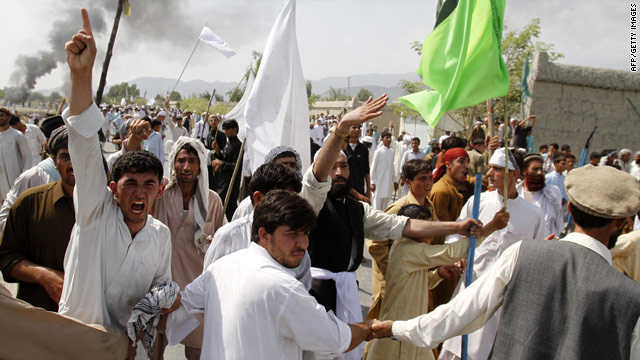
2 killed in Afghan protest over Quran-burning plan

Afghan protesters in Jalalabad shout slogans in a Friday demonstration against a pastor's plan to burn the Quran.


Kabul, Afghanistan (CNN) -- At least two people were killed and four were injured in Afghanistan Sunday in protests against the pastor who had planned to burn the Quran in Florida, a local official said.


On Saturday the pastor of the Florida church said the planned burning of the Quran had been canceled.

"We will definitely not burn the Quran," the Rev. Terry Jones told NBC's "Today." "Not today, not ever."

Demonstrations against the plan began in Afghanistan before Jones made his announcement.

About 600 people were at the protest which turned deadly Sunday, a spokesman for the governor of Logar province said.

Afghan security forces opened fire to prevent demonstrators from entering the offices of the governor of Baraki Barak district, Din Mohammad Darwish said.

He originally said one person was killed and five were wounded, but one of the injured later died, he said.

The protest lasted about three hours, he said.

And Iranian students plan to protest against the canceled Quran-burning on Monday, Iran's semi-official Fars news agency reported.

The group organizing the protest is the Union of Islamic Associations of Independent Students, the official Islamic Republic News Agency reported.

Demonstrators will gather outside the Swiss Embassy in Iran's capital, Tehran, on Monday afternoon. Switzerland represents American interests in the Islamic republic because Washington and Tehran have no diplomatic relations.

The planned Quran burning -- initially scheduled for the ninth anniversary of the September 11, 2001 terrorist attacks on the United States -- had sparked international condemnation.

The burning had been planned at the Dove World Outreach Center in Gainesville, Florida, for Saturday.

Jones arrived in New York late Friday night and was working to set up a meeting with the imam in charge of the New York Islamic center planned near ground zero.

The planned meeting, Jones had said, helped persuade him to halt the planned burning.

Jones' plan triggered expressions of concern from U.S. military leaders, who said the event would imperil the lives of troops abroad.

President Barack Obama said Friday that the idea that "we would burn the sacred texts of someone else's religion is contrary to what this country stands for."

He said he hoped Jones "prays on it" and refrains from doing it.

The government has to send a "very clear message" that burning the Quran would endanger U.S. troops and serve as a major recruiting tool for al Qaeda, Obama added.

'Bonsification' of the Malay mind

Dr M: Suicidal for Umno to part from Perkasa

(Malaysiakini) It would be suicidal for Umno to cut ties with Malay rights movement Perkasa as the party needs all the support it can get, said former premier Dr Mahathir Mohamad.

Speaking to reporters after hosting the Hari Raya Aidilfitri open house programme at his home in Seri Kembangan today, he asserted that Umno cannot afford to disown the right-wing NGO as it needed every possible vote to win the next general election.

mahathir mohamad hari raya open house 2"I think they (Umno) is ambivalent about this. While some say it should distance (themselves) from Perkasa others say (Umno is) so divided that to do so, would divide it even more.

"The last election, the margins were so small that to lose any more support may mean losing the election," warned Mahathir (left).

Mahathir, who is rather apprehensive over recent statements by several Umno leaders who have unequivocally expressed that the party's continuous association with Perkasa would erode its support base, said he didn't think that they were the official view of the government.
According to him, only a few Umno leaders have expressed their views on the matter, and this did not include party president Najib Razak.
'Najib has yet to state his views'
In a move seen to please BN's multiracial component party members, Umno secretary-general Tengku Adnan Tengku Mansor had recently assured that the party will neither back the controversial movement nor its president Ibrahim Ali.

It is understood that a majority of Umno members are also involved in Perkasa, but in spite of its common struggle to ensure that the constitutional rights of the Malays are met, several cabinet ministers had also supported Tengku Adnan's opinion that prolonging the association with the NGO was not a positive move.

NONE"I feel that Umno is not very strong so we cannot push people away from us. We can't afford to lose even a few. There is no need to be enemies with anyone," cautioned Mahathir.

He also opined that as prime minister and Umno president Najib (left) has yet state his view on Perkasa, he is probably not "totally against" the group.

"He (Najib) has met them. Ibrahim Ali claims 60 percent of the members are from Umno. It is possible because in the last election, Umno members actually voted for PAS.
"When your margin is very small the loss of a few voters may cause you to lose the election," he emphasised.

Ibrahim said yesterday that it did not rattle them if Umno leaders wanted to dissociate their party from the Perkasa.

He pointed out that BN had far more serious issues to deal with than Perkasa, to win back the people's confidence in the ruling coalition.
Voicing Malay community feelings
Mahathir, who is also Perkasa's patron, defended the right-wing movement, saying that they are voicing out the feelings of the Malay community who find that Umno is no longer protecting them.

"During my time, there was no such NGO. Maybe there is now a feeling that Umno is not protecting them so others are taking their place.

mahathir mohamad hari raya open house"Their struggle is based on the constitution and they are a NGO, not a political party and they are not tied to anyone.

"Whether its PAS, DAP or Umno, or even me, they will criticise (if there is something wrong)," said the ex-premier, who ran the country for 22 years.

Perkasa has its role, stressed Mahathir, as today people are questioning the social contract established before independence in 1957.

"They are making statements that we should forget about the social contract... which was made without their participation.

"They want to discard the old understanding... as something entered into by people without involving them and therefore, they are not bound. Then of course, there will be reactions."

‘Datuk’, seven others arrested in Sosilawati murder probe

Datuk Sosilawati Lawiya's friends as well as reporters waiting at the crime scene. — Picture by Jack Ooi
 

BANTING, Sept 12 — A “Datuk”, his brother and six plantation workers have been arrested in connection with the murder of cosmetics millionaire Datuk Sosilawati Lawiya and three others who went missing with her on August 30.

CID Director Datuk Seri Mohd Bakri Zinin today said police were still trying to obtain forensic confirmation to identify the dead, revealing that the four were set ablaze and their ashes scattered at a river near Ladang Gadong in Tanjung Sepat near here.

The suspects, aged between 19 and 41, were now detained at the Bukit Jalil police station in Kuala Lumpur, Bakri revealed. It was learnt that police have obtained seven-day remand orders to facilitate investigations into the case.

He said this at a press conference held at the Banting police district headquarters here, hours after newly-installed Inspector-General of Police Tan Sri Ismail Omar said “more than four people” have been arrested in connecting with the case.

Sosilawati, 47, her driver Kamaruddin Shamsudin, 44, CIMB Kampung Baru officer Noorhisham Mohammad, 38, and lawyer Ahmad Kamil Abdul Karim, 32, were reported missing since August 30 after going to Banting, Selangor, for a land purchase matter.

Police are also investigating several other kidnap-murder cases based on the statements given by the suspects arrested so far.

Bakri told reporters that the first four suspects who were nabbed on Friday had revealed that they were involved in similar cases within the past year.

“We’re now investigating, based on the first four suspects’ statements that there might be other cases,” he said, but was quick to add that the lead was purely based on their testimonies and not any solid evidence.

“They (the suspects) admitted to using the same modus operandi and we are now investigating the disappearance of four persons [missing] since a year ago,” he said.

The police believe Sosilawati and her companions may have been killed and their bodies burned following the discovery of charred remains at a poultry farm in Tanjung Layang, Morib yesterday night.

The police learned that their ashes may have been scattered along a river near the farm.

“We believe that they were murdered and torched and then the ashes were thrown into a river,” he said.

“There is a very slim chance that they were burnt alive but I cannot confirm without evidence,” Bakri added.

Bakri refused to confirm speculation that charred remains found in a Morib poultry farm last night belonged to the missing people, stressing that the forensic team is still collecting evidence on the crime scene.

The motives for the killings were still being considered, with the police saying that they may have been caused by a possible business rivalry or a deal gone awry.

Sosilawati, 47, her driver Kamaruddin Shamsudin, 44, CIMB Kampung Baru officer Noorhisham Mohammad, 38, and lawyer Ahmad Kamil Abdul Karim, 32, were reported missing since August 30 after going to Banting, Selangor, for a land purchase matter.

Sosilawati had told one of her daughters that she was going on a business trip to Banting for three days and was said to be carrying a large amount of cash.

It is learnt that Sosilawati’s relatives have arrived in Banting to provide DNA samples to the forensic team which is based in a Banting restaurant four kilometres from the farm.

Last Monday, police found her BMW at Angsana Apartment in USJ 1, Subang Jaya and the BMW of Ahmad Kamil in front of a hotel in Subang Jaya but the missing millionaire has not been seen since she was spotted buying Raya cookies at a shop in Kampung Sungai Lan, Banting on September 2.

Earlier, police cordoned off a site at the poultry farm that was said to belong to one of the suspects, where excavation work was expected to be carried out today.

It is believed that police recovered several items belonging to the four missing people at the same farm.

Bakri said several suspects including a lawyer with a “Datuk” title and two brothers, who are owners of the farm have been held in connection with Sosilawati’s disappearance.

He said it was information from the public and the press that had led to the swift arrests.

“One of the information we received was that one of them was wearing a watch similar to one of the missing persons,” he said.

According to Bakri, the family members of all four victims were informed of the police findings today

Ibrahim Ali mulls new political pact, accepts non-Malays


Ostracised by Umno and BN, Ibrahim was now widening his group’s embrace.

KUALA LUMPUR, Sept 12 — Perkasa chief Datuk Ibrahim Ali is considering a new political pact — including teaming up with non-Malays for the next general election — following Umno’s snubbing of the Malay rights group this week.

Ibrahim disclosed his new strategy after Umno and Barisan Nasional (BN) leaders moved to distance themselves from the Malay rights movement.

He, however, maintained that Perkasa will not enter into politics.

“I have made the decision, I will co-operate with candidates who understand our stand — including non-Malay candidates.

“I don’t care about race, [but] only those who understand the Federal Constitution, who is of good character, has integrity, fluent in Bahasa Malaysia and ready to face the 13th general election,” he told The Malaysian Insider today.

The Pasir Mas MP said he was taking the step to prove that both he and Perkasa were not racists but were instead sacrificing for the country, the Malays, the Bumiputeras and all races.

He added the decision was taken after the two main Malay parties — Umno and PAS — declared they would not support him in the next general election.

Ibrahim won in Election 2008 on a PAS ticket but broke ranks with the Islamist party after the polls.

“I realise and expected that PAS will not make way for me, and other parties are distancing themselves from me. I don’t care. It’s not about contesting or not.

“The main issue is the survival of the Malays in their own land,” he told reporters after his Hari Raya open house at the Pasir Mas railway station today.

The independent MP said a final decision will be announced at an appropriate time and that it will be a surprise to everyone.

“I have my own strategy, my strategy will surprise many quarters and is based on Malay and Muslim interests, but we know of 42 parliamentary seats which are being contested by those within BN, PKR, MCA, DAP and Gerakan... where 62 per cent of these are Malay-majority seats,” he added.

Yesterday, Ibrahim warned Umno that it could only count on the support of three out of 10 party members in the next general election, adding that only a fraction of the party’s 3.4 million members were hard-core supporters while the rest were influenced by issues and moves by other parties.

His attack against Umno and BN came after the coalition’s leaders repudiated him and Perkasa’s struggle, saying the latter’s actions could cost them support in the next elections.

Umno and BN secretary-general Datuk Seri Tengku Adnan Tengku Mansor told The Malaysian Insider last week that they will not support Ibrahim and will instead contest against him in the next polls.

Ibrahim had been sacked from Umno in 2004.

Perkasa said last March that its enemies will not get their support in the general election.

Former prime minister Tun Dr Mahathir Mohamad today repeated his backing for Perkasa, warning Umno it could lose badly at the ballot box if it snubbed the movement.

Umno’s Mingguan Malaysia also wrote today in its Awang Selamat column that the party should not alienate Perkasa. -The Malaysian Insider

Video: Peneroka Felda dihalau, disingkir dua kali

Peneroka Felda dihalau, disingkir dua kali

Oleh Jamilah Kamarudin - Free Malaysia Today

LAPORAN KHAS GEMAS: Menjengah ke tanah rancangan Felda Palong 9 pula, FMT menemui peneroka yang disingkirkan dua kali selepas dikatakan melanggar Surat Aku Janji Peneroka.

Che Hasyim Che Long,46, disingkirkan buat pertama kali pada Oktober 2000 kerana didakwa melanggar Seksyen 22 (1) GSA atas kesalahan tidak bermastautin bersama keluarga didalam tanah rancangan.

Namun Che Hasyim mempunyai alasan tersendiri kerana pada ketika itu, beliau mendakwa mengalami masalah keluarga apabila terpaksa membawa isterinya yang sakit berubat di Kelantan.

Sepanjang peninggalannya, beliau hanya menjengah ke Palong sebulan sekali dan kebun getah asal seluas 10 ekar bernombor Lot 7259 yang perlu diusahakannya tidak dijaga dengan baik.

Mengakui kesilapannya, Che Hasyim membuat rayuan untuk kembali semula sebagai peneroka pada awal tahun 2006 dan kemudiannya diterima oleh pihak pengurusan pada Oktober 2006.

Akan tetapi apa yang menghairankan, beliau mendapati kebun getahnya masih mempunyai rekod pengeluaran hasil di luar pengetahuannya sepanjang tahun 2000 hingga 2006.

Berikutan itu, beliau mengemukakan rayuan untuk menyemak semula rekod pengeluaran hasil dan mengemukakan tuntutan pembayaran hasil yang tidak diperolehinya sepanjang enam tahun tersebut berjumlah RM400,00.

"Sejak itu, saya dan keluarga menerima tekanan daripada pihak pengurusan supaya membatalkan niat saya untuk menyemak rekod dan menuntut pembayaran tersebut sehingga tercetusnya pergaduhan antara anak lelaki saya dengan pengurus Felda Palong 9 pada 7 Mac lalu," katanya.

Disingkir lagi


Disebabkan insiden itu, beliau sekali lagi didatangi surat penyingkiran dan diberi tempoh seminggu untuk keluar daripada tanah rancangan berkuat kuasa 13 April lalu.

"Saya keliru kenapa saya disingkirkan kerana surat tersebut tidak mempunyai kepala surat (letterhead) tanpa nama dan jawatan individu khas pegawai pengurus yang menandatangani kelulusan surat tersebut.

"Surat itu juga tidak memberi alasan yang munasabah serta tempoh untuk saya mengemukakan surat tunjuk sebab, malah kes anak saya masih lagi dalam perbicaraan mahkamah, jadi mereka tidak boleh tuduh anak saya bersalah selagi mahkamah belum memutuskannya," katanya.

Berikutan itu juga, beliau juga dilarang mengutip dan menjual hasil kebun getahnya kepada Felda sekaligus punca pendapatan untuk menyara 9 orang anaknya terjejas.

Ketika ini, Che Hasyim telah pun mengemukakan beberapa laporan polis serta mendapatkan bantuan guaman menuntut keadilan daripada pihak pengurusan Felda.

"Saya dianiaya. Banyak berlaku salah faham dan tekanan yang saya hadapi. Mereka dakwa saya melakukan pelbagai kesalahan dan gangguan ditanah rancangan sejak tahun 2006, tetapi saya tidak pernah menerima surat penjelasan secara hitam putih daripada pengurusan jika benar saya melakukan kesalahan yang dinyatakan," katanya.

Pairin sees no need to kick him out of office

By Joe Fernandez
KENINGAU: Parti Bersatu Sabah (PBS) president Joseph Pairin Kitingan sees no need for party members or voters to kick him out of public office.
He likened the party to a plane where the pilot, crew, mechanics and other workers must co-operate with each other to prevent any accidents.
“Even though I have been the pilot (of PBS) for 25 years, there would come a time when I would be replaced,” Pairin said in a pre-Hari Raya Aidilfitri remarks to PBS Sook delegates in Keningau in the west coast interior. “However, I would not use a parachute and suddenly jump from the plane.”
Pairin, also Huguan Siou (paramount chief) of the KadazanDusunMurut, was commenting on a growing unease with his long stay as party president, Keningau MP and state assemblyperson for Tambunan.
In reiterating that he would not quit suddenly, leaving PBS in the lurch, he gave no indication when he would walk into the sunset and not look back. His only promise was that he would “leave gracefully”.
Instead, he urged party members to co-operate with other BN component parties to ensure the ruling coalition won the election “that is expected to be held anytime soon”.
Pairin did not say what he plans on doing after he quits the political scene which he has dominated, along with his younger brother Jeffrey Gapari Kitingan, for the past quarter century.
He indicated, on the sidelines of the meeting, that he may write his autobiography. He has previously expressed the same desire as recently as late last month in Penampang at a book launch.
“Everybody in their heart of hearts would like to write their own book, one way or another, in a big or small way. It’s the same with me,” he said. “I have not worked it out. Some people have said why not but I have not given it serious thought. Other people have been writing about me in little ways.”
Pairin said that “maybe when I get inspired... maybe I will pen something and people can read about me in my own words.”
The criticism among the young in particular, especially the opposition, is that he’s squatting on the community. They want him to withdraw completely from the political scene immediately and focus instead on uniting the community as Huguan Siou.
Keningau parliamentary liaison chief officer Harry Otigil described Pairin as a great leader whose services and leadership are still needed by the people especially in the constituency.
The call for him to step down did not come from the people but the opposition who “resorted to provocative and cheap politics to gain attention”, he added.
“It’s not true that he has never spoken up for the benefit of the people especially those in the rural areas,” said Harry. “Pairin has done his best for the people.”
Undisputed leadership
Liawan PBS information chief James Stephen also said the opposition has no right to ask Pairin to resign as he was duly elected by the people to struggle for and defend their rights.
Pairin’s leadership could not be disputed, he added.
“He has championed the people’s rights in this state since he entered politics,” said Stephen. “The people still want him to be their member of parliament.”
Many PBS Youth leaders, however, feel that Pairin has long outlived his usefulness.
“If Pairin, again, decides to stand in Tambunan and Keningau in the next general election, he will really prove himself to be unreasonable, selfish and really unbecoming of a leader,” said a Youth leader who wished to remain anonymous. “He’s supposed to be old and wise, not old and foolish.”
Pairin has already been returned unopposed late last year for another three years as PBS president. Fifty-five of the party’s 60 divisions, based on the state constituencies, nominated him for the number one post.
Five divisions did not nominate him, according to PBS information chief Johnny Mositun because they could not hold their annual general meetings in time.
PBS deputy president Maximus Jonity Ongkili, meanwhile, has ruled out challenging Pairin, his uncle, for the party leadership. The thought has never crossed his mind, he said. “The party remains stable under the leadership of Pairin.”
Maximus had previously said in public that this would be his last term in the party.
Pairin has since twice invited Jeffrey, in recent months, to return to the party which he helped co-found in 1984 but left after difficulties with Maximus, among others.
The younger Kitingan, it is learnt, is unlikely to return unless he’s assured of the presidency by consensus and Maximus pledges loyalty to him.
PBS vice-president Herbert Timbon Lagadan, a Pairin loyalist, has publicly offered to vacate his party post for Jeffrey. He’s a national vice-president in the PKR, which has consistently tried to marginalise him in Sabah, according to his supporters.

Archaeologists Unearth Lousiest Civilization Ever

 
Researchers examine some "totally retarded" ancient pottery.

MANAUS, BRAZIL— Archaeologists working in a remote section of the Amazon Rainforest announced Tuesday that they have discovered the ancient remnants of what they claimed may be the lousiest civilization in human history.
According to Dr. Ronald Farber, a professor from the University of Minnesota who is leading the excavation, the "half-assed" culture existed from about 450 B.C. until 220 B.C., when it abruptly disappeared—an event he said was "honestly no big loss" for our understanding of human culture.
"From what we've unearthed so far, it appears this pre-Columbian civilization was pretty much just copying what other, more superior groups nearby were doing—albeit to a much shittier degree," Farber said. "They sucked. You should see the useless mess of a calendar these dumbasses came up with."
"Uh, hello?" he added. "Did these nimrods even try observing and recording the positions of the constellations in the sky right above their freaking heads?"
Enlarge ImageProminent archaeologists have identified this artifact as "some terrible shovel tool that can't dig for shit."
Explaining that the site is of absolutely no consequence to archaeological scholarship, Farber told reporters the civilization's extensive aqueduct system was so hilariously inefficient its inhabitants were practically drinking mud.
"And look at these piece of shit pipes they played music on," said Farber, holding up several hollowed-out bones found at the site. "Flutes. Fucking flutes—not even one goddamn drum, by the way—and they make this god-awful, horribly shrill sound. Can you imagine how painful it must have been when a bunch of these dumb-dumbs were all going at it with their little pipes at the same time?"
The "Dipshits," as Farber and his team have named them in a forthcoming paper in the American Journal Of Archaeology, are believed to have descended from tribes migrating south from Mesoamerica, but according to the study, their Olmec and Mayan contemporaries "could have shit better pottery and stonework than these guys made."
"I don't think we're even going to waste our time deciphering the Dipshits' written language," Farber said. "What do we have to gain—a better understanding of their asinine agricultural methods or some insight into their boring-as-hell daily lives? Give me a break."
An ancient ceremonial headdress, believed to belong to the ruler of the civilization, is reportedly the only artifact from the site that has captured the interest of the scientific community. However, the find was only deemed worthwhile after one of the archaeologists donned the feather diadem while prancing around and shouting, "Duh! Look at me, I'm King Fuckstick, Leader of the Numbskulls!"
Anthropologist Emily Sturgess, an expert on ancient religious ceremonies, said the evidence discovered by Farber's team suggests a belief system far lamer and stupider than any she has ever come across.
"Many of the statues they've recovered depict a deity in the form of a truly stupid-looking anthropomorphic cornstalk," Sturgess said. "And they seem to have made a series of blunders while constructing their massive sun temple, because each summer solstice the solar rays miss the opening at the top of the structure by a good two feet. Just unbelievable jackasses, these people."
Though the team excavating the site is rapidly cataloging evidence of the civilization's humiliating shortcomings, sources said it remained uncertain exactly how this society of rejects met its end.
"Our best guess is that these boneheads just lost interest in their completely forgettable culture, wandered off, and accidentally fell into volcanoes or burned to death in one of their ridiculous fire-dance rituals," said research fellow David Reagan, smashing an asymmetrical clay bowl on a nearby rock. "Or maybe they all went blind staring at one of those precious solar eclipses they seemed to be so goddamn fond of predicting. Really, though, who cares?"
"I think we're probably just going to cover all of this back up," Reagan added

Sosilawati And Three Others Brutally Murdered And Burnt

BANTING, Sept 12 (Bernama) -- In one of the most gruesome murder cases that stunned the nation, cosmetics millionaire Datuk Sosilawati Lawiya and three others were killed, their bodies burnt and ashes strewn into a river in Tanjong Sepat near here, ending the two-weeks mysterious disappearance of the four.

Adding to the drama in the midst of the Hari Raya Aidilfitri celebrations, a prominent 41-year-old lawyer in Banting, carrying the title "Datuk" was arrested along with his 38-year-old brother, two women and four others, including farm workers.

Bukit Aman CID director Datuk Seri Mohd Bakri Zinin said that the suspects admitted they took the victims to the four-hectare plantation, bludgeoned them to death and burned their bodies.

They later scattered the ashes at a river near Ladang Gadong, Tanjong Sepat, Mohd Bakri told a news conference at the Kuala Langat district police headquarters here Sunday.

Mohd Bakri said however that police would still need the forensic confirmation to fully determine their identities.

He said the families of the victims had been informed and that police would still need further confirmation from the forensic division and Chemistry Department.

"What I can confirm now is that after the admission of the suspects, the chances of them (missing four) still alive is extremely remote," he said.

Police had dispatched forensic and chemistry teams to comb the area, along with pathologist and police dog units.

A forensic personnel said they smelt petrol at the area where the four were believed to have been murdered and burned.

Besides the Nouvelle Visages (NV) cosmetics line founder, Sosilawati, 47, also killed were her driver Kamaruddin Shamsudin, 44, CIMB Kampung Baru branch bank officer Noorhisham Mohammad, 38, and her personal lawyer Ahmad Kamil Abdul Karim, 32.

The ex-wife of rock singer Nash, and the trio were reported missing since Aug 30 after going to Banting, apparently for a land purchase deal.

A week later, police found Sosilawati's BMW X5 at the Angsana Apartment in USJ 1, Subang Jaya and a BMW 5 series belonging to Ahmad Kamil, at a housing estate in front of a hotel in Subang Jaya.

Mohd Bakri said police were investigating the case under Section 302 of the Penal Code, which carries the mandatory death sentence if convicted, and that Kuala Lumpur police would handle the investigation because the victims were last seen leaving Sosilawati's office in Kuala Lumpur.

On the motive of the incident, Mohd Bakri said it pointed towards business rivalry between the two lawyers and Sosilawati.

The lawyers, believed to have been suspended from practice for one year in 2007, were known among locals as land brokers and believed to be handling some land matters worth millions for Sosilawati.

Police are believed to have obtained a seven-day remand order to facilitate investigations into the case on all the suspects, aged between 19 and 41, who were now being detained at the Bukit Jalil police station in Kuala Lumpur.

While the mystery surrounding Sosilawati's disappearance more of less unravelled today, it opened up another mystery of what was happening at the farm which is surrounded by concrete wall and oil palm trees, as well as goat and cattle barns.

Mohd Bakri said in fact, the suspects had confessed that they had used a similar modus operandi before and police were now investigating the disappearance of four people in the area since last year.

According to local residents, the lawyer is a well-known local figure and had assisted foreign workers who were cheated of their salaries by their employers.

"He is also known as a land broker. But we are certainly shocked with his arrest," said a resident.

A man who has plot of land near the farm of the accused said the latter's farm was surrounded by walls and had an automatic door and strictly out of bounds.