
Thursday, 1 October 2009

Kugan's death: One cop to be charged tomorrow
Attorney-general Abdul Gani Patail said a police officer will be charged tomorrow for the death of 23-year-old detainee Kugan Ananthan.
"Navindran Vivekanandan will be charged under section 331 of the Penal Code for voluntarily causing grievous hurt to extort confession from the deceased and alternatively section 330 for voluntarily causing hurt to extort confession from the deceased," he said in a press statement released late this evening.
 "I have instructed that he be charged at the Petaling Jaya Sessions Court," he added.
"Navindran Vivekanandan will be charged under section 331 of the Penal Code for voluntarily causing grievous hurt to extort confession from the deceased and alternatively section 330 for voluntarily causing hurt to extort confession from the deceased," he said in a press statement released late this evening.
"I have instructed that he be charged at the Petaling Jaya Sessions Court," he added.Malaysiakini reported two days ago that at least one policeman was expected to be hauled to court on Tuesday over Kugan's death.
However, reporters who were waiting as early as 8am outside the court found out later that the case was put off.
According to Abdul Gani, out of 92 witnesses questioned by the police, four identified Navindran as the one who had caused injuries to the deceased on two different occasions.
"On both occasions, the suspect was said to have beaten the deceased with a rubber hose and four days later Kugan met his death," he said.
The attorney-general added that Kugan had assisted the police in their investigation into the theft of luxury cars by taking them to four locations on four different days.
Why suspect not charged for alleged murder
Abdul Gani also took pains to explain why Navindran could not be charged for murder but a lesser charge of causing hurt. "There is no evidence that the deceased suffered an instant death. Instead, the deceased died four days after the alleged beating. Therefore, there was a wide gap in between and a charge of murder could not be preferred against the suspect.
"The finding of the medical report did not show that the deceased died due to the injuries suffered by him. But it was the result of acute myocarditis, a viral infection of the heart," he said.
Kugan died on Jan 20 at the USJ Taipan police station, five days after he was arrested.
His family has accused the police of foul play.
Two post-mortem examinations were conducted. The second of revealed that Kugan had been beaten, burnt and starved prior to his death.
Concerned groups have long complained about the lack of action in the case, which exploded into a national issue after a video recording revealed severe lacerations on Kugan's body.
AG explains the delay
In his three-page statement, the country's top legal officer also elaborated at length why it took him eight months to initiate action.
He said that two committees were formed to probe Kugan's death - one set up by health director-general Dr Ismail Merican and the other by the Malaysian Medical Council. The first committee comprised of both local and foreign doctors had conducted an in-depth study of the two conflicting post-mortem reports and submitted its final report on March 26.
However, the second committee has yet to complete its investigation following a number of postponements.
Abdul Gani also said that arising from the first committee's report, the police obtained a search warrant and seized specimens and documents from the pathologist who did the second post-mortem.
"These specimens were sent to the Chemistry Department and Institute for Medical Research for analysis and the results of the analysis have been obtained," he added.
Pressured by family's appeal to king
However, the attorney-general said the case was complicated by Kugan's mother N Indra, who had applied to the court for the return of the specimens.
"Prior to this, I had already decided to charge the police personnel responsible for the injuries sustained by the deceased.
"However, it is important for me to point out that because of these two pending hearings - one before the second committee and another before the High Court - I have taken the liberty to postpone the preferment of the charge as I was the view that all these matters should be resolved first and the family members be assured of a full and fair investigation," he added.
 Abdul Gani revealed that he decided to proceed with the charge after Kugan's family members and a number of parliamentarians went to Istana Negara last Saturday seeking to submit a memorandum to the king complaining about the delay.
"As the second committee has postponed its hearing to Oct 9, and will in turn prolong this matter, I decided not to delay this any further," he said.
Abdul Gani added that should the second committee come up with different findings, he will consider whether to "prefer heavier charges or otherwise."
IT’s JUSTICE SUICIDAL
I respect the decision made by Sujatha’s Inquest Coroner though he agreed the decision arrived without medical evidence. I too sadden to late K Sujatha as neither she is around nor anyone she trusted upon able to stand against luxurious material world.
One of main accused seem to be hitting out myself for seeking justice . The Malaymail report claims “While I am happy on one side, I am also saddened for Sujatha and her family for the name and reputation of this innocent girl has been dragged into the political gutter by an unscrupulous politician for his own political gain purely because she was not there to defend herself”.
For those with short memory , let me remind them that I had made myself available assisting those seeking justice and truth hiding behind mysterious death including Sujatha’s and custodial death such as Francis Udayappan even before been elected as Member of Parliament.
Even as an MP, I was the first to lend a hand to late Kugan’s family and still supporting them while others ran away afraid their political career will end instantly or changes to swindle government allocation or contracts may diminish forever.
The delay in calling upon Sujatha’s inquest already a signal that works in progress to hide or destroy evidence. While, I’m in opinion that by dragging an Ex-Minister and MIC President Son itself a Victory. The justice may have taken a temporary set back by those crooks behind the scene.
The inquest failed to haul and interrogate first Investigation officer then Sentul OCPD whom believed to closely associated with MIC leaders. Photo’s of his association already submitted to police but what’s the use, as usual it may end up at one of their dust bin or shedder . My lawyer yet to get any respond from him, despite High court order? Why?
Secondly, the Coroner do acknowledge that main accused did presence at Sujatha’s final ritual prayer. But, he failed to note my point that why the main accused conduct ceremony that usually done by a Husband of a married woman. It’s acceptable for Boss of a company to stand as guarantor for a car loan or present condominium on basis I like you like, but final ritual ceremony. That’s including taking away and dispose Sujatha’s Ash in India.
The Inquest barred my lawyers from participating as they afraid all their faces may torn apart by question bombarded when even my doubts it’s remains unclear despite verdict delivered.
The verdict too undermine Medical professionals as it acknowledge red tapes at Government KL General Hospital may complicate Sujatha’s treatment. Those whom really wish to save her could easily transport her to KL General Hospital where a Minister son surely can by pass all the red tape claimed by testifying government medical doctor whom bloodly related to the accused. Beside, Tawakal Hospital just across the government hospital while Sentosa Medical Centre too located within the vicinity. I will let those much well verse to argue on this point out.
Finally, the Coroner claim no physical injuries found on Sujatha’s body. Well, when paraquat from 1litre bottle can migrate to cough syrup bottle why cann’t she been forced to drink it by extortion….over to you, Sir.
PAS should be told that the Islamic State is a fallacy and does not exist

To his list, I would add “Islamic state”, because, contrary to popular Muslim opinion, there is not a shred of theological, historical or empirical evidence to support the existence of such an entity.
NO HOLDS BARRED
Raja Petra Kamarudin
'There's nothing Islamic about a state'
Mehdi Hasan
New Statesman, 2 April 2009
Mehdi Hasan explains why there could never be a true Islamic state
Like my fellow Muslims, I strenuously object to the lazy conjugation of the words Islamic and terrorism, for the rather obvious reason that there is nothing Islamic about the murder of innocent civilians. Unlike so many of them, however, I also take issue with the term “Islamic state”, and for the very same reason: there is nothing Islamic about a state. The two concepts have nothing in common.
Let’s take the word Islamic. The casual and careless application of this adjective to religious and cultural phenomena alike has blurred the all-important distinction between Islam, the divinely revealed, perfect and infallible faith, and Muslims, the rather flawed, imperfect and very human practitioners of that faith.
As the historian Marshall Hodgson pointed out: “One can speak of ‘Islamic literature’, of ‘Islamic architecture’, of ‘Islamic philosophy’, even of ‘Islamic despotism’, but in such a sequence one is speaking less and less of something that expresses Islam as a faith.”
To his list, I would add “Islamic state”, because, contrary to popular Muslim opinion, there is not a shred of theological, historical or empirical evidence to support the existence of such an entity. Its supporters tend to mumble vaguely about this or that verse from the Quran, or make vacuous references to the life example of the Prophet Muhammad. But the Quran prescribes no particular model of government, nor does it detail a specific political programme that Muslims must adopt. In fact, the concept of the state appears nowhere in the Quran.
And why would it? In his new book, Islam and the Secular State: Negotiating the Future of Sharia, the Sudanese-born academic Professor Abdullahi Ahmed An-Na’im points out: “You will not find any reference to an Islamic state or to state enforcement of sharia before the mid-20th century – it’s a post-colonial discourse based on a European-style state.”
Many Muslims fall back on a romanticised view of the very first community of believers in 7th-century Medina, ruled by the Prophet himself, and cite it admiringly as their precedent for an Islamic state, but this approach is flawed. First, any historical precedent that revolves around the presence of a divinely guided prophet-as-political-leader seems wholly irrelevant, in an era in which we have no divinely guided prophet to lead us.
Second, the Medina “state” should be seen as a purely political and pragmatic, rather than Islamic or religious, construct. The celebrated pact that the Prophet signed with the various tribes of Medina involved the non-Muslims of the city – chief among them the Jews, who were granted formal equality with the Muslims – recognising only his political and temporal, rather than his religious or spiritual, authority. As the historian Bernard Lewis puts it: “Muhammad became a statesman in order to accomplish his mission as a prophet, not vice versa.”
Third, Medina lacked fixed borders, a standing army, a police force, permanent civil servants, government ministries, foreign ambassadors and a public treasury. To pretend that it can serve as a practical model for the large, complex, post-industrial societies of the 21st century is fanciful.
Today it is difficult, if not impossible, to identify a Muslim-majority nation that could plausibly be identified as a modern, viable and legitimate “Islamic state”. Sunni Saudi Arabia and Shia Iran both loudly proclaim themselves to be such, but to each other they are heresies; they are also dictatorial regimes with terrible human-rights records. How about the Islamic Republic of Pakistan, blighted by military rule for much of its history? Or Sudan, accused of committing crimes against humanity among its own Muslim population in Darfur?
Not surprisingly, Professor An-Na’im concludes that “the Islamic state is a historical misconception, a logical fallacy and a practical impossibility”.
Mehdi Hasan is the New Statesman’s Senior Editor (politics) and the news and current affairs editor at Channel 4
*************************************************
The Falsity of the Concept of the Islamic State
by Abdassamad Clarke
There is no word in the Qur'an or in the hadith literature for 'state'. The Arabic word that is commonly used - 'dawlah' - does not occur in the Qur'an. [The word doulah does occur in the Qur'an. The best exegesis of both dawlah and doulah is in Sultaniyya by Shaykh Dr Abdalqadir as-Sufi.]
Nevertheless, later Muslims used the term, the Ottomans among others. The Ottomans were known as the Osmanli Dawlah and not the Ottoman Empire even though a word for Empire exists both in Arabic and Osmanlica. However, the Ottomans chose the term dawlah specifically in order not to use the term Empire.
The term 'state' begins to take its present day signification in the seventeenth century in Europe, some dating it from the Treaty of Westphalia. Its most essential feature in the modern world is that of a governing entity that legislates, i.e. creates laws, and most usually in our contemporary situation through some form of process of representative democracy.
For the Ottomans, dawlah encompassed the khalifah and his appointees whose job it is to bring the shari'ah into being, but not to create legislation.
The concept of the Islamic state first came about in the modern world by means of the Islamic modernists, so let us first examine the issue of Islamic modernism or modernist Islam. It has various roots, but in essence it stems from a misunderstanding of Western dominance over the lands of Islam, which itself issues from a complete misreading of western history and the nature of Western society. The modernists assume that it was the features of Western society that were unusual to it and different from Islamic modes that gave Westerners dominance over the lands of Islam, and that therefore it is sufficient merely to imitate the West in those unusual features for there to be a resurgence of political power in the lands of Islam.
This is why, we object seriously to the use of the term 'Islamic State', just as we object, if possibly even more strenuously, to terms such as 'Islamic economics' and 'Islamic banks'. All of these concepts are based on the idea that we can Islamicise things which are fundamentally alien to Islam, and Allah knows best.
The above is an extract. The full article can be read here: http://www.bogvaerker.dk/state.html
Islam as politics in Malaysia
Issues of political Islam - somewhere between "Western sexy" on the one hand, and jihadi terror on the other - are expected to weigh on Malaysia's national discourse.
By Simon Roughneen, Asia Times Online
Two years after canceling her last scheduled concert in the country, United States pop star Beyonce announced this month that she would perform in the Malaysian capital in late October. Her 2007 gig was canceled after the Pan Malaysian Islamic Party (PAS) - a party that forms part of the opposition coalition - threatened protests. "We are against Western sexy performances. We don't think our people need that," said PAS spokesman Sabki Yusof at the time.
Beyonce's about-turn comes despite a raft of piety-tinged controversies in recent weeks, including the sharia law sentencing of a 32-year-old woman and an Indonesian national to six lashes for drinking alcohol in public. The government did an about-turn of its own, rescinding a ban on Muslims - who make up around 60% of the population - from attending a Black Eyed Peas concert in the capital Kuala Lumpur on September 26. That gig was part of a global series of events to mark the 250th anniversary of the founding of Irish beer giant Guinness.
While political Islam has recently gained traction and plenty of profile in Malaysia, there is no indication the trend could acquire the violent edge that marks counterparts in the Philippines, southern Thailand and parts of Indonesia. Some have noted that until recently, Southeast Asia's most wanted Islamist terrorist, Noordin Mohammed Top, was a Malaysian national. Noordin was killed in a shootout with Indonesia's counter-terrorism unit, Detachment 88, this month.
Issues of political Islam - somewhere between "Western sexy" on the one hand, and jihadi terror on the other - are expected to weigh on Malaysia's national discourse. The opposition PAS and ruling United National Malays Organization (UMNO) - the biggest party in the Barisan Nasional (BN) coalition and long-time dominant force in national politics - are now competing in a sort of a sharia-promoting race-to-the bottom while trying to maintain alliances with their wary political allies, including moderate Muslim Malays, Christian Chinese, Hindu Malay-Indians and other secularists.
Malaysia's last elections, held in March 2008, made history by ending the BN's two-thirds parliamentary majority, which the coalition had maintained throughout Malaysia's post-independence history and ensured its dominance over the legislative process. The opposition, comprising the Chinese secular Democratic Action Party (DAP), PAS and opposition leader Anwar Ibrahim's Keadilan party, won 82 seats in the 222-member parliament as well as control of five of Malaysia's 13 states, including Penang, which the BN coalition lost control of for the first time.
Anwar made a play to lure a group of BN parliamentarians representing the states of Sabah and Sarawak to cross over to the opposition and topple the UMNO-led government on September 16, 2008, the date marking the anniversary of when the neglected eastern states joined with peninsular Malaya to form Malaysia, in 1963. (Singapore seceded and became an independent country in 1965.)
That came and went without success, and since new Prime Minister Najib Razak took office in April this year, he has tried to claw back some of the lost electoral ground by making changes to the New Economic Policy (NEP), an affirmative action program implemented in 1970 to help Malays attain equal economic footing with more prosperous minority groups, but which many Malaysians feel has long been submerged in cronyism and graft.
Racial profiling
Earlier this month Lim Guan Eng, chief minister of Penang and DAP secretary general told the Financial Times, "There is a chance [of the opposition winning a parliamentary majority], but it is not going to be easy. It is probably harder under Najib than under Abdullah [Badawi]." UMNO has been making efforts to woo Indian and Chinese voters, with rumors circulating that it will try to bypass its traditional ethnic-based partners in BN and set up its own Indian and Chinese wings.
In a similar, if contradictory vein, many believe that UMNO is upping the sectarian ante by taking a page from PAS's political playbook and demonstrating more forcefully its shariah credentials, as seen in the lashes handed down for two beer guzzling Muslims. That strategy plays on a divide inside PAS between hardliners who want sharia prioritized and realist types who see the need to reach out to moderate Muslims - as well as Chinese and Indians - if PAS and the opposition coalition are to have any hope of ultimately displacing the BN at the next elections.
Still, the opposition coalition, known as Pakatan Rakyat (PKR), has been on something of a roll. Former UMNO minister Zaid Ibrahim recently switched sides and past Malaysian Chinese Association (MCA - the main Malay-Chinese member of the BN) leader Chua Jui Meng also defected. The PKR has taken seven out of eight by-elections held across the country, at both national and regional parliament levels, since the 2008 elections. Most recently, the PAS candidate took Permatang Pasir from the BN, a local constituency in Penang, and attracted significant Malay-Chinese support.
Malay-Chinese are the largest population group in Penang, and while support for PAS is likely just as much a vote against UMNO, PAS has previously acquired non-Malay, non-Muslim support in its own stronghold state Kelantan. Lena Leong is a politically-unaffiliated Penang-based partner at Zaid Ibrahim's law firm. She told Asia Times Online that, despite mutual wariness and apparent incompatibility, "PAS and DAP can hold together until the next election."
While the PKR faces a long and likely twisting road to the next elections, which must be held by 2013 but could be called earlier, UMNO and BN is struggling to make sense of a Malaysia where the new politics involves opinion-forming and issue-driving over the Internet, by using alternative news sites and blogs, and bypassing the often-deferential pro-UMNO print newspapers.
Former prime minister Mahathir Mohamad wrote on his blog three weeks ago that the BN was heading for "the rubbish heap of history" unless it upped its game. Sim Tze Tzin is a Keadilan member of the Penang state legislature and an advisor to opposition leader Anwar. He told Asia Times Online that "BN and UMNO has not changed, even if its leadership has. Najib's reforms are cosmetic and there is a lack of real substance."
Najib is currently promoting his "One Malaysia" unifying theme - which PKR claims is derivative of its own commitment to transcending ethnic and religious differences. At the same time, Najib maintains that UMNO is a genuinely Islamic party. Such contradictions, analysts note, echo the opposites-attract composition of the PKR's political alliance. Whether these contradictions can be maintained until the next polls, either within BN or across the entire country, remains to be seen.
Malaysia is changing and it's not clear to many that UMNO is keeping pace with shifting voter perceptions and behaviors.
Audience treated to Dr M’s dry sense of humour
Written by Surin Murugiah, The Edge
Former prime minister Tun Dr Mahathir Mohamad had participants and journalists at the Forbes Global CEO Conference 2009 in stitches when he told a delegate that Malaysia does not have forest fires because the country has plenty of rainfall.
The delegate had asked how was it that Malaysia was able to cultivate and earn money from trees such as rubber and palm oil, as well as timber products while some of its neighbouring countries constantly fought forest fires.
“The secret is there is rain. We depend on rain. Sorry, we can’t export that,” said Dr Mahathir. The reply was among many that drew laughter during the final session at the conference A Meeting of Minds when Forbes chairman and CEO, and Forbes magazine editor-in-chief Steve Forbes spoke with the former premier.
To another question that the Iskandar Region in Johor seemed to rely very much on Singaporean investments, he said it was a good project but would be better if Singapore allowed Malaysia to build a second bridge to the republic.
“Don’t make problems about having a bridge. While the causeway might have nostalgic values, a second bridge would reduce traffic congestion and improve travel,” he said.
Dr Mahathir also took several jibes at the US in particular and the West on issues like the monetary policy and foreign relations during the session.
“We talk about globalisation, but when one country decides on a policy and imposes that on others, there are bound to be problems.
“It should consult others and work out a solution together. You had the G8, now you have G20. Who do they represent?” he said when asked to comment on the effect US monetary policy had on other countries.
When Forbes asked Dr Mahathir as to why he had resisted the advice given by the International Monetary Fund during the 1997-98 financial crisis, he said: “Fortunately, I am not a financier nor an economist, therefore my views are unorthodox.
I found their prescription would make matters worse, so we came up with a different method by understanding what was actually happening.”
In terms of the Asean region, Dr Mahathir said while the member states were progressing, they were not all equally developed, adding that the countries should be allowed to protect some of the industries within them. The protection should be removed when the industries were more independent and able to stamp their mark abroad.
Asked if Asean was moving towards a common currency like the euro, he said it should be gradual and start as a common trading currency between the members and not to be used as a currency like the euro.
On trade with China, he said the relationship had been established over many centuries. “They are only 2,000 miles away but we have had no problems. Portugal is 8,000 miles away and yet they invaded (Melaka). It is the attitude,” he said.
To a question on how the US dealt with Asia-Pacific nations and China, he said: “One of the problems with the US is that it claims to be a super power but yet it doesn’t understand the world.”
Dr Mahathir said among the reasons for Malaysia’s exponential growth was that as a young, independent nation it broke with world practice and invited foreign participation to invest and provide expertise where it lacked. “But not to interfere in domestic politics,” he quickly added.
When asked how he wanted historians to remember him, he said: “I started as an unpopular PM with the Chinese, I left unpopular with my own race because I spoke out the truth. But I guess they don’t hate me that much now. There were no racial conflicts when I was PM and I am happy with that.”
Dr Mahathir said among individuals he admired were the Prophet Muhammad and Nelson Mandela. When Forbes asked if he admired any business personalities, Dr Mahathir said he found it hard to answer. “I think we need to send you the Forbes magazine,” said Forbes, to loud laughter from an appreciative crowd.
Chin Peng: Next stop, the International Court of Justice?
SEPT 30 – Malaysia stands to be embarrassed internationally if former Communist Party of Malaya leader Chin Peng takes his grievance to the International Court of Justice: it will show up the government as having reneged on several important legally-binding obligations to the CPM.
A plain reading of the two agreements and a communiqué between the Government of Malaysia and the CPM signed on December 2, 1989 in Haadyai, Thailand, states clearly the rights and obligations of both sides.
But an examination of events since that historic day – called by one commentator the finest hour in Malaysian history – shows that while the CPM kept to its side of the bargain, the Malaysian government was somewhat cavalier in keeping its obligations under the “Agreement Between The Government of Malaysia and the Communist Party of Malaya To Terminate Hostilities’’ and the “Administrative Agreement Between The Government of Malaysia and the Communist Party of Malaya Pursuant To The Agreement To Terminate Hostilities.’’
These were among several important documents tendered in court by Chin Peng’s lawyers in their breach of contract case against the Malaysian government today.
The High Court sidestepped the substantive issue of whether the Malaysian government had reneged on the terms of the historic agreements that led to the CPM laying down arms.
The court instead viewed the case as a defamation action by Chin Peng and the CPM against the then Deputy Information Minister Datuk Zainuddin Maidin for comments made in 2005. It ruled that the offending comments were not defamatory.
But this is not likely to be the last word on the matter. Chin Peng has a few options, including appealing the High Court’s decision or taking his case to the ICJ.
Chin Peng, 85, has been trying to obtain permission to return to Malaysia but the authorities have refused to accede to his request, pointing to CPM’s past atrocities and the body count of servicemen at the hands of communists.
Yet, the agreements clearly spell out that:
a) CPM had
i) to cease all armed activities, disband all its armed units, destroy its arms, ammunitions, explosives and booby traps in Malaysia and Thailand.
ii) close down Radio Suara Demokrasi Malaya.
iii) ensure that members who settled down in Malaysia shall be loyal to King and Country, and shall abide by the Federal Constitution.
iv) ensure that all press statements shall be in the spirit of the agreement and shall not contain any slanderous terms such as “mass surrender’’ and “capitulation.’’
b) The Malaysian Government:
i) shall allow members of the CPM who are of Malaysian origin and who wish to settle down in Malaysia, to do so.
ii) may allow members of the CPM who are not of Malaysian origin and who wish to settle down in Malaysia to do so.
iii) should allow Malaysian citizens who have settled down in Malaysia to participate in political activities, including the formation of political parties and the registration of any political party.
iv) shall allow Malaysian citizens to register as voters and provide reasonable help to those who have settled down in Malaysia.
v) shall provide those settling down in Malaysia who have no homes with accommodation for a period of not exceeding three years from the date of their return.
vi) shall assist those wishing to settle down in Malaysia in order to help them to start their peaceful life afresh.
The Agreement Between The Government of Malaysia and The Communist Party of Malaya to Terminate Hostilities was signed by Datuk Wan Sidek Wan Abdul Rahman, the then secretary-general of Home Affairs; General Tan Sri Hashim ali, Chief of Defence Forces and Tan Sri Haniff Omar, the Inspector-General of Police. Chin Peng, Abdullah CD and Rashid Maidin inked the agreement on behalf of the CPM.
The Administrative Arrangement Between The Government Of Malaysia and The Communist Party Of Malaya Pursuant To The Agreement To Terminate Hostilities was signed by Tan Sri Rahim Noor, the then deputy IGP, and Datuk Zulkifli Abdul Rahman, director of Special Branch. Chin Peng and Rashid Maidin were the signatories for the CPM.
Rahim Noor is willing to given evidence on behalf of Chin Peng and the CPM. It is unclear if he will be given this opportunity in a Malaysian courtroom.
But his testimony or witness statement will just add to the overwhelming body of evidence before the ICJ should Chin Peng decide to take that route.
L high-rise buildings evacuated after Sumatra quake
 By Neville Spykerman - The Malaysian Insider
KUALA LUMPUR, Sept 30 – Thousands of people were evacuated from high-rise buildings here after tremors hit the country at 6.16pm Malaysian time following a strong earthquake of a magnitude of 7.6 on the coast of Sumatra in Indonesia.
Reuters has reported that the earthquake struck off the city of Padang on the coast of Indonesia’s Sumatra island, damaging houses, bringing down bridges and starting fires, according to witnesses.
A regional tsunami warning was issued by the Pacific Tsunami Warning Centre immediately after the quake but the alert was cancelled at 7.31pm.
According to Bernama, all 330 Malaysian students in Padang, Sumatra, are reported to be safe.
Malaysian Students Department director Dr Junaidi Abu Bakar said 80 per cent of the students had gathered at an open space of the Universiti Andalas medical campus at 6.30pm.
“Hundreds of houses have been damaged along the road. There are some fires, bridges are cut and there is extreme panic here maybe because water pipes are broken and there is flooding in the streets,” said a Reuters witness in the city. Indonesia is situated in a belt of intense seismic activity known as the “Pacific Ring of Fire”.
The US Geological Survey put the magnitude of the quake at 7.6, with its epicentre about 80km deep, and 475km (295 miles) south-south-west of Kuala Lumpur.
A series of tsunamis earlier smashed into the Pacific island nations of American and Western Samoa killing possibly more than 100 people, some washed out to sea, destroying villages and injuring hundreds, officials said on Wednesday.
Padang, the capital of Indonesia’s West Sumatra province, sits on one of the world’s most active fault lines along the “Ring of Fire” where the Indo-Australia plate grinds against the Eurasia plate to create regular earth tremors and sometimes quakes.
A 9.15 magnitude quake, with its epicentre roughly 600 km (373 miles) northwest of Padang, caused the 2004 tsunami which killed 232,000 people in Indonesia’s Aceh province, Thailand, Sri Lanka, India, and other countries across the Indian Ocean.
In Kuala Lumpur, occupants were evacuated from the Wisma IMC at Jalan Sultan Ismail and other tall buildings.
A member of the public who called The Malaysian Insider said he felt dizzy and thought she was falling ill before she was informed by her collegues that everyone had to evacuate the IMC tower which has 28 floors.
“Our friends at buildings nearby also felt the tremours but I am not sure if they had been evacuated.”
The New Zealand High Commission and Cathay Pacific is based at Wisma IMC.
In Bangsar, a resident of a high-rise condominium, Damyanti Ghose said she rushed down from her apartment after water began splashing from her aquarium.
“The fish were going up and down and then water splashed out,” she said.
Isa unlike other guilty leaders, says Hishammuddin
By Asrul Hadi Abdullah Sani - The Malaysian Insider
 PUTRAJAYA, Sept 30 – There’s good guilt and then there’s bad guilt, going by the argument Datuk Seri Hishammuddin Hussein (picture) put forward today in defence of Tan Sri Isa Samad’s selection as Umno candidate in the Bagan Pinang by-election.
In praising the man whom Umno once found guilty of vote buying as “a loyal servant of the party”, Hishammuddin also called Isa the “people’s candidate,” in an acknowledgement to polls which suggest the former Umno vice-president was very popular in Bagan Pinang despite being tainted by his corrupt past.
“He is different from certain individuals who, when found guilty by the party, they are willing to curse the party that has served them. Tan Sri Isa is different. He is patient and strong, and his loyalty to the party is one matter which was considered by the top leadership,” he said.
Umno yesterday picked Isa as the Barisan Nasional (BN) candidate for the Bagan Pinang by-election.
The by-election is expected to end Pakatan Rakyat’s (PR) winning streak in all by-elections in the peninsula since the last general election as the constituency is considered an Umno stronghold.
Hishammuddin told reporters today that the party’s top leadership considered the wishes of the people when nominating Isa.
“The consideration the top leadership had in announcing Tan Sri Isa as our candidate is the fact that the people of Bagan Pinang and Teluk Kemang, and not only Umno but people of all races, wanted him,” he said.
Hishammuddin said that the opposition would try to tie Isa to his past but stressed that it was the voters who would decide Isa’s fate.
“At the end of the day, these people trying to tie him to the past are not the ones who are going to vote. The ones that are going to vote are the people there and the people there want him,” he said.
The Bagan Pinang by-election was made necessary following the death of BN’s Azman Mohammad Noor on Sept 4.
It is situated within the Teluk Kemang parliamentary constituency represented by PKR’s Datuk Kamarul Baharin Abbas.
Apart from Bagan Pinang, Umno also won the neighbouring Linggi state seat in last year’s election, while PR controls three other state seats in Teluk Kemang — Chuah (PKR), Lukut (DAP) and Port Dickson (PKR).
In March last year, Azman defeated Ramli Ismail of PAS, by some 2,000 votes.
BN is currently ruling the state with a simple majority after winning only 21 out of the 36 state constituencies.
Mahathir will not campaign in Bagan Pinang
 KUALA LUMPUR, Sept 30 – Tun Dr Mahathir Mohamad (picture) will not be campaigning for the Barisan Nasional (BN) candidate in the upcoming Bagan Pinang state by-election.
“Well, he is the party nominee, I support. My personal feelings do not count,” he said when asked whether he was dissappointed by the nomination of the BN candidate.
Yesterday, former Negeri Sembilan menteri besar Tan Sri Isa Abdul Samad, 59, was nominated as the BN candidate for the by-election.
When asked whether it would jeopardise the coalition’s winning chances, he said: “I think it is good. We will win.” H
owever, when asked on the majority, he said: “I won’t know that. Probably will increase. I guess.”
The seat was won by the BN with a majority of 2,333 in the last general election but it fell vacant after the death of its assemblyman Azman Mohammad Noor on Sept 4.
The announcement that Isa would be the candidate was made by Deputy Prime Minister Tan Sri Muhyiddin Yassin at the BN operations centre here yesterday.
The by-election is scheduled for Oct 11 with nomination on Saturday.
To a question on whether fielding of a candidate found guilty of money politics would see some familiar practice in the future, Dr Mahathir said: “It is up to the people to make an assessment.” – Bernama
Chin Peng: Next stop, the International Court of Justice?
SEPT 30 – Malaysia stands to be embarrassed internationally if former Communist Party of Malaya leader Chin Peng takes his grievance to the International Court of Justice: it will show up the government as having reneged on several important legally-binding obligations to the CPM.
A plain reading of the two agreements and a communiqué between the Government of Malaysia and the CPM signed on December 2, 1989 in Haadyai, Thailand, states clearly the rights and obligations of both sides.
But an examination of events since that historic day – called by one commentator the finest hour in Malaysian history – shows that while the CPM kept to its side of the bargain, the Malaysian government was somewhat cavalier in keeping its obligations under the “Agreement Between The Government of Malaysia and the Communist Party of Malaya To Terminate Hostilities’’ and the “Administrative Agreement Between The Government of Malaysia and the Communist Party of Malaya Pursuant To The Agreement To Terminate Hostilities.’’
These were among several important documents tendered in court by Chin Peng’s lawyers in their breach of contract case against the Malaysian government today.
The High Court sidestepped the substantive issue of whether the Malaysian government had reneged on the terms of the historic agreements that led to the CPM laying down arms.
The court instead viewed the case as a defamation action by Chin Peng and the CPM against the then Deputy Information Minister Datuk Zainuddin Maidin for comments made in 2005. It ruled that the offending comments were not defamatory.
But this is not likely to be the last word on the matter. Chin Peng has a few options, including appealing the High Court’s decision or taking his case to the ICJ.
Chin Peng, 85, has been trying to obtain permission to return to Malaysia but the authorities have refused to accede to his request, pointing to CPM’s past atrocities and the body count of servicemen at the hands of communists.
Yet, the agreements clearly spell out that:
a) CPM had
i) to cease all armed activities, disband all its armed units, destroy its arms, ammunitions, explosives and booby traps in Malaysia and Thailand.
ii) close down Radio Suara Demokrasi Malaya.
iii) ensure that members who settled down in Malaysia shall be loyal to King and Country, and shall abide by the Federal Constitution.
iv) ensure that all press statements shall be in the spirit of the agreement and shall not contain any slanderous terms such as “mass surrender’’ and “capitulation.’’
b) The Malaysian Government:
i) shall allow members of the CPM who are of Malaysian origin and who wish to settle down in Malaysia, to do so.
ii) may allow members of the CPM who are not of Malaysian origin and who wish to settle down in Malaysia to do so.
iii) should allow Malaysian citizens who have settled down in Malaysia to participate in political activities, including the formation of political parties and the registration of any political party.
iv) shall allow Malaysian citizens to register as voters and provide reasonable help to those who have settled down in Malaysia.
v) shall provide those settling down in Malaysia who have no homes with accommodation for a period of not exceeding three years from the date of their return.
vi) shall assist those wishing to settle down in Malaysia in order to help them to start their peaceful life afresh.
The Agreement Between The Government of Malaysia and The Communist Party of Malaya to Terminate Hostilities was signed by Datuk Wan Sidek Wan Abdul Rahman, the then secretary-general of Home Affairs; General Tan Sri Hashim ali, Chief of Defence Forces and Tan Sri Haniff Omar, the Inspector-General of Police. Chin Peng, Abdullah CD and Rashid Maidin inked the agreement on behalf of the CPM.
The Administrative Arrangement Between The Government Of Malaysia and The Communist Party Of Malaya Pursuant To The Agreement To Terminate Hostilities was signed by Tan Sri Rahim Noor, the then deputy IGP, and Datuk Zulkifli Abdul Rahman, director of Special Branch. Chin Peng and Rashid Maidin were the signatories for the CPM.
Rahim Noor is willing to given evidence on behalf of Chin Peng and the CPM. It is unclear if he will be given this opportunity in a Malaysian courtroom.
But his testimony or witness statement will just add to the overwhelming body of evidence before the ICJ should Chin Peng decide to take that route.
“Bioused Judge,” “take the whole day” to uthaya (for one A4 page)
The “Bioused Judge” in the ethnic cleansing trial after persistently and insistently wanting to proceed with the trial “at any cost” then told off P.Uthayakumar that he could take the whole day to look at the first one A4 page document. P. Uthayakumar in turn told this “bioused Judge” that she cannot utter those words. That was why he had on many occasions since Monday asked her to recuse herself from hearing the matter. Uthaya said “had this been England the Judge would have discharged herself from the onset”. Uthaya said Justice must not only be done but must manifestly and undoubtedly be seen to be done. And that the public in the public gallery and through the media was “seeing justice being done”. This “bioused Judge” appeared not to be perturbed and said she would proceed anyway. To this Uthaya replied that he was not frightened of UMNO’s jail as he had already served almost 1 ½ years of jail under the ISA and had no regrets. And UMNO is now prosecuting him for the offence he had already served sentence for ie the 1 ½ years ISA jail. This “bioused Judge” said Uthaya has to go to a different forum. Uthaya replied that he has to make his point in this court as if he does not get Justice in a court of law he will never get it anywhere else in Malaysia. He is also prepared to be disbarred from contesting in the next general elections when convicted but would continue his struggle and that the disbarring would not stop him but further fuel his human rights strunggle. In open court he said that this a politically motivated prosecution by UMNO in collaboration with and the Attorney General who was misusing his prosecution powers by instituting this vindictive prosecution under UMNO’s instructions.
At the beginning of this trial despite informing this “bioused Judge” that an appeal has been filed with the Court of Appeal to recuse this Judge and an appeal also for an interim stay of proceedings at the Sessions Court and that an urgent hearing date may be given this afternoon, this “bioused Judge” once again insisted and persisted in proceeding with the trial and called in the first witness, a senior police officer to start testifying. This is unprecedented and despite being brought to her attention that even two days ago in the Teoh Beng Hock case the Magistrets Court had waited for the Court of Appeal’s decision for a stay of proceedings before proceeding with the Magistrets Court proceedings this “boused Judge” went on with the trial irrespective. So much for Justice for a Human Rights Lawyer in the dock. The matter was then adjourned to 15/10/09. P. Uthayakumar’s Lawyers are N. Surendran and M.Manogar.
Poor elderly Indian denied Welfare help
A poor unemployed elderly Indian couple (one aged 61) are forced to care for their two teenage grandchildren whose father passed away in an accident. They do not have their mother to care for them. Grandfather Chelliah also lost his job as a Security Guard as he had a fall and injured himself and has no income now. Why hasn’t this Indian family been given Welfare help by the Welfare Department? This case is just the tip of the iceberg of the hundreds of thousands of Indians needing Welfare help but have been denied of the same by UMNO. Because they are merely the poor politically and economically weak Indians? Or because Prime Minister Najib Razak’s One Malaysia does not include these Indians? Posted by P. Uthayakumar

No govt $ for Indian children, but Malay yes
RM8,333.33 per child in Malay Muslim Permata Kindergartens based the RM150 Million budget for 18,000 almost all Malay Muslim children but a mere RM952.38 per Tamil school pupil based RM100 Million for 105,000 Tamil school pupils as in our posting yesterday vide our letter to Prime Minister Najib Razak. Even then not a single cent of this RM100 Million allocation in the first and second economic stimulas package has yet to reach any of the 523 Tamil schools on the ground. We do no want empty promises of Millions. But the Indians should be made part of the National mainstream Education policy and the national mainstream development of Malaysia (posted by P. Uthayakumar)

2 ½ acres Tamil School, Bluff by LIM GUAN ENG
DAP’s Wayang Kulit of 2 ½ acres of land for the Seberang Perai Weld Road Estate Tamil school. Another “feat” by Kapitan China Lim Guan Eng’s DAP state government of Penang. As usual his Indian “Mandore” DCM II (should have been DCM I) makes a front page announcement in the Tamil newspapers of the same. But as usual nothing is given in writing. Why can’t all the 28 Tamil schools in Penang all be given land titles in one go.Why make empty promise and create political perceptions on a peacemeal basis and that too nothing in writing and not in black and white. Why can’t a 10 acre land title (not empty promise) be granted to this Tamil school to cater for future expansion, a school field and a school hall for this Tamil school which also doubles up as an Indian community Hall. How then is this DAP, PKR and PAS Penang state government any different form the previous UMNO and Gerakan State government. Worst still we had received information today that this Tamil school referred to by the DAP DCM Indian “Mandore” does not exist in the first place

Buah Pala, RM600,000.00 bluff by DAP
Kg. Buah Pala: DAP’s Bagan Pinang by election latest political gimmick Kg. Buah Pala residents to get a “RM600,000.00 house” on the front page and in colour in Tamil Daily Malaysian Nanban 26/9/09 front page. Kapitan China Lim Guan Eng is seen shaking his bare “kosong” hands with some of the working class residents. Up to date this supposed RM600,000.00 house is not in writing or in black and white. This scene is supplemented by a resident shedding “tears of joy” and ably witnessed by the Penang Indian Mandore DCM II. (Comment by Samy)

MIC veep hails PM’s nod on Indian issues
PUTRAJAYA: Many long-standing social, economic and educational issues involving the Indian community have been resolved with the timely intervention of Prime Minister Datuk Seri Najib Razak, MIC vice-president Datuk Dr S. Subramaniam said yesterday.
He said Najib, who chaired the special Cabinet Committee on Indian Affairs meeting here on Monday, had directed the relevant government departments and agencies to address the issues urgently.
“We (MIC) raised several issues for approval and many of them received the nod from the prime minister,” said the human resources minister in a statement.
He said his ministry, which acted as the secretariat for the cabinet committee, would immediately undertake follow-up action with the relevant departments and agencies.
On the re-development of Tamil schools, he said Najib had approved in principle an extra allocation in view of the increased cost incurred in the redevelopment work.
He said the prime minister had directed the relevant ministries to discuss with the Economic Planning Unit ways to overcome the extra RM65 million cost over the RM100 million allocated for the purpose.
He said Najib had also asked the Higher Education Ministry to consider recognising other existing pre-university courses to allow more Indians, especially, to enter public universities.
The target of 7.4 per cent intake of Indians into the civil service would be expedited and more employment and promotional opportunities would be created for Indians in government-linked companies (GLCs).
He said there were now only seven Indians in the boards of 130 GLCs and the MIC had requested that at least two Indians be appointed to the board of each GLC.
He added that temporary teachers in Tamil schools had been allocated a minimum of 300 seats for courses during the holidays this year, while more loans and business opportunities would be allocated to the Indian community. — Bernama
Latest Hishammuddin gem – “Good guilt, bad guilt”; Isa is “good guilty”
Isa unlike other guilty leaders, says Hishammuddin
Malaysian Insider
By Asrul Hadi Abdullah Sani
PUTRAJAYA, Sept 30 – There’s good guilt and then there’s bad guilt, going by the argument Datuk Seri Hishammuddin Hussein put forward today in defence of Tan Sri Isa Samad’s selection as Umno candidate in the Bagan Pinang by-election.
In praising the man whom Umno once found guilty of vote buying as “a loyal servant of the party”, Hishammuddin also called Isa the “people’s candidate,” in an acknowledgement to polls which suggest the former Umno vice-president was very popular in Bagan Pinang despite being tainted by his corrupt past.
“He is different from certain individuals who, when found guilty by the party, they are willing to curse the party that has served them. Tan Sri Isa is different. He is patient and strong, and his loyalty to the party is one matter which was considered by the top leadership,” he said.
Umno yesterday picked Isa as the Barisan Nasional (BN) candidate for the Bagan Pinang by-election.
The by-election is expected to end Pakatan Rakyat’s (PR) winning streak in all by-elections in the peninsula since the last general election as the constituency is considered an Umno stronghold.
Hishammuddin told reporters today that the party’s top leadership considered the wishes of the people when nominating Isa.
“The consideration the top leadership had in announcing Tan Sri Isa as our candidate is the fact that the people of Bagan Pinang and Teluk Kemang, and not only Umno but people of all races, wanted him,” he said.
Hishammuddin said that the opposition would try to tie Isa to his past but stressed that it was the voters who would decide Isa’s fate.
“At the end of the day, these people trying to tie him to the past are not the ones who are going to vote. The ones that are going to vote are the people there and the people there want him,” he said.
The Bagan Pinang by-election was made necessary following the death of BN’s Azman Mohammad Noor on Sept 4.
It is situated within the Teluk Kemang parliamentary constituency represented by PKR’s Datuk Kamarul Baharin Abbas.
Apart from Bagan Pinang, Umno also won the neighbouring Linggi state seat in last year’s election, while PR controls three other state seats in Teluk Kemang — Chuah (PKR), Lukut (DAP) and Port Dickson (PKR).
In March last year, Azman defeated Ramli Ismail of PAS, by some 2,000 votes.
BN is currently ruling the state with a simple majority after winning only 21 out of the 36 state constituencies.
Same Old UMNO, Same Old Ethics
By M. Bakri Musa
Biar mati anak, jangan mati adat! (Sacrifice your child if need be, but never your tradition!) Growing up in Negri Sembilan, that wisdom of my culture was continually drummed into me. To those outside the clan, that adage may seem extreme, an ugly manifestation of unyielding and irrational conservatism.
With my children now grown up, I recognize the verity of that village wisdom. Yes, it was hammered into me on the importance of our cultural tradition of fealty towards elders (our parents in particular), but there was also the equally important reciprocal tradition for the elders (who are presumably wiser) to be more patient and forgiving of their young.
It is this fidelity to adat that made my parents not put a guilt trip upon me when I chose a path that was not what they had expected. Cognizant of this adat too is what made me not stand in the way of my children when they too decided to venture on a journey beyond what is familiar to me.
My old Negri saying could be more accurately re-stated as: Jaga adat, jaga anak! (Save our tradition, and save our children!) Such an intricate system of social norms however, would easily be shattered if any of its component parts were to be compromised or exploited.
Consider the esteemed cultural trait of respect and loyalty to leaders and kings, and the associated severe penalty for derhaka (treachery). In tandem with that however, there is the reciprocal tradition encapsulated in the saying: Raja adil raja di sembah; Raja zalim raja di sanggah (Venerate the just king; defy the tyrant).
Yes, my culture demands that I revere and be loyal to my leaders and elders, but they must also be fully aware of the traditional countervailing restraints not to abuse that reverence I have of them.
Consider the nomination of Isa Samad to be UMNO’s standard bearer in the upcoming Bagan Pinang by-election. He was a Mentri Besar for 22 years and a Federal minister for a few years after that. He is the typical ‘local boy done good.’ His fellow villagers in Port Dickson have every right to be proud of him. To them, no honor however exalted would be adequate for him; they would wish upon him even more.
Thus it should not surprise us or Isa Samad that they would want him, and no one else, to have the singular honor to represent them in the state legislature. The surprise is that many are surprised by this expected and proper gesture of generosity on the part of Isa’s people towards him.
As per our adat however, it is not for the people to deny Isa Samad this honor; that would leave a bitter taste in their collective mouth as well as an affront to their cultural sensitivities. Rather it is for Isa Samad to have the wisdom and magnanimity to decline that honor. If he were to do that at the first round, again as per custom, they would again beg him to reconsider, and again Isa Samad should decline.
The social norms demand that these back and forth offers and declines would go on for at least three rounds, all to demonstrate (or at least make a show of) the “genuineness” of the gesture. Anything less and it would risk being interpreted as perfunctory, and less than genuine.
It is through such displays of finesse and subtleties that our culture and traditions have stood the test of time and smoothed our social order. Alas today our traditional values and generosities have been abused not by outsiders but by our own people. It is our own leaders and kin who betray us and our values, as so crudely and ruthlessly demonstrated by Isa Samad.
Nonetheless true to our tradition of “Raja zalim raja di sembah; Raja zalim raja di sanggah,” we should not hesitate, and do so in no uncertain terms, to sanggah (defy) these leaders.
UMNO’s Wet-Finger-In-the-Air Leaders
When UMNO chose a disbarred lawyer to contest the recent by-election in Penang, I commented that the next time around expect the party to scrounge even lower in search of even slimier characters to represent the party. I ventured that it would be difficult to find someone more unworthy than a disbarred lawyer, but trust those UMNO folks, they would find someone. I did not expect to be proven right, and so soon.
In Isa Samad UMNO has someone who had been expelled from the party for “money politics,” the euphemism for corruption. Knowing UMNO’s shady ethics, to be expelled for that must take some doing.
In justifying his party’s pick, UMNO’s Deputy President Muhyiddin Yassin declared, “We have decided that this is what the people want.” He was jubilant when making that declaration. Surrounded as he was by senior leaders of the Barisan and fellow ministers, and judging by their beaming smiles and other body language, they too shared his enthusiasm for the candidate.
Just in case we might miss the point, Muhyiddin went on to reassure everyone that the choice was made “after much thought and scrutiny.” Meaning, it was deliberate.
Even ignoring Isa Samad’s blatant bribing of UMNO delegates and then bragging about it (the reason for his expulsion), the more fundamental issue is this. The man has nothing more to offer the state after serving as Mentri Besar for over 24 years. If he had any talent or innovative ideas, that should have been obvious during all those years.
At this stage of their careers, leaders like Isa Samad should be seeking out and mentoring the next generation of leaders, not desperately hogging the stage, and their followers’ fast dwindling reservoir of respect and gratitude.
Only last week Muhyiddin was at pains to point out that he was intent on seeking fresh talent, especially after the Bagan Pinang branch folks brazenly declared that Isa was their only choice. In succumbing to local pressure, Muhyiddin’s leadership is nothing more than wet-finger-in-the-air variety. That is fine in leading a herd of kerbau (water buffaloes) but not a nation aspiring for Vision 2020.
There is nothing wrong with a leader sticking his wet finger in the air to check the prevailing wind if that would lead him to trim his sails and steer his ship of state better, while keeping his eye on the compass. Indeed that is the hallmark of a skilled skipper. However, if you keep changing course and be oblivious of the compass, you will never reach your destination.
The earlier rhetoric about UMNO having “to change or be changed” is now proven to be nothing more than just “cock talk,” to put it in the local vernacular. Muhyiddin is also Deputy Prime Minister, a heart beat away from the nation’s top job. This preview of his leadership does not reassure me.
In picking Isa, Muhyiddin obviously had to compromise his principles and abandon his commitment to reforming the party. He should be reminded of the old Xeno mathematical paradox: You will never reach your destination if you are satisfied at reaching only the halfway mark at every try.
Once you start compromising your principle at the first obstacle, then it gets easier the next time. Soon you would have no scruples compromising all your principles. By that time you would not only be willing to dispense with your adat but you also would be willing to part with your first-born, just to get your way.
Your corruption then would have been complete, with nothing worthy left to defend or honor. Then it would be: Mati adat dan mati anak (Death to your culture, and death to your children).
Samy Vellu losing his grip?
Allowing Subra to get away scot free unprecedented, MIC leaders say
The Malay Mail

SAMY VELLU: His party is badly cracked
The MIC’s timidity in not taking action against former deputy president Datuk S. Subramaniam and two of his supporters for tarnishing the image of the party in the lead up to the recent party polls is unprecedented.
The charge of tarnishing the party image has been used freely by Samy Vellu to sack critics over the years.
His decision yesterday at the first meeting of the new Central Working Committee (CWC) shocked many leaders.
The CWC sanctioned Samy Vellu’s decision in spite of a letter, handed over to party secretary-general S. Murugesan during the meeting, stating that yesterday’s meeting was illegal on the basis that the Sept 12 party polls were void.
The seven complainants are all allied with Subramaniam.
At 2.30pm, the seven members lodged a report with the Registrar of Societies on irregularities during
the elections.
They asked that the elections be nullified because of irregularities, vote buying and cheating (see accompanying story).
By the end of the day, several CWC members were wheeling out their withering metaphors about a weakening Samy Vellu.
They had joined the great rumpus about an “irrelevant president who has thrust the party into a full blown crisis”.
Quite unheard of remarks came from his close aides.
A CWC member who requested anonymity said: “The president has degenerated into a feeble figure,
devoid of any direction.”
He said they had expected Samy Vellu to unleash his power against his long-time nemesis Subramaniam.
“By not doing so, his stand is being interpreted as a sign of a pushover leader,” another CWC member said.
He said Samy Vellu should have sent a cutting message that he would not tolerate insolence and harm to the image of the party.
“By forgiving the trio, the perception of the Barisan Nasional, party members and the public towards Samy Vellu will not change.
“He’s at the lowest point in his political career and almost everybody is against him.”
Other leaders said trouble in the party has dynamited its foundation and that its dwindling prospects are being increasingly threatened by a rank and file meltdown.
A party stalwart said: “If his decision was to avoid a split in the party, it was directionless. The party is badly cracked. His weakness has destabilised the party and it is made even weaker by him giving in to the party’s main critic (Subramaniam).
“What is there to stop Subramaniam or any other member from hitting out at the president and party?”
Enough proof to nullify party polls

Saraswathy: Blatant cheating in the MIC
She said her clients had cited many irregularities, including vote buying and cheating, to back up their case.
“We can’t turn our backs on such blatant cheating and are confident of a positive response from the registrar.”
She said central to the irregularities is the alleged role of party president Datuk Seri S. Samy Vellu.
“After being returned unopposed as president in March, he broke all rules by fielding his own team, openly supporting and campaigning for them.
“He also used his office and party facilities to ensure victory for his team.”
The complainants include vice-presidential candidate P. Subramaniam and six candidates for the Central Working Committee.
Pushing their case under “MIC election irregularities committee”, they claimed wrongdoings during balloting and vote counting.
Supporters of Samy Vellu are also alleged to have been ordered to take pictures of their ballot papers with the “X”.
This apparently was to show proof that they voted for Samy Vellu’s official line-up. They further alleged that the delegates were promised “remuneration” after showing the photo.
Delegates were barred by the election committee from carrying handphones but Samy Vellu had intervened
to allow them on condition the devices were switched off.
This has cast doubts as the phones could very well have been on, said Saraswathy. She also said the complaints were rejected by the election committee because the seven members had one week after Sept 12 to lodge their complaints but had failed to do so.
“The committee chairman should be replying to us directly and not through the media,” said Saraswathy, adding that the complainants had yet to receive an official response.
Disciplinary action may have backfired
POSSIBLE reasons why no disciplinary action was taken against Datuk S. Subramaniam:
• Risk of further dilution of support for the MIC.
• Any action might badly affect the MIC’s campaign to woo the 19.9 per cent Indian votes in the Bagan Pinang by-election.
• The new Makkal Sakthi party, that has already pledged to campaign for the BN in the by-election, might get the credit for whatever Indian votes that go to the ruling coalition.
• Could lead to the MIC splitting into two as happened to Umno in 1988. That year, Umno split with former vice-president and Finance Minister Tengku Razaleigh Hamzah calling his half Semangat 46 and Tun Dr Mahathir Mohamad registering Umno Baru.
• Increased popularity of Subramaniam in the MIC, thereby becoming a bigger threat to Samy Vellu than ever before.
• The emergence of the Movement for Reawakening of the Indian community, all supporters of Subramaniam, to take charge of the future of Indians and reject the MIC as representatives of the Indian community and Samy Vellu and his team as community leaders.
• The worrying presence of at least 200 MIC branch chairmen at the large gathering of the movement in Klang on Sunday — an indication of mounting support for Subramaniam.
Makkal Sakthi threat
RECENT events that weakened Samy Vellu further:
• The decision by Prime Minister Datuk Seri Najib Razak to officiate the launch of the new Indian-based Makkal Sakthi party on Oct 10.
• Barisan Nasional’s apparent stand not to rely solely on partners like the MIC to garner support and votes.
• Makkal Sakthi receiving a confidence vote from the influential former Prime Minister Tun Dr Mahathir Mohamad.
• Verbal bashing from Dr Mahathir who has described Samy Vellu as a much hated leader.
• The Movement for Reawakening of the Indian community to fight the Indian cause.
Dadah: Dua Pemimpin Pemuda UMNO Diberkas
Malaysiakini | 29 September 2009
Polis menahan dua orang pemimpin Pemuda Umno bahagian setelah disyaki mengambil dadah dalam satu serbuan di sebuah rumah di Kampung Tengah, Kijal, Terengganu malam tadi.
Ketua Jabatan Siasatan Jenayah Narkotik Negeri Supt Roslan Abdul Wahid berkata, kedua-duanya yang berumur 41 tahun itu, merupakan antara 74 orang yang diberkas dalam Ops Sepadu yang dijalankan oleh jabatan berkenaan dengan kerjasama Ibu Pejabat Polis Daerah (IPD) Dungun dan Kemaman.
“Seorang daripada mereka ditahan di ruang tamu di rumah tersebut pada pukul 9 malam, manakala seorang lagi ditahan bersama abangnya dalam sebuah bilik di rumah yang sama.
“Kita merampas satu tiub straw yang mengandungi dadah jenis heroin daripada seorang daripada mereka,” katanya kepada Bernama hari ini.
Beliau berkata pemeriksaan air kencing yang dijalankan mendapati ketiga-tiga mereka positif dadah.
Seorang daripada mereka kemudian dilepaskan dengan jaminan polis setelah kenyataan diambil manakala seorang lagi bersama abangnya telah dibawa ke Mahkamah Majistret Kemaman sebelum dilepaskan dengan jaminan RM3,000 seorang.
Operasi itu dijalankan oleh 100 anggota dan pegawai dari cawangan narkotik di kawasan-kawasan panas di daerah Dungun dan Kemaman dalam usaha untuk membersihkan kawasan berkenaan daripada kegiatan pengedaran dan penagihan dadah.
MCA Allows Delegates To Register On Eve Of EGM
KUALA LUMPUR, Sept 30 (Bernama) -- The MCA headquarters and supporters of sacked deputy president Datuk Seri Dr Chua Soi Lek today held a final round of meeting on the party's Oct 10 extraordinary general meeting (EGM).
MCA secretary-general Datuk Wong Foon Meng said central delegates totalling 2,377 may register a day earlier at Wisma MCA from 3pm to 9pm.
He said the two sides agreed on the voting process and that campaign materials be banned from the pre-EGM dinner on the eve and during the EGM.
Datuk Seri Tan Chai Ho, a key backer of Dr Chua, was present at the three-hour meeting.
"We will minimise any procedure which might delay the whole process and the result of the voting will be announced as soon as possible," Wong told reporters at MCA's headquarters here.
A recount of votes would take place only if there was a difference of 1 per cent of total votes cast.
The EGM takes place in the aftermath of the sacking of Dr Chua by the presidential council on Aug 26 for tarnishing the party's image following a sex video scandal.
His expulsion however was subsequently overturned by the central committee which punished him with a four-year suspension.
President Datuk Seri Ong Tee Keat had accepted all five motions proposed by Dr Chua's team for the EGM, which include a motion of no confidence in Ong and to reinstate Dr Chua back to his former post.
PKR's Shahruddin Joins The Fray
PORT DICKSON, Sept 30 (Bernama) -- Telok Kemang PKR committee member Shahruddin Abd Hamid, 52, today announced that he intended to contest next month's Bagan Pinang by-election as an independent candidate.
He said he had been pressured not to do so by PKR leaders including its advisor Datuk Seri Anwar Ibrahim, but had no qualms leaving the party in order to pursue his dream of wanting to serve the people of the state constituency.
"It's not because I want to cause a split in the votes on any side," he told reporters here.
On Tuesday, the Barisan Nasional (BN) named former Negeri Sembilan menteri besar Tan Sri Mohd Isa Abdul Samad as its candidate for the seat while PAS announced that it would be fielding state PAS commissioner Zulkefly Mohamad Omar.
The Bagan Pinang by-election is called following the death of its incumbent, Azman Mohammad Noor of the BN on Sept 4.
Nomination is on Saturday and polling on Oct 11.
Wednesday, 30 September 2009
IMF warns of further recession risks

Banks round the world have still to reveal about half of their likely losses resulting from the financial and economic crisis, the International Monetary Fund said on Wednesday, warning that there was still a "significant" risk of another downward lurch in the global recession.

Protestors face policemen during an anti-International Monetary Fund demonstration in Istanbul.
The IMF described credit risks as remaining "elevated" even though financial conditions have improved significantly since spring.
It said these risks, alongside weakened banks, were likely to depress the availability of new credit and damp the global economic recovery unless significant additional capital was raised to improve the health and lending capability of banking systems.
In its twice-yearly Global Financial Stability Report, published on Wednesday in Istanbul, the IMF, estimated the ultimate losses in the financial system would total $3,400 billion between 2007 and 2010, an improvement from the $4,000 billion estimate it published in April.
The improvement in the prediction of likely losses reflects growing confidence in financial markets and higher assets prices, which have reduced mark-to-market losses on banks' books, and an improved economic outlook, with lowered estimates of credit losses.
Even so, the IMF warned that much still needed to be done to secure a recovery and to ensure that renewed stresses in the financial system did not restart the vicious spiral of banking losses, rationed credit, deeper recession, increased defaults and further banking losses.
Within the banking systems, the IMF estimates that losses will total $2,800 billion alone and that banks have so far recognized only $1,300 billion of those losses. "U.S. domiciled banks have recognized about 60 percent of anticipated writedowns, while euro area and UK domiciled banks have recognized about 40 percent," the report said.
The largest proportionate losses in banks are in the U.S. and UK, where losses on residential loans and commercial property, the loans with the highest default rates, account for a greater proportion of banks' balance sheets.
Although banks have been profitable this year as their borrowing costs have fallen with exceptionally low interest rates and the rates charged on lending have remained higher, the IMF warned that this happy position for banks might not last. "In the medium term, banks are likely to suffer reduced margins from paying more for deposits and incur higher interest costs," it said, so greater capital-raising measures were still necessary.
But the capital-raising exercises by banks and recapitalisation by government already undertaken have made banks more resilient to the losses they are likely to incur, the IMF added. Capital will be drained by future losses, but the emergency measures implemented so far meant that "banks in all regions have achieved a degree of stability in their capital positions".
Massive public deficits also complicated the financial stability picture, the IMF warned. They implied that total borrowing needs in certain countries, particularly the U.S. and UK, will exacerbate the difficulties in raising finance for the private sector, and imply the need to raise finance from abroad, potentially undermining the dollar and sterling, or raising long-term market interest rates.
"In terms of regional vulnerability, the UK appears most susceptible to credit constraints ... given its significant reliance on the banking channel and the projected sharp decline in domestic bank balance sheets, as well as substantial public financing needs," said the IMF.Dozens dead as tsunami slams into Samoan islands
(CNN) -- A huge emergency effort is under way in the Samoan islands after tsunami waves triggered by an 8.0 earthquake left dozens dead and flattened or submerged entire villages.
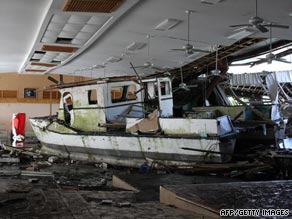

At least 84 people are so far confirmed killed in American Samoa, neighboring Samoa and Tonga. Officials in the Pacific region have expressed fears the toll will rise as rescue workers struggle to reach outlying villages.
The quake hit the small cluster of Samoan islands in the South Pacific early Tuesday.
In Samoa, the death toll currently stands at 55, according to government minister Maulolo Tavita. But he said he feared the number of casualities would continue to rise.
Around 220,000 people live on the two main islands which make up the nation of Samoa. The population of the U.S. island territory of American Samoa is about 66,000.
At least 22 people were confirmed dead late Tuesday in American Samoa. Salamo Laumoli, director of health services at the LBJ Tropical Medical Center in the capital, Pago Pago, said he feared more fatalities would turn up as rescue workers strived to access parts of the island severed by damaged infrastructure.
"I thought it was the end of the world," said Laumoli. "I have never felt an earthquake like that before."
In Tonga, Lord Tuita, the acting prime minister, said at least seven people had been confirmed dead on the northern island of Niuatoputapu. Three others were missing and four people were being treated for serious injuries, he said.
"The hospital on the island is reported to have suffered major damage; telephone communications has been cut as a result of damage to equipment and facilities on the island; homes and government buildings have been destroyed; the airport runway has been severely damaged making it impossible for any fixed wing aircraft to land," a statement from the Tongan prime minister's office said.
A series of aftershocks reverberated through the region Tuesday as reports emerged of entire villages flattened or submerged by the tsunami. The walls of water were so strong that they twisted concrete beams and mangled cars.
Laumoli said people in outlying villages on one end of the mainAmerican Samoa island had been cut off because the connecting bridge was washed away.
The Pacific Tsunami Warning Center in Ewa Beach, Hawaii, has canceled tsunami watches and warnings for American Samoa. However, a tsunami advisory is still in effect for for the coastal areas of California and Oregon.
The Japan Meteorological Agency canceled a tsunami advisory along its eastern coast Wednesday. The precautionary alert meant forecasters feared a tsunami wave of less than a foot and a half was possible.
American Samoa Gov. Togiola Tulafono, speaking from Hawaii, said Tuesday's quake ranked "right up there with some of the worst" disasters on the island. He said he had spoken to the military about mobilizing reserve forces for assistance.
Tulafono was on his way back home from Hawaii on Tuesday night on one of two U.S. Coast Guard transport planes delivering aid. He told reporters Tuesday it had been hard being away from home as the disaster unfolded. It was a time, he said, for families to be together.
President Barack Obama declared American Samoa a major disaster area, ordering federal aid to supplement local efforts.
The Coast Guard is transporting more than 20 officials from the Federal Emergency Management Agency to American Samoa, said John Hamill, external affairs officer for FEMA in Oakland, California.
The FEMA team will include a variety of debris experts, housing experts, members of the Corps of Engineers, and other disaster relief specialists, Hamill said.
The quake generated three separate tsunami waves, the largest measuring 5.1 feet from sea level height, said Vindell Hsu, a geophysicist with the Pacific Tsunami Warning Center. Preliminary data had originally reported a larger tsunami.
Subscribe to:
Posts (Atom)