Share |
Showing posts with label Tsunami. Show all posts

Thursday, 12 April 2012

Tsunami watch area reduced after 8.6 quake off Aceh

High-rise apartments in Penang swayed for around a minute late this afternoon when an 8.6 strong quake struck off the west coast of northern Sumatra, triggering a tsunami watch.
This was followed by an 8.2 after-shock a couple of hours later. But the watch area has since been reduced and Malaysia is off the list.
Source: USGS Earthquake Hazards Programme
In Penang, the main Tanjung Bunga road was choked with traffic, as many hastily left their homes along the sea front.
One Taiping resident said the chair he was seated on at home rattled during the quake.
Does the Najib administration still think it is a great idea to build the 100-storey Menara Warisan in Kuala Lumpur? Are our high-rise buildings capable of withstanding strong quakes?
Incidentally, some time ago, one of the senior engineers from China Harbour Engineering Company told me that the second Penang bridge is being built to withstand quakes of up to 8.0. CHEC has been laying the sub-structure for the new 23km bridge.
000
WEIO21 PHEB 111151
TSUIOX
TSUNAMI BULLETIN NUMBER 005
PACIFIC TSUNAMI WARNING CENTER/NOAA/NWS
ISSUED AT 1151Z 11 APR 2012
THIS BULLETIN IS FOR ALL AREAS OF THE INDIAN OCEAN.
… AN INDIAN-OCEAN-WIDE TSUNAMI WATCH IS IN EFFECT …
… A MAJOR AFTERSHOCK OCCURRED AT 1043Z WITH MAGNITUDE 8.3 …
… THE WATCH AREA IS NOW REDUCED …
A TSUNAMI WATCH IS IN EFFECT FOR
INDONESIA / INDIA / SRI LANKA / MALDIVES / UNITED KINGDOM
THIS BULLETIN IS ISSUED AS ADVICE TO GOVERNMENT AGENCIES. ONLY
NATIONAL AND LOCAL GOVERNMENT AGENCIES HAVE THE AUTHORITY TO MAKE
DECISIONS REGARDING THE OFFICIAL STATE OF ALERT IN THEIR AREA AND
ANY ACTIONS TO BE TAKEN IN RESPONSE.
AN EARTHQUAKE HAS OCCURRED WITH THESE PRELIMINARY PARAMETERS
ORIGIN TIME – 0839Z 11 APR 2012
COORDINATES – 2.3 NORTH 93.1 EAST
LOCATION – OFF W COAST OF NORTHERN SUMATRA
MAGNITUDE – 8.7
MEASUREMENTS OR REPORTS OF TSUNAMI WAVE ACTIVITY
GAUGE LOCATION LAT LON TIME AMPL PER
——————- —– —— —– ————— —–
TRINCONMALEE LK 8.6N 81.2E 1116Z 0.04M / 0.1FT 18MIN
COCOS ISLAND AU 12.1S 96.9E 1102Z 0.08M / 0.3FT 18MIN
TELUKDALAM ID 0.6N 97.8E 1045Z 0.19M / 0.6FT 10MIN
SABANG ID 5.8N 95.3E 1010Z 0.36M / 1.2FT 06MIN
MEULABOH ID 4.1N 96.1E 1007Z 1.06M / 3.5FT 12MIN
DART 23401 8.9N 88.5E 0956Z 0.03M / 0.1FT 06MIN
LAT – LATITUDE (N-NORTH, S-SOUTH)
LON – LONGITUDE (E-EAST, W-WEST)
TIME – TIME OF THE MEASUREMENT (Z IS UTC IS GREENWICH TIME)
AMPL – TSUNAMI AMPLITUDE MEASURED RELATIVE TO NORMAL SEA LEVEL.
IT IS …NOT… CREST-TO-TROUGH WAVE HEIGHT.
VALUES ARE GIVEN IN BOTH METERS(M) AND FEET(FT).
PER – PERIOD OF TIME IN MINUTES(MIN) FROM ONE WAVE TO THE NEXT.
NOTE – DART MEASUREMENTS ARE FROM THE DEEP OCEAN AND THEY
ARE GENERALLY MUCH SMALLER THAN WOULD BE COASTAL
MEASUREMENTS AT SIMILAR LOCATIONS.
EVALUATION
SEA LEVEL READINGS INDICATE A TSUNAMI WAS GENERATED. IT MAY
ALREADY HAVE BEEN DESTRUCTIVE ALONG SOME COASTS.
BASED ON THESE DATA THE THREAT CONTINUES FOR ALL COASTAL AREAS OF
THE INDIAN OCEAN. FOR THOSE AREAS – WHEN NO MAJOR WAVES HAVE
OCCURRED FOR AT LEAST TWO HOURS AFTER THE ESTIMATED ARRIVAL TIME
OR DAMAGING WAVES HAVE NOT OCCURRED FOR AT LEAST TWO HOURS THEN
LOCAL AUTHORITIES CAN ASSUME THE THREAT IS PASSED. DANGER TO
BOATS AND COASTAL STRUCTURES CAN CONTINUE FOR SEVERAL HOURS DUE
TO RAPID CURRENTS. AS LOCAL CONDITIONS CAN CAUSE A WIDE
VARIATION IN TSUNAMI WAVE ACTION THE ALL CLEAR DETERMINATION MUST
BE MADE BY LOCAL AUTHORITIES.
ESTIMATED INITIAL TSUNAMI WAVE ARRIVAL TIMES AT FORECAST POINTS
WITHIN THE WARNING AND WATCH AREAS ARE GIVEN BELOW. ACTUAL
ARRIVAL TIMES MAY DIFFER AND THE INITIAL WAVE MAY NOT BE THE
LARGEST. A TSUNAMI IS A SERIES OF WAVES AND THE TIME BETWEEN
SUCCESSIVE WAVES CAN BE FIVE MINUTES TO ONE HOUR.
LOCATION FORECAST POINT COORDINATES ARRIVAL TIME
——————————– ———— ————
INDONESIA SIMEULUE 2.5N 96.0E 0912Z 11 APR
BANDA_ACEH 5.5N 95.1E 0933Z 11 APR
SIBERUT 1.5S 98.7E 0944Z 11 APR
PADANG 0.9S 100.1E 1025Z 11 APR
BENGKULU 3.9S 102.0E 1037Z 11 APR
CILACAP 7.8S 108.9E 1150Z 11 APR
BANDAR_LAMPUNG 5.7S 105.3E 1200Z 11 APR
BALI 8.7S 115.3E 1234Z 11 APR
BELAWAN 3.8N 98.8E 1326Z 11 APR
KUPANG 10.0S 123.4E 1333Z 11 APR
BALI 8.7S 115.3E 1234Z 11 APR
INDIA GREAT_NICOBAR 7.1N 93.6E 0937Z 11 APR
LITTLE_ANDAMAN 10.7N 92.3E 1015Z 11 APR
NORTH_ANDAMAN 13.3N 92.6E 1045Z 11 APR
PORT_BLAIR 11.9N 92.7E 1050Z 11 APR
CHENNAI 13.4N 80.4E 1134Z 11 APR
TRIVANDRUM 8.3N 76.9E 1204Z 11 APR
KAKINADA 17.2N 82.7E 1204Z 11 APR
MANGALORE 13.3N 74.4E 1339Z 11 APR
BOMBAY 18.8N 72.6E 1605Z 11 APR
GULF_OF_KUTCH 22.7N 68.9E 1636Z 11 APR
SRI LANKA TRINCOMALEE 8.7N 81.3E 1049Z 11 APR
DONDRA_HEAD 5.9N 80.6E 1054Z 11 APR
COLOMBO 6.9N 79.8E 1121Z 11 APR
JAFFNA 9.9N 80.0E 1235Z 11 APR
MALDIVES GAN 0.6S 73.2E 1144Z 11 APR
MALE 4.2N 73.6E 1149Z 11 APR
MINICOV 8.3N 73.0E 1214Z 11 APR
UNITED KINGDOM DIEGO_GARCIA 7.3S 72.4E 1202Z 11 APR
ADDITIONAL BULLETINS WILL BE ISSUED BY THE PACIFIC TSUNAMI
WARNING CENTER FOR THIS EVENT AS MORE INFORMATION
BECOMES AVAILABLE.
THE JAPAN METEOROLOGICAL AGENCY MAY ISSUE ADDITIONAL INFORMATION
FOR THIS EVENT. IN THE CASE OF CONFLICTING INFORMATION…THE
MORE CONSERVATIVE INFORMATION SHOULD BE USED FOR SAFETY.

Friday, 8 April 2011

A nuclear scar on a haunting scenery

The road to Fukushima is near empty, a sign of its lost appeal after a devastating earthquake hit this once popular tourist destination.

Report from Fukushima


By Suvendrini Kakuchi

FUKUSHIMA: My decision to visit Fukushima – the area worst hit by the massive quake, tsunami and nuclear power accident on March 11 – was taken one afternoon last week after a long meeting with scientists.

The invitation to accompany the scientists on a private fact-finding mission to Fukushima was irresistible. The scientists and engineers who gathered that day, had, for decades, harboured misgivings over reactor safety design and policies and were active in the ongoing debate over the future of nuclear energy in Japan.

“There is a dire need for a real time radiation monitoring network to be set up in areas affected by the damaged Fukushima Daiichi Nuclear power plant,” Atsuto Suzuki, head of the high-energy accelerator research organisation at Tsukuba University, explained. “This is where our expertise can begin to play a role.”

We started our journey at 6am, armed with bottles of mineral water, clothing that could be discarded before our return to Tokyo, and special face masks to protect us from radiation when we approached the 20-kilometre exclusive zone around the damaged reactors.

Around our necks dangled radioactive dosimeters, resembling large thermometers. The machines would show accumulated microsieverts of radiation contamination on our bodies and instructions were given that we carry them all the time to record the rise in the figures while noting the exact locations.

“Our own documentation of radioactive material is key to understanding the Fukushima accident,” explained Yoichi Tao, a physicist specialising in risk management design, who is now retired. He is also a graduate from Tokyo University.

But Tao is not part of the cosy group of experts who have guided Japan’s ambitious post-war nuclear power industry. Instead, having experienced the atomic bombing of Hiroshima when he was just six years old, the scientist contends that the bitter truth that Japan had chosen to ignore till today, was that fool-proof safety in nuclear power is simply a “myth”.

“It is time,” he explained, “to embark on a clearer definition of the complex concept of safety. This calls for research from diverse perspectives – the views of residents, independent opinions, as well as taking in an assessment on the impact of the accident on other countries.”

The three-hour drive to Fukushima was hauntingly poignant. With most of the motorways now open for traffic, we passed the breathtaking scenery that marks Japan’s northern region – mountains dotted with pristine pine forests on one side of the road and the pale blue, now serene, ocean glistening on the other.

Sharp gusts of chilly air wrapped our car on a near empty road, a sign of the lost appeal of Fukushima – which had been up till now a tourist destination boasting therapeutic hot springs and fresh seafood.

Devastation

A harrowing scene awaited us at Iwaki, our entry point into Fukushima. Iwaki, a bustling coastal fishing city, had borne the full brunt of the tsunami, with some waves as high as 14 metres.

We stopped at Yotsukura hamlet where half the population of 1,000 had suffered fatalities, were still missing, or had lost their homes, fishing boats and cars.

People, protected with masks, appeared dazed while they pulled at piles of washed out rubble in a feeble attempt to reconstruct. “The community is still scattered in evacuation sites because shops continue to lack food and water and there is a severe shortage of gasoline,” explained Yuuji Kojima, head of the rescue operation in the local municipality.

The afternoon schedule was to get as close to the nuclear disaster as possible and the route we selected was not along the coast but inland. Getting closer to the vicinity, we passed miles of deserted villages where dogs and cattle – abandoned by their owners – walked past shuttered houses and broken roads.

The sky had begun to darken and we feared rain that would worsen our risk of contamination. We pulled on our masks and another layer of clothes. Then we watched our monitors.

Passing the 30-km limit, a recent extension of the risk zone ordered by the government, we reached Miyakoji-machi, once a lush farming area, now turned a ghost village.

A police car stood at the entry point and ordered our car to stop. Officers explained politely but firmly that only government officials or the Tokyo Electric Power Company – operator of the Fukushima nuclear power plant – were permitted inside. We pulled the car aside and kept the engine running while scanning the area for a suitable site for the scientists to set up their monitoring equipment.

Rain had turned to snow. Inside the darkening car, our monitors had begun to climb – mine was showing an accumulated 325 microsieverts, the equivalent of almost one chest X-ray already.

Evacuation centres

The most excruciating experiences during our visit were in the two evacuation centres we visited.

Located in Tamura town, the first contained 800 local residents who were packed into a large gymnasium. It was not the tsunami, but the accident in the nuclear power plant they had tolerated for the past 40 years, that had devastated their lives.

Cardboard linings demarcated tiny spaces for families. Old people covered in blankets lay in heaps off to one side.

Wanting to find out for myself, I deliberately avoided wearing the slippers given to guests who were asked to remove their shoes at the entrance. My feet froze almost instantly, reflecting the discomfort of the nuclear refugees who have lived on the cold and damp floor for weeks.

Portable toilets at the other refugee centre were situated outside the building, making visits during the freezing nights a nightmare for the elderly. A lone doctor at the centre described streams of patients seeking medical assistance.

“The authorities had promised us for years everything was safe. We do not believe them anymore,” she explained, declining to be photographed or identified. She hesitated to be overtly critical of their situation, preferring to focus her attention on the sick.

Lessons learned

As Japan struggles to contain the world’s second most catastrophic nuclear power accident, the public here is calling for an alternative energy model.

This marks the beginning of an unprecedented effort of the expanding network of scientists and designers in Japan – who are also reaching out for advice from their counterparts in the United States and Europe – to develop what some call the world’s most comprehensive study on safety.

For now, though, Tao and his team are concentrating on negotiating their way into the tightly controlled bureaucratic systems here that have long resisted outside intervention – one of the more troubling aspects of Japan’s economic development which now lays exposed by the disaster.

Returning to Tokyo, late at night, we wondered aloud what lessons had Japan learned from the disaster. We asked Tao, what would come next. “The answers will take time,” he said. “More important right now is maintaining a collective effort to contain the nuclear tragedy that must involve both proponents and opponents of nuclear energy technology.”

After more than 20 years in Japan, I knew Tao and his community of concerned scientists were right. At a time of tragedy, Japanese wisdom had won. First things first, and only then can the right platform be established to debate the larger challenges.

- IPS

Quake-ravaged Japan rattled by new tremor

Japan was rattled by a magnitude-7.1 aftershock nearly a month after a devastating earthquake and tsunami flattened the northeastern coast.

Thursday's aftershock, the strongest since the day of the magnitude-9.0 quake, was a fresh blow to victims of that March 11 quake and subsequent tsunami that killed at least 25,000 people, tore apart hundreds of thousands of homes and sparked the ongoing crisis at a nuclear power plant.

Al Jazeera's Marga Ortigas, reporting from Mizusawa in northeast Japan, said there were reports of injuries and gas leaks following the quake.

"Some traintracks have also been displaced and people were trapped in lifts. But Japanese have said that they do not expect further damage."

The Japan meteorological agency briefly issued another tsunami warning, but later cancelled it.

Al Jazeera's Harry Fawcett, also reporting from Misuzawa, said a 50cm wave was observed, according to local media.

"That was not confirmed by officials. The tsunami warning has been lifted but it was of course extremely disturbing for people who recently went through the trauma of that huge tsunami on March 11."

Officials at the tsunami-ravaged Fukushima Daiichi nuclear plant said there was no immediate sign of new problems caused by the aftershock.

Japan's nuclear safety agency said workers there had retreated to a quake-resistant shelter in the complex. No one there was injured.

Officials said Thursday's aftershock hit 50km under the water and off the coast of Miyagi prefecture.

The quake struck at 11:32pm local time and initially measured 7.4 on the Richter Scale, however, the US Geological Survey in Golden, Colorado, later downgraded it to 7.1. Buildings as far away as Tokyo shook for about a minute.

In Ichinoseki, inland from Japan's eastern coast, buildings shook violently, knocking items from shelves and toppling furniture, but there was no heavy damage to the buildings themselves.

Immediately after the quake, all power was cut. The city went dark, but cars drove around normally and people assembled in the streets despite the late hour.

Paul Caruso, a geophysicist at USGS, said it struck at about the same location and depth as last month's huge quake.

It was the strongest of the more than 1,000 aftershocks that have been felt since, except for a 7.9 on the same day.

Don Blakeman, another USGS geophysicist, said it was the strongest aftershock since March 11, although several aftershocks on that day were bigger.

The USGS said the aftershock struck off the eastern coast 65km from Sendai and 115km from Fukushima.

A Pacific Tsunami Warning Center evaluation of the quake said an oceanwide tsunami was not expected.

However, it noted quakes of that strength can cause waves that are destructive locally.

Japan: Relevant Again


Image
Sukagawa Factory Building collapse
Quake underscores the country’s global importance

There was a time when it was easy to discount Japan’s importance to the world economy. The country was supposedly mired in two-decades of stagnation, it had surrendered its second-place as a global economic power to China where all of the action seemed to be taking place. Japan was sliding into irrelevance.

No longer. The impact of the Great East Japan Earthquake last month and the continuing crisis at the Fukushima nuclear power plant complex has, if nothing else, exposed the important position that Japan still holds in the world economy, especially in making key components for cars, telephones and electronic products of all kinds.

"Japan is more global than we thought," said Eisuke Sakakibara, a former vice minister for international affairs at the Finance Ministry and a well-known commentator on finances, which earned him the nickname "Mr. Yen."

Most people in the US, for example, have probably learned that foreign-owned and domestic automakers have had to curtail production until the supply chain of critical parts could resume normal operations. But there are many crucial industries in which Japan has monopolies or near monopolies which will disrupt global production for months. Take Xirallic.

Never heard of Xirallic? It is a paint pigment that gives automobiles, especially expensive upmarket brands, their shiny, metallic look. This product is made by the German chemical company Merck in one factory, which happens to be in the town of Onahama, about 40 km from the damaged Fukushima plants.

The company estimates that it will be out of commission for at least six to eight weeks, and that assumes that the government doesn’t have to extend the radiation evacuation zone, now set at 30 km (18.6 miles), another 10 kilometers. Unusually high radiation levels have been observed (though later declining) in at least one other town 40 km away from the stricken plants.

Well, maybe the automobile industry can manage with cars with a duller finish, but can the high tech industries do without semiconductor-grade silicon wafers? Most are made by two Japan-based companies, the Shin-Etsu Chemical Co and Sumco Phoenix Company.

Shin-Etsu has two factories, one of which is located in Nishio village, Fukushima prefecture. The other is in Ibaraki prefecture north of Tokyo. The latter was not badly damaged by the earthquake and tsunami, but is in the Tokyo Electric Power Co. Service area and thus subject to rolling power blackouts. It is uncertain when either will restart.

The Sumco company is better off as most of its plants are in the undamaged Kansai region west and south of the capital. It also has a plant in Taiwan, which after the quake issued a message saying it would make an "all out effort" to meet worldwide demand for the wafers without raising prices. Even so prices for silicon wafers were double that of 2008.

Mitsubishi Gas Chemical Co. manufactures roughly half of world’s supply of hydrogen peroxide, used in making of many paper products. Its Kashima plant was knocked out by the earthquake. It has another in the Tokyo metropolitan area, but its operation is severely impacted by the blackouts.

In a way, the situation is similar last summer’s big blowup with China over the disputed Senkaku islands, when Beijing allegedly threatened to embargo rare earths. The world woke up to the fact that China controlled more than 90 percent of these minerals that most people never heard of but are crucial to making of modern electronic products and televisions.

Something similar is happening now. During Japan’s so-called stagnant years, its manufacturing companies moved much of their routine assembly to Southeast Asia and the US, but during those years it kept an iron grip on its monopolies of dozens of critical but little-known (except to affected industries) components.

The northeast coast of Japan, known locally as the Tohoku region, is not usually considered a major manufacturing center. The quake and tsunami-impacted prefectures account for only about 6-7 percent of the country’s gross domestic product.

That is not the case with Tokyo, which alone has a GDP roughly equal to Canada or Italy. There was little serious damage from the March 11 earthquake and tsunami in the capital itself, but the impact of rolling blackouts caused by dire electricity shortages is an increasing factor in pessimism over the economic recovery.

"The planned blackout is as bad as the earthquake itself," says Kyohei Morita, chief economist for Barclays Capital Japan Ltd. He estimated that the blackouts alone will shave as much as one percent off of Japan’s projected GDP growth.

The quake/tsunami is estimated to have cut about 12 percent off Japan’s electric power production. More importantly, it has cut nearly a quarter off the power for the Tokyo Electric Power Co. (Tepco), which has a monopoly of power production and distribution in the capital and its environs, serving about 45 million people in total.

Faced with a 10 million kilowatt shortfall, Tepco announced planned rolling blackouts within days of the earthquake. The utility owns 17 nuclear reactors, including the four badly damaged Fukushima reactors with 13 out of service. That doesn’t count the several coal and gas-fired plants that were also damaged in the quake.

Chairman Tsunehisa Katsumata last week announced that Tepco planned to scrap Units 1-4. No big surprise here. That has been foreordained from the first day of the crisis. Surprisingly, he made no mention of Units 5-6. Maybe some at Tepco think they will reopen. But Chief Cabinet Secretary Yukio Edano flatly stated they will be closed. Tepco will be lucky to keep the four other Fukushima Daini Plants currently in cold shutdown.

Tepco’s more immediate financial situation was eased temporarily at the end of March with a ¥1.86 trillion working capital loan secured through Japan’s seven largest banks. Combined with the approximately ¥400 billion cash on hand, it will see the company through the immediate crisis. But it faces huge problems.

Even as Tepco’s workers struggle to keep stricken reactor cores cool, the company is working feverishly to get more thermal power plants in operation to meet summer air conditioning demand. Last summer was the hottest in Japan on record; officials are hoping that things cool down this summer, in more ways than one.

Sunday, 3 April 2011

Attempt to plug radioactive water leak fails, TEPCO says

Tokyo (CNN) -- A first attempt to plug a cracked concrete shaft that is leaking highly radioactive water into the ocean off Japan failed Saturday, so officials are now exploring alternatives, spokesmen for Tokyo Electric Co. said.

Power plant workers had been trying to fill the shaft with fresh concrete, but that did not change the amount of water coming out of the crack, the spokesmen said at a news conference that ran late into the night Saturday.

Their "plan B" is to use polymers to stop the leak, the spokesmen said. A Tokyo Electric expert will visit the site Sunday morning and decide what polymer to use before the work begins.

Workers will then break the shaft's ceiling and insert the polymer in a different spot from where they tried to place the concrete, they said.

Water from the 2-meter-deep, concrete-lined basin has been seen escaping into the ocean through a roughly 20-centimeter (8-inch) crack, the company said earlier Saturday. The shaft lies behind the turbine plant of the No. 2 reactor at the Fukushima Daiichi nuclear plant, which was heavily damaged in the earthquake and resulting tsunami last month.

Radiation levels in the shaft have been measured at more than 1,000 millisieverts per hour, which is more than 330 times the dose an average resident of an industrialized country naturally receives in a year. Radioactivity above the shaft was measured at 250 millisieverts per hour, said Tokyo Electric, the plant's owner.

Tokyo Electric said it is discussing other methods to use should the polymer fail, but it hasn't identified what those other methods may be.

The discovery of the leak comes after a feverish effort in recent days to explain a sharp spike in contamination in seawater measured just off the plant. Tokyo Electric said the shaft lies next to the water intake for the plant's steam condenser, at the end of a long channel that has been filling with radioactive water for several days.

Officials announced Thursday, based on samples taken the previous afternoon 330 meters (361 yards) off the plant, that seawater showed levels of iodine-131 measuring 4,385 times above the standard and cesium-137 at 527 times beyond normal. Experts say the latter radioactive isotope may be a greater concern because it persists longer, since it takes 30 years to lose half its radiation -- compared to an eight-day half-life for the iodine-131 isotope.

The Nuclear and Industrial Safety Agency ordered the utility to start testing water further offshore and to the south, agency official Hidehiko Nishiyama said. Tokyo Electric has now established monitoring posts 15 kilometers (9.5 miles) off the coast, in a line directly offshore, 10 kilometers south, and 16 kilometers south.

Highly radioactive water has also been detected in several reactors' turbine buildings, nearby tunnels and groundwater in the immediate vicinity. But the area around the No. 2 reactor has been of particular concern, because water in an exposed maintenance tunnel leading from its turbine building showed radiation levels more than 100,000 times above typical levels for nuclear coolants.

A two-day project began Saturday to install a camera in that trench to help pinpoint potential leaks, a Tokyo Electric official said.

Spraying was also set to continue this weekend of an experimental new material to lock in radioactive material in and around the nuclear complex so that it doesn't seep further into the air, water or ground.

Crews have dispersed about 2,000 liters (more than 500 gallons) of synthetic resin in a 500-square-meter locale, according to Tokyo Electric. The aim is to hold the released radioactivity on the ground, so it can't interfere with the restoration of the cooling systems aimed at preventing the overheating of nuclear fuel rods in reactors and spent fuel pools at the plant.

"You spray it to hold down the loose contamination, and it acts like a super glue," said Nolan Hertel, a radiation engineering expert at the Georgia Institute of Technology in Atlanta. "You don't want radiaoactive materials that are loose to get away."

Meanwhile, Nishiyama said there is a plan to inject nonflammable nitrogen into reactors 1, 2 and 3 to prevent the risk of another hydrogen explosion like the ones that extensively damaged the unit 1 and 3 housings in the days following the March 11 earthquake and tsunami. A buildup of hydrogen is an early sign of damage to a reactor's superheated core, but Nishiyama said no alarms had been sounded about rising pressure and that adding nitrogen would not force engineers to release hydrogen from the reactor vessel.

"It is only to prevent the accumulation of hydrogen as part of the restoration effort," Nishiyama said.

The continued injection of tons of water into the reactor cores and spent nuclear fuel pools shows that the race to prevent further explosions or widespread releases of radiation into the atmosphere remains far from over.

Jeff Immelt, the chief executive of General Electric Co., was heading to Japan to meet with Tokyo Electric about stabilizing the damaged reactors, which were designed by GE, company spokeswoman Deidre Latour said Saturday.

All these efforts come just more than three weeks after a 9.0-magnitude earthquake and subsequent tsunami struck northeast Japan, effectively wiping out some communities and leading to the deaths of nearly 12,000 people and leaving more than 15,400 missing, according to Japan's National Police Agency.

The Fukushima Daiichi plant was hit hard in the disaster, especially after its primary and back-up systems to cool nuclear fuel in its six reactors and their respective spent nuclear fuel pools failed. Since then, there has been a multifaceted and at times problematic race to prevent explosions (three took place in the days immediately after March 11), the overheating of nuclear fuel and the resulting release of radioactive material into the air, soil and water.

By Saturday, concerns seem to have abated somewhat about the airborne radiation that led to the ordered evacuation of 78,000 people, with another 62,000 living within 20 to 30 kilometers being told to stay indoors. An official with Tokyo Electric said early Saturday that data from eight new monitoring posts around the plant showed airborne radiation levels had stabilized, at between .390 and .0019 millisieverts per hour.

Saturday -- after a stop in Rikuzentakata, in Iwate prefecture -- Japanese Prime Minister Naoto Kan went to Hironocho, a village in Fukushima prefecture that has served as the operations center for the nuclear crisis effort. The trip, described by the prime minister's office as aimed at boosting morale among utility company workers and soldiers involved in the effort, put Kan on the edge of the 20-kilometer evacuation zone.

"I appreciate your significant contributions in fighting the invisible enemies in this battle, which will determine the fate of Japan," Kan said at J-Village, a soccer complex that has become a staging area for the Fukushima Daiichi operation.

Saturday, 19 March 2011

Searches continues in Japan as death toll rises

Tokyo (CNN) -- As searches for survivors continued Saturday, police in Japan said more than 7,100 people had died since the monster earthquake and ensuing tsunami struck.

On Saturday morning 7,197 people were confirmed dead, according to Japan's National Police Agency. Another 10,905 people were missing and 2,611 were injured, the agency said.

Prime Minister Naoto Kan sought to reassure the nation, saying Friday that he is committed to taking firm control of a "grave" situation.

Kan said the disaster has been a "great test for all of the people of Japan," but he was confident of the resolve of his people.

Amid a raised crisis level at the Fukushima Daiichi nuclear plant from a 4 to 5 -- putting it on par with the 1979 incident at Pennsylvania's Three Mile Island -- Kan told his compatriots to bury their pessimism.

"With a tsunami and earthquake we don't have any room to be pessimistic," he said. "We are going to create Japan again from scratch. We should face this challenge together."

Kan acknowledged the situation at the Fukushima plant remains "very grave" and said his government has disclosed all that it knows to both the Japanese people and the international community.

"The police, fire department and self defense forces are all working together, putting their lives on the line, in an attempt to resolve the situation," he said.

Search teams continued Friday to comb through the rubble and residents of decimated towns sifted through twisted metal and broken wood beams, looking for remnants of the lives they lost. Rescuers planted red flags where they found dead bodies.

"I have no words to express my feelings. I lost my mind. We will have to start from zero," Hidemitsu Ichikawa said, taking a break from shoveling mud outside his home.

In Miyagi Prefecture, officials observed a moment of silence Friday to mark the one-week anniversary of the quake.

Schools have become impromptu morgues, with names of the dead posted on the doors, NHK reported.

Long lines snaked around supermarkets as survivors stocked up on supplies.

In the hardest-hit parts of the country, thousands of people, many of them frail and elderly, settled into shelters not knowing when they might be able to leave.

Japanese media have reported difficult living conditions, including kerosene shortages that make it hard to heat the shelters.

Some 380,000 people are staying at 2,200 facilities, Kyodo News reported.

"With all possible measures I'm determined, as part of the government, to improve their living conditions as much as possible," Chief Cabinet Secretary Yukio Edano told reporters Friday.

NHK reported that 25 of the nearly 10,000 evacuees from Fukushima Prefecture have died in shelters.

Twenty of them were elderly people forced to evacuate from nursing homes and a hospital after problems at the Fukushima Daiichi plant. Several died as they rode without adequate medical care on a bus on the way to the high school shelter, Fukushima Prefecture government officials said.

Volunteers tried to care for hundreds of patients in the school's unheated athletic building. They sent out radio messages asking people to bring in any fuel they could spare, Koyo High School Principal Masaaki Tashiro said, choking up as he recounted the struggle.

"It was so far beyond anything we had ever experienced that we were doing our very best, just trying to cope with what was in front of us, he said.

"People are exhausted from the earthquake, tsunami, and now the fear of radiation," he said.

Japan's nuclear safety agency described the situation at the earthquake-damaged Fukushima Daiichi nuclear plant Friday as a "Level 5" incident, a rating based on the International Nuclear and Radiological Event Scale, with 1 being least and 7 being most severe.

A level 5 indicates the likelihood of a release of radioactive material, several deaths from radiation and severe damage to a reactor core.

Workers resumed efforts to douse a spent fuel pond outside a nuclear reactor at the Daiichi plant Friday, with its owner saying that earlier attempts had been "somewhat effective" in addressing radiation concerns.

Conditions at the plant itself remain dangerous. Radiation levels Thursday hit 20 millisieverts per hour at an annex building where workers have been trying to re-establish electrical power, "the highest registered (at that building) so far," a Tokyo Electric official told reporters.

By comparison, the typical resident of a developed country is naturally exposed to 3 millisieverts per year.

The top priority for officials is the nuclear facility's No. 3 reactor -- the sole damaged unit that contains plutonium along with the uranium in its fuel rods, Edano said.

Significant amounts of radiation have been released since the earthquake hit on March 11, followed by a tsunami that swept away diesel generators needed to keep water pumping over the fuel rods. The disasters spurred several hydrogen explosions at the nuclear plant.

But Japanese officials have tried to allay fears of an imminent meltdown.

A meltdown occurs when nuclear fuel rods cannot be cooled and the nuclear core melts. In the worst-case scenario, the fuel can rupture the containment unit spilling out radioactivity through the air and water. That, public health officials say, can cause both immediate and long-term health problems, including radiation poisoning and cancer.

The government has ordered the evacuation of about 200,000 people living in a 20-kilometer (12.4-mile) area around the plant, and told people living between 20 kilometers and 30 kilometers (18.6 miles) from the plant to remain indoors.

"Evacuees, and that can be said of myself as well, are feeling anxious since we are not getting the needed information from the government in a timely manner," said Seiji Sato, a spokesman for the government of Tamura City, about 20 kilometers from the nuclear facility.

One group of 21 people evacuated from a town near the plant made it to a shelter in Shinjo-shi, 300 kilometers (186 miles) away.

They told officials there that they drove as far away as possible, until they ran out of gas.

Friday, 18 March 2011

Japan struggles to cool reactors, spent fuel at damaged plant

Tokyo (CNN) -- Japan turned helicopters, fire trucks and police water cannons on the No. 3 reactor at the quake-ravaged Fukushima Daiichi nuclear power plant and the pool housing its spent fuel Thursday in its latest attempt to stave off a nuclear disaster.

Military helicopters began dumping water on the reactor Thursday morning, with police and fire trucks opening up after 7 p.m. (6 a.m. ET). Japan's Defense Ministry said the first effort lasted 40 minutes, and the Tokyo Electric Power Company said the efforts would continue throughout the night in order to keep the reactor and its adjacent spent fuel pool from overheating.

"In order to cool the spent fuel storage pool, we have carried out water drop operations and the spraying of water from the ground," TEPCO officials said at a Thursday night news conference. "This needs to continue in several ways. Therefore, we will continue to ask for cooperation of the involved people so we can carry out continuously. The helicopter water dumping operation is something we have asked (the) government to provide us help with, and also the spraying of water."

Friday's earthquake and tsunami caused damage at four of the six reactors at the Fukushima Daiichi plant, located on the northern coast of the Japanese island of Honshu. TEPCO also was attempting to restore power to the facility, but those efforts had not been completed by nightfall Thursday, the company said. Restoring power would help get the plant's pumping systems going again, to try to get water to the pool.

Helicopters made four passes in about a 20-minute span Thursday morning, dropping 7.5 tons of seawater each time on the facility's No. 3 reactor in order to cool its overheated fuel pool. Video of the operation aired on NHK showed that only one of the loads appeared to drop directly on the building. Gusty winds dissipated much of the water carried by the other three helicopters. Experts believe that boiling steam rising from that pool, which contains at least partially exposed fuel rods, may be releasing radiation into the atmosphere.

Rebecca Johnson, founder of the London-based Acronym Institute for Disarmament Diplomacy, told CNN that Japanese engineers are "flying by the seat of their pants now." "Everything they try goes wrong. They're focusing on reactors, then spent fuel becomes damaged," Johnson said. "They've just got to get water in there, keep the water pumping."

And nuclear engineer Arnie Gundersen told CNN's "American Morning" that the effort will likely need to be sustained "for months, if not years."

"What's pushing the firemen back is the radiation that's coming from the spent fuel pool," he said. If the spent fuel rods in that pool are uncovered, "There's an awful lot of gamma rays flooding that site, forcing the workers to say further away."

Japanese Defense Minister Toshimi Kitazawa, in conjunction with Prime Minister Naoto Kan, said he decided early Thursday to address the crisis from the air and ground despite concerns about exposing workers to radiation.

"We could not delay the mission any further, therefore we decided to execute it," Kitazawa told reporters.

Radiation levels at the plant remained high Thursday evening, but had dropped sharply from the morning. At 4 p.m. (3 a.m. ET), the Japanese Nuclear and Industrial Safety Agency reported exposures of 1.6 millisieverts per hour, down from the nearly 3.8 millisieverts per hour TEPCO reported at 9:30 a.m. A typical resident of a developed country receives about 3 millisieverts per year.

"The radiation levels of individual workers are being properly managed by limiting their time in or close to the reactors," Hidehiko Nishiyama, NISA's deputy director-general, told reporters. Out of 18 workers tested Thursday morning, 17 tested normal, and the one who received a higher dose of radiation required no medical treatment, Nishiyama said.

The increased focus on the No. 3 reactor came after a stark U.S. warning about the fuel pool in the No. 4 reactor. Gregory Jaczko, the head of the U.S. Nuclear Regulatory Commission, told a congressional committee that there was "no water" in the No. 4 pool, resulting in the emission of "extremely high" levels of radiation.

But Japanese authorities disputed Jaczko's assertion, citing information gathered from a helicopter flight over the plant. A TEPCO official said Thursday that there was some water in the No. 3 spent fuel pool, "But we do not know how much water."

Nishiyama acknowledged that some data from the Daiichi plant may not be reliable as the quake knocked down power on site, rendering measurement equipment unstable. He was quick to defend how the government has handled information on the nuclear plant.

And the Japanese government came under fire Thursday with the release of a WikiLeaks cable attributed to the U.S. State Department. The document noted that a Japanese legislator, Taro Kono, had accused Japan's Ministry of Economy, Trade and Industry of "covering up nuclear accidents, and obscuring the true costs and problems associated with the nuclear industry."

A Japanese government spokesman, Noriyuki Shikata, warded off fears of an imminent meltdown, telling CNN Thursday, "We have not seen a major breach of containment" at any of the plant's troubled nuclear reactors.

A meltdown occurs when nuclear fuel rods cannot be cooled and the nuclear core melts. In the worst-case scenario, the fuel can spill out of the damaged containment unit and spread radioactivity through the air and water.

That, public health officials say, can cause both immediate and long-term health problems, including radiation poisoning and cancer.

Tests in Fukushima city, 80 kilometers (50 miles) away, found radiation measuring 12.5 microsieverts per hour -- well above the average reading of 0.04, but still well below that considered harmful to humans.

Small, and for now, harmless amounts of iodine -- a potential byproduct of a nuclear meltdown -- were found in the city's water.

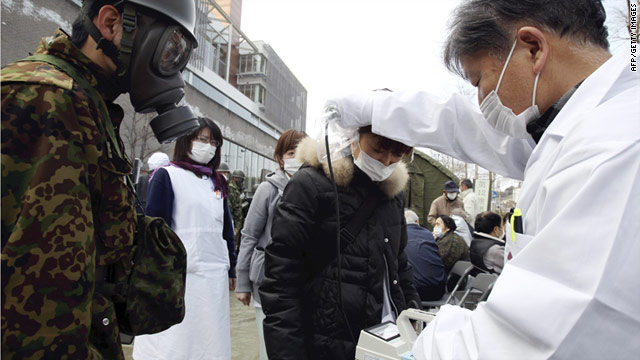
Citing Fukushima Prefecture officials, Kyodo News reported Thursday that about 10,000 people were screened for radiation exposure the previous day at evacuation centers and medical offices.

About 200,000 people living within a 20-kilometer (12-mile) radius of the plant have been evacuated; those living 20 to 30 kilometers from the site have been told to remain inside. Authorities also have banned flights over the area.

Koichi Shiga described the town of Minamisoma,25 kilometers from the plant and site of the Hotel Iseya that he owns, as ghostly quiet with most all shops closed and empty streets. Electricity and water were still flowing, though evacuation efforts have been hampered by a paucity of gasoline.

"People have not evacuated, they are staying at home," Shiga told CNN. "There was a ration of 10 liters of gas, and I saw a long line of people."

Several countries, including the United States, have called for a broader range, urging their citizens in Japan to evacuate or at least stay indoors if they live within 80 kilometers of the Fukushima Daiichi plant.

One positive development is that winds have been blowing from the northwest, helping push emitted radiation off to sea. Still, at least 20 people have fallen ill due to possible radiation contamination, in addition to 19 injured and two missing at the plant, the International Atomic Energy Agency reported.

Thursday, 17 March 2011

'Maximum' effort at Japan's stricken plant

The Japanese head of the International Atomic Energy Agency, the United Nations' nuclear watchdog, has denied that the situation at an earthquake-damaged nuclear plant is out of control.

"It is not the time to say things are out of control," Yukiya Amano told a news conference. "The operators are doing the maximum to restore the safety of the reactor.

Yukiya Amano was responding to comments by Guenther Oettinger, the EU energy chief, suggesting that efforts to contain the crisis at the Fukushima plant had failed after efforts to cool a reactor by dumping water on it from a helicopter were abandoned.

The plant has been hit by a series of explosions since Friday's quake knocked out reactor cooling systems.

"In the coming hours there could be further catastrophic events which could pose a threat to the lives of people on the island," Oettinger told a European Parliament committee.

There was hope early on Thursday that a newly built power line that could restore electricity at the plant would soon be ready. If the plant's electricity-powered pumps can be restarted, water could be pumped to the damaged reactors to cool them.

Naoki Tsunoda, a spokesman for Tokyo Electric Power Company, said officials planned to try the line as soon as possible, but could not say when, the AP news agency reported.

Radiation levels

Surging radiation levels forced Japan to order emergency workers at the crippled nuclear plant to be briefly moved to a bunker, as reported in the local media, in the desperate battle to cool the overheating reactors.

Al Jazeera's Harry Fawcett said workers struggling to avert a nuclear meltdown at the Fukushima nuclear complex were allowed to return to the facility later.

"The 70 workers who were taken into that protective bunker were able to go back and restart operations crucial to keeping this entire plant cool," he said.

"They have been pumping sea water into the reactors; the ones that were active before the earthquake and the ones which were just housing spent fuel."

Yukio Edano, the Japanese chief cabinet secretary, said the workers dousing the reactors in a frantic effort to cool them needed to be taken to safety after an explosion a day earlier in the Unit 4 reactor led to a surge in radiation.

The blast is thought to have damaged the reactor's suppression chamber, a water-filled pipe outside the nuclear core that is part of the emergency cooling system.

Hajimi Motujuku, a spokesman for the plant's operator, Tokyo Electric Power Company, said the outer housing of the containment vessel at Unit 4 was in flames on Wednesday.

The level of radiation at the plant surged to 1,000 millisieverts early on Wednesday before coming down to 800-600 millisieverts.

'Lethal doses'

But Gregory Jaczko, head of the US Nuclear Regulatory Commission, said Wednesday that emergency workers may have been exposed to "lethal doses" of radiation.

"It would be very difficult for emergency workers to get near the reactors. The doses they could experience would potentially be lethal doses in a very short period of time," told a House subcommittee.

Hundreds of thousands of people have been evacuated from a 20 km zone around the plant, while those within 30 km of the plant have been told to stay indoors because of the risk from heightened radiation levels.

The official death toll from Friday's massive earthquake and tsunami rose to 4,340 on Wednesday although thousands of people are still missing and officials say at least 10,000 have likely been killed.

Japanese Emperor Akihito also gave a rare televised address to the nation describing the catastrophe as being of an "unprecedented scale".

Many governments have urged their citizens to leave Tokyo and earthquake-affected areas amid concerns Japan's capital could be exposed to dangerous levels of radiation if the situation worsens.

Great Britain said Britons in Tokyo should leave because of the "evolving situation at the Fukushima nuclear facility". Australia, France and Germany have also advised their citizens to leave Tokyo.

The US said Americans living within 80 km of the plant should leave the area or take shelter indoors.

Tokyo reported slightly elevated radiation levels on Tuesday, but officials said the increase was too small to threaten the 39 million people in and around the capital.

Businesses have issued similar travel advisories telling people to consider moving away from disaster areas if they have no reason to be there.

Meanwhile US forces in Japan have been told to stay at least 80 km from the crippled Fukushima complex without special authorisation.

Reuters news agency, citing the US military, said potassium iodide tablets have been given to some air crews ahead of missions as a precaution against radiation, though no personnel in Japan are showing signs of radiation poisoning.

Rising toll

Authorities are staring at a staggering death toll following last week's twin disasters which decimated Japan's northeastern coastline.

The devastation in the tsunami-hit areas such as the small fishing town of Minamisanriku have been huge, with the northeastern settlement missing about half of its 17,000 people.

"Ten of my relatives are missing. I haven't been able to get in contact with them," 54-year-old Minamisanriku resident Tomeko Sato, who lost her house in the disaster, told AFP news agency.

"I was very surprised by the power of the tsunami... next time, I will live on the hill and hope it never happens again."

Andrew Thomas, Al Jazeera's correspondent in Osaka, Japan, said the trouble with the tsunami is that many of those people may never be found having been washed out to sea. He also said the weather had taken a turn for the worst for any survivors."

Another of our correspondents in the north said apart from a few isolated incidents of rescue on Tuesday, the large amount of work rescuers do is recovering bodies and looking after those who have been displaced.

Millions in Japan have been left without water, electricity, fuel or enough food. Hundreds of thousands more are homeless, stoically coping with snow and freezing rain in the northeast.

Source:Al Jazeera and agencies

Praise for 'heroes' working to avert Japan's nuclear catastrophe

Thousands of people living near the troubled Fukushima Daiichi nuclear power plant have been evacuated from their homes.

(CNN) -- As the rest of the world waits with bated breath to see if Japan can avert a nuclear catastrophe, a small band of experts is putting their lives at risk to prevent the disaster.

Thousands of people living near the troubled Fukushima Daiichi nuclear power plant have been evacuated from their homes because of the risk of radiation leaks from reactors damaged by last week's devastating earthquake and tsunami.

But while most hurry in the opposite direction, about 180 plant workers are staying put -- despite the fact that doing so could result in serious illness or even death -- to battle the meltdown threat.

"The workers at this site are involved in a heroic endeavor," former U.S. Department of Energy Official Robert Alvarez told CNN.

"There is at least fragmentary evidence that in some places on this site there are life-threatening doses of radiation. I think they are doing enormously heroic work"

The workers left at the site are said to be highly trained and experienced nuclear operators, engineers and safety staff with highly specialized knowledge.

Professor Richard Wakeford, of the Dalton Nuclear Institute at the University of Manchester, said for many of them -- despite the highly unusual and potentially dangerous circumstances -- it will be just another day at the office.

"They see it as doing their job," he said. "The Japanese in particular are dedicated to duty, and they will see it as their duty to do what they are doing."

According to the World Health Organisation, the average person is exposed to about 3.0 millisieverts (mSv) a year of radiation, from naturally-occurring, medical and other sources.

But monitoring at the Fukushima Daiichi site has recorded radiation as high as 400 millisieverts an hour -- a level known to be a risk to human health.

Exposure to 1,000 millisieverts (1 Sievert) of radiation can cause radiation sickness.

"It is difficult to get a clear picture, but there have been spikes in radiation to enormous doses, high enough to risk radiation sickness," said Dr Ira Helfand, a member of the organization Physicians for Social Responsibility.

"These people are undergoing total body radiation, which can cause leukaemia and lymphoma as well as thyroid cancer later on," he said.

Experts say lessons have been learned since the nuclear disaster at Chernobyl 25 years ago, when an unauthorized experiment saw radioactive dust spread across swathes of Ukraine, Belarus, Russia and western Europe.

Then, emergency workers were sent in with little or no protection to deal with the fallout.

"The workers at Chernobyl had no idea that they were walking into an intense radiation field," said Professor Wakeford. "It was pandemonium; there was no monitoring, no idea of the risks."

By contrast, he said, staff at Fukushima Daiichi will be kitted out in protective clothing and breathing apparatus, they will be closely monitored and working in teams to limit their exposure to radiation.

"If I were them I would be more worried about the hydrogen explosions, which have been huge -- enough to blow the roofs off two buildings -- and which I think are a much bigger risk to the workers on the ground," he told CNN.

But Dr. Helfand said reports suggested that the operation was not going 100% to plan, describing it as "something out of an adventure movie."

"We are in totally uncharted waters, people are ad-libbing to deal with the situation," he said. "Using fire trucks to pump a mixture of sea water and boron onto the reactors is not in any of the manuals."

Professor Wakeford said the workers will have known they may one day face a risky situation such as this.

However, Dr. Helfand said that made them even braver, and their work more admirable.

"These workers are trained to understand the risks, but that only makes it all the more heroic that they have agreed to stay and work to prevent a disaster," he said.

"They know that if there is a reactor meltdown it could be a major disaster affecting huge areas and massive numbers of people, and they are risking their lives to try and prevent that. All of us owe them a huge debt of gratitude."

Professor Wakeford agreed: "They are heroic, there is no doubt about that -- it's a pity that isn't recognised more. They are heroes, and I bow down to them."

Wednesday, 16 March 2011

Radiation prompts Japan plant evacuation

Japan has suspended operations to prevent quake-affected Fukushima nuclear plant from melting down after a surge in radiation made it too dangerous for workers to remain at the facility.

Yukio Edano, Japan's chief cabinet secretary, said on Wednesday work on dousing reactors with water was disrupted by the need to withdraw.

The level of radiation at the plant surged to 1,000 millisieverts early on Wednesday before coming down to 800-600 millisieverts. Still, that was far more than the average. "So the workers cannot carry out even minimal work at the plant now," Edano said.

Earlier, a fire broke out at the nuclear reactor again, a day after the Fukushima Daiichi power plant emitted a burst of radiation that panicked an already nervous Japan and left the government struggling to contain a crisis caused by last week's earthquake and tsunami.

The outer housing of the containment vessel at the Unit 4 at the nuclear complex erupted in flames early on Wednesday, Hajimi Motujuku, a spokesman for the plant's operator, Tokyo Electric Power Co (TEPCO), said.

On Tuesday, a fire broke out in the same reactor's fuel storage pond - an area where used nuclear fuel is kept cool - causing radioactivity to be released into the atmosphere.

TEPCO said the new blaze erupted because the initial fire had not been fully extinguished.

About three hours after the blaze erupted on Wednesday, Japan's Nuclear and Industrial Safety Agency said fire and smoke could no longer be seen at Unit 4, but that it was unable to confirm that the blaze had been put out.

Public broadcaster NHK also said flames were no longer visible at the building housing the Unit 4 reactor.

The Nuclear and Industrial Safety Agency said two workers were missing after the multiple explosions and fires at the plant in Fukushima, 240km north of Tokyo, since the quake and tsunami damaged its cooling system.

Radiation levels in areas around the nuclear plant rose early on Tuesday afternoon but appeared to subside by evening, officials said.

But the unease remained from the massive disasters that are believed to have killed more than 10,000 people and rattled the world's third-largest economy.

The radiation leak caused the government to order 140,000 people living within 30km of the plant to seal themselves indoors to avoid exposure, and authorities declared a ban on commercial air traffic through the area.

'Fuel rods damaged'

Separately, the Nuclear and Industrial Safety Agency said 70 per cent of the nuclear fuel rods in Unit 1 may have been damaged following an explosion.

Minoru Ohgoda, a spokesman, said "it's likely that roughly about 70 per cent of the fuel rods may be damaged".

But he said "we don't know the nature of the damage, and it could be either melting, or there might be some holes in them".

Worries about radiation hung heavy over Tokyo and other areas far beyond that cordon. The stock market plunged for a second day, dropping 10 per cent.

The troubles cascaded on Tuesday at the Daiichi plant, where there have already been explosions at two reactor buildings since Friday's disasters.

An explosion at a third reactor tore out a 26ft hole in the building and, experts said, damaged a vessel below the reactor, although not the reactor core. Three hours later, a fire broke out at a fourth reactor, which had been offline for maintenance.

In a nationally televised address on Tuesday, Naoto Kan, the Japanese prime minister, said radiation had seeped from four of the plant's six reactors.

The International Atomic Energy Agency said Japanese officials informed it that the fire was in a pool where used nuclear fuel rods are stored and that "radioactivity is being released directly into the atmosphere".

Long after the fire was extinguished, a Japanese official said the pool might still be boiling. Depending on how bad the blast was at Unit 2, experts said more radioactive materials could seep out.

If the water in the storage pond in Unit 4 boils away, the fuel rods could be exposed, leaking more virulent radiation.

Risk perceptions

Experts noted that much of the leaking radiation was apparently in steam from boiling water and the falling radiation levels suggest the situation could be stabilising.

Al Jazeera’s Steve Chao, reporting from Yamagata on Tuesday, said a no-fly zone had been established in a 30km radius over the Fukushima plant.

Four out of six reactors at the facility were in trouble, he said.

Yukio Edano, the government spokesman, said the radiation leak potentially affected public health. But authorities and experts said the risks to the public diminished the farther the distance from the plant.

At its most intense, the leak released a radioactive dose in one hour at the site 400 times the amount a person normally receives in a year. Within six hours, that level had dropped dramatically.

A person would have to be exposed to that dose for 10 hours for it to be fatal, Jae Moo-sung, a nuclear engineering expert at Seoul's Hanyang University, said.

Radiation elsewhere never reached that level. In Tokyo, 270km to the southwest, authorities reported radiation levels nine times normal - too small, officials said, to threaten the 39 million people in and around the capital.

Weather patterns helped, shifting on Tuesday night to the southeast, blowing any potential radiation from the plant towards the sea.

The IAEA said on Tuesday that all other Japanese nuclear plants were in a safe and stable condition.

Growing panic

Though Kan and other officials urged calm, the developments triggered panic in Japan and around the world amid widespread uncertainty over what would happen next.

In the worst case scenario, one or more of the reactor cores would completely melt down, a disaster that could spew large amounts of radioactivity into the atmosphere.

Three of the plant's six reactors were out of service for maintenance at the time of Friday's disasters, which compromised cooling systems at all of the reactors. Before Tuesday's fire in Unit 4's storage pool, workers were desperately trying to pump seawater to cool the fuel rods in the three active reactors.

Conditions in Unit 2 are less clear after a blast near a suppression pool, into which fuel rods are plunged to cool them and which also serves as an emergency receptical for excess steam, according to TEPCO.

The nuclear core was not damaged but the bottom of the surrounding container may have been, Shigekazu Omukai, a spokesman for Japan's nuclear safety agency, said.

The IAEA's head, Yukiya Amano, urged the Japanese government to provide better information to the agency about the situation.

Temperatures in the two other offline reactors, units 5 and 6, were slightly elevated, Edano, who is also Japan's chief cabinet secretary, said.

Fourteen pumps have been brought in to get seawater into the other reactors, and technicians were trying to figure out how to pump water into Unit 4, where the storage pool fire occurred.

Early on Wednesday, TEPCO officials said they had scrapped a plan to use helicopters, deeming them impractical, and said they were considering other options, including using fire engines.

About 70 workers remained at the complex, struggling with its myriad problems. The workers, all in protective gear, are being rotated in and out of the danger zone quickly to reduce their radiation exposure.

Kan and other officials warned 30km of the Fukushima plant to stay indoors to avoid exposure that could make people sick.

Some 70,000 people had already been evacuated from a 20km radius from the Daiichi complex. About 140,000 remain in the wider zone.

Four days after the 9.0-magnitude earthquake and tsunami, millions of people strung out along the east coast had little food, water or heat, and already chilly temperatures dropped further as a cold front moved in. Up to 450,000 people are in temporary shelters.

Likely death toll

Officials have only confirmed about 3,300 deaths, but officials have said the toll was likely to exceed 10,000 in one of the four hardest-hit areas. Experts involved in the 2004 Asian tsunami said there was no question more people died, despite Japan's high state of preparation, and like the earlier disaster, many thousands may never be found.

In a rare bit of good news, rescuers found two survivors on Tuesday, one of them a 70-year-old woman whose house was torn off its foundation by the tsunami.

Mostly, though, search teams found few signs of life. More than 200 rescue crews from the US and Britain poured on Tuesday into the coastal city of Ofunato, finding little but rubble and people looking for lost possessions.

As rescue teams and survivors hunted through ruined communities and officials struggled to deliver supplies to the displaced, Japan was shaken by more strong aftershocks, prompting buildings to sway in Tokyo.

The first, measuring 6.2 in magnitude, struck on Tuesday night off the coast of Fukushima prefecture.

Three minutes later, a 6.0-magnitude quake hit Shizuoka prefecture, 90km southwest of Tokyo.

"We had an aftershock of about 6-magnitude," Al Jazeera's Wayne Hay, reporting from Akita, said. "I was on the 11th story and certainly the building did sway for about 30 seconds."

Foreigners began leaving in larger numbers on Tuesday. China organised an evacuation of its citizens from Japan's stricken northeast. The US urged Americans to avoid travel to Japan. Austria moved its embassy from Tokyo to Osaka. Lufthansa diverted its two daily flights to Tokyo to other Japanese cities.

The US navy shifted some ships from Japan's east coast to western waters to avoid hazards from debris dragged into the sea by the tsunami and to be away from any radiation plume. One ship at its base south of Tokyo detected low levels of radiation from the Fukushima plant.

Source: Agencies

Workers abandon Japan nuclear reactor due to radiation risk

TOKYO: Workers were ordered to withdraw from a stricken Japanese nuclear power plant on Wednesday after radiation levels rose, Kyodo news reported, a development that suggested the crisis was spiraling out of control.

Just hours earlier another fire broke out at the plant, which has sent low levels of radiation wafting into Tokyo in the past 24 hours, triggering international alarm.

Japan’s chief government spokesman said it was “not realistic” to think the Daiichi nuclear plant in Fukushima, 240 kms (150 miles) north of Tokyo, would reach the start of a nuclear chain reaction, but said officials were talking to the U.S. military about possible help.

While public broadcaster NHK said flames were no longer visible at the building housing the No.4 reactor of the plant, TV pictures showed smoke or steam rising from the facility around 0100 GMT.

Academics and nuclear experts agree that the solutions being proposed to contain damage to the reactors are last-ditch efforts to stem what could well be remembered as one of the world’s worst industrial disasters.

“This is a slow-moving nightmare,” said Dr Thomas Neff, a research affiliate at the Center for International Studies, which is part of the Massachusetts Institute of Technology.

Concern had earlier been mounting that the skeleton crews dealing with the crisis might not be big enough, or were possibly exhausted after working for days since Friday’s massive earthquake damaged the facility. Authorities had withdrawn 750 workers on Tuesday, leaving only 50.

The plight of hundreds of thousands left homeless by the quake and devastating tsunami that followed worsened overnight following a cold snap that brought snow to some of the worst-affected areas.

While the official death toll stands at around 4,000, more than 7,000 are listed as missing and the figure is expected to rise.

In the first hint of international frustration at the pace of updates from Japan, Yukiya Amano, director general of the International Atomic Energy Agency, said he wanted more timely and detailed information.

“We do not have all the details of the information so what we can do is limited,” Amano told a news conference in Vienna. “I am trying to further improve the communication.”

Several experts said that Japanese authorities were underplaying the severity of the incident, particularly on a scale called INES used to rank nuclear incidents. The Japanese have so far rated the accident a four on a one-to-seven scale, but that rating was issued on Saturday and since then the situation has worsened dramatically.

France’s nuclear safety authority ASN said Tuesday it should be classed as a level-six incident.

Japanese Prime Minister Naoto Kan on Tuesday urged people within 30 km (18 miles) of the facility — a population of 140,000 — to remain indoors, as authorities grappled with the world’s most serious nuclear accident since the Chernobyl disaster in Ukraine in 1986.

Officials in Tokyo said radiation in the capital was 10 times normal at one point but not a threat to human health in the sprawling high-tech city of 13 million people.

But residents have nevertheless reacted to the crisis by staying indoors. Public transport and the streets are as deserted as for a public holiday and scores of shops and offices closed.

Winds over the plant will blow from the north along the Pacific coast early on Wednesday and then from the northwest toward the ocean during the day, the Japan Meteorological Agency said.

Fears of transpacific nuclear fallout sent consumers scrambling for radiation antidotes in the U.S. Pacific Northwest and Canada. Authorities warned that people would expose themselves to other medical problems by needlessly taking potassium iodide in the hope of protection from cancer.

The nuclear crisis and concerns about the economic impact from last week’s earthquake and tsunami have hammered Japan’s stock market.

The Nikkei index ended the morning up 4.37 pct after closing down 10.6 percent on Tuesday and 6.2 percent the day before. The fall wiped some $620 billion off the market.

Scramble to stop water evaporating

Authorities have spent days desperately trying to prevent the water which is designed to cool the radioactive cores of the reactors from evaporating, which would lead to overheating and the release of dangerous radioactive material into the atmosphere.

Levels of 400 millisieverts per hour had been recorded near the No. 4 reactor, the government said. Exposure to over 100 millisieverts a year is a level which can lead to cancer, according to the World Nuclear Association.

Several embassies advised staff and citizens to leave affected areas in Japan. Tourists cut short vacations and multinational companies either urged staff to leave or said they were considering plans to move outside Tokyo.

German technology companies SAP and Infineon were among those moving staff to safety in the south. SAP said it was evacuating its offices in Tokyo, Osaka and Nagoya and had offered its 1,100 employees and their family members transport to the south, where the company has rented a hotel for staff to work online.

What the hell is going on?

Japanese media have became more critical of Kan’s handling of the disaster and criticized the government and plant operator Tokyo Electric Power Co. for their failure to provide enough information on the incident.

Kan himself lambasted the operator for taking so long to inform his office about one of the blasts on Tuesday, Kyodo news agency reported.

Kyodo said Kan had ordered TEPCO not to pull employees out of the plant. “The TV reported an explosion. But nothing was said to the premier’s office for about an hour,” a Kyodo reporter quoted Kan telling power company executives. “What the hell is going on?”

Nuclear radiation is an especially sensitive issue for Japanese following the country’s worst human catastrophe — the U.S. atomic bombs dropped on Hiroshima and Nagasaki in 1945.

There have been a total of four explosions at the plant since it was damaged in last Friday’s massive quake and tsunami. The most recent were blasts at reactors Nos. 2 and 4.

Concern now centers on damage to a part of the No.4 reactor building where spent rods were being stored in pools of water outside the containment area, and also to part of the No.2 reactor that helps to cool and trap the majority of cesium, iodine and strontium in its water.

Villages and towns wiped off the map

The full extent of the destruction from last Friday’s 9.0-magnitude earthquake and the tsunami that followed it was becoming clear as rescuers combed through the region north of Tokyo where officials say at least 10,000 people were killed.

Whole villages and towns have been wiped off the map by Friday’s wall of water, triggering an international humanitarian effort of epic proportions.

There have been hundreds of aftershocks and more than two dozen are greater than magnitude 6, the size of the earthquake that severely damaged Christchurch, New Zealand last month.

About 850,000 households in the north were still without electricity in near-freezing weather, Tohuku Electric Power Co. said, and the government said at least 1.5 million households lack running water. Tens of thousands of people were missing.

Hiromichi Shirakawa, chief economist for Japan at Credit Suisse, said in a note to clients that the economic loss will likely be around 14-15 trillion yen ($171-183 billion) just to the region hit by the quake and tsunami.

“The earthquake could have great implications on the global economic front,” said Andre Bakhos, director of market analytics at Lec Securities in New York. “If you shut down Japan, there could be a global recession.”

- Reuters

Handful of 'heroes' battles to keep nuclear plant under control


Tokyo (CNN) -- After three explosions and a fire in four days, the situation at Japan's earthquake-stricken Fukushima Daiichi nuclear plant grew more serious Tuesday, chasing all but a handful of workers from the site and raising fears of a far more dangerous radiation threat.

The latest incidents, an explosion Tuesday at the plant's No. 2 reactor and a fire in a cooling pond used for nuclear fuel at the No. 4 reactor, briefly pushed radiation levels at the plant to about 167 times the average annual dose of radiation, according to details released by the International Atomic Energy Agency.

That dose would quickly dissipate with distance from the plant, and radiation quickly fell back to levels where it posed no immediate public health threat, Chief Cabinet Secretary Yukio Edano said.

But the deteriorating situation and concerns about a potential shift in wind direction that could loft radiation toward populated areas prompted authorities to warn people as far as 18.6 miles (30 kilometers) away from the plant to stay inside.

"There is still a very high risk of further radioactive material coming out," Prime Minister Naoto Kan said, asking people to remain calm.

About 200,000 people living within a 12.4-mile radius of the plant already had been evacuated.

Authorities also banned flights over the area and evacuated most workers from the plant.

Those who remained behind continued a seesaw, last-ditch effort to flood reactors with seawater to keep them cool and prevent a wider environmental and public health catastrophe.

The beleaguered crew had to abandon the plant control room Tuesday night because of high radiation levels, Kyodo News reported, citing plant owner Tokyo Electric Power Company.

"Their situation is not great," said David Brenner, director of the Center for Radiological Research at Columbia University. "It's pretty clear that they will be getting very high doses of radiation. There's certainly the potential for lethal doses of radiation. They know it, and I think you have to call these people heroes."

Troubles at the plant began shortly after the 9.0-magnitude earthquake that struck Friday off the shore of northeast Japan.

Although the plant's three functioning reactors shut down automatically when they detected the quake, the tsunami that followed swamped the diesel generators that provided backup power to the reactor cooling systems.

Crews eventually were able to restore backup power, but problems keeping the reactors cool eventually forced plant officials to take the drastic step of flooding them with seawater in a bid to keep the temperatures down. Still, pressure buildups, problems with valves and even a failure to fill a generator's gas tank have led to explosions and other problems with keeping the reactors under control.

Tuesday's incidents appeared to escalate the situation: Edano said the radiation releases from the explosion and fire were the first that appeared to pose a threat to human health, if only briefly.

Radiation levels also spiked Monday, after workers vented steam to release pressure, but the levels quickly dropped, officials said.

Also Monday, an explosion in the building housing the plant's No. 3 reactor apparently damaged both a water-filled chamber at the base of the reactor and the reactor containment unit itself, IAEA Director General Yukiya Amano said at a news conference Tuesday.

Damage to the core involved about 5% of the core's nuclear fuel, Amano said.

It was still unclear how much radioactive material may have been emitted, what kind of health threat that could pose or when the danger would end.

The central concern Tuesday seemed to be the cooling pool for used nuclear fuel that caught fire Tuesday, as well as others like it.

"The fire there yesterday dramatized quite clearly the dangers there," said Dr. Ira Helfand, a member of Physicians for Social Responsibility.

"There are enormous quantities of radiation," Helfand said. "The containment is not nearly as good as around the reactor core themselves. The potential for a major release of radiation from those sites is very real, as we saw last night with the fire while it was burning."

Japanese officials told the International Atomic Energy Agency that radioactivity was "being released directly into the atmosphere" during the fire, according to a statement from the U.N. watchdog organization.

High temperatures inside the building that houses the plant's No. 4 reactor may have caused fuel rods sitting in a pool to ignite or explode, the plant's owner said.

Crews put that fire out, and by Tuesday afternoon, Edano said radiation readings -- which had reached dangerously high levels at the plant earlier -- had decreased.

Still, concerns about hot radioactive fuel boiling off cooling water and catching on fire continued into Wednesday, with plant operators and government officials considering a plan to use helicopters to drop water into the cooling pond through the damaged roof of the reactor building, according to a Kyodo News report.

And as if the suddenly minimal crew at the plant did not already have enough to worry about, Edano said, cooling systems at two other reactors, No. 5 and No. 6, were "not functioning well."

Plant managers were said to be considering removing panels from the buildings housing those reactors in an effort to prevent the hydrogen buildup that officials believe caused the other explosions, according to the IAEA.

Tuesday's announcement "points to something different, something more serious" after the explosion at the No. 2 reactor, CNN analyst James Walsh said. "But we don't have the definitive evidence yet."

Edano said earlier that he could not rule out the possibility of a meltdown at all three troubled reactors at the plant.

A meltdown occurs when nuclear fuel rods cannot be cooled and melt the steel and concrete structure containing them. In the worst-case scenario, the fuel can spill out of the containment unit and spread toxic radioactivity through the air and water. That, public health officials say, can cause both immediate and long-term health problems, including radiation poisoning and cancer.

If fuel rods inside the reactors are melting, Walsh said, a key detail is whether the melted material stays inside the reactor.

"The Japanese plants and all modern plants have a containment vessel. Essentially the reactor is inside of a vault. And that vault is made of thick concrete and steel," Walsh said. "The million-dollar question is whether that melting will be contained. ... We'll know within 24 hours. That's the key thing people should be paying attention to."

The long-term impact on public health from the crisis at the plant remains unclear. At the moment, it appears minimal, Brenner said.

"I think, at this point in time, there's no real evidence that there are health risks to the general population," he said.

Until crews are able to bring the situation under full control, it's impossible to say how much radiation may be released from the plants or for how long.

A fresh concern was the weather. Wind patterns that had been blowing the thin plume of radiation out to sea appeared to be shifting towards more populated areas, CNN meteorologist Jennifer Delgado said. The IAEA said it believed the winds would continue to blow the radiation out over the ocean, where it would pose little risk to overseas populations.

The U.S. Department of Energy has sent a team and a package of monitoring equipment to help detect any movement of dangerous concentrations of radiation toward population centers, Energy Secretary Steven Chu said Tuesday.

The U.S. Nuclear Regulatory Commission also announced that it was sending nine more experts to Japan.

U.S. Navy personnel in Japan began limiting outdoor activities and securing external ventilation systems after instruments aboard an aircraft carrier docked in Yokosuka detected low levels of radioactivity from the Fukushima Daiichi nuclear plant, the Navy said.

The USS George Washington was docked for maintenance about 175 miles (280 kilometers) from the plant when instruments detected the radiation at 7 a.m. Tuesday, the Navy said in a statement.

"These measures are strictly precautionary in nature. We do not expect that any United States federal radiation exposure limits will be exceeded even if no precautionary measures are taken," the Navy said.

On Monday, defense officials said the Navy had repositioned the USS Ronald Reagan after detecting low-level radiation on some sailors and equipment.

Radiation levels in Tokyo, about 225 kilometers (140 miles) southwest of the plant, were twice the usual level on Tuesday. The concentration -- 0.809 microsieverts per hour -- still was too negligible to pose a health threat, the Tokyo Metropolitan Government said.

Tuesday, 15 March 2011

New Explosion Shakes Stricken Japanese Nuclear Plant

The No.3 nuclear reactor of the Fukushima Daiichi nuclear plant is seen burning after a blast following an earthquake and tsunami in this handout satellite image taken March 14, 2011. REUTERS/Digital Globe/HandoutBy Taiga Uranaka and Ki Joon Kwon

FUKUSHIMA, Japan, March 15 (Reuters) - A fresh explosion rocked a damaged Japanese nuclear power plant on Tuesday where engineers have been pumping sea water into a reactor to prevent a catastrophic meltdown in the wake of a devastating earthquake and tsunami.

Japan's nuclear safety agency said Tuesday's explosion at the plant's No.2 reactor was caused by hydrogen. There was no immediate word on damage, but Jiji news agency quoted the trade ministry as saying radiation levels remained low after the blast, the third at the plant since Saturday.

Japan has asked the United States for more equipment to help cool reactors at the Fukushima nuclear complex, which was hit on Monday by a dangerous drop in cooling water levels that exposed fuel rods in the No. 2 reactor.

The full extent of the destruction wreaked by Friday's massive quake and tsunami that followed it was still becoming clear, as rescuers combed through the region north of Tokyo where officials say at least 10,000 people were killed.

"It's a scene from hell, absolutely nightmarish," said Patrick Fuller of the International Red Cross Federation from the northeastern coastal town of Otsuchi.

Prime Minister Naoto Kan said Japan was facing its worst crisis since World War Two and, with the financial costs estimated at up to $180 billion, analysts said it could tip the world's third biggest economy back into recession.

The U.S. Geological Survey upgraded the quake to magnitude 9.0, from 8.9, making it the world's fourth most powerful since 1900.

SPECIAL REPORTS

Japan's unfolding disaster, click http://r.reuters.com/mak58r

CHARTS

Japan graphics suite, click http://r.reuters.com/quh58r

How a meltdown can occur, click http://r.reuters.com/rah58r

Nuclear plants, quakes zones, click http://r.reuters.com/qah58r

World's costliest disasters, click http://r.reuters.com/jah58r

Car makers, shipbuilders and technology companies worldwide scrambled for supplies after the disaster shut factories in Japan and disrupted the global manufacturing chain.

Japanese stocks were expected to fall further on Tuesday, after Nikkei futures traded in Chicago fell 6.15 percent to be 70 points below the Osaka close.

Tokyo's TOPIX index closed down more than 7.5 percent on Monday, wiping $287 billion off market capitalisation in the biggest fall since the height of the global financial crisis in 2008. Insurers' shares fell for a second day in London and New York, as world stocks slid to a six-week low.

"NOT CHERNOBYL"

The fear at the Fukushima complex, 240 km (150 miles) north of Tokyo, is of a major radiation leak after the quake and tsunami knocked out cooling systems. The complex has seen explosions at two of its reactors on Saturday and Monday.

The worst nuclear accident since the Chernobyl disaster in Ukraine in 1986 has drawn criticism that authorities were ill-prepared and revived debate in many countries about the safety of atomic power.

Switzerland put on hold some approvals for nuclear power plants and Germany said it was scrapping a plan to extend the life of its nuclear power stations. The White House said U.S. President Barack Obama remained committed to nuclear energy.

Yukiya Amano, head of the International Atomic Energy Agency, said the reactor vessels of nuclear power plants affected by the disaster remained intact.

"The nuclear plants have been shaken, flooded and cut off from electricity," he told a news conference. But "the reactor vessels have held and radioactive release is limited."

Amano, a veteran Japanese diplomatic, added that a Chernobyl-style disaster was "very unlikely".

An explosion at the Soviet Chernobyl plant sent radioactive fallout across northern Europe.

Whilst the Fukuskima plant's No.1 and No.3 reactors both suffered partial fuel rod meltdowns, operator Tokyo Electric Power Co (TEPCO said the No. 2 reactor was now the biggest concern.

A sudden drop in cooling water levels when a pump ran out of fuel had fully exposed the fuel rods for a time, an official said. This could lead to the rods melting down and a possible radioactive leak.

TEPCO said it had resumed pumping sea water into the reactor early on Tuesday.

"This is nothing like a Chernobyl," said Murray Jennex, a nuclear expert at San Diego State University. "At Chernobyl you had no containment structure -- when it blew, it blew everything straight out into the atmosphere."

Nonetheless, the government warned those still in the 20-km (13-mile) evacuation zone to stay indoors. TEPCO said 11 people had been injured in the blast.

U.S. warships and planes helping with relief efforts moved away from the coast temporarily because of low-level radiation. The U.S. Seventh Fleet described the move as precautionary.

South Korea, Hong Kong, Singapore and the Philippines said they would test Japanese food imports for radiation.

France's ASN nuclear safety authority said the accident could be classified as a level 5 or 6 on the international scale of 1 to 7, putting it on a par with the 1979 U.S. Three Mile Island meltdown, higher than the Japanese authorities' rating.

Japan's nuclear safety agency has rated the incidents in the No.1 and No.3 reactors as a 4, but has not yet rated the No. 2 reactor.

TOWNS FLATTENED

About 850,000 households in the north were still without electricity in near-freezing weather, Tohuku Electric Power Co. said, and the government said at least 1.5 million households lack running water. Tens of thousands of people were missing.

"The situation here is just beyond belief, almost everything has been flattened," said the Red Cross's Fuller in Otsuchi, a town all but obliterated. "The government is saying that 9,500 people, more than half of the population, could have died and I do fear the worst."

Kyodo news agency reported that 2,000 bodies had been found on Monday in two coastal towns alone.

Whole villages and towns have been wiped off the map by Friday's wall of water, triggering an international humanitarian effort of epic proportions.

"When the tsunami struck, I was trying to evacuate people. I looked back, and then it was like the computer graphics scene I've seen from the movie Armageddon. I thought it was a dream . it was really like the end of the world," said Tsutomu Sato, 46, in Rikuzantakata, a town on the northeast coast.

In Tokyo, commuter trains shut down and trucks were unable to make deliveries as supermarket shelves ran empty.

Estimates of the economic impact are only now starting to emerge.

Hiromichi Shirakawa, chief economist for Japan at Credit Suisse, said in a note to clients that the economic loss will likely be around 14-15 trillion yen ($171-183 billion) just to the region hit by the quake and tsunami.

Even that would put it above the commonly accepted cost of the 1995 Kobe quake which killed 6,000 people.

The earthquake has forced many firms to suspend production and shares in some of Japan's biggest companies tumbled on Monday, with Toyota Corp <7203.T> dropping almost 8 percent.

Global companies from semiconductor makers to shipbuilders faced disruptions to operations after the quake and tsunami destroyed vital infrastructure, damaged ports and knocked out factories.

"The earthquake could have great implications on the global economic front," said Andre Bakhos, director of market analytics at Lec Securities in New York. "If you shut down Japan, there could be a global recession."

The Bank of Japan offered a combined 15 trillion yen ($183 billion) to the banking system earlier in the day to soothe market jitters.