Share |

Tuesday, 29 November 2011

Human Rights Watch backs Bar Council march

The international human rights body also calls for an immediate withdrawal of the Peaceful Assembly Bill.


PETALING JAYA: The Bar Council’s walk of protest against the controversial Peaceful Assembly Bill has received international backing from the Human Rights Watch (HRW).

The Bill which was tabled last Tuesday will be debated in Parliament today and is expected to be voted on today.

The Bill has been slammed by the opposition and various civil society groups as being even more repressive than the Section 27 of the Police Act which it is meant to replace.

At 11.30am today Bar Council members and supporters will begin their march from Lake Gardens Park to Parliament where they will submit a draft copy of an alternative proposal.

In a show of support, HRW has written a letter to prime minister, Najib Tun Razak, urging for the march to be allowed to proceed without disturbance from police.

“Malaysia’s lawyers are marching out of real concerns that Malaysians’ freedoms of peaceful assembly and association are under threat from the proposed law,” said HRW deputy Asia director, Phil Roberson in a statement today.

“They have serious proposals to amend the law and the government should give them a serious hearing.”

In its letter to Najib, HRW also raised concerns about the Bill’s blanket prohibition against “assemblies in motion,” such as marches and processions.

Other concerns raised include “overly broad authority” for local police officials to regulate and disperse assemblies, an extensive list of prohibited places and a ban on participation by children below 15 years and non-citizens.

HRW further noted the “undue haste” with which the Bill is being propelled through parliament and the “lack of meaningful consultation” with civil society before it was introduced.

“The Malaysian government should withdraw the draft law immediately and refer it to a Parliamentary Select Committee where stakeholders can have an opportunity to express their views on the measure,” Robertson stated.

“The government has yet to explain why it is rushing to pass a law that so many Malaysian groups are saying is seriously flawed. Najib should take the time to listen to all sides in this critical debate, starting with the Bar Council.”

Kavyan: Interlok Kulit Biru belum murni

Kumpulan karyawan tersebut turut membantah tindakan DBP yang tidak memberi hak cipta karya kepada penulis asalnya, Sasterawan Negara Datuk Abdullah Hussain.


PETALING JAYA: Dalam perkembangan terbaru kontroversi novel Interlok Edisi Murid, Kumpulan Sasterawan Kavyan (Kavyan) berpendapat bahawa teks Komsas itu yang dicetak semula baru-baru ini adalah edisi yang lebih baik daripada cetakan 2010 tetapi bukan edisi yang dijanjikan oleh Timbalan Perdana Menteri merangkap Menteri Pelajaran, Tan Sri Muhyiddin Yassin pada Mac lalu.

Presiden Kavyan, Uthaya Sankar SB berkata, keputusan itu dibuat berdasarkan penelitian terperinci ke atas edisi 2011 serta membandingkannya dengan edisi 2010 dan senarai saranan pindaan yang diperakukan Panel Bebas.

Uthaya menggunakan istilah “Interlok Kulit Merah” bagi edisi cetakan 2010 dan “Interlok Kulit Biru” bagi cetakan 2011.

“Kavyan memutuskan bahawa kerja-kerja pemurnian yang dipersetujui oleh Muhyiddin di Menara Parlimen pada 23 Mac lalu dan diumumkan oleh beliau di Dewan Rakyat pada keesokannya belum dilaksanakan sepenuhnya,” katanya dalam kenyataan rasmi yang disiarkan di blog Kavyan, hari ini.

Menurut kenyataan itu, Kavyan berasa bangga kerana berjaya memperjuangkan maruah dan hak Sasterawan Negara Datuk Abdullah Hussain apabila nama beliau dicetak pada kulit hadapan novel itu.

Terdapat beberapa perkara yang tidak dipersetujui oleh Kavyan, misalnya, frasa “Cetakan Pertama 2010” tidak memadai, sebaliknya perlu ditambah frasa yang menunjukkan dengan jelas bahawa Interlok Kulit Biru dicetak pada 2011.

Hak cipta

“Kami turut membantah sekeras-kerasnya dan merakamkan kenyataan tidak bersetuju dengan tindakan Dewan Bahasa dan Pustaka (DBP) tidak mengembalikan hak cipta karya kepada Datuk Abdullah Hussain,” kata Uthaya dalam kenyataan itu.

Kavyan bagaimanapun gembira dan puas hati kerana maklumat yang dicetak pada kulit belakang (blurb) tidak lagi berciri propaganda politik.

Ayat “Varuntinal varataku illai” pada halaman 209 masih menimbulkan bantahan kerana ayat itu tidak membawa makna yang wajar.

“Perkara ini sudah dinyatakan dengan jelas dalam senarai saranan pindaan yang diperakukan Panel Bebas tetapi tidak dibetulkan dalam Interlok Kulit Biru.

“Hal ini boleh dilihat sebagai sikap tidak prihatin pihak berkenaan dalam melaksanakan tugas yang diamanahkan,” kata kenyataan itu.

Kavyan bagaimanapun puas hati dengan beberapa pindaan dan pemurnian yang dibuat.

Antaranya adalah membuang frasa “seperti kambing” (211), “seperti lembu atau kambing memamah biak” (224) serta frasa “yang ada hubungannya dengan kaman, dewa cinta” (227).

Kavyan juga amat berpuas hati dengan aspek pemurnian melibatkan pembuangan frasa “untuk dewa Palikai” (227), bahagian “diikuti dengan upacara nalanku … perkataan nalam itu sendiri” (228) serta ayat “Menurut kepercayaan, tiap-tiap langkah … dan kesetiaan” (228).

“Kavyan yang amat prihatin terhadap aspek bahasa, sastera, seni dan budaya juga merakamkan rasa gembira kerana perkataan ‘tali’ dibetulkan kepada ‘taali’ (228).

“Perkara ini penting kerana terdapat perbezaan amat besar antara ‘tali’ (string) dan ‘taali’ (mangala sutra),” kata Uthaya yang turut dilantik menganggotai panel bebas itu sebelum ini.

Menurutnya, hasil penelitian terhadap novel cetakan terbaru itu, Kavyan mendapati bahawa kerja-kerja pemurnian tidak dilakukan sepenuhnya seperti diharapkan.

“Ini adalah edisi yang lebih baik daripada cetakan 2010 tetapi bukan edisi yang dijanjikan Muhyiddin,” katanya.

Dalam perkembangan berkaitan, sumber-sumber dalaman memaklumkan bahawa MIC dan dua panelis kaum lain telah pun memberikan lampu hijau kepada edisi ini.

Anwar likens assembly area restrictions to Mubarak’s military rule

Anwar questioned today how the government intended to “become the best democracy in the world” when it is “making it more difficult to gather than in Zimbabwe and Myanmar.” — file pic
KUALA LUMPUR, Nov 29 — Datuk Seri Anwar Ibrahim said today the government was following in the footsteps of toppled Egyptian dictator Hosni Mubarak by barring protests from taking place on the streets and at least 20 other kinds of venues.

“The prohibition of places like kindergartens follows Hosni Mubarak’s military rule,” the opposition leader said when debating the Bill that has been criticised by several quarters as being more repressive than existing regulations.

Mubarak’s 30-year presidency came to an end in February this year after hundreds of thousands of Egyptians gathered to demand his exit.

The PKR de facto leader was replying to his colleague and Kuala Kedah MP Ahmad Kassim who asked “what is the meaning” of the long list of prohibited areas.

The Bill prohibits assemblies from being held at dams, reservoirs, water catchment areas, water treatment plants, electricity generating stations, petrol stations, hospitals, fire stations, airports, railways, land public transport terminals, ports, canals, docks, wharves, piers, bridges, marinas, places of worship and kindergartens and schools.

Anwar questioned how the government intended to “become the best democracy in the world” when it was “making it more difficult to gather than in Zimbabwe and Myanmar.”

He was referring to Prime Minister Datuk Seri Najib Razak’s statement just days after his September 15 pledge of democratic reforms, including repealing the controversial Internal Security Act (ISA), that the move was to make Malaysia the world’s best democracy.

But critics have said that the proposed law is more repressive than those in countries like Myanmar, which has one of the world’s poorest human rights records.

Myanmar’s military-dominated Parliament passed a law last week allowing street protests and a notice period of just five days, fewer than the 10 days required by the Peaceful Assembly Bill.

“The new law is even more repressive than Section 27 of the Police Act. Powers held by the police and the minister have not changed, only the timeframe for them to act,” the Permatang Pauh MP said, referring to the provision that requires a police permit for all public gatherings.

Pakatan Rakyat (PR) has called for the Bill to be withdrawn and put before a parliamentary select committee.

Draft Peaceful Assembly Bill prepared by Bar Council Malaysia

ImagePlease click here to download the draft Peaceful Assembly Bill prepared by Bar Council Malaysia.

Explanatory Statement

The proposed Peaceful Assembly Act 2011 (“the proposed Act’) as drafted by the Bar Council takes significantly different approaches from the Bill drafted by the government.

Among the differences in the policies and principles include the following.

The government’s Bill approaches the right of peaceful assembly from a very limited and restrictive stand point that does not accord with international norms, the current rapid developments around the world on such fundamental rights, as well as the aspirations of the Malaysian people.

On the other hand, the Bar Council’s draft Bill approaches the matter with an understanding of the urgent need to change the mindset of how such matter has been dealt with by the authorities in the past half a century, and the democratic necessity to fulfill the Rakyat’s growing expectations of greater fundamental liberties in line with international practices and developments.

The Bar Council’s draft Bill is intended to promote and facilitiate the freedom of the right of peaceful assembly, whereas the government’s Bill, while providing small improvements in certain limited aspects, continues to constrict the space for freedom of peaceful assembly that the Malaysian people ought to have. Worse still, in some aspects, such as the total prohibition of street protest, the government’s Bill contains conditions or restrictions which are not currently expressly provided for.

The Bar Council’s draft Bill complies with international conventions and norms, whereas the government’s Bill does not. For instance, the government’s Bill prohibits assemblies in motion (processions or street protests) which no other progressive jurisdiction does. The governement’s Bill vests excessive powers and control with the police whilst imposing onerous duties and responsibilities on organisers and participants of public assemblies.

The Bar Council’s draft Bill takes into account the internationally accepted principle that the exercise of the right of peaceful assembly is part of “public order”, whereas the government’s Bill appears to view such exercise of fundamental right as antagonistic to public order.

The government’s Bill continues to retain the unacceptable practice of allowing the police to be its own judge and jury on matters relating to freedom of assembly. On the other hand, the Bar Council’s draft Bill has removed this unacceptable practice, by the creation of an independent Peaceful Assembly Board.

For the full explanatory statement, please refer to pages 16-18 of the Bar Council's draft Peaceful Assembly Bill.

Live – Walk for Freedom

Live coverage of the walk for freedom by the Bar Council and concerned Malaysians against the ‘Peaceful Assembly Bill’.

<a href="http://www.coveritlive.com/mobile.php?option=com_mobile&#038;task=viewaltcast&#038;altcast_code=186f2971f3" >Walk for Freedom</a>

Inside Story: India's 'forgotten' war

Belgian ‘Honor Killing’ Trial Places Entire Family on Dock

By Palash R. Ghosh

In what is believed to be the first ‘honor killing’ trial in Belgian history, an entire family has been charged with the death of a 20-year-old law student of Pakistani origin.

Sadia Sheikh was shot and killed in late October 2007, allegedly by her elder brother Mudusar in retaliation for her living with a Belgian man and refusing to accept an arranged marriage.

Mudusar, his parents -- father Tarik Mahmood Sheikh, 61, mother Zahida Parveen Sariya, 59, -- and another sister Sariya, 22, are facing charges related to the murder in a court in the Belgian city of Mons, about 42 miles southwest of Brussels.

The four are looking at a possible sentence of life in prison should they be convicted by a jury of five women and seven men.

The trial is expected to last up to four weeks.

The killing occurred when Sadia decided to return home in order to patch things up with her family.

Sadia’s father, mother and sister have denied being involved in the killing and claim that Mudusar, now aged 27, acted alone in a fit of rage.

Mudusar has confessed to his sister’s murder and absolved his family of her death.

However, in a bizarre admission, Mudusar told the court judge he also tried to kill his other sister Sariya (who was wounded in the arm during the 2007 shooting of Sadia).

"I am confronted by two acts, one that succeeded -- that eradicated a person, Sadia -- and one that failed, on my sister Sariya," Mudusar said, according to media reports.

"I want to tell my family this, I wanted to kill Sariya. I don't dare look you in the eye. I left you for dead."

It is unclear why Mudusar would have also wanted to kill Sariya.

Jilted Muslim Love Jihadists in West Bengal increasing Cruelty upon Hindu Girls terribly.

<1<2
Pic.1. Ritu the Victim of Jilted Love Jihad in Kakinara, West Bengal. Rape, Molestation, stabbing upon Hindu girls are growing.
Pic.2. Stabbing upon Ritu by a Muslim Culprit came to the banner in Media without any reaction of Hindu people of West Bengal.

Hindu Girl stabbed by jilted Muslim lover, another raped by four Koran followers……

Upananda Brahmachari.

Report in Bartaman Patrika in Bengali

KAKINARA | WEST BENGAL, 26 NOV, 2011: The non satiated Love Jehadists are getting more violent in West Bengal. The Muslim Romeos are very much interested to use them against the consent of the Hindu girls and a result of that the angry Muslim guys mostly in disguised in the Hindu names are attacking the unwilling Hindu girls brutally with choppers, knives and some times the Hindu girls are the victims of Islamic gang rape. The numbers of such menace under love Jihad in West Bengal are growing under the protection of the TMC ( All India TrinMool Congress) in the ‘CHANGE’ whirlwind.

Now, a 17-year-old girl was stabbed at Kakinara, North 24-Parganas, this morning (26/11) by a youth when she resisted a molestation bid.

Police said that a resident of Kakinara Bazar, Ritu Sahu, who is a student of Class XII of Kakinara Arya Samaj High School, went to fetch water from a well at around 7.30 a.m. today. Shortly afterwards, a local youth, Chottu, tried to molest her after she spurned his marriage proposal. The incident led to an altercation between the girl and Chottu. Eyewitnesses told police that the jilted lover, who had a chopper with him, stabbed Ritu repeatedly during the altercation and managed to escape. Ritu started bleeding profusely. Local people rushed her to Bhatpara state general hospital where a senior doctor stated her condition to be critical. Ritu’s father, Mr Om Prakash Sahu, who is a retired schoolteacher, lodged a complaint with the police. The police have launched a raid to arrest the accused.

Local people alleged that criminal activities are on the rise in the area these days.

A Mafia like TMC Leader and MLA Arjun Singh of TMC can do nothing against a rapist Chottu Ismail.

The Big Boss of the area Mr. Arjun Singh, MLA from TMC rejected any increase of such planned violence of Islamic hooliganism upon the Hindu residence of the mixed areas, especially upon the Hindu teen-aged girls. This tiger is totally perplexed to search out the mole Chottu Ismail from his refuge in a local Mosque.

While Hindus of the area is in an attacking mode to strick out the Muslim culprits, the Muslim Society of the area are chalking out another plan to hide the culprits with getting some more Hindu girls anyway.

But, it is not an isolated case in Bengal now a days. The creeping cries of Hindu girls are tactfully suppressed by the Trinmool Congress Supremo and the State Chief minister, Mamata Banerjee (read correctly as Mamtaz Banu Arjee) to satisfy the Islamic lust to enjoy Hindu Girls. As a matter of fact, keeping eyes to the Muslim Vote equations, Mamtaz Banerjee is allowing all such Muslim menace in all TMC dominated areas.

The spot where Sampa was raped by Four Koran Follower Muslim Guys.

As an example, Kumari Sampa Naskar (slightly Changed), daughter of Kanai Naskar of Gayen Para, village: Raghunathpur, P.S. Mandirbazar, District: 24 Paraganas (South), was gang raped by Four Muslim Culprits ( all in teens or just crossed teens) on November 16, 2011, in a paddy field nearby to her house. Sufficient to shame that wild beasts even, surpasses all these. Sampa happens to be an innocent Hindu girl of 17 years and on the fateful day, she went to a small pond in the field, behind her house, to fetch some fishes for the lunch. She was seized there by 4 Muslim hooligans and was gang raped. An FIR was lodged by the wretched Hindu family but now, it is proved that both the FIR and Medical Report have been twisted by the anti Hindu and Jihad propagators in TrinMool Congress Party, leading to execute an Islamic terror over the Hindus before snatching the Political Powers in coming Panchayet Election from the loosing Hindu grip as a Gift from ‘Mamta Didi’.

Though Police arrested the main culprit Halim Baidya (one of the four rapists), the other three are still untraceable and the case is being diluted in favour of Muslims by giving early bail for the main accused.

Fishes caught by Sampa were lying in the field when we visited the area. But the dead fishes have no way to give witness for any Islamic menace. Allah is Great and Merciful. Love Jihad Quran. 7.8.6.

Actually, it is known for the cause of unchecked bleeding and sinking condition, Sampa was referred to Diamond Harbour Sub divisional Hospital for urgent and necessary treatment on that late night of the day of incident from Naiharhat Block Primary Health Centre, but she was discharged forcefully before the completion of treatment with a purported medical report mentioning no external and internal injury with a comment that Sampa is a suspected psychiatric patient and referred to any psychiatrist.

All these were done most unethically only to appease the Muslims in the Raghunathpur and Madhabpur locality under Hindu repercussion.

Actually, C. M Jatua, MP of the Mathurapur Loksabha Constituency, the Local MLAs like Jogranjan Halder (Kulpi AC), Jaydeb Halder (Mandirbazar), Dilip Jatua (Chairman, Mandir Bazar Panchayet Samity) all from Mamtaz Banerjee’s TMC are turned as puppets of the local Muslim operators.

Some fake anti-Jihadists in the net and some paper tigers in the Bengal Hindu Organizational scenario are frying their cakes in their own pans and Bengal Hindus are set on fire of a red hot Islamic Oven.

Political uprising unlikely in Malaysia, says Dr M

KUALA LUMPUR, Nov 28 — Tun Dr Mahathir Mohamad today praised the government for listening to the concerns of Malaysians, dismissing chances of a political uprising any time soon.

“I don’t see how the Arab Spring can spread to us. If we don’t take care of the people then of course they will rebel.

“But we have worked hard to create opportunities for the people such as giving land, industrialisation, job opportunities,” he told reporters here.

Commenting on the government’s tabling of the Peaceful Assembly Bill, Dr Mahathir (picture) said it proved the government was quick to adjust and listen to public concerns.

“I think this government is listening to the people very quickly; in my time, I don’t respond at all.

“You can interpret it as giving in or you can interpret it as being sensitive,” he added.

The Najib administration recently pledged a slew of reforms to allow more space for civil liberties.

Prime Minister Datuk Seri Najib Razak tabled in Parliament last week a Bill regulating public assemblies.

The proposed law has been criticised by opposition leaders as well as civil society groups as “haphazard” and they have demanded it be withdrawn completely.

Provisions of the Bill concerning the notification period for an assembly were amended after last Friday’s Cabinet meeting.

“He (Najib) is trying very hard, he has the hard task because he has all these crises and there are the problems of people taking potshots at him, he doesn’t have the majority that I had,” said Dr Mahathir, the country’s longest-serving prime minister.

‘Ban’ on Dataran Merdeka mocks at ‘independence’

An autonomous grassroots initiative wants the Peaceful Assembly Bill withdrawn.


PETALING JAYA: A group calling itself the KL People’s Assembly has taken the authorities to task for barring groups from using Dataran Merdeka to “meet and discuss the future” of the country.

Group founder and spokesperson Fahmi Reza said Dataran Merdeka has been closed for the past several weeks to all except for “other people not participating in our discussions”.

“We question why we are not allowed to use Dataran Merdeka to have a discussion on the future of our country while other people not participating in our discussions are allowed to gather around Dataran Merdeka,” said Fahmi.

The group, which is better known as Occupy Dataran, also criticised the government’s decision- making process which did not allow people’s participation.

“We, the KL People’s Assembly, hold that the current practice of decision-making on policies that affect all peoples… is undemocratic as there is no room for people to participate in the decision-making process.

“We strongly suggest that a participatory, consensus-driven decision-making process be adopted for all future laws and policies that affect the people of Malaysia.”

The group also called for the Peaceful Assembly Bill to be withdrawn.

Bill to be tabled tomorrow

The Bill was tabled on Tuesday and promptly received brickbats from the opposition and civil society groups.

Two protest assemblies were held on Saturday against the Bill.

Fahmi questioned the meaning of “independence” in opposing the Bill and the ruling against groups congregating in Dataran Merdeka.

“Is this the true meaning of ‘Merdeka’ in Dataran Merdeka?

“Is independence of any person at the discretion of the authorities?” asked Fahmi in a statement today.

Merdeka is the Malay word for independence.

Meanwhile, Prime Minister Najib Tun Razak confirmed today that amendments would be done before the tabling of the Bill slated for tomorrow.

Among others, Najib said that time period to inform the police has been reduced from 30 to 10 days.

Najib: How can you break down the prison?


If we do not respect the law, there will be chaos in the country, says the prime minister.

KUALA LUMPUR: Prime Minister Najib Tun Razak today reminded the people, including opposition party leaders, not to wantonly break the law as it will lead to chaos in the country.

“We have laws. We must respect the law. If we do not respect the law, there will be chaos in the country. How can you break down the prison?” he told a news conference after opening an international forum at the Putra World Trade Centre, here.

Najib was responding when asked to comment on the remark by PKR deputy president Azmin Ali last Friday that PKR would break down the prison walls to free PKR adviser Anwar Ibrahim if he is jailed.

Asked whether Azmin’s remark was a threat, the prime minister said it was only a political statement.

Azmin, who is also Selangor PKR chief, said last Friday when opening the PKR Youth and Wanita congress in Johor Baru that PKR would even break down the prison walls to free Anwar.

The High Court has set Dec 8 to hear the submissions at the end of the defence case in Anwar’s sodomy trial.

- Bernama

Marry for love, not hate

Let us take a hypothetical situation. Let’s, say, Najib Tun Razak resigns as Prime Minister and, say, Tengku Razaleigh Hamzah takes over. Also, say, many ministers, politicians, police officers, senior government officials, etc., are arrested and charged for corruption. Also, say, the new Prime Minister, Ku Li, reforms the police, judiciary, election commission, etc. Do you think all those who voted Pakatan Rakyat in 2008 would still do so now?

NO HOLDS BARRED

Raja Petra Kamarudin

Anwar takes some of the blame for defections in PKR after 2008 polls

(The Star) - Opposition Leader Datuk Seri Anwar Ibrahim has accepted some of the blame for the defections that have plagued the party after the 2008 election.

“I admit that I am partly to be blamed because I endorsed their candidacies,” he said.

“But, at that time we lacked candidates and some even declined to become one.

“Those who aspire to be our candidates, but have only the intention of becoming rich can forget about receiving the authorisation letters from the president,” he said at the closing of PKR's Eighth National Congress here yesterday.

Anwar predicted that the coming general election would be a “defining battle” for the country's political landscape.

“We are better organised now compared with the last time,” he said.

“Traitors have left and the cooperation with the DAP and PAS is improving, which is a good sign for us in our effort to capture Putrajaya.”

Anwar claimed that he had been handed a booklet purportedly issued by Umno, containing instruction to spread lies and slanders about him and the PKR.

He said this only confirmed his suspicions that Umno was fearful of him and was using everything it had to destroy the PKR.

**********************************************

PKR party leader Anwar Ibrahim and party president Dr Wan Azizah Wan Ismail have promised us quality candidates in the coming general election.

By the way, my party, the Liberal Democrats of UK, also have the same structure. Nick Clegg is the party leader (and Deputy Prime Minister) while Tim Farron is party president (and MP). The only thing is both positions need to be contested, unlike PKR where Anwar does not need to contest his post.

Not a very good reflection of democracy at work. Anyway, even if there is a contest, I suppose no one would dare go against Anwar (or even Wan Azizah) lest they suffer the fate of Zaid Ibrahim.

But I am digressing (as usual). Let us get back to the issue of quality candidates.

A year ago, we launched the Malaysian Civil Liberties Movement (MCLM) in London and one of our objectives (in response to Anwar’s statement regarding his dilemma in finding quality candidates) was to help find quality candidates and offer them to Pakatan Rakyat. PKR, DAP and PAS can, of course, choose not to accept these candidates and, if they do, they can decide where they would like to field them.

In the 1999, 2004 and 2008 general elections, the opposition did field independent or non-party candidates. So there is a history of the opposition being receptive to this practice. PAS, in fact, even fielded one non-Muslim/non-Malay female candidate in Johor (the first for the Islamic party).

This time around, however, which caught us quite by surprise, the opposition demonstrated hostility towards the idea. There were even allegations that we are agents of Barisan Nasional and that our agenda is to trigger three-corner fights to ensure that the opposition fails to form the next federal government.

In previous general elections there were quite a number of three-corner fights when PKR, DAP and PAS could not come to an agreement in some constituencies. So three-corner fights is quite normal. It even happened in the recent Sarawak state election and we can certainly expect it in the coming general election as well.

Anyway, because of the controversy that we attracted, I told Haris Ibrahim to drop the whole idea and let’s just sit back and let Pakatan Rakyat sort out the seat distribution and candidates issues on their own. If our gesture is not welcome it is no use pushing the issue.

What is important is that the message has sunk in. And the message is: we are not happy with the choice of candidates in the previous general election. And our unhappiness is not just regarding the crossovers but regarding the performance of some of these candidates as well. It appears that either they are not interested in serving the rakyat or they have no idea what the role and function of a wakil rakyat is.

Granted, some want to become a wakil rakyat just for the glamour of being called Yang Berhormat. I suppose this is why some people pay RM250,000 just to get titles and awards. They get an orgasm when the rakyat address them as Yang Berbahagia. I suppose they are very bahagia with all these titles and awards. Nowadays, you can get titles and awards from the back of a cornflakes box. That’s how cheap they have become.

Another thing we told Anwar, which he agreed, was that, in 2008, most people who voted Barisan Nasional in earlier elections and who for the first time voted opposition, did so because they were angry, disgusted, etc., with Barisan Nasional. These were mainly protest votes and they wanted to send Barisan Nasional a message that they were unhappy. So they were prepared to vote even for monkeys or donkeys as long as they are not Barisan Nasional candidates.

This time around, these same people are not going to vote opposition for that same reason. They are going to gauge the quality of the opposition candidates compared to Barisan Nasional candidates and only if the opposition candidates prove better would they vote opposition.

I have been saying this for more than ten years since 1999. The opposition can’t build a relationship with the voters based on hate -- hate for Barisan Nasional. It has to be built on a relationship of love -- love for the opposition.

In 1999, the opposition did quite well. Many people hated Tun Dr Mahathir Mohamad. So they voted opposition. Then, when Dr Mahathir handed over power to Abdullah Ahmad Badawi, the voters went back to Barisan Nasional. And that is why Barisan Nasional did so well in 2004, the best in the history of Malaysian elections.

An enemy of my enemy is my (temporary) friend is not a lasting relationship.

The analogy I used in my argument was the Afghan Mujahideens. For generations they had been fighting each other. Then, when the Russians came, they united. And because they were united they managed to defeat the Russians (with some US help of course). However, once the Russians went home to Moscow, the Afghans turned on each other again.

A marriage of convenience is not always the best type of relationship. Even marriages founded on love face the risk of break-ups and divorce. What more marriages of convenience.

And we face two problems here. One is regarding the Pakatan Rakyat parties themselves, which the Malays would say: tidur satu bantal, mimpi lain-lain (share one pillow but have different dreams: READ MORE HERE). And the other is between Pakatan Rakyat and the voters (united by their hate for Barisan Nasional but not really in love with each other -- at least as far as the voters are concerned: who do not really like Pakatan Rakyat but hate Barisan Nasional even more).

So, Pakatan Rakyat still has a lot of work to do.

Let us take a hypothetical situation. Let’s, say, Najib Tun Razak resigns as Prime Minister and, say, Tengku Razaleigh Hamzah takes over. Also, say, many ministers, politicians, police officers, senior government officials, etc., are arrested and charged for corruption. Also, say, the new Prime Minister, Ku Li, reforms the police, judiciary, election commission, etc.

Do you think all those who voted Pakatan Rakyat in 2008 would still do so now?

Okay, before you fly off the handle, I said ‘hypothetically-speaking’. You can argue that this can never happen. In theory it can, although we can argue that in reality it may not happen. It is extremely difficult to happen, of course, but not impossible. And since it is not impossible then in theory it can happen.

Let me argue it another way. It is extremely difficult for a plane to crash and only one passenger survives the crash while everyone else dies. But this has happened before, although very rare. And the fact that it did happen means it can happen. So, the possibility of a change of leadership in Barisan Nasional, which in turn triggers reforms, is not really a pipedream.

The question would be: would everyone who voted Pakatan Rakyat in 2008 still do so or would they go back to Barisan Nasional if this hypothetical situation arises?

I think most of you know the answer to this question. We all hate Barisan Nasional for a reason and if this reason no longer exists then there is also no longer any reason to continue hating Barisan Nasional. Nevertheless, there would be no change for those of you who love Pakatan Rakyat. You will still support Pakatan Rakyat come hell or high water. But is this the majority or the minority?

Japan Strengthens its Southern Flank

Image

Troop deployment too close for comfort to China and Taiwan

Alarmed by a Chinese move last year to send a fleet through the Miyako Channel 1,700 km south of Tokyo and into the open waters of the Pacific Ocean for maneuvers, Japan is deploying self-defense forces to an island that overlooks the strategic channel.

Japan’s redeployment also stems from concerns over increasing Chinese assertiveness over the disputed Senkaku chain, known as the Daioyutai to the Chinese. The deployment has not only upset the Chinese but unsettled the Taiwanese as well.

The deployment, to Yonaguni Island, is part of a general trend of transferring forces from Japan's northern flank to the extreme southern flank. Aside from a small contingent on Miyako Island, the southern islands have been totally demilitarized and vulnerable. The establishment of a so-called coastal monitoring unit can be seen as a means of asserting Japanese sovereignty over islands in a region of conflicting claims.

The decision to install a 100-man unit, estimated to cost ¥1.5 billion (US$20 million) and expected to be completed by 2015, is part of a growing trend by the nations that surround China to tighten up their defenses as they increasingly side against what they perceive as the growing belligerence of the region’s biggest country.

Yonaguni, only 28.8 sq. km in size and with a population of 1,700, overlooks the 300-km gap in the so-called First Island Chain, a maritime line running between Japan, Taiwan, the Philippines, Vietnam and Indonesia – all of which would potentially side with the US in case of war with China. If the situation were to turn sour in the West Pacific, it's the Miyako Channel where the US, Chinese and Japanese navies would likely grind together.

While the deployment has been greeted with anger in Beijing, it has also led to concern in Taipei. The island is so close to Taiwan’s east coast that seamen say on a good day they can see it, roughly 100 km east of Taiwan’s eastern town of Hualien.

Yonaguni is close to the resource-rich and strategic regions in the East China Sea that are disputed by Tokyo, Beijing and Taipei, such as the Japanese-controlled Senkaku Islands (Diaoyutai in Mandarin), which in 2010 witnessed the Japanese seizure of a Chinese fishing vessel for trespassing, setting off a major Sino-Japanese row that culminated in a Chinese threat to cut off rare metals shipments for Japanese industry. Observers say the Yonaguni deployment was chosen in this context. They say Tokyo thinks Beijing's rationale for claiming Senkaku – Chinese fishermen have visited it from time immemorial – could just as easily apply to any of Japan's southern islands, and therefore is shifting its defensive focus from guarding against a Soviet or Russian attack to one coming from China.

Aside from a small contingent on Miyako, the southern islands have been totally demilitarized and vulnerable. The deployment of a so-called coastal monitoring unit can be seen as a means of asserting Japanese sovereignty over islands in a region of conflicting claims.

The first time Japanese military plans involving Yonaguni made headlines in Taiwan was in June 2010. Tokyo had snubbed Taipei by extending its Air Defense Identification Zone (ADIZ) – an area where entering aircraft are obliged to radio their intended flight course to the respective country's air traffic controllers – from Yonaguni westwards by 22 km at Taiwan's expense without having given the long-time de facto ally a heads-up. At that time, observers close to Taiwan’s opposition anti-unification Democratic Progressive Party (DPP) saw the move as a sign that President Ma Ying-jeou’s Beijing-friendly policies had distanced Taiwan from the US and Japan, and that Tokyo had accordingly lost its trust in Taipei.

In a recent interview with Asia Sentinel, Lai I-chung, a member of the research body the Taiwan Thinktank, still supported that notion. By strengthening Yonaguni, he said, Japan hasn't so much got Senkaku in mind as hedging at a time when Taiwan is perceived as increasingly falling into China's hands and thus ceases to function as a buffer.

“The decision was already made when Taro Aso was prime minister (Sept. 2008-Sept. 2009) before the flare-up of the Senkaku dispute,” Lai said. Yonaguni's location – well south of Senkaku – suggests that there's no direct connection with that issue. Also, he said, during a possible China-Japan conflict, Yonaguni itself would be shielded by Taiwan anyway.

“It could be Japan's uneasiness with Ma's China-leaning foreign policy. The waters east of Taiwan have become of concern for Japan in recent years, and the frequency of Chinese vessels and aircraft appearing there has significantly been increasing,” Lai said.

Unsurprisingly the Chinese have their own interpretation. Beijing regards Japanese expenditure on maritime construction and reinforcing of islands in the context of Tokyo's covert quest to get rid of the constraints of its Peace Constitution, imposed on the country by the US after its defeat in World War II.

In a recent article published in the PLA Daily, the official daily of the People's Liberation Army, author Liu Liqun listed the deployment on Yonaguni in one breath with Japan's plans to start construction of two helicopter carriers in 2012, the general stockpiling and updating of military technology, the sending of warships to provide logistical support and oil to the US military, as well as the employment of anti-submarine patrol aircraft to cruise the Gulf of Aden.

“These moves to advance Japan's open-ocean strategy completely lay bare Japan's aggressive posture. When Japan's Maritime Self-Defense Force was first established, it was just a small naval force to be used for coastal defense. Now, however, it has become the most formidable maritime armed force in Asia, excluding the US Navy,” Liu wrote.

“By deploying the Self-Defense Force to islands in the southwest, […], Japan is going in a dangerous direction.”

Observers say the move's importance is out of proportion to the small numbers. James Holmes, an associate professor at the US Naval War College, said the decision is kills not only two birds with a stone but most likely quite a few more.

“Defending the island itself will obviously be a major purpose of any deployment; stationing forces there would signal China that it couldn't quickly or easily seize it. That's valuable in itself,” Holmes said. “But the passages around the island are also important.”

It was through this passage that Chinese fleet consisting of two guided missile destroyers, three frigates, two Kilo-class submarines and one supply ship crossed the strait in April of 2010 to hold sea-air joint anti-submarine warfare drills near the Okinotorishima Reef. During the exercise, China's ship-borne helicopters once came as close as 90 meters to a Japan Maritime Self-Defense Force ship. The reef lies midway between Taiwan and Guam, home to a major US naval base. Japanese media speculated that China's ships used the drills to map the ocean's bottom over which the US Pacific Fleet would pass in future conflicts on its way to Taiwan.

“Anti-ship missiles positioned on Yonaguni could help close nearby straits to Chinese warships,” Yonaguni said. “This would ease the pressure on the Japanese or Taiwanese east coasts, helping US forces steaming westward gain access to the region. A well-designed force deployment at Yonaguni could provide disproportionate bang for the buck.”

Three things I like about the Peaceful Assembly Bill

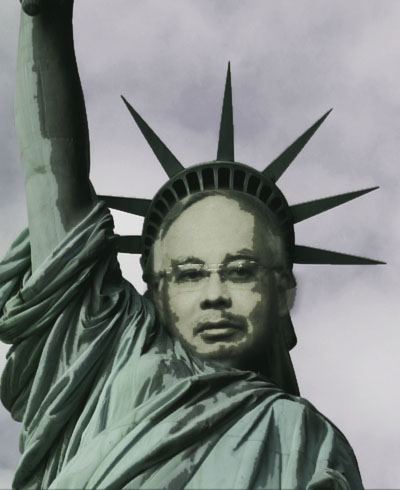
More liberty under Najib's administration? Bring it on! (Statue image source: sxc.hu)

More liberty under Najib's administration? Bring it on! (Statue pic source: sxc.hu; Najib image © thenutgraph.com)

MUCH has been said about how undemocratic the Peaceful Assembly Bill is. I beg to differ. On the contrary, three very good aspects of the Peaceful Assembly Bill have been missed by commentators. Here they are:

More religious

The Bill promotes a religious society. We all know how important religion is to ensure that we do not get discouraged by the high rate of inflation, caused entirely by the decadent West due to their blind adherence to the present Jewish financial system. By stipulating that assemblies cannot be held in a close proximity to religious places of worship, we can be sure that more effort will be put in by the government to build more places of worship, so that the space for assemblies can be restricted.

Furthermore, non-Muslims who have been facing difficulty getting approval to build places of worship can heave a collective sigh of relief because they now have one more reason to support their application. By approving more places of worship, the government will be able to restrict more places for assemblies. At long last, the objectives of the government and of the non-Muslim communities would be better aligned.

The authorities will listen to us

The Bill encourages true, participatory democracy. It used to be that our voices are only heard during election time. Once our representatives are elected, then we pretty much have no avenue to voice our grievances until and unless another election comes around.

With this Bill, we all have a positive role to play to object to assemblies that are planned near our place of business or abode. And the likelihood is that the authorities would be responsive to our objections. Can you believe how empowered we would all become? No longer will we be ignored by the authorities. Perhaps our views will even be positively solicited by them. An empowered citizenry is definitely the way to go.

No more gutter politics

The Bill will promote positive values and a positive society. We must all be sick to our stomachs with the kind of gutter politics that we see today. Enough of such nonsense, I say. Here is a Bill that specifically stipulates that in our assemblies, we are not to incite hatred, dissatisfaction or enmity in any way. No more negative politics. We now need to switch gears to only extol the virtues of our wonderful leaders.

Of course, this may pose a slight problem to the opposition, since they have no leader of virtue to speak about. But for the Barisan Nasional (BN), under whose glorious rule we continue to improve by leaps and bounds, to stand heads and shoulders above the rest of the nations of the world, this Bill is a godsend.

(Pic source: johnnyberg / sxc.hu)

(Pic source: johnnyberg / sxc.hu)

Of course, there are still the fence-sitters and naysayers who refuse to acknowledge this truth. These people need to wake up to the fact that we have even successfully defended our SEA Games football gold medal, and realise that we are definitely an up-and-coming nation.

So, kudos to the current government for leading the charge in formulating reforms for our country through the Peaceful Assembly Bill. It is undeniable that the foresight of the current cabinet is most exemplary and commendable. Why, even Barack Obama thinks so. And if Barack Obama has declared it, then who are the rest of us to argue otherwise?

Hidup BN, hidup Umno, hidup Malaysia!

Umno kini parah, akibat buatan pemimpinnya sendiri

Perhimpunan pada disember 2011 akan menjadi penebus pskologi untuk Umno sebelum ia berdean dengan pilihanraya. Ada pengkritik yang berpendapat bahawa keputusan sudah pun dibuat dan Umno tidak dapat diselamatkan. Umno sudahpun dianggap lemah dibawah kepimpinan ini.

Walaubagaimanapun, ramai dikalangan pemimpin Umno akan tetap mengutarakan retorik tidak tidak masuk akal untuk memastikan ahlinya menyokong mereka pada Pilihanraya umum ke 13 yang akan diadakan berkemungkinan besar awal tahun depan. Tidak ramai dikalangan mereka sedar bahawa kebanyakkan ahli mereka sebenarnya gundah gulana memikirkan kepimpinan parti.

Ramai ahli yang sedar bahawa tidak semuanya baik diantara parti itu dengan BN. Imej yang semakin teruk telag menyebabkan kebanyakkan ahlinya menjadi terdesak. Mereka sekarang tidak mempunyai banyak pilihan dan terus menggunakan seks, bangsa, agama dan kesetiaan untuk memenangi hati pengundi Melayu. Strategi itu juga tidak memberikan impak yang baik untuk parti untuk pilihanraya seterusnya.

Delegasi itu nanti, walaupun berasa kecewa, mungkin akan tidak menyentuh mengenai hal-hal yang penting yang merosakkan Umno kerana elemen feudal mereka akan menyebabkan wujud pendekatan laissez-affair dalam politik. Delegasi akan berkemungkinan berdiam diri kerana takut mereka akan dicela sekiranyan mereka mengkritik pemimpin.

Retorik panas daripada delegasi semasa perhimpunan itu akan menjadi seperti icing pada kek yang buruk. Tindakan mengapi-apikan sentiment agama dan bangsa hanya akan menutup kelemahan mereka seraya mengaburi pandangan ahli mereka. Ramai ahli akan tetap menghadiri persidangan tetapi mereka tetap berasa marah terhadap prestasi pemimpin Umno. Kebanyakkan pemimpin mereka sekarang ini sememangnya tidak menyinar langsung.

Mereka sedar bahawa kebanyakkan pemimpin Umno merupakan beban buat parti itu sendiri yang sudahpun berusia 55 tahun dan mereka mungkin juga mahu pembangkang menang dalam pilihanraya seterusnya supaya ini dapat menyedarkan dan membersihkan Umno. Ini adalah harapan terpendam ahli Umno memandangkan mereka tidak boleh dilihat menyuarakan kekecewaan mereka di perhimpunan itu nanti kerana takut boleh di ambil tindakan. Drama-drama dan gimik-gimik perhimpunan itu nanti akan tetap di ketengahkan oleh media kerajaan walaupun orang ramai sebenarnya tidak lagi berminat dengannya.

Menunggang kuda yang salah

Mahathir Mohamad, perdana menteri paling lama berkhidmat seperti suka menunggang kuda tetapi, beliau tidak cukup mengkaji kuda yang suka meruntuhkan tiang sosial masyarakat Malaysia. Beliau sebenarnya telah menunggang kuda yang salah iaitu Perkasa untuk membawa kejayaan kepada Umno dan BN pada pilihanraya umum tahun depan.

Mahathir sedang membuatkan kehadirannya dalam Perkasa dirasai dan mengetengahkan Najib Razak sebagai pemimpin yang lemah dan cuba sedaya upaya mengatur Umno dan BN untuk membaikpulih imej nya sebagai perdana menteri. Najib dilihat oleh ramai sebagai membawa banyak masalah personal dan psikologi bersama beliau. Beliau gagal meredakan kemelut dalam Umno dan Mahathir sedar akan perkara ini.

Mahathir lantang mengkritik polisi kerajaan yang dibuat oleh mereka yang mentadbir selepas beliau – yang dipilihnya sendiri, Abdullah Badawi. Gagal untuk menutup mulut beliau dan tidak mahu melihat Umno jatuh ibarat pokok yang buruk, beliau telah sekali lagi bersuara mengenai beberapa polisi Najib walaupun dengan rasa was-was kerana takut Najib akan jatuh dan Umno juga musnah.

Mahathir sedar bahawa masalah peribadi pemimpin, rasuah yang semakin menjadi-jadi, penyalahgunaan wang cukai, kelembapan ekonomi, ketidak-adilan dan kecekapan kerajaan akan membawa negara kepada kehancuran.

Ahli UMNO yang berharap

Mahathir merasakan bahawa jika dia terus mengkritik Najib dengan keras, UMNO akan hancur dan tidak boleh diperbaiki. Jika dia senyap UMNO akan jatuh. Pada masa-masa tertentu, Mahathir terpaksa menghadapi dilema ini – bukan sebab dia sayang Najib tetapi dia terlalu cinta pada UMNO.

Mahathir juga terhutang budi dengan Allahyarham ayahanda Najib, Abdul Razak Hussein (perdana menteri kedua Malaysia), kerana membawa dia kembali ke dalam UMNO selepas dia dipecat daripada parti pada tahun 1969 oleh Almarhum Tunku Abdul Rahman, perdana menteri pertama negara. Apa lagi, Mahathir juga tidak sanggup melihat musuh politik nombor satunya, Anwar Ibrahim, menjadi perdana menteri - sekurang-kurangnya semasa dia masih wujud. Tidak mengapa jika Anwar menjadi Perdana Menteri selepas kematian beliau. Atas sebab ini, Mahathir telah menyokong Perkasa - menunggang 'kuda' yang salah dan memikirkan bahawa pasukan UMNO yang ditolak ini boleh menyelamatkan UMNO. Beliau telah mencipta satu kesilapan besar untuk dirinya sendiri dan UMNO dengan langkah ini.

Jika dikaji selidik dalam talian ini boleh diambil sebagai penunjuk keadaan, maka UMNO akan menghadapi masalah dalam dalam pilihan raya umum akan datang. Sejumlah besar responden dari kalangan 1879 pengundi Melayu yang berpotensi dan 1657 pengundi bukan Melayu di negara ini (limitasi pengajian: Korpus hanya terdiri daripada mereka yang mempunyai akses kepada Internet) tidak berpihak kepada Mahathir, Perkasa mahupun Ibrahim Ali:

# 1 Apakah Mahathir masih relevan kepada orang Melayu? Ya (29 peratus) Tidak (68 peratus) No response (3 peratus)

# 2 Bolehkah Perkasa membantu UMNO memenangi Pilihan Raya Umum akan datang? Ya (9 peratus) Tidak (83 peratus) No response (8 peratus)

# 3 Apakah Perkasa suatu liabiliti kepada UMNO? Ya (84 peratus), Tiada (9 peratus), No response (7 peratus)

# 4 Adakah UMNO memerlukan Perkasa untuk memenangi pilihan raya umum akan datang? Ya (3 peratus), No (85 peratus), No response (12 peratus)

# 5 Adakah parti-parti komponen Barisan Nasional (di luar UMNO) selesa dengan Perkasa? Ya (1 peratus), No (94 peratus) No response (5 peratus).

# 6 Perkasa menjejaskan peluang bukan Melayu mengundi untuk Barisan Nasional (BN)? Ya (87 peratus), Tiada (3 peratus), No response (10 peratus)

# 7 Apakah Perkasa liabiliti kepada Barisan Nasional (BN)? Ya (93 peratus), Tiada (3 peratus), No response (4 peratus)

# 8 Patutkah Perkasa menjadi sebuah parti politik? Ya (18 peratus), No (54 peratus), No response (28 peratus)

# 9 Apakah Perkasa ikhlas dalam peranannya dalam menyatukan orang Melayu? Ya (5 peratus), No (86 peratus), No response (9 peratus)

# 10 Adakah Perkasamemcahbelahkan orang Melayu lebih daripada menyatukan mereka? Ya (79 peratus), No (11 peratus), No response (10 peratus)

# 11 Adakah Melayu selesa dengan Perkasa? Ya (9 peratus), No (79 peratus), No response (12 peratus)

# 12 Adakah bukan Melayu selesa dengan Perkasa? Ya (2 peratus), No (95 peratus), No response (3 peratus).

# 13Patutkah UMNO berbaik-baik dengan Perkasa untuk mendapatkan semula undi Melayu? Ya (8 peratus), No (83 peratus), No response (9 peratus)

# 14 PAtutkah UMNO menjauhkan diri daripada Perkasa? Ya (87 peratus), Tiada (6 peratus), No response (7 peratus).

# 15 Bolehkah sekiranya Perkasa menjadi satu platform yang lebih baik untuk orang Melayu berbanding UMNO, PAS atau PKR? Ya (4 peratus), No (89 peratus) No response (7 peratus).

Najib dilihat sebagai pemimpin yang lemah

Bertentangan dengan apa yang Mahathir fikirkan mengenai dirinya, kebanyakan pengkritik melabelkan beliau sebagai dinasor dalam politik Malaysia. Kepada rakyat, beliau telah dianggap sebagai sudah melepasi jangka hayat politik beliau, konservatif, tua dan tidak relevan.Mahathir yang keras kepala masih belum mahu menarik brek politiknya walaupun dengan usia tuanya itu dan selepas meninggalkan kerajaan 8 tahun yang lalu – dan ini lebih mengecewakan beberapa pemain muda dalam UMNO, seperti Khairy Jamaluddin.

Banyak lagi dalam UMNO yang tidak berada dalam buku baik beliau, tidak cukup gembira kerana Mahathir mati terhadap mereka. Najib, yang dilihat sebagai pemimpin yang lemah, tidak mempunyai pilihan lain tetapi sedang berhati-hati supaya tidak menyinggung perasaan Mahathir, kerana dia mampu membawa kembali apa yang telah berlaku kepada pendahulunya, Abdullah, perdana menteri kelima Malaysia. Namun, akhir-akhir ini, Mahathir telah agak terganggu dengan beberapa keadaan yang tidak menyenangkan yang berlaku dalam UMNO. Kepada kepimpinan yang ada sekarang, Mahathir tidak akan teragak-agak untuk memberi petunjuk bahawa bagi setiap lelaki yang 'gagal', ada seorang wanita.

UMNO kini dilihat oleh rakyat Malaysia sebagai parti yang lemah dan bersandar sepenuhnya kepada Perkasa untuk memenangi sokongan Melayu yang telah hilang. Sebaliknya, Perkasa, telah dengan jayanya membawa perkauman seraya memberi imej buruk kepada UMNO. UMNO telah membuat kesilapan besar dalam politik dengan memberi gambaran kepada rakyat bahawa Perkasa adalah pasangan sejiwa parti itu dan ini telah menimbulkan kemarahan MCA, MIC dan Gerakan.

Oleh itu, Perkasa bukanlah aset kepada UMNO, ia telah memakan diri sendiri dan ini membuatkan imej BN terjejas dengan teruk. Perkasa - sebuah organisasi yang tidak penting dalam politik Malaysia - juga ditolak pihak yang berpendirian sederhana di dalam UMNO. UMNO dan Barisan Nasional (BN) akan kehilangan undi penting dalam pilihan raya umum akan datang jika Perkasa dibiarkan berbuat sesuka hati dan Mahathir berterusan merungut tentang rasa tidak puas hati mengenai hal-ehwal UMNO.

Mahathir silap dalam analisisnya pada tahun 2008 mengenai hasil pilihan raya umum. BN mengalami kekalahan teruk dalam pilihan raya umum 2008 bukan kerana perpecahan Melayu tetapi orang Melayu sebenarnya bersatu dalam melumpuhkan BN kerana keangkuhan dan ketidakcekapannya.Keputusan pilihan raya bukan sahaja menunjukkan kehadiran perpaduan Melayu di negara ini tetapi juga perpaduan Malaysia yang menjadi petanda baik bahawa Malaysia adalah untuk semua orang.

BN menyerahkan 82 kerusi persekutuan dan lima kerajaan negeri kepada pembangkang dalam pilihan raya Mac 2008 dan ini telah mencerminkan demokrasi yang sihat di negara ini yang dalam jangka masa panjang akan membawa keadilan politik yang lebih baik kepada negara. Kelihatan seperti bukan sahaja sejumlah besar orang Melayu tidak akan menyokong UMNO, malah kebanyakan daripada kumpulan etnik yang lain juga tidak akan mengundi BN pada pilihan raya umum akan datang.

Rakyat Malaysia akan menjadi Bangsa Malaysia

Pilihan raya umum akan datang akan menyaksikan sekali lagi undi perpecahan di kalangan semua kaum di negara ini. Kaum atau agama tidak akan menjadi kriteria utama yang akan menentukan gabungan yang akan mendapat kemenangan. Isu-isu yang akan mempengaruhi keputusan pilihan raya umum yang akan datang adalah ekonomi, rasuah, kadar jenayah yang semakin meningkat, sistem pendidikan yang lemah dan kos hidup yang tinggi. Bangsa dan agama tidak akan menjadi pembolehubah yang penting dalam menentukan gerak balas pengundi. Rasuah, skandal, kepura-puraan di kalangan pemimpin dan keangkuhan – adalah sesuatu yang biasa di kalangan pemimpin-pemimpin UMNO dan BN – inilah yang akan membawa rakyat pelbagai kaum dan agama untuk bersama-sama menggulingkan tuan-tuan politik yang sedia ada di peringkat persekutuan.

Sekali lagi, orang bukan Islam tidak akan teragak-agak untuk mengundi PAS dan orang Melayu juga tidak ragu-ragu untuk mengundi calon-calon yang bukan Islam kali ini. Penekanan secara tiba-tiba Mahathir dan Ketuanan Melayu tidak akan berjaya kerana orang ramai melihat ini sebagai helah politik UMNO untuk terus berkuasa dan kekal angkuh. Atas alasan ini, kelihatan seperti rakyat Malaysia akan menjadi Bangsa Malaysia, yang tidak henti-henti dicanangkan oleh Mahathir semasa tempoh beliau sebagai Perdana Menteri dan idea beliau ini didokumenkan dalam Memoirs (2011). Mahathir seharusnya berasa gembira melihat visi beliau yang akan menjadi kenyataan - Bangsa Malaysia - kini menjadi kenyataan selepas beliau tidak lagi menjadi perdana menteri negara:

"Kita perlu mewujudkan satu bangsa Malaysia yang bersatu padu. Walaupun lahir dari pelbagai kaum, semua rakyat Malaysia telah melihat diri mereka sebagai rakyat dari negara yang sama.Walaupun berbeza asal-usul kita, kita menuju ke arah yang sama. Kita juga mungkin berbeza dari segi politik tetapi kesetiaan dan dedikasi kepada negara tidak tergugat. Kami semua, tanpa pemisah atau had, sebahagian daripada satu Bangsa Malaysia - satu umat Malaysia, satu tapi pelbagai "(p597-8).

UMNO perlu undi bukan Melayu sepertimana ia memerlukan undi Melayu, UMNO tidak boleh dilihat sebagai parti Melayu 'unggul' seperti yang Perkasa atau Mahathir mahukan.UMNO telah mengambil petunjuk dari PAS, PKR dan DAP di mana pemimpin-pemimpin mereka secara rasional berpendapat bahawa parti-parti politik harus memenuhi keperluan masyarakat yang berbilang kaum walaupun terdapat kepelbagaian dalam bangsa atau agama.

UMNO menolak Perkasa yang membuang masa mereka memperjuangkan isu-isu perkauman yang mungkin relevan dalam tahun 1940-an tetapi tidak dalam era ini. Ektrimis kaum juga harus sedar bahawa bangsa Melayu bukanlah baka tulen. Mereka banyak bercampur-campur dan sebahagian besar daripada mereka lebih toleransi kepada orang-orang berbilang kaum dan beragama lain. Orang-orang Melayu moden tidak melihat pada bangsa atau agama sebagai perkara-perkara yang penting dalam politik. Mereka kini mencari pendidikan, ekonomi dan kerajaan yang bebas rasuah untuk membawa Malaysia ke arah di mana semua rakyat akan mempunyai peluang yang sama dalam masyarakat.

Bangsa dan agama tidak akan memberi banyak kesan dalam politik semasa pilihan raya umum akan datang. Malangnya, UMNO, Perkasa, dan Mahathir ketinggalan dalam pemikiran politik mereka. Pluralisme atau perpaduan di dalam kepelbagaian ini yang lebih dikehendaki oleh generasi sekarang- orang Melayu dan rakyat Malaysia secara umum.

Bangsa Melayu telah berubah menjadi orang-orang yang matang

UMNO, PAS dan PKR mungkin tidak mempunyai masalah untuk menarik ahli-ahli komuniti yang berbakat. Melayu tidak hidup dalam kepompong seperti pada tahun 1950-an 'atau sebelum itu. Bangsa Melayu telah berubah menjadi orang-orang yang matang yang sanggup untuk menampung mana-mana parti politik yang boleh membawa kepada sebuah kerajaan yang bersih rasuah.

Pilihan raya umum dijangka akan diadakan sekitar awal tahun depan – akan menjadi suatu tugas yang sukar bagi BN untuk mengekalkan Putrajaya. Untuk BN memperoleh dua pertiga majoriti seperti biasa adalah agak sukar untuuk direalisasi. Ada kemungkinan bahawa BN akan kalah dalam pilihan raya ini dengan majoriti mudah. Rakyat berwajah baru - orang Melayu Cina, India dan Orang Asli sudah bersedia untuk memperbaharui politik dan tadbir urus negara. UMNO dan BN akan berakhir dan menjilat luka-luka mereka sebelum mereka boleh kembali dalam pilihan raya umum masa depan, dan kali ini mungkin dengan pasukan yang lebih bersih.

Sistem dua parti kini semakin serasi dengan jiwa rakyat Malaysia dan ini membimbangkan pemikir UMNO lebih daripada ahli-ahli biasa. Apabila pembangkang semakin popular di kebanyakan negeri, ahli-ahli UMNO akan lebih fokus kepada imej mereka daripada menyatukan parti.

Berjuta-juta ringgit dibazirkan untuk membina imej dan wang yang dibelanjakan untuk rakyat asing untuk tujuan ini mungkin lebih baik digunakan untuk membantu rakyat. Semua akronim hebat untuk pembaharuan ekonomi dan mengherankan minda mereka yang seperti Warren Buffett dan Carlos Slim - belum diterjemahkan ke realiti selepas hampir empat tahun UMNO / BN menjadi kerajaan. Mahathir sedar bahawa tiada apa-apa yang nyata berlaku dalam ekonomi. Apabila tidak banyak langkah yang telah diambil dan ini mengingatkan rakyat Malaysia kepada pemimpin yang terdahulu - Abdullah - yang sedang tidur semasa tugasnya selama hampir dua penggal sebagai Perdana Menteri.

Tiada cara untuk atasi kelemahan

UMNO sangat kuat rasuah sehinggalah ke terasnya kata Mahathir. UMNO akan kucar-kacir dan pilihan raya umum akan datang akan menyaksikan parti itu kehilangan lebih banyak kerusi kepada Pakatan. Terdapat puak dan perbalahan dalaman dalam parti. Ramai yang mengintai peluang menjadi pemimpin-pemimpin cawangan. Terdapat ramai yang mengharapkan UMNO untuk membawa masuk wang dan kontrak untuk mereka.

Laporan Ketua Audit Negara bagi tahun-tahun yang lepas telah menunjukkan bagaimana wang pembayar cukai telah dengan cuai dibelanjakan. Pesalah rasuah telah dilepaskan untuk memelihara imej UMNO dan kerajaan. Dana yang sepatutnya digunakan untuk menghasilkan daging lembu berakhir dengan pembelian kondominium untuk 'lembu suci', begitu juga percutian dan melaksanakan Umrah. Kemelut RM250 juta NFC telah menarik minat yang meluas dikalangan orang awam dan kekecewaan mereka. Pemimpin pula senyap mengenai isu ini.

Tiada siapa dalam UMNO akan mempersoalkan perkara ini kerana setiap ahlinya mempunyai aspirasi untuk menjadi kaya melalui parti. Dari membeli mi Maggie ke kapal selam, rakyat melihat wang pembayar cukai telah disalahguna. Najib terlalu sibuk membina imej peribadinya sehinggakan beliau tiada masa untuk memastikan dana awam dibelanjakan dengan betul.

Mahathir juga bukan penyelesaian untuk UMNO kerana beliau dilihat sebagai orang di belakang kumpulan ekstrimis - Perkasa. MCA, MIC dan Gerakan tidak menyukai Mahathir kerana dilihat mereka sebagai berdiri di atas nama bangsa. UMNO juga secara beransur-ansur menjadi lebih tidak relevan kepada nasib orang Melayu tulen atau pribumi disebabkan campuran India Muslim, Arab, Indonesia dan banyak bangsa asing lain.

Banyak cawangan UMNO kini diketuai oleh mereka yang berfikiran wang dan sesetengah daripada mereka bukanlah Melayu tulen atau yang Asli. Perhimpunan Agung UMNO yang akan diadakan Disember ini akan menyaksikan satu protes senyap daripada wakil-wakil terhadap pemimpin-pemimpin mereka yang sedia ada kerana mereka mempunyai firasat bahawa UMNO dan BN akan mempunyai harapan yang sedikit untuk menang dalam pilihan raya umum akan datang.

UMNO meninggal dunia akhirnya

Kali ini perwakilan UMNO perlu bimbang mengenai imej kendur parti tersebut. Pilihan raya umum akan datang akan melihat sistem dua parti berbalah untuk kuasa yang boleh membawa kepada kematian akhirnya. Kerajaan yang mengamalkan rasuah pasti tidak akan menjadi pilihan rakyat dalam pilihan raya umum akan datang.

Perhimpunan Agung UMNO pada bulan Disember tidak syak lagi akan menjadi suam-suam kuku kerana delegasi takut membangkitkan isu yang menyelebungi parti itu dan memikirkan penyelesaian untuknya. Perwakilan akan menghadiri perhimpunan itu dengan perasaan teragak-agak kerana mereka tidak akan mampu untuk meluahkan rasa tidak puas hati mereka. Seolah-olah mereka tidak gembira dengan kepimpinan mereka dan akan teragak-agak untuk menyuarakan ketidakpuasan hati mereka.

Pelantikan menteri kebanyakkan melalui pintu belakang telah mengecewakan banyak ahli UMNO. Mereka juga melihat pelantikan Ezam Mohd Nor dan Nallakarupan KS - sebagai senator sebagai helah politik untuk menyelamatkan kepimpinan atasan lebih daripada segala-galanya. Ini telah menghina kebijaksanaan kebanyakkan ahli-ahli UMNO dan rakyat Malaysia biasa, dan dianggap oleh rakyat sebagai satu pembaziran wang pembayar cukai.

Ekonomi terus lemah dengan kos sara hidup meningkat. Berjuta-juta ringgit yang dibelanjakan untuk membina imej pemimpin disia-siakan dan tidak memihak kepada akar umbi. Pengundi juga tidak gembira dengan rasuah yang berleluasa dalam kerajaan dan politik berat sebelah dan pilih kasih yang berlaku di dalam BN serta memburukkan imej Umno.

Dalam UMNO, minda Melayu agak feudal dan kebenaran tidak dapat diucapkan secara langsung, terutama apabila ia menyentuh tentang orang-orang diperingkat tertinggi dalam hierarki politik atau sosial. Mereka akan menyimpannya seperti bom masa dalam perasaan dalaman mereka sehingga pilihan raya umum akan datang ia akan meletup. Ramai ahli UMNO akan mengundi pembangkang seperti apa yang mereka lakukan pada tahun 2008 – inilah satu-satunya cara untuk memperbaiki akhlak UMNO dan BN mengenai politik dan tadbir urus yang sepatutnya.

Malaysia Chronicle

Najib’s “clarification” is proof that PAB is the worst and most slipshod bill in 54-year parliamentary history

The Prime Minister, Datuk Seri Najib Razak’s last-minute clarification today of the Peaceful Assembly Bill (PAB) is testimony that the PAB is the worst and most slipshod bill ever drafted in the 54-year history of Malaysian Parliament as well as raising questions about Najib’s bona fides in political reforms and transformation.

Najib blamed Pakatan Rakyat (PR) for “confusing” the public with regard to the 30-day notification requirement.

He said:

“Actually the wording is within 30 days, it can be within five or 10 days but that word led to so much confusion so we decided that 10 days to be specific, so that there will be no doubts.” (The Malaysian Insider)

Najib said the previous 30 days’ notification did not mean a month’s notice was needed.

Najib’s ”clarification” is utterly ridiculous. In fact, Najib is presenting a sorry public spectacle of a Prime Minister who does not know what he is talking about, and even worse does not understand the content of the Bill he introduced in Parliament on Thursday though he described it as “revolutionary”.

It is a terrible reflection of the quality of leadership and governance in Malaysia that the Prime Minister can be so badly advised as to the Bill he presented in Parliament as to cause the Prime Minister to totally mislead Parliament and the country about its import and implications.

I do not believe that Najib has deliberately told a lie about the PAB, but clearly he had been told a lie by his advisers causing him to spread a lie!

I challenge Najib to explain how he could claim that under the PAB, before the proposed amendment tomorrow to reduce the 30-day notice requirement to 10 days, it would be possible to organise an assembly “within five or 10 days”?

Let us take a hypothetical case. Say an organiser wants to hold an assembly on 30th December 2011.

Clause 9 (1) of the PAB on “Notification of assembly” provides:

“An organizer shall, within thirty days before the date of an assembly, notify the Officer in Charge of the Police District (OCPD) in which the assembly is to be held”.

Can Najib explain how the organiser could comply with the PAB if he gives notice to the police “within five or 10 days”, i.e. from 20th December or 25th December?

This is clearly impossible because Clause 12 requires the OCPD concerned to inform “persons who have interests” within 48 hours of the assembly notification and who have five days to communicate to the Police their “concerns or objections to the assembly”. This would have taken up seven days – exceeding the five-day claim by Najib that a proposed assembly could be held.

Under Clause 14, the OCPD has to respond to the notification of assembly within 12 days. Clause 16 provides four days for the right of appeal of the organiser to restrictions and conditions imposed by the police to the Home Minister, who has six days to give his decision.

This means that the quickest an organiser will know about the outcome of his notification of an assembly on Dec. 30 is 12 days after submission of notification, provided the police does not impose restrictions and conditions.

If there are police restrictions and conditions followed by appeal to the Home Minister, the quickest an organiser can clear the bureaucratic notification process is 22 days.

This means that an organiser must give notification at least 22 days before the proposed assembly date or he may not be able to complete the maximum of 22-day bureaucratic notification process.
The words “within thirty days before the date of an assembly” in Clause 9(1) is utterly misleading and meaningless and is no help to Najib to explain how an assembly under the PAB could be held “within five to 10 days”.

Najib should not blame the Pakatan Rakyat for the atrocious PAB drafting but the parliamentary draftsmen, the Attorney-General and his legal officers, as well as the entire Cabinet who have proven to be sleeping on their jobs.

Najib said that under the PAB: “The Peaceful Assembly Act is divided into two categories, for designated areas, they only need to inform the police and there will be people to supervise even if it’s on a short notice.

“For non-designated areas, then it will require a 10-day period so the police can negotiate with the local community to get their views.” (Malaysiakini)

Here is further testimony of the atrocious drafting of the PAB. Where does the PAB say that the police must be informed for assemblies to be held in designated areas? The PAB is silent on the matter.

Najib is offended at the comparison with Myanmar but can he explain why Myanmar can pass a law on freedom of assembly requiring only five days’ notice but Malaysia needs 10 days’ notice?

In actual fact, if Article 10 of the Constitution guaranteeing freedom of assembly as one of the fundamental rights of Malaysians is to have real meaning, the government should not be designating permissible places of assembly, as all areas should be open to Malaysians to exercise their right to freedom of assembly – except for certain designated areas declared/gazetted “out of bounds” for security and other considerations.

The “designated areas” should be places where freedom of assembly is not allowed rather than where freedom of assembly is permitted.

Najib has only provided more grounds why there should be no indecent haste to force through the passage of PAB in Dewan Rakyat tomorrow and that it should be referred to a Parliamentary Select Committee for full, meaningful and mature consultation, consideration and consensus.

FAQs on Peaceful Assembly Bill 2011

ImagePlease click here to see the "FAQs on Peaceful Assembly Bill 2011" prepared by Bar Council's Constitutional Law Committee, as well as a comparison between section 27 of the Police Act 1967 (current law on assemblies) and the Peaceful Assembly Bill 2011 (which is meant to replace section 27).

Please click here for the Bahasa Malaysia version (Rang Undang-undang Perhimpunan Aman 2011: Soalan-soalan Lazim).

You can also click on the links below to view the:

(1) Bar Council press release entitled “Peaceful Assembly Bill is more restrictive than present law and must be improved” issued on 22 Nov 2011;
(2) Bar Council press release entitled “Broken promise: Prime Minister has not lived up to Malaysia Day 2011 pledge” issued on 24 Nov 2011;

Bridge Collapse Death Toll Rises To Eleven, 34 Still Missing

By Ahmad Fuad Yahya

JAKARTA, Nov 28 (Bernama) -- The number of people killed in a bridge collapse in East Kalimantan Saturday has risen to 11 after more bodies were recovered by search-and-rescue teams Monday, according to police.

The Indonesian police headquarters here also said that 34 people are still missing.

Its public relations division chief, Inspector General Saud Usman Nasution, told a press conference here that 34 people were injured in the incident.

The Kutai Kartanegara Bridge collapsed at about 4.30 pm (5.30 pm in Malaysia) on Saturday during heavy traffic, resulting in vehicles falling into the Mahakam river.

The 710-metre long bridge was one of the longest suspension bridges in Indonesia. Its suspended section was 270 metres long.

The design of the bridge is similar to that of the Golden Gate Bridge in San Francisco, United States.

Built in 1995 and completed in 2001, the bridge was among the most important links for the land route between Tenggarong and Samarinda and Balikpapan in East Kalimantan.

Many people were shocked at the collapse of the bridge which was only 10 years old.

Monday, 28 November 2011

Scarred and scared, these Pakistani Hindus seek refuge in India

New Delhi, Nov 27, (IANS): Sitting hunched with his face cupped in his hands, 42-year-old Shobhamal dreads going back to Pakistan's Sindh province where he has earned the status of a pariah and ''bore the brunt of being a non-Muslim''.

A group of 146 Pakistani Hindus took refuge at capital's Majnu ka Tilla Sep 8 after crossing the Attari border Sep 4.

"I don't fear for my life but for my family. I decided to come here as there is no place for Hindus in Pakistan. Sexual assault, forced conversion, abduction and humiliation is all this country (Pakistan) has given us," Shobhamal told IANS.

Shobhamal's 18-year-old son died of cancer here earlier this month. 

With their tourist visas expired some two months ago, these people from Bagidi community are reluctant to go back to Sindh where, they say, there is no security of their life and property.

Hindus form around seven percent of the total population of Sindh province.

"We don't want to go back. We are outcast there. We appeal to the government that please just give us refuge and we don't want any citizenship," rues 45-year-old Ganga Ram.

Gang Ram has written to Prime Minister Manmohan Singh, requesting extension of their visas and shelter.

They are currently living in 12 tents and share one dilapidated toilet -- but say they don't have much complaints.

"We are happy here. Though life is tough here, it's not an ordeal what it used be in Pakistan. There, you bear the brunt of being non-Muslims," said Sagar, a mechanic, who was robbed of all his tools with which he used to make his ends meet.

"They force us to convert to Islam and threaten of dire consequences. They abduct our children  and loot our property. If we complain, nobody listens. There, even the prime minister is not safe, let alone Hindus," says Mithalal, who is in his 50s.

When this IANS correspondent tried to speak to the women in the community, a sense of reluctance took over. However, a few narrated their ordeal, after much convincing. 

"When our husbands are away for work, we keep our doors locked and live in constant fear. We are not allowed to wear vermillion on our foreheads," said Rukmini.    
            
"We don't eat our food until our children come back as you never know they might be kidnapped or circumcised," said a woman, refusing to reveal her identity.

Kit Siang warns of ‘disaster’ if assembly law passed

KUALA LUMPUR, Nov 28 — Lim Kit Siang warned Datuk Seri Najib Razak today of a “political disaster” if he insists on pushing the Peaceful Assembly Bill through Parliament without public consultation.

Echoing calls from civil society groups and other opposition lawmakers, the senior DAP MP said Najib should withdraw the Bill before tomorrow’s debate and form a parliamentary select committee (PSC) to look into public recommendations for amendments.

“Najib should be forewarned that he is heading for another political disaster after his July 9 Bersih 2.0 misjudgment if he rejects the proposal for a PSC on the Bill,” Lim (picture) said in a statement.

“I call on him to reconsider the decision to force the Bill through all three readings in the Dewan Rakyat tomorrow as it will be proof that he has not learnt the lessons of his massive misjudgment and mishandling of the July 9 rally,” he added.

Najib mooted the new law to regulate public gatherings following international condemnation over his administration’s handling of Bersih 2.0’s march for free and fair elections.

Just days after it was tabled, however, his Cabinet agreed to amend several contentious provisions in the Bill after complaints that it would further restrict individual freedom.

But Pakatan Rakyat (PR) and several civil society groups, including Suhakam, Bersih 2.0 and the Bar Council, have vowed to continue protesting the Bill, insisting that it go back to the drawing board to include public recommendations.

Lim complained that Clause 16 of the Bill accords the home minister powers as the “final arbiter” to decide if an assembly could be held.

He said such powers should lie in the hands of the judiciary, similar to the Queensland Peaceful Assembly Act 1992, which he said Malaysia’s proposed law is modelled after.

“The Australian home minister and the various Australian state police ministers have no role whatsoever in the decision-making process on freedom of assembly in Australia.

“This is why more time must be given not only to MPs but to civil society, human rights groups and all concerned Malaysians to study the implications of the very badly drafted Bill by referring it to a PSC,” he said.

Lim reminded the government of complaints against bias and discrimination by the police that was listed in the Dzaiddin Police Royal Commission Report, saying that since its findings were released in 2005 public confidence still remained low.

Among the complaints, he said, were that permits granted to opposition parties and NGOs deemed as anti-establishment had come with numerous “ridiculous” conditions.

“There were also complaints that the police do not seem to be neutral and impartial in the granting of permits, as would appear to be the case from their alleged numerous refusals of permits to opposition political parties and organisations perceived to be linked to them.

“There were also allegations that those attending the events were arrested and questioned as to why they did so and why they expressed opposition towards the government,” he added.

But despite the report findings, said Lim, the police have yet to earn respect as an “independent, incorruptible and professional” force.

Interlok dan Siru Kambam (Bahagian 2)

Mampukah tiga wakil dalam faksyen ini berjuang menegakkan tuntutan yang disuarakan penduduk kampung berkenaan?
“Mengapa pengukir veteran itu begitu bodoh? Mengapa dia begitu mudah mengakui kesilapan? Tak bolehkah duduk diam di rumah?”
Demikian bentak wakil Perpena yang mengadakan pertemuan tertutup bersama ketua panchayat di rumahnya.
“Ini adalah soal maruah para pengukir di Siru Kambam! Kita tidak boleh tunduk kepada tuntutan penduduk yang mendesak berhala itu dipinda atau ditukar semata-mata kerana menghina agama Hindu!”
Demikian pula hujah sekutu Perpena yang hadir sama mewakili beberapa pertubuhan bukan kerajaan (NGO).
Akhirnya, keputusan diambil untuk menyembunyikan surat yang diberikan oleh pengukir veteran kepada ketua panchayat. Pengukir yang sedang uzur itu diarah menutup mulut dan tidak mengeluarkan sebarang kenyataan.
Seperti yang saya nyatakan sebelum ini, satu jawatankuasa khas dibentuk dan ia bersidang pada Februari 2011 untuk mengemukakan saranan pindaan yang perlu dilakukan pada berhala Dewa Shiva.
Pada waktu itulah muncul seorang pakar ikonografi yang kurang dikenali masyarakat umum selama ini.
Dia bersama-sama dua lagi pakar bidang – seorang pensyarah Kolej Siru Kambam dan seorang bekas jawatankuasa pentadbiran kuil – dilantik menganggotai jawatankuasa khas berkenaan mewakili penduduk beragama Hindu di Siru Kambam.
Ikonografer itu bersama-sama kumpulan yang diketuainya sudah mula mengumpul pelbagai maklumat berkaitan berhala Dewa Shiva yang menjadi kontroversi sejak Januari lalu.
Maka, dia bersama-sama dua lagi anggota dalam jawatankuasa khas mula memantapkan senarai saranan pindaan yang perlu dilakukan terhadap berhala Dewa Shiva sekiranya ia mahu terus ditempatkan di Kuil Sivaperuman.
Kalau dahulu hanya alat sulit berhala yang menjadi isu, pakar ikonografi pula berjaya mengesan 16 pindaan yang perlu dilakukan pada patung itu sebelum ia layak diangkat sebagai berhala.
Daripada ikonografer itulah saya mendapat tahu bahawa pengukir veteran tersebut ada menyerahkan surat rasmi kepada ketua panchayat.

Balasan pedas

Maklumlah, pakar ikonografi itu mengenali keluarga si pengukir veteran sejak dahulu.
Cuma, katanya, maklumat mengenai surat itu didiamkannya kerana mahu melihat setakat mana Perpena dan sekutunya sanggup memanipulasi keadaan demi kepentingan peribadi.
Kesemua 16 saranan pindaan yang dikemukakan itu dibahas, dihujah dan akhirnya diterima sebulat suara oleh kesemua anggota jawatankuasa khas yang dilantik ketua panchayat.
“Ah! Dulu, wakil PPI hanya mampu tertunduk apabila mendengar segala hujah kami. Kamu ini pula biadab dan berani bersuara,” tegas salah seorang wakil sekutu Perpena yang turut menganggotai jawatankuasa berkenaan.
“Maaf, saya bukan wakil PPI dan saya juga bukan menerima lantikan daripada ketua panchayat untuk duduk diam seperti pak turut.”
Demikian khabarnya balasan pedas yang diberikan oleh ikonografer berkenaan pada akhir mesyuarat jawatankuasa itu.
Pada Mac 2011, ketua panchayat yang turut meneliti dan meluluskan kesemua 16 saranan pindaan itu mengumumkan kepada para penduduk Siru Kambam bahawa pindaan akan dilakukan.
“Seperti yang saya tegaskan lebih awal, berhala Dewa Shiva akan kekal di Kuil Sivaperuman. Bagaimanapun, sehingga kesemua 16 pindaan ini dilakukan, berhala itu tidak akan digunakan bagi tujuan sembahyang.”
Demikian diumumkan ketua panchayat walaupun sekutu Perpena yang ada agenda tersendiri masih tidak berpuas hati.
Kemudian, pada Jun lalu, timbul sedikit kekecohan berikutan pengumuman yang dilakukan pembantu kepada ketua panchayat.
“Kita tak ada masa nak lakukan pindaan pada seluruh berhala. Kita hanya akan gunakan pelekat khas atau kondom untuk menutup anggota sulit Dewa Shiva. Selepas itu, penganut agama Hindu di Siru Kambam boleh menyembah berhala itu seperti biasa.”
Kenyataan itu diselar pakar ikonografi dan kumpulannya yang memang lantang bersuara.
“Apa yang dipersetujui sebulat suara oleh jawatankuasa khas pada Februari lalu dan kemudian diluluskan juga oleh ketua panchayat adalah bahawa kesemua 16 pindaan akan dilakukan. Pastikan kesemua pindaan dilakukan atau gantikan berhala itu dengan berhala lain oleh pengukir veteran berkenaan.”
Pembantu kepada ketua panchayat tidak memberikan sebarang jawapan balas. Khabarnya, kenyataan awalnya itu dibuat sebagai usaha meninjau sama ada penduduk Siru Kambam masih ingat akan apa yang dijanjikan oleh ketua panchayat semasa persidangan rasmi di bawah pohon beringin pada Mac lalu.
Upacara ritual
Kemudian, menyedari bahawa sekurang-kurangnya kumpulan kecil yang diketuai ikonografer itu mempunyai daya ingatan yang sangat menakjubkan dan sukar dimanipulasi, panchayat sekali lagi mengumumkan bahawa pindaan penuh akan dilakukan seperti dijanjikan.
Beberapa individu dari luar – seperti si pemilik kedai buku yang bercuti di Siru Kambam setiap tahun – mengatakan bahawa isu berhala Dewa Shiva di Kuil Sivaperuman hampir sama seperti kontroversi novel Interlok Edisi Murid.
“Oh, tidak! Kontroversi novel Interlok Edisi Murid melibatkan pelbagai pihak pada peringkat kebangsaan,” saya segera memintas. “Isu itu melibatkan Kementerian Pelajaran, Menteri Pelajaran, Perdana Menteri, Barisan Nasional, Umno, MIC, Gabungan Persatuan Penulis Nasional Malaysia (Gapena) dan sekutunya, Dewan Bahasa dan Pustaka (DBP) serta pelbagai pihak pada peringkat tertinggi.”
“Bukankah isu berhala ini juga hampir sama?” Tanya pekedai buku itu yang mula-mula datang ke kampung kami selepas membaca buku Unknown Facts About Little Known Siru Kambam.
“Ini cuma isu setempat yang melibatkan panchayat, PPI Siru Kambam, Persatuan Pengukir Berhala (Perpena) dan penduduk di sini. Mustahil dapat disamakan dengan suatu isu nasional yang khabarnya turut dibawa kepada perhatian Yang di-Pertuan Agong!”
Pada Disember 2011, upacara kumbhabhishekam harus diadakan sebagai ritual tahun ini. Maka, berhala Dewa Shiva sepatutnya sudah siap menjalani proses pindaan seperti dipersetujui.
Khabarnya, pindaan sudah dilakukan tetapi tidak secara menyeluruh. Daripada sejumlah 16 pindaan yang dipersetujui sebulat suara oleh jawatankuasa khas dan kemudian diperakukan ketua panchayat, hanya tiga pindaan dilakukan.
Maka, apabila mulastanam di Kuil Sivaperuman dibuka nanti dan penduduk beragama Hindu di Siru Kambam datang untuk bersembahyang, mereka dijangka mendapat kejutan besar!
Saya bertanya kepada pakar ikonografi mengenai perkara itu. Katanya, dia sendiri belum berpeluang melihat berhala Dewa Shiva selepas pindaan dilakukan.
“Tetapi bukankah presiden PPI Siru Kambam baru-baru ini mengatakan bahawa pindaan terbabit sudah diteliti dan pihaknya berpuas hati?” Saya bertanya dengan hairan.
Ikonografer itu tidak menafikan kemungkinan PPI diberi peluang melihat dan meneliti berhala Dewa Shiva yang sudah menjalani proses pemurnian seperti dipersetujui.
“Bagaimana dengan tiga individu – termasuk saudara – yang dilantik mewakili penduduk beragama Hindu di Siru Kambam?”

Dewa Shiva yang belum dimurnikan

Pakar ikonografi itu sekali lagi tidak menafikan kemungkinan pensyarah Kolej Siru Kambam dan bekas jawatankuasa pentadbiran kuil yang dilantik mewakili penduduk beragama Hindu diberi peluang melihat dan meneliti berhala berkenaan yang sudah selesai dimurnikan.
“Bagaimana dengan saudara?” Saya bertanya.
“Sewaktu ditunjukkan kepada saya pada Ogos lalu, kurang daripada empat pindaan sahaja dilakukan. Mungkin pindaan selebihnya sudah selesai sekarang,” katanya dengan nada optimis.
“Tapi saudara belum melihat berhala itu selepas semua kerja pemurnian selesai?”
“Tidak.”
“Dan saudara tidak menandatangani sebarang dokumen mengatakan bahawa saudara sudah meneliti berhala itu dan berpuas hati dengan segala pindaan yang dilakukan?”
“Tentu sahaja tidak!”
Maka, saya sudah boleh membayangkan apa yang bakal berlaku apabila pintu mulastanam di Kuil Sivaperuman dibuka nanti.
Para penduduk beragama Hindu akan tetap terkejut melihat berhala Dewa Shiva yang belum dimurnikan seperti dijanjikan.
Apabila dipersoalkan, Perpena dan ketua panchayat akan menuding ke arah presiden PPI Siru Kambam.
Presiden PPI pula akan menuding ke arah si pensyarah Kolej Siru Kambam dan bekas jawatankuasa pentadbiran kuil yang khabarnya sudah menandatangani dokumen rasmi yang disediakan PPI.
Ya, isu novel Interlok Edisi Murid (mungkin) sudah selesai tetapi lingkaran syaitan – vicious circle – melibatkan berhala Dewa Shiva nampaknya akan berterusan di Siru Kambam.

Turut baca:

Interlok dan Siru Kambam (Bahagian 1)
Uthaya Sankar SB adalah presiden Kumpulan Sasterawan Kavyan yang diasaskan pada 1999. Pengarang ini menulis secara profesional sejak 1992 dan sering diundang ke program sastera di dalam dan luar negara. Beliau memblog di www.uthayasb.blogspot.com.