Share |

Sunday, 22 May 2011

What now for boat people?

The Star 
by SHAILA KOSHY and RASHVINJEET S. BEDI

The asylum seeker-refugee swap Australia has proposed with Malaysia has raised concerns about the fate of those who are coming here.

FREEDOM from persecution and war is a powerful motivator that makes thousands uproot loved ones or break up their families to leave their home countries in search of asylum every year.

The journey is costly and fraught with danger and at the end of it, asylum seekers face the possibility of repatriation, being thrown behind bars or stuck in immigration detention centres for years.

On March 28, the office of the United Nations High Commissioner for Refugees (UNHCR) in Geneva reported a dramatic fall in the number of asylum seekers in the industrialised world over the last 10 years. It fell from 620,000 applications in 2001 to 358,800 in 2010.

But, notes the UN Refugee Agency's High Commissioner Antonio Guterres, the root causes of the decline need to be studied to determine whether it is because of “fewer push factors in areas of origin, or tighter migration control in countries of asylum”.

“Overall, it's still the developing world that is carrying the lion's share of responsibility for hosting refugees,” he says.

Malaysia has been drawing economic migrants to its shores for centuries but it was only in 1975 that we came into contact with refugees, when hordes of Vietnamese boat people began arriving along the east coast of the peninsula.

The UNHCR set up office here then and assisted Malaysia in hosting close to 250,000 of them for over two decades before long-term solutions were found. Over 240,000 Vietnamese boat people were resettled and some 9,000 returned home.

Currently, Malaysia is home to around 93,000 refugees and asylum seekers registered with UNHCR, of whom 92% are from Myanmar. There are another 4,000 Sri Lankans, 1,050 Somalis, 710 Iraqis and 510 Afghans.

However, unless there is a refugee community in their neighbourhood, few Malaysians notice their presence or might even mistake them for a foreign worker.

They couldn't be more wrong in equating the two: the foreign workers are here for economic reasons, but the refugees have escaped torture and threat to life and are awaiting resettlement to a third country.

Foreign workers can hold jobs as long as they have a work permit. However, asylum seekers have no such right and are subject to harassment by enforcement authorities and detention even if they carry a UN card verifying their refugee status.

As such, they usually take on invisible jobs such as kitchen help in restaurants, factory hands, or labourers on construction sites and plantations, says James Wong, who supports the 300-odd Myanmar community in Kuchai Lama by helping them find housing and jobs.

When he first met them, they were living in squatter settlements in the jungle to avoid the enforcement authorities and danger, says Wong, the head of a training school for welders.

Except for the odd report now and again, international focus has been more on Malaysia's role in preventing/abetting human trafficking rather than on the lives of asylum seekers here.

But this will now change.

Recently, Australia announced an agreement with Malaysia to send 800 asylum seekers here for processing. In exchange, Australia will accept 4,000 refugees who have had their claims processed in Malaysia over four years at a cost of A$292mil (RM935mil).

Australian Prime Minister Julia Gillard has said the deal would result in boat people “going to the back of the queue” of those seeking resettlement and would render nugatory what people smugglers try to sell a ticket to Australia.

Home Minister Datuk Seri Hishammuddin Hussein, who is finalising the deal with the consultation of the UNHCR and the International Organisation for Migration (IOM), has called the deal a pioneering and cutting-edge solution to tackle people smuggling worldwide.

The agreement is yet to be formalised but many groups here and overseas have already expressed concern.

One question being asked is why Australia a signatory to the UN Refugee Convention Relating to the Status of Refugees is making a deal with a country that is not a signatory to the 1951 Convention or its 1967 Protocol.

“If this were an agreement between two countries which had ratified the Refugee Convention and provided fair treatment to asylum seekers and refugees, we could support a reasonable proposal to share responsibility,” says Refugees Council of Australia chief executive officer Paul Power.

On this side, Malaysian Bar president Lim Chee Wee points out that Australia is consigning 800 people to a life of uncertainty and probable suffering, given that there are no legislative or administrative provisions in place for dealing with the situation of asylum seekers or refugees here.

A 2009 Inter Press Service (IPS) report notes that it has become commonplace for the authorities here to use Rela to “periodically arrest and deport' Rohingyas, a Muslim minority.”

As Myanmar does not recognise them as citizens, the practice is to take them to Bukit Kayu Hitam on the Thai-Malaysia border and force them to cross over. The IPS report claims that those unable to pay are turned over to human peddlers in Thailand, who represent a variety of business interests from fishing boats to brothels.

Refugees International (RI) says many refugees interviewed in a recent study claim they had been stopped by police, forced to pay bribes to avoid being arrested and caned for immigration offences.

Looking at these comments, it would seem that Malaysia is an asylum seeker's worst nightmare.

There is no clear policy on their treatment, their lives are a game of roulette and the outcome depends largely on which enforcement authority stops them for a check, according to some refugees.

On March 29, The Star reported Suhakam commissioner Sha'ani Abdullah as saying how one investigating officer (IO) had released a group of refugees they had picked up after police had verified their status with UNHCR. But one from another station thought he could only release them if a deputy public prosecutor okayed it, even though no criminal offence had been committed.

Sha'ani said that if he had not called the IO's senior officer to protest, the refugees would have had to spend the weekend in detention.

His fellow commissioner James Nayagam highlights another incident recently where he queried the detention of a busload of Myanmar asylum seekers who had gone shopping at Masjid India, although they had a letter from the Chin Refugee Committee stating who they were.

“These people are not criminals! They are victims, they should be sent to shelters and not lock-ups,” says Nayagam.

Wong says that when they set up the community in Kuchai Lama four years ago, police harassment was common but over the years, “it has become less with civil society protests and us engaging with them, although it has picked up again the last two months.”

The threat from gangsters hasn't abated though, he says.

For some refugees, it is Rela officers rather than the police they try to avoid, says Tual Khau Lian, 55, who came here in 2004.

“The police are not so bad, they make me feel protected. But I stay away from Rela and never go into the city on weekends.”

While having access to medical facilities is important for Vung Lam Dim, 33 and Suan Cing, 26, who have young children who were born here, the Christian refugees from Myanmar value greatly “the religious freedom here” unlike the persecution they faced at home.

A fellow Chin, Tual speaks warmly about how Malaysians “do not look down on me just because I am a Chin, unlike the soldiers and some others at home.”

It would appear that refugees who have local community support have a slightly better time waiting for resettlement even though many of them live from hand to mouth.

For the Chins in Cheras, the Life Harvest Assembly in Taman Miharja is their bedrock of support.

“We help with finances, job placement and housing,” says Pastor May Kow, who also runs a school for the Chin children.

What began with a Myanmar woman asking whether she could attend the English service even though she couldn't understand the language, led to the setting up of a Myanmar Church there and the rest followed.

While the Government consults with the UNHCR on the agreement with Australia, there is a need to check on how to hasten the time taken to process and register an asylum seeker.

Vizla Kumaresan, of Health Equity Initiatives (HEI), an NGO that deals with refugee rights, says some wait for years just to be registered with UNHCR while others wait much longer to be resettled.

“Some of them were born as refugees, and now have children born as refugees. They just want to start a new life. For the desperate, it's (a boat trip to Australia) a real option.”

The uncertainty and sheer desolation drive them to hazard a eight- to 10-day trip on a trawler in overcrowded and unhygienic conditions.

If Malaysia is going to sign the agreement with Australia, there should be a more consistent policy on refugees, one that eschews harassment and detention for more humane alternatives.

On May 11, a global roundtable in Geneva kicked off a series of regional discussions hosted by the UNHCR, the UN High Commissioner for Human Rights with support from the NGO International Detention Coalition.

The exchange of global best practices provided some viable alternatives; among them:

>The Philippines releases asylum-seekers with no conditions and gives them asylum-seeker certificates;

>Others release on condition, such as reporting in person to renew identity documents, or reporting to the police or immigration at regular intervals; and

>Canada's Toronto Bail Programme individuals are released to a government-funded NGO that provides a full range of services, including help in navigating the asylum and social service systems.

According to the RI study “Malaysia: Invest in Solution for Refugees,” the Government has taken significant steps forward in improving refugee rights.

In the past year, it says there have been no reported attempts to deport Myanmar refugees to the Thai border and there has been a decrease in immigration raids and arrests of registered refugees.

But these advances need to be codified into written government policy otherwise refugees will still be considered “illegal migrants” and therefore subject to arrest and detention.

In calling for Malaysia to “build on this progress by setting up a system of residence and work permits for refugees,” RI also urges the international community to mobilise additional funds for UNHCR and NGOs to use this opportunity to improve refugee rights.

Lorry Driver Regrets Not Fulfilling Son's Last Wish

KUALA LUMPUR, May 22 (Bernama) -- Regret is tugging at the heartstrings of lorry driver Johari Awang, 40.

He was unable to fulfil the last wish of his 11-year-old son Mohd Kamarul Amizan who was killed in the Hulu Langat landslide tragedy on Saturday.

Johari wistfully recounted the request of Mohd Kamarul Amizan, fondly called Boboy, several months ago for a sling bag.

"I was thinking about Boboy a lot these past few days, but I did not have the time to visit him and hand over the bag I had bought for him.

"However, I have to accept it all as fate," said Johari, who learnt of the landslide at 6pm yesterday.

The body of Boboy, the third of five siblings, was the last to be recovered by search-and-rescue personnel, at 5.05am today, following the landslide which hit Rumah Anak-anak Yatim dan Anak-anak Hidayah Madrasah Al-Taqwa in Hulu Langat near here at 2.30pm yesterday.

The tragedy claimed the lives of 16 people, many of them children. Nine people were rescued from the rubble.

SAMM sedia jayakan "Walk For Democracy" (BERSIH 2)

Gabungan Pilihan Raya Bersih dan Adil (BERSIH) telah mengumumkan akan diadakan satu mobilisasi terbesar rakyat yang dikenali sebagai "perarakan demokrasi" (Himpunan BERSIH 2) yang akan diadakan pada 19 Julai 2011, jam 2 petang.

Pengumuman ini telah dibuat oleh Pengerusi Badan Penggerak Mobilisasi Demokrasi PAS Mohamad Sabu, semalam dan turut menyatakan program ini akan berlansung di Kuala Lumpur dan tempat yang spesifik akan diumumkan nanti.

Sehubungan dengan itu, Solidariti Anak Muda Malaysia (SAMM) juga telah membuat keputusan hari ini untuk mendokong sepenuhnya program tersebut memandangkan sikap regim yang lansung tidak mem pedulikan 4 tuntutan yang dituntut oleh BERSIH semenjak Himpunan BERSIH kali pertama November 2007 lalu. Selain menambah dua lagi tuntutan yang dikira penting dalam menjamin demokrasi hak rakyat dalam pilihanraya akan datang.

Tuntutan tersebut ialah :

  • Penggunaan dakwat kekal seperti mana yang dilakukan di banyak negara untuk elak pengundian berganda (undi hantu), hanya ada satu alasan tidak melakukan ini iaitu Bn gusar kalah jika tidak melibatkan undi hantu
  • Pemansuhan sistem pengundian pos kecuali untuk para diplomat dan pengundi lain di luar negara;
  • Penyemakan semula daftar pemilih yang lengkap demi memastikan segala kesalahan dan ketimpangan yang sedia ada dapat dihapuskan dan menyediakan satu daftar pemilih yang sebenar-benarnya telus dan meyakinkan;
  • Semua parti yang bertanding sepatutnya menerima akses yang sama rata kepada media yang dikawal kerajaan terutamanya TV dan radio. Iklan politik daripada semua parti mestilah diterima tanpa sebarang sikap pilih kasih. Media juga perlu memberi hak menjawab sekiranya terdapat laporan berunsur negatif yang berkaitan dengan seseorang ahli politik atau parti politik.
  • penyalahgunaan institusi kerajaan dalam pilihan raya sehingga rakyat tidak dapat menilai antara parti politik dan kerajaan.
  • melanjutkan tempoh pilihan raya di peringkat kebangsaan dengan "tempoh yang lebih munasabah" berbanding tempoh lapan hari yang dianggap sebagai terlalu singkat.
Semua tuntutan ini adalah tuntutan munasabah, namun regim seolah pekak dan angkuh tidak lansung mahu mendengar. Tuntutan - tuntutan ini bukan tuntutan baru, ia telah lama berkumandang namun regim terus angkuh. Maka oleh kerana tidak ada jalan lain maka jalan mobilisasi rakyat dipilih.

SAMM bersedia menawarkan diri menyertai jawatankuasa mobilisasi yang akan dibentuk dalam turut sama menjayakan program tersebut. SAMM akan menggerakkan semua poket sel - sel anak muda yang bergabung dengan SAMM untuk turut sama terlibat dalam proses mobilisasi ini. Sememangnya pertahan demokrasi hak rakyat merupakan antara teras utama pendiri SAMM.

Ini merupakan program aman dan dalam ruang hak rakyat yang dijamin perlembagaan persekutuan. Perkara ini dilakukan demi masa depan negara dan menjamin hak demokrasi rakyat. Dalam proses pilihanraya sudah tentu ada menang dan ada kalah namun SAMM sedia melihat mana - mana pihak untuk kalah kepada rakyat namun tidak akan sanggup melihat rakyat tewas kerana penipuan pilihanraya.

SAMM akan bersungguh - sungguh untuk memastikan kelancaran dan kejayaan program ini. Himpunan kali ini dijangka akan menjadi dua kali ganda lebih besar dari Himpunan BERSIS 2007.

Meet the Lynas Corp directors

These are the men behind Lynas Corporation, which is bringing to the folks in Kuantan a controversial rare earth refinery.
Lynas Corporation Board of Directors - Source: Lynas Corp, Annual Report 2010
Unfortunately, we don’t know who really owns the firm as the main shareholders are hidden behind nominees. (See extract below from the Annual Report 2010 of Lynas Corporation.)
Major shareholders of Lynas - mostly hidden behind nominees

‘Racist Uthayakumar a BN agent’

Perak DAP leader A Sivanesan shreds the HRP leader, calling the latter a racist whose logic of winning seats did not make sense.
IPOH: Human Rights Party (HRP) leader P Uthayakumar has been accused of being a Barisan Nasional agent out to destroy Pakatan Rakyat’s chances of taking Perak and Putrajaya in the next general election.

Perak DAP state vice chief A Sivanesan told FMT that HRP just wants to be a spoiler and they do not have the numbers to win the state and parliamentary seats that they have demanded.

“Uthayakumar’s political aim is always focused on attacking Pakatan and its elected representatives but not BN. Why doesn’t he ask BN for the 15 parliamentary and 38 state seats? His political moves and actions indicate that he is a BN agent,” he added.

Sivanesan said he cannot make sense of Uthayakumar’s logic of taking seven state seats and three parliamentary seats in Perak with only Indian votes.

“He is a racist by only talking about Indian rights and will not get the support of the Chinese and Malay voters,” added the Sungkai assemblyperson.

Sivanesan said while Uthayakumar always degraded Pakatan’s Indian elected representatives as being “mandores”, these “mandores however do not betray the people like him.”

“He does not have the numbers (voters) to win the seats and he wants to threaten us by demanding to ride piggy-back on our support to win the seats. If they are so sure of getting all the votes of the Indian community then let them stand on their own and lose their deposits,” he said.

‘Money bait for Hindraf rally’


As for the Hindraf rally in 2007, Sivanesan said the huge turnout was because Uthayakumar and his brother Waythamoorthy had baited the Indians with the promise of monetary rewards.

The brothers promised to file a Four Trillion British Pound law suit against the British government at the British court and claim US$1 million compensation for every Indian residing in Malaysia.

“So, why was the lawsuit not filed to get the so-called compensation as promised. So, it was all a sandiwara on their part to get the support of the Indian community and now Indians have realised the ulterior motive of the brothers and have boycotted all their road shows,” said Sivanesan.

The DAP leader demanded that the brothers show all the accounts for the public funds collected in the name of Hindraf from 2007 till now.

Uthayakumar had wanted to contest in 15 parliamentary and 38 state seats in the coming general election to safeguard the interests of the marginalised Indian community. He had also warned Pakatan that the coalition would lose Perak if it did not come to the negotiation table with HRP.

PSM: What has he contributed?
Meanwhile, Parti Sosialis Malaysia (PSM) also saw red over Uthayakumar’s labelling of Indian representatives as “mandores”.

PSM national coordinator K Kunasekaran said: “Uthayakumar is only good at calling Pakatan leaders as mandores and making media statements but what has he done to improve the socio-economic welfare of the Indian community?

“What are his programmes to improve the social status of the Indian community and can he produce his track record of services rendered by him for this marginalised community?”

“HRP is taking a racist stand as a short-cut for political mileage but in the long run it wont get the support of other races and will die off like other mosquito Indian-based parties,” he pointed out.

Ananda’s telco deal under Indian CBI spotlight

The Indian Central Bureau of Investigation is looking into alleged discrepancies in the ownership change in Aircel by Ananda Krishnan's Maxis Communications.

KUALA LUMPUR: Business tycoon T Ananda Krishnan could face Indian investigations over his takeover of Chennai-based cellular company Aircel in 2006.

The Indian Central Bureau of Investigation (CBI) is looking into alleged discrepancies in the ownership change in Aircel by Ananda Krishnan’s Maxis Communications.

The inquiry, as directed by the Indian courts, is to examine decisions taken by the Indian Telecom Ministry, including the decision to allow the takeover of Aircel by the Malaysian telco giant.

A report in the New Delhi-based Economic Times today stated that the CBI is likely to name former Telecoms Minister Dayanidhi Maran and Maxis over the ownership change. Maran is now the Indian textile minister.

The daily reported that a preliminary investigation is expected to be filed before July 6.

“Yes, we are at an advanced stage of investigations into the case. We will be in a position to file the FIR (first information report) before July 6,” a CBI official added.

During the deal entered by Maxis to takeover Aircel in 2006, the Indian telco was owned by C Sivasankaran. CBI officials investigating the case believed that Sivasankaran was under pressure to strike the deal.

According to the Economic Times report, the CBI is likely to allege in the FIR that actions of Maran in not clearing Aircel’s application for licences and spectrum as a telecom minister caused Aircel to be sold to Maxis.

CBI officials believed, the report added, the delay in granting licence and spectrum to Aircel was a ‘ploy’ to get them to sell to Maxis.

“A person, who was close to the negotiations between Sivasankaran and Maxis at that time, confirmed that pressure was brought upon the former to dispose off his stake,” add the report.

CBI officials also claimed that Ananda Krishnan was close to the Maran family.

Astro’s deal under spotlight too

The report further stated that CBI was also investigating Ananda Krishnan’s satellite station Astro All Asia Networks’ (Astro) Rs830 crore investment in Sun Direct TV to see if it was linked with the Aircel buyover.

Sun Direct is a part of the Sun Group owned by Kalanidhi Maran, southern India’s largest vernacular language broadcaster. He is also minister Maran’s brother.

Economic Times said Dayanidhi Maran refused to comment on the matter.

Economic Times had reported on Feb 15, 2011, that CBI was interested in the transaction between Sun Direct and Astro.

Sun had previously denied any quid pro quo between Dayanidhi Maran and Astro of Malaysia. Sun had also said that the MoU with Astro was signed in 1997 when Aircel was not even in existence.

Ananda Krishnan’s Maxis is Malaysia’s largest cellular phone company with more than 10 million subscribers, with around 40% market share in Malaysia.

As for the agreement between Astro and Sun Network, Ananda Krishnan has been reported as wanting to produce TV channels which cater to the Indian market, especially Tamil diaspora in countries such as US and Europe.

Ananda Krishnan is Malaysia’s second richest man, with a personal worth of more than US$7 billion.

Landslide hits orphanage, 13 dead

Relatives of the landslide victims arriving at Kajang Hospital. – Photo by Jack Ooi
KAJANG, May 21 — At least 13 people were killed when a landslide almost buried an orphanage in Hulu Langat near here this afternoon.

Firemen and villagers manage to rescue nine people alive while another three remain buried in the rubble as at 11pm. A boy was pulled out alive from the rubble at 10.45pm, eight hours after the landslide occured.

Initial reports said the landslide hit the Rumah Anak Yatim Al-Takwa orphanage in Jalan Felcra Semungkus, 14th mile Hulu Langat at about 2.30pm.

Forty-nine students and caretakers were said to be in the building when the landslide hit, but 24 escaped injury.

Rescuers were hampered by the wet soil that was still moving and rain.

As at 10pm, Asrul Hadi Abdullah Sani reported from the scene that rescue workers continued to struggle in their effort to dig out the remaining victims.

The heavy rain finally stopped at 9pm, but the huge crowd of onlookers and the narrow road continued to hamper traffic in and out of the scene.

Ambulances are finding it hard to enter or exit the area because of the chaotic conditions.

Visiting politicians are also contributing to the chaos and hampering rescue operations.

Saturday, 21 May 2011

Lynas says paid Putrajaya for toxic waste cover

The AELB chief pleaded ignorance over the security deposit mentioned by Lynas. — file pic
KUALA LUMPUR, May 21 — Lynas Corp has revealed it deposited money with Putrajaya as an indemnity for potentially dangerous residue that may result from processing its radioactive rare earths in its Pahang plant, which is now under review. However, Lynas did not elaborate on the deposit. It also did not disclose the sum paid to the Atomic Energy Licensing Board (AELB) under the purview of the science, technology and innovation ministry in charge of approving and monitoring radioactive industries.
“Lynas has also agreed to place funds with the Malaysian government to ensure safe management of any remaining residues as required by the AELB,” the Australian miner told The Malaysian Insider in a statement.
But AELB’s director-general Datuk Raja Abdul Aziz Raja Adnan denied his agency had made the deposit a requirement.
Lynas and the AELB insist the rare earths ore is safe.
“It’s got nothing to do with AELB. You got to check with Mida. Check with MITI,” he told The Malaysian Insider when contacted. The Malaysian Industrial Development Authority (Mida) under the Ministry of International Trade and Industry (MITI) had successfully pulled Lynas to set up shop here after China — the world’s biggest rare earths producer — closed its doors to foreign firms to maintain its 97 per cent chokehold on the global rare earths market.
In recent weeks, green groups here and in Australia have been lobbying their respective governments to nix the project ahead of Lynas’s September start, citing the company’s opaque plans on waste, storage and transport management across 3,000km from the Mount Weld mine in Western Australia to the Gebeng refinery.
Lynas has repeatedly stressed it is committed to safety and transparency.
In the same statement, the company refuted claims its rare earths cargo breached Australian safety laws and accused naysayers of having personal and political agendas to thwart its business plans.
Lynas is among the world’s biggest suppliers of rare earths, a group of minerals vital in the manufacture of high technology goods that is eco-friendly but creates toxic by-products in the process.
Opposition to the Lynas plant continues to mount.
Its RM700 million refinery being built in Gebeng on Malaysia’s east coast is touted to be the world’s largest and most sophisticated upon completion. “To be clear, the Mount Weld rare earth concentrate is not classified as Dangerous Goods by the criteria of the Australian Dangerous Goods Code (ADG Code) for transport by road or rail, and is not classified as Dangerous Goods for transport by sea (International Maritime Dangerous Goods Code 2006),” Lynas said in response to the mounting criticism.
It added that Australia’s Environmental Protection Authority (EPA) had given it the thumbs-up to move its export cargo from Mount Weld to Fremantle port in June 2009.
“The EPA concluded that there was no radiation risk to public health or to the environment,” it said.
Lynas also rubbished comparisons between its operation and that of Magellan Metals that was forced to shut down its shipping operation after its lead cargo was found to have leaked toxins on route.
“The Lynas rare earths concentrate has been irresponsibly compared to lead carbonate concentrate. There can be no comparison between the two.
“Magellan’s lead carbonate concentrate is a toxic material classified as a dangerous good. The Lynas rare earths concentrate is not classified as a dangerous good,” it said.

As belts tighten, Anwar tells poor to punish Umno

Anwar accused Umno of pandering to business tycoons at the expense of the poor. — file pic
KUALA LUMPUR, May 21 — With Putrajaya on the verge of cutting subsidies, Datuk Seri Anwar Ibrahim called on the poor to replace the Umno-led Barisan Nasional (BN) government with one sympathetic to their lot.

In a hall surrounded by low-cost houses last night, the opposition leader accused the Najib administration of burdening the public further amid surging inflation while protecting its cronies.

“Datuk Seri Najib Razak called petrol subsidies opium. So giving subsidies to the poor is opium. But opium to rich taukehs is okay,” he told an audience of nearly 1,000 here in Pandan.

He claimed that independent power producers were being handed RM19 billion in subsidies and named the likes of Ananda Krishnan, Tan Sri Francis Yeoh and Tan Sri Syed Mokhtar Al-Bukhary as “opium addicts” who were being protected by the BN government.

Although the government said this week that controversial gas subsidies for independent power producers (IPPs) are under review, the Permatang Pauh MP said that there was “no way” the negotiations would succeed.

“Nowhere in our history have rich taukehs given in to BN. Umno always bows to them. The poor must oust Umno,” the former deputy prime minister said.

The federal government said this week that its subsidy bill would double to RM21 billion this year if cuts were not made and yesterday committed itself to slashing subsidies despite rising cost of living.

The consumer price index rose by three per cent in March — the fastest rate in nearly two years — and prices of non-alcoholic foodstuff increased by 4.7 per cent.

Analysts and politicians believe that economic woes will be the biggest problem for the ruling coalition as the country heads into a general election expected within the year.

Anwar also repeated his challenge to Prime Minister Najib for a debate on economic policies, promising the audience that “I will not promise what I cannot deliver.”

He added that it was possible to maintain subsidies if corruption was curbed.

“Who here can say that they have not been asked for bribes in the streets? Yet this is small corruption,” the former finance minister said.

He claimed the Auditor-General’s report had shown a total of RM28 billion was wasted by the government last year.

The opposition leader had also said yesterday that the “alarming” 4.9 per cent rise in food prices from January to April this year compared to the same period last year suggested that there would be “the pain of 2008” would be repeated when food prices jumped 8.8 per cent following sudden fuel price hikes.

According to a Bloomberg report last month, surging fuel prices and unhappiness over the implementation of race-based policies contributed to the ruling coalition losing control of five of 13 states to Pakatan Rakyat in Election 2008, where it also ceded a record 82 out of 222 seats in Parliament.

Remember the 2009 speech, Najib?

During a speech that year, the PM stressed on fair and responsible reporting. But the current controversy surrounding Utusan sends a different signal.

PETALING JAYA: Three days after taking office as the nation’s sixth prime minister on April 3, 2009, Najib Tun Razak attended the Malaysian Press Institute (MPI) awards night.

During his speech, Najib had stressed on the importance of the media’s role in nation-building, underscoring the need for responsible and fair reporting.

“We need world-class, fact-based reporting in Malaysia. The media must be fair and responsible in reporting. I believe we can move beyond those offering journalism of conspiracy theories and rumors,” he had said.

Najib had added that the media was powerful in lending credibility to stories and rumours that percolate up from the grassroots and the internet.

Two years on, the Umno president was now drawing flak for allowing his party-owned newspaper Utusan Malaysia to publish reports that critics claimed were not only seditious, but threatened national security.

The latest controversy involving the Malay daily was a front-page report on the alleged collusion between DAP and Christian leaders to undermine the position of Islam in Malaysia.

The report was based on the unsubstantiated claims of two pro-Umno bloggers on what had allegedly transpired during a closed-door meeting in the DAP-run state of Penang.

Commenting on how the situation had changed since Najib made that speech in 2009, analysts panned the premier for reneging on his words.

‘This shows he is double-faced’

Centre for Policy Initiatives(CPI) Asia director Lim Teck Ghee said Najib’s silence or a lack of a stand in the latest controversy would lead the public to believe that he was “double-faced”.

“Well, what can I say… Najib was either lying… or he has forgotten completely about what he said (in the 2009 speech),” Lim told FMT.

He said this example meant that Najib’s opinions and statements were not to be believed and should be taken with “an enormous quantity of salt.”

“I think this certainly affects his credibility not only nationally but internationally. He will go down in history as a weak and vacillating leader who is so consumed by wanting to stay in power that he is totally unscrupulous,” he added.

Lim said such contradictions showed that Najib “thinks he can get away with it” as he had the backing of the mainstream media.

“He has not only allowed Utusan to publish every kind of anti-national and very divisive reporting but seems to be condoning and encouraging it,” he added.

The academic said Najib’s “hypocrisy” applied to other issues as well, including religious freedom, tackling corruption and ensuring transparency.

“He appears to say something and do something entirely different,” he said, adding that politicians were supposed to adhere to a minimal standard of leadership and should be held accountable for what they say.

These examples, Lim said, showed that the government, which was claiming to be transforming, was “totally incapable of any kind of change.”

‘What else do you expect?’

Meanwhile, Monash University Malaysia’s political scientist James Chin said it was hard to expect anything else from Najib.

“All past prime ministers of this country have done this, every time Utusan does something naughty, they keep silent,” he told FMT.

Chin stressed that Utusan was the “cheerleader of Umno” and its role was to provide a direct link between Umno and the grassroots Malays.

“It is understood. All politicians contradict themselves everyday. They say one thing but tomorrow they say another thing. Everything Najib said about freedom of the press is just the opposite of what the government is doing,” he noted.

Chin said that Najib’s recent call for moderation was exactly what his predecessor Abdullah Ahmad Badawi had said in a speech during his tenure as prime minister.

“Hyporisy is so common. It’s become part and parcel of Malaysian life,” he added.

Chin said that he would not take any minister, or Najib, seriously when it came to allowing free and fair reporting.

“There will always be tight control over the mainstream media, and I don’t see them giving up control of this anytime soon,” he added.

‘Najib waiting for probe report’

However, another political analyst, Universiti Sains Malaysia’ Sivamurugan Pandian was more accomodative of Najib’s stance, or lack thereof.

“I think in that case what he did was he allowed others to air their views first,” he said.

Sivamurugan said he strongly believed that Najib was waiting to see the outcome of the Home Ministry and police’s investigations into Utusan before coming up with a statement on the issue.

Sivamurugan, who writes the “Pena Dr Siva” column in Utusan, said the country was undergoing an unprecedented change in that the degree of sensitivity of certain issues had changed due to an increasing level of education.

DAP man’s son – from victim to suspect

The branch leader is confused why his son, who was slashed, has now been remanded for a week while his assailants remain free.

BUTTERWORTH: A local DAP leader is confused why his son, who was attacked by a group of motorcyclists, has been remanded for a week in connection with the case.

Bagan Luar branch chairman G Asoghan wanted to know why his son, Suria Pragasam, 26, the branch youth wing chief, was being “treated like a suspect when he was the victim.”

“Police should have detained the assailants not the victims,” he told FMT.

Asoghan could not get any official answer from the North Seberang Perai (SPU) district police headquarters either.

The DAP man said he could not get in touch with the investigating officer, only known as Inspector Azlizan, district police chief Zulkifli Alias or other officers in SPU.

He claimed that none of them responded to his numerous calls.

He alleged that his request to meet with the relevant officers when he went to the SPU police headquarters in Kepala Batas was also turned down.

“I was told that the investigating officer did not want to meet anyone until he finished investigating the case. This is unfair, the family has the right to know what is going on,” he said.

Attempts by FMT to contact Azlizan and Zulkifli were also futile.

Until Friday, Asoghan was even prohibited from visiting his son at the Seberang Jaya Hospital, where the latter had been undergoing treatment since last Tuesday’s incident.

The distraught father then sought the assistance of Bagan Dalam assemblyman A Thanasekaran, a lawyer, to facilitate his visit.

Following Thanasekaran’s request, Asoghan was allowed to visit his injured son.

Suria had claimed that he and two others were hacked with machetes by a group of motorcyclists during a temple festival on Wesak Day.

The trio were sitting with some friends in Taman Mewah here around 8pm when a group of some 20 motorcyclists armed with machetes, knives and helmets attacked them.

Suria and his friend Gopinath, who had also been remanded, sustained slash wounds on their arms and heads.

Meanwhile, Thanasekaran said he would liaise with the investigating officer to obtain details on the duo’s detention.

FMT learnt that the police now plan to detain the two under the Emergency Ordinance.

Who wants another 13 May?

I DIDN’T live through the racial clashes of 13 May 1969. I was born a year after. And yet, throughout my childhood and into my adulthood, just mentioning “13 May” evoked whispered warnings and an unnameable fear.
In the aftermath of 13 May: A few days later, at the corner of Jalan Yap Ah Shak and Hale Road in Kuala Lumpur (Pic by Hassan Muthalib)
What is it about 13 May that gives rise to fear and suspicion that fellow Malaysians might re-enact the violence of 42 years ago? As citizens and a nation, what have we been told – and continue to be told – that makes us believe that it will take little for hatred of another race to explode into bloodshed and mayhem at any moment?
For certain, those who experienced or witnessed the violence of the clashes, and many who lived to tell the tale today, have reason to associate 13 May with a dark period in our nation’s history. That the racial clashes, arising in part from suspicion and fear of another race, caused untold deaths, injuries and damage, is undeniable.
However, beyond that singular story of racial hatred and distrust – primarily between Malay and Chinese Malaysians – are other narratives, many of which have not found their way into our collective understanding of why 13 May happened. What are these narratives, and what do they tell us about 13 May and about today’s politicians?
What the Chinese did
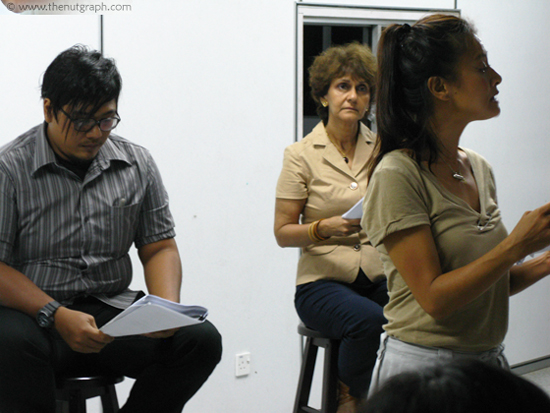
From 11 to 13 May 2011 in Penang and on 14 May in Kuala Lumpur, Five Arts Centre and Pocketsize Productions staged a workshop presentation of stories of 13 May 1969. The presentation was titled I was 13 at the time. On the day it happened…
In my research to curate the different narratives about the incident for the reading, one thing above all surprised me. Chinese Malaysians, it was reported, were clearly responsible for the rising racial tensions that exploded on the streets of Kuala Lumpur in the evening of 13 May 1969. What did the Chinese Malaysians do?
The results of the 10 May 1969 general election showed that Chinese and Indian Malaysian voters had deserted the ruling Alliance, rejecting the MCA and MIC in favour of the opposition DAP and Gerakan (which later joined the Alliance, then known as the Barisan Nasional or BN, in 1973). This left the Umno-led Selangor government in a precarious position.
(From right) Foo May Lyn, Lucille Dass and Shah Zainal during the workshop performance
(From right) Foo May Lyn, Lucille Dass and Shah Zainal during the workshop performance by Five Arts Centre and Pocketsize Productions
In Goh Cheng Teik’s The May Thirteenth Incident and Democracy in Malaysia (1971), he writes: “Realising that the Umno branch in Selangor was in a precarious situation, bands of youthful sympathisers from the DAP and Gerakan headed towards Dato Harun (Idris)’s house in Jalan Raja Muda and rudely invited him to quit this state residence since he was allegedly no longer Menteri Besar. At processions held to celebrate individual Opposition successes, youthful Chinese and Indian supporters booed and jeered at Malays they encountered or at Malay houses they passed … Some of these were: ‘Kapal layar bochor!’; ‘Melayu sudah jatoh!’; ‘Melayu sekarang ta’ada kuasa lagi!’; ‘Kuala Lumpur sekarang China punya!’; ‘Melayu boleh balek kampong!’”
William C Parker, Jr, as quoted by John G Butcher in May 13: A Review of Some Controversies in Accounts of the Riots, writes that there were “repeated instances of physical harassment and of threats and insults directed at Malays by non-Malay demonstrators in Kuala Lumpur on May 11th, 12th and 13th. These included threats of killing and serious bodily harm. Insults included ethnic slurs and obscenities, and also instances of indecent exposure … ”
These insults and threats only succeeded in angering Umno members and supporters in Selangor, and added fuel to the pre-existing suspicion and fear some Malay Malaysians had of Chinese Malaysian domination and ascendancy at a critical juncture in our history. However, these taunts and the potential loss of political power for the Malays cannot justify the violence that was finally unleashed upon Chinese, and to some extent Indian, Malaysians.
Still, there is no denying that the provocative behaviour of the jubilant DAP and Gerakan supporters was one of several factors that eventually led to a tense situation where violent retaliation seemed to be a justifiable option. I’m no historian, and my research for the workshop reading was, for certain, limited to published texts I could find. But the historical documentation does suggest strongly that Chinese Malaysians weren’t just passive victims who were suddenly and irrationally set upon by the Malays.
What Umno is doing
Fast forward 40 years later, and what do we see? The same behaviour employed by some Chinese Malaysians in 1969 is today being repeatedly used to invoke racial fear, hatred, anger and suspicion. But it is not being employed by Chinese Malaysians or politicians. Rather, it is being used by certain Malay Malaysians, such as some in Umno, and Perkasa and Pembela leaders who tell non-Malay Malaysians they are “pendatang”.
They insist that non-Malay, non-Muslim citizens have less rights because “ketuanan Melayu” is somehow enshrined in the Federal Constitution. And should any citizen object to the notion of Malay supremacy, we are told that we can get out of the country, in other words “balik kampong!”, even if our home is in Malaysia.
Datuk Ahmad Ismail, infamous for having called Chinese Malaysians pendatang during a ceramah in 2008 (Ahmad Ismail pic courtesy of Oriental Daily)
These same individuals and groups are also the ones who warn non-Malays that Malays will run amok and spill blood if they don’t get what they want regardless of the legitimacy of their demands. The same tactic to stir up racial strife and anxiety is being used by Umno-owned Utusan Malaysia, which unethically and irresponsibly reports half truths, threatens that Malay Malaysians are close to having their power snatched away, and conjures fiction about a non-Muslim takeover of the country.
It would seem then that while non-Malay Malaysian politicians and groups have learnt the lesson of 13 May and are no longer willing to risk the consequences of unnecessary taunting and provocation, Umno, Pembela, Perkasa, Utusan Malaysia and even Berita Harian haven’t.
Remember that after the historic 2008 elections where the opposition denied the BN its two-thirds majority like it first did in 1969, the Pakatan Rakyat made clear there would be no victory marches on the streets. Additionally, it isn’t non-Malay individuals, groups or political parties that are exhorting for racial/religious domination at the expense of the rights of other citizens.
And yet today we are more segregated than we have ever been. And racial tension is continuously stoked and invoked as a national sport, as if 13 May wasn’t lesson enough for all of us, whether we lived through it or not.
What then becomes clear for me is this: It isn’t a repeat of 13 May per se that we should fear. What we should revile and reject are the individuals and groups who did not learn the lessons of 13 May.
By recreating some of the conditions that led to the racial clashes that have defined our nation ever since, it is clear that these individuals and groups want another 13 May. After the 1969 riots, a national emergency was declared and Parliament, indeed democracy, was suspended until 1971. The country was ruled by a National Operations Council (NOC) that placed all power in one man – Tun Abdul Razak.
Tun Abdul Razak (Wiki commons)
In the preface to the NOC report on 13 May, Razak, who was the NOC director of operations, wrote: “May 13, 1969 will go down in our history as a day of national tragedy … On that day we were jolted into a sharp realisation that the racial problem in this country is a serious one and measures taken in the past to cope with it have not proved adequate …  The lesson of the recent disturbances is clear. This nation cannot afford to perpetuate a system that permits anybody to say or do things which would set one race against another. If the events of May 13 are not to occur again, if this nation is to survive, we must make sure that subjects which are likely to engender racial tensions are not exploited by irresponsible opportunists.”
More than 40 years after the tragedy of 13 May, Razak, who was eventually Umno president and our nation’s second prime minister, must be turning in his grave.

Janji TPM Kecewakan 400,000 Orang Guru

Lebih dari 400,000 guru biasa kecewa dipinggirkan
Kira-kira 400,000 guru kelas biasa kecewa dengan pengumuman kerajaan pada Hari Guru baru-baru ini yang hanya membawa berita gembira kepada 2,000 guru besar dan guru penolong kanan yang akan menikmati kenaikan gaji mulai awal tahun depan.
Sehubungan itu, Setiausaha Agung, Kesatuan Perkhidmatan Perguruan Kebangsaan (KPPK) Lok Yim Pheng berharap kerajaan akan menangani rintihan dan masalah serta memberikan mereka lebih banyak peluang kenaikan pangkat.
“Ironinya di sebalik membawa kegembiraan, pengumuman itu menimbulkan kebimbangan dan rasa sedih di kalangan guru kerana sejumlah besar daripada mereka seperti diketepikan,” katanya kepada Bernama di Kuala Lumpur hari ini.
Lok juga meminta guru-guru yang dipinggirkan ini tetapi menjadi “teras” pendidik peringkat akar umbi supaya bertenang dan meneruskan tugas-tugas murni mereka seperti biasa serta menyerahkan kepada kesatuan soal mengenai perjuangan menjaga kebajikan mereka.
Beliau berkata, pihak kesatuan yang mewakili 140,000 guru di seluruh negara akan berusaha untuk mengadakan perjumpaan dengan Perdana Menteri, Datuk Seri Najib Razak secepat mungkin untuk memaklumkan sendiri mengenai rintihan dan masalah yang dihadapi oleh guru kelas biasa.
Ramai tak puas hati
Menurutnya, pihak kesatuan tidak akan menghampakan guru-guru ini kerana mereka merupakan “tonggak” pendidikan, di mana semua sekolah bergantung kepada kejayaan meraka melaksanakan tanggungjawab dengan baik.
“Tanpa dedikasi guru-guru kelas ini, kalangan guru besar dan pengetua sahaja tidak akan dapat mengendalikan sekolah,” katanya.
Sementara itu, tinjauan rambang Bernamamengesahkan kenyataan kesatuan itu bahawa ramai guru pada dasarnya tidak berpuas hati dengan pengumuman kerajaan yang memberikan kelebihan hanya buat ketua-ketua sekolah.
Seorang guru yang dikenali sebagai Chandran, 45, yang berpengalaman 18 tahun mengajar berkata, beliau amat sayangkan karier sebagai seorang guru dan amat sayangkan muridnya, namun beliau merasa kecewa kerana merasakan dedikasinya selama ini seperti tidak dipandang.
“Saya biasanya pulang ke rumah sejam atau dua jam lebih lewat kerana saya lanjutkan masa mengajar di sekolah, khusus buat pelajar yang lemah, malah saya ambil inisiatif himpunkan mereka pada hujung minggu untuk membantu mereka dalam pelajaran, namun ini nampaknya tidak dihargai oleh pihak sekolah,” katanya.
Seorang lagi guru yang hanya mahu dikenali sebagai Miss Tan berkata, beliau sedih dengan pengumuman itu, kerana beliau mahupun rakan-rakan sejawatannya tidak memperolehi apa-apa manfaat daripadanya.
“Kami bekerja keras, tapi dedikasi kami seperti tidak dihargai,” katanya.

NATO destroys 8 Libyan warships

(CNN) -- NATO jets pounded Libyan ports overnight, destroying eight of Moammar Gadhafi's warships, an alliance spokesman said Friday.

NATO targeted the ships in Tripoli, Al-Khums and Sirte after it was apparent that Gadhafi's forces were increasingly using naval vessels to launch attacks on civilians, said Mike Bracken, NATO's military spokesman. He said Gadhafi was indiscriminately mining waters in Misrata and hampering the flow of humanitarian aid.

"He was using maritime forces to lay mines. These were legal targets," Bracken said at a briefing in Brussels, Belgium.

He did not say whether crew members were aboard when the ships were hit.

Bracken said the NATO campaign is progressing and Gadhafi's combat power had been severely curtailed.

But the Libyan leader's forces continued their heavy shelling of Dehiba, on the Tunisian border, where thousands of refugees have amassed in recent weeks. The border crossing, through which humanitarian aid is often trucked in, was closed Friday.

Earlier in the week, rebel forces in the Nafusa Mountains of western Libya were under such heavy attack that they issued a call for help, the National Transitional Council in Benghazi said.

They were faring better along southern borders, according to a report by the International Medical Corps, which has teams in various locations in Libya and Tunisia. The report said rebels gained control of the border crossings between Libya and Sudan, and Libya and Chad, and regained control of Kufra in the southeast.

The global medical organization said rebel control along the Chad border was significant because of material supplies that flow through there to Gadhafi's forces.

"While control of the entire border will be difficult, the rebels are reported to have a large force in the region," it said. "The Niger and Morocco border crossings remain under Gadhafi control."

The International Medical Corps also reported constant shelling by pro-Gadhafi forces in Zintan, where at least one person was killed and six were brought to hospitals. The group also reported heavy fighting in the besieged city of Yefren, where the group said the situation was deteriorating with food and medical supplies in short supply.

Meanwhile, the African Union announced it would hold a two-day meeting of heads of state in the Ethiopian capital of Addis Ababa next week to address the conflict in Libya, as well as other security issues in Africa.

In another development, the family of South African freelance photojournalist Anton Hammerl, who has been missing in Libya since April, said late Thursday they now believe he was killed by Libyan government forces.

The statement was posted on the "Free photographer Anton Hammerl" Facebook page and follows interviews given in The New York Times, Global Post and The Atlantic by two journalists who say they were with him at the time he was shot.

"On 5 April 2011, Anton was shot by Gaddafi's forces in an extremely remote location in the Libyan desert. According to eyewitnesses, his injuries were such that he could not have survived without medical attention," according to the Facebook statement.

Hammerl was last reportedly seen in a remote region of the Libyan desert. He was reportedly captured by Gadhafi's forces near the town of al-Brega, a key oil town in eastern Libya, that has been the site of intense fighting.

Anwar: Prepare for ‘repeat pain’ of 2008 food price hike

KUALA LUMPUR, May 20 — Malaysians can expect food prices to go up by some eight per cent by year-end with “haphazard” subsidy cuts driving the country’s worsening inflation, Datuk Seri Anwar Ibrahim has said.

The opposition leader said the “alarming” 4.9 per cent rise in food prices from January to April this year compared to the same period last year suggested that there would be a “repeat [of] the pain of 2008”, when food prices jumped 8.8 per cent following sudden fuel price hikes.

“If this pattern persists for the remainder of the year, 2011 will register the second-highest food price increase for the people to bear since 2006,” Anwar (picture) said in a statement today.

This would mean food prices have increased by 30 per cent since 2005 while average wages have only gone up 2.6 per cent during the same period, he pointed out.

The former finance minister said that there was a “direct correlation” between the government’s subsidy cuts and the persistent food price increases registered so far this year.

Anwar also slammed Barisan Nasional (BN) for offloading the financial burden of the country’s economic mismanagement to the people while tycoons and cronies who benefited most from government largesse over the past decade went “unpunished”.

He stressed that the moral and social justification for making the public bear the cost of poor governance was weak when the excesses and wastages that led to Malaysia’s growing budget deficit were left untouched.

“A vote for Barisan Nasional is a vote for economic mismanagement and escalating food prices,” he said.

The PKR de facto leader reiterated that the opposition has already outlined clear steps to reduce the budget deficit without burdening the people in its Orange Book manifesto.

He said this included the removal of RM19 billion in corporate subsidies to “elite and well-connected companies” like independent power producers (IPPs) and clamping down on corruption to stem an estimated RM28 billion in leakages suffered by the government each year, highlighted in the 2008 Auditor-General’s Report.

Bank Negara said today that inflation this year would fall within its initial forecast of 2.5 to 3.5 per cent despite increasing inflationary pressure.

“We have already made a projection between 2.5 per cent and 3.5 per cent and our expectation is that it will be closer at the higher end of the projection,” Bank Negara governor Tan Sri Dr Zeti Akhtar Aziz said.

The Najib administration has embarked on its latest round of subsidy rationalisation to slash ballooning petroleum subsidies despite inflation hitting a two-year high of 3.2 per cent last month.

Prime Minister Datuk Seri Najib Razak earlier this week reaffirmed his commitment to the gradual removal of subsidies — which he said was “like opium” — to help bring Malaysia’s budget deficit under control.

I am an unwanted step-child — Henry T.

MAY 20 — I am a Malaysian Chinese and please notice that I did not mention Chinese Malaysian as I feel that one should be a Malaysian first and a Chinese second. I love Malaysia and as a kid I had wonderful memories growing up in Penang. When I was 19, I went to Singapore for my university education as my Bahasa grade was not good enough to qualify for local university entrance.

I worked in Singapore for 20 over years, married a Singapore girl and in 2000 migrated to New Zealand and have been there for 10 years. Over the years, I truly appreciated my adopted countries of Singapore and New Zealand as they made me quite welcome. I never felt unwanted (which I sometimes do in Malaysia simply because I am Chinese).

I left Malaysia because of the following reasons in order of priority:

1) Better prospects overseas (and this is sometimes race related… no jobs for non-Bumis in the public sector and promotion only for Bumis).

2) Racial discrimination (look if I am unwanted I can contribute to other countries that appreciate me... e.g. I work as an educational IT consultant for groups of schools and colleges in Auckland).

3) Environment and weather... beautiful environment here in NZ (although certain parts of Malaysia in the old days could be just as nice but alas on my recent trip back some of these places have truly deteriorated due to bad maintenance).

In spite of all these reasons I still sometimes dream of going back to retire in Malaysia... why? I do not really know except that deep inside me I am still a Malaysian boy at heart if only the political and religious situation is more salubrious!

But things are not getting better. In fact it’s getting worst and the way things are developing there can only be one ending... racial chaos and bloodshed with possible military conflict with neighbouring countries and international condemnation of human rights violations. So heck no! I think my family and I are far better off staying put but I fear for my many friends and relatives in Malaysia.

So do I miss Malaysia. Yes, it is my country even though I am an unwanted step-child. Do I owe Malaysia anything? Maybe to the people but not the bigoted and corrupt system on both sides of the divide!

So all the best Malaysia. May I be wrong!

* We asked readers who have migrated to tell us in their own words why they left. This is one of the stories.

Cite Ibrahim for sedition, says Hata

But others say that while the Perkasa leader deserves punishment for inciting hatred, calling for the use of the draconian Sedition Act amounts to endorsing it.

KUALA LUMPUR: National Union of Journalists President Hata Wahari today accused Perkasa leader Ibrahim Ali of abusing free speech and urged the authorities to charge him with sedition.

“What he says isn’t freedom of speech,” he said. “It’s inciting hatred amongst the Malays against other communities. We need the Sedition Act to be used on people like Ibrahim Ali. Right now the government uses it with double standards.”

The Sedition Act prohibits, among other things, discourse deemed to engender ill will between different races. It has long been the subject of controversy. The government has often been accused of using it to silence dissent and as a weapon against political opponents.

Hata was a senior journalist with the Umno-owned Utusan Malaysia until recently, when he was sacked for critical statements against the paper.

His sentiments were echoed by PKR publicity chief Nik Nazmi Ahmad, who said it was unethical to have “bloggers arrested under the Sedition Act, but not Ibrahim Ali. It’s hypocritical.”

However, Nik Nazmi said he would not support draconian laws, even if used against the likes of Ibrahim. There were other laws he could be charged under for his provocative demeanour, he added.

In the most recent of his controversial statements, Ibrahim called for a jihad against Malaysian Christians, accusing Christian leaders of plotting to install one of their own as prime minister.

Other public figures agreed with Nik Nazmi against the use of the Sedition Act.

Masjalizah Hamzah, who heads the Centre for Independent Journalism, said it would be an endorsement of its previous misapplications.

Fadiah Nadwa of Lawyers for Liberty said there was “sufficient legislation to deal with incitement to hatred without resorting to the Sedition Act.”

Suaram coordinator Hasbeemasputra Abu Bakar said the Sedition Act should be repealed along with other repressive laws.

“But to allow Ibrahim Ali to incite hatred without punishment is tantamount to showing him support,” he said.

Palanivel gets stung again

Bagan branch MIC chief Henry Benedict Asirvatham thumbs his nose at the disciplinary committee and repeats his claim that the party boss is trying to get rid of his deputy

PETALING JAYA: Bagan branch MIC chief Henry Benedict Asirvatham today called party president G Palanivel a coward, just two days after being threatened with disciplinary action for accusing the latter of plotting the downfall of his deputy, Dr S Subramaniam.

He also repeated the allegation, in apparent unconcern over a show-cause letter that the MIC disciplinary committee issued to him last Wednesday.

“Palanivel is a coward,” he said. “Previously he was hiding behind Samy Vellu. Now he hides behind the disciplinary committee. People from within and outside the party, from Perlis to Johor, are talking about it.”

The show-cause letter challenges Asirvatham to provide proof of the alleged plot against Subramaniam.

“Does the central working committee want me to bring busloads of people to the party headquarters to show that I am not alone in saying what I said?” he asked.

He alleged that Palanivel was strengthening his position for the presidential election for fear that S Samy Vellu, the powerful former party president, would back Subramaniam for the top post.

“There are rumours within the party and among Indians that Palanivel is setting up 1,000 branches in divisions that favour him,” he said.

“I will not stop saying the truth because MIC is a good party. Palanivel is trying to ruin the party by creating more tensions.”

He aimed some of his venom at members of the central working committee (CWC), saying they were ingratiating themselves with Palanivel in order to be in his list of candidates for the coming general election.

“They’ll bring thick, colourful brochures to promote themselves, but at the CWC meeting they are silent.”

He also accused them of eyeing seats in the boards of government linked corporations.

In another development, Malaysia Nanban reported that Palanivel told S Veerasamy, who heads MIC’s Jalan Changkat Asa branch, to leave the party for accusing it of making false promises to estate workers during last year’s Hulu Selangor by-election campaign.

Child abuse spikes to record high

The number of physical child abuse cases jumped about 26 percent from 203 in 2009 to 257 in 2010.

KUALA LUMPUR: Child abuse reports in Malaysia spiked to a record high last year, according to statistics, as police blame the crime on misunderstandings and financial difficulties.

The number of physical child abuse cases jumped about 26 percent from 203 in 2009 to 257 in 2010, the highest recorded over the last five years, Malaysian federal police revealed to local daily, the Malay Mail on Friday.

In 2006, the figure was only 141.

“In their zeal to teach the children a lesson, many parents go overboard and end up injuring the child,” sexual crimes and child abuse investigations division deputy director, Hamidah Yunus told the Malay Mail.

She said majority of the abusers were guardians or babysitters and fathers.

The lack of information, such as the exact location of the crime made it increasingly difficult for police to track down the abusers and police reckon many more child abuse cases went unreported.

Child abuse offenders could be fined, jailed and whipped under the Malaysian law if convicted.

The latest incident occurred earlier this month when a 41-year- old mother was charged with splashing hot water on her lover”s 13-year-old daughter, hitting her with a rubber hose and stick and inserting a mop handle and chillies into a private part.

The case was discovered by the staff of a child care center, where the girl was sent to by the accused.

The death of a 7-year-old boy allegedly assaulted by his teacher late March grabbed local media headlines.

The boy was said to be beaten to death by a 26-year-old warden of a school dormitory, who accused the boy of stealing.

The victim”s hands were also said to be tied to the window when he was beaten.

-Xinhua

Temples unhappy over relocation site

Chinese and Hindu temple committees reject current site located under high-voltage TNB power cables.
SUNGAI PETANI: The respective temple committees of a demolished Chinese and neighbouring Hindu temples on a hill in Bandar Perdana township project site here are seeking appropriate alternative permanent sites for relocation.

Both committees have rejected an alternate site offered by the township developer, Plenitude Sdn Bhd, a subsidiary of Plenitude Bhd, about 2km away from the main road.

The Hindu temple, Nagamah Kovil, committee chairman C Vijayakumaran, 46, and the Chinese temple, Guanyin committee chairman Lim Kim Hua, 47, said the site offered was unsuitable and dangerous since it was located beneath high-voltage TNB power cables.

“We want suitable permanent sites,” they told FMT here today.

The Chinese and Hindu temples have co-existed side by side for the past 10 years on a hillslope at the border of the Bandar Perdana project site and Bandar Puteri Jaya here.

Both temples were issued a two-month notice of evacuation on March 16 by Plenitude, which had already secured a court order for demolition.

The temple committees were in discussions with Plenitude to identify suitable alternate sites for relocation when the Chinese temple was demolished on Wesak Day on May 17.

The developer’s demolition team was accompanied by a similar team from the Sungai Petani Municipal Council (MPSP).

Inconsiderate act


The Hindu temple was, however, spared from demolition. Vijayakumaran said the committee was ordered by the developer “to move as soon as possible.”

The timing of the Chinese temple’s demolition was condemned by PKR Sidam assemblyman and Kedah executive councillor Tan Choo Kang (in charge of environment, Chinese community affairs and transport) and Gerakan state chairman Cheah Soon Hai.

Tan, who was the mediator between the temple and developer, was disappointed with Plenitude and MPSP for not being considerate of religious sensitivities.

He said that the issue was not one of law and order, but rather of religion since the demolition involved temples.

“After all, both temple committees had agreed to relocate. Moreover, the negotiations were still ongoing to find suitable relocation sites.

“The developer has all the time in world to wait before demolishing the temple,” said Tan.
The site will be cleared by Plenitude to carry out its later phases of the multi-million ringgit Bandar Perdana residential project, which has now been partly constructed.

Pakatan’s incompetence

The later phases are expected to take off only in 2013 and completed in 2016. Cheah, who is also the Derga assemblyman, criticised Pakatan Rakyat for not keeping its promise not to demolish any places of worship in states under its control.

Kedah is ruled by PAS-led Pakatan government since the general election of 2008. Cheah said the demolition of the temple showed Pakatan’s incompetence and lack of credibility.

He said the PAS government had also previously been insensitive by demolishing a Hindu cemetery in Ladang Pekaka, Kuala Ketil, last year.

He also criticised MPSP for being insensitive by allowing the demolition of the Chinese temple on an auspicious day like Wesak.

Cheah, the head of the Gerakan central bureau on environment, safety and quality of life, said that any action pertaining to religious issues must always be mutual.

“The act of demolishing a temple on Wesak Day will only lead people to think that the council has acted with malicious intent,” he said.

Tan added that he would update the state exco at next Wednesday’s meeting on the issue.
In the meantime, he will hold negotiations with the developer to provide alternative permanent sites to relocate both temples.

The proof of the pudding is in the eating

The Balinese Hindus are a perfect example of good Muslims. That is what troubles me. The Balinese Hindus are what Muslims should be but are not. And I really need to find out why this is so even if it is the last thing I do.
NO HOLDS BARRED

Raja Petra Kamarudin
My wife and I spent three weeks in Bali in April this year. We were there to celebrate our 38th wedding anniversary as guests of a very good friend who allowed me to stay in his exquisite villa for free. It would have cost me USD1,100 a night otherwise.

That was after my Australian trip and just before the talk Haris Ibrahim I gave in Bangkok followed by all that drama.

What impressed me most about Bali was the honesty of the people, who are 90% or so Hindu (but very different from Malaysian Hindus). We left all our things including our cash in our room. The staff walked in and out freely and we did not feel any anxiety. In fact, our bedroom did not have any locks but just glass shutters.

I asked one Balinese girl who was giving me a two-hour massage how come the Balinese are so honest.
It is because we believe in karma, she replied.

Oh, I responded, that means whatever you do to others the same thing will happen to you (balasan yang sama).

No, she replied. Whatever you do to others ten times more will happen to you. And that includes both good and bad things.

Whenever we took a taxi the taxi driver would automatically switch on his meter. And they never took the longer route to get where we wanted to get to. It was always short cuts.

Whenever we stopped at the shopping complex to buy our groceries and stuff the taxi driver would switch off the meter and wait, however long it took. So we did not have to pay for ‘down time’.

On one occasion my friend left his Blackberry at Macdonalds. We were halfway back to the villa before he realised he had lost his Blackberry and we suspected he may have left it at Macdonalds, the last pit stop we made.

We asked the driver to turn around and go back to Macdonalds, although we did not really think that his Blackberry would still be there.

But lo and behold, it was still there. Someone had found it on the counter and had handed it to the manager. What a relief it was for my friend who could ill-afford to lose all his data.

There were many other instances regarding the honesty of the Balinese that impressed us immensely. I joked that if I did not yet have any religion and was looking for a religion I would probably become a Balinese Hindu. That’s how impressed I was.

After Bali we went over to Jakarta and suddenly it was another world altogether. Jakarta is predominantly Muslim but you did not feel safe in that city. You felt like you were constantly under siege.

“Why can’t the Muslims in Jakarta be like the Hindus of Bali?” I commented to my wife. I was so impressed with the Balinese Hindus and disgusted with the Jakarta Muslims. And it is the Muslims who cause all the commotion in Bali with the bombings and whatnot.

I would like to believe that Muslims have reduced Islam to a religion of rituals minus the commitment to the ideals of the religion. But then the Balinese are even more ritualistic than the Muslims. In fact, they appear to be constantly in prayer.

I am yet to put my finger on it. There is something about the Balinese version of Hinduism that makes them extremely honest and decent people. But what is it?

I think I am going to go back to Bali and spend some time studying the people there, in particular their religion. I need to find out what it is they are doing right and we are doing wrong.

The Balinese Hindus are a perfect example of good Muslims. That is what troubles me. The Balinese Hindus are what Muslims should be but are not. And I really need to find out why this is so even if it is the last thing I do.

Afghan Women after Osama's Death

ImageStill a horrific situation

After the US killing of Osama bin Laden on May 1, the organization Women for Afghan Women reported an eerie quiet in Kabul, the capital of strife-torn Afghanistan.

"Police are patrolling the streets," Manizha Naderi, executive director of Women for Afghan Women, wrote to her supporters the day after the Al Qaeda terror boss was shot dead following a 40-minute gun battle with the US Navy Seals in the army town of Abbottabad in Pakistan. "But very few people are walking around, and even at the office, people aren't talking about the news that is ricocheting across the world - Osama bin Laden has been killed."

Naderi instructed all staff members "to lie low for the next few days," Offices would remain open, but travel would be avoided, she said.  Since bin Laden's death on May 2, little has changed outwardly. Given the society, it is unsure what will happen.

"We simply cannot know whether the death of bin Laden is or is not good for the Afghan people, but we are worried about what will happen next," Naderi wrote. "Will Al Qaeda and the Taliban be weakened? Will negotiations with the Taliban be stepped up? Will this decade-long chapter in Afghanistan's history end with the foreign troops hastening away?"

Naderi advocates for women in a country that recently took the limelight for a reason other than its Taliban sphere of influence. Afghanistan came last on Save the Children's latest annual global rankings of countries on the basis of maternal health. The best place in the world to be a mother, according to these rankings, is Norway, where the average maternity leave is about one year.

The reasons for Afghanistan's last place - 164 out of 164 - are no doubt numerous, but Naderi writes about the group's difficulty of setting up shelters for battered women highlights women's lack of autonomy there.  Women continue to be subjected to kidnappings, widow sales, child marriages, forced marriages and sexual assaults in different parts of the country.

Subjected to forced marriages and deprived of their rights, many women seek refuge in suicide, escape from home and divorce, says Fawzia Amini, in charge of the human rights department at the Ministry of Women's Affairs, confirming that girls are banned from going to school and university.

"The government still wants shelter clients to be handed over to any family member who comes to claim them," Naderi said. "WAW will never agree to such a clause because it negates the whole purpose of a safe house. With the continued support of all our allies and supporters, we will prevail in this case as well."

In closing her note to WAW's supporters, Naderi said that bin Laden's death has done little for the girls and women in this country. "They still live in a country that is ravaged by poverty, corruption, violence and terror. They still must cope with a conservative culture that does not uphold their human rights."

The condition of Afghan women is horrific at best. Hundreds of women set themselves afire last year out of despair over their condition despite the Afghan government's alleged commitment to equal rights, according to the Afghanistan Independent Human Rights Commission (AIHRC) said on Sunday. Nearly 2,800 cases of violence against women and girls were reported to the rights watchdog from different parts of the country, AIHRC official Latifa Sultani told Pajhwok Afghan News.

The incidents included 144 self-immolations, 261 attempted suicides, 237 forced marriages, 538 beating and 45 murder cases. The self-immolation attempts left 75 dead and 20 others disabled. Twenty-two individuals recovered after treatment, according to the AIHRC.  Of the rights violations reported to the commission, 2,269 pertained to violence, including 119 self-immolation, 23 suicide, 134 murder and 909 severe beating cases.

Dr. Arif Jalali, a doctor at the Herat Civil Hospital, said the hospital had received 90 women who committed self-immolation in the western zone. Fifty-one of them succumbed to their injuries.

In the solar year 1388 (AD 2009), 85 women resorted to self-immolation in western Afghanistan. Fifty-nine of them lost their lives. Most of them were aged between 15 and 25 years. As many as 69 women lost their lives to domestic violence and family feuds in 1389, compared to 64 such deaths in 1388, the report said

Sociologists noted high self-immolation rates among women refugees who returned to Herat from Iran, where living conditions were much better, the report said.  On coming back to Afghanistan, their husbands failed to meet their expectations and respect their rights. As a consequence of frustration, they tended to end it all, the experts explained.

AIHRC Commissioner Nader Naderi viewed women's inadequate access to judicial redress as a major factor behind the increasing violence. "As long as relevant laws are not implemented, the scourge can't be eliminated." Urging religious scholars to preach respect for women, he said, violence against females had pushed up the overall crime graph. 

Fawzia Amini said the human rights department at the Ministry of Women's Affairs registered 6,765 cases of violence against women and girls across the country. During the previous year, such cases stood at 6,692.

But acting Minister of Women's Affairs Husn Bano Ghazanfar believes the violence against women has not risen, according to the report. In fact, Husn said, women have gained greater awareness of their rights and are increasingly reporting their cases to the ministry.

Read more about the AIHRC at  http://www.rawa.org/temp/runews/2011/04/17/violence-against-women-on-the-rise-aihrc.html#ixzz1MqnCHBj0

By arrangement with Women's eNews.  Corinna Barnard is editor of Women's eNews. http://www.womensenews.org/story/the-world/110506/bin-laden-death-raises-cautious-questions-in-kabul  Copyright Women's Feature Service)

Next General Election Critical For BN, Says Muhyiddin

BALING, May 20 (Bernama) -- The 13th general election is expected to be the most challenging that the Barisan Nasional (BN) will face, said Deputy Prime Minister Tan Sri Muhyiddin Yassin.

As such, he warned all BN, particularly Umno, members that they should not treat the next general election like in the past because the parties contesting in the election this time would be most aggressive.

"In the last 16 by-elections, I was leading (the coalition) in more than half. They were very bitter and fierce because of the politicking adopted by the opposition which was no longer like before, while the voters had already made up their mind.

"The people nowadays are making various demands and they must be fulfilled otherwise they will not change their mind," he said when opening the delegates meeting of the Baling Umno division at the Kompleks Rakan Muda, here Friday.

According to Muhyiddin, the BN must make better and thorough preparations to face the next general election although public perception on the BN and Umno particularly had improved.

"We must ask whether after the 13th general election we will still be in power...it will be most painful if we don't have two-thirds majority in Parliament.

"We must make up our mind. Resolve all problems from the bottom upwards. There should no longer be any quarrels at the divisional level because our struggles will have a different meaning when we lose and no longer have power," he said.

Muhyiddin, who is also the Deputy Prime Minister, said every Umno member must take the loss during the 12th general election as a lesson.

"I'm thankful that Umno members are now in better and stronger spirit and the change in attitude is good and crucial as we face the next general election," he said.

Also present at the meeting were Baling Umno division head Datuk Abdul Azeez Rahim, Baling Wanita Umno head who is also Deputy Minister in the Prime Minister's Department Datuk Dr Mashitah Ibrahim, Deputy Minister of Agriculture and Agro-based Industry Datuk Wira Mohd Johari Baharom and almost 2,000 delegates.

Francis Loh speaks on 'New Politics'

Aliran secretary Prof Francis Loh will be speaking tomorrow, Saturday, 21 May from 11.00am – 2.00pm at The Annexe Gallery, Central Market Annex, KL.

The University of Nottingham’s Centre for the Study of Communications and Culture has been organising an ongoing seminar series on culture, media and identity, titled Voices: Public Intellectuals and Public Discourse in South and Southeast Asia.
In the upcoming presentation, the fifth in the series, Prof Francis Loh Kok Wah from Universiti Sains Malaysia, Penang, will deliver a talk titled “Contesting and Reconstituting the Malaysian Nation amidst New Politics.”
The following is an abstract of Prof Loh’s lecture:
In recent years a public and at times acrimonious debate has ensued over various ethno-religious issues including the ‘Social Contract’, the History curriculum used in secondary schools, the publication of the pamphlet myBalikPulau, Interlok, the distribution of the BM version of the Holy Bible, etc. On the basis of these debates and related incidents, some analysts have expressed concern that Malaysia is headed towards a breakdown in ethnic relations. This talk explores whether this is the case. Or is it, perhaps, because of the emergence of the political cultures of developmentalism, and a more participatory form of democracy, signalling the demise of ethnicism, that these controversial issues are coming to the fore nowadays? How should we understand the Malaysian nation amidst New Politics in Malaysia?
Dr Loh received his PhD (Politics and Southeast Asian Studies) from Cornell University. His latest publications include Southeast Asian Responses to Globalisation: Restructuring Governance and Deepening Democracy (co-editor, 2004), Politik Baru di Malaysia (2005), Old vs New Politics in Malaysia (2009) and Building Bridges, Crossing Boundaries: Everyday Forms of Inter-Ethnic Peace Building in Malaysia (editor, 2010). He is the Secretary of Aliran, a multi -ethnic Malaysian NGO advocating human rights and justice for all, and a member of the editorial collective of its Aliran Monthly.
For registration and further enquiries, please contact Agnes Selvaragi (agnes.selvaragi@nottingham.edu.my) or Ng Eng Kiat (engkiat.ng@nottingham.edu.my).

WLeaks: Siapa 19 Napoleon Kecil Bersama Najib?

WikiLeaks dedah 19 ‘aktor berpengaruh’ dalam kitaran politik Najib
Kabel diplomatik Amerika Syarikat (AS), yang terbocor dan disiarkan oleh Malaysia Today hari ini menyenaraikan 19 pemimpin bisnes utama sebagai “aktor-aktor berpengaruh” dalam kitar politik Datuk Seri Najib Razak — dua tahun selepas menjadi perdana menteri.
Najib kini berada di AS sempena lawatan kerja.
Maklumat kabel itu, yang ditulis oleh kaunselor politik Mark D. Clark untuk membantu Jabatan Negara AS meneliti pentadbiran dan keputusan-keputusan dasar Najib , adalah yang pertama diterbitkan menerusi Malaysia Today, kendalian Raja Petra Kamarudin, selepas ia menandatangani memorandum persefahaman dengan Wikileaks, Isnin lalu.
Pengerusi Ethos Capital Rohana Mahmood mengetuai senarai personaliti korporat.
Maklumat yang diterbitkan menunjukkan Rohana ada hubungan dengan kebanyakan syarikat yang berhubung kait dengan Najib, yang sebelum ini merupakan menteri pertahanan.
Pada 2008 Najib dilantik sebagai menteri kewangan, portfolio yang disandang sehingga kini.
Antara 19 pemimpin bisnes yang disenaraikan, Rohana sangat berkait rapat dengan kepentingan-kepentingan komersial keluarga Najib.
Rohana bersama pembantu rapat Najib, Abdul Razak Baginda, yang dibebaskan daripada kes pembunuhan wanita Mongolia Altantuya Shariibuu, menubuhkan Pusat Penyelidikan Strategik Malaysia — badan pemikir yang menasihati beliau masa-masa lalu.
Pihak pembangkang seringkali mendakwa Altantuya, yang membantu dalam urusan pemerolehan kapal selam Scorpene bernilai RM3 bilion (AS$1 bilion), dibunuh disebabkan hubungannya dengan Najib, dakwaan yang dinafikan oleh perdana menteri.
Turut disertakan dalam senarai itu ialah pemilik MMC Corp Bhd, Tan Sri Syed Mokhtar Albukhary, Tan Sri Vincent Tan dari Berjaya Corp Bhd dan Pengerusi Hong Leong Group Quek Leng Chan.
“Syed Mokhtar Albukharry… mempunyai operasi bisnes yang signifikan dalam konstituensi Najib dan sektor pertahanan,” kata kabel itu.
The Malaysian Insider difahamkan Syed Mokhtar muncul sebagai penyumbang utama dana kepada Umno selepas ahli-ahli perniagaan Cina tempatan keberatan ekoran kekurangan kontrak di bawah pentadbiran Najib.
Syed Mokhtar memperluaskan empayar bisnesnya dengan memperoleh Pos Malaysia dan projek MRT Lembah Klang baru-baru ini.
Turut disenaraikan ialah:
6• Pengarah urusan Khazanah Nasional Azman Mokhtar;
7• Pengarah Khazanah Mohamed Azman Yahya, pengasas dan ketua eksekutif Symphony House Bhd;
8• Pengerusi dan ketua eksekutif Johan Holdings Bhd Tan Kay Hock, yang juga anggota Lembaga Pembangunan Wilayah Iskandar (IRDA);
9• Shahril Shamsuddin dari Kumpulan Sapura;
10• Pengerusi jawatankuasa eksekutif Khazanah dan bekas pengarah urusan MAS Nor Yusof;
11• Pengerusi dan pengarah urusan Konsortium Transnational Bhd Mohd Nadzmi Mohd Salleh;
12• Pengarah eksekutif CIMB Group dan bekas konsultan Unit Perancang Ekonomi Dr Gan Wee Beng;
13• Pengasas bersama Ethos Capital Omar Mustapha Ong, bekas pegawai khas Najib;
14• Pengarah urusan dan ketua eksekutif Paramount Corporation Bhd Teo Chiang Quan;
15• Pengarah urusan TH Group Bhd Lei Lin Thai;
16• Ketua eksekutif Mamee Double Decker Bhd Pang Tee Chew;
17• Ketua eksekutif Multi Vest Resources Bhd (MVest) Kenneth Eswaran, yang menurut kabel rapat dengan isteri Najib Datin Seri Rosmah Mansor;
18• Ketua eksekutif Felda Holdings Bhd Bakke Salleh; dan
19• Ketua Lembaga Tabung Angkatan Tentera Lodin Wok Kamarudin.
Mesej kabel itu terdedah ini, yang ditulis sebelum Najib disahkan sebagai perdana menteri keenam pada April 2009, menyusul penerbitan siri pertukaran sulit antara Washington dan Kedutaan AS di Kuala Lumpur dalam Asia Sentinel membutirkan keprihatinan AS berhubung perbicaraan dua anggota polis yang dituduh membunuh Altantuya.