Share |

Monday, 22 March 2010

Early Literacy Important For Children And Nation, Says Rosmah

KUALA LUMPUR, March 22 (Bernama) -- Early literacy is one of the most important elements in shaping the life and future of children, the Prime Minister's wife, Datin Seri Rosmah Mansor, said Monday.

She said this was important because early literacy was an imperative human capital investment that was fundamental for the nation's progress and prosperity.

"In the context of Malaysia, since independence, the government had embarked on various programmes to improve the literacy rate of our young nation as part of the nation-building strategies.

"Systematic education programmes have been put in place in order to create an information-rich society and to achieve the national literacy goal of 100 per cent literacy rate by 2020," she said in her keynote address at the official launch of the 4th International Children's Book Conference 2010, here.

Also present was Director-General of Education Tan Sri Alimuddin Mohd Dom, who is also the chairman of the National Book Council of Malaysia.

According to Unesco statistics, in 2008 more than 93 per cent of Malaysians were able to read and write, with only 1.5 million people considered as illiterate.

"This achievement could be attributed to the government's efforts in ensuring that the number of illiterate in the country's population is reduced substantially," she said.

Rosmah said literacy had been continually changing with the advent of the new modes of communication and information dissemination. New technologies presented new forms of medium such as audio books, websites, blogs, podcasts, audio streams and photo streams, she added.

"With these technologies, literacy instructions are changing rapidly and, today, children need to prepare for much more than just the traditional literacy.

"With the recent development of network information and communication technology, I feel there is a need for Malaysians, and especially children, to keep themselves abreast with these changing technologies," she said.

The two-day conference, with the theme "Children's Literacy in the Changing World", is held in conjunction with the 29th Book Fair 2010 from March 19 to 28 at the Putra World Trade Centre.

Why is Sabah still poor? asks Kit Siang

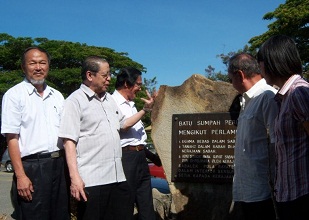
Batu Sumpah, Sabah

KOTA KINABALU: DAP parliamentary leader Lim Kit Siang has called for the establishment of a Royal Commission of Inquiry (RCI) on whether the expectations of Sabahans and Sarawakians in forming Malaysia had been fulfilled or betrayed over the past 50 years.

He stressed that this would be appropriate in view of the fact that in 2013 the country would mark the 50th anniversary of the formation of Malaysia.

“Have the people of Sabah been granted their full citizenship rights as Malaysians in the past five decades?

“Let the debate and soul-searching begin as to how one of the richest states in Sabah had been reduced in five decades to become the poorest state in the federation,” he said in a statement issued here on Saturday following a visit to Keningau.

Lim who is also the MP for Ipoh Timor is currently in the state on a three-day working visit. He is accompanied by the DAP MPs for Serdang and Segambut, Teo Nie Ching and Lim Lip Eng as well as Sabah state assemblyman for Sri Tanjong Jimmy Wong.

He recalled that before Malaysia was formed in 1963, the Cobbold Commission conducted a fact-finding survey of the people of Sabah and Sarawak for their views as to whether the new nation should be established out of the federation of Sabah, Sarawak, Singapore and Brunei with Malaya.

“Numerous fact-finding tours were also organised at that time to send Sabah and Sarawak leaders to Malaya to see for themselves the benefits and developments Sabah and Sarawak would enjoy if they agree to the establishment of Malaysia.

“It was precisely on the dual promises of the constitutional safeguards for Sabah and Sarawak and the material and developmental rewards the two states would enjoy that the new Malaysian nation was formed in 1963,” he said.

He said that his visit to Keningau had reinforced his conviction that a RCI is vital as there are deep-seated frustrations and dissatisfactions that the two promises of constitutional safeguards and development progress for Sabah and Sarawak had not been realised.

The purpose of the RCI would be to help the government and people to ascertain and remedy the shortfalls of the constitutional safeguards for Sabah and Sarawak on the formation of Malaysia, he said.

The forgotten oath

Lim also shared his thoughts on the ‘Batu Sumpah’ at the Keningau District Office which read:

“BATU SUMPAH MENGIKUT PERLEMBAGAAN

1.Ugama Bebas dalam Sabah
2.Tanah Tanah dalam Sabah di kuasai oleh Kerajaan Sabah
2.Adat istiadat anak rayat Sabah dihormatkan dan dipelihara oleh Kerajaan.

Sebalik pula rayat2 Sabah di dalam interior bersumpah taat setia kepada Kerajaan Malaysia.”

“These were the terms of the oath of loyalty of the Sabahans from the interior five decades ago in exchange for the formation of Malaysia. Have these solemn pledges laid out in the Keningau Batu Sumpah been honoured by both sides?” he asked.

He claimed that many Keningau folks were distressed that the government had not honoured the terms of the Batu Sumpah.

It is generally agreed that infrastructural development in the state is far short of expectations and the DAP leader emphasized this by relating to the distressing sight of extreme poverty when he visited Kg Tuarid Liawan about 1.5 km from Keningau.

“In Kg Batu Biah about 8km from Keningau, there are water pipes for 15 years but with no water supply. In Tambunan, we saw a road in good condition but which was dug out last year and remade. I understand the digging of a good road just to rebuild it cost some RM150,000.

“After nearly five decades, many in Sabah and Sarawak still lack the most basic infrastructure to be found in the rest of Malaysia like regular electricity supply, uninterrupted piped water and good roads and bridges – and not bridges when there is no river,” he added.

He quipped that Sabah probably leads the country as the state with the most pipes without water and most electric poles/lines without power.

He also hoped Sabah and Sarawak Barisan Nasional MPs would speak up in parliament during the current parliamentary debate to endorse his call for the setting up of the RCI.

Democracy — Dr Mahathir Mohamad

The Malaysian Insider

MARCH 21 — Many people think that as soon as you accept democracy, then you will be practising democracy.

Unfortunately mere acceptance is not enough. It is not enough because everyone, from the top most person to the ordinary people, be they from a political party or of a nation, can find ways to abuse and frustrate the true democratic process. As a result we see democracies failing to work in most organisations or political parties and in many nations.

Basically democracy is about giving power to the majority. It is assumed that the majority knows what is best for the whole. The minority should therefore be prepared to accept the rule of the majority albeit after presenting opposing views and criticisms. The minority must be prepared to wait for the next election in order to make another bid.


In a mature democracy almost everyone respects the results of national elections. The majority forms the Government and the minority take their places in the legislature and try their best to influence policies and laws introduced by the majority Government. And so for the four or five years before the next elections, the legislature debates, approves or disapproves the proposals by the Government. But the minority and even the individual legislator may also move proposals or laws although in most instances they will not get through for lack of majority support. Playing their parts, both the majority and the minority would contribute to the proper workings of a democratic Government.

Political parties love democracy as it seems to be fair to everyone. Anyone can bid for any place in the party, including the top most. That is the theory at least.

But the reality is that only certain people could aspire to lead because of the support of a substantial number of the members.

Ideally in a contest the one with the biggest number of supporters should win. Ideally as with Government the loser and his supporters should accept the decision of the majority.

Unfortunately the loser or losers may not want to accept the results. This can ultimately lead to the party being split and weakened.

The process may have been very democratic but the objective of choosing a leader by majority vote has not been achieved. The losers must also remember that when they win the same can happen to them. In other words a democratic contest can only lead to the break-up of the party (I am speaking from experience). I would like to cheer on the candidates who are contesting for any post anywhere through the democratic process. Obviously only one would win. If those who lose cannot accept the decision of the majority of the members, then it is better not to talk about democracy. You really do not know what democracy is about. *


* Of course I am assuming the contest is fair.

* Tun Dr Mahathir Mohamad was Prime Minister of Malaysia 1981-2003

* This is the personal opinion of the writer or publication. The Malaysian Insider does not endorse the view unless specified.

Anwar-bashing season at its height again

by Nathaniel Tan

(pardon the absence, been under the weather)

And now they’re trying to suspend DSAI, just like they suspended Gobind.

For shame.

These relentless attacks on Anwar. You’d really think they would have learnt by now.

As I recall it told to me, there were two last ditch efforts to stem the tide, going into March 8th, 2008: overturn the use of indelible ink; and hit Anwar.

I think you can look up all the papers, March 5-7th probably, and see it full of nothing but attacks on Anwar.

I’m truly amazed at the stupidity of BN (not that this should happen to any sane observer, mind) in failing to see how spectacularly this has backfired, time and again.

We have the whole of BN trying to kick a brother who’s down, picking on every single spot, while the rest of the world looks on and says “Hey. That ain’t right.”

And then there’s Zahrain. But I think that’s another post entirely.

(pardon the absence, been under the weather)

And now they’re trying to suspend DSAI, just like they suspended Gobind.

For shame.

These relentless attacks on Anwar. You’d really think they would have learnt by now.

As I recall it told to me, there were two last ditch efforts to stem the tide, going into March 8th, 2008: overturn the use of indelible ink; and hit Anwar.

I think you can look up all the papers, March 5-7th probably, and see it full of nothing but attacks on Anwar.

I’m truly amazed at the stupidity of BN (not that this should happen to any sane observer, mind) in failing to see how spectacularly this has backfired, time and again.

We have the whole of BN trying to kick a brother who’s down, picking on every single spot, while the rest of the world looks on and says “Hey. That ain’t right.”

And then there’s Zahrain. But I think that’s another post entirely.

Tanah Melayu

Sunday, 21 March 2010

IGP: 'Third party' intervening in the police force - Malaysiakini

Inspector General of Police (IGP) Musa Hassan has revealed the presence of a 'third party' that is making demands on the police force.

In an interview published in Utusan Malaysia's Sunday edition Mingguan Malaysia today, Musa said the third party could be “pihak politik” (politicians) or “orang-orang tertentu" (certain individuals).

According to him, the efforts at putting pressure on the Royal Malaysian Police Force (RMP) may derive from being uncomfortable with orders that he had given.

NONE“So there have been some orders issued directly to officers under me without the knowledge of the top management (of the police force),” said Musa (left) in Mingguan Malaysia.

“To me, this is trend is an erroneous one, because in the police force, there are certain (rules pertaining to) commands and supervision.

“The only one allowed to issue orders is the IGP, according to the laws,” said Musa, stressing that Section 4 of the Police Act 1957 states that all actions and supervision falls under the IGP.

“If there is a third party trying to intervene, it could ruin the police. Because at this time, (police) personnel are confused (as to who to obey) as there are other (sources of) authority that are issuing them orders,” he asserted.

'Somebody wants me to leave already'

Musa clarified that if a person in authority gave orders, then it is that person is responsible for issuing those orders, and legal action can be taken against the person in question.

“But if there is a third party giving orders and yet we do not know who they are, then if (police) officers are doing things wrong, then my officers will become victims.

"This is because kesalahan yang dilakukan, mengikut arahan yang tidak sepatutnya (the offense is following those orders that should not have been issued).

NONE“If those who issued the orders then deny that they were behind the directives, then this will adversely affect the police force,” he added.

On that matter, Musa said he hoped such interference would stop, as the administration of police matters, action and operations being carried out are done under the authority of the IGP and other top officers.

Asked to comment on the China Press report that claimed he had tendered his resignation, Musa said he was perplexed and surprised as to why the report emerged.

“Something that I had not done, I was said to have done. It is as if some quarters want to rush me into leaving this position (as IGP).

"We know when we are supposed to go, so there is no need to speed up the process. But if someone does want to speed up that process, I need to receive the order from the government to retire early.

"If that is the case, I will retire (early). That's all I can say. But on the part of the government, nothing has happened,” he said.

Asked about claims that a particular minister was not quite on the same page as he, Musa said: “I don't know. I am only carrying out my duties. Whether somebody likes or does not like the way I carry out my tasks, I don't know.”

Asked whether the issue would adversely affect the police force, Musa said: “I feel it will.”

“When a leader is seen as being susceptible to diperkotak-katikkan (manipulation), then the lower ranks will feel the same way,” he said, adding that some had sent him SMSes asking how this could occur.

“I don't know how to answer them. So I tell my officers to be patient. I also understand, I will be retiring this September,” he added.

Dato Seri Anwar(DSAI), if you call Hindraf racists for wanting to correct the consequences of the evil racist system, what do you call yourself who cr

By Naragan

At the outset of this piece, let me set the tone – the days of manipulation of the Aiyyas are gone. You cannot go on with your opportunistic ways and become the Prime Minister you want to be, by buying the votes of the Aiyyas for a bottle of cheap liquor. You are not getting to Putrajaya, without first settling your scores with the Aiyyas. And there is a lot to settle and you know it.

We do not need you as a leader of this country in your present manipulative form, because, from our Aiyyas view point, it is no different to us than what Najib has to offer. There is no real and substantive change.

Dear DSAI, you have the audacity to call Hindraf a racist organsiation after having ridden to victory in 5 states on shouts of “Makkal Sakthi” a Hindraf Slogan in the last GE by stealing our votes with those shouts. You are exposing the opportunist in you.

DSAI. you are responsible for creating this racially bigoted system in Malaysia, in the first place.. Go back to the 80s and the 90s, Do you remember you were the Minister of Culture, Youth and Sports in 1983, Minister of Agriculture in 1984, Minister of Education in 1986, Finance Minister in 1991 and DPM in 1993 – all in, a total of at least 15 years in setting up and fine tuning the current racist regime. What we have today is the outcome of exactly the policies of your past. You are responsible for what we have today, DSAI.

We in Hindraf and HRP are struggling, tooth and nail to change exactly that exploitative system, that you are responsible for setting up. You call us racists for doing that. What does that make you, dear DSAI, the creator of that system. Again, I say it, it was in your and Mahathir’s heydays that this racist system was crafted and fine tuned. It was in this period that marginalization of the Indians accelerated.

DSAI,.we have had enough, please stop your slick acts. We are no more the Aiyya’s that you and the likes of you take us to be. We are now just as savvy as you, if not more, because of our experiences of repeated betrayals.
So, please start coming clean - if you truly want to make it as the next PM. You will only get there, with complete Indian support and you know that. If you want that complete Indian support, then start getting away from your own ghost and start to listen. Shouts of Makkal Sakthi are not going to get you there, we have learnt that lesson only too well.
Start positively addressing the critical problems of the Indian poor.

Heritage Hope for Kampung Tanjong Tokong


Kampung Tanjong Tokong is a Malay village on the verge of complete disappearance. In fact t
he Malay houses, some having stood for hundreds of years, have been demolished and the villagers moved to transit homes nearby. The developer, the Urban Development Authority (UDA), is compensating these villagers with high rise apartments.However, a group of villagers are lobbying for the kampung (village) to be retained as a heritage site - taking a leaf out of the pages of the Kampung Buah Pala saga. Kampung Buah Pala had tried this route, hoping that the village will be declared heritage site to save it from demolition, but failed and Kampung Buah Pala is now, no more. Two experts in heritage conservation, Dr. Wazir Jahan Karim and architect Lawrence Loh presented the plans for preserving part of Kampung Tanjong Tokong to the Penang State Government. CM Lim said the state is powerless in halting demolition and development as the land belongs to UDA. Nevertheless, the state will submit the plans for conserving part of the village to UNESCO as there are historical traces which proves that Kampung Tanjong Tokong existed even before Georgetown, which is itself a UNESCO Heritage site. Video by Chan Lilian, Citizen Journalist

300 student leaders defy ban to attend meet - Malaysiakini

About 300 student leaders today defied threats of disciplinary action from campus authorities to attend a national university students' congress in Petaling Jaya.

They were, however,forced to sit on the floor after the bookings of the original venue in Taman Setiawangsa was cancelled at the last minute.

kongres gerakan mahasiwa nasional 200310Universiti Malaya had yesterday barred students from attending the convention, warning that they could be subjected to disciplinary action.

UM vice-chancellor Dr Ghauth Jasmon said in a campus circular that the convention contravened section 15 of the Universities and University Colleges Act (UUCA).

"Therefore, all students are prohibited from participating or involving themselves in any of the congress' activities," he said.

He warned that students found defying his directive could be punished under the UUCA.

According to organiser Solidariti Mahasiswa Malaysia, the Dewan Centrum Setiawangsa was the third to have cancelled their bookings as a result of what the students believe to be political pressure.

The 2010 National University Student Movement Congress, held today, finally relocated to the Petaling Jaya City Council Civic Hall where participants shared the venue with those attending another meeting - the Selangor government's National Youth Conference.

“When I arrived (at Dewan Centrum Setiawangsa) for our rehearsal yesterday the management told me that they were instructed not to allow any university student activities in the hall,” said congress director Mohd Hilman Idham.

'Don't invite Nurul Izzah'

However, according to Hilman, the manager said that the students can still use the hall if they cancel their invitation to PKR Lembah Pantai parliamentarian Nurul Izzah Ibrahim to officiate the event.

“They also demanded that we pay a 50 percent deposit, and that we show them the congress' programme,” he said.

Hilman also revealed that notices were put up today in university campuses warning that students who attend the congress risk having disciplinary action taken against them.

Representatives from the university's student affairs departments also visited residential colleges to remind students to stay away from the event.

kongres gerakan mahasiwa nasional 200310 nurul izzah anwarNurul Izzah,who launched the event with a rousing speech about her involvement in the reformasi movement as a student, said that such strong-arm tactics inadvertently force students to the streets.

“Stop this hypocritical behaviour. (The government tells) these students not to demonstrate in their streets, and yet they are harassed when they want to hold an indoor congress,” she said.

Meanwhile, organiser Shazni Munir Mohd Ithnin called for those behind the harassment to come out in the open.

“We don't know who is doing this to us, but we want to send them the message that we are rallying the grassroots to bring change to Malaysia.

“If they feel uneasy about this, then they should direct their dissatisfactions at us, and not harass the venue managers,” he said.

Zaid slams Perkasa for twisting facts - Malaysiakini

Pakatan Rakyat coordinator Zaid Ibrahim lashed out today at Malay rights group Perkasa, accusing it of twisting the facts concerning the special rights of bumiputeras.

He was referring to Perkasa president Ibrahim Ali's interview with Malaysiakini where he was quoted as saying that the Malays have been "insulted and derided" and Malay rights as bumiputera have to be protected.

selangor youth convention 200310 zaid ibrahimSpeaking at the National Youth Conference organised by the Selangor government in Petaling Jaya, Zaid (right) said Perkasa was an example of irresponsible leadership.

He charged Perkasa with deliberately alarming the Malays just to achieve its aims.

"This is what we call primitive politics," said the former law minister and ex-Umno member who had quit the all-Malay party last year over difference in principles.

He told the students present that Ibrahim has repeatedly troubled the community with his call that the rights of the Malays privileges as provided for in Article 153 of the Federal Constitution have to be protected.

"Even I am Malay but who wants to take our rights away that he has to protect them?" asked Zaid.

The former minister also implied that Dr Mahathir Mohamed was involved in their activities as the former prime minister is scheduled to officiate the NGO's first general meeting next week.

He then urged the 900 participants not to be fooled by "the fear that has been engineered by irresponsible politicians".

"selangor youth convention 200310 crowdsIn Malaysia (number of) bumiputeras is large. In Sabah and Sarawak, the Ibans are about 60 percent and that does not include the Melanaus.

"It is not right to say our rights will be taken away by anyone," he told the mostly Malay participants.

He pointed out that the majority of parliamentarians are bumiputeras, so it is an impossible to move an amendment to the special rights.

"Although it is an irrational approach there are people who would be fooled and trapped by it... that is why it is important to educate yourself," he said.

Let people see oil royalty agreement

On another matter, Zaid challenged the federal government to put on display the oil royalty agreement between Petronas and the state governments so that the people can evaluate for themselves.

"Have ever seen the agreement? Why can't the three-page agreement be displayed to the public? Why? Simply because they want to trick the people," he said.

The issue of the petroleum and liquefied gas royalty has been a hot issue since last year after Prime Minister Najib Abdul Razak announced that Kelantan and Terengganu will be given "goodwill" payments for the oil that extracted off their coastal borders.

Opposition MPs, especially those from PAS-ruled Kelantan, rejected the offer saying that the federal government should pay the state royalty - to which it is entitled - rather than a 'goodwill payment', likening it to charity.

Zaid said the agreement between the state governments and Petronas clearly specifies the former's share of the company's profits.

"It does not state anywhere the distances in nautical miles (which is disputed by federal government). It just states, if I get RM1, you will get 5 sen," he said.

Social media can help bring change

Israeli fire kills Palestinian teen

The Israeli army claims the Palestinian boys were hurt by riot-control weapons rather than live fire [AFP]

Israeli forces have killed a Palestinian teenager during violent clashes in the occupied West Bank, medics have said.

Muhammad Qadus had been taking part in a demonstration on Saturday, in which stones were thrown at Israeli soldiers in the West Bank city of Nablus.

Palestinian hospital officials said the 16-year-old was struck in the heart by a bullet fired by Israeli forces.

Qadus was pronounced dead shortly after arriving at a local hospital.

Medical sources said that the Red Crescent ambulance sent to collect him was delayed by Israeli forces.

Live ammunition?

The Israeli military said the soldiers did not fire live ammunition, but used riot control weapons such as teargas and rubber-coated bullets to disperse the Palestinians who were approaching a nearby Jewish settlement.


However, sources have told Al Jazeera that Qadus was shot and killed by two live bullets to his chest.

The clashes also seriously injured another 16-year-old Palestinian boy, identified as Useid Abed an-Nasser Qadus, the cousin of the dead boy.

Medical sources said was shot in the head and was transferred to a hospital for emergency surgery.

An Israeli military spokesman insisted that both injured Palestinians were hurt by riot-control weapons rather than live fire.

The spokesman said the incident came amid "a violent and illegal riot" near Iraq Burin, during which dozens of rock-hurling Palestinians approached Bracha, a nearby settlement.

One "rock-hurler" was arrested, he added.

Clashes take place in the village on a nearly weekly basis over a water well that Palestinians claim Jewish settlers are trying to seize for their own use.

The fatality was the first during a string of clashesthat erupted this week following of Israel's consecration of an ancient synagogue in the Old City of Jerusalem and would likely increase tensions.

The death has overshadowed a visit by Ban Ki-moon,the UN secretary-general, to the Palestinian territories to reiterate the commitment of the Quartet of Middle East negotiators' to an independent Palestinian state.

The Quartet - which brings together the United Nations, the European Union, Russia and the US - had issued a statement condemning Israeli settlement building and calling for a peace deal by 2014 after a meeting in Moscow the previous day.

Following Israel's announcement of 1,600 new housing unitsfor a development in East Jerusalem last week, the Palestinian Authority pulled out of planned "proximity" talks demanding a complete halt to settlement activity.

Indira’s fight for kids to go to Parliament

Kulasegaran (right) said the problem was caused by Parliament and should be resolved by Parliament. — Picture by Choo Choy May

By Clara Chooi

IPOH, March 20 — Parliament will again be the stage of an inter-religious custody battle, when M. Kulasegaran raises the plight of M. Indira Gandhi, in a bid to force legislation banning conversions to Islam as a means to gain custody of children.

The Cabinet had decided last April that children remain in the religion of the parents at the time of marriage, should one of them decide to convert to Islam. It also decided that outstanding issues in a marriage must be settled before conversion to avoid children from becoming the victims.

But a subsequent decision by the Conference of the Malay Rulers to seek the view of state authorities had delayed the government’s plan to table amendments to three laws — the Islamic Family (Federal Territories) Law 1984, Administration of Islamic (Federal Territories) Law 1993, and Law Reform (Marriage and Divorce) Act 1976.

So far, the government has given no indication of when the laws will be amended.

Kulasegaran, who is Indira’s lawyer, told a press conference here today that the problem faced by Indira and her husband was not caused by either the Syariah or civil courts, but by Parliament, which had failed its duty as a law-making institution.

“Now we have two custody orders — one by the Syariah Court and one by the civil High Court. Both orders give custody to each parent. But which should prevail?” he said.

On March 11, Indira won a short-lived victory when the Ipoh High Court granted her custody of her toddler, but she will have to return to the courts soon, as her Muslim-convert husband refused to give up the child.

K. Pathmanathan, now known as Mohd Ridzuan Abdullah, had immediately filed a notice of appeal to the court and an application for a stay of execution of the High Court order for him to return 23-month-old Prasana Diksa to the mother.

The couple have two other daughters — Tevi Darsiny, 13, and Karan Dinish, 12 — who are living with their mother.

Last April, the Syariah court granted custody of the three children to the father.

Kulasegaran pointed out today that since Indira was a non-Muslim and had no standing in a Syariah court, the civil court’s decision should prevail.

“Since her husband can stand before a civil court, this means that he should be bound by its decisions. But this is arguable because in our country’s present system, there is no proper law to determine this. Parliament has failed in this,” he said.

Kulasegaran said that when the issue was raised in Parliament last year, Minister in the Prime Minister’s Department Datuk Seri Nazri Aziz had agreed to take the matter to the Cabinet for discussion.

“The Cabinet appointed that lame duck (Minister in the Prime Minister’s Department, Tan Sri) Dr Koh Tsu Koon to handle the issue,” said Kulasegaran.

Koh, he claimed, had subsequently come up with a temporary decision, which stated that in the cases of conversion, children have to remain in the religion of their parents’ civil marriage.

“In the meantime, the laws governing these issues would be looked into and studied for the purpose of making further amendments,” he said.

Since then, added Kulasegaran, nothing had been done.

“It has gone quiet and no one has raised the issue further. Nazri told me that the matter has now been placed in the hands of the Malay Rulers to decide,” he said.

Kulasegaran added that Koh’s decision was also not binding as there was no formal mechanism for it to be enforced.

“It is just a play of words and nothing more. What we need is concrete amendments of the law,” said Kulasegaran.

He pointed out that the very crux of the issue lay with former prime minister, Tun Dr Mahathir Mohamad’s move to amend Article 121 (1a) of the Federal Constitution, which now states that matters pertaining to Syariah matters cannot be heard in the civil court.

“It all boils down to that problem,” he said, adding that the country needed to quickly formalise new laws and make the necessary amendments to the existing laws in order to solve the deadlock as soon as possible.

“I am not saying this in order to protect the non-Muslims but this would also be good for the Muslims themselves. What we need is something concrete in which we can refer to so as to avoid future confusions and emotional stress for the people,” he said.

Indira has been embroiled in a bitter custody battle for her children since early last year, after her formerly Hindu husband converted her children to Islam without her knowledge.

Since then, her husband has also obtained a Syariah Court order which granted custody of all three children to him.

As a non-Muslim, however, Indira has chosen to wage her legal war in the civil courts, which she claims should be binding to her husband as the couple had exchanged marriage vows in a civil marriage to begin with.

Tan thinks Zahrain not fibbing

PENANG, March 20 — The claim by Datuk Seri Zahrain Mohamed Hashim that Datuk Seri Anwar Ibrahim had said he had the blessings of the Yang di-Pertuan Agong to execute his Sept 16 takeover plan in 2008, may be true.

This is based on the good relations between them (Zahrain and Anwar), said Tan Tee Beng, who quit Parti Keadilan Rakyat (PKR) last month to become an independent MP for Nibong Tebal.

Tan said he did not know of the plan until a state PKR meeting was chaired by Zahrain, who at that time, was the state PKR liason chief.

“I personally think that Zahrain’s claim might be true, in view of his relationship with Anwar, and he was also the state chief at that time,” he said, adding that their relationship was very close and they met on a monthly basis.

When contacted by Bernama here today, Tan, however, said he was against the move by Anwar to persuade MPs to jump ship, instead of getting the mandate of the people to form the government.

He claimed that he had also met Anwar before Sept 16, 2008 to discuss about matters concerning Penang, and had also asked the latter about a possible takeover of the Federal Government.

“Anwar just told me that there were MPs who would be joining Pakatan Rakyat soon but did not elaborate,” he said.

During the discussion, Tan claimed that he told Anwar it was not the proper way to take over the government by encouraging MPs to join Pakatan.

“Lastly, it was all up to Anwar to make the decision and he insisted that the MPs were ready to cross over,” he said.

Two days ago, Zahrain, the independent Bayan Baru MP, had said in the Dewan Rakyat that Anwar had allegedly convinced opposition MPs that the Yang di-Pertuan Agong was waiting to confirm the number of BN MPs joining Pakatan Rakyat. — Bernama

Walking the talk is the main issue

Yes, to Muslims, ‘crimes’ are just confined to wine, women and song. Everything else is okay. Offer Muslims pork chops and they will go berserk. Offer them a glass of beer and they will foam at their mouth in anger. Offer them a bribe and they will say, “Alhamdulillah for God’s rezeki showered on me.

NO HOLDS BARRED

Raja Petra Kamarudin

Low salaries not main factor in corruption, says MACC

Low salary scales and high cost of living are not the main factor for corruption among the support group in the civil service, according to a survey by the Malaysian Anti-Corruption Commission (MACC).

On the contrary, corruption is caused by individuals’ own weaknesses such as greed and having the desire to live in wealth and luxury despite not having the means to attain them.

Internal shortcomings in an organisation such as weak leadership, opaque system and procedure, the existence of bureaucratic red tapes and extensive discretionary powers open up the opportunities for corruption.

Is corruption on the rise among civil servants?

MACC corporate communications director Datuk Ahmad Khusairi Yahaya said there was a decline in the number of corruption involving the group in 2007, 2008 and last year.

This, he said, showed that the level of integrity and awareness among civil servants on the scourge of corruption and their responsibility in battling corruption were on the increase.

In 2007, a total of 591 people were arrested for corruption. Of the total, 51 per cent or 303 were members of the civil service.

The number decreased to 282 civil servants or 47 per cent of the total number of arrests of 605 in 2008.

There was a sharp decline last year when only 194 or 39 per cent of 500 people arrested were civil servants.

Statistics also showed that the number of corruption charges against civil servants were on the decline in the past three years.

In 2007, 133 charges were brought against civil servants. The number went down to 104 in 2008 and further declined to 90 last year.

Among the reasons for this were the success of programmes introduced by the government and awareness campaign by MACC community education division.

The implementation of corruption prevention modules in induction courses, promotion of officers and the introduction of government policies including on public delivery system and the setting up of Good Governance Committee contributed to the better figure.

Following an increase in awareness, members of the civil service were becoming more forthcoming in reporting offer of bribes, leading to the arrest of bribe givers, Ahmad Khusairi said.

For instance, he said, in 2007, a total of 89 civil servants came forward to report bribe offers. In 2008 and last year respectively, there were 81 and 79 officers who reported attempts to bribe them.

Ahmad Khusairi said between January and this month this year, 14 civil servants came forward to report bribery attempts.

“This is an encouraging trend. Integrity, which the government is trying to imbibe among the civil servants, is becoming a reality,” he said.

In line with this development, he said, the MACC would carry out a massive anti-corruption campaign to nab those who tried to bribe civil servants.

Civil servants would also be constantly reminded of their obligation to report corruption under Section 25(1) of the MACC Act, failing which they could be fined up to RM100,000 or jail not more than 10 years or both upon conviction, Ahmad Khusairi said.

He warned the public not to attempt to bribe civil servants.

“The law will come down hard on them, including a jail term of up to 20 years and a fine of not less than five times the amount of bribe or RM10,000 whichever is higher,” he said. — Bernama

***********************************************

Remember my earlier article about lies, damn lies and statistics? Well, here we go again. The MACC is giving us statistics on corruption cases and they are telling us that corruption has reduced because less people have been caught.

Is it not possible that the number of people being caught for corruption has come down because those who commit acts of corruption are getting smarter and therefore it is not so easy for the MACC to catch them like before? Is it not possible that the MACC has given up on trying to catch corrupted officials because most times when the cases go to court those on trial get acquitted anyway? Is it not possible that the MACC officers see no point in fighting a losing battle -- so if you can’t beat them then join them and now the MACC officers are getting a cut of the action? Is it not possible that the MACC officers are otak lembu (cow brains) while those corrupted people are far cleverer? Is it not possible that the MACC is too busy trying to get opposition people on all sorts of flimsy and frivolous charges like cakes and cows that there is just no time left to go after the real criminals?

Yes, there are many possible reasons for the decline in cases of people caught for corruption. It does not have to mean that the country is getting cleaner. It could just mean that the cleaners are getting dirtier.

Anyway, why talk so much about corruption and what to do about it and whatnot? Okay, corruption is not confined to just the Malays or Muslims. Non-Malays and non-Muslims are also corrupted. But then Zoroastrian, Judaism, Christianity, Hinduism, Buddhism, and whatnot are not the official religions of this country. Islam is. And Islam takes preference and priority over all other religions. And while the imams in the mosque can whack the other religions and call them false religions, you may not do the same to Islam. You say Islam is a false religion you will get arrested and will be sent to jail. But you can say what you like about the others.

Therefore, people are more concerned about corrupted Muslims. In fact, the religious department wants Muslims to lead pure lives. They do not like you and your neighbour’s wife bonking in a hotel room. Non-Muslims can bonk till dawn and the government doesn’t care. At 3.00am the religious department officers will come knocking on your hotel room to check whether you have a naked woman in your bed. And if you refuse to open your door they will break it down. (Read here)

Yes, the Malaysian government is against you playing footsie and bonking pussies that don’t belong to you. And they mean business. So don’t play play. And it not just ‘illegal’ pussies that upset the religious department. Drinking, gambling, etc., are also no-nos for Muslims. You drink or play poker and they will haul your arse into court and if found guilty you can get caned; even women offenders.

So you see, with such high morals that Muslims have to observe, we are more concerned about corruption committed by Muslims, who are God’s chosen people, while we really don’t care about those non-Muslims who are supposed to go to hell anyway even if they lead the life of Mother Teresa.

Why are Muslims so upset if I check into a hotel with my neighbour’s wife and bonk her till dawn? Why are Muslims so upset if I drink and gamble? Why are Muslims not upset if I am corrupted and take bribes? Why will Muslims not vote for me if I womenise, drink and gamble but they have no problems voting for me if I take bribes?

Yes, to Muslims, ‘crimes’ are just confined to wine, women and song. Everything else is okay. Offer Muslims pork chops and they will go berserk. Offer them a glass of beer and they will foam at their mouth in anger. Offer them a bribe and they will say, “Alhamdulillah for God’s rezeki showered on me.”

PR can work, provided…

MARCH 20 — As Zaidel Baharuddin’s The Malaysian Insider article ‘Pakatan Rakyat to Pakatan Riot’ explains, there remain unresolved doubts about how PR parties can work together to lead the country.

Surely they cannot be given the reins to rule? Or can they?

I have been a long-time sceptic of PR. But having laboured long and hard over how they might share power, I am now warming up to them.

I am beginning to sense that they might actually be viable as an alternative to BN, provided they are willing to make some fundamental changes in the way they think about power sharing.

If they can discard the conventional wisdom that applies as to how a federal government should normally operate, and build a new model suited to PR, then it might just work.

Imagine three fuels. Leaded, Unleaded and Diesel. These fuels when mixed together cannot power any car. But yet each fuel could be used to run a specific kind of car quite effectively. And this is, to me, the key to solving PR’s power-sharing impasse.

If Malaysians insist on having Malaysia governed centrally as a single unit (like riding in one big bus with one driver using one fuel), then BN remains the only option.

Pakatan Rakyat fuels cannot be used for this bus when mixed together. But what if we threw out the ‘single bus’ model and opted for a ‘tag-team model’ instead?

The tag-team model would mean that there would be separate vehicles going forward independently, but yet working together, supporting one another, even competing with each other, and united and bonded by the desire to get everyone to the same destination.

Let me elaborate.

For illustrative purposes, Malaysia could be divided into three distinct socio-economic zones. Say, firstly, the West Coast of the peninsula; secondly, the East Coast of the peninsula; and thirdly, Sabah and Sarawak. Each zone is like a vehicle in this tag-team model.

The tag-team model would have the following governance structure:

Firstly, a ‘presidential-like’ prime minister, who would oversee all matters that truly relate to holding the federation together and bringing it forward for the sake of all Malaysians. His responsibilities would therefore include all portfolios, but only in so far as they are truly relevant at a national level (much like that of a US President).

He would then delegate his executive authority in relation to the administration of federal matters for each zone to an appointed viceroy. The viceroy for each zone would in essence be the driver of the vehicle in the tag team.

The viceroy’s federal responsibility for his zone might include finance, trade and industry, education, religion, health, infrastructure and human capital development, tourism, youth and culture, etc. The federal Cabinet will ensure that each zone is allocated a fair and equitable share of the federal budget to enable the viceroy to do his job. The viceroy would be a full member of the Cabinet and would remain answerable to the prime minister.

The viceroy for the West Coast might be from PKR or DAP (or this zone could itself be split into two to make for easier governance). The viceroy for the East Coast might be from PAS. And the viceroy for Sabah and Sarawak might be from a new PR component party representing those states.

The viceroy would be selected by the prime minister in consultation with party leaders. Although representative of the party to which he or she belongs, the viceroy must be independent and be willing to put the interest of the country first, before the zone or the party he or she represents.

The prime minister will manage all inter-zone affairs himself, for the interest of the country as a whole. But beyond that, each zone will naturally go forward based on policies of the PR party to whom its viceroy belongs. Yet the administration of the zones will be structured to promote and foster collaboration and co-operation, and be subjected to the collective accountability of the Cabinet and compliance with the Federal Constitution.

The struggle between PR component parties to secure other Cabinet positions becomes less intense, because via the viceroy, they each have effective administrative influence where real change can take place, especially in the zone where they have the greatest support.

Other federal ministries will focus on national policy development but no longer wield the authority to impact real change on the ground, since this is left primarily to the viceroy.

This would be a total departure from the BN governance model of today.

What happens to state governments? They remain as they are. To build state governments into the equation makes it too complex a model to manage. This is especially so if Barisan Nasional remains in control of a large number of state assemblies. This is only a proposal how PR could allocate federal responsibility between the parties should they come into power.

The net effect is that we have different parts of the country that will have different federal administrative styles. And as private citizens, we would be quite at liberty to move to the zone that we think most suits our lifestyle, and other people might move in the opposite direction for the very same reason.

So there will no longer be a ‘one-size-fits-all’ model.

I struggle to see how PR can ever look to run the federal government based on the ‘one bus-one driver-one fuel’ model, given their ideological differences. But if they offer the ‘tag-team’ model, then it might be an interesting proposition to consider.

For sure, if that were the case, it will make it so much easier for me to decide where to cast my vote at the next general election.

* The views expressed here are the personal opinion of the columnist.

Ku Li claims Petronas makes 'huge oil discovery'

(Bernama) - Gua Musang MP Tengku Razaleigh Hamzah today claimed he was told that the national oil company, Petronas, has made a “very big discovery of an oil field, probably the biggest in the world”.

This discovery, he asserted, meant that Petronas would have a very good future. However, the founding chairman of Petronas declined to go into details.

"I was told... no announcement (was) made (about) a very big discovery of oil. I was told there was a big discovery... which could depress the oil price. I was also told it is the biggest oil field or oil well (not only) in this part of world but also in any part of the world.

"I cannot disclose the (location)... I cannot tell you," he said when asked repeatedly about the discovery, which he mentioned in his talk titled, 'Conversations on the Constitution and Oil Royalty - A Constitutional Right?' organised by the Bar Council today.

He also did not identify who had told him of the developments in Petronas.

Razaleigh had recently spoken against the federal government's stand that the Kelantan government had no right to demand royalty for the oil extracted from the state's offshore area.

Razaleigh, a former finance minister, said a large oil find means Petronas had a good future but added, it must be properly managed.

"I hope Petronas will be managed well... no leakages, so that money will come back to the people," he added.

He also said that he was very happy to note that despite Petronas having to spend money for the construction of the Petronas Twin Towers here and the development of Putrajaya, the federal administrative capital, the national oil company "is still in the black, with money and had some reserves left".

Petronas contributed about RM75 billion annually to the federal government, which is equivalent to about 42 percent of the country's revenue.

Since it was founded on Aug 17, 1974, Petronas has grown to be an integrated international oil and gas company with business interests in 31 countries.

Petronas is ranked among Fortune Global 500's largest corporations in the world.

Fortune ranks Petronas as the 95th largest company in the world in 2008 and 80th largest in 2009.

It also ranks Petronas as the eighth most profitable company in the world and the most profitable in Asia.

Oil prices have fallen in the last two weeks by up to 2.8 percent to below US$80 a barrel early Friday. London Brent Crude for May fell US$1.60 a barrel to US$79.88.

Sidang Media Tian Chua Dan Nurul Izzah Sebaik Selesai Beri Kenyatan Kepada Pihak Polis

Sabah State Assembly next month should pass special resolution to support RCI on 50 years of Sabah and Sarawak in Malaysia

The Sabah State Assembly, when it meets next month, should pass a special resolution supporting the establishment of a Royal Commission of Inquiry on how the dreams and aspirations of Sabahans and Sarawakians in forming Malaysia had been fulfilled or betrayed in the past five decades.

However, even before the Sabah State Assembly meets starting on April 15, I hope that the Sabah and Sarawak Barisan Nasional MPs would speak up in Parliament in the current parliamentary debate on the royal address to endorse my call in Parliament on Thursdays for such a Royal Commission of Inquiry.

2013 in three years’ time mark Sabah’s 50th anniversary in the formation of Malaysia. It is appropriate in preparing for the occasion to seriously assess whether the dreams of Sabahans and Sarawakians in 1963 to form Malaysia had been fulfilled or betrayed.

Have the people of Sabah been granted their full citizenship rights as Malaysians in the past five decades?

Let the debate and soul-searching begin as to how one of the richest states in Sabah had been reduced in five decades to become the poorest state in the federation.

Before Malaysia was formed in 1963, a Cobbold Commission conducted a fact-finding survey of the people of Sabah and Sarawak for their views as to whether the new nation should be established out of the federation of Sabah, Sarawak, Singapore and Brunei with Malaya.

Numerous fact-finding tours were also organised at that time to send Sabah and Sarawak leaders to Malaya to see for themselves the benefits and developments Sabah and Sarawak would enjoy if they agree to the establishment of Malaysia.

It was precisely on the dual promises of the constitutional safeguards for Sabah (commonly known as the 20 Points) and Sarawak and the material and developmental rewards the two states would enjoy that the new Malaysian nation was formed in 1963.

My visit into the Sabah interior yesterday has reinforced my conviction that a Royal Commission of Inquiry on five decades of Malaysian federation is vital and paramount as there are deep-seated frustrations and dissatisfactions that the two promises of constitutional safeguards and development progress for Sabah and Sarawak had not been realised.

The purpose of such a Royal Commission of Inquiry is for the Malaysian government and people to ascertain and to remedy and rectify the frustrations and disappointments of Sabahans and Sarawakians over the dual promises on the formation of Malaysia some 50 years ago.

Yesterday, together with DAP MPs Hiew King Cheu (Kota Kinabalu), Teo Nie Ching (Serdang) and Lim Lip Eng (Segambut), and DAP Sabah State Assemblyman for Sri Tanjong Jimmy Wong, I visited Keningau and saw for ourselves the historic “Batu Sumpah” at the Keningau District Office, bearing the words:

“BATU SUMPAH MENGIKUT PERLEMBAGAAN

  1. Ugama Bebas dalam Sabah
  2. Tanah2 dalam Sabah di kuasai oleh Kerajaan Sabah
  3. Adat istiadat anak rayat Sabah dihormatkan dan dipelihara oleh Kerajaan.

Sebalik pula rayat2 Sabah di dalam interior bersumpah taat setia kepada Kerajaan Malaysia.”

These were the terms of the oath of loyalty of the Sabahans from the interior five decades ago in exchange for the formation of Malaysia. Have these solemn pledges laid out in the Keningau Batu Sumpah been honoured by both sides?

I asked the Sabahans in Keningau and they were distressed that the Malaysian Government had not honoured the terms of the Batu Sumpah.

This is what a Royal Commission of Inquiry on five decades of Sabah and Sarawak in Malaysia should probe into – the extent of fulfillment and shortfalls of the constitutional safeguards for Sabah and Sarawak on the formation of Malaysia.

Even on the other promise of material development, it is clear that the material and infrastructural development and progress of the ordinary people of Sabah and Sarawak had fallen far short of expectations.

The DAP team visited Kg Tuarid Liawan which is only 1.5 km from Keningau and we found extreme poverty and shocking infrastructure backwardness.

In Kg Batu Biah about 8 km from Keningau, there are water pipes for 15 years but with no water supply.

In Tambunan, we saw a road in good condition but which was dugged out last year and remade – the equivalent of pork barrel politics of funds being given to build a bridge where there is no river! I understand the digging of a good road just to rebuild it cost some RM150,000. It would be better to spend this money be giving cash payout of RM10 for every voter in Tambunan and allow some cronies to benefit from such political largesses for “building a bridge when there is no river”.

In fact, Sabah probably leads the country as the state with the most pipes without water and most electric lines without power.

The people of Sabah and Sarawak were promised progress and development, at least to the level achieved by the Peninsular states.

Have these promises to Sabah and Sarawak been fulfilled in the past five decades? The answers must be a loud No.

Where have all the wealth of Sabah and Sarawak gone to in the past five decades?

After nearly five decades, many in Sabah and Sarawak even lack the most basic infrastructures to be found in the rest of Malaysia like regular electricity supply, uninterrupted piped water and good roads and bridges – and not bridges when there is no river!

This year, the people of Tawau celebrated Chinese New Year’s Eve in darkness because of power blackout – not a rare occurrence but a regular ordeal to the people of Tawau, Sandakan, Lahat Datuk and most parts of Sabah.

The people of Sabah are entitled to ask why with Sabah’s immense wealth, they cannot enjoy the basic infrastructures that are taken for granted in other states – why, for instance, Sabahans must suffer constant power black-outs which are unheard of in Kuala Lumpur, Penang, Alor Star, Ipoh, Seremban, Malacca, Johore Bahru, Kuantan, Kota Bahru, Kuala Terengganu – even in Kuching, Sibu, Miri?

A Royal Commission of Inquiry on five decades of Sabah and Sarawak in Malaysia will put all these shortfalls and failures of the dual promises of constitutional safeguards and development progress in proper perspective and in the forefront of the national agenda.

Have you heard of Aneurin Bevan?

If you haven’t, it is time you got acquainted with the man: Aneurin Bevan was the Minister of Health in post-war Britain who played a key role in setting up the National Health Service.

Aneurin BevanIt was Bevan who uttered those immortal words: “The collective principle asserts that… no society can legitimately call itself civilised if a sick person is denied medical aid because of lack of means.”

Which means health care is not a commodity but a basic right that should be made available and accessible to all. It also means we need a top-class public health care system with adequate funding.

At a talk at the Caring Society Complex this afternoon, many in the audience were moved to hear a woman, Roszita, describing how she lost her husband, Ahmad Nazri, 49, a heart patient, because they were unable to raise RM19,000 in time to buy three stents that were needed to deal with blockages.

Since the privatisation of the hospital’s pharmaceutical services, patients have had to buy such things on their own before surgery can be performed.

In Ahmad’s case, he did have the money – but it was tied up with the EPF, which was then apparently involved in a ridiculous ding-dong with the Penang GH over a guarantee of payment letter. By the time, the EPF finally issued the guarantee letter it was too late for Ahmad, who passed away on 19 January 2010.

As Ahmad noted just a month earlier: “Tak ada wang pun mati, ada wang di EPF pun mati. Ini adalah wang sendiri bukan nak minta wang EPF!” (Full story here.)

We can see the Health Ministry and other “health care industry” players rushing to turn health care into a commodity and trying to capitalise on so-called “medical tourism”. Hello, health care is a basic human right! What happened to rakyat didahulukan? How many more Ahmad Nazri’s are out there? I remember my plumber too succumbed to heart failure in very much similar circumstances a couple of years ago.

Steeped in its neo-liberal mindset, the Health Ministry now plans to extend the ‘Full Paying Patients’ scheme to even more hospitals on the quiet. Basically, under this scheme, patients in general hospitals can now jump the queue to see specialists if they have the money. Apparently, the specialists are happy with the scheme (because they make more money, perhaps up to RM20,000 more a month) while patients – the ones with the money, that is – are pleased they can see the specialists more quickly.

But what about those patients without the money? No money, no talk.

What a ‘caring’ society. People First? More like Profits First.

Saturday, 20 March 2010

The Politics of Rage: Why Do They Hate Us?

To dismiss the terrorists as insane is to delude ourselves. Bin Laden and his fellow fanatics are products of failed societies that breed their anger. America needs a plan that will not only defeat terror but reform the Arab world

To the question "Why do the terrorists hate us?" Americans could be pardoned for answering, "Why should we care?" The immediate reaction to the murder of 5,000 innocents is anger, not analysis. Yet anger will not be enough to get us through what is sure to be a long struggle. For that we will need answers. The ones we have heard so far have been comforting but familiar. We stand for freedom and they hate it. We are rich and they envy us. We are strong and they resent this. All of which is true. But there are billions of poor and weak and oppressed people around the world. They don't turn planes into bombs. They don't blow themselves up to kill thousands of civilians. If envy were the cause of terrorism, Beverly Hills, Fifth Avenue and Mayfair would have become morgues long ago. There is something stronger at work here than deprivation and jealousy. Something that can move men to kill but also to die.

Osama bin Laden has an answer--religion. For him and his followers, this is a holy war between Islam and the Western world. Most Muslims disagree. Every Islamic country in the world has condemned the attacks of Sept. 11. To many, bin Laden belongs to a long line of extremists who have invoked religion to justify mass murder and spur men to suicide. The words "thug," "zealot" and "assassin" all come from ancient terror cults--Hindu, Jewish and Muslim, respectively--that believed they were doing the work of God. The terrorist's mind is its own place, and like Milton's Satan, can make a hell of heaven, a heaven of hell. Whether it is the Unabomber, Aum Shinrikyo or Baruch Goldstein (who killed scores of unarmed Muslims in Hebron), terrorists are almost always misfits who place their own twisted morality above mankind's.

But bin Laden and his followers are not an isolated cult like Aum Shinrikyo or the Branch Davidians or demented loners like Timothy McVeigh and the Unabomber. They come out of a culture that reinforces their hostility, distrust and hatred of the West--and of America in particular. This culture does not condone terrorism but fuels the fanaticism that is at its heart. To say that Al Qaeda is a fringe group may be reassuring, but it is false. Read the Arab press in the aftermath of the attacks and you will detect a not-so-hidden admiration for bin Laden. Or consider this from the Pakistani newspaper The Nation:

"September 11 was not mindless terrorism for terrorism's sake. It was reaction and revenge, even retribution." Why else is America's response to the terror attacks so deeply constrained by fears of an "Islamic backlash" on the streets? Pakistan will dare not allow Washington the use of its bases. Saudi Arabia trembles at the thought of having to help us publicly. Egypt pleads that our strikes be as limited as possible. The problem is not that Osama bin Laden believes that this is a religious war against America. It's that millions of people across the Islamic world seem to agree.

This awkward reality has led some in the West to dust off old essays and older prejudices redicting a "clash of civilizations" between the West and Islam. The historian Paul Johnson has argued that Islam is intrinsically an intolerant and violent religion. Other scholars have disagreed, pointing out that Islam condemns the slaughter of innocents and prohibits suicide. Nothing will be solved by searching for "true Islam" or quoting the Quran. The Quran is a vast, vague book, filled with poetry and contradictions (much like the Bible).

You can find in it condemnations of war and incitements to struggle, beautiful expressions of tolerance and stern strictures against unbelievers. Quotations from it usually tell us more about the person who selected the passages than about Islam. Every religion is compatible with the best and the worst of humankind. Through its long history, Christianity has supported inquisitions and anti-Semitism, but also human rights and social welfare.

Searching the history books is also of limited value. From the Crusades of the 11th century to the Turkish expansion of the 15th century to the colonial era in the early 20th century, Islam and the West have often battled militarily. This tension has existed for hundreds of years, during which there have been many periods of peace and even harmony. Until the 1950s, for example, Jews and Christians lived peaceably under Muslim rule. In fact, Bernard Lewis, the pre-eminent historian of Islam, has argued that for much of history religious minorities did better under Muslim rulers than they did under Christian ones.

All that has changed in the past few decades. So surely the relevant question we must ask is, Why are we in a particularly difficult phase right now? What has gone wrong in the world of Islam that explains not the conquest of Constantinople in 1453 or the siege of Vienna of 1683 but Sept. 11, 2001?

Let us first peer inside that vast Islamic world. Many of the largest Muslim countries in the world show little of this anti-American rage. The biggest, Indonesia, had, until the recent Asian economic crisis, been diligently following Washington's advice on economics, with impressive results. The second and third most populous Muslim countries, Pakistan and Bangladesh, have mixed Islam and modernity with some success. While both countries are impoverished, both have voted a woman into power as prime minister, before most Western countries have done so. Next is Turkey, the sixth largest Muslim country in the world, a flawed but functioning secular democracy and a close ally of the West (being a member of NATO).

Only when you get to the Middle East do you see in lurid colors all the dysfunctions that people conjure up when they think of Islam today. In Iran, Egypt, Syria, Iraq, Jordan, the occupied territories and the Persian Gulf, the resurgence of Islamic fundamentalism is virulent, and a raw anti-Americanism seems to be everywhere. This is the land of suicide bombers, flag-burners and fiery mullahs. As we strike Afghanistan it is worth remembering that not a single Afghan has been tied to a terrorist attack against the United States.

Afghanistan is the campground from which an Arab army is battling America. But even the Arab rage at America is relatively recent. In the 1950s and 1960s it seemed unimaginable that the United States and the Arab world would end up locked in a cultural clash. Egypt's most powerful journalist, Mohamed Heikal, described the mood at the time: "The whole picture of the United States... was a glamorous one. Britain and France were fading, hated empires. The Soviet Union was 5,000 miles away and the ideology of communism was anathema to the Muslim religion. But America had emerged from World War II richer, more powerful and more appealing than ever." I first traveled to the Middle East in the early 1970s, and even then the image of America was of a glistening, approachable modernity: fast cars, Hilton hotels and Coca-Cola. Something happened in these lands. To understand the roots of anti-American rage in the Middle East, we need to plumb not the past 300 years of history but the past 30.

Chapter I: The Ruler

It is difficult to conjure up the excitement in the Arab world in the late 1950s as Gamal Abdel Nasser consolidated power in Egypt. For decades Arabs had been ruled by colonial governors and decadent kings. Now they were achieving their dreams of independence, and Nasser was their new savior, a modern man for the postwar era. He was born under British rule, in Alexandria, a cosmopolitan city that was more Mediterranean than Arab. His formative years were spent in the Army, the most Westernized segment of the society. With his tailored suits and fashionable dark glasses, he cut an energetic figure on the world stage. "The Lion of Egypt," he spoke for all the Arab world.

Nasser believed that Arab politics needed to be fired by modern ideas like self-determination, socialism and Arab unity. And before oil money turned the gulf states into golden geese, Egypt was the undisputed leader of the Middle East. So Nasser's vision became the region's. Every regime, from the Baathists in Syria and Iraq to the conservative monarchies of the gulf, spoke in similar terms and tones. It wasn't that they were just aping Nasser. The Middle East desperately wanted to become modern.

It failed. For all their energy these regimes chose bad ideas and implemented them in worse ways. Socialism produced bureaucracy and stagnation. Rather than adjusting to the failures of central planning, the economies never really moved on. The republics calcified into dictatorships. Third World "nonalignment" became pro-Soviet propaganda. Arab unity cracked and crumbled as countries discovered their own national interests and opportunities. Worst of all, Israel humiliated the Arabs in the wars of 1967 and 1973. When Saddam Hussein invaded Kuwait in 1990, he destroyed the last remnants of the Arab idea.

Look at Egypt today. The promise of Nasserism has turned into a quiet nightmare. The government is efficient in only one area: squashing dissent and strangling civil society. In the past 30 years Egypt's economy has sputtered along while its population has doubled. Unemployment is at 25 percent, and 90 percent of those searching for jobs hold college diplomas. Once the heart of Arab intellectual life, the country produces just 375 books every year (compared with Israel's 4,000). For all the angry protests to foreigners, Egyptians know all this.

Shockingly, Egypt has fared better than its Arab neighbors. Syria has become one of the world's most oppressive police states, a country where 25,000 people can be rounded up and killed by the regime with no consequences. (This in a land whose capital, Damascus, is the oldest continuously inhabited city in the world.) In 30 years Iraq has gone from being among the most modern and secular of Arab countries--with women working, artists thriving, journalists writing--into a squalid playpen for Saddam Hussein's megalomania. Lebanon, a diverse, cosmopolitan society with a capital, Beirut, that was once called the Paris of the East, has become a hellhole of war and terror. In an almost unthinkable reversal of a global pattern, almost every Arab country today is less free than it was 30 years ago. There are few countries in the world of which one can say that.

We think of Africa's dictators as rapacious, but those in the Middle East can be just as greedy. And when contrasted with the success of Israel, Arab failures are even more humiliating. For all its flaws, out of the same desert Israel has created a functioning democracy, a modern society with an increasingly high-technology economy and thriving artistic and cultural life. Israel now has a per capita GDP that equals that of many Western countries.

If poverty produced failure in most of Arabia, wealth produced failure in the rest of it. The rise of oil power in the 1970s gave a second wind to Arab hopes. Where Nasserism failed, petroleum would succeed. But it didn't. All that the rise of oil prices has done over three decades is to produce a new class of rich, superficially Western gulf Arabs, who travel the globe in luxury and are despised by the rest of the Arab world. Look at any cartoons of gulf sheiks in Egyptian, Jordanian or Syrian newspapers. They are portrayed in the most insulting, almost racist manner: as corpulent, corrupt and weak. Most Americans think that Arabs should be grateful for our role in the gulf war, for we saved Kuwait and Saudi Arabia. Most Arabs think that we saved the Kuwaiti and Saudi royal families. Big difference.

The money that the gulf sheiks have frittered away is on a scale that is almost impossible to believe. Just one example: a favored prince of Saudi Arabia, at the age of 25, built a palace in Riyadh for $300 million and, as an additional bounty, was given a $1 billion commission on the kingdom's telephone contract with AT&T. Far from producing political progress, wealth has actually had some negative effects. It has enriched and empowered the gulf governments so that, like their Arab brethren, they, too, have become more repressive over time. The Bedouin societies they once ruled have become gilded cages, filled with frustrated, bitter and discontented young men--some of whom now live in Afghanistan and work with Osama bin Laden. (Bin Laden and some of his aides come from privileged backgrounds in Saudi Arabia.)

By the late 1980s, while the rest of the world was watching old regimes from Moscow to Prague to Seoul to Johannesburg crack, the Arabs were stuck with their aging dictators and corrupt kings. Regimes that might have seemed promising in the 1960s were now exposed as tired, corrupt kleptocracies, deeply unpopular and thoroughly illegitimate. One has to add that many of them are close American allies.

Chapter II: Failed Ideas

About a decade ago, in a casual conversation with an elderly Arab intellectual, I expressed my frustration that governments in the Middle East had been unable to liberalize their economies and societies in the way that the East Asians had done. "Look at Singapore, Hong Kong and Seoul," I said, pointing to their extraordinary economic achievements. The man, a gentle, charming scholar, straightened up and replied sharply, "Look at them. They have simply aped the West. Their cities are cheap copies of Houston and Dallas. That may be all right for fishing villages. But we are heirs to one of the great civilizations of the world. We cannot become slums of the West."

This disillusionment with the West is at the heart of the Arab problem. It makes economic advance impossible and political progress fraught with difficulty. Modernization is now taken to mean, inevitably, uncontrollably, Westernization and, even worse, Americanization. This fear has paralyzed Arab civilization. In some ways the Arab world seems less ready to confront the age of globalization than even Africa, despite the devastation that continent has suffered from AIDS and economic and political dysfunction. At least the Africans want to adapt to the new global economy. The Arab world has not yet taken that first step.

The question is how a region that once yearned for modernity could reject it so dramatically. In the Middle Ages the Arabs studied Aristotle (when he was long forgotten in the West) and invented algebra. In the 19th century, when the West set ashore in Arab lands, in the form of Napoleon's conquest of Egypt, the locals were fascinated by this powerful civilization. In fact, as the historian Albert Hourani has documented, the 19th century saw European-inspired liberal political and social thought flourish in the Middle East.

The colonial era of the late 19th and early 20th centuries raised hopes of British friendship that were to be disappointed, but still Arab elites remained fascinated with the West. Future kings and generals attended Victoria College in Alexandria, learning the speech and manners of British gentlemen. Many then went on to Oxford, Cambridge and Sandhurst--a tradition that is still maintained by Jordan's royal family, though now they go to Hotchkiss or Lawrenceville. After World War I, a new liberal age flickered briefly in the Arab world, as ideas about opening up politics and society gained currency in places like Egypt, Lebanon, Iraq and Syria. But since they were part of a world of kings and aristocrats, these ideas died with those old regimes. The new ones, however, turned out to be just as Western.

Nasser thought his ideas for Egypt and the Arab world were modern. They were also Western. His "national charter" of 1962 reads as if it were written by left-wing intellectuals in Paris or London. (Like many Third World leaders of the time, Nasser was a devoted reader of France's Le Monde and Britain's New Statesman.) Even his most passionately held project, Pan-Arabism, was European.

It was a version of the nationalism that had united Italy and Germany in the 1870s--that those who spoke one language should be one nation. America thinks of modernity as all good--and it has been almost all good for America. But for the Arab world, modernity has been one failure after another. Each path followed--socialism, secularism, nationalism--has turned into a dead end. While other countries adjusted to their failures, Arab regimes got stuck in their ways. And those that reformed economically could not bring themselves to ease up politically. The Shah of Iran, the Middle Eastern ruler who tried to move his country into the modern era fastest, reaped the most violent reaction in the Iranian revolution of 1979. But even the shah's modernization--compared, for example, with the East Asian approach of hard work, investment and thrift--was an attempt to buy modernization with oil wealth.

It turns out that modernization takes more than strongmen and oil money. Importing foreign stuff--Cadillacs, Gulfstreams and McDonald's--is easy. Importing the inner stuffings of modern society--a free market, political parties, accountability and the rule of law--is difficult and dangerous. The gulf states, for example, have gotten modernization lite, with the goods and even the workers imported from abroad. Nothing was homegrown; nothing is even now. As for politics, the gulf governments offered their people a bargain: we will bribe you with wealth, but in return let us stay in power. It was the inverse slogan of the American revolution--no taxation, but no representation either.

The new age of globalization has hit the Arab world in a very strange way. Its societies are open enough to be disrupted by modernity, but not so open that they can ride the wave. They see the television shows, the fast foods and the fizzy drinks. But they don't see genuine liberalization in the society, with increased opportunities and greater openness. Globalization in the Arab world is the critic's caricature of globalization--a slew of Western products and billboards with little else. For some in their societies it means more things to buy. For the regimes it is an unsettling, dangerous phenomenon. As a result, the people they rule can look at globalization but for the most part not touch it.

America stands at the center of this world of globalization. It seems unstoppable. If you close the borders, America comes in through the mail. If you censor the mail, it appears in the fast food and faded jeans. If you ban the products, it seeps in through satellite television. Americans are so comfortable with global capitalism and consumer culture that we cannot fathom just how revolutionary these forces are.

Disoriented young men, with one foot in the old world and another in the new, now look for a purer, simpler alternative. Fundamentalism searches for such people everywhere; it, too, has been globalized. One can now find men in Indonesia who regard the Palestinian cause as their own. (Twenty years ago an Indonesian Muslim would barely have known where Palestine was.) Often they learned about this path away from the West while they were in the West. As did Mohamed Atta, the Hamburg-educated engineer who drove the first plane into the World Trade Center.

The Arab world has a problem with its Attas in more than one sense. Globalization has caught it at a bad demographic moment. Arab societies are going through a massive youth bulge, with more than half of most countries' populations under the age of 25. Young men, often better educated than their parents, leave their traditional villages to find work. They arrive in noisy, crowded cities like Cairo, Beirut and Damascus or go to work in the oil states. (Almost 10 percent of Egypt's working population worked in the gulf at one point.) In their new world they see great disparities of wealth and the disorienting effects of modernity; most unsettlingly, they see women, unveiled and in public places, taking buses, eating in cafes and working alongside them.

A huge influx of restless young men in any country is bad news. When accompanied by even small economic and social change, it usually produces a new politics of protest. In the past, societies in these circumstances have fallen prey to a search for revolutionary solutions. (France went through a youth bulge just before the French Revolution, as did Iran before its 1979 revolution.) In the case of the Arab world, this revolution has taken the form of an Islamic resurgence.

Chapter III: Enter Religion

Nasser was a reasonably devout Muslim, but he had no interest in mixing religion with politics. It struck him as moving backward. This became apparent to the small Islamic parties that supported Nasser's rise to power. The most important one, the Muslim Brotherhood, began opposing him vigorously, often violently.

Nasser cracked down on it in 1954, imprisoning more than a thousand of its leaders and executing six. One of those jailed, Sayyid Qutub, a frail man with a fiery pen, wrote a book in prison called "Signposts on the Road," which in some ways marks the beginnings of modern political Islam or what is often called "Islamic fundamentalism."

In his book, Qutub condemned Nasser as an impious Muslim and his regime as un-Islamic. Indeed, he went on, almost every modern Arab regime was similarly flawed. Qutub envisioned a better, more virtuous polity that was based on strict Islamic principles, a core goal of orthodox Muslims since the 1880s. As the regimes of the Middle East grew more distant and oppressive and hollow in the decades following Nasser, fundamentalism's appeal grew. It flourished because the Muslim Brotherhood and organizations like it at least tried to give people a sense of meaning and purpose in a changing world, something no leader in the Middle East tried to do.

In his seminal work, "The Arab Predicament," Fouad Ajami explains, "The fundamentalist call has resonance because it invited men to participate... [in] contrast to a political culture that reduces citizens to spectators and asks them to leave things to their rulers. At a time when the future is uncertain, it connects them to a tradition that reduces bewilderment." Fundamentalism gave Arabs who were dissatisfied with their lot a powerful language of opposition.

On that score, Islam had little competition. The Arab world is a political desert with no real political parties, no free press, few pathways for dissent. As a result, the mosque turned into the place to discuss politics. And fundamentalist organizations have done more than talk. From the Muslim Brotherhood to Hamas to Hizbullah, they actively provide social services, medical assistance, counseling and temporary housing. For those who treasure civil society, it is disturbing to see that in the Middle East these illiberal groups are civil society.

I asked Sheri Berman, a scholar at Princeton who studies the rise of fascist parties in Europe, whether she saw any parallels. "Fascists were often very effective at providing social services," she pointed out. "When the state or political parties fail to provide a sense of legitimacy or purpose or basic services, other organizations have often been able to step into the void. In Islamic countries there is a ready-made source of legitimacy in the religion. So it's not surprising that this is the foundation on which these groups have flourished. The particular form--Islamic fundamentalism--is specific to this region, but the basic dynamic is sim- ilar to the rise of Nazism, fascism and even populism in the United States."

Islamic fundamentalism got a tremendous boost in 1979 when Ayatollah Ruhollah Khomeini toppled the Shah of Iran. The Iranian revolution demonstrated that a powerful ruler could be taken on by groups within society. It also revealed how in a broken society even seemingly benign forces of progress--education and technology--can add to the turmoil. Until the 1970s most Muslims in the Middle East were illiterate and lived in villages and towns. They practiced a kind of street-Islam that had adapted itself to the local culture. Pluralistic and tolerant, these people often worshiped saints, went to shrines, sang religious hymns and cherished religious art, all technically disallowed in Islam. (This was particularly true in Iran.) By the 1970s, however, people had begun moving out of the villages and their religious experience was not rooted in a specific place. At the same time they were learning to read and they discovered that a new Islam was being preached by the fundamentalists, an abstract faith not rooted in historical experience but literal, puritanical and by the book. It was Islam of the High Church as opposed to Islam of the village fair.

In Iran, Ayatollah Khomeini used a powerful technology--the audiocassette. His sermons were distributed throughout the country and became the vehicle of opposition to the shah's repressive regime. But Khomeini was not alone in using the language of Islam as a political tool. Intellectuals, disillusioned by the half-baked or overrapid modernization that was throwing their world into turmoil, were writing books against "Westoxification" and calling the modern Iranian man--half Western, half Eastern--rootless. Fashionable intellectuals, often writing from the comfort of London or Paris, would critique American secularism and consumerism and endorse an Islamic alternative. As theories like these spread across the Arab world, they appealed not to the poorest of the poor, for whom Westernization was magical (it meant food and medicine). They appealed to the half-educated hordes entering the cities of the Middle East or seeking education and jobs in the West.

The fact that Islam is a highly egalitarian religion for the most part has also proved an empowering call for people who felt powerless. At the same time it means that no Muslim really has the authority to question whether someone who claims to be a proper Muslim is one. The fundamentalists, from Sayyid Qutub on, have jumped into that the void. They ask whether people are "good Muslims." It is a question that has terrified the Muslim world. And here we come to the failure not simply of governments but intellectual and social elites. Moderate Muslims are loath to criticize or debunk the fanaticism of the fundamentalists.

Like the moderates in Northern Ireland, they are scared of what would happen to them if they speak their mind.

The biggest Devil's bargain has been made by the moderate monarchies of the Persian Gulf, particularly Saudi Arabia. The Saudi regime has played a dangerous game. It deflects attention from its shoddy record at home by funding religious schools (madrasas) and centers that spread a rigid, puritanical brand of Islam--Wahhabism. In the past 30 years Saudi-funded schools have churned out tens of thousands of half-educated, fanatical Muslims who view the modern world and non-Muslims with great suspicion. America in this world view is almost always evil.

This exported fundamentalism has in turn infected not just other Arab societies but countries outside the Arab world, like Pakistan. During the 11-year reign of Gen. Zia ul-Haq, the dictator decided that as he squashed political dissent he needed allies. He found them in the fundamentalists. With the aid of Saudi financiers and functionaries, he set up scores of madrasas throughout the country. They bought him temporary legitimacy but have eroded the social fabric of Pakistan.

If there is one great cause of the rise of Islamic fundamentalism, it is the total failure of political institutions in the Arab world. Muslim elites have averted their eyes from this reality. Conferences at Islamic centers would still rather discuss "Islam and the Environment" than examine the dysfunctions of the current regimes. But as the moderate majority looks the other way, Islam is being taken over by a small poisonous element, people who advocate cruel attitudes toward women, education, the economy and modern life in general. I have seen this happen in India, where I grew up. The rich, colorful, pluralistic and easygoing Islam of my youth has turned into a dour, puritanical faith, policed by petty theocrats and religious commissars. The next section deals with what the United States can do to help the Islamic world. But if Muslims do not take it upon themselves to stop their religion from falling prey to medievalists, nothing any outsider can do will save them.

Chapter IV: WHAT TO DO

If almost any Arab were to have read this essay so far, he would have objected vigorously by now. "It is all very well to talk about the failures of the Arab world," he would say, "but what about the failures of the West? You speak of long-term decline, but our problems are with specific, cruel American policies." For most Arabs, relations with the United States have been filled with disappointment.

While the Arab world has long felt betrayed by Europe's colonial powers, its disillusionment with America begins most importantly with the creation of Israel in 1948. As the Arabs see it, at a time when colonies were winning independence from the West, here was a state largely composed of foreign people being imposed on a region with Western backing. The anger deepened in the wake of America's support for Israel during the wars of 1967 and 1973, and ever since in its relations with the Palestinians. The daily exposure to Israel's iron-fisted rule over the occupied territories has turned this into the great cause of the Arab--and indeed the broader Islamic--world. Elsewhere, they look at American policy in the region as cynically geared to America's oil interests, supporting thugs and tyrants without any hesitation. Finally, the bombing and isolation of Iraq have become fodder for daily attacks on the United States. While many in the Arab world do not like Saddam Hussein, they believe that the United States has chosen a particularly inhuman method of fighting him--a method that is starving an entire nation.

There is substance to some of these charges, and certainly from the point of view of an Arab, American actions are never going to seem entirely fair. Like any country, America has its interests. In my view, America's greatest sins toward the Arab world are sins of omission. We have neglected to press any regime there to open up its society. This neglect turned deadly in the case of Afghanistan. Walking away from that fractured country after 1989 resulted in the rise of bin Laden and the Taliban. This is not the gravest error a great power can make, but it is a common American one. As F. Scott Fitzgerald explained of his characters in "The Great Gatsby," "They were careless people, Tom and Daisy--they smashed things up and creatures and then retreated back into their money, or their vast carelessness... and let other people clean up the mess." America has not been venal in the Arab world. But it has been careless.

Yet carelessness is not enough to explain Arab rage. After all, if concern for the Palestinians is at the heart of the problem, why have their Arab brethren done nothing for them? (They cannot resettle in any Arab nation but Jordan, and the aid they receive from the gulf states is minuscule.) Israel treats its 1 million Arabs as second-class citizens, a disgrace on its democracy. And yet the tragedy of the Arab world is that Israel accords them more political rights and dignities than most Arab nations give to their own people. Why is the focus of Arab anger on Israel and not those regimes?

The disproportionate feelings of grievance directed at America have to be placed in the overall context of the sense of humiliation, decline and despair that sweeps the Arab world. After all, the Chinese vigorously disagree with most of America's foreign policy and have fought wars with U.S. proxies. African states feel the same sense of disappointment and unfairness. But they do not work it into a rage against America. Arabs, however, feel that they are under siege from the modern world and that the United States symbolizes this world. Thus every action America takes gets magnified a thousandfold. And even when we do not act, the rumors of our gigantic powers and nefarious deeds still spread. Most Americans would not believe how common the rumor is throughout the Arab world that either the CIA or Israel's Mossad blew up the World Trade Center to justify attacks on Arabs and Muslims. This is the culture from which the suicide bombers have come.

America must now devise a strategy to deal with this form of religious terrorism. As is now widely understood, this will be a long war, with many fronts and battles small and large. Our strategy must be divided along three lines: military, political and cultural. On the military front--by which I mean war, covert operations and other forms of coercion--the goal is simple: the total destruction of Al Qaeda. Even if we never understand all the causes of apocalyptic terror, we must do battle against it. Every person who plans and helps in a terrorist operation must understand that he will be tracked and punished. Their operations will be disrupted, their finances drained, their hideouts destroyed. There will be associated costs to pursuing such a strategy, but they will all fade if we succeed. Nothing else matters on the military front.

The political strategy is more complex and more ambitious. At the broadest level, we now have a chance to reorder the international system around this pressing new danger. The degree of cooperation from around the world has been unprecedented. We should not look on this trend suspiciously. Most governments feel threatened by the rise of subnational forces like Al Qaeda. Even some that have clearly supported terrorism in the past, like Iran, seem interested in re-entering the world community and reforming their ways.

We can define a strategy for the post-cold-war era that addresses America's principal national-security need and yet is sustained by a broad international consensus. To do this we will have to give up some cold-war reflexes, such as an allergy to multilateralism, and stop insisting that China is about to rival us militarily or that Russia is likely to re-emerge as a new military threat. (For 10 years now, our defense forces have been aligned for everything but the real danger we face. This will inevitably change.)

The purpose of an international coalition is practical and strategic. Given the nature of this war, we will need the constant cooperation of other governments--to make arrests, shut down safe houses, close bank accounts and share intelligence. Alliance politics has become a matter of high national security. But there is a broader imperative. The United States dominates the world in a way that inevitably arouses envy or anger or opposition. That comes with the power, but we still need to get things done. If we can mask our power in--sorry, work with--institutions like the United Nations Security Council, U.S. might will be easier for much of the world to bear. Bush's father understood this, which is why he ensured that the United Nations sanctioned the gulf war. The point here is to succeed, and international legitimacy can help us do that.

Now we get to Israel. It is obviously one of the central and most charged problems in the region. But it is a problem to which we cannot offer the Arab world support for its solution--the extinction of the state. We cannot in any way weaken our commitment to the existence and health of Israel. Similarly, we cannot abandon our policy of containing Saddam Hussein. He is building weapons of mass destruction.

However, we should not pursue mistaken policies simply out of spite. Our policy toward Saddam is broken. We have no inspectors in Iraq, the sanctions are--for whatever reason--starving Iraqis and he continues to build chemical and biological weapons. There is a way to reorient our policy to focus our pressure on Saddam and not his people, contain him militarily but not harm common Iraqis economically. Colin Powell has been trying to do this; he should be given leeway to try again. In time we will have to address the broader question of what to do about Saddam, a question that, unfortunately, does not have an easy answer. (Occupying Iraq, even if we could do it, does not seem a good idea in this climate.)

On Israel we should make a clear distinction between its right to exist and its occupation of the West Bank and Gaza. On the first we should be as unyielding as ever; on the second we should continue trying to construct a final deal along the lines that Bill Clinton and Ehud Barak outlined. I suggest that we do this less because it will lower the temperature in the Arab world--who knows if it will?--than because it's the right thing to do. Israel cannot remain a democracy and continue to occupy and militarily rule 3 million people against their wishes. It's bad for Israel, bad for the Palestinians and bad for the United States.

But policy changes, large or small, are not at the heart of the struggle we face. The third, vital component to this battle is a cultural strategy. The United States must help Islam enter the modern world. It sounds like an impossible challenge, and it certainly is not one we would have chosen. But America--indeed the whole world--faces a dire security threat that will not be resolved unless we can stop the political, economic and cultural collapse that lies at the roots of Arab rage. During the cold war the West employed myriad ideological strategies to discredit the appeal of communism, make democracy seem attractive and promote open societies. We will have to do something on that scale to win this cultural struggle.

First, we have to help moderate Arab states, but on the condition that they embrace moderation. For too long regimes like Saudi Arabia's have engaged in a deadly dance with religious extremism. Even Egypt, which has always denounced fundamentalism, allows its controlled media to rant crazily about America and Israel. (That way they don't rant about the dictatorship they live under.) But more broadly, we must persuade Arab moderates to make the case to their people that Islam is compatible with modern society, that it does allow women to work, that it encourages education and that it has welcomed people of other faiths and creeds. Some of this they will do--Sept. 11 has been a wake-up call for many. The Saudi regime denounced and broke its ties to the Taliban (a regime that it used to glorify as representing pure Islam). The Egyptian press is now making the case for military action. The United States and the West should do their own work as well. We can fund moderate Muslim groups and scholars and broadcast fresh thinking across the Arab world, all aimed at breaking the power of the fundamentalists.

Obviously we will have to help construct a new political order in Afghanistan after we have deposed the Taliban regime. But beyond that we have to press the nations of the Arab world--and others, like Pakistan, where the virus of fundamentalism has spread--to reform, open up and gain legitimacy. We need to do business with these regimes; yet, just as we did with South Korea and Taiwan during the cold war, we can ally with these dictatorships and still push them toward reform. For those who argue that we should not engage in nation-building, I would say foreign policy is not theology. I have myself been skeptical of nation-building in places where our interests were unclear and it seemed unlikely that we would stay the course. In this case, stable political development is the key to reducing our single greatest security threat. We have no option but to get back into the nation-building business.

It sounds like a daunting challenge, but there are many good signs. Al Qaeda is not more powerful than the combined force of many determined governments. The world is indeed uniting around American leadership, and perhaps we will see the emergence, for a while, of a new global community and consensus, which could bring progress in many other areas of international life. Perhaps most important, Islamic fundamentalism still does not speak to the majority of the Muslim people. In Pakistan, fundamentalist parties have yet to get more than 10 percent of the vote. In Iran, having experienced the brutal puritanism of the mullahs, people are yearning for normalcy. In Egypt, for all the repression, the fundamentalists are a potent force but so far not dominant. If the West can help Islam enter modernity in dignity and peace, it will have done more than achieved security. It will have changed the world.