Share |

Friday, 6 December 2013

Muslim cleric objects to Taslima Nasreen's tweets, files FIR

An First Information Report has been lodged against controversial Bangladeshi writer Taslima Nasreen for allegedly hurting religious sentiments following a complaint by a prominet Muslim cleric in Bareilly district of north Indian state Uttar Pradesh.

The case was lodged last night at Kotwali police station by Hasan Raza Khan Noori Miyan, son of the 'sajjadanasheen' of Dargah-e-Ala Hazrat Maulana Subhan Raza Khan Subhani Miyan, who objected to certain tweets by Nasreen against clerics on November 6, police sources said here Thursday.

In the complaint, it was alleged that with her remarks against clerics on Twitter the writer had hurt the feelings of the Muslim community.

Earlier, during a meeting last evening, Noori Miyan said a fatwa is issued in the light of Hadees and Quran. It was demanded that the passport of the writer should be seized and she should be arrested.

These are the supposed tweets that got Nasreen into trouble:

100,000 Ethiopians sent back from Saudi Arabia

ADDIS ABABA - Ethiopia has repatriated over 100,000 citizens from Saudi Arabia, Addis Ababa's Foreign Ministry said Thursday, following a violent crackdown against illegal immigrants in the oil-rich kingdom.

Ethiopian Foreign Minister Tedros Adhanom said that up to 50,000 more citizens are still expected to come home.

"Last night arrivals from Saudi reached 100,620," Tedros said in a statement, adding that "all citizens that were detained in Riyadh deportation camps are back."

Ethiopia started repatriating its citizens from Saudi Arabia last month after a seven-month amnesty period for undocumented immigrants expired, sparking violent protests between Ethiopian migrants and Saudi police.

Repatriation efforts have been "successful so far," the Foreign Ministry said.
"The number is increasing over time," foreign ministry spokesman Dina Mufti told AFP.

The Ethiopian government said three of its citizens were killed in the clashes with Saudi police.

Human Rights Watch has urged Saudi authorities to launch a probe into the violence, and warned of a potential "humanitarian disaster" for workers held in custody.

Dina said the repatriation operation, which started on November 13, could take a couple more weeks to complete.

"Hopefully we will do it as soon as possible... if the current pace continues, it may be it will be in a week or two," he said.

Large numbers of Ethiopians leave the country every year looking for work abroad, often in the Middle East.

Many face poor working conditions, mental and physical abuse, low pay and discrimination, according to the International Labor Organization.

In October, Ethiopia said it was banning nationals from moving to the Middle East for work after reports of maltreatment.

With 91 million citizens, Ethiopia is Africa's second most populous nation and also one of the continent's poorest; the majority of people live on less than two dollars a day.

Though it is one of the fastest growing economies on the continent, unemployment persists. Around 27 percent of women and 13 percent of men are jobless, according to the ILO.

Migrants from other nations are also returning home from Saudi Arabia.
Last week, official media in Sudan said more than 11,000 workers had returned voluntarily after the amnesty ended.

'Umno will lose a constituency if all candi sites gazetted' - Malaysiakini

GENERAL ASSEMBLY Umno will lose a constituency in Kedah if all areas where a candi is found is gazetted, the Umno general assembly was told today.

Kedah delegate and Tanjong Dawai assemblyperson Tajul Urus Mat Zain said that this is because these ruins are located all over the place, including under people’s homes.

“If these areas are to be gazetted as heritage areas then I will lose a constituency as these small candis are everywhere, under kampung homes, by the roadside, everywhere,” he said.

He also said that the destruction of a candi, reportedly part of an 8th century archeological site, for a housing project is a “small matter turned into a fiasco”.

The candi is part of the Bujang Valley which is located in the Merbok parliamentary constituency and Tanjong Dawai state constituency.

Tajul Urus, who is also a Kedah exco member, said that the demolished candi is not the original ruin but a reconstructed one.

“What had happened was that the candi was rebuilt using river rocks in 1974 to a height of two feet,” he said.

This is why the comparisons between the candi to the Taliban-destroyed Afghanistan Bamiyan Buddhist structures by Padang Serai MP N Surendran is an overstatement for political gains.

“This is like comparing an ant to an elephant,” he said.

He added that the Bujang Valley is pre-Islamic heritage not part of Malay myth and folklore.

“What about the Merong Mahawangsa which involves the Jerai mountain? I urge the Heritage Department to look into this for the sake of tourism,” he said.

The state government has said that the candi will be reconstructed by the developer, who was unaware that it was an ancient ruin.

In 2011, then information, communication and culture minister Rais Yatim, in a reply to Parliament, said that the government will buy land where the Bujang Valley ruins are located to preserve the ancient heritage site.

Umno man wants '1Melayu' to replace '1Malaysia'

An Umno delegate wants the 1Malaysia slogan to be replaced with the 1Melayu slogan because people from the other races did not help Umno in Penang during the 13th general election.

Debating the president's address at the Umno general assembly today, Bukit Mertajam Umno division head Musa Sheikh Fadzir spoke of his experience of being "stabbed in the back" by the other races during the last general election.

NONE"Where they contested, we worked day and night, but where we contested, they didn't even work for a day," he said, referring to the other race majority parties that are components of the BN.

However, Musa (right) did not name the parties he was referring to.

He also called for government-linked companies (GLCs) to help Malays, especially Umno members.

The veteran party member went on to criticise Umno's top leaders for neglecting "loyal members" when giving out projects and positions in the GLCs.

'GLCs neglecting Malays and Umno too'

"They want to make the women (Wanita Umno) as the backbone of the party. If they want work to be done, they call the Wanita, but they give GLC jobs to outsiders," Musa said.

"Umno was formed by Malays. We are Malays. If DAP, MCA and Gerakan can talk about their own races, we too can do that," he said to loud cheers from the delegates.

Musa then trained his guns on GLCs that supposedly neglect Malays and Umno members, and named Petronas and Tenaga Nasional Bhd.

"There now are GLCs that want to import nasi lemak from abroad. Our own nasi lemak is more delicious," he said.

Malay generosity

Meanwhile, Kedah delegate Tajul Urus Mat Zain said that Umno should stop "begging" (menagih) support from other races.

He said that in the Sungai Limau by-election, all the money thrown at Chinese schools barely raised Chinese support.

"This method should no longer be employed. We should stop begging for sympathy from other races," he said.

He added that the BN government is already so generous to other races.

"We entertain the minority. Malaysia is a country of Malays, we are only sharing our development and administration."

As proof of Malay generosity, he said the total amount of PTPTN loans converted into scholarships in public tertiary institutions for non-Bumiputera students amount to RM205.5 million from 2008-2012, compared to RM77.4 million for the bumiputera.

This was because more non-bumiputera students meet the first class honours requirement for the scholarships.

"This does not include loans given out by Bank Pertanian. I am sure most are to non-bumiputera farmers, and yet they are not grateful. It's all perception," he said.
'Chinese tsunami' in Selangor
Meanwhile,Selangor delegate Kamaruzzaman Johari defended Umno president Najib Abdul Razak's "Chinese tsunami" remark, stressing that Umno's experience in the state proved that the remark reflected the true situation.

He said an analysis of the election result showed that BN lost in ever polling station which had high Chinese turnout, which implied that the community refused to vote for BN en masse.

He added that Selangor voters are different from other states and suggested that policies such as BR1M cash handouts, book vouchers and handouts for school children were not effective.

"On the contrary, they think of us as corrupt... These is what is being perceived by voters," he said.

He also alleged that some political parties are relocating Chinese voters from Ipoh and Kuala Lumpur to Selangor for the purpose of changing the composition of the electorate in the state.

"We are concerned that this can happen in a large scale without even us knowing... The voters whom we registered are not as many as theirs," he said, adding that the government should change the law to allow all above the age of 21 to be automatically registered as voters.

Additional reporting by: Aidila Razak, Kow Kwan Yee and Lee Long Hui.

A silent Perak MIC supporter speaks up

 S Param

I was once a MIC member in one of the branches in Ipoh in the early 80s. I was elected as a committee member in charge of education. Due to work commitment I decided to quit the party after a short stint to focus on my career and activities related to animal welfare and care. Till today I have not joined any other political party but I have been a silent supporter of MIC projects that were geared towards uplifting the Indian community.

I was utterly shocked and disappointed to note that of the many candidates from Perak who stood for the national MIC elections, only one person (Ellengo) made it through to represent the state in the powerful MIC central working committee (CWC). The speaker of the Perak state assembly (SK Devamany) and the head of Perak MIC (R Ganeson) were rejected by the majority of the delegates.

Perak is said to have the second largest number of delegates represented at the national congress and yet the bulk of the Perak MIC candidates lost miserably. Perhaps in the history of Perak MIC, this must have been the worst demoralising outing for Perak MIC. It is indeed a big blow to the state MIC leadership. If these state MIC leaders are rejected by their own people, how on earth are they going to win the support of the public during the general election?

It is obvious something has terribly gone wrong some where in the Perak state MIC line up. A serious soul-searching and a post-mortem should be conducted on the recent MIC election results by the state leadership. If allegation of money politics and other irregularities can be proven to have played havoc in the outcome of the final results for the CWC and vice-presidents posts, then it should be reported to the relevant authorities for immediate action.

If money politics is not checked MIC will end up as a party to cater for the rich and wealthy and their cronies. The poor and the middle class in the community will be left out to fight for the crumbs or perhaps they may decide to abandon ship and join other parties.

In the meanwhile, the Perak state MIC should take a hard look at what they have achieved so far for the Indian community and their glaring shortcomings.

It is time to infuse new blood into the party at all levels in Perak MIC. I noticed practically all the old and fatigued faces are still heading the division and the branches. Old may be gold for some but they may also be seen as an obstacle to transform the party into a dynamic and vibrant one to cater for the aspiration of the younger generation.

The veterans who have given their best all these years should step aside and make way for the younger generation instead of hogging on their their postions. I believe Perak MIC will make a great comeback and a difference provided some drastic and bold steps are taken to revamp the party at all levels.

I have written this piece with no malice to anyone living or dead but with a sincere intention of ensuring MIC stays relevant to the Indian community which is facing all kinds of challenges on all fronts.

More schools to teach human rights values

Suhakam's ‘Best Practices of Human Rights' or ‘Atham' programme, which is aimed at educating children on human rights and character-building, will be implemented in 168 schools next year.

The programme was introduced in 2009, with five schools taking part. The number of participating schools has since increased to 21, Suhakam vice-chairperson Khaw Lake Tee said.

NONESpeaking at a press conference after the launch of the third phase of the Atham programme yesterday, Khaw (left) said feedback from the participating schools has been very positive.

The programme, drawn up by the United Nations and adopted by Malaysia, infuses human rights principles, such as non-discriminatory practices, equality, respect and dignity into the regular school lessons and extra-curricular activities.

The aim of this programme is to instil a harmonious school and social environment.

Teachers in participating schools are specially trained by the Education Ministry to implement Atham and enlighten the children on important human rights instruments such as the Universal Declaration of Human Rights and the Children's Rights Convention.

Khaw said the Atham programme was not designed to test the children but to instil good values in them.

Students can voice their opinions


SMK Taman Tun Dr Ismail headmistress Hasmah Abu, who was present at the press conference, explained how her school emphasised the principle of freedom of speech, with the students being given the opportunity to voice their opinions in class and during the weekly school assembly.

The programme was also lauded by Abdul Khalid Bujang, the headmaster of SK Penderas in Temerloh, Pahang, which is a school exclusively for the Orang Asli.

Khalid said the programme helped the Orang Asli children to believe, and gave them the confidence that they can address marginalisation by active participation in inter-school activities.

His school students decided to compete in the district-level choral competition for the first time in 2011, competing against more established schools. They took the fifth spot in the competition, despite the large number of teams taking part.

"The following year, we took part in the competition again and though we remained in the fifth position, our conductor was awarded the best conductor award," Khalid added.

Kerajaan perlu utamakan orang Melayu, kata wakil Kedah

Peruntukan RM2 juta kepada sekolah jenis kebangsaan di Sungai Limau tidak menambah undi Cina kepada BN.

KUALA LUMPUR: Wakil Kedah, Datuk Tajul Urus Mat Zain (gambar) berkata, kerajaan perlu mengutamakan orang Melayu dalam menghadapi pilihan raya umum akan datang.

Ketika membahaskan ucapan dasar presiden sempena perhimpunan agung Umno di PWTC hari ini, Ketua Umno Bahagian Merbok itu berkata, peruntukan RM2 juta kepada sekolah jenis kebangsaan di Sungai Limau tidak menambah undi Cina kepada BN.

“Sebab itu kita perlu mengutamakan orang majoriti iaitu bangsa kita,” katanya.

Tajul merujuk kepada kekalahan BN kepada PAS dalam pilihan raya kecil DUN Sungai Limau barui-baru ini.

Beliau juga meminta kerajaan supaya mermberi peruntukan besar untuk pembangunan Kedah.

BN berjaya merampas Kedah Mei lalu kerana berjaya mendapat sokongan dari pengundi Melayu luar bandar.

Wakil Kelantan pula Datuk Norzula Mat Diah pula menggamatkan perwakilan dengan gelagatnya mencuit hati.

Beliau banyak menggunakan dialog Kelantan serta menyanyikan dua lagu tradisional Melayu.

Stop playing the race card, Heng tells Umno

Khairy Jamaluddin's call for an 'Equal Opportunity Act' to end racial discrimination at workplace has raised the ire of MCA's Heng Seai Kie who felt that the Umno Youth chief's remarks were discriminatory.

PETALING JAYA: MCA deputy national organising secretary Heng Seai Kie today urged Youth and Sports Minister Khairy Jamaluddin and other Umno politicians to stop playing the race card by spewing illogical rhetoric just to gain political mileage.

Heng was referring to Khairy’s remark that the “private sector discriminates against the Bumiputera” .

During the Umno Youth Assembly yesterday, Khairy said that “non Bumiputera companies are not hiring Malay chief executive officers (CEOs), unlike the Malay-led government that had non-Malay secretary generals”.

She commented that this statement was in fact, self-contradictory as it instigates discrimination against non-Bumiputeras.

“Since the Malaysian government has initiated many programmes to enhance the well being of Bumiputeras, most recently the BEE or Bumiputera Economic Empowerment agenda, can it be misconstrued that non-Bumiputeras are not being assisted?” she questioned.

She said that in contrast, in the private sector, Khairy has undeniably directed his verbal lash against non-Bumiputeras.

Heng said she is sure that Khairy is aware that the ultimate goal of the commercial world is one of survival based on reaping profits, as in the words of the late Chinese President Deng Xiaopeng, who said that it did not matter if the cat was black or white, as long as it caught mice.

“Similarly, it is the practice of the private sector whereby the employer will invest in employees whose skills and abilities will most advance the company.

“Human capital is based on talent and not skin colour,” she stressed.

Meanwhile, Johor Umno youth deputy chief Khairul Anwar Rahmat also in response to Khairy’s remarks yesterday urged Putrajaya to form a committee to audit non-Bumiputera companies for not hiring Malay CEOs.

Tmn Permata residents plead for ministry’s quick action

They sacrificed their homes for the development of Putrajaya, yet after 14 years their housing problem is still not solved.

SEPANG: Residents of Taman Permata low-cost flats in Dengkil who have been living in tents for the last five months urged Urban Wellbeing, Housing and Local Government Ministry (KPKT) to respond to Selangor state government’s letter regarding their housing woes.

The initial letter was sent to KPKT by the Selangor state government in September with a second follow up letter sent in October.

Taman Permata action committee member N Kumaran said that residents have lost their patience and wondered why KPKT in taking such a long time to respond to the state government’s request to use a piece of land near Dengkil for their housing development.

The residents are formerly Prang Besar, Galloway, Medinglay and Segdelay estate workers who were relocated to Taman Permata for the development of Putrajaya administrative capital in 1999.

At that time, the federal government had promised the residents a terrace house each and placed them in the flats temporarily.

The Sepang Municipal Council has however declared the flats as being unfit for occupancy after cracks started appearing on the walls, and further investigations showed that the ceiling was on the verge of collapse.

Since then the residents have been living in tents pitched at the carpark. The Selangor state government has promised to solve their problems but the pending issue is the ministry’s approval for the land.

“It has been 14 years now, but our housing problem is yet to be solved,” sad Kumaran.

Kumaran said that residents were very happy with the land provided by the Selangor state government and were willing to move there.

He lamented that the residents were going through hard times and hoped that KPKT can expedite their decision on the land matter.

“We are waiting for the green light from KPKT. They surveyed the land in September but till today we have yet to get any response from them.”

“We hope KPKT will approve the land (given by Selangor state government) for our housing development.

“We sacrificed our houses for the government and it is time for them to pay back.”

Pindaan Akta Cukai 1967 menekan rakyat, pilih bulu

Malahan para wakil rakyat dari Barisan Nasional (BN) sendiri tidak perasan impak pemindaan akta ini,

KUALA LUMPUR: Tindakan kerajaan membentangkan pindaan Akta Cukai 1967 dilihat seakan menindas rakyat bawahan terutamanya peniaga kecil apabila Kerajaan Pusat akan diberi lebih kuasa mengutip cukai melalui undang-undang yang diperketatkan.

Menurut Ahli Parlimen Pandan Rafizi Ramli, dengan hanya pemindaan dua, tiga perkataan kepada akta tersebut, ia sememangnya akan memberi impak yang besar kepada rakyat.

“Ramai yang tidak perasan impak pemindaan ini kerana ianya sangat teknikal. Malahan, para wakil rakyat dari Barisan Nasional (BN) sendiri tidak perasan impak pemindaan akta ini,” katanya dalam sidang media di Parlimen hari ini.

Pindaan Akta Cukai 1967 menetapkan bahawa sebarang pengeluaran simpanan dari Skim Persaraan Swasta sebelum umur 55 tahun (kecuali atas sebab-sebab kemalangan dan hilang upaya) akan dikenakan cukai penuh.

Tambah Rafizi, pemindaan tersebut ini bertentangan dengan janji Perdana Menteri Datuk Seri Najib Razak semasa pelancaran Skim Persaraan Swasta pada Julai tahun lalu bahawa keuntungan dan pendapatan dari skim tersebut dikecualikan dari cukai untuk menggalakkan lebih ramai pekerja swasta mempunyai simpanan persaraan.

“Perkara ini sudah menjadi amalan BN sejak kempen Pilihan Raya Umum ke-13 (PRU13) lalu iaitu mengumumkan janji manis yang akhirnya dimungkiri,” katanya.

Katanya, jawapan Timbalan Menteri Kewangan bahawa kerajaan berhak mengenakan cukai kerana penabung Skim Persaraan Swasta yang mendapat pelepasan cukai adalah tidak tepat.

“Pembayar cukai hanya mendapat pelepasan cukai sehingga maksimum RM3,000 setahun (pada kadar cukai yang dibayar) sedangkan tabungan dalam Skim Persaraan Swasta kebanyakannya melebihi RM3,000 setahun.

“Dengan pindaan ini, penabung terpaksa membayar cukai tambahan melebihi dari pelepasan cukai yang diberikan sebelum itu. Maka persoalannya di sini, bagaimana dengan mereka yang menabung lebih?” katanya.

Selain itu, pindaan Akta Cukai 1967 juga menurut Rafizi meluaskan kuasa kerajaan mengutip cukai syarikat dari mana-mana pemegang saham melebihi 20% atau pengarah atau mana-mana individu yang ditaksirkan mempunyai kawalan terhadap pengurusan sebuah syarikat.

Ini sekaligus menyebabkan pemegang saham terpaksa berhadapan risiko menanggung cukai syarikat walaupun pemegang saham itu tidak terlibat di dalam apa-apa pengurusan.

Pengarah Strategi PKR itu menyifatkan, pindaan ini sama seperti menghapuskan pemisahan (“corporate veil”) diantara liabiliti syarikat dan individu atau pemegang saham yang menjadi asas persyarikatan.

“Dengan ini, jika syarikat tidak membayar cukai maka individu akan membayar cukai walhal liabiliti syarikat seharusnya terhad kepada jumlah pelaburan.

“Pindaan-pindaan ini sudah tentu bertujuan untuk membolehkan kerajaan mengutip lebih banyak cukai dari rakyat dan syarikat; walaupun kutipan cukai meningkat secara purata 10% setiap tahun sejak 3 tahun kebelakangan ini,” katanya.

Tambahnya, pemindaan ini memberi kuasa kepada Lembaga Hasil Dalam Negeri (LHDN) untuk mengutip cukai dari pengarah syarikat serta individu. Katanya, ini tidak munasabah kerana LHDN telah mengutip 13% ke 14% cukai tahun lepas.

Bagaimanapun, beliau berkata pihaknya kesal apabila wujud ‘double standard’ dan kesungguhan yang sama tidak pula ditunjukkan dalam kes skandal kewangan yang merugikan negara melibatkan pimpinan Barisan Nasional (BN).

Bila ditanya samada beliau bersetuju dengan penghapusan “corporate veil”, Rafizi menyatakan tidak persetujuannya.

“Saya tidak bersetuju dengan pemusnahan corporate veil tetapi jika kerajaan ingin melaksanakan pemindaan ini, maka kerajaan tidak boleh double standard,” katanya.

Tambahnya, kerajaan juga harus menghapuskan pemisahan di antara pengarah-pengarah Pusat Fidlot Nasional (NFC) dari syarikat NFC dalam soal hutang RM250 juta yang diambil dari kerajaan.

“Oleh kerana pindaan Akta Cukai Pendapatan 1967 telah menghapuskan “corporate veil” itu, maka pengarah-pengarah NFC dari keluarga Ketua Wanita Umno Datuk Seri Shahrizat Jalil tidak lagi boleh berselindung di sebalik alasan hutang diambil syarikat dan perlu membayar segera RM250 juta itu.

“Saya cabar Menteri Kewangan jika kerajaan mahu menghapuskan pemisahan di antara individu dan syarikat dalam hal kutipan cukai, maka pendekatan yang sama perlu digunakan dalam soal mengutip hutang dari individu yang terlibat di dalam skandal kewangan harta negara,” tegasnya.

Government, eight others stand in way of ‘Allah’ appeal

Members of Perkasa hold a rally outside the Court of Appeal in Putrajaya on October 14, 2013 before the court ruling on the ‘Allah’ appeal. The appeal against the ruling is being blocked by the Home Ministry, along eight other respondents.— Picture by Saw Siow FengMembers of Perkasa hold a rally outside the Court of Appeal in Putrajaya on October 14, 2013 before the court ruling on the ‘Allah’ appeal. The appeal against the ruling is being blocked by the Home Ministry, along eight other respondents.— Picture by Saw Siow Feng - See more at: http://www.themalaymailonline.com/malaysia/article/government-eight-others-stand-in-way-of-allah-appeal#sthash.DmvvSpZ0.dpuf

Members of Perkasa hold a rally outside the Court of Appeal in Putrajaya on October 14, 2013 before the court ruling on the ‘Allah’ appeal. The appeal against the ruling is being blocked by the Home Ministry, along eight other respondents.— Picture by Saw Siow Feng
KUALA LUMPUR, Dec 5 — The Home Ministry and eight others are seeking to block the Catholic Church’s application to contest an appellate court ruling in October that barred it from using the word “Allah” in its weekly paper the Herald.

S. Selvarajah, the Catholic Church’s lawyer, confirmed this while saying that the Federal Court will hear arguments from both sides on February 24 before deciding if the appeal can proceed.

“The case is now fixed for hearing of application or of leave on February 24,” he told The Malay Mail Online today.

“It will be opposed by all nine respondents,” he said of the Catholic Church’s application, referring to the Home Ministry, the government, the Malaysian Chinese Muslim Association and the Islamic councils of six states.

According to Selvarajah, the Federal Court gave the respondents two weeks to file their affidavits of opposition and fixed February 10 as the deadline for submissions.

He also confirmed that Dewan Bahasa dan Pustaka (DBP) — the country’s leading authority on the Malay language — has indicated that it intends to apply to be an intervener or to be a party to the court proceedings.

“I don’t think they will be able to intervene at this late stage,” Selvarajah said, saying that DBP was not represented by any lawyers today but had expressed its intention through one of the lawyers representing the state councils.

Although he expressed doubt on the likelihood of DBP’s success in applying to be an intervener, Selvarajah said they would respond after the application is filed.

The case had come up for case management before the Federal Court’s deputy registrar Nor Aziati Jaafar today, following the Catholic Church’s application on November 11 for leave to appeal against a Court of Appeal ruling.

In the Federal Court filing on November 11, the Catholic Church submitted a list of 26 questions — which revolved around the Federal Constitution, administrative law and the general conduct of the courts in deciding on the dispute — as debate on the word “Allah” continues five years after the Home Ministry’s ban on the Arabic word in the Herald’s Bahasa Malaysia section.

Among the key questions the Catholic Church asked was whether the home minister has absolute discretion to impose such a prohibition, as well as whether claims of potential threats to public order and national security are sufficient grounds to impose restrictions without being subject to a legal challenge.

On the constitutionality of the decision, the Church is asking the apex court whether the government can impose restrictions on the choice of words used in religious books, materials or publications on the grounds that “some persons of another religious group may be confused”.

The Church is seeking an answer as to whether the government’s argument of a potential confusion provides a strong enough reason to deny another religious group its constitutional rights as enshrined under the Federal Constitution.

Also being questioned is the Court of Appeal’s recent decision, in which a panel of three judges unanimously ruled against allowing the Herald to use the word “Allah”, saying that the government did not impugn on the Church’s constitutional rights in banning the use of the word.

On October 14, Justice Datuk Seri Mohamed Apandi Ali, in reading a summary of Court of Appeal judgement, said the home minister had acted well within his powers to disallow the Herald from using the word “Allah” in its Bahasa Malaysia section.

“It is our common finding that the usage of the name ‘Allah’ is not an integral part of the faith and practice of Christianity. From such finding, we find no reason why the respondent is so adamant to use the name ‘Allah’ in their weekly publication. Such usage, if allowed, will inevitably cause confusion within the community,” he said before a packed courtroom.

According to a 2010 census, Muslims are Malaysia’s largest religious group, followed by Buddhists. Christians are the third largest at 2.6 million, which comes up to about 10 per cent of the entire Malaysian population.

Bumiputera Christians, who form about 64 per cent or close to two-thirds of the Christian community in Malaysia, have used the word “Allah” when praying and speaking in the national language and their native tongues for centuries.

- See more at: http://www.themalaymailonline.com/malaysia/article/government-eight-others-stand-in-way-of-allah-appeal#sthash.DmvvSpZ0.dpuf

Candi controversy: Heritage body hits out at developer


(The Star) - The Malaysian Heritage Trust (Badan Warisan) has hit out at the developer who allegedly destroyed the eighth-century candi in Bujang Valley, saying he should rebuild it if he has “any guilty conscience”.

Its president Tun Ahmad Sarji Abdul Hamid said for the developer to plead ignorance was “no plea at all”.

“I’m very disappointed. It’s surprising that the developer could claim he didn’t know of its existence,” he said.

“He should pay to restore it if he has any guilty conscience,” Ahmad Sarji said in an interview after launching the book Chronicle of Malaysia 1963-2013 here yesterday.

Ahmad Sarji, who is Permodalan Nasional Bhd chairman, commended the Kedah government for issuing a stop work order and urged the relevant authorities to quickly declare the area a protected heritage site.

“Regulatory bodies must look into this issue and enforce the National Heritage Act,” he said.

Ahmad Sarji expressed regret that the destruction had took place despite the work carried out to restore the area previously.

The candi in Bujang Valley was allegedly unknowingly destroyed by a housing developer during land clearing.

Saw Guan Keat, the Bandar Saujana Sdn Bhd project manager, said he would have left the site alone if he had known.

The idea of rebuilding the site has been criticised by some, however.

“You can’t rebuild something so historical. It just makes no sense at all. It’s not as simple as that. You can’t undo the destruction of a historical site,” said a reader of The Star, who is from Kuala Lumpur and wished to remain anonymous.

Six bills withdrawn for fine-tuning

The New Straits Times 
by ILI LIYANA MOKHTAR AND ELVINA FERNANDEZ

OPEN APPROACH: Government to improve them after taking into account people's views, says minister

SIX bills have been withdrawn from the Dewan Rakyat, including an amendment to the Criminal Procedure Code  Bill 2013, to allow more time to fine-tune them.

The bills were due for their second and third readings in the august house.

Ministers in the Prime Minister's Department Nancy Shukri and Datuk Seri Shahidan Kassim as well as Deputy Finance Minister Datuk Ahmad Maslan submitted the motion to withdraw the bills.

The other bills are the Common Gaming Houses (Amendment) Bill 2013, Lotteries (Amendment) Bill 2013, Pool Betting (Amendment) Bill 2013, Emblem and Names (Prevention of Improper Use) (Amendment) Bill 2013 and the Evidence (Amendment) Bill 2013.

Nancy said the government had decided to improve on the bills after taking into account the views of stakeholders, including suggestions from members of parliament, politicians, representatives of non-governmental organisations and lawyers.

"This is proof that the government is willing to listen and has the people's interests at heart.

"We are taking an open approach towards improving the judicial system."

She said the withdrawal of bills did not mean that the government was not serious about fighting crime, but that there was a commitment to make the amendments.

"Some of the opinions and suggestions we have received are parallel to the focus and objectives of the government."

Nancy said although the bills were tabled for first reading, views and suggestions could be considered to make the bills more comprehensive.

PM Praises Flood Evacuees For Their Fortitude

KUALA LUMPUR, Dec 5 (Bernama) -- Prime Minister Datuk Seri Najib Tun Razak Thursday praised the flood evacuees he visited in Pahang for their fortitude, saying they were keeping their spirits up despite the difficulty they were in.

"Despite the difficult moments, the spirit and tenacity of the flood victims are still clearly visible," he said in his latest post on his Facebook account.

Najib opened the 2013 Umno General Assembly at the Putra World Trade Centre here today and rushed to Pahang to look at the flood situation in his home state.

In his Facebook post, the Umno president said he found the 500 evacuees at the relief centre at the Sekolah Sultan Haji Ahmad Shah in Pekan to be in high spirits despite the discomfort of having to stay away from their homes.

He expressed the hope that the situation in the flood-affected areas would return to normal soon.

Pahang is the worst-affected of the states hit by the floods this week.

The floods in the state claimed the life of Mohamed Alif Khalid, 21, who was found drowned yesterday in Sungai Kampung Sepial, Kuala Tembeling, Jerantut.

The number of evacuees in Pahang dropped to 29,270 this evening from 38,323 this morning.

-- BERNAMA

Wednesday, 4 December 2013

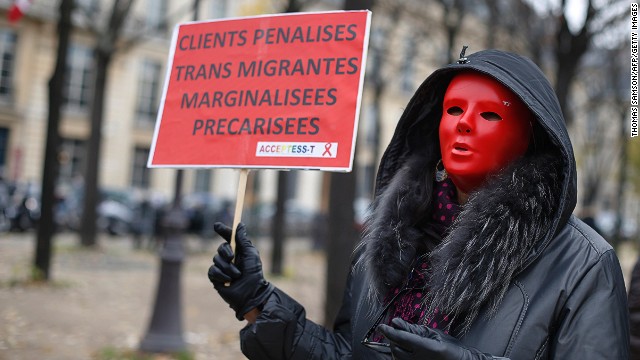
French lawmakers consider fining prostitutes' clients

 
People demonstrate on November 29, 2013 in Paris to protest against a bill that would punish those who use prostitutes.
People demonstrate on November 29, 2013 in Paris to protest against a bill that would punish those who use prostitutes

(CNN) -- French lawmakers are scheduled to vote Wednesday on a law to ban paying for sex -- a potential move to clamp down on prostitution, which is currently legal in France.

France's lower house, the National Assembly, is expected to approve the bill Wednesday and send it to the upper house, the Senate, French media report.

The Senate would then need to OK the bill before it would become law -- a process that could take months.

The measure would impose fines of at least 1,500 euros against people caught paying for sex.

For Gregory III, Syria's Greek-Catholic Church has three "true martyrs"

by Fady Noun

The patriarch spoke to the pope about the tragic events in Maaloula, the Syrian Christian village where people still speak Aramaic. In a climate of terror, three men were told to repudiate their faith, and when they refused, they were publicly executed.

Beirut (AsiaNews) - The Syrian Greek-Catholic Church has three "true martyrs". They are the "three men from Maaloula who refused to repudiate their faith," and were killed for this reason, said Patriarch Gregory III Laham during his meeting with Pope Francis on Sunday, this according to a press release issued by the Catholic Patriarchate of Antioch and All the East, of Alexandria and Jerusalem of the Melkites.

The events that led to the three men's death occurred during fighting on 3 -7 September in the town of Maaloula.

According to eyewitness accounts, men from the Syrian Free Army and the Jabhat al-Nusra Islamic Front carried out a coordinated attack in order to take control of Maaloula.

When the town fell, a climate of fear was imposed, witnesses said. When three men refused to repudiate their religion, they were summarily executed in public, and six more were taken hostage. This was followed by a failed attempt by Syrian government forces to retake the town (pictured).

"You," Gregorios III told the pope, "spoke to us, asking us not to let the flame of hope die in our hearts . . . . We want to be martyrs on this earth, martyrs in blood, as was the case for some of our faithful, including the three men from Maaloula: Michel Thalab, Mtanios Thalab and Sarkis Zachem."

"Holy Father, they are true martyrs. Ordered to give up their faith, they proudly refused. Three others however gave in and were forced to declare themselves Muslim, but later returned to the faith of their ancestors."

According to what the families who fled from Maaloula had to say, some of their Muslim neighbours took part in the attack that devastated this historic village where people still speak Aramaic, the language of Jesus. Muslims are approximately one third of the population of the village, which is about 50 kilometres from Damascus.

"Our Church, which you love, today is a church in distress," the Patriarch said. "For this church, which is facing an unprecedented situation in its history, you are Simon of Cyrene, who carried the cross."

"Like the Blessed Pope John Paul II who, through his prayers and brave actions brought down the Berlin Wall, you, Holy Father, have performed a miracle, calling on Christians and the whole world to fast and pray. You brought about a turning point in the Syrian crisis and in the vision of global politics. The world, after 7 September 2013, has changed."

It’s Kedah government’s fault, says deputy minister over failure to gazette Lembah Bujang

Candi The National Heritage Department had tried to gazette the historic temple site of Lembah Bujang in 2006 as a heritage site but it was stymied by the Barisan Nasional-led Kedah state government.

In making this revelation, Deputy Natural Resources and Environment Minister Datuk Seri James Dawos Mamit said the department had applied to the state government to gazette the area under the National Heritage Act 2005.

"Until today, there is no response from the state government," he said when winding up points raised by MPs on the Fees (Department of Museums Malaysia) (Validation) Bill 2013.

Dawos Mamit had answered on behalf of the Tourism Ministry as both its minister and deputy were at the Umno general assembly.

He said the department is still in contact with the state government for the area to be gazetted.

Saying that he supported the move to gazette Lembah Bujang, Dawos Mamit said once gazetted, an application can be made to Unesco under the Convention Concerning the Protection of the World Cultural and Natural Heritage for it to be listed as ancient artefacts.

The state government has received a lot of flak for allowing a housing developer to proceed with demolition works of one of the country's oldest archaeological sites, the Candi number 11.

Officials had claimed ignorance by stating that the land is a private land and it was not gazetted as a historic site.

Meanwhile, the developer, Bandar Saujana Sdn Bhd, insisted that official documents did not show that an archaeological site was sitting on the land.

Menteri Besar Datuk Mukhriz Mahathir had revealed that approval to develop the land in Sungai Batu, where Candi 11 was located, was granted 20 years ago but the developer only started clearing the land last August.

In the face of a barrage of criticism over the demolition of the centuries-old temple ruins, Mukhriz took to his Twitter account that Candi 11 that was destroyed was not the original one built in the 8th century.

He said it was the rebuilt version done in 1974 of the base. He said there were still 17 candi remaining, and that number 11 was just one of it.

"The whole Lembah Bujang was not destroyed," he had tweeted.

The Bujang Valley is an archeological site and excavation had revealed jetty remains, iron-smelting areas and a clay-brick monument dating back to 110AD, making it the oldest man-made structure to be recorded in South-east Asia.

The site was the foundation of a flourishing Hindu-Buddhist civilisation and a centre of international trade and commerce. - December 4, 2013.

Muslim MPs urged to back anti-Shiite amendment

Muslim parliamentarians from both sides of the political divide have been urged to back an amendment to the federal constitution so that only Sunni followers are recognised as Muslims.

NONEUmno Youth Terengganu delegate Azizul Jasmi Mohamad said this is because the amendment will safeguard Islam from the "dangerous" influence of Shiites.

"If this motion is accepted today, I hope all PAS parliamentarians who are Muslim and all Muslim parliamentarians from PKR will support the constitutional change when it is tabled (in the Dewan Rakyat)," he said.

Debating the Youth chief's address, he also urged the government to take stern action against those who insult Islam and Prophet Muhammad.

"Umno Youth will support the government in defending against these enemies of Islam," he said at the wing's general assembly at the Putra World Trade Centre in Kuala Lumpur.

A change to the federal constitution requires support from two-third of the House - or 148 of the 222 MPs.

NONEAzizul was backing Umno deputy president Muhyiddin Yassin’s (right) proposal for the constitutional amendment.

Umno Youth deputy chief Khairul Azwan Harun also endorsed the call.
In his speech this morning, he urged the government to act against "deviant lifestyles”.

"Umno Youth urges the government to be strict in dealing with threats to the Islamic faith through deviant cultures which go against religious and values," Khairul Azwan said.

He listed these threats as religious pluralism, liberalism, extremism, deviant teachings and "certain groups" who threaten national stability.

Kedahans slam culprits for destroying heritage

Locals and tourists have been flocking to the Bujang Valley this past week, thinking that the entire site of a former Sri Vijaya Kingdom, which spans 4,844 sq ft and goes back some 2,000 years, has disappeared overnight.

NONESeveral people met at the Lembah Bujang Archeological Museum in Bukit Batu Pahat yesterday, expressed relief that they could still see some structures and artefacts that have been carefully preserved by the museum management.

However, a local teacher, Abdul Rahman Noordin (left) expressed disappointment with the way the country's historical sites have been managed by other relevant authorities.

"They do not promote our history well enough. Lembah Bujang is not even specifically mentioned in our school history books. More should be done to promote and preserve places such as this one" Rahman, 49, told Malaysiakini.

"I heard about the demolition of Candi 11. It should not have happened. As a local, I feel hurt because this is part of our state and national treasure," said the father of three.

NONEThe demolition of Candi 11, an 8th century temple with Hindu Buddhist elements, has sparked public outrage.
Some have blamed the federal government for "cultural barbarism", while others have accused Kedah Menteri Besar Mukhriz Mahathir's administration of encouraging "Talibanism".

People have come to the site in Sungai Batu from as far as Johor, after reading about the demolition in media reports.
On Monday, Mukhriz had issued a stop work order to the developer.

NONEOther than Penang Deputy Chief Minister P Ramasamy and Makkal Sakthi members, former PKR Batu Uban assemblyperson S Raveentharan dropped in at the museum with his aunt yesterday.

"The MB's stop work order is tantamount to closing the stable doors after the horses have bolted. BN will lose the support of all Indians and also all the other international historical groups and bodies," Raveentharan said.

"Prime Minister Najib Abdul Razak and his executives cannot bury the truth in a pre-dominantly Islamic state. Islam came to Malaysia through Gujerat in India, so please do not, in the name of 'Ketuanan Melayu', erase history and create one that does not exist."

NONEAlso at the museum was former journalist Ng Boon Hooi, who said that the culprits who destroyed the candi must be punished harshly and Malaysia should do more to protect its heritage.

"They (the developers) have taken away our shared memory and history. Our heritage plays an important role for our progress as a nation," said Ng, a mother of two young children who lives in Malacca.

"But more than mere punishment, the younger generation must be made aware of how important our shared heritage is so that incidents like this are not repeated."

Engineer R Indran, 48, who lives near Sungai Petani, rushed to the museum after reading news reports. He said he could not understand how such a historical site was destroyed with impunity.

bujang valley 011213Indran is also baffled that Saw Guan Keat, the spokesperson for developer Bandar Saujana Sdn Bhd, had claimed the company was not aware of the historical value of the candi.

"It is common sense that such a site should be preserved. The developer could just build a fence around the temple ruins. It would enhance the value of the housing project. Now it is all gone. Very sad," said the father of three.
Department failed to act

Malaysiakini has learnt that the Kedah office of the Department of National Heritage had been aware of the demolition when the work began in September.

NONEWhile the department did inform the museum of this, it did not stop the clearing of the site.

It is learnt that the museum was unable to prevent the demolition as the site has not been under its jurisdiction since 2006.

It is also learnt that Bandar Saujana had obtained the right to develop the land in 1993, while the state was under BN rule.
The area was not gazetted as a heritage site, like the entire Lembah Bujang, which is yet to apply to Unesco to be recognised as a world heritage site.

"It is impossible for the developer not to be aware of the historical significance of the temple. Every developer knows what it is getting into when land is purchased, for we have laws," said a museum officer who did not wished to be named.

The staff member also questioned why the Indian Malaysian community living within the range of the site did not alert the authorities earlier, while NGOs highlighted the matter only after the site had been flattened.

NONEMalaysiakini visited the site yesterday and despite the heavy rain, teenager Dinesh Kumar (right, in red T-shirt) was eager to take visitors to the spot where the candi once stood.

Against the backdrop of the mystic Gunung Jerai, the site - now just raw earth - has been cordoned off by the police. Development work has come to a standstill.

Dinesh said the local residents were not aware of the demolition exercise as the site had been surrounded by an oil palm estate.

"Only when the estate was cleared and "big people" (authorities) started visiting, did we realise that the candi had been torn down," said Dinesh, 16.
NONEThe incident has disheartened local residents. They live in low-cost houses built close to the tiny, run-down Immaculate Conception chapel.
"Of course we are very angry, as the temple has been (part of our) area ... How are we supposed to rebuild it? It will never be the same," said Dinesh who lives with his grandmother.

Reconstructed from an original site in 1974, Mukhriz said the destroyed Candi 11 can be rebuilt at the original plot if the company agrees, or it may be placed near the Universiti Sains Malaysia excavation site within the area.

However, after the harrowing experience of losing such a landmark, the locals are doubtful that Candi 11 can ever be replaced.

Bujang Valley fiasco draws international flak

The Universal Society of Hinduism has expressed unhappiness over the destruction of an ancient temple in Bujang Valley, Kedah.

In a statement, the US-based society’s president Rajan Zed said it was shocking and saddening to learn about the damage.

“These Hindu temple ruins, besides being dear to Hindus, were a highly important heritage for Malaysians and the world,” he added.

NONERajan (left) urged Prime Minister Najib Abdul Razak to launch a thorough investigation into this damage and allocate additional funding to conserve the area.

He also asked the United Nations Educational, Scientific and Cultural Organisation (Unesco) to declare Lembah Bujang a World Heritage Site and help fund its preservation efforts.

“It needs to be urgently protected and some serious efforts and strong political will be needed in this direction by the Malaysian government,” he added.

Rajan said efforts must be made to reconstruct the damaged structure and the developer responsible should provide most of the funding.

He argued that such callous treatment to ancient monuments should not be acceptable in Malaysia and the world.

NONE“This should serve as a wake-up call for Malaysia and the world to take care of heritage sites and Malaysia should declare all Lembah Bujang archaeological sites as national heritage sites,” he said.

Rajan also wondered why it took so long for this damage to come to light.

“Chalking out some proactive policies for preservation of these valuable monuments might help in the future.

NONE“According to reports, there were many temple ruins in the Bujang Valley which were still undocumented and damage caused to some during the recent development might have thus gone unnoticed,” he said.

 “Malaysians should be proud of their legacy in the Bujang Valley and should preserve for future generations what their ancestors left for them,” he added.

Rajan stressed that any further irresponsible and needless damage to the sites must be prevented with swift action.

Surendran: Umno's split personality set to stay

PKR vice-president N Surendran said the split personality that had characterised the Umno leadership was set to continue even after six months of a victory in the general election and a more recent re-endorsement of incumbents at internal party polls.

NONESurendran (left) said if it was felt that successive electoral victories in the national and internal party arenas would infuse the leadership with the confidence to chart new trails, the hope of that was extinguished by the opening overtures of the Umno general assembly.

“If you are expecting change, you’ll have to perish the thought after looking at the speech of Umno’s deputy president at the opening of the youth and women’s wings of the party,” offered the MP for Padang Serai.

“A day earlier, the Umno president was on record holding forth on what has come to be seen as a familiar stance of his when not under pressure - the enunciation of an inclusive vision based on moderation, with a hint that the party under his steering was going to move with the times,” said Surendran, as he warmed to his theme.

“Barely had the public the chance to assess the prime minister’s drift, then his deputy warns the party faithful of threats from western liberalism and deviationist religious teachings,” elaborated Surendran.

The human rights lawyer said if one juxtaposes the separate pronouncements, the feature of the first term of the Najib Abdul Razak administration reasserts itself, with the No 1 scanning the horizon and the No 2 intent on navel-gazing.

“In other words, the split personality of the Najib reign is set to continue, with the PM affecting an inclusiveness and liberalism that will not pan out and the deputy PM focusing on bogus threats to Malay rights and other features of our polity that if at all are under threat, the perils are more from within than without,” mused Surendran.

He observed that this schizophrenia, which he said was a stark feature of Najib’s first years as PM, was set to continue into the second term because the “government was more infatuated with its rhetoric than with the reality of the challenges it faces and of how to proceed.”

“With Umno-BN’s ownership of mainstream media and their manipulation of state-owned channels of information, their media will supinely relay their message and those without access to alternative media are without the means to sieve fact from fiction,” said the human rights advocate.

Thus, Surendran said, the united nation that the PM rhetorically quests after is as delusive as a dream.

‘Re-examine students on leaked SPM papers’

Leaked SPM question papers warrants a re-examination to restore public trust, demands parliamentarian

KUALA LUMPUR: DAP’s Sandakan MP Stephen Wong calls for a re-examination on the alleged leaked SPM subjects to restore public trust on the prestigious high-school certificate.

He said this in response to allegations that question papers of up to six SPM subjects, namely mathematics, history, additional mathematics, chemistry, biology and science were leaked beforehand last month.

A private tutor in Kuala Lumpur and another in Sabah have been accused of leaking the questions, which prompted the Education Ministry to setup a task force for investigations.

Wong said a re-examination would not cause any prejudice to the students because those who are really competent in the subjects would still achieve good results.

“For those who are lazy, we give them another chance to study hard,” he said.

Kampar MP G Manivannan claimed that the KL tutor is a repeat offender on the matter but has been let off the hook.

He claimed that the tutor is from Setiawangsa and has used mosques as venue to leak out the question papers.

UK hears of God, Allah, sermons and firearms

A British MP has described the recent Allah issue in Malaysia and calls for Islamic Affairs officers to be armed as a 'dangerous' path

KUALA LUMPUR: Just weeks before Christmas, the alleged persecution of Christians in Malaysia, was again raised in the UK parliament as part of a debate on Christians around the world, with an MP urging its government to look at the right to practice ones’ religion as a human rights issue.

Rutherglen and Hamilton West MP, Tom Greatrex, noted recent worrying signs of such persecution especially in view of Malaysia being “an important” and “strategic” Commonwealth partner for the UK.

“It has had a significant trading and strategic relationship with this country over many years,” he told the House of Commons.

“Because of that background, it is right to be concerned about recent worrying signs in Malaysia, and to draw them to the attention of the Government through this debate,” said Greatrex.

He said the Malaysian Court of Appeals ruling banning the use of the term ‘Allah” a Bahasa Malaysia term refering to God “effectively” meant that the Bible was “outlawed” is some parts of Malaysia.

“Some Christian communities in Malaysia are now very much in fear of not being able to practise their faith without interference, or with limits on their ability to observe their faith in peace.

“They have been banned from using the word “Allah”, which has been used as terminology for God in Malay for centuries. That effectively meant that in some parts of Malaysia the Bible has been outlawed.

“When a concern was raised, or an attempt was made to raise it, in the state legislative assembly in Sarawak, it was ruled out of order and subjudice.

“So the legitimate concerns of Sarawak Christians about the Malaysia agreement that governs the relationship stretching back 50 years between the peninsula and other parts of Malaysia, have effectively been censured,” said Greatrex.

Sermons and firearms

Greatex also pointed out his concern over Sarawak Minister for Islamic Affairs Daud Abdul Rahman’s call for its religious department to be upgraded to a syariah prosecution department and its officers to be equiped with firearms.

He noted that last month the Malaysian Government’s religious affairs department, which is part of the Prime Minister’s office, had reportedly issued a sermon to be read in every mosque in Malaysia, “condemning supposedly liberal forces undermining Islam”.

“The implication taken by many people in Malaysia was that it was aimed at those who practise the Christian faith.

“There is real concern that such behaviour has relatively little to do with religion or the tolerance and understanding that religion can often promote, but that it is about seeking to create supporters who identify with one political party as pro-Islam, and brand their political opponents as anti-Islam.

“That is a dangerous road to take, because it unleashes mindless aggression, prejudice and fear,” he said, adding that the current policies in Malaysia were “effectively” making it “impossible” for people of other religions to practice their faith.

Urging his government and colleagues to act, Greatrex said: “I implore the Minister and his colleagues, when they represent the Government abroad – taking into account the important, specific and specialist relationship between the UK and other countries around the world, such as Malaysia – to use that opportunity to highlight the fact that human rights are also about the right to practise religion without fear of prosecution.

“Although freedom of religion is supposedly guaranteed by Article 11 of the Malaysian constitution, the reality for many is quite different,” he said insinuating that the stunningly successful ‘Malaysia Truly Asia’ tourism campaign was a farce.

NGOs call for probe into thugs who disrupted forum

Hindraf activist assaulted by one of the uninvited goons during a meeting on Hindu cemeteries over the weekend

GEORGE TOWN: A group of Indian NGOs has urged the police to investigate the disruption of a forum on Hindu cemeteries held at the Caring Society Complex last weekend.

The group’s spokesperson, N Ganesan, said that at least four local thugs attended the forum uninvited, caused a ruckus and assaulted one man, forcing the organisers to call off the forum.

Ganesan identified one of the thugs as S Ragendran, commonly known as Weld Quay Tambi and another as Segaran.

Ragendran and his cohorts had disrupted the forum by constantly raising their voices, interrupting speaker Ganesan’s speech and talked on irrelevant matters.

Eye witnesses said Ragendran had at least thrice punched a Hindraf activist, Selvam on his face causing his mouth to bleed.

“The forum was attended by people on invitation. These thugs attended the forum uninvited. They also refused to leave the forum when told to do so.

Stop the bullying

Ganesan alleged that some powerful people were behind the disruption.

“We learnt that similar disruptions have marred other forums in the past. But we can’t speak on behalf of others,” Ganesan told press conference here today.

He lodged a police report in Jalan Patani police station yesterday on the incident that took place last Saturday Nov 30.

“We want the police to investigate thoroughly and take necessary steps to stop this bullying,” urged Ganesan.

The forum was organised by an ad-hoc coalition of NGOs and Concerned Citizens Penang to deliberate issues of burial grounds and crematoriums for the Indian community in Penang.

The forum was also to focus on current cessation of incinerator crematorium services at the Batu Lanchang Hindu Cemetery.

The meeting was to conclude with preparing a petition to be submitted to the Chief Minister, demanding him to address the pressing issues.

The ad-hoc coalition will re-organise the forum again this Saturday, this time probably with police protection, and finalise the petition to the Chief Minister. The venue has not been decided yet.

Among NGOs were Hindraf, Malaysia Hindu Dharma Mamandram, Malaysia Hindu Sangam, Bayan Lepas Tamil School Old Boys Association, Penang Hindu Association, temple and community leaders.

GLC digesa bantu Bumiputera

Penubuhan GLC adalah bertujuan untuk membantu memperkasakan golongan Bumiputera, bukan sekadar untuk mengaut keuntungan

SHAH ALAM: Ketua Pegawai Eksekutif (CEO) syarikat-syarikat milik kerajaan (GLC) digesa untuk membantu memperkasakan golongan Bumiputera.

Ketua Pemuda Umno Bahagian Batu Gulam Muszahar Gulam Mustakim berkata detika ketika membahaskan ucapan dasar Ketua Pemuda Umno dalam perhimpunan Umno hari ini.

Jelasnya, penubuhan GLC adalah bertujuan untuk membantu memperkasakan golongan Bumiputera, bukan sekadar untuk mengaut keuntungan.

Beliau turut mendakwa mempunyai bukti bahawa Petronas menggunakan syarikat milik warga asing sebagai pembekal makanan tempatan di kedai runcit stesyen-stesyen minyaknya.

“Saya ada bukti surat dari Persatuan Pengusaha Stesen Minyak Melayu bahawa Petronas bawa syarikat tempatan milik warga asing sebagai rakan niaga oleh Petronas Dagangan Bhd,” katanya.

Gulam Muszahar menyifatkan perkara itu sebagai ‘rompakan’ keatas hasil pendapatan pengusaha makanan Industri Kecil dan Sederhana (IKS) dan akan membunuh IKS.

“Ini dasar kapitalis, hanya untuk mengaut keuntungan,” jelasnya lagi sambil menambah syariakt-syarikat milik warga asing ini tidak mempunyai kredibiliti untuk menyediakan sajian makanan tempatan.

Disamping itu, Gulam Muszahar turut menyarankan jabatan-jabatan khas diwujudkan di GLC-GLC bagi membantu kelangsungan perniagaan Bumiputera.

Soi Lek quits politics

http://www.freemalaysiatoday.com/wp-content/uploads/2011/04/Chua-Soi-Lek-MCA-300x202.jpgAnisah Shukry, FMT

MCA President Dr Chua Soi Lek announced today he would not defend his position in the party polls this Dec 21, saying it was time for him to retire from politics.

He said many supporters had urged him to go back on his May 6 pledge that he would not contest, telling him a four-corner fight would give him an advantage.

“But I don’t want to go down in the history of MCA as a leader with no integrity; when I say I am not defending my position, I mean it,” the veteran politician said at a press conference at the party headquarters here.

He said if he were to stand and win it would be an “empty victory” because he would have backtracked on a promise after his chances had increased.

The MCA leaders gunning for the top position are deputy president Liow Tiong Lai, former president Ong Tee Keat and vice president Gan Ping Sieu.

Chua had vowed to not defend his presidency immediately after last May’s general election, which saw MCA suffer the worst defeat in its history, winning only seven federal and 11 state seats.

But speculation was rife that Chua would renege on his pledge. It was fueled further when he censured his deputy at an annual general meeting in October and gave elusive answers to questions from the media.

But Chua clarified today that the “hard work” he had done in the party since the general election was meant to convince his comrades there was still hope in MCA, not for his own political gain.

He urged his supporters not to “grudge” him his retirement, saying he believed he had earned it.

“Of course, there are people who think that I will not give up easily; hence I will seek re-election. Once again I would like to emphasise that I am not giving up, but giving way to new blood.

“After my retirement, I will continue to play whatever role I can to contribute to the transformation of MCA and to strengthen the Barisan Nasional.”


Money politics

He said that the MCA leadership needed to give room for the younger generation, but he did not endorse any candidate in the party election.

Chua also urged party veterans to not use the polls as a means to settle old scores and warned businessmen to stay away from the proceedings.

“Every time businessmen come in, money is involved,” he said. “MCA must stand firm and reject money politics in party elections. If we are involved in money, it will only serve to devalue the position of the MCA party president and other posts.”

He urged party members, including the leaders, to practise the “politics of transforming MCA” and to close ranks once the polls were over.

Chua was optimistic that the tide of voter sentiment would turn towards MCA in the next general election.

Candi destruction shocks former Kedah MB


(The Star) - It started as a dream to create a tourist attraction with an ancient candi of Bujang Valley as its centrepiece. Two decades on, it’s now an archaeological nightmare.

Former Kedah Mentri Besar Tan Sri Osman Aroff said he had made preservation of all the candi a “strict condition” when approving the Kedah International Resort City project in Bujang Valley in 1993.

The project never saw the light of the day. However, things have spiralled out of control.

“I am devastated to learn that a candi in Sungai Batu was destroyed by a private developer recently.

“This begs the question of how the state land ended up in private hands,” said Osman.

That is the burning question, because his successors as Mentris Besar have also denied selling the land to any developer.

Bandar Saujana Sdn Bhd project manager Saw Guan Keat had said that the company bought eight lots of land in Sungai Batu from another developer earlier this year.

The new developer destroyed the candi while clearing the land for a housing project.

Osman said the Kedah Inter-national Resort City project was a joint venture between a Qatar-based company and Mentri Besar Inc. The state had a 40% stake while the company held the remaining shares.

“The state also acquired the surrounding piece of land for the project covering about 400ha,” he added.

Osman said he was surprised to learn that a private developer now owned part of the land.

“The project was supposed to comprise an agriculture park and a hotel amid the preserved ruins of an ancient civilisation,” said Osman who was Mentri Besar from 1985 to 1996.

Another former Mentri Besar, Tan Sri Sanusi Junid (1996-1999), said he had rejected the request of a foreign company to be recognised as a local one. Sanusi told the company to abide by the country’s rules and regulations.

“But after one meeting with me, they never came back,” he said.

Former executive councillor Datuk Amiruddin Hamzah of the Pakatan Rakyat state government (2008-2013) said the company had threatened to sue the state for rejecting its proposal to build houses in the area.

Amiruddin said the late Kedah Mentri Besar Tan Sri Azizan Abdul Razak rejected the company’s proposal because it involved building thousands of housing units in the area.

“We do not need a foreign company to build houses here.”

Archaeology expert: Still hope for razed Lembah Bujang temple


(MM) - Armed with blueprints from historical texts and research papers, an archaeological expert believes it possible to rebuild the millennia-old temple in Lembah Bujang, Kedah that was torn down by a housing developer.

According to director of the Universiti Sains Malaysia (USM) Centre for Global Archaeological Research (CGAR) Professor Dr Mokhtar Saidin, who leads a team that has excavated 46 sites in the area, there exists sufficient information to allow the prehistoric structure to be reconstructed, hopefully, where it once stood.

“We can reconstruct it again because I saw some of the publication before and there is a plan, so we can reconstruct again, the best is to construct on the original site,” Mokhtar said, referring to plans of the ancient temple contained in published works.

The candi in question had been restored once in 1974. The archaeology expert said the restoration commissioned by the then-Museum Department had been minor as the candi was only “naturally disturbed”, but it would require a complete reconstruction this time around.

“The developer should help because it’s just a small area and I think Jabatan Warisan should too and if they want USM to help, no problem,” he told The Malay Mail Online when contacted.

Yesterday, Kedah Mentri Besar Datuk Mukhiz Mahathir also spoke of the possibility to rebuilding the demolished candi number 11.

“The ruins can be reconstructed on its original site with the agreement of the company or near the Universiti Sains Malaysia excavation site at Sungai Batu,” he was quoted as saying by national news agency Bernama last night.

The recent discovery of the demolition of the 1,200-year-old candi number 11 at Sungai Batu triggered national outrage over the callous treatment of the country’s historical monuments.

A candi, short for candigarh, has been described as a place of worship with elements of either Hinduism or Buddhism; about 50 are peppered across the Kedah valley and believed to date back to between the 8th and 13th centuries.

Lembah Bujang is also thought to be the foundation for the rise of the Malay kingdom in Southeast Asia, and the region’s foremost entrepot and trading centre in ancient times.

Earlier yesterday, Mukhriz said the state government has appealed to the Tourism and Culture Ministry to gazette over 100 archaeological sites as national heritage sites.

“The state places the utmost importance in preserving all heritage sites in Kedah so we are saddened over the recent destruction of candi number 11,” he said.

However, Mokhtar said even if the historical sites are not gazetted as such, future development plans in the Merbok area should be referred to the local authorities and the National Heritage Department to prevent the destruction of other historical locations.

Recounting a previous visit in 2007 to what was then an oil palm estate, the professor said the candi had still been intact. He added that had the land status not been changed from agricultural to residential, the tragedy might not have taken place.

“Before this, as far as I know, all candis are in private land, usually in plantation area, the owners know the sites shouldn’t be disturbed, but for site 11, they want to develop housing, so they bulldoze all the trees and everything there.

“It is very sad; it serves as a lesson for us ― for all of us ― to be responsible [and] to take care of such historical sites.”

According to Mukhriz, the developer had obtained planning permission to develop the land back in 1993 but only started clearing works this August.

On Monday, the Lembah Bujang Archaeological Museum — the candi’s former caretakers — said it informed National Heritage Department of the destruction in September.

It is unclear if the department did anything to stop the developer, as its director-general, Datin Paduka Prof Siti Zuraina Abdul Majid could not be reached as she is currently abroad for the month.

Lembah Bujang is the richest archaeological site in Malaysia and the home of the oldest man-made structure recorded in Southeast Asia — a clay brick monument nearly 1,900 years old.

Excavations on the site have also uncovered jetty remains, iron smelting sites and relics with Hindu and Buddhist influences that point towards a Hindu-Buddhist kingdom there as early as 110 CE.


The “non-fulfillment” of the Malaysian agreement: Who is to blame? - Arnold Puyok

In 1963, Sabah, Sarawak and Peninsular Malaya formed what is now called Malaysia. But the forming of Malaysia was not without challenges. In terms of population demography, Sabah and Sarawak were more culturally heterogeneous than Peninsular Malaya.

Sabah and Sarawak were also economically under-developed. Due to Sabah and Sarawak’s distinctive characters, they were allowed to make specific demands as part of a deal before their incorporation into Malaysia.

These demands were known as the 20-point memorandum for Sabah and 18-point memorandum for Sarawak. Both memorandums were later used as a guide by the Cobbold Commission to ascertain the views of Sabahans and Sarawakians about Malaysia.

The demands were later discussed in the Inter-Governmental Committee before their incorporation into the Federal Constitution. At the London talks in July 1963, Great Britain, Northern Ireland, the Federation of Malaya, North Borneo (Sabah), Sarawak and Singapore agreed to sign the Malaysia Agreement.

The signing of the agreement was significant because it paved the way for the enactment of the Malaysia Act (Act No. 26 of 1963) which sealed the formation of Malaysia. With the enactment of the Malaysia Act, the Federal Constitution took over from the Malayan Constitution as a new “document of destiny” for Malaysia. The rights and privileges for Sabah and Sarawak are clearly stated in the Federal Constitution (Articles 161, 161A, 161B, 161E).

Apart from becoming a supreme document in the land, the Federal Constitution also reflects the new political reality in Malaysia. It should be stated that Malaysia was formed through the merging of three separately independent entities – Peninsular Malaya, Sabah and Sarawak.

However, some people argue that the federal government does not honour the 20/18-point memorandum. The issue becomes complicated when the legality of the 20/18-point is questioned. For some, raising the 20/18-point is akin to flogging a dead horse because it is already incorporated into the Federal Constitution. For others, the 20/18-point is a legal document and it is the federal government’s duty to fulfill the demands of Sabah and Sarawak before their incorporation into Malaysia. But ironically, the non-fulfillment of the 20-point demands were a work of Sabah own leaders.

In 1973, Sabah Chief Minister Mustapha Harun of Usno (United Sabah National Organisation) amended the State Constitution to make Islam the official religion of Sabah. In the 20-point memorandum, Sabah leaders requested for Islam not to be made official religion because the majority of the population was non-Muslims and many were not inclined towards Islam.

Mustapha continued to amend the State Constitution to make Bahasa Melayu the official language in replace of English. The 20-point stated that English should be the “official language of [Sabah] for all purposes, [s]tate or [f]ederal without limitation of time”. Mustapha’s actions were driven by his beliefs that Sabah could only be developed under one religion (Islam), one language (Bahasa Melayu), and one culture (Malay).

In 1976, the 20-point and Sabah’s autonomy were further eroded by Mustapha’s successor Harris Salleh of Berjaya who surrendered the state’s control over natural resources to the federal government. In 1984, Harris continued with his massive federalisation policies by surrendering Labuan. In 1991, the federal influence in Sabah came to its high point with the establishment of Umno and other Peninsular-based parties in the state. Most of the Usno members left the party and joined Umno.

The rotation system of the chief minister’s post introduced by then Prime Minister Mahathir Mohamad to ensure equal representation of the main ethnic groups in Sabah was just a temporary measure to consolidate Umno’s powers in Sabah. Just before the system completed its full cycle, it was abolished by Umno to seal its dominance in Sabah.

Changes in Sabah’s political landscape also affected the relations between one ethnic group with the other. Sabah has never experienced any serious ethnic tension since the formation of Malaysia. But when the Sabah Mufti called for the “Malay-isation” of the Muslim indigenous people, it caused a lot of anxiety – and potentially explosive ethnic fissures – in Sabah. The mufti’s refusal to apologise did not go well with many who continued to force the state Islamic leader to appear before the Native Court.

The mufti’s suggestion came amid the growing number of Malay/Muslim population in Sabah since the era of Mustapha. The non-Muslim people were aware of the fact that Sabah’s population demography had been altered to increase the Malay/Muslim population for political expediency. This is among the factors making the ruling party BN unpopular in the non-Muslim constituencies.

Sabahans have every reason to voice out their unhappiness about the attempt to alter Sabah’s plural identity and autonomy. But they must look introspectively and stop blaming the federal government and “semenanjung” people. The problems that happen in Sabah are mainly caused by Sabah leaders and Sabahans themselves.

Of course, one can say that the federal government has the innumerable powers to exert its influence in Sabah. But it is the duty of Sabah leaders to defend the Federal Constitution which grants Sabah certain rights and autonomy. Sabahans must also be aware that many Sabah leaders are using the 20/18-point issue and the Malaysia Agreement to revive their fading political support. Others use it as a “bargaining chip” to pursue their political ambition.

So, Sabahans should not trust these opportunist politicians too much. They must seek the truth themselves and use their democratic rights to elect leaders who are sincere in fighting for their rights.

The Federal Constitution protects the special privileges for Sabah and Sarawak. Malaysians of all walks of life have the duty to defend the sanctity and sovereignty of the Federal Constitution. Any attempt to erode the constitutional safeguards of Sabah and Sarawak must be stopped.

The formation of Malaysia happened by the sweat and toil of our founding fathers who envisioned a new country that belongs to all Malaysians irrespective of their ethnic identity and religion. Let us all defend what Malaysia was meant to be. – December 4, 2013.

*Arnold Puyok is a political analyst, and reads The Malaysian Insider.

* This is the personal opinion of the writer or publication and does not necessarily represent the views of The Malaysian Insider.

Groups: Get Malaysia in line with its human rights obligations

The Star
by SHAILA KOSHY


KUALA LUMPUR: Malaysia should seriously consider the recommendations the United Nations members states gave during its Universal Periodic Review (UPR) on reviewing the mandatory death penalty here.

Sedar Institute executive director Ivanpal S. Grewal said this would ensure Malaysia functioned in line with its human rights obligations.

At Malaysia’s UPR in Geneva on Oct 24, the second highest cluster of recommendations involved the death penalty.

“I am taken in by one point made by the review that we do not have the luxury of bringing a person back from the dead if he is executed and found later to have been innocent,” said Ivanpal in an interview.

He was commenting on the recent articles in The Star on the UPR recommendations and results of the Death Penalty Project (DPP) Survey which show that the public is more comfortable with a discretionary death penalty.

Oxford University Emeritus Prof Roger Hood, who was commissioned by DPP to design and analyse the large-scale public opinion survey, said the findings suggested “public opinion ought not to be regarded as a definite barrier to the abolition of the death penalty for murder”.

Malaysian Bar president Christopher Leong and Suhakam chairman Tan Sri Hasmy Agam have also called on the Government to abolish the mandatory death penalty or give the discretion to judges.

Ivanpal said Malaysia must institutionalise respect for human rights and dignity and the surest way forward is for Malaysians to reject the death penalty.

“Sedar Institute believes that the death penalty is a cruel, inhuman and degrading punishment and it’s contrary to basic human rights.

“The state should not justify the death penalty as a form of deterrence because crime has not decreased despite having the death penalty.”

“We should look towards rehabilitation and there is always imprisonment for life for the worst of the worst of offenders,” he said, stressing Sedar Institute’s belief in the wisdom of Gandhi who had said that an eye for an eye makes the whole world blind.

Najib Chairs Special MT Meeting In Conjunction With 2013 Umno General Assembly

KUALA LUMPUR, Dec 4 (Bernama) -- Prime Minister Datuk Seri Najib Tun Razak, who is also Umno President, tonight chaired a special Umno Supreme Council (MT) meeting in conjunction with the 2013 Umno General Assembly.

The assembly is the first after the 13th general election last May and the party election last October.

The special meeting, held at the Umno headquarters at Menara Dato' Onn here, was also attended by Deputy Prime Minister Tan Sri Muhyiddin Yassin, who is also Umno Deputy President.

Others present included Vice-President Datuk Seri Dr Ahmad Zahid Hamidi, secretary-general Datuk Seri Tengku Adnan Tengku Mansor, Youth leader Khairy Jamaluddin, party treasurer Datuk Seri Ahmad Husni Hanadzlah and Information Chief Datuk Ahmad Maslan.

Among the new MT-appointed members present were Youth vice-chief Khairul Azwan Harun, Puteri vice-chief Zahida Zarik Khan, Titiwangsa Member of Parliament Datuk Johari Abdul Ghani, former Universiti Teknologi Mara Vice-Chancellor Prof Tan Sri Dr Ibrahim Abu Shah, Yayasan Dakwah Islamiah president Dr Asyraf Wajdi Dusuki and Kuala Selangor Member of Parliament Datuk Irmohanizam Ibrahim.

All the MT members present took their oath of office before Najib and Muhyiddin prior to the meeting which started at 9pm.

Najib will open the Umno General Assembly 2013 at Dewan Merdeka, Putra World Trade Centre tomorrow, as well as deliver the presidential address before the 2,759 delegates attending the assembly.

Tunku Aziz: 'Don't politicize Bujang Valley demolition'