Share |

Friday, 22 February 2013

Sri Lanka's Ominous Authoritarian Turn


Rajapakse cracks down
(Asia Sentinel) The International Crisis Group's call for international action will probably be ignored
The Mahinda Rajapaksa government in Sri Lanka, more than three years after the end of the devastating civil war that paralyzed the country for 22 years, has instituted a virtual reign of terror against not only its defeated Tamil minority but against many of its own citizens in the south, critics say.

The government's repressive nature is hardly news. Virtually since the defeat of the Tamil separatists in 2009, the government has continued to crack down on any dissent. In January, the parliament, dominated by Rajapaksa's followers, impeached chief justice Shiran Bandaranayake, eliminating the last institutional check on the executive branch.

The government consistently denies any wrongdoing. However, according to a report released this week by the Brussels-based International Crisis Group (ICG), the Rajapaksa regime "has crossed a threshold into new and dangerous terrain, threatening prospects for the eventual peaceful transfer of power through free and fair elections."

ICG called for international action to halt the slide to tyranny: "Strong international action should begin with Sri Lanka's immediate referral to the Commonwealth Ministerial Action Group and a new resolution from the United Nations Human Rights Council calling for concrete, time-bound actions to restore the rule of law, investigate rights abuses and alleged war crimes by government forces and the Liberation Tigers of Tamil Eelam, and devolve power to Tamil and Muslim areas of the north and east."

That is unlikely to happen. Human rights groups say the Rajapaksa government, now that its power base is unthreatened, has systematically annulled a wide range of human rights, including turning a blind eye to the murder of dissidents and independent journalists. According to the New York-based Committee to Protect Journalists, "Sri Lanka remains a highly restrictive and dangerous nation for the press." As many as 20 journalists have gone into exile over the past five years, with nine killed since the end of hostilities in 2009.

The New York-based Human Rights Watch, in an earlier report, called attention to similar human rights abuses, including the beating with iron bars of Gnanasundaram Kuhanathan, editor of a Jaffna-based newspaper. The report also pointed out that there has been no government accounting for the deaths of tens of thousands of ethnic Tamils in the wake of the surrender by the Tigers.

Sri Lanka is faced with two worsening and inter-connected governance crises, the ICG said. "The dismantling of the independent judiciary and other democratic checks on the executive and military will inevitably feed the growing ethnic tension resulting from the absence of power sharing and the denial of minority rights. Both crises have deepened with the Rajapaksa government's refusal to comply with the United Nations Human Rights Council's March 2012 resolution on reconciliation and accountability."

Although the government claims to have implemented many of the recommendations of a truth and reconciliation commission established at the urging of the Human Rights Council, there has been no meaningful progress on the most critical issues, the ICG says.

"The government has conducted no credible investigations into allegations of war crimes, disappearances or other serious human rights violations," the report said. "There has been no progress toward a lasting and fair constitutional settlement of the ethnic conflict through devolution of power, the military still controls virtually all aspects of life in the north, intimidating and sidelining the civilian administration, more than 90,000 people remain displaced in the north and east, amid continued land seizures by the military, with no effective right of appeal and no fair process for handling land disputes."

Government security forces have broken up peaceful Tamil protests in the north, detained students on questionable charges of working with the defeated Tamil Tigers and actively harassed Tamil politicians, the report says, responding with force to protest and dissent on the part of its own citizens in the south as well, deploying troops to prevent the newly impeached chief justice and supporters from visiting the Supreme Court while pro-government groups have attacked lawyers protesting the impeachment.

"Analysts and government critics have warned of Sri Lanka's growing authoritarianism since the final years of the civil war, but developments over the last year have worsened the situation," the report says. "The president's willingness and ability to push through the impeachment - in the face of contrary court rulings, unprecedented opposition from civil society and serious international concern - confirms his commanding political position."

The impeachment completes what the ICG called a "constitutional coup" initiated in September 2010 by the 18th amendment, which removed presidential term limits and the independence of government oversight bodies. The government in 2010 jailed Saranath Fonseca, the commanding general who defeated the Tamil Tigers, when he sought to declare his candidacy to run against Rajapaksa.

"The consolidation of power paves the way for moves that could further set back chances of sustainable peace." The report continues. "The president and his two most powerful brothers - Defense Secretary Gotabaya and Economic Development Minister Basil - have signaled their intention to weaken or repeal the provinces' already minimal powers. As the government makes explicit its hostility to meaningful power sharing between the center and the Tamil-speaking north and east, Tamil identity and political power are being systematically undermined by the military-led political and economic transformation of the northern province."

Ominously, sectarian violence has also begun to spread, with a recent upsurge in attacks by militant Buddhists on Muslim religious sites and businesses. The government has done little to discourage these attacks.

"Should such provocations continue, the remarkable moderation of Sri Lanka's Muslims could face serious tests," the report notes. "Given the country's history of violent resistance to state power perceived as unjust, the authoritarian drift can only increase the risk of an eventual outbreak of political violence."

Sri Lankans of all ethnicities who have struggled to preserve their democracy deserve stronger international support. The Human Rights Commission's 2012 resolution was an important first step, but more is needed, the report continues.

"This should begin with a stronger HRC resolution in March 2013, which must demand concrete reforms to end impunity and restore the rule of law; mandate the Office of the High Commissioner for Human Rights to monitor violations and investigate the many credible allegations of war crimes committed in the final months of the war by both sides; and, where possible, identify individuals most responsible."

The ICG published a list of specific demands on the government including implementing core recommendations of the truth commission, strengthening the rule of law, greater accountability, devolution of power and national reconciliation, through a process that includes opposition political parties and independent civil society representatives of all ethnic communities, meaningful reconciliation and others.

However, given the overwhelming sway of the Sri Lankan government, it is unlikely that any of the recommendations will be heeded. Likewise, recommendations to the Human Rights Council to attempt to deal with the situation are likely to be ignored by the government if they are put in place, as are recommendations to the Commonwealth Secretariat.

PKR Unveils Think-Tank to Help Make Better Policies


PKR has launched its new think-tank today with the aim to help them make policies that are “directed towards social justice and a sustainable future”.

In addition, it would also run programmes to educate youths on being more effective in their activism.

The think-tank, dubbed ‘Institut Rakyat’, featured many prominent thinkers in its eight-member advisory panel.

These include former UN Research Institute for Social Development board member and economist Jomo Kwame Sundaram, constitutional law expert Azmi Sharom, Malaysia CEO of the Year 2010 award winner Stanley Thai, and media professor Zaharom Nain.

“They are the ones, with their expert advice, professional experience, intellectualism and scholarly experience, who will give directions to the think tank,” said Institut Rakyat director Wong Hoy Cheong.

“We need evidence-based policies, not policies that are created, and then followed by ‘evidence’ pulled out of thin air to support it.”

Other notable figures in the institute include suspended Bank Islam economist Azrul Azwar Ahmad Tajudin who serves as the institute’s research consultant, and former Maybank CEO Wan Azmi Wan Hamzah who serves as a director.

The institute is chaired by PKR president Dr Wan Azizah Wan Ismail and her deputy Syed Husin Ali, a former senator.

Although PKR-linked, Wong said the institute is dependent on donations from well-wishers and does not receive any funding from neither the party nor any government.

‘Offering critical analysis and commentary’

Meanwhile, the PKR de facto leader said the institute would be independent despite its relationship with his party during his keynote speech at the launch event in Subang.

“The paramount role of a policy studies institute is to offer critical analysis and commentary in order to influence them to meet the requirements of good governance.

“The establishment of this institute, being affiliated with PKR, grants the risk of being reduced to a self-serving mouthpiece.

“Hence it is of the greatest consequence that it should be independently run and that it performs the task it is set out to do in its charter, which among others is to advise and critique without fear or favour.

“To remain true to this, it must listen to the voice of the people. It must promote the culture of the ruling political coalition from the government – and I am anticipating an imminent victory, God willing,” Anwar (right) said.

He added that young leaders in the party have long lobbied with the party’s ‘old guard’ for a party-linked think tank just as other parties have done, but with freedom to do its own research.

“This is a rather unique event in my political experience, which is that I have to succumb to the pressure of the youth from time to time to create new institutes and new ideas,” he said while thanking those involved in the lobbying.

49-Day Countdown to 13GE: Najib has presented me with a dilemma – is the Election Integrity Pledge worth signing when the Prime Minister can sign it with such aplomb, contempt and cynicism?

By Lim Kit Siang
The Prime Minister, Datuk Seri Najib Razak, has presented me with a dilemma – is the Election Integrity Pledge proposed by Transparency International-Malaysia (TI-M) worth signing when Najib could sign it with such aplomb, contempt and cynicism after his four-year premiership witnessed corruption in Malaysia plunging to its worst depths in the nation’s 56-year history.

In Najib’s four years as Prime Minister, Malaysia’s Transparency International (TI) Corruption Perception Index (CPI) plunged to its lowest rankings in the past 18 years, i.e. No. 56 in 2009 and 2010, No. 60 in 2011 and No. 54 in 2012, as compared to Malaysia’s No. 23rd ranking in the first TI CPI in 1995, No. 37th placing in 2003 when Tun Dr. Mahathir stepped down as Prime Minister after 22 years of authoritarian and corrupt rule and No. 47 ranking in 2008 after five years of Tun Abdullah’s “Mr. Clean” premiership.

It is incontrovertible and undeniable that corruption under Najib’s four-year premiership is the worst under any Prime Minister in the nation’s 56-year history, as apart from being worse than the Mahathir and Abdullah eras, no one has ever suggested that corruption under the first three Prime Ministers, Tunku Abdul Rahman, Tun Razak and Tun Hussein were ever more serious than under their successors.

What makes a meaningful signing of the TI-M’s Election Integrity Pledge even more questionable is the presence of the Sarawak Chief Minister, Tan Sri Abdul Taib Mahmud, who had put Malaysia on the international radar of anti-corruption campaigns after the allegations in the ground-breaking and explosive report by the Swiss-based NGO Bruno Manser Fund (BMF) last September which estimated the assets of Taib Mahmud’s family at US$21 billion (RM64 billion), with the wealth of Taib himself put at a whopping US$15 billion (RM46 billion) making him Malaysia’s richest man outstripping tycoon Robert Kuok who has US$12.5 billion.

Najib not only failed to show any seriousness or commitment in the battle against corruption by setting up a Royal Commission of Inquiry into the BMF report to clear Taib’s name but even more important to vindicate Malaysia’s reputation, he as good as directed the Malaysian Anti-Corruption Commission (MACC) to leave the BMF report alone by publicly dismissing its allegations of grand corruption against the Sarawak Chief Minister.

If the Sarawak Chief Minister was present at Najib’s Election Integrity Pledge signing ceremony yesterday, why was the Sabah Chief Minister Datuk Seri Musa Aman, another Barisan Nasional leader who has put Malaysia on the world radar in international anti-corruption campaigns, absent?

In my speech in Parliament on the 2013 Budget last October, I had spoken about the “test of the trio” as to whether there is real political will in the Najib premiership to combat “Grand Corruption” by VVIPs, and I had named Taib, Musa and the Attorney-General Tan Sri Abdul Gani Patail.

But there is only complete silence from Najib on the “test of the trio” in the battle against “grand corruption” in Malaysia.

What credibility and legitimacy could Najib’s signing of the Election Integrity Pledge inspire and generate when the 66th UMNO General Assembly last December was such a dismal failure as far as fighting corruption and ensuring election integrity in the 13th General Elections are concerned?

A month before the 66th UMNO General Assembly, China’s outgoing President and General Secretary of the Chinese Communist Party (CCP) Hu Jintao warned at the 18th CCP Congress that corruption could trigger the collapse of the Party and the fall of the State – a theme which was taken up in the first speech of the new Chinese Communist Party leader, Xi Jinping, who denounced the prevalence of corruption and said officials needed to guard against its spread or it would “doom the party and the state”.

There was more reason for Najib than Hu Jintao and Xi Jinping to give priority to the grave problem of corruption as in the last two decades, China had been making measurable progress in the battle against corruption while the reverse is the case for Malaysia.

In fact, if the trend of China’s improvement in the Transparency International (TI) Corruption Perception Index (CPI) in the past 18 years (1995-2012) and Malaysia’s regression continues unchecked, China will be placed in a better position than Malaysia in the TI CPI in being internationally regarded as being less corrupt in less than five years.

But the 66th UMNO General Assembly only provided further evidence that although Umno and Barisan Nasional have become synonymous with corruption in Malaysia and the four-year Najib premiership, Najib is only good at mouthing anti-corruption slogans but totally lacking the political will and commitment to root out corruption, especially grand corruption involving political and government leaders.

This was why the 66th UMNO General Assembly presented the sad spectacle of the Sabah Chief Minister Musa Aman successfully performing the “disappearance” act despite valiant efforts by the media representatives on a look-out for him to respond to demands by Sabah UMNO delegates that Musa explain the scandal of the RM40million “political donation to Sabah UMNO” which involved him and the Sabah timber trader Michael Chia.

There was also the spectable of the the backing out and silence of the Defence Minister, Datuk Seri Zahid Hamidi coupled with the failure of Najib to respond to the serious allegations of integrity about a RM100 million defence ministry project in 2005 raised by businessman Deepak Jaikishan implicating the Prime Minister’s family and which is also related to the high-profile and long-running Mongolian Altantuya Shaariibuu murder case.

It was at the 66th UMNO General Assembly that some Sabah UMNO delegates told online news portals that although they full support Musa Aman, they were in the dark about the RM40 million “political donation” to Sabah UMNO and they wanted Musa to personally explain the issue.

However, there were also Sabah UMNO delegates who dismissed the controversy on the ground that the RM40 million donation was pittance compared to the millions UMNO dished out during elections – with one Sabah UMNO delegate revealing that in the Putatan constituency in his home state, UMNO would have to spend up to RM6 million during the polls.

With 26 parliamentary constituencies in Sabah (and Labuan) and at the average of RM6 million per constituency, the total election expenses would exceed RM150 million at the parliamentary level – which would more than doubled when the election expenses in the state assembly constituencies are taken into account.

With UMNO/BN spending at least RM300 million in Sabah, another RM300 million in Sarawak, and similar election expenditures for the 165 Parliamentary seats and 441 State Assembly seats in the eleven states in Peninsular Malaysia, we are looking at the UMNO/BN coalition spending billions of ringgit in the 13GE to retain power and recapture two-thirds parliamentary majority at the federal level, as well as regain the four Pakatan Rakyat states of Penang, Kelantan, Selangor and Kedah and ,maintain its unconstitutional rule in Perak.

With the UMNO/BN set to spend billions of ringgit in the 13GE, what is the use of Najib signing TI-M’s Election Integrity Pledge? I will discuss with Datuk Seri Anwar Ibrahim and Datuk Seri Hadi Awang whether under these circumstances, there is any purpose in our signing the TI-M’s Election Integrity Pledge.

The Economist Intelligence Unit Says Barisan Nasional Will Win 13th General Election

KUALA LUMPUR, Feb 21 (Bernama) -- The Economist Intelligence Unit (EIU), which is part of the respected London-based magazine, 'The Economist', predicts that the Barisan Nasional (BN) will win the 13th General Election (GE13) based on its successful track record, Prime Minister Datuk Seri Najib Tun Razak's reform agenda and his successful economic leadership.

For international observers, the outcome of the upcoming polls is already clear, that the BN will be victorious, the EIU said.

It also said the opposition Pakatan Rakyat has been making "costly promises" to gain power, and these were a big stumbling block.

On all these counts, Pakatan Rakyat comes a distant second, prompting the EIU to predict BN will be the winner.

The EIU, a think-tank which offers regular country, industry and risk analysis, said that "it is clearly not feasible" for Pakatan to implement all of its campaign promises.

"For example, providing free secondary education would cost the government RM43 billion, while abolishing car duty would cut tax revenue by RM4.6 billion a year," it said.

The EIU pointed out that Pakatan had broken many of its earlier promises, including financial assistance for pre-school education, for university students, senior citizens and the disabled; free healthcare for those over 65; lower property taxes; and assistance for home buyers.

On all these counts, Pakatan's populism has remained just hot air.

In Selangor, for example, BN claimed that Pakatan has implemented only 15 per cent of its 31 election pledges, RM2.4 billion worth, made in its 2008 general election manifesto.

"Selangor Menteri Besar (Tan Sri Abdul) Khalid Ibrahim commented that a manifesto is not a promise but conceded that voters may think otherwise," the EIU noted.

Compared this with BN's successful track record in fulfilling its promises, and you have a clear difference in approach.

For instance, Najib has promised Penang 20,000 affordable houses and a monorail service to ease traffic congestion, and if BN comes to power in the state, voters can be sure that these plans would be implemented.

"The stakes are high for both (BN and Pakatan)...the bidding war is likely to continue as both sides make preparations for what is being billed as one of the hardest-fought elections in Malaysia's history," the report said.

"Both will need to appeal to young, first-time voters, given that nearly three million people in this crucial voting block have been added to the electoral register since the last election," it added.

The EIU claimed the "bulk of this group" was undecided about which party to vote for and could swing the outcome of the election.

Najib needs to win big in order to secure the future of his reform agenda, while on the other hand, the opposition leader, Datuk Seri Anwar Ibrahim, wants to be the first to break the BN's stranglehold on power.

Meanwhile, Umno is upbeat with only weeks left for the polls, as Najib said the party machinery was in the final stages of its preparations.

"We have received the audit report on our machinery and from there I can say our preparations are satisfying.

At the same time, I hope the efforts to strengthen our preparations will continue to be carried out by leaders at the state level," he told reporters after the Umno supreme council meeting last Friday.

Najib, who is also Umno President and BN Chairman, made the selection of winnable candidates the focus of his strategy, making it clear that the BN should field candidates with the best chance of winning, regardless of which BN component party had kept the seats previously.

Another key reason for the ruling coalition's strong morale is the "gravity defying" growth of 5.2 per cent that the country is enjoying under Najib's leadership, along with a jump in domestic and foreign investments. And to top it all, per capita income hit US$9,700 from US$7,500 in 2010.

The EIU agrees with the upward trajectory: "Following an estimated expansion of 5.2 per cent in 2012, we expect GDP to grow at the same rate during the 2013-17 forecast period."

Growth figures announced yesterday by the Statistics Department showed that the economy accelerated to 6.4 per cent growth in the last quarter of 2012 and supporting the full year growth to expand by 5.6 per cent from 5.1 per cent a year earlier.

Against such a backdrop, the EIU said: "No wonder the writing is on the wall for Pakatan as it tries to cobble together some opposition unity between its squabbling leaders before the polls."

Thursday, 21 February 2013

Deepak's controversial land deal, simplified


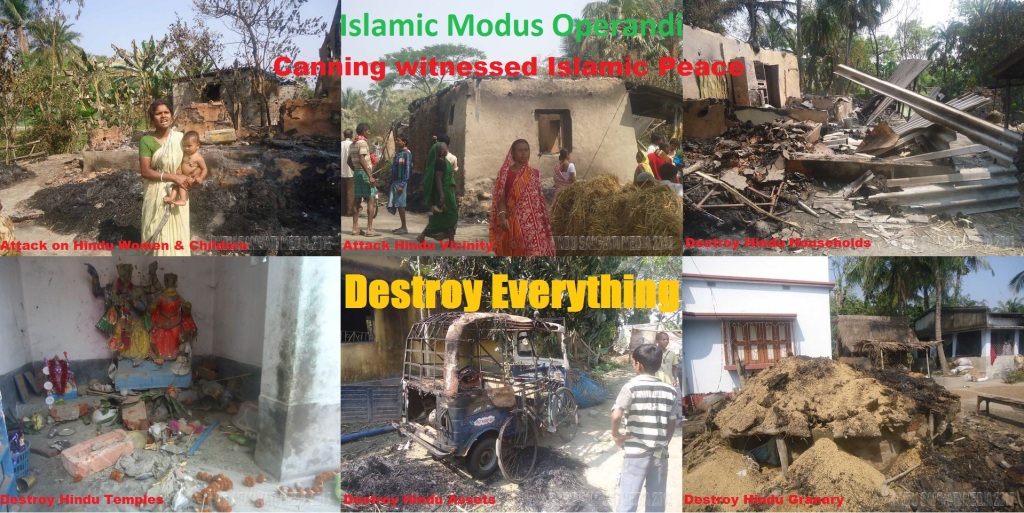
Canning Hindus under Islamic Inferno. Hell bent Situation for Hindus in West Bengal.

Islamic Violence upon Hindus after murder of a Imam by unidentified persons. Hindu Persecution in Canning is being suppressed otherwise by secular media.

Canning Riots

Canning Town | South 24 Parganas, West Bengal | 20 Feb 2013:: Again Islamic Jihad engulfed the the unwarranted Hindus on Feb 19, while the whole situation of Canning put under inferno of Islamic brutality– the entire area chanced to witness again the worst Hindu persecution in recent times and as at least four Hindu Villages viz. Naliakhali, Boyeramari, Herobhanga and Simultala were set on fire after plundering devastatingly and molesting Hindu women and girls and the saga of thrashing Hindus is extending far and wide, strangulating the adjoining areas of Joynagar, Kultali, Basanti and Sandeshkhali as well, as the reports came in.

Nobody is willing to understand the actual communal situation of West Bengal under the ‘Parivartan Raj’ of TMC. One Muslim Maoulavi was murdered by some unknown persons. Nobody knows the clue. But Muslims attacked Hindu villages planfully and plundered the Hindu villages and put fire. Hindu women molested in a riot like situation. Muslim goons reached Canning from Rajabazar, Park Circus, Metaburz or Gardenreach of Kolkata City only to make a Jihad in Canning.Police and RAF took possession after Hindus lost everything. Nobody feels the reality. In a “Change Syndrome’ of Bengal, Bengali Hindus going to enter into a Carnage. The dreadful face of Islam in Canning cannot be singularized out in the rise of Neo-Rajakars in Bengal Politics. But, the political parties and the media are preaching a Secular sermon only to complete a total Islamization of West Bengal.

As per available report, the murder of an elderly villager by a gang of suspected robbers sparked large-scale violence in Canning subdivision on Tuesday morning. Fuelled by wild rumours spread by the Islamists in different mosques and anger against police for allegedly taking the case lightly, Muslim mob of thousands plundered four villages and burnt down more than 200 houses.

The administration has been shaken the most by reports that a section of Muslim attackers was ferried from Kolkata in trucks. They came from the Islamic Dens of Park Circus, Rajabazar, Metiaburz, Garden Reach (all Mini Pakistan in Kolkata). This has been confirmed by intelligence officials, say sources. The situation is still tense and there is apprehension that the violence may spread to other parts of the district. Reinforcements have been rushed from neighbouring districts.
Canning - Islamic Modus Operandi
According to residents of Naliakhali village in Canning-I block, the victim was returning to his home in Basanti after a religious concert (Islamic Jalsa) at Jamtala village late on Monday when he was accosted by a gang on Naliakhali Main Road. Ruhul Kuddus, a 49-year-old Muslim religious leader (Moulavi and an Imam of a Mosque in Park Circus area) was on a motorcycle with an aide when the goons fired, killing him and injuring the other person, Sirajul Molla (45). Sirajul was admitted in Canning Sub-Divisional Hospital for treatment at first but transferred afterwards to CMCH, Kolkata as his condition turned critical.

As per a report published in Hindustan Times: “Police sources said Kuddus was carrying Rs. 11,50,000 on him which the attackers looted.” Other sources say that a huge amount of unaccounted money (mainly from some cheat funds like KWIL, VIVA, GREEN VALLEY etc. headed by Muslim businessmen) are being used for procuring un-licensed fire-arms and ammunition to carry on Jihad in entire West Bengal. But the appropriate agencies are reluctant to investigate the matters of tantamount Islamic warfare now speedily going in West Bengal under a political blessing of ruling Trinmool Congress.

Samir Sen, a bus driver, was the first to see the body around 4.25am on Tuesday. “Mine was the first bus to Canning from Golabari terminal around 3.50am. At Naliakhali, I found a man lying on the road and decided to check on him with conductor Biswanath Singh. We saw that he was dead. His clothes were soaked in blood and a motorcycle lay by the side of the road. Finding nobody else around, we left and reported the matter to the police in Canning. By then, some other bus drivers had also called police but the cops made no effort to arrive,” Sen said.

The injured aide had managed to reach a safe place and got in touch with friends and relatives. By first light, a large crowd had gathered on the spot and rumours started swirling around. Initially, police didn’t treat the matter seriously enough and sent a junior officer and two constables to remove the body. The crowd barricaded them. A few more policemen were sent, but by then the mob had swollen and a rumour had spread that the killers were from Naliakhali village. The mourners blocked roads and railway tracks.

“Police stood by and watched as thousands of men stormed our village around 10am,” said Biswajit Sardar, whose two-storied building was torched in the violence. Others alleged that most of the attackers were outsiders, who hurled bombs at houses, poured petrol and set them ablaze. “Whoever dared to protest was beaten up,” said villager Sanatan Adhikari. The rampage continued for three hours.

The Hindu villagers in Naliakhali say they had no clue about the murder. “It was only at dawn, when police arrived, that we came to know of the killing,” said Shaktipada Adhikari, an elderly villager whose house near the crime scene was reduced to ashes.

Only at the Kholakhali Baazar (P.S. Joynagar), medicine shop of Sachin Sardar and one saloon of another Hindu individual were attacked and despoiled and all these happened before the police stationed there – effete enough to protect Hindus in any case.

The Islamic persecutions were spreading then with the help of armed outsiders with slogans of “Naraye Taqbir – Allah ho Akbar”.

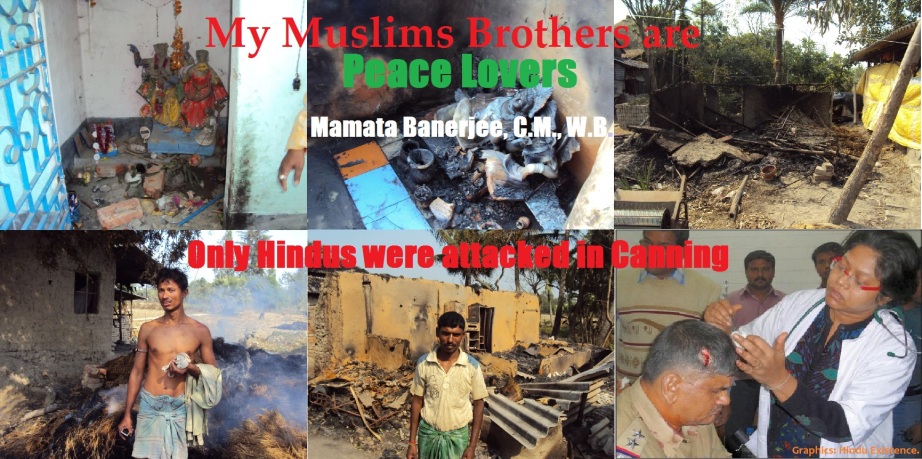
Mamata Banerjee, Cheif Minister of West Bengal appealed a peace in Canning and West Bengal and described her ‘Muslim brothers as Peace Lovers”.


Even if Hindus managed to take some measures in self-defence only in few areas, the wild fire of Islamic onslaught is being witnessed in the vicinity – areas of Notunhati in Joynagar and Simultala in Basanti being the greatest victims. Road blockades by Islamists are going on in full might at several areas including Natunhat, Priyor More (P.S. Joynagar), Bhangankhali (P.S. Basanti), Boyarmari (P.S. Sandeshkhali). The wild attacks have extended to P.S. Sandeshkhali, District: 24 Paraganas (North) by now.

Kolkata – Basanti Road has been blocked at Boyarmari. Sanjay Singh, resident of Boyarmari and also CRPF jawan, posted at P.S. Goaltor, District: Medinipur has been beaten up at Boyarmari for refusing to get off from his cycle.

Police and administration have deputed a huge contingent of armed policemen, issued a red alert but it is getting more than impossible for them to contain the widespread violence. Police is running to and fro haplessly. The wrath of Islamic mob did not scared the Police contingents also. The Second Officer of Canning Police Station Sri Anup Kumar Ghosh was attacked by brick-bating and finally fell down due to head injury. Some Police Officials have been admitted to Canning Hospital in a critically injured situation. At least two police officers have been severely injured while two police vehicles have been burnt down.

Last but not least, a large number of motor vehicles carrying thousands of Muslims from Garden Reach, Metiabruz, Tilajla, Park Circus areas in Kolkata have been seen to proceed towards Joynagar. They are also heading towards Ghutiari Shariff by train phase wise still now.

To tackle the situation, rather guarding the Jihadists, the Chief Minister of West Bengal Miss. Mamtaz Banu Arjee sent a State Delegation of TMC (Critiques say, Total Muslim Congress) comprising Firhad Hakim (Minister – Urban Development and Municipal Affairs), Mohammad Sufi (Minister – Waterways Transport), Giasuddin Molla (Minister – Minority Affairs), Javed Khan (Minister – Fire Brigade), Haider Aziz Safi (Minister – Cooperative Dept.) and Abu Taher (Karmadhkshya of Civil Matters, South 24 Pgs Zilla Parishad). Anyway the local MP, Sri Tarun Kanti Mondal (SUCI) reached the spot and took a good initiative to distribute foods, tarpouline, medicine etc. to the victimized Hindu people of the affected areas.

Under a strategic Islamic design, Islamist aired various rumours in entire South Bengal. As an immediate effect Muslim fundamentalists tried to spread communalism in the areas of Kalna (Burdwan); Sarberia, Malancha, Ghatakpukur, Belegachi, Godra, Amraberia, Chadaneshwar, Bhoto Mollar Pole (all South 24 Pgs); Panskura (Purba Medinpur); Santragachi, Kona (Howrah), Bhangore, Barasat-Kadambgachi (North 24 Pgs) etc. and blocked the roads in some those areas, until police cleared the roads.

In this situations Hindus are put under a compulsion for a self defense, while police and political protections have been made a farce to them. When an unarmed police is failed to protect themselves in Kulpi and Canning Police station attacks or the blood of killed Late Tapas Chowdhury (SI, Special Branch, Kolkata Police, shot dead recently by a Muslim goon in Gardenreach area) is not fully soaked yet, Hindus must think of their own protection in every villages in West Bengal. Right to Live as Hindu is not Crime. But, allowing Hooliganism in the name of minority appeasement is obviously a crime on the part of an one-eyed TMC Govt in West Bengal.

Always the victim: Arabs in NYC pull racist card after beating man to death with bat

Racist epithet led to vicious Greenwich Village beating of Massachusetts man outside Artichoke Pizza last month: Suspect

Kevin McCarron was enjoying a falafel sandwich from Mamoun’s when he was pummeled with a bat, tire iron and club in the middle of MacDougal St. Alleged assailants claim someone part of McCarron’s group called them ‘f—–g dirty ArabsA screen grab from video footage of a beating in the Bronx that sent at least one person to the hospital.
Tuesday, February 19, 2013, 8:01 PM

(LEFT) Sherif Rizk, aka Sharif Rizk, appears in Manhattan Supreme Court on Tuesday, February 19, 2013. Rizk and another man are charged with attempted murder for beating a man into a coma on MacDougal Street in Greenwich Village. (Jefferson Siegel/for NY Daily News)(RIGHT) Hatem Farsakh appears in Manhattan Supreme Court on Tuesday, February 19, 2013. Farsakh and another man are charged with attempted murder for beating a man into a coma on MacDougal Street in Greenwich Village. (Jefferson Siegel/for NY Daily News)

(LEFT) Sherif Rizk, aka Sharif Rizk, appears in Manhattan Supreme Court on Tuesday, February 19, 2013. Rizk and another man are charged with attempted murder for beating a man into a coma on MacDougal Street in Greenwich Village. (Jefferson Siegel/for NY Daily News)(RIGHT) Hatem Farsakh appears in Manhattan Supreme Court on Tuesday, February 19, 2013. Farsakh and another man are charged with attempted murder for beating a man into a coma on MacDougal Street in Greenwich Village. (Jefferson Siegel/for NY Daily News)

Sherif Rizk (left), aka Sharif Rizk, appears in Manhattan Supreme Court on Tuesday with Hatem Farsakh, both of whom are charged with attempted murder and gang assault in attack on Kevin McCarron.

A racist insult sparked the savage Greenwich Village beatdown of a 24-year-old Massachusetts man outside a pizza shop, said one of the alleged assailants.

“Everything started when they call us f—–g Arab,” Hatem Farsakh told detectives on Jan. 14, according to statements filed with court papers at his arraignment Tuesday in Manhattan Supreme Court with one of the other five guys allegedly involved in the attack.

The group allegedly pummeled the out-of-towner with a bat, tire iron and club to near death in the middle of MacDougal Street as horrified onlookers watched.

Prosecutors have at least five videos of the attack. Four were from businesses on MacDougal St. including Artichoke Pizza and one was from a cell phone camera — likely the same footage that went viral online.
BEATDOWN20N_5_WEB
Heather Mancini/Heather Mancini

Kevin McCarron, 24, was badly beaten while eating a falafel sandwich from Mamoun’s on MacDougal St.

Farsakh and his cohort Sherif Rizk pleaded not guilty to attempted murder, gang assault, attempted gang assault and two counts of assault.

“Officer, everything that I did was with my fist. I never used no weapon,” Farsakh also said, according to court papers.

He previously told the Daily News he was just eating a falafel sandwich at Mamoun’s when a fight involving his friends broke out.

RELATED: MAN BEATEN WITH BAT, TIRE IRON IN VILLAGE
BEATDOWN20N_4_WEB
Jefferson Siegel

Sherif Rizk was among the alleged assailants who used a tire iron, baseball bat and club to beat McCarron.

“I’m trying to break it up and I’m slapping them on the face. I’m like, ‘Wake up! You guys are drunk and s—, let’s everybody go home!’” he said.

Rizk also told cops in a written statement on Jan. 15 that someone in the victim’s group “was calling us ‘f—–g dirty arabs’ and their group consisted of at least 10 people so we were outnumbered as well.”

Both he and Mahmoud Habib claimed the victim Kevin McCarron’s crew started the fight after they tried to diffuse the tense situation.

“The guys followed us to the next block and they keep on calling us names when we told them ok no problem keep on going home have a nice night and we dont want no problems,” Habib wrote.
BEATDOWN20N_2_WEB
Jefferson Siegel

“Officer, everything that I did was with my fist. I never used no weapon,” Hatem Farsakh said about brutal beating on MacDougal St., according to court papers.

Farsakh is free on $5,000 bail and Rizk is out on $15,000.

Their co-defendant Mahmoud Habib, out on $75,000 bail, saw a judge on Jan. 30 and also pleaded not guilty.

All three face up to 25 years in prison and are due back in court on April 16.

Three others wanted in connection to the attack are still at large.

Teacher gets 15 years for raping 4-year-old boy

Defendant raped boy while giving him Quran lesson in family home

Dubai: A Bangladeshi man has been jailed for 15 years after a court convicted him of raping a four-year-old boy while teaching him how to memorise the Quran.

The Dubai Court of First Instance convicted the defendant, 24-year-old H.M., although he pleaded not guilty and denied the accusations.

Prosecutors asked the court to implement the death sentence against H.M. as per Article 354 of the Penal Code.

The boy’s father testified that the incident happened two months after he agreed to the defendant teaching his son the Quran along with the neighbour’s son.

“The accused will be deported following the completion of his punishment,” said the presiding judge in courtroom three on Tuesday.

Records said the incident happened in a villa shared by four families in Al Hamriya.

“I agreed with H.M. to give my son Quran lessons once I learnt that he was teaching our neighbour’s son. He gave our children Quran lessons at the kitchen table after Maghrib prayer except over the weekend. I was in Bur Dubai when my wife told me over the phone that our son had been abused. She claimed that my son told her that the defendant exposed himself and did something bad to him. I rushed home and my son told me the same thing. My four-year-old said H.M. did something bad to him at the beginning of the lesson… then the defendant cleaned himself up and continued the lesson. My son claimed that when he asked the defendant to stop because what he did to him was painful… H.M. asked my son to keep silent. Our neighbour’s son confirmed that he saw the incident and described what happened,” claimed the father.

Records said the father and his brother-in-law lured the defendant to Abu Hail. The defendant tried to run away when he saw the boy’s father. Records said the father and his brother-in-law took H.M. in their car to their residence and called the police.

Meanwhile H.M. repeatedly apologised to the father and asked for forgiveness.

A Yemeni policeman claimed that the defendant was scared and apologised alleging that he was seduced by the devil.

Tuesday’s judgement remains subject to appeal within 15 days.

Documents show Deepak deal includes gag order

Boustead Holdings Bhd's acquisition of Deepak Jaikishan's Astacanggih Sdn Bhd included a clause prohibiting Deepak from speaking about the deal without Boustead's permission.


This was divulged by PKR strategy director Rafizi Ramli today, after he scrutinised several of Boustead's documents that he viewed as a minority shareholder in the company.

"The agreement specifies that Deepak cannot make any statement without the (permission) of Boustead, which verifies my claim that the deal was to shut Deepak up," Rafizi told a press conference in Petaling Jaya today.

Previously Rafizi had alleged that the wholly-owned Boustead subsidiary Bakti Wira Sdb Bhd's purchase of Astacanggih was a means to silence Deepak over his revelations about the deal, the alleged complicity of Raja Ropiaah in "cheating" him.
It was also to silence him on the purported involvement of Premier Najib Abdul Razak and family members in corruption, and a cover up linked to the murder of Mongolian national Altantuya Shaariibuu.

Malaysiakini is attempting to reach Boustead for its comments.

Ready to go to court
Rafizi also today declared he has no intention of answering the letter of demand sent to him by Defence Minister Ahmad Zahid Hamidi over his allegations on the Boustead deal.

Indeed he is challenging the minister to take him to court so that he can let loose the arsenal of information he has pooled with regards to the deal.

He believes it will lead to an indictment of Zahid for negligence at least, and at most, for failing to look after funds for military veterans and servicemen, which are currently heavily invested in Boustead via fund manager LTAT.

"I am more than ready and quite eager to meet him in court. He should ask his lawyer to quickly file a summons against me," quipped Rafizi.

Rafizi had alleged that Zahid has failed to watch over the LTAT funds invested in Boustead by allowing the deal to go through. The defense ministry through LTAT controls 60 percent of Boustead with numerous seats on the board.

Rafizi reveals Boustead's 'bonus' to Raja Ropiaah

Other than the RM130 million payment to Awan Megah Sdn Bhd, owned by Selangor Wanita Umno chief Raja Ropiaah Raja Abdullah, Boustead Holdings Bhd has more goodies for the company that it did not reveal to Bursa Malaysia, PKR says.

“This is durian runtuh (a windfall) for Raja Ropiaah... After reading this I wish I was her,” PKR director of strategy Rafizi Ramli said today.

NONESpeaking at a press conference at party headquarters in Petaling Jaya, Rafizi (left) revealed that he found this out after given access to two agreements, one a land development deal between Raja Ropiaah’s Awan Megah, Boustead’s wholly-owned subsidiary Bakti Wira Sdn Bhd and Astacanggih Sdn Bhd, which is owned by controversial carpet trader Deepak Jaikishan; and the second, an agreement to buy out Astacanggih from Deepak.

Rafizi went through the documents at the Boustead headquarters in Kuala Lumpur this morning, in his capacity as a minority shareholder.

The extra perks accorded to Awan Megah in the agreements described by Rafizi are:
  • An RM15 million contract given to Awan Megah by the Defence Ministry last June, despite its seven-year failure to deliver the construction of the National Defence Institute or Puspahanas.
  • Awan Megah will retain 23.2 acres of land in Shah Alam that is worth millions of ringgit.
  • Boustead advanced RM4 million to Raja Ropiaah to buy a 20 percent stake in Astacanggih.
  • The agreement specifies that Bakti Wira will undertake to pay all debts incurred by Awan Megah to GuppyUnip Sdn Bhd, so that GuppyUnip will agree to terminate its joint-venture agreement with Awan Megah.
All these additional perks, Rafizi said, are being given freely to the company owned by the Selangor Wanita Umno chief, as if they are a windfall.
Asked if the documents specify any reciprocation of like value on Awan Megah’s behalf, Rafizi said that he does not see that in the documentation, adding further that unlike most standard contract involving land transfers, it was strange that this deal does not require neither Awan Megah nor Astacanggih to ensure the over 200 acres of land be transferred to Bakti Wira which is footing the bill for all of the payments in the deal.
Rafizi added that he will be bringing his findings, which covered over 12 pages of notes he took down while perusing the contracts, to the PKR political bureau meeting this evening to consult with the party leadership and representatives from the Pakatan-controlled Selangor government and decide what to follow up on.
Confident he can mount legal challenge

Labelling his findings “juicy” and “scandalous” Rafizi said that he is confident he can mount a legal challenge to declare the contract null and void as the current situation around the deal may have violated conditions set in the contract.

He said some of these included areas under the purview of the Selangor government pertaining to land status and transfer of ownership.

Malaysiakini
is attempting to reach Boustead for its comments.
The tripartite land deal first took the limelight when Deepak became miffed with Raja Ropiaah for allegedly “cheating” him and came to the media to start his one-man crusade against the Selangor Wanita Umno chief and the family of Prime Minister Mohd Najib Abdul Razak, whom he has linked to various allegedly corrupt deals and a cover up linked to the deal of Mongolian national Altantuya Shaariibuu.

The deal began to catch criticisms from another front after it was alleged by PKR that funds from contributions of veterans and serving military servicemen are being used by Boustead to bail out and give a windfall to Raja Ropiaah and pay off Deepak.

Boustead is 60 percent owned by military servicemen’s fund LTAT, hence the link that lead to the allegations.

azlan

Rosmah kpd penjawat awam: Jawab tohmahan pembangkang

Isteri Perdana Menteri, Datin Seri Rosmah Mansor mahu mereka menjadi 'orang tengah' antara rakyat dan kerajaan.

PUTRAJAYA: Penjawat awam di negara ini wajar memberi penjelasan terhadap tohmahan dan serangan daripada pihak pembangkang sekiranya
perkara tersebut berada di luar batasan kebenaran, kata isteri perdana Menteri Datin Seri Rosmah Mansor.

Rosmah yang juga Penaung Persatuan Suri Dan Anggota Wanita Perkhidmatan Awam Malaysia (Puspanita) berkata penjawat awam yang menjadi ‘orang tengah’ antara rakyat dan kerajaan juga mesti memberi perkhidmatan terbaik melangkaui harapan rakyat, mengurangkan kerenah birokrasi serta profesional dan mesra, cepat dan tepat, serta menghasilkan pulangan yang berganda kepada kekayaan negara.

“Selain itu, mahu tidak mahu penjawat awam wanita khususnya mesti berfikir di luar lingkungan kotak. Kita seharusnya berfikiran kritis dan konstrukti dalam menunaikan tanggungjawab dan amanah dengan mencari penyelesaian-penyelesaian kreatif dan inovatif di luar kelaziman,” katanya pada Majlis Pertemuan Mesra Bersama Puspanita Kebangsaan di Seri Perdana di sini hari ini.

Majlis yang julung kali diadakan itu disertai kira-kira 800 ahli Puspanita, dan turut hadiri isteri timbalan perdana menteri, Puan Sri Noorainee Abdul Rahman merangkap Naib Yang Dipertua Badan Amal dan Kebajikan Tenaga Isteri-Isteri Menteri dan Timbalan Menteri (Bakti) dan Yang Dipertua Puspanita Datin Seri Rohani Abdullah.

Rosmah berkata penjawat awam wanita juga perlu berkhidmat untuk rakyat sebagai satu keluarga besar tanpa wujud budaya dan mentaliti keterpisahan antara keduanya, berbanding selama ini rakyat dianggap sebagai pelanggan.

Program yang berorientasikan masyarakat

“Dalam erti kata lain, khidmat yang diberi hendaklah mencerminkan kesungguhan sepertimana kita ingin memberi yang terbaik kepada keluarga sendiri,” katanya yang turut menyatakan bahawa integriti penjawat awam juga memainkan peranan penting dalam meraih kepercayaan dan keyakinan rakyat.

Mengenai Puspanita, Rosmah berkata setelah 30 tahun penubuhannya, sudah tiba masanya Puspanita mentransformasikan persatuan supaya menjadi lebih responsif, berani, progresif dan keluar dari zon selesa.

Beliau turut menyarankan persatuan itu melaksanakan program yang berorientasikan masyarakat melalui aktiviti kemasyarakatan atau turun padang, dan menyediakan platform kepada penjawat awam dan isteri untuk menjadi sukarelawan.

“Saya cukup yakin melalui program bersama rakyat setempat akan memberi pendedahan kepada ahli-ahli Puspanita dalam usaha-usaha kemanusiaan dan membina kemahiran berkomunikasi, bekerjasama di dalam satu pasukan dan bersosial dalam budaya dan cara hidup yang pelbagai.

“Secara tidak langsung negara kita dapat melahirkan penjawat awam yang bukan saja cemerlang dan mempunyai mutu kerja yang tinggi tetapi bergiat aktif dalam aktiviti kesukarelaan dan kemasyarakatan,” katanya.

Puspanita yang ditubuhkan pada 1 Mac 1983 mempunyai 104,000 ahli sehingga Jun tahun lalu.

Bernama

MIC to stage second show of strength

Party sources claim the latest gathering is to "counter" the successful Ponggal celebration organised by MIC vice-president M Saravanan.

PETALING JAYA: After successfully staging the “unity Ponggal” celebration at Dataran Merdeka some three weeks ago, MIC is planning its “second show of strength” in Selangor soon.

The party, touted to be the largest Indian-based political party in the country, would hold a mammoth gathering of 50,000 to 80,000 Indian voters in Selangor early next month.

The party is targeting to bring together its members and Indian voters to explain to them the good of the MIC and Barisan Nasional.

“We are hoping to gather about 50,000 to 80,000 MIC members who are eligible voters. We will also launch our election machinery at the gathering. This is just to show our strength and unity.”

“The event is being organised not only by the party leadership but also involves all branch chairmen in Selangor,” party treasurer Jaspal Singh told FMT today.

He, however, said the event was still at its planning stage and nothing has been finalised.

“We have yet to confirm the time and place. We have also not decided on who and how many BN leaders would attend. But it will be held before the dissolution of Parliament,” he added.

The party, after a lull, organised the “unity Ponggal” celebration attended by Prime Minister Najib Tun Razak earlier this month. It attracted some 80,000 to 100,000 Malaysian Indians.

That event was hailed as a success by Najib in his speech, giving the party a glimmer of hope for the future.

MIC went into slumber after a devastating 2008 general election defeat. It won only three out of the nine parliamentary seats contested. It won a fourth seat at a by-election held in 2010. The then president S Samy Vellu and Palanivel were both defeated at the election, which also saw the ruling BN lose its long held two-thirds majority in Parliament.

The bruising defeat forced Samy Vellu to relinquish his post after more than 20 years at the helm. Palanivel took charge of the party in 2009.

Open secret

At the 2008 general election, the Malaysian Indian community had turned its backs on the MIC and BN and efforts to woo the community back to the BN fell on MIC.

However, to the dismay of the BN, MIC failed to move under the new president. Although the party organised a couple of mammoth gatherings, all failed to bear fruit until the “unity Ponggal” celebration. It was the first time the party managed to bring together more than 50,000 Indians in one venue.

Party sources, however, claim that the latest gathering organised in Selangor is to “counter” the “unity Ponggal” celebration, which was organised by MIC vice-president M Saravanan, who is also Federal Territories and Urban Well-being Deputy Minister.

“The president [Palanivel] is the Selangor MIC state chairman. If the Selangor MIC wants to organise something, the announcements must come from either Palanivel or the deputy or even the state MIC secretary.

“But this is not the case. The national treasurer is an appointed post. He is not even elected. Asking Jaspal to organise a gathering is something not done before. I think Palanivel just wants to show he is in control of the party.

“He does not want other leaders taking the limelight. Saravanan did that through the Ponggal show and this has irked several top leaders,” said a party source, who did not want to identified.

FMT learnt that apart from Jaspal no other national leaders are part of the organising committee. It is an open secret in the party that Jaspal is aligned to Palanivel, who appointed him to the post in the first place.

Baby tossing video goes viral on YouTube


The recording of a maid abusing a four-month-old baby, captured on CCTV, sparks outrage among the social networking site users


PETALING JAYA: A video of an Indonesian maid abusing a baby is going viral on the Internet, drawing the ire of its viewers.

The two-and-half minute CCTV footage, uploaded on YouTube by “Sir Ark”, shows the maid tossing and throwing the baby on a mat violently.

The maid did the heinous act while feeding and dressing the baby, oblivious to the fact that her actions were being recorded.

One upset viewer, Amerul Afiq, said: “Dia ingat baby tu roti canai ke ape?!! Kene gi tau mael lambong ni , kasi lambong sama dia” (What does she think the baby is? Roti canai? The maid deserves a beating).

Another viewer, Akmal Baharum, urged everyone to be careful when choosing a maid.

Viewer Digganesh, on the other hand, advised families to raise their own children instead of relying on maids.

“I never trust my child with any one else except my mom and wife. You want to have a child? Make sure you raise him or her yourself!” he said.

The video currently has 36,582 views.

In an update, the police arrested the maid, Yuliana, 24, recently and the Kuantan Sessions Court sentenced her to a 20-year imprisonment yesterday.

She pleaded guilty to the charge of attempted murder and physical abuse of four-month-old Mohamed Hareez Mohamed Zamri at his parents’ home in Kuantan.

The incident was said to have happened on the morning of Feb 15.

Aliens in the land – Indian migrant workers in Malaysia (part 1)


Amarjit Kaur, New Mandala

In the past 130 years, the number of foreign migrant workers in Malaya has grown from about 84,000 in 1880 to more than three million in 2010. Originally, foreign workers were predominantly from China and India and most were locked into semi-permanent “labour circulation” arrangements through their employment contracts. Currently, foreign workers originate from a range of South and Southeast Asian countries, and Indonesians dominate labour flows.

These workers migrate to Malaysia because they and their governments believe that temporary labour migration is a pathway to development. Predictably, most have also become trapped in circulating contract labour regimes. The debate on the developmental impacts of migration meanwhile continues to exclude discussion on the risks involved and the longer-term consequences of temporary migration. There is no conversation either on integration of earlier cohorts of migrant workers in society, let alone recent migrant workers who are increasingly referred to as aliens. The outlook is particularly gloomy for Malaysia’s marginalised South Indian plantation workers who became “orphans of empire” when hardliners in the ruling United Malays National Organisation legislated to deny them citizenship rights.

Commodities of empire and migrant labour, 1880s – 1970s

Britain’s ‘forward movement’ in Malaya after the 1870s resulted in the country’s greater integration into the international economy and facilitated the production of mineral and agricultural commodities. Concurrently, labour migration became a fundamental component of Malaya’s economic growth model and related social structures. Malaya’s main’s commodity exports were tin, coffee and sugar. Chinese entrepreneurs monopolised tin production, recruiting workers from China for their mines. European planters were chiefly involved in coffee and sugar cultivation and they relied on indentured labour from India for their enterprises. In the early 20th century, the planters switched to rubber and it subsequently became the main agricultural commodity. However, they lacked the capital to establish large properties and British trading (agency) houses in Singapore consequently played a vital role in bringing together planters and overseas financial interests (mainly in Britain), to convert the estates into joint-stock companies through flotation on the stock market in London. The 1909-10 rubber boom led to further changes and the proprietary estates largely disappeared, with their former owners often taking up shares in the new corporate entities as part of the sale price. These events foreshadowed major changes in the industry since rubber production necessitated the development of a distinctive agricultural ‘complex’ with inter-connected operations and a particular cultural milieu. Moreover, the development of the rubber industry reinforced the connections between Indian labour mobility and capital and both the Indian and Malayan colonial administrations strategically planned and organised Indian labour migration to Malaya.

The plantation production system effectively established the Indian workers’ subsequent employment circumstances and contributed to their marginalisation in Malaysia. The plantation system has since continued into the 21st century and has been adapted for oil palm production. Analogous to colonial frameworks, the Malaysian government and labour-sending states presently organise inter-state labour mobility. Additionally, since the 1980s Indonesian and Bangladeshi migrant workers have mostly replaced the former Indian workforce on plantations. These new migrant workers face a similar marginalisation progression. This paper compares past and present plantation labour regimes in Malaysia and frames the subject in the broader context of the plantation complex to suggest the larger, wider significance of the plantation management system and its institutional frameworks.

Indian workers and rubber

The rubber production system that was developed in Malaya was centred on cultivation of a single crop– rubber; an imported workforce mainly from India; and capital for the enterprise came from Britain, the United States and Europe. By 1910, rubber plantations covered approximately 225 000 hectares, rising to 891 000 hectares in 1921. This accounted for 53 per cent of the total land under rubber in South and Southeast Asia; and Malayan rubber exports also rose from 6500 to 204 000 tonnes between 1910 and 1919. As stated previously, rubber cultivation necessitated recruitment of a large, cheap and “disciplined” workforce that had be settled and organised to work under pioneering conditions in the country. British India with its teeming poverty-stricken millions and caste-ridden society was the preferred provider for this labour. The state and planters (as employers) essentially regarded the Indian labourer headed for Malaya as another tradable commodity in the production cycle. All the essential arrangements for his sojourn abroad – recruitment, transport and employment – were made by four parties: the sub-imperial Indian Government (or India Office); the Colonial Office in London; the Malayan (Straits Settlements and Federated Malay States) Government; and the employers. Since most Indian emigrants lacked the funds for spontaneous mass migration, Indian labour recruitment was managed by the India Office and sponsored by the Malayan administration. Governance arrangements for the plantation labour regime rested on two pillars – the mobilisation of a largely migrant labour force that facilitated the use of economic and extra-economic measures to maintain low wage bills; and an ethnic (and gender) differentiation of the labour force that enabled the manipulation of both workers and wages.

READ MORE HERE

Only RM22.5bil to implement Hindraf blueprint

FOCUS Detractors of Hindraf's document, "The Five-Year Blueprint to bring the Indian poor and marginalised into the mainstream of national development", want to erode support for the document and have been hitting out at Hindraf by pointing to various peripheral but contentious issues about Hindraf.

The detractors span the entire Malaysian political spectrum, all the way from the right in the BN camp to the left in the Pakatan camp. They take this stealthy path because they have their reasons to want to kill off support for the blueprint. And they do it in so many ways.

What they all fail to realise is that they are really hitting at something that is fast becoming a central issue in the forthcoming general election, insofar as the Indian Malaysian electorate is concerned.

And what these detractors also do not realise is that they are close to shooting themselves in the foot, should they persist. This blueprint is becoming a central issue in the general election because of what it truly is.

NONEThe Hindraf blueprint is a systematic and verbal expression of the yearnings and aspirations of the Indian poor and marginalised for justice, for rights, for dignity and for an even shot at life in this country of ours.

The energy of the November 2007 expression of the frustrations of Indian Malaysians on the streets of Kuala Lumpur was just one expression of these yearnings and aspirations.

This blueprint is in that same class. The anger against Umno in 2007 was the cause then. Today it will be the spurning of the unfulfilled yearnings. This document has that similar significance. This is something that all should realise.

All Hindraf is doing is articulating these yearnings, giving expression to them and fitting them into the electoral process in ways that will, hopefully in time, bring about the realisation of these yearnings.

This blueprint does not belong to Hindraf, though we issued it. This is about the Indian Malaysian people. Hindraf is nothing more than the messenger. Hitting at Hindraf amounts to saying that these yearnings and aspirations do not matter - and puts the detractors into an oxymoronic situation.

Today, we look at the remaining key points in the blueprint: Unequal employment and business opportunities that Indians suffer; the impunity of the police against the community and the standard of human rights practices in Malaysia.

We will also explain why we need to have a Ministry of Minority Affairs in the country.

Unequal job and business opportunities

We want to see employment opportunities opened up in the government service and in all government-linked companies (GLCs), without exception and at all levels, for Indian Malaysians.

Ten percent of all government and GLC employee intakes at all levels should be Indians and 10 percent of all taxi, lorry and bus permits, contract jobs, petty trade and scrap metal trade licences, maintenance jobs and franchises must be given to local Indians.

azlanOf the businesses and contracts awarded by the local authorities, state governments, federal government and federal agencies and all GLCs, 10 percent must go to Indian businesses, which must also be provided with equal participation opportunities in all entrepreneur development programmes.

Marginalised Indians must also be provided with support to start small businesses related to the skills development programmes they have been trained in.

Micro-credit must be provided to Indian applicants on terms similar to the Tekun programme. Tekun Nasional, which is a micro-credit scheme, is an Umno brainchild and is run by the government.

The government must provide technical /management and marketing support to existing Indian small businesses, similar to the Tekun programme or open up the Tekun programme to all, without conditions relating to ethnicity.

The statistics on applications and approvals must be made freely available to the people.

Hindraf estimates a budget of RM4.5 billion a year to implement all the recommendations in our blueprint. All major needs of the marginalised and poor Indian Malaysians can therefore be implemented within five years, at a total cost of RM22.5 billion.

Impunity of the police force

We demand that the Independent Police Complaints and Misconduct Commission be set up immediately, as per the recommendations of the Royal Commission to Enhance the Operation and Management of the Royal Malaysian Police.

NONEEffective measures must be put into place to stop all extra judicial killings of citizens in the custody of the Malaysian police.

Malaysian laws must also be made consistent with international human rights laws. The country should sign and ratify all international covenants of the United Nations that it still has not done so.

These include the International Covenant on Civil and Political Rights and the International Covenant on the Elimination of all Forms of Racial Discrimination, after which we must move to adjust the local laws so that they are consistent with these international laws.

Further, the guiding principles, as set forth in the guiding principles on internal displacement by the United Nations, must be adopted.

Ministry of Minority Affairs

Another significant demand in our blueprint is the establishment of a new federal ministry, the Ministry of Minority Affairs.

The charter of the ministry shall be to:
  1. Lead the socio-economic development efforts of marginalised and minority communities in Malaysia;
  2. Plan the budgetary requirements and obtain the necessary allocations;
  3. Plan and execute all the development efforts;
  4. Supervise all the relevant ministries in the implementation of the quotas/target allocations relating to the marginalised and minority communities; and
  5. Be held accountable for the delivery of socio-economic development to the communities under its purview.
The first identified marginalised and minority community to come under the purview of this ministry will be the Indian poor and marginalised community.

Others need to be identified and added into the portfolio of the marginalised and minority communities.

The Ministry of Minority Affairs is to be an empowered ministry that will embark on its development efforts independently of the other ministries, so that the socio-economic development of the marginalised and minority communities is focused and targeted and not hampered by a very recalcitrant, racist bureaucracy.

Hindraf is prepared to provide the expertise required for the smooth function of this ministry.

YESTERDAY:
Digging deeper into Hindraf's blueprint


N GANESAN is Hindraf national adviser.

Hindraf is on the wrong track

COMMENT Our intention is not to engage in polemics with Hindraf but to weigh in on the current debate on Hindraf's plan of socio-economic advancement for the Indian poor and how that vision can best be fulfilled.

We feel we have a right to our views as Malaysians and as ISA detainees of the Hindraf-led campaign of late 2007 that culminated in the historic march of Nov 25 that year.

That march was crucial to the withdrawal of Indian electoral support for BN in the 12th general election of March 2008, a move that resulted in the unprecedented denial of a two-thirds majority to the coalition that has ruled the country since independence in 1957.

hindraf british petition rally 251107 gandhiMuch good to the national polity has since resulted from that and Hindraf must be credited with having pulled off an event that helped produce an election result of great effect to the nation.

But to attribute exceptional importance to the Hindraf-led march is to replicate the same mistakes that have led an Umno-dominated BN to its present predicament - the looming loss of majority support among Malaysian voters.

Now, by demanding of Pakatan Rakyat - a vehicle forged in the aftermath of the March 2008 election - that they sign on the dotted line backing Hindraf's blueprint for the Indian poor and set aside more than a dozen of seats for the Hindu rights movement to contest at the 13th general election, Hindraf is positioning itself against the essential nature of the tides let loose by the tsunami of 308.

The effect of the tides is to reduce the race-based obsession by which the BN has long approached the problems afflicting our polity. Everything is seen through the lens of race, and in the peculiar situation of this country, its attendant: religion.

This has eventuated in the myopia and hallucination that have marked the BN approach and brought it to the advanced decay of its rule, so evident at all levels of our society that the electorate now harkens to the Pakatan call for change.

60% households exist on RM1,500 and below

Change to what?

Essentially, a needs - as distinct from a race-based approach - to the urgent problems of the nation: the gross inequalities of income that see 60 percent of households exist on RM1,500 a month and less.

NONEThe problems of the Indian poor, who admittedly form a disproportionately large percentage of those households earning RM1,500 and less a month, are urgent, but no more so than that of the Malay, Chinese, Dayak and KadazanDusunMurut poor.

To claim that they are more urgent is to succumb to the race-mania and hallucination that have characterised the sterile and ultimately self-defeating Umno-BN approach.

Pakatan has articulated and has pledged its allegiance to the needs-based approach which is the sanest way out of the political cul de sac that Umno-BN had brought the country to.

We have good reason to believe in the sincerity of their pledge and in their sensitivity to the electoral consequences should they fail to deliver on their promise.

We feel that Pakatan should be given a chance to do what they pledged to do; that Hindraf should not place provisos on their support for Pakatan; and that Hindraf should continue as a pressure group rather than opt for electoral contest.

Hindraf's current stance, as articulated by its chief P Waythamoorthy, will accentuate rather than alleviate the race-based approach to the problems of the Malaysian poor, an approach that is ultimately a deadend.

V GANABATIRAU and K VASANTHA KUMAR were among five Hindraf leaders detained under ISA in 2007.

Bangkitlah anak muda Malaysia

NONEOleh: Nurul Izzah Anwar

Negara kita kini sedang berada di persimpangan. Dengan nisbah hutang kepada GDP yang kini sudah mencapai kadar 53 peratus – bahana bakal menanti anak muda yang tentunya akan mengambil alih bebanan hutang negara kita pada masa akan datang.

Berdasarkan bancian 2010, bilangan anak muda di bawah umur 35 tahun adalah 65 peratus. Pada 2020, mereka merupakan penentu masa depan negara, sama ada yang masih bersekolah, mahupun profesional. Golongan inilah yang akan memutuskan jaminan serta keselamatan masa depan negara kita.

Jika dilihat statistik pengundi baru, demografi juga berubah – terdapat lebih dari 2.4 juta pengundi baru daripada 13.3 juta pengundi untuk PRU13. Ini merupakan kenaikan sebanyak 30 peratus pengundi baru jika dibandingkan 2008.

Anak muda perlu bangkit dan meningkatkan kesedaran tentang PRU13, iaitu satu peluang untuk Malaysia beralih kepada sistem dua parti supaya kita mempunyai timbang tara lebih baik demi mengurangkan penyalahgunaan kuasa yang berpotensi menjunam ke arah kezaliman parti pemerintah.

Negara kita juga mengalami masalah pengangguran dan pengurangan tenaga kerja. Antara puncanya, ramai anak muda berkelayakan universiti tidak memperoleh pekerjaan atau terpaksa mencari pekerjaan yang tidak setimpal dengan tahap pendidikan mereka. Sejak 2006-2009 juga, pengangguran graduan hampir mencecah 30 peratus.

Inilah antara masalah anak muda yang perlu diberi perhatian dan diusahakan jalan penyelesaian agar mereka boleh mengecapi pendidikan tinggi dan pekerjaan dengan gaji yang cukup untuk menampung kehidupan di negara ini.

Salah satu inisiatif ingin saya pelopori adalah satu dasar khusus buat golongan muda yang boleh dipraktikkan di Malaysia. Antara agenda ingin saya ketengahkan dari segi ekonomi termasuklah memastikan golongan muda memperoleh pekerjaan yang akan menjamin masa depan mereka serta kestabilan ekonomi dan aset masing-masing.

Golongan muda seharusnya terlatih dan mempunyai ilmu pengetahuan berkenaan pengurusan hutang agar mereka dapat melangsaikan segala pinjaman yang tertangguh. Kebolehan untuk menguruskan kewangan dengan baik akan memberikan keuntungan dalam pelan jangka masa panjang.

Keutuhan sistem politik yang tidak berpaksikan sistem authoritarian juga akan memanfaatkan rakyat. Masanya telah tiba untuk kita merombak sistem pilihan raya yang tidak adil. Isu pendaftaran pengundi tidak lengkap, kawasan sempadan yang tidak mencerminkan populasi pengundi, serta masalah pengundi hantu adalah perkara yang sehingga kini masih membayangi PRU.

Untuk mengurangkan masalah pendaftaran pengundi, sudah tiba masanya diwujudkan sistem pendaftaran automatik. Ia telah digunakan di negara seperti Finland, Chile, Germany dan Singapura. Sesiapa layak mengundi berdasarkan umur minimum, akan disenaraikan secara automatik untuk mengundi dalam pilihan raya.

Sekiranya gagasan politik yang sedia ada gagal menunaikan tanggungjawab memenuhi aspirasi rakyat, ia adalah menjadi tanggungjawab kita sebagai generasi muda untuk membangkitkan sebuah gagasan alternatif agar terhasilnya timbang tara untuk kesejahteraan negara.

Saya berikan satu contoh usaha untuk merakyatkan politik dan memberi suntikan kepada semangat politik baru, di mana saya telah menjemput Menteri Wilayah Persekutuan dan Kesejahteraan Bandar, YB Senator Datuk Raja Nong Chik untuk turun berdebat. Rata-rata jawapan diterima daripada Barisan Nasional adalah pendirian bahawa pendebatan di dalam arena politik bukanlah sebahagian daripada budaya kita, tetapi kita harus sedar bahawa melalui perdebatan idea, cendekiawan-cendekiawan Islam seperti Ibnu Khaldun dapat mengembangkan pemikiran dan idea secara terbuka dan tidak secara sehala.

Saya pasti, berdebat dan penukaran idea adalah satu saluran penjana minda dan penaiktarafan daya intelek anak-anak muda di negara ini dan pendebatan di antara para pemimpin di mana terdapat pertembungan idea adalah satu model peranan yang baik untuk anak-anak muda di Malaysia.

Sudah tiba masanya kita menghentikan trafik bertali arus yang merupakan jalan sehala. Sudah tiba masanya suara dan aspirasi anak-anak muda didengari melalui saluran-saluran yang sedia ada.

Percayalah, debat itu, budaya kita.

 Dipetik dari laman berita Sinar Harian.

The Chinese owe BN nothing

Kee Thuan Chye

COMMENT Prime Minister Najib Abdul Razak, the vendor of half-baked spin, was at it again a few days ago when he said the Chinese owed their success to the BN.

At a 1Malaysia open house, he said BN formulated good policies and ensured there was harmony in the country and an environment that "allowed the Chinese to make a good living".

Najib had the cheek to say this.

dong zong cny open door 170213 05He of course wants the Chinese to be thankful to BN and therefore vote for the coalition in the coming general election. But his half-baked spin completely ignores the other side of the story.

For instance, the Chinese also owe it to BN that they became second-class citizens in their own country because of BN's discriminatory policies - and, let's not forget, practices.

As a result, the Chinese have to work harder to succeed. To get places in Malaysian public universities. To have their children score the highest number of As and still not get accepted to do, say, Medicine, in these institutions. And therefore be forced to send them overseas at a much higher cost.

The Chinese owe it to BN that they were compelled to leave Malaysia to seek fairer opportunities overseas, some never to return, and thereby contributing to a huge brain drain for which Malaysia is now paying the price.

Many who are now settled overseas may indeed be thankful that they left, but I'm sure Najib is not looking to them for gratitude. Some of them won't be eligible for voting, anyway, having taken citizenship in their countries of adoption.

The Chinese also owe it to BN that to take on business projects of sizable proportions, they have to pay kickbacks - some to BN bigwigs themselves, some to their cronies.

Impossible to rise to highest echelons

The Chinese owe it to BN that they find it virtually impossible to rise to the highest echelons of public service - in the judiciary, the military, the police, the universities, the civil service. Not because they don't have the merit to fill these positions; in fact, they do, which therefore makes it even more unjust and painful.

Can Najib name a single Chinese vice-chancellor in a Malaysian public university? Can a Chinese person become inspector-general of police or admiral of the fleet or chief justice?
Najib should note that despite the barriers, the Chinese accepted their lot. And many Chinese - for whatever warped or bewildering logic - actually supported BN throughout the times they were marginalised!

br1m 2.0 launch by najib razak janji ditepatiNajib should watch what he says in the run-up to the general election, especially if he is hoping to win Chinese support for BN.

As it is, many analysts believe that about 70 to 80 percent of the Chinese are not in favour of the ruling party. If he wants to win at least some over, he needs to say the right things. More than that, he needs to do the right things. Although even then, one wonders if it might not be too late.

Many Chinese still remember what he reportedly said in 1987, on the eve of Operasi Lalang at the Umno Youth rally in the TPCA Stadium. As the Umno Youth chief then, he displayed ethnocentric gusto in unsheathing his keris and announcing that it would taste Chinese blood.

It might have been an act of foolish bravado, but it still resonates among some Chinese today. Considered together with the video that is making the rounds again of his address to the Umno and Malay NGOs audience at Putra World Trade Centre (PWTC) a few days after Bersih 2.0, in which he said, with much tribal sound and fury, "We will show them whose country this is!", many wonder if the leopard has changed its spots.

For all his talk of 1Malaysia, Najib is still an ethnocentrist at heart.

He has said he will meet the Chinese educationist group Dong Zong to discuss its demands in regard to Chinese education. In all likelihood, he will agree to meet some, if not all of them, as a last-ditch measure to win Chinese votes. He might well declare the government's recognition - finally - of the United Examination Certificate (UEC), a dream the Chinese educationists have been pursuing for the longest time.

Be wary of Najib's sweet talk

If this consequently prompts Dong Zong to endorse Najib and BN for the coming general election, it could sway a good number of Chinese votes in the direction of BN. Then, like they did in 1999 when they saved Dr Mahathir Mohamad's bacon by strongly supporting his coalition when the Malays were swinging away from him, they could hand BN a victory... and, who knows, maybe even a two-thirds majority, which is what Najib desperately covets.

azlanHowever, this is going to be a crucial general election. It is the one time when real change for the country can come about with a change of government.

The Chinese need to consider carefully about giving their vote to BN. They need to consider the long-term effects of another BN victory. They need to weigh the possibility of real reform in the event of BN being booted out and a new coalition taking over that could bring positive change.

They need to be wary of Najib's sweet talk and his gifts. If he gives them government recognition of the UEC, more independent Chinese schools, whatever, they might want to just accept these politely, say thank you and think of voting according to what they think is right.

Dong Zong, on its part, should remain neutral and not take a stand by endorsing BN. For if it does and Pakatan Rakyat wins the general election, it would find itself in an awkward position.

The Chinese have a big role to play now in this coming general election. Najib can say anything till he is blue in the face, but they have to weigh the truth or lack of it in what he says.

Above all, they must not forget about the corruption that has been rampant under BN rule for decades. And the rent-seeking. And the slow growth of our GDP since 1980 in comparison with South Korea, Taiwan, Singapore, etc. These affect the whole country, not just the Chinese, and are therefore all the more important.

When it comes to the crunch, the Chinese must vote for only one thing - a better Malaysia.

KEE THUAN CHYE is the author of the bestselling book ‘No More Bullshit, Please, We're All Malaysians', and the latest volume, ‘Ask for No Bullshit, Get Some More!'

Court fixes date for hearing on death in lock-up

Malay Mail
by Zalinah Noordin


THE magistrate’s court yesterday fixed March 8 to hear preliminary issues over the death of Cheah Chin Lee, who died while in police custody.

However, magistrate Siti Salwa Ja’afar has yet to set the actual date of the inquest.

Counsel M. Visvanathan, representing Cheah’s family, filed an application for a copy of all related documents that the police have on the case, including post-mortem and chemical reports and CCTV footage of the lock-up where Cheah was found dead.

However, DPP Mohd Faisal Md Noor said the matter would need to be referred to his higher-ups first.

“We will need time before producing these documents and settle all preliminary issues before an inquest can be called,” said Mohd Faisal.

Visvanathan said he had also asked for leave to cross-examine the witnesses.

Present were Cheah’s mother, Lim Geik Suan, 67, and uncle, Cheah Ewe Yeow.

On Aug 13 last year, Chin Lee was arrested for allegedly trying to steal a motorcycle at 12.30am and held at the Tanjung Tokong police station.

He was then taken to the Patani Road police station to undergo an urine test before being brought back to the station at 5am. He was found dead 20 minutes later.

People's Confidence Enables Barisan Nasional To Bring Progress - Najib

MIRI, Feb 21 (Bernama) -- The real changes and progress taking place in Malaysia since independence proves that the country is in good hands when Barisan Nasional (BN) becomes the government, said Prime Minister Datuk Seri Najib Tun Razak.

He said the excellent work done by BN had won the confidence of business people at home or abroad, to enable the country to continue developing under a progressive economy.

Speaking at a dinner in conjunction with the Chinese new year celebration here Wednesday night, he said BN has very clear and well laid-out plans via the implementation of specific projects with specific goals coupled by the people's confidence.

"You can have all the best plans in the world, but if the people don't have confidence in you, they will not make their investments."

He said Malaysia's success to achieve an overall economic growth rate of 5.6 percent last year as announced by Bank Negara Malaysia Wednesday was due to the increased investments and consumption taking place in the country, which were driven more through private sector's initiatives. Najib said the Malaysian government success in sealing an agreement with Singapore to develop a high speed rail link had also showed the neighbouring country's confidence in their future with Malaysia.

"No one would want to take long term ventures like this with us unless they are very confident with us," he said.

In the political context, he said the people would have to decide not only about what happened today but their future as well, by electing only the right people to govern the country.

"They must put in place the right people so that their future will be secured, rather than to gamble on people who can only bring uncertainty."

He said parties under Pakatan Rakyat had shown obvious differences in their struggle and would not be able to form a government that could secure the country's wellbeing.

Najib said the opposition could afford to have chaos among themselves due to the differences but would spell a disaster for Malaysia should they continue to do so when they form the government.

In contrast, he said, Barisan Nasional had proven that it could deliver real changes and progress in the country.

At the gathering, Najib announced that a secondary school and a primary school will be built in Tudan, in the northern part of the city, to meet the education needs of the growing population in the area.

He said the government would also build 500 houses under the People's Housing Program in Lambir, in the city's southern part, which would start soon.

His wife, Datin Seri Rosmah Mansor, Sarawak Chief Minister, Tan Sri Abdul Taib Mahmud and Miri Member of Parliament and Sarawak United People's Party (SUPP) president, Datuk Seri Peter Chin were among 5,000 people who attended the gathering hosted by SUPP.

Stadium roof collapse 2.0: How to build nuclear power plants?

If the roof of the stadium in Gong Badak in Terengganu can collapse for a second time, what can we expect if the government goes ahead with its plan to build nuclear power plants?

Malaysia boleh?! Good grief!

The steel structure of the stadium roof collapsed this morning and pinned down workers. Five were pulled out of the rubble, three of them seriously injured.

The stadium cost RM292m. Its roof first collapsed in 2009, a year after it was opened for the Sukma Games in 2008. The roof was being repaired at a cost of RM15m (according to Bernama) when it collapsed again.

Check out some (unverified) photos here and here.

Will anyone be hauled up and held accountable? Don’t hold your breath. And how safe are the rest of our stadiums?

Is this a sign of things to come for Terengganu at the polls?

Wednesday, 20 February 2013

Blind UMNO politics

By Saravanan

On the 13th of Feb, Mr Deepak Jaikishan requested Dr Mahathir to advice Najib to step down and give way to Muhyiddin Yassin to take over the PM's post. Malaysia has seen UMNO blindly passing the PM's post from Mahathir to Abdullah Badawi then to Najib and now there are calls within UMNO to pass it to Muhyddin in some sort of a musical chair game. Even though Malaysia is a secular country and consists of many races but the PM's post is being passed on from one UMNO leader to another like a relay baton without seeing any real change taking place. Is there anything in the Federal Constitution that states that only an UMNO president should become the PM and that the PM's post can be passed on from an UMNO President to his Deputy President with such relative ease ? The UMNO party is suppressing the Federal Constitution to suit to its own whims and fancies.

Supreme Muslim religious authorities in Malaysia should issue a Fatwa to deter and punish Muslim leaders who are practising racism and Malay supremacist policies in this country . Even Prophet Muhammad never condoned racism. In fact when a Jewish woman in Mecca, who used to throw garbage on his doorstep, fell sick, the Prophet visited her showing no signs of any racial discrimination.

Malaysia should stop racism and Malay supremacy policies of UMNO as it is making Malays not intelligent and it also against Prophet Muhammad's teachings. The government should allow Malays to comptete with other races fairly and on a level playing field. To defend Malay supremacy policies is unconstitutional. No one in this country is taking away Malay rights. It is only UMNO that is making the Malays fearful and creating an inferiority complex among them.

To have a better Malaysia, everyone should have equal rights. Every individual should be able to compete with one another equally to earn a better living for themselves. By implementing racist policies, Malaysia will never progress.  The quota system and other racist and supremacy policies should be abolished. This will make Malaysia more vibrant for the future of our children. UMNO also must adopt equal rights into their mindset.