Share |

Tuesday, 7 September 2010

Inspector held over Samurai attack on student

By Ivan Ho - Free Malaysia Today

LAHAD DATU: A General Operations Force officer was arrested yesterday to facilitate investigation into an assault with a homemade Samurai sword that left a student seriously injured. The 48-year-old officer with the rank of inspector was believed to have been picked up by a police team at his quarters in the 17th Battalion camp more than 24 hours after the incident.

Initial investigations revealed that the officer had gathered local thugs, one armed with a homemade Samurai sword, to attack the student while the latter was about to leave a karaoke outlet here with more than 10 of his classmates early Sunday.

The victim, Ling Kim Tun, 18, sustained a deep slash wound on his right arm while attempting to block the sword.

According to witnesses, the officer then punched and kicked the victim in the stomach.

The attack only stopped after a member of the public prevented the officer from continuing the assault on the teenager who was then rushed to the district hospital by his classmates.

The victim’s father Ling Zhi Zhong has accused the police of being slow to act.

According to him, his son’s classmates told him that one of Kim Tun's friends had quarreled with the police officer inside the karaoke lounge earlier.

The victim had apparently attempted to defuse the situation but this only angered the police officer further.

“They (Kim Tun's classmates) told me the police officer punched my son's face and kicked his stomach while he was on the ground. He is a police officer who received strict training… he shouldn’t be reacting so violently. My son cannot move two of his fingers now, he is only a kid,” said the father.

Meanwhile, Battalion 17 GOF commanding officer Supt Ahmad Fuad Osman together with Chief Inspector Afiz Abdullah visited the victim at the hospital.

Apart from apologizing on behalf of GOF, Ahmad Fuad assured the teenager's family that the police and GOF will conduct a thorough investigation

Azmin dicabar 'hantu' Gombak

Muda Mohd Noor - Free Malaysia Today,

PETALING JAYA: Satu kawasan yang menjadi tumpuan utama dalam pemilihan PKR kali ini ialah Gombak yang kini menjadi milik naib presiden parti, Azmin Ali.

Ahli Parlimen Gombak itu mungkin mendapat sokongan dari ramai pemimpin parti PKR yang lain untuk bertanding jawatan timbalan presiden PKR, November depan.

Semalam 18 ahli parlimen dan dua senator PKR menyatakan sokongan kepada Azmin bertanding jawatan timbalan presiden PKR. Hari ini pula sekurang-kurangnya 13 Adun PKR menyatakan sokongan kepada Azmin untuk jawatan sama.

Tetapi di peringkat cabang (bahagian) Gombak beliau akan ditentang satu lawan satu untuk jawatan ketua.

Azmin akan dicabar oleh bekas timbalan ketua cabang Gombak, Bakar Ninggal yang kini menjadi peniaga buku-buku kisah hantu.

Ketika dihubungi pagi ini, Bakar, ketua ranting (cawangan) pusat bandar Seri Gombak mengesahkan perkara tersebut.

"Saya bertanding atas kehendak ramai iaitu ahli cabang Gombak. Sebagai pemimpin saya perlu memenuhi permintaan mereka.

"Setelah berbincang dengan ahli, saya mengambil keputusan untuk menerima pencalonan bertanding jawatan ketua cabang Gombak.

"Saya bertanding dalam satu kumpulan di mana kumpulan saya juga bertanding untuk jawatan timbalan ketua cabang, naib dan ahli jawatankuasa (AJK) cabang," katanya.

'Beliau seorang yang sombong'
Menurut Bakar, beliau dan kumpulannya telah menyerahkan borang pengesahan bertanding kepada jawatankuasa pemilihan cabang, Ahad lalu.

Mesyuarat pemilihan cabang Gombak akan diadakan di Hotel De Palma, Ampang pada 3 Oktober depan.

Azmin, orang kuat Anwar menjadi ketua cabang Gombak sejak PKR ditubuhkan pada 1999.

Bakar pula menjadi timbalan ketua dari 1999 hingga 2005 dan bendahari cabang Gombak selama sepenggal hingga 2007 sebelum meletakkan jawatan kerana berselisih faham dengan Azmin.

Beliau mendakwa, beliau bersama lapan yang lain termasuk Azmin menjadi pengasas penubuhan PKR Gombak pada 1999.

Bakar juga mendakwa, ramai bukan sahaja di Gombak tetapi seluruh negara yang tidak suka dengan perangai Azmin.

"Beliau seorang yang sombong kerana beliau tahu disokong oleh Datuk Seri (Anwar). Di kawasan saya (Seri Gombak) beliau jarang datang, cuma sekali dua sahaja. Kita panggil pun dia tidak datang," dakwanya.

PKR cabang Gombak mempunyai kira-kira 20 ranting (cawangan) dan 7,000 ahli.

And they all lived happily ever after…

By Haris Ibrahim,

That’s how every fairy tale I’ve read ends.

A load of crap, followed by a happy ending.

PKR Sec-Gen Saifudin would have us believe that this whole fiasco of bringing charges against the 12 Sabah PKR leaders was about maintaining party discipline and nothing else.

And after that, he would also have us believe, like in those fairy tales, all will be well in PKR again.

Malaysiakini reports him saying that the “party’s supreme council was prepared to expedite the appeal process so as not to prejudice the 12′s involvement in the party elections later this year”.

Would Saifudin swallow it if Najib explained that Anwar’s Sodomy II trial is being expedited in the hope that by the time he serves his term of imprisonment and waits out his disqualification period of thereafter, he will be eligible to contest in the 14th GE?

If he won’t , he should not expect us to swallow the baloney that he is dishing out.

Is there any Minister concerned enough about the escalating rhetoric of race and religion to propose in Cabinet tomorrow a “Say No to Racism” nation-wide campaign

The common response to my suggestion yesterday that the Prime Minister, Datuk Seri Najib Razak should propose to the Cabinet meeting tomorrow a nation-wide “Say No to Racism” campaign headed by him to give flesh to his 1Malaysia slogan and policy as well as his “Zero tolerance for Racism” declaration is one of skepticism and cynicism that Najib would do any such thing.

I admit that recent developments do not indicate that Najib is capable of rising to the occasion to prove that he is Prime Minister for all Malaysians and the future of Malaysia instead of being a prisoner of Umno politics and the past.

These developments include:

*

His “Zero Tolerance to Racism” declaration lack credibility and legitimacy as it was preceded by his two-week silence on the racism and seditious outbursts of the two school principals in Johore and Kedah and followed by another two weeks of further inaction against the two errant school principals.
*

Najib’s belated statement two days ago to re-open the controversy over the surau visit of DAP MP for Serdang, Teo Nie Ching saying that she had entered the prayer hall of Surau Al-Huda, Kajang last month when she had already tendered her apology to the Sultan of Selangor for any unintended offence caused, resulting in the statement by the chairman of the sacked Surau Al-Huda committee Azemi Ahmad refuting Najib’s claim that Teo had delivered a “tazkirah” during her visit. Azemi said the Prime Minister had obtained “wrong information” and insisted that Teo had not touched on religious matters and had therefore not delivered a “tazkirah”.
*

Najib’s warning yesterday to Malaysians not to question provisions in the constitution, particularly those related to the “social contract” saying that they had been agreed upon by the nation’s forefathers, without distancing him from the recent escalation of rhetoric of race based on the irresponsible and mischievous equation of the entrenched sensitive provision of Article 153 with the concept of Ketuanan Melayu and New Economic Policy.

If it is most unlikely in these circumstances for Najib to propose the initiative of a nation-wide “Say No to Racism” to end the rise of racist bigotry and religious extremism, is there any Minister concerned enough about the escalating rhetoric of race and religion to propose in Cabinet tomorrow a “Say No to Racism” nation-wide campaign?

‘My Constitution’ head laughs off sedition claim

Image The Malaysian Insider 
by Debra Chong
KUALA LUMPUR, Sept 6 – Lawyer Edmund Bon, who heads the Bar Council’s “My Constitution” campaign, said today he was surprised and tickled by a youth group’s claim that its public awareness booklets were seditious.

Bon was responding to a police report lodged yesterday by the 1 Malaysia Youth Graduands Club in Serdang, calling on the authorities to take immediate action against the campaigners for allegedly advocating the changing of provisions in the Federal Constitution, especially those touching on the special position of Malays and Islam.

Click here to read full article.

Nik Aziz: Nothing wrong for a Chinese to enter mosque

The Star 
by SYED AZHAR

KOTA BARU: PAS spiritual adviser Datuk Nik Abdul Aziz Nik Mat said it was nothing new for a Chinese to enter a mosque.

He added that those who politicised the issue should also find it unacceptable that the Chinese built mosques for the Muslims in the country.

“I cannot understand why the issue over a Chinese entering a mosque has been blown out of proportion.

“I am puzzled why this matter has been politicised when there are also cases of Chinese who made contributions in cash and kind to build mosques.

“Some give cash, others provide building materials. This is nothing new in Kelantan and I cannot see any fault in such acts,” he told reporters after handing out aid to the poor in conjunction with the Hari Raya celebration in Kubang Kerian here.

Nik Aziz, who is also Kelantan Mentri Besar, was asked to comment on Serdang MP Teo Nie Ching having to apologise to the Sultan of Selangor after she visited a surau in her constituency recently.

Nik Aziz reiterated his stand that there was nothing wrong with Teo’s action and said it was unfortunate that the matter had been politicised by certain quarters.

A Malay daily published a front-page picture of the first-term MP addressing worshippers at the Al-Huda Surau in Kajang Sentral, saying she was disrespectful to the religion.

Teo was also issued with a warning letter by the Selangor Islamic Religious Council.

To a question, Nik Aziz said he would not be drawn into a debate with Malay pressure group Perkasa’s president Datuk Ibrahim Ali who wanted him to explain in detail his stand on the issue.

“I know him very well,” he said.

Kidnapped girl reveals new details of her life as a 'domestic slave'

Natascha Kampusch pictured in a German TV studio during the recording of Beckmann, on September 4, 2010.


London, England (CNN) -- Natascha Kampusch, the Austrian woman who was held prisoner for eight years in a basement, has revealed new details of her ordeal in an autobiography.

In the book, entitled "3,096 Days," Kampusch, who was abducted aged 10 in 1998 while walking to school, describes the relationship she fostered with her abductor Wolfgang Priklopil in order to ensure her survival and the bizarre routines she endured at his hands.

The serialization in the UK's Daily Mail newspaper details how Kampusch was locked inside a "hermetically sealed" concrete jail, beaten up to 200 times a week until she heard her own spine "snap" and was manacled to Priklopil while they slept together in his bed.

Kampusch escaped in August 2006 aged 18 and now lives in Vienna, Austria. Priklopil, 44, an engineer, committed suicide shortly after her escape.

Penguin, the British publishers of the English version, released a statement on behalf of Kampusch: "I now feel strong enough to tell the full story of my abduction for the first time."

Describing her captor, Kampusch writes: "At 35, he had soft features and neatly parted brown hair. It was only when you observed him for a longer period that you noticed the traces of madness lurking beneath his conservative exterior."

During her captivity she was held in a subterranean bunker which was initially equipped with just a bed, toilet and sink.

She also recalls her first night in captivity. "I asked him to put me to bed properly and tell me a goodnight story," she writes. "I even asked him for a goodnight kiss. Anything to preserve the illusion of normality. And he played along."

Kampusch, now 22, goes on to describe how Priklopil would threaten her, saying: "If you're not good, then I'll have to tie you up."

"He told me my parents had refused to pay a ransom, 'Your parents don't love you at all... They don't want you back... They're happy to be rid of you.'"

She also describes the psychological games Priklopil played with her. "In all his visits he talked about the people who'd supposedly 'ordered" my kidnapping and would come and take pictures of me 'and do other things as well'. I lived in constant fear that at any moment a horde of evil men would come into my dungeon and attack me.

"And of course my fear of the 'true kidnappers' made the man who had abducted me seem caring and friendly by contrast."

Some psychologists have described this relationship as Stockholm Syndrome, a psychological condition when the victim of an abduction identifies with the kidnapper and becomes attached to him or her.

Kampusch recounts how Priklopil ordered her to call him "Maestro" or "My Lord" and to kneel in front of him. He also forced her to shave off her hair and work half-naked as a domestic slave, driving her to repeated suicide attempts.

Since her release Kampusch has become a media personality, appearing on television shows around the world. She worked for a while as a television presenter in Austria in 2007.

A spokesman for Penguin told CNN: "This is her first autobiography and the most detailed account of her life during captivity."

The English version of the autobiography is published on September 13 in the UK.

IAEA: Iran boosts nuclear work

 Iran continues to enrich uranium despite four rounds of UN sanctions [GALLO/GETTY]

UN nuclear watchdog concerned about country's expansion of low-enriched uranium production by 15 per cent.
(Al Jazeera) Iran's total production of low-enriched uranium has risen by around 15 per cent since May to reach 2.8 tonnes, according to a restricted UN report.

The report, obtained by news agencies on Monday, said that the International Atomic Energy Agency (IAEA), a Vienna-based UN agency, remained concerned about possible activity in the Islamic Republic to develop a nuclear payload for a missile.

"Iran has estimated that, between February 9 2010 and August 20 2010 ... 22 kilogrammes or UF6 enriched up to 20 per cent has been produced" at its pilot fuel enrichment plant in Natanz, the report said.

The White House called the report "troubling" and said that it showed Tehran was still trying to develop a nuclear weapons capability.

"The IAEA's latest report on Iran again demonstrates that Iran is refusing to comply with its international nuclear obligations, and continues its effort to expand its nuclear program and move closer to a nuclear weapons capability," Tommy Vietor, the White House spokesman, said.

Despite four rounds of UN sanctions, Iran is continuing to enrich uranium at its plant in Natanz.

UN inspectors barred

The Islamic republic says it needs the 20 per cent enriched uranium for a research reactor that makes radioisotopes for medical purposes, but the West fears the material is ultimately intended for a nuclear weapon.

Speaking to Al Jazeera from Tel Aviv, Meir Javedanfar, the author of The Nuclear Sphinx of Tehran, said: "Iran has now overcome the biggest hurdle in its enrichment process."

"The distance between 20 per cent, which can be used for both civilian and military [purposes], and 90 per cent enriched uranium, which is for military purposes only, is very small."

"[It] is much smaller than between three and a half per cent to 20 per cent."

The IAEA also voiced concern about what it called Iran's "repeated objection to the designation of experienced inspectors hampers the inspection process and detracts from the agency's ability to implement safeguards in Iran."

"[It] thereby detracts from the agency's capability to implement effective and efficient safeguards in Iran."

The complaint follows Iran's recent decision to strip two experienced inspectors of the right to monitor Tehran's nuclear activities after they reported undeclared nuclear experiments conducted by Tehran.

According to Iran, the reporting by the two experts was inaccurate. But the IAEA said it had "full confidence in the professionalism and impartiality of the inspectors concerned, as it has in all of its inspectors."

The report is being circulated to the IAEA's 35-nation board and to the UN Security Council.

MIED lawsuit against 'MIC Top 8' to proceed

(Malaysiakini) The Court of Appeal today upheld a decision of a Kuala Lumpur High Court in giving the green light to MIC's educational arm, Maju Institute of Educational Development (MIED), to sue its chairperson and eight trustees for alleged mismanagement.
samy vellu mic agm 110710 03Justices Zainun Ali, Ramly Ali and Jeffery Kok Wha dismissed MIED's appeal to set aside the High Court's June 14 decision to grant leave to former MIC Youth chief A Vigneswaran to name the institute as the plaintiff in a suit against its trustees.
Under Section 181A of the Companies Act 1965, Vigneswaran, who is a member of MIED is required to get court's permission to name MIED as plaintiff in a proposed legal suit.
Following the granting of the leave, MIED had commenced a RM100 million suit against MIED chairperson S Samy Vellu (above) and seven MIED trustees over alleged mismanagement which it claimed caused the institute to incur financial losses.
In the statement of claim, MIED named Samy Vellu, M. Mahalingam, Dr T. Marimuthu, Dr SK Ampikaipakam, G Palanivel, Dr KS Nijhar, K. Kumaran, G Vadiveloo and a firm, Kumpulan Naga, as the defendants.
Injunction against Samy sought
In the suit, MIED claimed that all the defendants had breached fiduciary duties, breached statutory duties and failed to discharge responsibilities as trustees and auditors which caused MIED to suffer huge losses.
mic and mied education scandalIt is also seeking an injunction to restrain Samy Vellu from continuing to helm the institute, that he (Samy Vellu) be stripped of his membership in MIED and for him to return all monies or profits made from MIED either by himself or through family members and close friends.
MIED is also seeking a court order to make Samy Vellu compensate all the financial losses incurred by the institute in the time he had administered MIED as its chairperson.
The three-men panel chaired by Justice Zainun unanimously dismissed the appeal with costs of RM30,000 for proceedings at the Court of Appeal and High Court after it ruled that there was no reason to interfere with the decision of Judicial Commissioner Mah Weng Kwai.
– Bernama

Chi Too: This is my own f****ing country

Ops Padam Hindraf ASP loses defamation suit and ordered to pay cost of RM7,000 to Senior Hindraf Coordinator.

asp vasanthakumar
clip_image002
 NO.6, Jalan Abdullah, Off Jalan Bangsar, 59000 Kuala Lumpur, Malaysia

Tel: 03-2282 5241 Fax: 03-2282 5245

Website: www.humanrightspartymalaysia.com Email:info@humanrightspartymalaysia.com

Media Statement (6/9/2010)

Ops Padam Hindraf ASP loses defamation suit and ordered to pay cost of RM7,000.00 to Senior Hindraf Coordinator.

This morning (6/9/2010) the Kuala Lumpur High Court Judge Datin Zabariah Othman dismissed ASP Vasantha Kumar’s civil suit No S-23-6-2010 for defamation against Hindraf National Coordinator Tamil Selvam A/L Krishnasamy and had ordered ASP Vasantha Kumar to pay K.Tamil Selvam costs of RM7,000.00.

In his defamation suit ASP Vasantha Kumar had alleged that Tamil Selvam had at a Press Conference held at Rawang and reported in the Tamil daily Makkal Osai on 8/7/09 said :-

1) referred to Vasantha Kumar as a “suspected” police planted guy in Hindraf “who made wild accusations on Hindraf and it’s true leaders.

2) ASP Vasantha Kumar was since the day of his “release from ISA” had been alleged to have been throwing wild accusations on Hindraf.

3) The Hindraf struggle is not for money but about poor Indian rights championed by P.Waythamoorthy and P.Uthayakumar who are the true leaders leading Hindraf. The fact that Hindraf still exist because of P.Waythamoorthy and P.Uthayakumar and we maintain and sustain the real struggle under their leadership till today.

4) Why are they (ASP Vasantha Kumar) attacking Hindraf. They are diverting the real struggle staged by true Hindraf leaders.

In the written submissions to the Kuala Lumpur High Court, Tamil Selvam’s lawyer P.Uthayakumar had submitted that:-

“ (4) Plaintif telah secara mencurigai dan/atau dengan niat dan/atau motif serong enggan dan gagal memberitahu pekerjaan sebenarnya dalam menyangkal persepsi umum yang beliau adalah seorang pegawai dari pasukan polis perisik Cawangan khas E3M.

(5) Walaupun Defendan (Tamil Selvam) telah lama terlibat dengan Hindraf sejak tahun 2006, tetapi Defendan (Tamil Slevam) telah tidak pernah mendengar nama atau berjumpa dengan Plaintif (ASP Vasantha Kumar) sehingga lebih kurang tiga bulan sebelum Plaintif kononnya ditangkap dan ditahan dibawah Akta Keselamatan Dalam Negeri (ISA) (yang dinafikan disini).

(6) Plaintif (ASP Vasantha Kumar) dalam kesemua kertas caranya telah tidak menyatakan bila sebenarnya beliau telah menjadi seorang pemimpin Hindraf, siapa yang melantiknya dan dalam keadaan apa beliau telah menjadi seorang pemimpin Hindraf.

(7) Kecuali Plaintif, (ASP Vasantha Kumar) tidak ada sejarah di Malaysia dimana seseorang telah ditahan dibawah ISA dengan penglibatan untuk tempoh hanya cuma selama tiga.

(8) Plaintif (ASP Vasantha Kumar) telah “diistiharkan” sebagai seorang Ketua Hindraf hanya oleh Ketua Polis Negara pada 13/12/07 iaitu hari beliau kononnya ditangkap dan ditahan di bawah ISA.

(9) Plaintif telah gagal memberikan kronologi dan sejarah NGO-NGO yang diceburinya, jawatan- jawatan yang dipegangnya dan dokumen- dokumen sokongannya dalam membuktikan yang Plaintif bukanlah seorang pegawai dari pasukan polis perisik cawangan khas E3M.

(10) Satu Google search telah dibuat oleh Defendan (Tamil Selvam) mengenai nama Plaintif yang tidak menunjukkan sebarang “postings” langsung mengenai nama Plaintif sebelum 13/12/2007 iaitu tarikh kononnya beliau ditahan dibawah ISA.

(11) Pertanyaan (Inquiries) Defendan (Tamil Selvam) menunjukkan yang tidak ada mana- mana ahli politik atau ahli NGO yang mengenali Plaintif sebagai seorang aktivis politik atau aktivis NGO sebelum kononnya penahannya di bawah ISA pada 13/12/2007.

(12) Plaintif (ASP Vasantha Kumar) adalah seorang individu yang penuh bermisteri dan telah layak menjadi kononnya “pemimpin Hindraf” hanya semata- mata berdasarkan kepada kononnya penangkapannya dibawah ISA pada 13/12/2007 oleh Ketua Polis Negara.

(13) Tugas dan tanggungjawab Plaintif (ASP Vasantha Kumar) selepas kononnya dibebaskan dari tahanan ISA adalah jelas hanya untuk mengelirukan dan memecah- belahkan Hindraf dan masyarakat India melalui terutamanya akhbar- akhbar dan media massa Tamil.

(14) Plaintif telah hanya membuat “bare denials” kepada tohmahan- tohmahan Defendan diatas dalam Jawapan kepada Pembelaan (oleh Plaintif) sebelum daripada ini.

(15) Jika diteliti keseluruhan afidavit sokongan Defendan yang telah diikrarkan pda 5hb April 2010 kemusykilan-kemusyikilan yang sangat serius telah dibuat mengenai identiti sebenar Plaintif dan perwatakan dan peranannya yang penuh bermisteri dalam Hindraf.

(16) Tetapi dalam afidavit balasannya Plaintif (ASP Vasantha Kumar) telah hanya dalam perenggan keempat Afidavit balasannya yang telah diikrarkan pada 10hb Ogos 2010 cuma secara “kosong” (bare denials) dan tidak mahu menjawab kepada persoalan Plaintif (ASP Vasantha Kumar) tersebut telah cuma menjawab seperti berikut:-

4. Saya mengikrarkan Afidavit ini untuk menjawab Afidavit Defendan (K.Tamil Selvam) dan merujuk Perenggan 6 hingga 27 dan menyatakan seperti berikut:-

a)Pernyataan-pernyataan Defendan (K.Tamil Selvam) adalah tidak relevan, berskandal, penafian dan pernyataan kosong dan remeh;

b) Defendan (K.Tamil Selvam) tidak mendedahkan apa-apa merit dalam Afidavit Defendannya mahupun alasan yang diberi dalam Permohonan Defendan;

5. Saya menegaskan bahawa tuduhan-tuduhan yang dibuat oleh Defendan (K.Tamil Selvam) tidaklah berasas, tanpa bukti dan adalah suatu yang berunsur niat jahat dan dengan tujuan untuk mengelirukan Mahkamah Yang Mulia ini.

(17) Perenggan Keenam sehingga Kedua-puluh tujuh afidavit Defendan K.Tamil Selvam tersebut adalah dua-puluh satu perenggan tetapi jawapan Plaintif (ASP Vasantha Kumar) adalah cuma tiga perenggan sahaja seperti diatas.

(18) Jika Plaintif (ASP Vasantha Kumar) berani mengapa dan kenapa Plaintif enggan/gagal/cuai menjawab kepada kemusykilan-kemusykilan yang ditimbulkan oleh Defendan (K.Tamil Selvam) satu per satu seperti yang dinyatakan dalam Pernyataan Pembelaan Defendan (K.Tamil Selvam) dan juga dalam duapuluh-satu perenggan dari perenggan 6 hingga ke 27 Afidavit Defendan (K.Tamil Selvam) yang telah diikrarkan pada 5/04/2010 seperti yang dinyatakan diatas.

(19) Oleh kerana Plaintif (ASP Vasantha Kumar) takut kepada kebenaran maka Plaintif berselindung disebalik perkataan “tidak relevan” dan sebagainya seperti yang telah dinyatakan di atas”.

Lawyer P.Uthayakumar appeared at the Kuala Lumpur High Court this morning for K.Tamil Selvam. ASP Vasantha Kumar is represented by lawyer G.Ragumaren. K.Tamil Selvam’s solicitors M/s Kumar Hashimah & Co has today sent a letter to Vasantha Kumar’s solicitors G.Ragumaren & Co demanding the award court cost of RM7,000.00 to be paid to K.Tamil Selvam forthwith and in any event within (7) days from today.

Hindraf maintains that ASP Vasantha Kumar is not known to both P.Uthayakumar or P.Waytha Moorthy or any other key Hindraf members until about three months before the Hindraf Rally on 25/11/07 and in fact had spoken to lawyer Manoharan Malayalam for the first time only at the Kamunting prison. ASP Vasantha Kumar remains a mysterious character up to date.

Despite police reports lodged, the Inspector General of Police has yet to reveal the truth as to who is this ASP Vasantha Kumar, whether this ASP Vasantha Kumar is indeed an E3M police special branch officer planted into Hindraf and assigned to create confusion, break up Hindraf under Ops Padam Hindraf Neither has the IGP replied to Items No 4 to 19 hereinabove.

S.Jayathas

(Information Chief Hindraf)

S’gor PKR Exco mandore orders Hindus not to build temples without permission. But zero land allocated & zero permission granted.

url s'gor
We recall that just up to over two years ago, UMNO’s MIC mandores were saying this. And now this PKR Selangor Indian Exco mandore is the MIC within PKR and PR.
But his Tuan Anwar Ibrahim has refused to grant land to build new Hindu temples in new housing estates as is provided by Section 94 the Local Government Act. However land is given to build new suraus and masjids without any problems at all whatsoever.
And despite having been in power in Selangor for three years now even all the existing Hindu temples in Selangor have been denied land all in one go.
Instead this ex-16 year UMNO stalwart Anwar Ibrahim gets his Indian Exco mandore to do an MIC by using the Tamil dailies to misinform the Indians by his kosong wayang kulit that Hindu temple land, tamil school land, etc., is given out here and there but this Exco mandore just like the previous UMNO’s MIC mandore has never handed over land to the Hindu temple.
In fact this Selangor PKR state government has become more racist and supremacist when an announcement was made a few month ago that (if at all) the land granted to Hindu temples would be in the name of the Selangor State Secretary and no more the respective Hindu temples.
Why, for the State Secretary to have absolute authority to take away the Hindu temple land and demolish and “ethnically cleanse” the same as he wishes?
Karunai Nithi @ Compassionate Justice
s'gor pkr exco mandore00001

Raja Petra: Non anti Indian starts with Malaysia Today also publishing pressing Indian problems.

raja petra
Dear PRK, my response on your take on HINDRAF – R. Shan (Human Being)
The first thing that irked me is your statement

“There are those who say I am anti-Indian or anti-Hindraf. My outspokenness towards a single-race struggle has been condemned as that of an anti-Indian or anti-Hindraf stance. And many who propagate the Hindraf cause have taken me to task for this perceived ‘anti’ stance. Maybe it is time I made my stance clear, for whatever it is worth”.

Frankly, I don’t think there is any truth to it. Nobody questioned you nor indicted you in the cyber world if you notice that you actually do not carry any HINDRAF news at all unless it actually warrants for whatsoever reasons that you decide to publish it.

I guess the rebuttal that you face is if alike others for a political reason, you ran an oiled agenda to portray them as racist but now you make your stance, therefore there are quite a considerable sympathizes who would castigate you to clear the air even with your so called the elite NATO commenter’s.

You say the HINDRAF case should be a Malaysian cause, let’s look at the factual aspect of it. Tell me or show me how many of the moderate bloggers and liberated bloggers from either the Malays or other non Malay carry their news? Look even at Malaysia Today, even they don’t carry HINDRAF news to ensure the tilt of the artificial power of the arm chair critics stays in course without making an actual change.

Now, I look back and ponder, how have this “semua tahu” community in the comments have made the change that most desire for others, other than voicing their frustration as tomorrow is just another day in their day to day life but not for those in poverty and discriminated. Sure we are also discriminated, but we are with choice not those without choice yet we sit and brood irrespective of race, religion or color.

Sorry, RPK, I maybe blunt in my approach but I alone cannot defeat the forces of evil unless and until I recognize the purpose in such exercise that can benefit Malaysians at large. That purpose can only exist if you are genuine in your approach rather than to pander to those commenter’s who will talk about the whole nine yard yet when action is required, swivel into their coconut shell for their own needs. Please enlighten me how many of the the ultra vires bloggers or alternative media carry HINDRAF/ HRP news or why they have not approached HINDRAF?

Just look at the some of the comments on your site on this article, they don’t even know what they are talking about, because, you are just a temporary reprieve for the moment until you exist, then it is history as they will move on in their own way and you will in your own way .

RPK, I feel rather than giving political and appeasing speeches, we should support any cause that addresses the needy and those deprived even if it involves a certain segment of a group. It has to start somewhere. Nobody denies that others are as vulnerable as the Malaysian Indians are in the current situation, but the nonchalant attitude towards Malaysian Indians should not be used as a political agenda as and when it fits an agenda.

I think, HINDRAF knows what it wants for the poor and the poverty stricken to salvage even if it starts with the Malaysian Indians, but more pertinent is people need to be more akin to their agenda on a humanity aspect rather than that appeases our glorified commenter’s.

For a start in a pro active manner, you should include and highlight HINDRAF / HRP issue as often as you can in your site amongst others, then we would know that you actually mean what you say.

R. Shan (Human Being)

Teo did not deliver tazkirah, sacked surau chairman claims

KUALA LUMPUR, Sept 6 – Sacked Surau Al-Huda committee chairman Azemi Ahmad has refuted Datuk Seri Najib Razak’s claim that Serdang MP Teo Nie Ching had delivered a “tazkirah” during her controversial visit last month.

He told The Malaysian Insider that the prime minister had obtained “wrong information” and insisted that Teo’s speech had not touched on religious matters.

“He has received the wrong information obviously. She only spoke about the education loan scheme by the Selangor state government for entry into public universities.

“To deliver a tazkirah, on the other hand, means she would have to touch on religious issues, to talk about Islam. She did not do that,” Azemi said when contacted.

As such, he insisted that neither Teo nor the sacked mosque committee had committed any wrong in the matter.

When commenting on the issue yesterday, Najib insisted that Teo (picture) had violated the fatwa issued by the National Fatwa Council in March this year.

The council had decided that non-Muslim tourists could enter mosques and prayer rooms on condition that they received permission from the respective managements and that their actions did not violate the sanctity of the mosque.

Najib had also claimed that Teo had committed another offence by delivering a tazkirah (sermon) during her visit.

“Only Muslims are allowed to deliver tazkirah in mosques or surau. If a non-Muslim enters a mosque and start giving a tazkirah to the Muslims, that is against the teachings of the Prophet,” he had said.

Azemi also claimed that Teo had not violated the fatwa or decree despite her failure to cover her hair when she entered the surau’s main prayer hall.

“It is just manners to wear the tudung. She is a non-Muslim so it is not exactly a must for her to wear it... it is by choice and just manners and yes, it is encouraged.

“But like I said, as a non-Muslim, it is not a must. It is an obligation and a must for Muslims to wear it,” he said.

Former Perlis Mufti Dr Mohd Asri Zainul Abidin also disagreed with Najib that Teo had violated the fatwa, pointing out that the decree specifically states that non-Muslims could enter mosques.

“I will not focus on the tazkirah because I was not present when Teo delivered her speech. But of course, like I have mentioned before, the surau should not be used for political purposes.

“But my focus now is on whether a non-Muslim can enter the mosque and the answer to that is – Yes,” he said.

On the issue of Teo’s failure to cover her hair with a scarf or tudung, Dr Asri pointed out that many Umno members had done the same themselves.

“It is not exactly wrong in Teo’s case because she is not a Muslim. It is just that those who enter the mosque should respect it by covering themselves.

“Just like if I were to go to the Prime Minister’s office or the Mentri Besar’s office, I would have to dress respectfully, in order to keep with the culture of the place. It is just common understanding,” he said.

However, Dr Asri insisted that it was not Teo’s fault for not wearing the headscarf.

“It is the fault of the mosque committee, not hers. They should have informed her, and she should not be expected to know because she is not a Muslim. As Muslims and caretakers of the mosque, the committee should be the one to inform her,” he said.

He urged the National Fatwa Council to hold a briefing with all surau and mosque committees to determine the proper procedure of things so that similar misunderstandings would not recur.

“Who knows, they might one day change the fatwa again because they see different practices outside the country. They would see (US president) Barack Obama entering a mosque somewhere and then they would change the fatwa.

“We need more uniformity and we need to advise the mosque committees on what they should do,” he said.

Perak Mufti Tan Sri Harussani Zakaria however agreed with Najib that Teo had violated the council’s fatwa, pointing out that such decrees were applicable to all, including non-Muslims.

“It is a law and all are bound by it. In this case, she went against it because she did not cover her hair when she walked in and she also delivered a speech inside the prayer hall.

“Non-Muslims can enter the mosque, under the religion, but they must respect the rules and sanctity of the place. This means that they must tutup aurat,” he said.

Teo’s visit last month had sparked off much religious tension in the nation as Muslim leaders from both sides of the political divide scrambled to issue differing views on the matter.

Malay rights group Perkasa demanded for syariah laws to be created to ban non-Muslims from entering mosques and suraus while Pakatan Rakyat leaders chose instead to back Teo in her move.

Teo has since written to the Selangor Sultan to explain her visit after the Selangor religious department (Mais) claimed that she had displeased the ruler.

Mais had also claimed to have sent a warning letter to Teo. It has also taken over the management of the surau and a new committee has replaced the one chaired by Azemi. - The Malaysian Insider

Rattled 'cartel' at work?

By FMT Staff
PETALING JAYA: The move by several PKR MPs to endorse Azmin Ali for the party's number two post at a press conference here this afternoon has raised eyebrows in certain quarters.
Some party sources asked if this was an attempt to ensure that control of PKR remained in the hands of a select few.
Questioning the timing of the press conference given that nominations had not concluded, the sources asked if Azmin's camp was rattled by the prospect of supreme council member Zaid Ibrahim entering the ring.

Azmin, who is a close associate of PKR supremo Anwar Ibrahim, was always said to be uncomfortable with Zaid's presence and meteoric rise.

"So is this a move by the Anwar-Azmin 'cartel' to make sure that the party remains in the hands of a privileged few instead of having an 'outsider' like Zaid move up the ranks?

"Zaid has been getting tremendous support in the party, especially in Sabah and Sarawak, and this has left some leaders in PKR squirming uncomfortably in their seats," said a source.

The source also questioned why PKR was averse to allowing new leaders to rise up the ranks compared to its Pakatan Rakyat partners PAS and DAP.

"This does not happen in the other parties, only in PKR. Like when (former MCA vice-president) Chua Jui Meng joined, it took him such a long time to go up," he said.

The source also claimed that the recent action taken against 12 Sabah PKR leaders was also an attempt to prevent nominations from falling Zaid's way.
“It is an open secret that Jeffrey Kitingan is close to Zaid and the 12, half of whom are divisional leaders, and are linked to Jeffrey.
“So this was a clear-cut attempt to thwart Zaid's chances in the party polls,” he said.
The source lamented that such actions went against the principle of free and fair elections and do not represent the wishes of the grassroots.
"This is the way Umno would do things," he said.
Several PKR leaders had also expressed unhappiness with how a small group of "elitist MPs" in the party were calling the shots.

This, they said, was one of the main reasons why several PKR MPs had decided to quit and become independents.
The Ghafar Baba scenario
Meanwhile, Zaid himself indicated in his blog that certain forces were at work to undermine him and drew a comparison between his position and with what happened to Umno stalwart Ghafar Baba in the past.

Zaid said when he joined the opposition party a year ago, he was hailed as a hero, but now he was being branded as an Umno agent on a mission to destroy PKR.

He also revealed that his rivals had paid a popular blogger to tarnish his name.

"The blogger was asked to write that I will pay RM20,000 to the branch that nominates me, and that I was tasked by (former finance minister) Daim Zainuddin to destroy PKR," he said.

"My loyalty has been questioned, but loyalty to whom? Perhaps, I am not loyal to the party's cause or to the highest leadership, I don't know.
"Perhaps these MPs will come forward and explain why my nomination will not be supported at their press conferences to show support for the great Anwar-Azmin combination," he added.
On Ghafar's exit after being challenged by Anwar, who was then a rising star in Umno, Zaid said he remembered the 1993 incident clearly.
“Ghafar was attacked by Umno to the point that he could not garner enough nominations and had to withdraw from the race. His years of service to the party were forgotten just like that,” he said.
“If my fate is to end up like him, so be it. My political struggle is simple: I will support the truth and not falsehoods,” he added.

Chua: Not all news is true


By Sylvia Looi, TheStar

CAMERON HIGHLANDS: People should be critical enough not to accept everything that is reported online as all the information need not necessarily be true, said MCA president Datuk Seri Dr Chua Soi Lek.

“It is important for people to differentiate the truths, half-truths and what is a complete lie,” he said.

Dr Chua, who is Perak MCA chairman, was commenting on Prime Minister Datuk Seri Najib Tun Razak’s statement that the public should trust the mainstream media as its reports are based on facts compared to the alternative media that is based on opinions.

Dr Chua was speaking to reporters after closing a cadre training for Perak MCA members and division leaders yesterday.

On claims by opposition parties that the Government was practising double standards in handling the issues of two principals who made racists remarks on students and the subsequent controversial video clip by Namewee on YouTube, Dr Chua said police should investigate the principals on whether they had committed sedition.

“Only then will the Government be seen as acting fairly and impartially. There should not be a dichotomy system. Civil servants are equally liable and subject to the same law,” he added.
Dr Chua, however, admitted that the case of the principals was complicated as they are government servants.

The Education Ministry had on Thursday announced that the matter had been
passed to the Public Service Department to handle.

On the cadre training, Dr Chua said it was the first training for party members and it would continue until the general election.

“The model used to train members is new as the old model is no longer relevant in the current political climate,” he said.

Oh yeah? Is this also an opinion?


Dr Chua Soi Lek, the MCA President, says that we should not believe what the Internet, Blogs or alternative media publishes because these are merely opinions and are not necessarily the truth. Okay, maybe Chua can then tell me whether the report below by the Jabatan Audit Negara is merely my opinion or the truth.
NO HOLDS BARRED
Raja Petra Kamarudin
Chua: Not all news is true
People should be critical enough not to accept everything that is reported online as all the information need not necessarily be true, said MCA president Datuk Seri Dr Chua Soi Lek.
“It is important for people to differentiate the truths, half-truths and what is a complete lie,” he said.
Dr Chua, who is Perak MCA chairman, was commenting on Prime Minister Datuk Seri Najib Tun Razak’s statement that the public should trust the mainstream media as its reports are based on facts compared to the alternative media that is based on opinions. -- The Star
********************************************


The lies on the Internet

Special rights can’t be erased unless the Malays agree to it, says Khoo Kay Kim


(Bernama) - The people, irrespective of race, who question Article 153 of the Federal Constitution, which spells out the special rights and privileges of the Malays and Bumiputeras, are blind about history and the constitution, an analyst said.
Prof Emeritus Tan Sri Dr Khoo Kay Kim said the special position of the Malays was recognised way back since the British era.

“When the British came to Malaya, they found that there were already Malay governments in several parts of the peninsula, and the British recognised these governments.

“These governments took care of a large number of people (the Malays). For the British, these people had their special rights. But those who came and lived in Malaya were not subjects of the Rulers and therefore, did not enjoy the same rights enjoyed by the Malays,” he told Bernama.

He said the non-Malays in the peninsula at that time were not citizens or subjects of the king, saying they only had the opportunity to apply for citizenship when the Federation of Malaya was formed on February 1, 1948.

“When the British planned the formation of the Malay Federation as a nation state, it was an extension of what already existed then, and by 1957, the Federal Constitution was formulated, incorporating the prevailing arrangement at that time,” he said.

The people, especially those from other races, should therefore respect the rights and privileges of the Malays as enshrined in the constitution because when it was first formulated, the various races had already agreed to what needed to be incorporated in it, he said.

“The special position of the Malays started since a long time ago and based on the system of government existed then. In the peninsula, nine Malay kingdoms existed since 1895, and continue to exist until today,” he said.

The Federal Constitution was formulated based on the recommendations of the Reid Commission. It took effect soon after the independence on August 31, 1957.

Article 153 spells out powers vested upon the Yang di-Pertuan Agong in safeguarding the special position of the Malays and the natives of Sabah and Sarawak, as well as the legitimate interests of other communities.

It also spells out in detail the functions of the King in ensuring quotas for the Malays and Bumiputeras in the public service, scholarships, public education as well as the provisions of permits and business licences.

Khoo said the reason why there were groups questioning the rights and privileges of the Malays was because the society of today was “blind about history”.

“They don’t understand (the constitution) and are ignorant of what they can or cannot do. There shouldn’t be any debate on the constitution because what is important is to follow what has been in use for so long,” he said.

He said that if the constitution was to be amended, it would require the agreement of two-thirds of MPs in Parliament and should be consented to by the King.
He added that anyone wanting to abolish or amend Article 153 should obtain the agreement of the Malays and Bumiputeras, the agreement of two-thirds of MPs in Parliament and the consent of the King.

A shared history of suffering

Teo Nie Ching (all pics below courtesy of Teo Nie Ching)

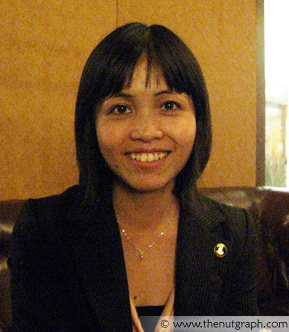
ENTERING politics was just a matter of time for Malaysia’s youngest member of Parliament (MP), Teo Nie Ching. As her parents, sister and brother-in-law are all DAP members, discussions on political developments were common in the Teo household.
Teo recalls how she was first invited to stand for elections as an MP. “It was just after Chinese New Year. I was in my office [when] I received a call from Tony Pua, whom I had met before at functions. I greeted him, ‘Happy Chinese New Year! Where is my angpow?’ And he replied, ‘Ok, I have an angpow for you — the candidacy of the Serdang parliamentary seat.’”
Teo said she had to resign from the law firm she was practising in to stand as a candidate but her boss gave her the option to return if she lost. “My boss expected me to lose the election,” Teo said, Serdang being a former MCA stronghold. “But who would have known that I and so many other [opposition] candidates would win.”
Life is certainly not the same and Teo has less time now with family and friends since being elected. But she is positive when asked why she is willing to make the sacrifice.  “Every occupation involves expectations that need to be met,” Teo says. “In meeting those expectations, you may need to sacrifice some things but you also gain other things. So to me, these ‘sacrifices’ are the tuition fees I need to pay to learn all that I have so far.”
The Nut Graph interviewed Teo on 14 July 2010 at Parliament.
TNG: Where were you born and where did you grow up?
Teo: I was born in Kampung Bindu, Batu Pahat in January 1981. I was born at home. The nurse came to the house to help my mother to give birth. I’m the third out of four children.
What are some of your strongest memories of the place where you grew up?
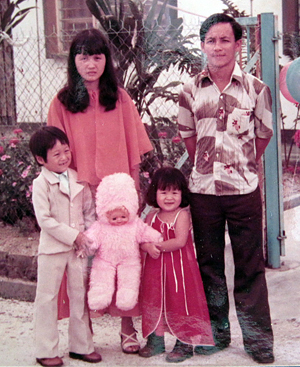
Teo's family (before Teo's birth)
I grew up in a Malay kampung. It is very unlike KL (Kuala Lumpur). I only realised the difference when I came to study in KL. In KL, people are so used to locking their doors. When you go back, the first thing you do is lock the door, even if there are five people at home. When you go out, even for two minutes, you lock the door. And not just with the key, but also with an extra padlock.
In my kampung, it was very different, especially when I was growing up. We locked the door only at night. During the day, whether or not you lock (the door), it’s no big deal.
Here in KL, not every taman has a playground. Even if you go to the playground, an adult needs to accompany the children. For us, we just roamed anywhere in the kampung. Of course, it’s better to let your parents know where you’re going but they won’t really be nervous if they didn’t know exactly where we were. Maybe in the evening, if they think it’s getting late, they might go around the kampung shouting your name, “Where are you? Ey, time to go back.”
I only realised how lucky I was after I came to KL. Even though we didn’t have Playstation or lots of gadgets, we had a lot of freedom.
Can you trace how your family came to Malaysia?
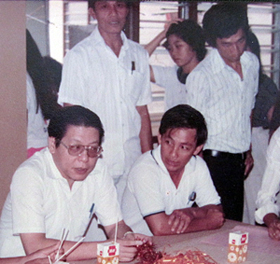
Teo's father (right) seated next to Lim Kit Siang, 1984
On my father’s side, I’m the fourth generation here. My great-grandfather came here from Teochew in China. My great-grandfather managed to get a piece of land in Kampung Bindu and started tapping rubber.
On my mother’s side, my grandfather came here from Fujian in China when he was about 12 or 13. He was the youngest son and all his siblings remained in China. Until recently, he still tried to go back once a year. But he’s very old now. His siblings have also passed away. He’s settled in Johor and owned a timber company. Actually, my father worked for him and that was how my father met my mother. Eventually, my father took over the timber company from my [maternal] grandfather.
Are there any stories that you hold onto from your family?
My father was from a poor home. I remember he told me about how his father passed away when he was about 15. My grandfather was a rubber tapper. One day, he didn’t come home, even though it was late, about 8 or 9am. In those days, they go out as early as 4am to tap rubber. My father and uncle went to look him and found him in the rubber estate lying on the ground. A rubber tree had fallen on top of him and he had died.
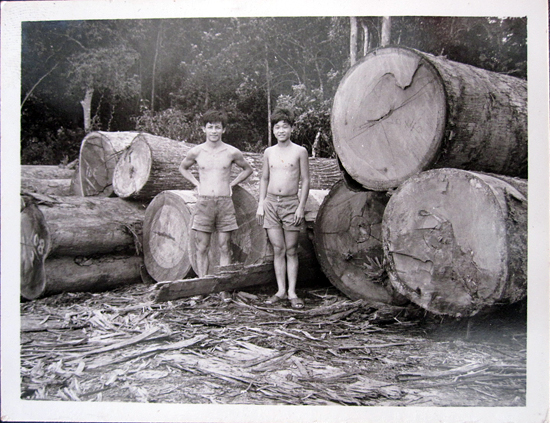
Bekok, Segamat: the place of work for Teo's father, 1978
My father, as the eldest son, decided to leave school and start working to take care of the family. He told me that his grandmother, who loved him the most, didn’t want him to stop school. He was one of the top students in his school. But he decided to stop school to support the family.
Another family story is about my father’s aunt. My great-grandmother had three sons and one daughter. When her daughter was about 12, she was boiling water but she was shocked by people playing firecrackers outside. [She upset the pot] and the boiling hot water spilled all over her. At that time, maybe the medicine was not so good so eventually she passed away. Since then, my great-grandmother [gets] very upset and really [dislikes it when] people play with firecrackers.
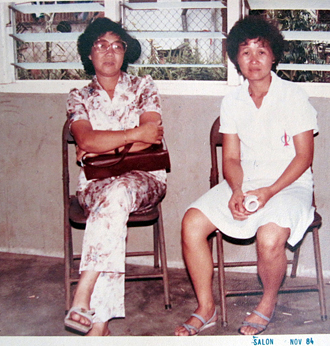
Teo's mother (right) with Lim Kit Siang's wife, 1984
How do you connect to these stories as a Malaysian?
I believe many people have similar experiences. I think at the beginning, when Malaysia was not so well developed, many families lived in poverty. Medicine was also not widely available.
I believe every family has had their share of suffering. Now, in modern Malaysia, we have schools, hospitals, medicine. After our families have gone through all this, I wonder sometimes, do we really cherish all that we have?
Are there any aspects of your identity that you struggle with as a Malaysian?
In school, I would wonder sometimes, why are we not treated equally in this country? When I was young, I didn’t declare myself as Malaysian, I would just say I’m Chinese. Not that I’m from China, but because I went to a Chinese [language] school and everything we learnt or read was in Chinese.
When I went to university, especially when I went overseas, that’s when I realised, I’m not just Chinese, I’m also Malaysian. I started to look at Malaysia as a country, where I was born and where I grew up.
I started to question, how well do I know my country? I could name the prime ministers so far, but about what each of them has done? What about other parts of Malaysia other than Johor, like Sabah and Sarawak? I knew there were Kadazan in Sabah and Iban in Sarawak, but what about their cultures? Even for Malay culture, what is Hari Raya all about? People overseas would ask me to tell them more about my country and I realised how little I knew. There was so much to learn about my own country and I’m still learning.
Describe the kind of future you would like for yourself and for future generations.
I hope that future generations [do not have to deal] with being treated differently in Malaysia. I remember in Chinese school, our teachers would share with us about the struggles the Chinese in Malaysia went through. They impressed on us to cherish everything the Chinese have worked for.
Teo Nie Ching at work
But in another way, this is also sad. It’s only emphasising what the Chinese community has done for the Chinese community. But what about the larger picture of what Malaysians have done for other Malaysians? That is more important. I hope future generations whether Chinese, Malay, Indian, Iban or Kadazan, can feel they are in a country where everyone is treated the same.
I’m also very concerned about corruption. We will have to deal with a [financial] crisis in the future. Our petroleum revenue will run out by 2014 or 2015 and we are in very high debt. Can we do well in the next five years, ten years, 50 years?
To me, whether we are a developed or developing country, I don’t really mind. It’s great if we are a developed country, but I think what is more important is the quality of life. It doesn’t necessarily mean that if you earn more, your quality of life is better. To have a caring society, one where we respect each other, that is also very important. Yes, it would be a plus if we became a high income nation but we don’t need that to happen for us to be a harmonious and happy nation. I believe that is more important.

Now You See It, Now You Don't: Thai Sex Changes

Image
Peekaboo!
(Asia Sentinel) In Bangkok, making yourself into what you want to be takes on a whole new meaning


Making an outie into an innie has long been a hallmark of Thailand's thriving sex change industry, but doing the opposite – making a woman into a man – is difficult and it will cost about US$12,000 an inch, at least for the first inch, says Thailand's most famous transgender surgeon.

The price per inch goes down but the pain goes up for acquiring a longer bit of wedding tackle. At that, having your gender reassigned is cheaper in Bangkok than anywhere else on earth, and it's so common that it is advertised in the newspapers in bold print, attracting generations of journalists eager to tell the tale. Thousands of people flock here from all over the world, but particularly the United States, Australia, Europe, China, Japan, South Korea and the Middle East, mostly men seeking to match their softer side with a physique to match.

Using a penis to create a vagina is relatively easy compared to the surgical difficulty of constructing a penis from a clitoris, says Dr Preecha Tiewtranon, who bends people both ways. "I have done more than 3,500 of this kind of operation in 30 years," Preecha said during a recent interview at his modern, three-story, white-walled Preecha Aesthetic Institute on upmarket Thonglor Road (http://www.pai.co.th). Preecha leads a staff of 15 plastic surgeons slicing, dicing and reconfiguring both male and female sexual organs.

The Thai government recently changed its law on transgender operations and now requires Thais to wait at least one year before undergoing a sex change. In response to the new law, Preecha says he sends his Thai patients to two psychiatrists to confirm that the individuals qualify. After a surgeon slices off the male organ (aaagh), and plumps the breasts with implants, the newly created woman can usually enjoy sexual relations and climax, he says.

"Eighty percent have a relationship with a man. The rest become the so-called lesbian. About 80 percent of the patients are able to get the orgasm," Preecha said, describing the result of a male-to-female sex change. "Orgasm depends on so many factors. If the patient receives a big dose of hormones, then it suppresses the orgasm. The patient must reduce the dose.

"If the patient is old, and the patient has diabetes, the chance to get the orgasm is low. But they get the sexual pleasure OK," he says, indicating that there is some sensuality inside their new vaginas. "In the young patient, it depends on the partner. If they get the good partner, they will get the orgasm."

Displaying excruciatingly graphic medical photos on his computer's screen, Preecha explained why it is much more difficult to turn a woman into a man. The medical and cosmetic problems convince most women to opt for a very small penis, instead of an average-sized longer one.

"To do the long penis involves a very big operation, and quite a lot of mutilation, because the patient will have big scarring on the side of their belly, or on the arm, or the thigh, from the skin graft or the skin flap.

"Today, we have more and more patients wanting the so-called 'small penis,' or the 'micro penis.' We usually elongate the clitoris, and the patient is able to have about one-inch of a penis. He can stand up to urinate in the toilet. They still can stimulate themselves with masturbation. They can achieve sensation." Sexual intercourse, however, is not possible with a one-inch penis.

"Of course they cannot do penetration. Too short. Only rubbing around. But they still can enjoy sexual pleasure."

The other advantage is "no scar at all," Preecha said. Skin grafts from elsewhere on the body are not needed if an entire phallus is not required.

"Longer, you need a lot of skin. Average size? We can do six inches, eight inches. But average is about four. It depends on the wish of the patient.

"Four inches is enough for insertion. But even you go for four inches, you still have the scar."

Preecha says his handful of Japanese female-to-male patients tell him they can earn more money after they get their penises, a disheartening commentary on Japanese sexism in the marketplace.

"Now they like to do the small one-inch, because in Japan, you are able to get a promotion when you are the man. After you do the one-inch, you go back and apply to be a 'Mister.' When you are 'Mister,' you get a higher salary in Japan. "They want a penis for the job," but that is not the only reason Japanese women undergo surgery to become men, he says.
Whatever the size, Preecha creates a penis by tugging a woman's clitoris outward. "We keep the clitoris. The patient, after they have the penis, the clitoris is still there. And they can stimulate."

To make a penis longer than one-inch, a tubular shape must be added, which can function in ways similar to the real thing -- albeit with some numbness. "The reconstructed phallus, the penis, has no sensation. They are able to stand up and have urination. They are able to rub it, and feel like they are getting the female partner excited. And they are able to get the hardness, by using the silicone implant, and have the sexual intercourse."

Switching sex under a surgeon's blade, takes time. If you are a woman who wants to become a man, "you have to go through multiple operations. There is no such 'one stop', like male-to-female. "Male-to-female you can do 'one stop,' get everything in two weeks, and then you go back home -- recuperation for another two weeks -- and then you are completely a woman. ‘

"In six weeks, you can start to have the partner. Male-to-female is straightforward." Female-to-male, however, increases the patient's future risk, especially if a woman requests a penis long enough for penetration.

"The more you do the penetration, the silicone could extrude. When you have the extrusion back home, the cost is so high to go to see the doctor," Preecha says.

The relatively low cost of surgery in Thailand is why so many patients choose Bangkok for sex change operations. Another woe, for women who become men with an insertible phallus, involves “possible leakage of urine, because in the [original] female, the opening for urine is just at the skin level. You have to make it longer, so the connection is [vulnerable to] leaking. If they are in Thailand, it is very simple to repair. But back home, they don't have the experience to do it."

Preecha charges female patients US$12,000 for a one-inch penis, which includes deflating the breasts and removing the uterus and ovaries. A longer phallus boosts the total cost to almost US$20,000. Males pay US$9,000 to $20,000 or more to become females, and comprise the overwhelming majority of Preecha's patients.

Business is booming, especially because his clinic also does plastic surgery on noses, eyelids, and for other cosmetic purposes, including liposuction. Preecha said he will open another clinic in Hanoi, Vietnam, later this year. He also hopes to expand to Dubai.

Monika Weiss, 29, from San Francisco, California, underwent a partial male-to-female change at Preecha's clinic in January, and is considering a final penis cut. "I paid one-third of what I would have paid in America for the same procedures," Weiss said in an interview while recovering in Bangkok. "It was US$10,700. This was basically my first semi-permanent move to see if being a transgender, being a woman, was the right move for me. I've been on female hormones for 11 years, and most people in San Francisco still take me as male. So I was hoping this would push me, and that most people would start perceiving me as female. We shall see."

One of Preecha's surgeons gave Weiss breast implants, a "new nose" and other procedures to "feminize my face."

Weiss says she may return for "sexual reassignment surgery, to remove my penis and make it into a vagina. It depends on money at this point, and how all this works out for me."

Weiss is comparing two options for a vagina. "They can invert what's there, and put it inside. It's called a 'penile inversion.' That is about US$8,000 dollars here in Thailand. They have another procedure, where they use a piece of your colon to create a vagina," which costs US$20,000, Weiss says. "I would probably go for the colon one, because it is a better quality. Certain complications are lessened with that, and it's more durable.

"And I've been told that it feels more real." Weiss is anxious, however, about a possible loss of orgasm after either operation. "It is always a concern."

Richard S Ehrlich is a Bangkok-based journalist who has reported news from Asia since 1978. His web page is http://www.asia-correspondent.110mb.com

Zero tolerance for racism or zero action?

By Thomas Lee

It is nearly a month since the controversial racist remarks allegedly made by Johor school principal Siti Inshah Mansor on 12 August 2010 was highlighted in the media, but no action has so far been taken on the case.
On the contrary, the case involving 27-year-old rapper Wee Meng Chee, popularly known as Namewee, who last week uploaded a video titled “Nah” on the YouTube criticizing Siti Inshah’s alleged racist remarks uttered against students, was investigated straight away by the Malaysian Communications and Multimedia Commission (MCMC), which questioned him for more than seven hours.
It was reported that the police also went to Meng Chee’s house in Muar 15 minutes before midnight on the eve of the 53rd Merdeka celebration, leading him to post this message on his Facebook: “3 POLICE CARS FINALLY CAME TO MY MUAR HOME TO ARREST ME***** this happened 15 minutes before our 53rd National Day Celebration. YES, I’m still here but for how long more, I don’t know … my beloved MALAYSIA, where is our justice system?! (THIS IS NOT A JOKE)”.

Federal CID chief Datuk Seri Bakri Zinin has also confirmed that Meng Chee was being investigated under the Sedition Act.
DAP parliamentary leader Lim Kit Siang wants to know why the police are investigating Meng Chee for sedition when there is nothing seditious in his three-minute rap against the Kulai secondary school principal for making racist slurs against students while the school principal is still scot-free for her seditious racism.
Siti Inshah’s case concerns her remarks likening Indian students wearing prayer threads to dogs, and ordered dissatisfied ethnic Chinese and Indian students to “return to China or India”.
Her remarks sparked a nationwide public furor and drew calls for her to be sacked. Several police reports were lodged against her, but despite setting up a task force to probe the allegations, Deputy Prime Minister cum Education Minister Muhyiddin Yassin has so far stonewalled on taking any action.
She had reportedly made the derogatory remarks during the launch of the school’s Merdeka celebrations on Thursday 12 August 2010.
Prime Minister Datuk Seri Najib Razak had recently declared that there should be “zero tolerance for racism”, yet there has been no concrete action taken against the racists and extremists, some within the ranks of his own party, who are making his 1-Malaysia concept into a worthless slogan, and causing him to be held in contempt by the people.
The unremitting incessant racist comments by the mercenary newspaper columnists and the igneous fiery rhetoric of the ardent fervid racist politicians promoting the supremacy of one particular race are creating an atmosphere of dread and fear among the people.
The chorus of protests and condemnation against such racist propaganda seems to have fallen on the deaf ears of the power-that-be, with no vocal and visible actions being taken to curb the racist politicians and civil servants.
For example, in the Siti Inshah case, Education director-general Tan Sri Alimuddin Mohd Dom trivialized the whole serious matter as simply a “misunderstanding”, instead of viewing her racists remarks as something that hurt the feelings of others, jeopardizing the peace, harmony and unity of the nation.
Alimuddin’s thoughtless dismissal of the grave scenario exposes him as being incapable and incompetent in understanding the severity and gravity of the consequences of such damaging remarks, which could destroy the peaceful co-existence of our multi-racial, multi-religious, multi-cultural, and multi-lingual nation.
The Najib administration has a duty and accountability to take fast and hard actions against those who fan the racial fire, threatening the peace and harmony of the nation, and creating disunity among the people.
First of all, Najib and his ministers cannot keep silent in the face of such racist rhetoric and racial power play among the nefarious politicians, especially those promoting the supremacy and superiority of any particular race.
Najib wants to create a 1-Malaysia community, but it is surely obvious that his ideal has not been filtering down to the people, with several extremist rights groups going all out to create disharmony.
Over the last one year or so, the dubious and shady characters of certain rights groups have been going around disparaging the non-Malays calling them “immigrants” or “passengers”, and asking them to leave the country. There was also the so-called cow-head protest, and the arson attacks on places of worship.
There were also acts of sabotage against a duly elected state government by creating problems and scandals with racial or religious overtones, such as the doctored picture of Penang Chief Minister Lim Guan Eng.
Secondly, the Najib administration must go all out to rein in the unscrupulous malevolent elements in positions of power in the civil service and weed them out to preserve and protect the harmony, peace and unity of the nation.
Fast disciplinary and legal actions must be instituted against those who cast aspersion and obloquy on people of other races, like the school head who made racial slur against the non-Malays, and the police officer who told a snatch theft victim to “go back to China” when she couldn’t speak proper Bahasa Malaysia while making a police report.
Thirdly, the Najib administration should heed the proposal by DAP national chairman Karpal Singh to enact a Race Relations Act as a deterrent to prevent further racist remarks from being uttered by irresponsible individuals.
I believe that such a legislation would contribute much to enhance race relationship in Malaysia. I suggest that the following objectives be used as guiding principles for such a legislation:
  1. To promote greater integration and better relations among people of the various races and ethnic groups.
  2. To eradicate racial discrimination, harassment and abuses.
  3. To promote racial equality in the civil service, and education institutions.
  4. To support private sector employers to ensure equality of opportunity and good race relations.
  5. To increase public awareness of racial discrimination and injustice through education and the information media.
  6. To win the hearts and minds of the people and unite them to create a just, fair and equal society.
If Prime Minister Datuk Seri Najib Razak is truly serious and earnest about “zero tolerance for racism”, then he must act positively and constructively in dealing with the increasingly intolerant racist insurgency that is gathering momentum and threatening the fragile and friable mosaic of our multi-racial, multi-religious, multi-cultural, and multi-lingual nation.

What social contract?

by Clive Kessler

“Najib warns against questioning ‘social contract’,” it is reported.

This claim is plain and simple “historical revisionism”.

To what “social contract” precisely is the PM referring?

In the 1980s a new political idea was created: that of “Ketuanan Melayu”, of Malay ascendancy, supremacy, domination.

Thereafter, especially from 2008 it has been ever more powerfully promoted, generally in association with the suggestion that a “social contract” had been entered into and constitutionally enshrined in the mid-1950s.

How was this manoeuvre executed? With what purpose and consequences?

It was, from 1986, now newly suggested that the notion of “Ketuanan Melayu” had been part of the “Merdeka process and agreements”, and that the nation’s non-Malay citizens had thereby consented to accept, and thereafter ever live subject to, Malay ascendancy and supremacy.

There was perhaps an implicit, but only implicit, “social contract” formed in 1955-1957. If that is how one chooses to denote the core political substance of the Merdeka process, then that implied “contract” was about inter-communal or inter-ethnic power-sharing and the secular nature of the Malaysian state. It was not about notion of “Malay supremacy”. That notion was only subsequently, indeed very much later, confected.

If there was at that time a “social contract”——if that is how some people later may choose to characterize the Merdeka process and agreements——then what they are referring to is merely a retrospectively imputed or implied social contract.

This term was now offered as a new way of denoting, and seeing, that national political legacy and foundation, that core political substance. But, when reached, in their own time, those agreements, that subsequently implied “contract” (to use the new, and newly inflated term) was not about and did not provide for “Ketuanan Melayu” — nor for the supremacy of Islamic shari’ah law as the supreme and uncontestable law of the land either, for that matter, as some creative constitutional revisionists also now like to suggest.

Yet there was no “social contract” as such at the time. People have only inferred and argued subsequently that there was, because there somehow must have been, such a contract at the time of Merdeka — and, driven by retrospective wish-fulfilment, they have then “filled in” what it pleases them to believe, or passionately desire, that its terms must have been. They “read back” the politics of the present, and their preferred political future that they like to imagine for themselves, into the historic past.

Yet nobody talked at the time, in 1955-1957, about there being concluded any such “social contract”. Nobody seriously imagined that any such contract formally enshrining and constitutionally entrenching Malay domination was being entered into by all the people. Nobody suggested that people, or the nation as a whole, had signed up to and agreed to be bound by any such “contract” providing for enduring Malay ethnocracy — for Malay domination in perpetuity and with the unalterable assent over the generations of the dominated.

Subsequently, from the mid-1980s, the idea that there had been an implicit “social contract” was fashioned. It was suggested that the notion of “Ketuanan Melayu” had, by inference, been part of or implied by that contract.

In this way, born only in the 1980s, the new idea of “Ketuanan Melayu” was “read back”, or subsequently “smuggled”, into the Merdeka agreements and process, or into now authoritatively offered but very questionable claims about what those agreements had provided for and “locked in” as the solemn foundations of nationhood . If there was an implicit contract at that time (it was at first subliminally and then explicitly suggested) then universal assent to “Ketuanan Melayu” was and must have been part of it.

This, quite simply and evidently, is historically erroneous. It is sheer revisionism. It is retrospective meddling with national historical truth and the nation’s constitutional foundations.

Never has the need for clear historical study, analysis, accuracy and faithfulness to the facts been greater.

* Clive S. Kessler is Emeritus Professor, Sociology & Anthropology at The University of New South Wales, Sydney, Australia

Press Release: Kelab Belia Graduan 1Malaysia’s Police Report Baseless

Image The Malaysian Bar understands that a police report has been lodged against its MyConstitution Campaign by Kelab Belia Graduan 1Malaysia (KBGM). KBGM has reportedly voiced concern that the booklets produced under the Campaign (Rakyat Guides) may be seditious.

We believe that KBGM’s concerns about the Campaign are misplaced, and stem from a lack of knowledge and understanding of the Campaign as well as the Federal Constitution (Constitution).

The Campaign’s aim is to increase awareness of the Constitution among Malaysians because the Constitution defines our country. It is not the Malaysian Bar’s aim to seek to amend the Constitution. The Campaign is non-partisan and we make every effort to work with all individuals and entities who wish to work with us. To date, our activities have been graced and supported by a Minister and a Deputy Minister in the Prime Minister’s Department, a Chief Minister, two Menteri Besar, Members of Parliament including the Speaker and Deputy Speaker of the Dewan Rakyat, and many other bodies.

KBGM’s main concern seems to be that the Rakyat Guides have informed the Malaysian public that the Constitution says it can be amended by Members of Parliament who are elected by Malaysians. The Constitution does in fact say this. To our knowledge, Parliament has amended the Constitution more than 40 times over the past 53 years with approximately 650 individual amendments. 

In general, constitutional amendments require support from two-thirds of Members of Parliament. However, some provisions in the Constitution, like that relating to the special position of the Malays, can only be amended with the consent of the Council of Rulers.

KBGM’s allegation that the Campaign is funded by a foreign NGO that is anti-government is baseless. The MyConstitution Campaign is non-profit. It is funded by the Malaysian Bar and has received contributions from many other bodies, including the Federal Government, State Governments, political and non-political organizations, and the Malaysian public.

The MyConstitution Campaign seeks to inform Malaysians on what the Constitution actually says. It encourages people to read the Constitution themselves, and learn what is and is not in the Constitution. In this regard, we believe that KBGM’s concerns can be alleviated by knowledge of the Constitution. We invite KBGM to a discussion and are willing to work with it so that we may together ‘Merakyatkan Perlembagaan’.

A press conference in relation to this statement will be held tomorrow (7 September 2010) at 12:30pm at the Conference Room 1, 3rd floor, Bar Council, No. 15, Leboh Pasar Besar, 50500 Kuala Lumpur. An invitation to the press conference will follow.

Ragunath Kesavan
President
Malaysian Bar

Utusan, BH, Star, NST circulations drop

By Anil Netto,

Utusan has been very much in the news for its sensationalist and racially tinged reporting. Less well known is the fact that the paper’s circulation has been sliding over the last four years.

According to Audit Bureau of Circulation (figures for West Malaysia publications for the period ending 31 December 2009), Utusan Malaysia’s daily circulation has dropped 21 per cent from 213,445 in 2006 to 169,548 in 2009. The group revenue of Utusan Melayu (Malaysia) Bhd fell correspondingly from RM384m in 2006 to RM349m in 2009, according to Utusan’s Annual Report for 2009. This had an impact on its bottom line as well, as profit before tax plunged from RM21m to RM7m in the last four years. The firm’s performance was saved by sister publication Kosmo!’s steady rise in circulation from 100,798 in 2007 to 172,253 in 2009.

Berita Harian too fell from a circulation of 203,704 in 2006 to 154,868 in 2009 – a fall of 24 per cent. But the circulation of sister paper Harian Metro, like that of Kosmo!, jumped from 249,575 to 358,676 in the same period.

Mainstream English-language papers have not been spared the gloomy figures. The Star’s circulation has fallen from 310,008 in 2006 to 286,857 in 2009. Likewise, New Straits Times sales have slumped from 139,468 to 111,158 in the last four years.

Free newspaper theSun bucked the trend, its circulation soaring from 174,179 in 2006 to 300,587 in 2009.

Chinese-language newspapers generally did all right, Sin Chew‘s, China Press’ and Oriental Daily News’ circulations all rising over the same period. Only Guang Ming recorded a small drop in circulation.

The top selling daily newspapers are Sin Chew (382,000), followed by Harian Metro (359,000) and The Star (287,000). The best-selling weekend editions are Metro Ahad (406,000) and Mingguan Malaysia (370,000), along with Sin Chew.

All the above figures are based on ABC West Malaysia publications figures only. Figures for Sarawak and Sabah are reported separately.

From the recent trend, it appears that the future of blatantly pro-BN newspapers that are perceived to be sycophantic does not look encouraging as readers shift towards online news sources.

The only papers that seem to be coping well with this shift are the gossip or life-style tabloids, a free newspaper that is a bit more independent (theSun), a business paper like The Edge (circulation of around 21,000-25,000), and the slightly more independent Chinese-language newspapers.

What do you think?

Minister in MoneyLaundering WhistleBlower Attacked


Whistleblower Mohd Tahir whom recently named a former cabinet minister to involved in million of dollar money laundering act  was servely attacked by unknown person. He was attacked last week at Bukit Bintang area and being under ICU for past week.
The attack happen just days after Mohd Tahir had a press conference at my service centre in Kapar . Refer  ‘Ex-minister laundered tens of millions’.
The attack was primarily targeted at his head which lead him to coma stage during past week. Could it be  well planned work by those aligned to multi million dollar money laundering act

Mohd Tahir whom initially couldn’t recall myself during the visit however managed to gain some memory moments later.

The incident and  ineffecient of police to act despite report launched by the family lead  to possible involvement of highly connected person behind such attack just days after he agreed disclose details of money laundering act by a former cabinet minister.
The safety of Mohd Tahir and his family now becomes grave concern Malaysian citizen when authorities either choose to close an eye or act loopsided.  Political violence too gaining momentum in Malaysia due to such act by related authorities.
I call upon Prime Minister to ensure safety of Mohd Tahir and his family while bring to justice those culprit behind such incident and investigate throughly involvement of  a former cabinet Minister in RM25million money laundering act.