Share |

Wednesday, 2 March 2011

Karpal fails in bid to compel CJ

KUALA LUMPUR: Lawyer Karpal Singh today failed in his preliminary bid to compel Chief Justice Zaki Azmi to respond to his letter regarding alleged misconduct on the part of the chief justice while the latter was a practising lawyer in 1987.
High Court Judge Aziah Ali dismissed Karpal Singh’s application for leave for a judicial review in seeking a court order to force Zaki to explain the alleged misconduct.
On Jan 12, Karpal Singh, who is DAP chairman and Bukit Gelugor MP, filed the application for leave for a judicial review in seeking a court order to force Zaki to explain his alleged misconduct with regard to an admission by Zaki on the bribing of court officials during his days as a lawyer.
Besides seeking to have Zaki brought before the Judges Code of Ethics Tribunal, Karpal was also asking for a court order to prevent Zaki himself from determining the merits of the complaints lodged against him under Section 13 of the Judges’ Code of Ethics 2009.
In his application, Karpal said the proper authority to hear complaints against Zaki would be a retired chief judge or a retired Federal Court judge.
- Bernama

A promise broken thrice

Merlimau Indians have been waiting for a Tamil school since the 1999 general election, says DAP.
MERLIMAU: The Indians of Merlimau have been hearing the same Barisan Nasional (BN) promise to build a Tamil school through three general elections, but nothing has materialised.
They are hearing the same promise again in the campaign for the March 6 by-election.
“Enough is enough,” said N Ghandirajan, Malacca DAP’s vice-chairman.
He told FMT he was not impressed by the ground-breaking ceremony that Deputy Prime Minister Muhyiddin Yassin conducted two weeks ago, saying it was 12 years too late.
He spoke in the presence of several companions who claimed to be representatives of the local Indians.
He said BN first made the promise in 1999, and again in 2004 and 2008, each time changing the proposed location of the school.
“Now, for the by-election, they are promising it again. The only difference is the ground-breaking ceremony was Feb 14.”
This time the proposed site is a football field belonging to Sime Darby.
The Merlimau Tamil School currently operates from a temporary building belonging to a secondary school.
Ghandirajan noted a discrepancy in recent announcements about the cost of the proposed school. Muhyiddin said on Feb 14 that it would be RM4 million, but a week earlier, Malacca executive councillor R Perumal said it would be RM6.1 million.
“I urge Perumal to explain the difference,” he said. “Did he give the statement only to please the Indians or is the plan real?”
He challenged Perumal and MIC vice-president S Subramaniam to ensure that the construction of the school begin within 100 days of the ground-breaking ceremony, which both of them attended.
“If they fail to do so, this will be another classic example on how the MIC and BN leaders simply take Indians for a ride and are never serious in helping them to gain proper and quality education,” he said.
“I urge the Merlimau voters – not only the Indians, but other races as well – to learn from the empty promises of BN.
“During the Bagan Pinang by-election in October 2009, they promised to build a new Tamil school, but till today nothing has happened there.”

Folly to ignore the cry for justice

The rally organised by Hindraf appears as a last resort to get the government to treat the Indian community with respect.
COMMENT
When Malay-rights group Perkasa keeps making racist remarks, does it translate to all Malays’ being racist? If not, then what made the Barisan Nasional (BN) government think that all Indians out on the streets of Kuala Lumpur on Sunday were “criminals”, all because Hindraf decided to hold a rally?
The police in their bid to halt the rally to protest Umno’s racial discrimination, turned up at Human Rights Party (HRP) leader P Uthayakumar’s residence, handcuffing and taking him in for questioning.
On what grounds did the police handcuff Uthayakumar? Is he a criminal just because he organised a rally without police permit? If he is, then equally guilty are the people who demonstrated when the non-Malays complain about the loud call for prayer made by mosques.
Just as guilty are those Malays who cold-bloodedly severed a cow’s head, spit and stomp on it. And the biggest cuplrit would then be Perkasa whose founder Ibrahim Ali keeps threatening non-Malays to shut up and not question Malay rights.
Have the police taken any action against them? No and it seems the police never will.
The “Solidarity Against Umno’s Racism” march, organised by two ethnic Indian groups, the Hindu Rights Action Force and Huma Rights Party at Kuala Lumpur on Feb 27 was to protest against the government’s decision to ignore the Indian community’s strong objections over the disparaging contents in the novel “Interlok” which is a compulsory reading material for Form Five students.
On Feb 24, the Dang Wangi police rejected a formal request made by W Sambulingam, national coordinator of Hindraf, to hold the rally.
Granted that such rallies cause great inconvenience to the public and temporarily paralyse the city’s activities but what prompted it in the first place?
To keep warning the people to stay away from such rallies and not challenge the police authority is nothing but an act of bully. Is it a coincidence or deliberate move to target the Indians all because they are unhappy over the discrimination they have been putting up with? The move by the police to nab any Indian found walking on the streets of Kuala Lumpur to teach all Indians a lessons is not going to place Umno in the good books of this community.
When national laureate Abdullah Hussain goes and portrays the Chinese and Indians in a degrading manner in his book Interlok, what should be done to avoid racial conflict? Would it not be best that such a reading material be withdrawn due to its contentious nature? Instead, Deputy Prime Minister Muhyiddin Yassin, who is also education minister, showed no empathy and decided Interlok would remain as a reading material for students but with alterations.
Rallies a last resort
But then Muhyiddin’s reaction was not a surprise since it was he who proudly claimed that he is “Malay first” and then a Malaysian.
Life always presents us with options and in Hindraf’s case, it could have decided to not go ahead with its rallies. But it did. Why? Is the purpose solely to gain political mileage? Looking at the state-of-affairs affecting the Indians, the rallies appear as a last resort to get the government to “wake up” and treat the Indian community with respect.
Yes, the rallies pose a headache to the lay person but then this seems the only way to get the “powers that be” to sit up and realise their folly. Also, unlike the cow head carried by Muslim protesters, Hindraf demonstrators did no such thing – all they ask is for their grouses to be heard and addressed in a fair manner.
How would the Indians have felt when former prime minister Dr Mahathir Mohamad claimed that this country belongs to the Malays by virtue of it once being called “Tanah Melayu”?
The country achieved independence 53 years ago but racial discord among people of different faiths is still going strong. Why?
The nation’s oil and gas company, Petronas, takes great pride in splashing money to build mosques throughout the country. But for the non-Malays, they have to work hard at getting funds to construct their places of worship. Why this discrimination?
When issues concerning Malay rights assured under Article 153 of the Federal Constitution are raised, the Malays are quick to threaten the non-Malays, to the point of willing to kill those who question privileges enjoyed by the Malays. Is there no decent way to react apart from threats of bloodshed?
It is no exaggeration to say that the plight of the Indian community has long been ignored. It is bad enough that the MIC failed to champion the welfare of the Indians, resulting in entities like Hindraf taking shape. Why did MIC not protect the rights of the Indians and what was holding MIC back from doing so?
These days you hardly get to see an Indian face at government departments. All the top government posts are occupied by the Malays. Whatever happened to the non-Malays? Because of the discrimination and no prospect for promotion, non-Malays have moved to work in the private sector where they do get some recogntion for their efforts.
Prime Minister Najib Tun Razak’s 1Malaysia concept is hardly of concern to the fast-food chains who lack non-Malay faces at their premises. And the fact that some Malays like the residents of Section 23 in Shah Alam who refused to let a Hindu temple take shape in their neigbourhood speaks volumes of the failure of 1Malaysia.
Dead in custody
There have been several cases of Indian men caught by the police ending up dead while in custody. Why is this happening and who is looking into this matter to ensure it does not happen again?
Detainee A Kugan died in police custody and the policeman said to have physically abused him was declared a free man by the court. Why?
Malaysia’s refusal to allow the Hindraf rally to take place is an act of arrogance and disrespect. Even the call made by New York-based Human Rights Watch (HRW) to Home Minister Hishammuddin Hussein to respect Malaysia’s international and legal obligations and allow Sunday’s Solidarity March Against Racism to proceed was ignored.
HRW’s deputy Asia director, Phil Robertson, said: “The Malaysian government’s opposition to peaceful marches results in three big losers: the rights to free expression, freedom of association and peaceful assembly.”
“The Malaysian government’s commitment to diversity and development is betrayed when it refuses to permit peaceful criticism of its policies and programmes.
“Banning this march makes a mockery of the principles the government pledged to uphold when it assumed its seat on the United Nation’s Human Rights Council,” Robertson said in press statement.
Hishammuddin had earlier said that Hindraf would not get a police permit to march.
“It is a banned movement… It doesn’t have locus standi to ask for a permit,” he said.
The government banned Hindraf after it staged a massive demonstration in Kuala Lumpur in 2007. Meanwhile, HRP has applied for registration and its application is still pending.
Post-2007, has the government become so insecure and afraid of the Indian community’s anger that it quickly started a crackdown on the HRP’s right to peaceful assembly?
Recruitment drive
On Feb 13, barely two weeks before the scheduled march, HRP initiated a grassroots information and recruitment drive in several states, dispatching convoys of cars loaded with activists wearing the group’s distinctive orange T-shirts and carrying posters, banners, and assorted promotional materials to various locales.
Police, however, stopped the convoys at roadblocks and diverted participants to police stations, where many were detained.
The police arrested at least 59 people on various grounds. In one instance, participants were held for driving in a convoy without a permit. In other instances, police charged the activists with illegal assembly, interference with on-duty officers, obstructing traffic and moving in a large group in a busy area.
Some participants, held overnight, were offered their freedom if they gave up their orange T-shirts, but when it became clear they would not do so, they were released on bail.
On Feb 20, police in three locations broke up HRP forums designed to explain the group’s concerns about certain issues and to continue membership recruitment. The police claimed that permission to hold the forums had been denied.
HRP leaders were among some 59 arrested and eventually all were released on bail. In a further pre-emptive move, M Gobalakrishnan, the person named on fliers as the contact for further information in Hulu Selangor, was picked up at his home by six plainclothes officers and detained hours before the local meeting was to begin. Police also sealed off the forum site. Gobalakrishnan has since been released.
In November 2007, between 10,000 and 30,000 people participated in the first Hindraf-organised demonstration.
The then prime minister Abdullah Ahmad Badawi reportedly said that Hindraf leaders undermined national security by threatening racial and religious harmony.
Following the protest, the government detained five Hindraf leaders under the Internal Security Act (ISA) and banned Hindraf.

Hisham & co in denial, says Hindraf

Adviser Ganesan says the movements anti-racism campaign is “very much alive”.
UPDATED
GEORGE TOWN: Hindraf Makkal Sakthi has castigated the Home Minister and other Barisan Nasional leaders for equating the foiling of Sunday’s protest march with the movement’s alleged loss of popularity.
Hindraf advisor N Ganesan said the conclusion was ludicrous and reflected only BN’s wishful thinking.
BN leaders were in denial and should stop insulting the intelligence of ordinary Malaysians, he added.
“Popularity and support cannot be accurately adjudged by the size of the crowd,” he told FMT.
“Furthermore, it was the police dragnet that prevented the crowd from getting bigger.
“But Hindraf’s anti-racism campaign is very much alive.”
Ganesan was commenting on claims by several BN leaders, including Home Minister Hishammuddin Hussein, that Hindraf had lost support among Malaysian Indians.
They said this was the reason that police succeeded in preventing the march from KLCC.
Scores of Hindraf activists, including legal adviser P Uthayakumar, national coordinator W Sambulingam and Ganesan himself, were detained in a pre-demonstration police crackdown on Sunday morning.
Police also arrested Indian men and women found around KLCC.
“The real measurement of popularity is whether the people believe in Hindraf’s struggle,” Ganesan said.
Because of the police clampdown, he said, no one could now say for sure how many people actually turned up for the march.
Many protestors on their way to KLCC turned back after hearing that police had foiled the protest, he claimed.
Five activists charged today
The massive deployment of police against the protest exposed Umno’s fear of the movement, he said.
“If we lack support, why should the Umno government initiate such a massive security operation to halt our peaceful march?”
But the crackdown had not dampened Hindraf’s fighting spirit, he said.
“Indeed, it is a morale booster for the movement to intensify its struggle to get the novel Interlok off the school shelves.”
He said Hindraf was not against the novel remaining in bookshops because it respected freedom of expression.
But, he stressed, the movement was against the book being in schools because it would further the cause of racists.
He described the book as “shallow”, and said it distorted historical and cultural facts and was a symbol of Umno racism.
He said Hindraf would continue to galvanise the people to rise and vote out the “racist Umno government”.
Meanwhile in another development, five Hindraf activists, including spokesman S Jayathas, were arrested in Kuala Lumpur today and were charged at the Selayang Sessions’ Court for being involved in a banned organisation – Hindraf – under Section 43 of the Societies Act. All five claimed trial.
Jayathas, K Navakrishna, K Tamil Selvam, T Periasamy dan S Loshna Rau were accused of committing the offence at Bukit Kanching, Jalan Ipoh, Rawang on Feb 13.
Loshna also faced another charge of disrupting a police officer from carrying out his duties.
Deputy public prosecutor Ridha Abdah Subri prosecuted while the five were represented by P Uthayakumar.

Pluralism and public policy

WHAT’S wrong with a Muslim saying that religious pluralism is harmful to Muslims? Or for a believer of any faith to say that his or her religion is the true one? Or even for an atheist to be adamant that there is no God?
Nothing. As personal statements of belief, most persons of faith would say that their respective religion, or lack of one, is complete. As a privately held claim, and in line with Article 11 on the freedom of religion, thinking of one’s belief system as superior to others is a right of personal choice.
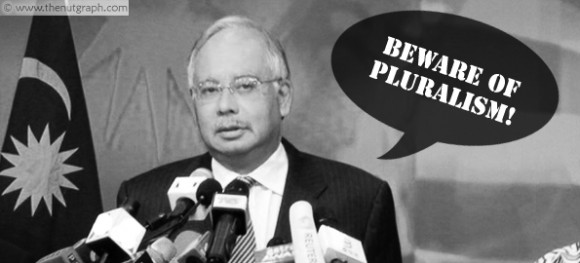
But is there a problem when a head of government warns citizens against religious pluralism, as Prime Minister Datuk Seri Najib Razak reportedly did on 18 Feb 2011? Was it just Najib exercising his right to a theological stand, as Malaysian Consultative Council of Buddhism, Christianity, Hinduism, Sikhism and Taoism (MCCBCHST) president Rev Thomas Phillipsasserted? In responding to Najib’s comments, Rev Phillips advised the public against taking Najib’s statement out of context.
However, it is precisely the Malaysian context that makes it problematic when something like this is said by the head of government. Malaysia is a pluralistic country, where policies and the implementation thereof are largely determined by people of a particular ethnic group and religion. Theological claims to religious exclusivity would not matter as much if all citizens were treated as equal before the law. Nor would it matter as much if politicians did not seek to use religion to divide people. But what really is the situation here?
Prioritising Islam
Najib may have been specifically addressing a meeting of religious teachers. When he said, “To say all religious are equal before Allah is against the Islamic belief”, it may well have been a personal theological opinion. He may also have been sincere in not insulting other religions, as he said.
But with a public delivery system that has been increasingly Islamised arguably from the time of Tun Dr Mahathir Mohamad’s leadership, was it responsible of Najib to make a statement that could be interpreted as placing Islam above other religions? How sure are we that the rest of his administration and his political cohorts wouldn’t interpret his words to mean that they must prioritise Islam in making decisions?
Intentionally or not, Najib may have merely helped to perpetuate an existing tendency of some politicians and bureaucrats to make decisions according to religious and also racial bias. These are just some examples that demonstrate existing bias in government decisions and actions, whether corporately by state apparatus or individually by their players:
 Biro Tatanegara‘s (BTN) indoctrination of civil servants to prioritise “ketuanan Melayu”;
 the Home Ministry’s ban of the use of “Allah” by Catholic weekly Herald, which has been pending appeal for over a year. Until the appeal is heard, the ban remains due to a stay of the High Court’s decision overturning the ban;
 allegations of Orang Asli tricked or forced to convert toIslam, although this has been denied by the Jabatan Hal Ehwal Orang Asli;
 a 26-year delay for building approval for the Church of Divine Mercy in Shah Alam, which now sits in an industrial area;
 the home minister appearing with the cow-head protesters, despite the protesters having threatened violence against the relocation of a Hindu temple in Shah Alam;
 demolition or prohibition of church buildings by Orang Asli on their own land;
 unilateral moves by certain Education Department officers to close down non-Muslim clubs in schools, and a federal circular requiring new clubs from 2000 onwards to get approval from state education departments;
 alleged racial slurs by school principals against non-Muslim pupils; and,
 a directive by another school head to non-Muslim pupils not to bring “wet food” to the school’s Children’s Day celebration.
Lim
None less than a former minister, Tun Dr Lim Keng Yaik, told The Nut Graph in an interview of similar frustrations with civil servants during his time in the cabinet. Lim recounted an incident where a government officer blocked his directive for a sum of money to be allocated to a Chinese temple. The reason cited by the officer was that as a Muslim, he could not be aiding other religions. Lim also recalled officers who wanted to end the vernacular school system.
Doublespeak
Just how do some in the civil service become so zealous and powerful as to get away with the above examples? As Lim said in his interview: “unchecked … forced nationalism” based on the dominance of one race and religion. The work of BTN is also likely a contributing factor. And now, public remarks like that of Najib’s may only further entrench already narrow mindsets.
One reaction to all this is that Islam is, after all, the religion of the federation as enshrined in the Federal Constitution. But let us also recall what Malaysia‘s founders had in mind: that Islam’s status would not erode Malaysia’s position as a secular state. This historical fact was affirmed by the judiciary in 1988 – that Islam’s role in government was for rituals and ceremonial purposes and that Malaysia was not an Islamic state. There are of course, objections to this judicial decision, and today, one can see how far Malaysia has moved beyond its founders’ position.
As a non-Muslim, I won’t presume to tell Najib what he should have said instead when carrying out his official duty at the meeting of religious teachers. But I do wonder if our leaders from both sides of the divide at the very least think about the impact of their words on all communities.
Otherwise, it’s a joke, really, when Barisan Nasional leaders preach 1Malaysia, yet allow something poisonous like BTN to exist, and then scramble to do damage control when public delivery system implementers let slip their prejudices. And it’s a concern when the Pakatan Rakyat tries to sell its brand of equality when their leaders cannot yet confront their differences over the Islamic state issue, or fall back on communalism in attempts to beat political rivals.
Or maybe it’s not a joke after all. Unfortunately for Malaysia’s diverse peoples, ensuring communal politics has long been a strategic and expedient way to attain and stay in power. But it’s time Malaysians reject politicians who double-speak and use communal politics to their own benefit, to the detriment of the country’s harmony. - The Nut Graph