Share |

Saturday, 4 December 2010

FTA talks: Risky or beneficial?

By Patrick Lee - Free Malaysia Today

PETALING JAYA: Malaysia's policies and the Federal Constitution may not be as easy to amend as some politicians think, even with the risk of the private free trade agreement (FTA) talks.

Klang MP (DAP) Charles Santiago said recently that the outcome of the two FTA negotations could change Malaysia's laws and the Federal Constitution without parliamentary consent.

Monash University political analyst James Chin, however, disagreed with Santiago's warnings, saying that it was difficult to change the constitution without involving the monarchy.

“You cannot touch articles such as Articles 151, 152 (and) 153 without the consent of two-thirds of Parliament and the Rulers,” said Chin.

Certain Articles involving the special position of Bumiputeras or the status of Islam require the approval of a two-thirds parliamentary majority and the Conference of Rulers.

Chin added that it was more likely that several Malaysian regulations and laws would be modified to fit labour practices after the FTA negotiations had been concluded.

Nevertheless, he said that Parliament needed to be wary of Bills being passed when changes were being introduced.

“The Malaysian Parliament is not very good with technical details. Sometimes, four to five Bills get passed at once,” he said.

Chin also cautioned against crying wolf against the FTA. “It's too early to tell or to raise an alarm over what may happen. They haven't even agreed on an agenda yet,” said Chin.

He said that FTA negotiations did not need to be conducted in the open as with other major trade talks such as the World Trade Organisation (WTO) discussions.

Major step for the country

Unlike Chin, former Transparency International Malaysia president Ramon Navaratnam said that the Malaysian public needed to be familiar with the topics in the FTA negotiations.

“There should have been talks and discussions by the ministers involved as was done with the Economic Transformation Programme (ETP),” he said.

Navaratnam said that the public deserved to know which way the country would be heading when it came to the FTA because it was a major step for the country.

“It's better to have discussions and consultations later than not have it at all, otherwise it can cause problems for the people,” he said.

Malaysians, said Navaratnam, would not be happy if policy changes were announced without warning. If push came to shove, the government would lose out at the ballot box.

Santiago had warned that the FTA negotiations could adversely affect the business future of small and medium enterprises (SMEs). More than 95% of Malaysia's business comes from SMEs.

Even so, Navaratnam was not opposed to the idea of an FTA.

“FTAs are part and parcel of a worldwide trend. We must face reality and look forward instead of resorting to being on the defensive,” he said.

"Malaysia must look towards competition and meritocracy to progress. We are no longer an agricultural or a manufacturing-based economy.

We are moving into a services-based economy, and have to follow economic forces instead of tilling the soil and making cheap electronics.”

Malaysia is expected to begin its first round of FTA negotiations with the European Union in Brussels from Dec 6-7.

Separate negotiations with the US and eight other nations, including Australia, Singapore and Vietnam over the Trans-Pacific Partnership FTA are scheduled from Dec 6-10 in New Zealand.

'RM544m bond means Sabah has no liquid cash'

By Amde Sidik - Free Malaysia Today

COMMENT The Sabah government recently declared that the controversial “bond” it issued in 2009 was part of its revenue in the state 2010 Budget.

Firstly be reminded that the state issued two bonds and not one. The earlier one was the RM500 million bond issued by the Sabah Development Bank. The second RM544 million bond was issued by the Sabah Ministry of Finance.

I’m just going to simplify the issue and focus on the RM544 million borrowed from the State Ministry of Finance.

What is a bond? A bond is a debt instrument.

A government bond is a government debt. It can't be much different from a commercial accounting system. If it's a debt it must be paid once it matures. Any payment will include the bond yield or interest.

Under normal circumstances, when the government treasury is in deficit, it’s only fair to think about reducing the deficit as soon as possible.

In our case, over the years we have not seen concrete efforts to improve revenue collection or to findnew resources of revenue.

Instead, we all know now that the easiest and most convenient way to get over a deficit is for the state to issue a government bond.

Hiding real deficit

The Sabah Ministry of Finance in 2009 initiated the issuance of government bond worth RM544 million, which is to mature in 2014 at a capped rate of 5%.

Amortisation of this bond requires the sabah government to pay RM615 million, with a monthly payment of RM10.27 million or RM123.24 million. Total cap-on will be RM71.96 million

Placing the debt in the revenue column is a trick, which makes the state government deficit expenditure look small.

This is a way of hiding the real deficit, which would otherwise be too huge to be in the picture and not sustainable

This method of accounting would serve as the easiest and convenient way to get new money.

In as far as Moody and Rating Agency Malaysia (RAM) is concerned, giving Sabah a triple “A” rating isn't really a big problem.

It’s not because of Sabah's capability or capacity. In fact, it is because of its available resources, which simply means Sabah has good asset -based collaterals.

In simple term, the whole state can and is good for “pawning off” or in local terms “pajak gadai”.

By default this means that the whole of Sabah can be put up for sale.

Questionable state

The United States can afford to use bonds to finance or balance its deficit. This is because the world has confidence in the country and it is also because the worldwide commerce is using US dollar as a medium of trade currency.

This is also the reason why the US government bonds is also called Treasury Bills.

But even then the use of the bond in the US has reached a critical point largely because of the size.

China, one of the US main trading partners, is already holding too much of the US bonds and this is one of the reasons why President Barack Obama went to India and Indonesia to find new markets for the US bonds.

If Sabah is as rich as claimed by Sabah Chief Minister Musa Aman, with a reserve of RM2 billion, why does the state need to raise this bond and give away the RM71.96 million for no reason?

The only plausible explanation is that the RM2 billion is fixed asset – not liquid cash. Therefore the bond is used as cash reserve meant for paying emoluments (a state governments needs eight months in reserves).

Don’t forget the state government has yet to pay more than RM1 billion on water bills to Jetama Air. This should give us some idea if the state government is financially sound as portrayed.

Wrong accounting

This is a wrong way of solving payment of emoluments. The Ministry of Finance has purposely exposed Sabah to unnecessary default risk, while there are no changes to the capacity and capability of the state institutions.

This confirms the view that the state is stagnating on purpose. The people are made to believe rhetoric and hang on to palliatives.

There’s no concerted effort to develop Sabah to be at par with the other states in the country.

By putting bond as revenue, Musa, who is also the State Minister of Finance, had deliberately lied to the people on the health of Sabah's revenue.

This is a wrong accounting practice.

The whole State Legislative Assembly has been deceived into approving the 2010 Budget without much debate.

Members of the State Legislative Assembly are either ignorant or not even aware of this deception.

Amde Sidik is a citizen journalist with CJ Malaysia and the deputy president of SAPP.

MCCBCHST: Our family lives are no longer secure

Unity_between_Cultures_Nations_by_mclaire89By Lord Bobo
The recent sidestep decision of the Federal Court in Shamala’s case prompted the Malaysian Consultative Council of Buddhism, Christianity, Hinduism, Sikhism and Taoism to express its despair over the inaction by the authorities in addressing these serious issues. The press statement issued by its current President it reproduced below from the MCCBCHST website Harmony Malaysia.


Tan Cheow Hong. Indira Gandhi. Nedunchelian. Shamala. Genga Devi.

These 5 names should be seared in all our memories as symbols of the deep sense of insecurity Buddhists, Christians, Hindus, Sikhs and Taoist now feel in Malaysia.

All these 5 people have had their family lives totally disrupted when their children were converted to Islam without their knowledge or consent by a disgruntled spouse.

All 5 have had to battle the government servants who act as the Islamic religious authorities in Malaysia and with lawyers from the Attorney General’s Chambers who argue that they must go to the Syariah court (despite being non Muslim) in order to exercise their constitutional rights to raise their children in their own religion.

All 5 have had to battle with Judges within the civil court system who constantly abdicate their constitutional oath to protect and preserve the Federal Constitution, and their role in a democracy such as ours to protect the rights of minorities.

The recent decision of the Federal Court is just another example of this.

The MCCBCHST has since 2004 made numerous calls to numerous governments. We have presented memoranda, made press statements and written letters to the editor.

Together with other members of civil society, we have had candle light vigils and held roadshows. The police stopped the roadshows because of the violent actions of extremists from the other side who sought to prevent us from speaking.

We have had meetings with Prime Ministers, Cabinet Ministers, Parliamentarians, State Governments (from both sides of the political divide), politicians and civil servants.

The Cabinet boldly announced its decision on 21 April 2009 that the religion of a child under 18 years would continue to be the religion of that child at the time of his/her birth, and that children cannot be converted without the joint consent of both parents. But sadly to this date we have not seen the implementation of that decision.

We have read of calls by many Islamic scholars that children cannot be converted to Islam. The Director General of IKIM said in the Star of 12 June 2009 that “…. the call to Islam is a willing and conscious submission, hence it cannot be forced upon anybody including the conversion of a child or minor to Islam”. Despite this, we are inundated with cases of children – some as young as a 11 month old baby still being breastfed by her mother, and 3 to 6 years old children – being converted by one parent and then taken away from the other parent.

The decision of the judges of the Federal Court led by Chief Justice Tun Zaki Azmi to dismiss Shamala’s case on a mere technicality rather than determine the five constitutional questions she had raised is of much concern. If not the Federal Court who else should the non converting spouse turn to in order to protect and uphold their basic rights enshrined in the Federal Constitution.

The above events have led to most Malaysian losing their faith in government, the civil service and the Judiciary.

We will turn to Prayer and seek recourse through all lawful means to right these wrongs so glaringly being committed with impunity.

The MCCBCHST urges all its component members, and all Malaysians, to include in their prayers each week a prayer that
  • our lawmakers, civil servants and judges to recall and administer their duties in accordance with their oaths of office to defend the Constitution
  • that our fellow Malaysians – Tan Cheow Hong, Indira Gandhi, Nedunchelian, Shamala and Genga Devi – get to bring up their children and to educate their children in their own respective religions, and exercise their freedom of religion
Rev Dr Thomas Philips
President, MCCBCHST

Ketuanan Melayu is for Bullies and Cowards Only

By batsman

Whether the above debating statement is true or false depends on the definition. If one goes by PKR’s definition and what popular definition says, then the proposition is true. If however, one goes by the definition of UMNO, then the opposition (in true UMNO) style is false.

UMNO’s definition links Ketuanan Melayu to the sovereignty of the Malay Rulers. This being so, why talk about a contentious phrase called Ketuanan Melayu at all? Why not go directly to the point and demand that the rakyat pay homage to the sovereignty of our constitutional monarchy?

The only reason to keep the phrase Ketuanan Melayu is that certain people want to share in the power and sovereignty of the Malay Rulers. This sounds like sedition to me.

So it seems that UMNO’s definition is cowardly and obtuse, not daring to go directly to the point, but by using such obtuse and imaginary manner and using the name of the Malay rulers to attack opponents, UMNO also looks like a bully. On both counts, the proposition is true.

Let us now try and analyse the character of Ketuanan Melayu types.

They are fearful of the truth (see One man’s lie is another man’s fact)

They are fearful of disagreements (see Plans for cyber sedition law... )

They are fearful of criticism (see Anwar barred from testifying over APCO accusation)

They are fearful of speaking honestly, directly, accurately and truthfully (see Hisham.. )

They are fearful of checks and balances (see On Selective Prosecution.. )

They are fanatical about their own sensitivities and deny others’ (see Ibrahim Ali. )

They are fanatical about their own imaginary rights and thrash the real rights of others’ including incarceration for political reasons – ISA (sheeeesh – do your own homework! heeheehee)

They hide inside the trousers of the Malay Rulers when their own positions are not defensible, but think nothing of attacking the Malay Rulers when trying to seize power (unfortunately some idiots who claim to support the opposition have this same rotten character)

They accuse others on trumped up charges

They bully others on imaginary and non-existent issues

They indulge in recividism in twisting both facts and opinions

They try their best to get rid of honest capable men and put their own cronies and sycophants in place (see The Petronas poltergeistand also Last of the portmen)

This list is not even a week’s exposés and articles in MT, but I tire of going too far back in time so please do your own homework, and especially if you do not trust MT to tell the truth or if you think some of the opinions are RPK’s aptitude tests. heeheehee

So it would seem as if the proposition in the above debating topic is overwhelmingly right and the opposition overwhelmingly wrong.

I submit that this is because UMNO and their Ketuanan Melayu attack dogs indulge in a static culture. Some people call this conservative, but basically it tries to freeze everything in place. To do so, they cannot but become bullies and if they are also afraid of the truth, they become cowards as well.

You can, of course also become a practitioner of static culture. RPK himself claims that there are many Indians and Chinese (not just Malays) who support Ketuanan Melayu.

Unfortunately life moves on and the farther life moves ahead, the greater the tension between those who practice static culture and those who just wish to live life in an ordinary way without being bullied by cowards.

I submit that life if dynamic. (Isn’t this obvious?). This is because life is full of energy. When something has great energy, a dynamic equilibrium is better than a static equilibrium.

For example running is a dynamic equilibrium, so is walking. Hi tech research institutions spend billions just to develop robots which can walk like humans do, so walking is no mean feat.

Even just sitting down is mostly a dynamic equilibrium (Have you seen movie scenes where the heroine touches a dead man sitting down quietly and he topples over?). So even sitting down quietly is mostly dynamic equilibrium because the muscles involved in sitting down quietly prevent the person from toppling over.

Even sleeping in a prone position needs movement otherwise the limbs get numb. Besides, the mind even when a person is asleep is furiously working.

So it would seem that the only static human is a dead human, but even dead humans move as worms do their work. Even the bony skeleton moves as it crumbles into dust over time. I submit that even dust moves, but I don’t want to spoon-feed you so please use your own imagination.

It would be a great tragedy indeed if the cowardly practitioners of static culture get their way and impose static culture on the whole of Malaysia. Malaysia then becomes basically lifeless with all the dynamism sucked out of her to be enjoyed only by worms, parasites, bullies and cowards.

Our wise predecessors put a time limit on the NEP because they knew it was not a 100% good thing and that in time, the bad effects of the NEP will make themselves felt.

One of the bad effects is Ketuanan Melayu, in fact I would say the worst one. When Ketuanan Melayu hijacked the NEP and abolished the time limit imposed on it by our glorious predecessors, they turned something dynamic into something static and twisted.

When the Malay Dilemma which spawned Ketuanan Melayu in my humble opinion, argues for the creation of Malay millionaires, the NEP hijacked and deprived of a time limit on its lifespan has turned into an abusive monopoly of crony millionaires and corrupt bureaucrats and which now threatens to become a brutal dictatorship of all-powerful crony billionaires and bureaucrats.

Cronies who are fearful of the truth, who are cowardly and use the power of the state to oppress and bully selected individuals.

I submit to you that the arguments are solid and the case is clear that the proposition “Ketuanan Melayu is for Bullies and Cowards Only” is true and undeniable.

NEM hot potatoes to test Najib’s resolve

The Malaysian Insider


KUALA LUMPUR, Dec 4 — The final filtered New Economic Model (NEM) report released yesterday spoke out strongly against many issues plaguing the economy including rent-seeking, and abuse of affirmative action but will be meaningful only if acted upon.

The distinct lack of excitement that greeted the report however reflected general public fatigue due to previous government attempts at reform which eventually fizzles out.

While the National Economic Advisory Council (NEAC) running the NEM is supposedly independent, the need for Cabinet approval prior to public disclosure of its recommendations casts doubts on it independence.

The Malaysian Insider understands that the Cabinet had crossed out the more controversial parts of the report including those touching on political funding and timelines for affirmative action.

Nevertheless what has survived in the final report could still turn out to be meaningful if acted upon and given full backing by the Najib administration.

Among the more interesting recommendations are right-sizing of the public sector to lower wage expenditure, ensuring government contracts reserved for bumiputeras are awarded to small and medium size enterprises only and a re-engineering of GLCs so they support and not compete with the private sector.

The government has in the past resisted calls to reduce the size of the public sector which is seen as among the largest in the world on a per capita basis and the civil service is also often perceived as a vote bank for the ruling Barisan Nasional (BN) coalition.

Previous administrations had also awarded government contracts to large Malay companies in the hope of building up Malay “champions” and no longer affording preferential access to large Malay companies could signal a shift that the government is serious about fostering performance and merit.

The report also said that government reservations for bumiputeras will be reduced gradually as expenditure decreases due to the need for tighter fiscal control.

“The eligibility criteria, processes, procedures and monitoring mechanisms should be strictly transparent, market friendly and based on needs and merit,” said the report.

The NEM also said that programmes to assist the bottom 40 per cent of households shall be “ethnically blind” and without any market distorting elements such as quotas or preferences or entitlements to access to financial resources, jobs, contracts and licences.

The NEM also recommended that the government end preferential access to contracts for GLCs which means they will no longer be able to rely on public largess and also means increased opportunities for the private sector.
“The Government should refrain from providing automatic guarantees for GLC liabilities,” said the report.

“Barriers, both formal and informal, in government procurement processes which accord GLCs preferential access should be removed. To ensure operational independence, political and ministerial interference in the day-to-day management of GLCs should be met with stiff sanctions.”
The NEM also recommended that GLCs that own infrastructure adopt the service competition model which effectively means that companies like

Telekom Malaysia will be split into two — one that owns and rents out the physical cable network and another that provides services and competes with other service providers, a move that was previously considered unpalatable by previous administrations although proponents of such a move said that it would boost quality of service.

Then there is the recommendation for tax and revenue reforms including the implementation of the Goods and Services Tax (GST) which was delayed again this year ostensibly due to concerns over public understanding of the issue but widely perceived to be due to a need to preserve popularity ahead of general elections.

The NEAC also recommended setting aside all petroleum related revenues as designated revenue into a special account/fund.

It said that the draw down from this account will be at a strictly rule-based, sustainable rate and starting from the 11th Malaysia Plan, the funds from this account should not be used to finance current expenditure.

“This mechanism will impose fiscal discipline,” said NEAC.

Currently more than 40 per cent of the government revenue comes from petroleum derived revenues, mostly dividends and taxes paid by national oil company Petronas which has said that the high dividend payout ratio of 74 per cent of profits is hurting its ability to reinvest for the future.

It is unclear how far the recommendations will be carried out but the outcome will decide whether the Malaysian public becomes even more jaded and cynical due to failure in implementation or whether the prime minister emerges triumphant due to the success of his brainchild.

On his part, Datuk Seri Najib Razak appeared to lend his full backing to the NEM saying in his remarks at the NEM report launch yesterday that “implementation (of the NEM) will follow and must be executed effectively if this nation is to progress.”

South Korea Urged To Hit Back Hard If Attacked Again

A South Korean soldier is seen through a fence as he moves to a guard post at Imjingak pavilion near the Demilitarized Zone (DMZ) separating the North and the South in Paju, about 52 km (32 miles) north of Seoul, December 3, 2010. REUTERS/Kim Kyung-HoonSEOUL, Dec 4 (Reuters) - A former commander of the U.S. Forces Korea has called for a strong, "asymmetrical" retaliation against North Korea in the event of further provocations against the South and a halt to all contact with the reclusive regime.

North Korea shelled an island near its disputed border with the South last week, killing two marines and two civilians. South Korea on Friday threatened air strikes if the North repeated the attack.

"Next time the North attacks, there should be an immediate and properly measured asymmetric retaliatory military strike by South Korea," Burwell Bell, who retired in 2008, was quoted by Yonhap news agency as saying.

"Allowing North Korea to attack the South with no counter-strike consequences sends a message of weakness and timidity to Kim Jong-il," he added, referring to the North's leader.

North Korea attack the island of Yeonpyeong and its surrounding waters with 170 artillery shells, to which the South retaliated with 80 rounds minutes later.

Bell urged allies to suspend all ties with the North through "total economic sanctions" and an abandonment of the six-party talks aimed at dismantling the North's nuclear programme.

North Korea walked out of the talks, bringing together the two Koreas, host China, the United States, Japan and Russia, two years ago.

"As long as Kim Jong-il is in power, the six-party talks process is dead, and both the United States and the Republic of Korea (South Korea) should give the talks an official funeral," Bell said, also criticising China for not reining in its ally.

The foreign ministers of the United States, Japan and South Korea, long-time allies, meet in Washington on Monday to discuss North Korea.

China, pushing for an emergency meeting of the six parties, is not going. That means the discussions in Washington have little chance of breaking the impasse.

Press Release: Workshop on “Native Title Rights – the Issues, Claims and the Law”

Image The Bar Council’s Committee on Orang Asli Rights (“COAR”), Human Rights Committee and Professional Standards and Development Committee, co-organised a workshop on “Native Title Rights – the Issues, Claims and the Law”, which is being held at the Bar Council today.  The aim of the workshop is to equip lawyers with the fundamentals of the law and practice on native customary rights claims.

On 9 Oct 2010, COAR organised a public forum to discuss the proposed amendments to the Aboriginal Peoples Act 1954 and its impact on the land rights of the Orang Asli.  It was attended by about 190 Orang Asli.  The Orang Asli who attended this forum provided accounts of exploitation, discrimination and deprivation of their livelihood.  These were stories of misery and hardship visited upon the poor and downtrodden of our land.  It was an eye opener for many and heart wrenching to all.  It was clear that the Orang Asli had come to the forum to appeal to the Bar.  This was a desperate cry for help.

In the wake of the forum, and our experience in dealing with Orang Asli claims, we need a large number of lawyers to represent the Orang Asli in court to expose the injustices that have been perpetrated against them.  Their claims revolve around native customary rights to their ancestral lands and the denial of their economic, social, cultural and religious rights.

We have invited lawyers with vast experience and knowledge in this area to conduct the training.  In addition, Dr Colin Nicholas (Director of the Centre for Orang Asli Concerns) and Prof Dr Ramy Bulan (Centre for Indigenous Studies, Universiti Malaya) will speak on current issues and challenges faced by the Orang Asli.  We have also invited representatives from the Orang Asli community to share their plight.

The workshop has been very well received, and that is very encouraging.  We have more than 70 participants, which include pupils in chambers and students.  We hope that the workshop will create awareness of the many issues and challenges faced by the Orang Asli.  We also hope that the participants, and other Members of the Bar, will actively take up cases for the Orang Asli and represent their interest.


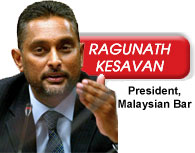
Ragunath Kesavan
President
Malaysian Bar

Jan 28 decision for cop in Kugan case

The Star

PETALING JAYA: The policeman charged with two counts of causing grievous hurt to suspected car thief A. Kugan will know on Jan 28 whether he would be required to defend himself in the case.

Sessions Court judge Aslam Zainuddin fixed the date to deliver his decision at the end of the prosecution stage at the court complex here yesterday.

In the dock is Kons V. Navindran who pleaded not guilty to two charges of causing grievous hurt to 23-year-old Kugan, who died in police custody.

The 28-year-old policeman was alleged to have committed the offences at the interrogation room of the serious crimes branch office at the Taipan police station in USJ, Subang Jaya, at 7am and 4pm on Jan 16 last year.

Kons Navindran, who is attached to the Subang Jaya district police station, was alleged to have caused grievous hurt to Kugan to extort a confession or information, which might lead to the detection of an offence or misconduct.

If found guilty, the father of two could be jailed up to 10 years and fined for each charge under Section 331 of the Penal Code.

Once again, Penang shows the way…

Once again, Penang is showing the way with a week-long fun-filled and educational campaign for greater local democracy.
The events in Local Democracy Week, an initiative arising from Penang Forum 2, are being organised by various Penang-based civil society groups.
Click on the programme below to expand and see if there’s anything in there that might interest you.

For more detailed and up-to-date information on the events, visit the Local Democracy Week blog.

Israel battles deadly forest fire

Israel is battling to put out a blaze that is raging out of control in the Carmel Mountains near the northern town of Haifa, that has killed at least 41 people and injured many others, rescue officials said.

It is the worst fire in the country's history, and officials said on Friday that they are receiving assistance from other countries to battle the blaze.

Local media reported that 36 of the killed were prison guards from Damon jail, a nearby prison, who were caught on their way to rescue inmates from the jail in the fire zone.

After raging for over 24 hours, police and firefighters said the blaze is still not under control and was spreading after destroying over 4,000 hectares of land and forcing the evacuation of more than 13,000 people.

Al Jazeera's Tony Birtley, reporting from Haifa, said that the blaze is spreading in a southeasterly direction, but it was unclear whether the blaze may change direction.

"It's been fanned by strong winds blowing in every direction, so you can't really assess where the real danger is," he said.

Icebreaker

Turkey was amongst the first countries to offer assistance to Israel, laying aside recent diplomatic strains to dispatch two firefighting aircrafts to Israel to help contain the deadly wildfires.

The Israeli and Turkish prime ministers held an ice-breaking telephone conversation on Friday, with Tel Aviv thanking Ankara for sending fire-fighting aircraft to help quell the wildfire.

The chat was the first between Benjamin Netanyahu and Tayyip Erdogan since the Israeli prime minister took office in March 2009.

"I told Erdogan that we appreciate the major efforts during this time and I am sure that this will be a gateway to improving relations between the two countries", Netanyahu said.

In Ankara, a statement said Erdogan had expressed condolences for the 41 Israelis killed in the blaze on Thursday.

"In the face of this disaster it was a humanitarian and Islamic duty for us to help," said Erdogan, adding Turkey would be "ready to make any form of help for the injured".

Greek and Turkish fire-fighting planes flew side by side in Israel on Friday as they dumped water on the flames engulfing woodland near the Israeli port city of Haifa.

However, Erdogan told reporters after his conversation with Netanyahu that Turkey would not fully restore relations before Israel met its demands to apologise and compensate flotilla raid victims, according to Turkey's Anatolian news agency.

"Our demands are clear and these subjects should not be mixed up," Erdogan was quoted as saying.

"We have already said that as long as these demands have not been met, our relations cannot be as they were before."

International help

Meanwhile, firefighting aircraft from four other countries also flew into Israel on Friday to help battle the fire, and more than a dozen countries pledged immediate assistance in response to an urgent personal appeal by Binyamin Netanyahu, the Israeli prime minister.

Five out of seven planes expected to arrive had landed at the Ramat David air base and were preparing to take off to assess the size of the fire and start efforts to distinguish it.

"First we have to take off to go there and see the size of the fire," Captain Nickolas of the Greek air force, told Reuters news agency.

"The operation works like we scooping water from the sea and dropping it into the fire."

Israel, which has a formidable air force, has no firefighting aircraft of its own.

"Israel has never prepared itself in any form for such a need," Netanyahu said. "It was never taken into account.

"We have to stop the fire. It can only be done with the aircraft, we don't have any other means ... We need to bring in more planes."

A plane and a helicopter from Cyprus and two British helicopters have been sent to help fight the enormous blaze from above, while a group of Jordanian firefighters tackled the flames on the ground.

Bulgaria, Russia Egypt, Azerbaijan, Spain, Croatia and France had also offered contributions, with Israel waking up to the fact that it had few effective means of its own to tackle the inferno.

"I think this symbolises an unprecedented response to our request for international help," Netanyahu said after chairing an emergency cabinet meeting in Tel Aviv.

Bulgaria sent 92 firefighters, who were accompanied to the scene by Dimiter Tzantchev, the country's deputy foreign minister.

"We arrived this morning with the governmental aircraft and we have 92 firefighters, experienced people, professionals. These people participated in the operations to fight fires in Russia last summer," he said.

"We are fighting the fire, preventing the expansion of the fire to the houses. One of the teams is staying near a gas station, trying to prevent the expansion of the fire."

'Preventing expansion'

Israel has only 1,500 firefighters, a number widely accepted as inadequate for a country of 7.6 million people.

Major General Nachustan, who is heading co-ordinating international rescue efforts, said he hoped the planes "will be a significant contribution to the fight against the fire".

"These are airplanes that have the capacity which we don't have in this country and we hope to put them into operation very soon."

It was not immediately clear what started the huge fire, but police said on Friday that arson was suspected in two smaller fires that were burning nearby.

Israel has experienced unseasonably hot weather for months and it was the driest November in 60 years.

Source: Al Jazeera and agencies

MIC only interested to score political points and not the welfare of Indian comm

Senator Dr. S.Ramakrishnan,

The recent huge and cry of MIC youth shows its hypocrisy in championing Indian issues. Yayasan Selangor did no better for Indians and Chinese under BN before 2008 and MIC youth did not say anything. But now that Yayasan Selangor is more accountable and transparent, they are criticized for their poor contribution towards non Malays communities. These are the legacies left behind by BN for Pakatan Rakyat to put right.

Yayasan Selangor has a new General legacies left behind by BN for Pakatan Rakyat to put right. Yayasan Selangor has a new General Manager who is willing to offer more loans, scholarships and places to non Malays in residential schools. But to-date the responses from non Malays are weak. Yayasan Selangor needs the support of Indian community leaders to enroll more students in residential schools, loans and scholarships. The political leaders should help enroll more students and not score political points at the expense of Indian community.

MIC youth should stopping politicking and find ways to put in more Indians in these residential schools, loans and scholarships. MIC youth must find out the name of students who did not get the loans or scholarships after applying and highlight their case. The general manager of Yayasan Selangor says the number of students applying is small and even that reduces if the same students get PTPTN loans. Looks like PTPTN loan is more favored by Indian students. More students should apply for Yayasan Selangor loan because if the loan holder gets high points continuously the loan is converted to scholarship. MIC youth and their supporters should take the effort to register more local university students for Yayasan Selangor loan which can be converted into scholarship if the students can maintain high points every year.

Yayasan Selangor also runs residential schools all over Selangor. Standard 6 students who score a minimum 4 A and 1 B can apply for residential school. A student admitted to form 1, will get scholarship all the way to university. This year, out of 1200 students who applied for residential only 9 were Indians and 2 were Chinese. Yayasan Selangor has agreed to extend the closing date for residential schools from today (3/12/2010 to 10/12/2010). More Indian students, who have finished standard 6, should apply to study in residential schools. Application forms for residential schools, loans and scholarships can be down loaded from www.yayasanselangor.org.my website. Parents who apply are kindly requested to keep one copy of the application for referral purpose later. Tamil school headmasters must be more resourceful and show the way to parents. Parents and students who need more information on Yayasan Selangor residential school, loan or scholarship can contact senator S.Ramakrishnan, 03-79541830, fax no 03-79541831, H-6, 2nd floor, Jalan 8/1E, 46050 Petaling Jaya, Selangor Darul Ehsan.

MIC youth and its supporter must go down to the ground find out what exactly is the problem with the community that merely issuing Press statements. Give a helping hand to the needy on the ground and don’t play politics with every issue.

Further fuel and sugar price hikes from tomorrow

Petrol, diesel and LPG will cost more from tomorrow. — Reuters pic
PUTRAJAYA, Dec 3 — The price of fuel and sugar will go up from midnight tonight as part of the Najib administration’s ongoing drive to reduce subsidies, but it is fraught with political risks as he mulls early elections next year.

The price of RON95 will increase by five sen to RM1.90 per litre, diesel by five sen per litre to RM1.80 and liquefied petroleum gas (LPG) by five sen to RM1.90 per kg. Sugar will also cost 20 sen more at RM2.10 per kg.

Through these price hikes, the government expects to save subsidy payments of RM621.9 million on RON95, RM213.2 million on diesel, RM63.5 million on LPG and RM283.5 million on sugar a year, or a total of RM1.18 billion annually.

RON97 will remain on a managed float based on market prices.

This is the second wave of subsidy cuts following the first round of hikes on July 16, when prices went up by five sen per litre for petrol and diesel, 10 sen per kg for LPG and 20 sen per kg for sugar.

Performance Management and Delivery Unit (Pemandu) CEO Datuk Seri Idris Jala said today subsidy rationalisation was needed to bring down government expenditure.

“We are... doing this to make sure that our deficit is reduced. We are a responsible government. We will make sure that we will live within our means,” he said at a media briefing on the latest subsidy cuts.

Also present was Domestic Trade, Co-operatives and Consumerism Minister Datuk Seri Ismail Sabri Yaakob.

“One of the measures to reduce cost is to rationalise our subsidies because Malaysia’s total subsidies are higher than many other countries. Our subsidies are also not targeted at the poor. There’s quite a lot of leakages and abuses.”

The savings will be used to fund rural development, education, urban transport and other areas under the Government Transformation Programme (GTP), he added.

Idris stressed, however, that prices for fuel and sugar in Malaysia will remain one of the lowest in the region even after the subsidy cuts take place.

“Even after we have put this five-sen increase... our selling price for RON95, and also LPG and diesel and sugar, is still lower than Indonesia, lower than Singapore and lower than Thailand,” he said.

The minister in the Prime Minister’s Department was heartened by fair public reception to the last round of subsidy cuts, which he attributed to the government’s success in keeping inflation under three per cent.

“The CPI (consumer price index) increase was very, very small and that is why, when we did this, it was well taken by the public and the public didn’t really feel financially disadvantaged,” he said.

“We are controlling inflation in this country despite the first wave of increases. Because it’s very small increase, we are still able to contain everything so that does not put any burden onto the people.”

Idris said the government would take into account public feedback and the strength of the economy before deciding on when to make further moves to cut subsidies.

He added that renegotiation of independent power producers’ (IPPs) contracts was ongoing but declined to comment on the status.

Gaps tells ruler to ban 'virus' Anwar from S'gor


SHAH ALAM: Irked by Pakatan Rakyat's call to abandon the “ketuanan Melayu” (Malay supremacy) concept, the Gagasan Anti-Penyelewengan Selangor (Gaps) has turned to Selangor Sultan Sharifuddin Idris Shah for help.

Although they aimed to mobilise 2,000 people, only 200 people - led by Gaps chairman Hamidzun Khairuddin- turned up to submit two memorandums to the ruler, which among others called for Opposition Leader Anwar Ibrahim to be banned from the state.

The memorandums were received by palace representative Ahmad Amri.

"We urge the sultan to ban Anwar from entering Selangor. He is the virus behind the hatred and jealousy of the Malays' development and unity. He is also the culprit that breaks the friendship among the Malays," Hamidzun quoted from one of the memorandums.

Gaps also called on the ruler to urge the state government to strip Anwar's post as Selangor's economic adviser.

"Since he has rejected ketuanan Melayu, he deserves to lose the position. Besides, he only wants to use that position for his own political gain. He has not contributed to Selangor," said Hamidzun.

Gaps also urged the Sultan not to award any honorific titles to those who questioned Malay rights.

Meanwhile, the second memorandum contained a list of 30 corruption allegations against the Pakatan Rakyat state government.

Among others, the allegations involved state-owned companies Talam Corporation, PKNS and Yayasan Selangor.

The crowd dispersed peacefully at 3.30pm.

The controversy surrounding ketuanan Melayu started when PKR top leaders, during their party congress last weekend, called for introduction of the ketuanan rakyat (supremacy of the people) instead of ketuanan Melayu, as they claimed that the concept has been abused by Umno leaders for their own political mileage.

Perkasa challenges Anwar


Earlier, Gaps associated members, Malay right wing Perkasa, challenged Anwar to address the Sultan with other titles instead of 'Tuanku' now that he has rejected ketuanan Melayu.

Perkasa Youth chief Arman Azhar Abu Hanifah said 'Tuanku' (His Majesty) is an address that one should uphold if he embraces ketuanan Melayu.

"We believe in the spirit of ketuanan Melayu and he (Anwar) just does not understand it. So we are challenging Anwar to address the Sultan with these names - will he call him 'tuan', 'friend', 'sir' or 'mister'?" said Arman, who was fully clad in Baju Melayu and sampin.

He said no one should question the concept as it has kept the nation in peace and harmony for the past 53 years since independence.

"With this ketuanan Melayu concept, we have also preserved the harmony with other races. Without ketuanan Melayu, the Indians and Chinese and other races will be marginalised.

"Anwar's head is full of ants, that is why he doesn't understand it...if you don't even respect the rulers, don't be a leader in this county," he said, adding that ketuanan Melayu concept is still relevant while stressing that the Malays "love everyone else".

The alleged malpractices

The memorandum on Selangor state government's alleged malpractices listed 30 instances, including as follows:

1. The state government used the people's money to bail out corporate company Talam Corporation worth RM392 million and failed to release a white paper on Talam Corporation's financial situation as promised by Menteri Besar Abdul Khalid Ibrahim.
2. The state government called off the construction of Universiti Teknologi MARA (UiTM) Selangor in Serendah, Hulu Selangor.
3. The state governemnt robbed the people's land under Yayasan Basmi Kemiskinan in Hulu Selangor.
4. The state government closed down skills training institutions for the bumiputera in Institut Kemahiran Yayasan Selangor (IKYS).
5. The state government failed to administrate University Selangor (UNISEL) until it faced a huge loss and significant decline of new intakes.
6. The state government wasted the people's money by spending RM800,000 for Yayasan Selangor 40th anniversary celebration.
7. It failed to manage its sand mining operation, resulting in sand theft and environmental destruction and had fooled the Sultan of Selangor and the people by failing to collect RM150 million for the sale of the sand every year.
8. It failed to manage Kumpulan Semesta Sdn Bhd's (KSSB) finances properly, through the giving of excessive and unreasonable bonuses to its employees.
9. It failed to manage the Menteri Besar's office when a surveillance camera was found in his office.
10. It failed in the administration of PKNS when it needed to pawn off all of its real estate to REIT, resulting in no premise of its own and PKNS needing to rent a building for its operations.
11. PKNS had wasted the people's money by bearing the cost of a celebrity wedding worth RM520,000 and by paying RM2.3 million for implementing telemarketing service. It had also paid RM935,000 to a consultant who only serves for six months.
12. The state government failed to properly manage the water issue in Selangor until it blocked the construction of a tunnel from Pahang which may cause Selangor to experience water shortage by 2014.
13. The state government lied to the people when it tabled a stimulus package worth RM50 billion last year, but we have not seen any impacts from it.
14. The state government has allowed the mosque to be used as a political platform during Friday sermons or religious studies and talks.
15. It has failed in its management of the state's finances leading to a deficit of RM49 million in 2008 and RM66 million in 2009. This figure surpassed RM144 million in 2010. Compare this to the surplus during the BN rule that stood at RM72.5 million in 2006 and RM131.8 million in 2007.
16. It has wasted the people's money by paying RM330,367.96 for the treatment of YB Dr. Cheah Wing Yin at Sunway Medical Centre after his involvement in an accident. Why must he receive treatment in a private hospital knowing the high cost of treatment compared to a government hospital that is of equal standing? This reflects the state government's extravagance.
17. The state government has misused the MB's official letterhead to collect party funds during the cleebration of its 100 day in office.
18. The state government has ignored many of the Sultan Selangor's commands and has caused him great sorrow over the various flaws in the manner the state is run.

NEAC carves out perfect map for M'sia to make quantum leap

PUTRAJAYA: The National Economic Action Council (NEAC) has carved out a perfect map for Malaysia to make the quantum leap into the future and to position itself to counter the cyclical performance of the world market and to realise its goal to emerge as a high-income, sustainable and inclusive nation, says Prime Minister Najib Tun Razak.

"The New Economic Model (NEM) won't be an overnight panacea that can solve all issues. However, it represents a journey that all of us -- the government, the private sector and the people -- must undertake together," he said.

He said the concluding assessment of the NEM by the NEAC would certainly prepare the government to face head-on the challenges towards reforming the country's economy.

The NEAC NEM-Concluding Part has clearly presented a case of a burning platform in spite of the fact that it may seem fine on the surface.

"Of course, there are always skeptics and detractors, but actions and results are the best way to sway them. I want to reaffirm the government's resolute commitment to see through the transformation of Malaysia to become an advanced nation," he said when launching the "New Economic Model for Malaysia-The Concluding Part" here today.

The concluding report released today outlines challenges and requirements needed to transform the economy into an advanced nation, says Najib, who is also Finance Minister.

"The NEAC's economic assessment has identified many areas where improvements must be made if Malaysia is to escape the middle-income trap. Most of these issues are known to the government.

Piecemeal attempts to address them have proven ineffective; hence the need for a concerted and holistic efforts as represented by the Government Tranformation Programme (GTP) and the Economic Transformation Programme (ETP)," he said.

Among concerns raised in the report was the dismal level of investment in innovation and research and development (R&D) which falls far short of the amount required for a country aspiring to become an advanced nation.

He said the country's outdated business regulations and rules have not created an environment conducive to attracting investment and many of the manufacturing businesses remained inward-looking, used low-cost business models and distinct lack of drive and incentives to move up the technological ladder.

The Prime Minister said there are four thrusts under NEM, with the first three dealing with accelerating growth, while the fourth focuses on inclusiveness and social cohesion.

Among the initiatives are the government's plan to reform insolvency laws which include relief provisions for companies and individuals with financial problems.

On the private sector, Najib said one of the NEM's goal was to strengthen Malaysian firms' capacity to make them competitive internationally and succeed independently.

"Their viability depends solely on market terms, without subsidy and with the adherence to international standards and best practices. Without a doubt, companies will have to restructure their operations and business models accordingly," he said.

In coming months, Najib said the government will expedite implementation of the Economic Transformation Programme (ETP), with the Performance Management and Delivery Unit (Pemandu) keeping track on the progress.

- Bernama

Abu Sayyaf 'claim' another victim at high sea

By Ivan Ho - Free Malaysia Today

LAHAD DATU: Police here are investigating yet another armed robbery at sea allegedly involving members of the notorious Abu Sayyaf terrorist group from Southern Philipines.

In the incident off Lahad Datu - in the east coast fo Sabah - six armed men in a high-speed boat boarded a Malaysian flagged vessel and made off with equipment and fuel.

The tug boat from Tawau belonging to Syarikat One Up Sdn Bhd, was pulling a scow loaded with 1,700 metric tonne of lumber on its way to Sandakan.

According to sources, a group of six armed men opened fire on the tug boat forcing it to stop at Tambisan water off Tungku near here on last Saturday afternoon at around 2.30pm.

Boasting that they are members of the notorious Abu Sayyaf terrorist group, the group armed with two M16 rifles and four semi automatic hand guns fired a warning shot into the air before letting loose a fusillade of shots at the tug boat when it did not stop.

The skipper of the tug boat finally stopped when bullets started whizzing by the crew and hit the tug boat's engines and propellers.

Five of the pirates then boarded the boat and robbed the skipper and his four sailors, all Indonesian Bugis with Malaysian work permits, of cash and cellphones.

They also took away a global positioning System (GPS) devise, seven thousand litres of diesel, six batteries and several cooking gas cylinders.

A crew member revealed that one of the men told them laughingly in fluent Malay: "Terima Kasih, kami akan datang lagi malam ini" (thank you, we will return tonight).

Investigations underway

With no communication tools, fuel or GPS devise the stranded crew drifted for an hour before a passing boat towed them to Tambisan.

They lodged a police report at the the Cendera Kasih police station in the Felda settlement.

Both the boat and the scow are still docked at the Tambisan’s jetty.

Lahad Datu District police chief, Supt Shumsuddin Bin Mat confirmed police had received an official report concerning the "pirate attack" but declined to elaborate and requested the media not to highlight the incident till police had completed their investigations.

It is learnt that the marine police dispatched a patrol boat to the scene and the navy had also been called to assist tighten security in the area.

Meawnhile newly appointed Sabah Commissioner of Police, Hamsa Taip when contacted declined to comment citing the possibility of involvement of members of a terrorist group from Southern Philippines.

Sabah police are believed to be seeking the assistance of Philippine security forces following the attack.

The attack comes almost 10 months after the yet-to-be solved kidnapping incident at Sebangkat Island in Semporna where five armed men kidnapped businessmen Tsen Vui Chung, 41, and Lai Wing Chau, 33, on Feb 8.

Daulat Tuanku!

Tunku Abdul Aziz, Sin Chew

In an article I wrote recently, Rulers for all Malaysians, I had suggested, in a spirit of helpfulness, that their highnesses the rulers should drop the word “Malay” and instead use the more commonly understood title Sultan, for example, of Selangor or Sultan of Kedah as the case may be.

Continuing to describe themselves as Malay Rulers at a time when inclusiveness is what is required as part of the process of integrating our disparate community of races seems to be a little perverse.

His Highness the Sultan of Selangor, in decrying the suggestion I had made in my article, has, I fear, got the wrong end of the stick. Even a cursory reading of the article will show that the position of their highnesses in the constitutional arrangements of our nation remains inviolate, and Malaysians do not want it any other way.

We recognise the crucial importance of stability in the life of a nation. Stability is inherent in the system of constitutional monarchy. Rulers in today’s terms must be forward looking and open to ideas. It is no longer appropriate, at the drop of the hat, to invoke the divine rights of kings, used in the past by kings and emperors the world over, to legitimise absolutism. Nothing in the nature of things is permanent and if we cannot adjust to change, we are doomed to extinction.

Of course, we respect the institution of rulers because we respect our Constitution. We believe the institution represents all that is noble; the fountain of honour and justice for all. It would be senseless to replace an institution that has worked well.

The post-Hindu Kedah Sultanate, for example, goes back to 1136, making it arguably the oldest ruling house in the world. This is history, not fiction. It has survived to this day because it has changed with the times. There will always be a role for relevant institutions, and we have opted for a system of constitutional rulers instead of other forms of government. That we will always protect.

The Sultan of Selangor has been less than fair to suggest that I am less Malay for submitting, humbly, that the term “Malay Rulers” be dropped altogether and refer to themselves as sultans. I know this could give rise to some confusion because there are Mamaks who use “Sultan” as part of their names.

We want our Rulers to identify themselves with all Malaysians and for all Malaysians to accept that our Rulers are their Rulers as well and, in this way hope that they will learn to embrace and understand the system employed in governing this, their country. The position of the Rulers will be greatly enhanced.

I am proud Malay, as proud as the next, in fact, prouder than most because I can trace my genealogy, in an unbroken line of recorded history, spanning a thousand years. I am not a Malay come lately.

History is important, but I do not let it stand in the way of my concern for national unity. The Malays must not allow the notion of Malayness blind themselves to the demands of the new social, political and economic reality. We and our Rulers will always have an important role to play in the future development of this country, but it will have to be a role we will share with the other citizens of Malaysia.

I have lived long enough to understand, though I do not always agree, with the basis of the Malay suspicion of the so-called non-Malay, particularly, the Chinese agenda. They point out that while the non-Malays are as quick as a flash claiming their rights, they drag their feet when it comes to fulfilling their duties and responsibilities.

Generalisations breed irrationalism and distort our sense of justice and fair play. These are long-held views, and sadly have become dangerous combustible tinder that, if not stopped, and allowed to ignite, could engulf this nation we are all trying to build, in flames of irreversible destruction to benefit only those on the lunatic fringe.

Not working toward a common goal grounded in fairness and equal opportunity is not an option for Malaysians of all racial and cultural stripes. In this great Malaysian endeavour, all of us have to subordinate our prejudices, often born of ignorance, in the greater interests of a Malaysia that offers a rightful place for all. The Rulers who are natural leaders have a particularly important role to play.

Daulat Tuanku!

One man’s lie is another man’s fact


But are Chin Peng and Lee Kuan Yew mentioned in this context? They were significant players in the creation of Malaya and later, Malaysia. What we read is about Umno this and Umno that. We are told that Malaya gained independence and Malaysia was later created because of Umno.

NO HOLDS BARRED

Raja Petra Kamarudin

Malaysian students abroad told to be wary of media spinning

(Bernama) - Tan Sri Muhyiddin Yassin today advised Malaysian students abroad to be wary of some Malaysian media that are inclined to spinning news stories and spreading lies.

"I ask that the students understand the situation to prevent themselves from being influenced by the news spins and lies," he told a press conference after a dialogue with a group of Malaysian student leaders from throughout Indonesia, here, today.

Muhyiddin, who is on a four-day working visit to Indonesia since yesterday, was responding to the student leaders' call for the Malaysian media to be truthful and transparent in their news reports.

"I explained that the media was very influential, and while there were media which were supportive of the government, there were others that belonged to the opposition or were pro-opposition, with some of them good at spinning stories," he said.

Also present at the dialogue were Malaysian ambassador to Indonesia Datuk Syed Munshe Afdzaruddin Syed Hassan and director of the Malaysian Students Department in Indonesia, Datuk Dr Junaidy Abu Bakar.

The deputy prime minister agreed that a seminar on the 1Malaysia concept be organised for the Malaysian students in Indonesia and other Malaysians in Jakarta so that they would understand the concept better.

He said experts on the concept could be invited to give talks and interact with the seminar participants here.

Muhyiddin said the Malaysian student leaders also expressed their support for the government's decision to abolish the Penilaian Menengah Rendah (PMR) examination, but wanted the school-based assessment system that would replace the PMR, to be a sound and viable one.

****************************************

It is certainly sound advice that Deputy Prime Minister Muhyiddin Yassin gave to Malaysian students overseas. History as taught in Malaysian schools in the 1950s and 1960s was very different from the history being taught today.

The history that I learned in the Alice Smith School in Kuala Lumpur starts from 1066. I had to research on my own the history of 55 BC when the Romans under Emperor Claudius unsuccessfully invaded England and were sent packing back to Rome with their tails between their legs. The general who suffered this most humiliating defeat was none other than Julius Caesar himself who later on became Emperor of Rome.

It was not until almost 100 years later that the Romans managed to tame England -- but then only stayed for about 367 years before they decided to call it quits and abandon England’s shores for good.

The Romans could not bear the extremely cold English weather and extremely hot resistance from the Britons who never allowed the Romans one bit of peace. England, of course, was thereafter invaded by many regional powers such as the Vikings and the political boundaries of Great Britain were redrawn many times over those 600 years before the Norman invasion of 1066.

For some time England was ruled by France and there were occasions when the English king spoke only French. In fact, the language of the English court at that time was French and not English.

There is no longer any such thing as an Englishman. The term Englishman is a misnomer. What would you regard as an Englishman? For 2,000 years England had been occupied by one power or another, and at times many powers at the same time. The blood of the Englishman has been ‘contaminated’ by almost every known Caucasian.

In short, the Englishman jati (pure) is a fallacy and does not exist.

That is how I have understood history. And that was what we were taught in school back in the 1950s and 1960s.

Malaysian history, however, starts from 1946, the year Umno was born. And Malaysian students are taught that Umno fought for independence. They are also taught that the British tried to undermine the Raja-Raja Melayu (Malay Rulers) by introducing the Malay Union. In speeches by Umno leaders we are even told that the Rulers ‘sold out’ to the British and if not for Umno, who defended the Rulers, the Malay Rulers would no longer exist today.

Some try to downplay the ‘treacherous act’ of the Rulers by saying that the British tricked the Rulers into agreeing to the Malayan Union and it was Umno who pressured the Rulers to abort the plan. Without Umno the Rulers would have kowtowed to the British and would have lost all their powers.

In short, the Rulers had to be saved from themselves and it was Umno that had saved them.

Yes, there are much lies and spinning, as Muhyiddin said. Malaysians are not being taught real history. They are being taught Umno’s version of history. So what Muhyiddin said is true: Malaysians overseas must be careful of these lies and spins.

But it is the lies and spins of Umno that Malaysians must be careful of. What we are being told is not what really happened. Sure, Umno did send a delegation to meet the British to oppose the Malayan Union. But who were these so-called ‘Umno people’?

They were not the rakyat. The rakyat did not care. They were not concerned. In fact, they were not even aware about what was going on.

Those who went to meet the British were the orang istana or people from the royal court, the palace people. Is it any wonder that they all had Raja or Datuk in front of their names? In fact, Umno was ‘born’ in the palace of the Sultan of Johor. For all intents and purposes it was a ‘royal effort’.

So dispel all this talk about the Rulers selling out to the British and that Umno, a party of the rakyat, saved the Rulers who had agreed to the Malayan Union due to their ignorance. Many of the royalty then were well educated and were more English than the Englishman. I remember my grandfather speaking just like Winston Churchill. How more English than that can you be?

The British, then, were good at what they called ‘gunboat diplomacy’. They ‘persuaded’ foreign leaders to agree to the terms of His Majesty’s government with a gun at the head. Did they not use the same tactics on the Chinese Emperor to gain Hong Kong?

Umno, at that time, were not seeking Merdeka. They only wanted the British to abandon the Malayan Union and opt for a Federation of Malaya, which eventually did happen two years later. It was MCA that first broached the subject of Merdeka.

The British, of course, would not talk to MCA unless the Malays too were in the equation. The MIC at that time did not bother about Merdeka. MIC was a communist party that was more concerned with independence for India. Malaya was not their home. India was.

It was not until the Communist Party of Malaya (CPM) stepped up the insurgency -- which resulted in the British declaring the Malayan Emergency -- that the British decided it would be prudent to allow Malaya self-rule. Many would not agree with me, of course, but I would dare say that Chin Peng accelerated Merdeka. If not, Malaya would have gained independence much later than 1957.

In fact, Malaysia too came about because of the Communists. Lee Kuan Yew was one smart cookie. He made a deal with the CPM who swept half the seats in the Singapore elections. This frightened the British who saw Singapore falling to the Communists.

Lee Kuan Yew told the British that the only way to stop the march of the Communists was to give Singapore independence so that, together with Sabah and Sarawak, it could form a new country with Malaya that would be called Malaysia. Singapore, on its own, would fall to the Communists. As part of Malaysia the Communists could be stopped.

So, while Chin Peng accelerated Merdeka, Lee Kuan Yew ‘convinced’ the British to give independence to Singapore so that it could join Malaya to form Malaysia. Of course, Singapore was not really interested in being part of Malaysia. It just wanted independence. And not long after that it left Malaysia to become an independent Republic of Singapore, which was what Lee Kuan Yew really wanted.

Lee Kuan Yew then got rid of the Communists by detaining them all without trial. He had used them to frighten the British and now no longer had any use for them. So he rounded them up and locked them away for a long time, the sneaky bugger.

But are Chin Peng and Lee Kuan Yew mentioned in this context? They were significant players in the creation of Malaya and later, Malaysia. What we read is about Umno this and Umno that. We are told that Malaya gained independence and Malaysia was later created because of Umno.

These are the lies and spins that Malaysians overseas and at home must be wary of. The history you are being taught is not the real history. What I have just related is the real history. But rest assured not a single Umno member would admit this. They are too ashamed to admit it. By admitting this they would be admitting that Umno is not really the hero that they pretend to be.

Anwar to be suspended without his defence heard

By Hafiz Yatim | Malaysiakini
Dec 3, 10

Opposition leader Anwar Ibrahim today accused Parliament’s rights and privileges committee of pushing for his suspension without hearing his defence on his allegations about US-based consultancy Apco.

Bukit Gelugor MP Karpal Singh, who is a member of the powerful committee, said today’s meeting was called without any fixed agenda.

Karpal said the committee members were given a letter from Apco, dated Aug 19, at the meeting.

“Suddenly, Muar MP Razali Ibrahim moved a motion that the matter be heard and the motion was seconded by Alor Gajah MP Dr Fong Chan Onn,” he said.

“R Sivarasa (Subang Jaya MP) was also there, and we protested against the hearing of the matter. I questioned the hurry, and Razali asked, ‘why not?’,” added Karpal.

Following this, Karpal said that he and Sivarasa walked out of the meeting in protest.

“The meeting went on without our presence,” he said. Karpal and Sivarasa said they had no idea what transpired at the meeting after they left.

Anwar: Decision is totally outrageous

Anwar, who was also present at the press conference, described the process as “totally outrageous”.

“When I was referred to the committee, the speaker had promised a proper hearing where documents will be presented, and I will be able to defend myself,” he said.

“However, this is not being done. This is unfair, and a black mark in Parliament’s history,” he added.

He showed the Parliament Hansard dated April 22, where Ipoh Timor MP Lim Kit Siang had raised the issue, and the speaker Pandikar Amin Mulia’s (left) reply which stated the rights and privileges committee will call whomever witness to testify and important documents will be tabled.

“We will call anyone who is needed and documents wil be tabled. The committee will then make its recommendation and decide on the proper punishment,” Pandikar was quoted as saying.

Anwar’s lawyer, Ambiga Sreenevasam (right), said the Parliament had acted against the rule of natural justice by having the rights and privileges committee meet without calling Anwar.

“This has never happened before in courts where a person is at least given his right to defend himself, but this was not done,” she said.

Anwar said if he was to be called he had prepared his defence, showing the file which he had with him.

“I have all the evidence to rebut all the allegations and denial but I was not given the right to defend myself.

“They are merely taking the words from a document (Apco) and not from other witnesses including me. This is truly unfair and undemocratic and violates the rules of natural justice,” he said.

Despite the adversities he faced, the Permatang Pauh MP is prepared to face the music when parliament resumes on Monday.

The powerful rights and privileges committee, which is tasked to discuss the 1Malaysia and One Israel issue, comprised of House speaker Pandikar Amin, deputy speaker Ronald Kiandee, Karpal Singh, Sivarasa, Nancy Shukri, Dr Fong Chan Onn and Razali Ibrahim.

Committee had made a decision

When contacted later, Pandikar Amin, who chaired today’s meeting, said that the committee had made a decision.

However, he declined to reveal its decision and said the matter will be finalised on Wednesday.

The decision will then be tabled to Parliament for further action.

Anwar was also asked whether such actions directed to prevent him from coming to Parliament are signs that the general election is approaching, and to this Karpal responded he believed it is so.

“Such a move done by the committee is unwarranted,” he said, adding that despite being faced with the prospect of suspension Anwar was still eligible to contest.

“This does not affect his rights but it will only hinder Anwar’s presence in Parliament if he is suspended,” he said.

——-

Anwar barred from testifying over APCO accusation
By Adib Zalkapli | The Malaysian Insider
December 03, 2010

PETALING JAYA, Dec 3 — Opposition Leader Datuk Seri Anwar Ibrahim will not be allowed to testify over his remarks linking Datuk Seri Najib Razak’s 1 Malaysia to One Israel, Parliament’s Rights and Privileges Committee decided today.

The committee’s decision was seen as an attempt to hasten Anwar’s suspension from Parliament, said DAP chairman Karpal Singh (picture) today.

The Bukit Gelugor MP said the powerful committee decided to rely solely on a letter from public relation consultancy APCO and not to call other witnesses and Anwar to testify.

The decision prompted Karpal and Subang MP R. Sivarasa to leave the committee meeting.

“Me and Siva have no alternative but to withdraw,” Karpal told a press conference.

He also complained that APCO’s letter, which he refused to disclose, was only submitted to the committee this morning.

The powerful committee is chaired by Speaker Tan Sri Pandikar Amin Mulia. Karpal and Sivarasa are the only opposition MPs in the committee. The other members are Deputy Speaker Datuk Ronald Kiandee, Muar MP Datuk Razali Ibrahim, Alor Gajah MP Datuk Seri Dr Fong Chan Onn and Batang Sadong MP Nancy Shukri.

“In my view the Rights and Privileges Committee has abdicated from its responsibilities,” said Karpal.

He revealed that Razali suggested that the committee continue its proceedings without calling witnesses or Anwar to testify, and this was supported by Fong.

“The issue needs to be investigated, cannot be based on a letter and without calling witnesses and not allowing Anwar to testify,” said Sivarasa.

“Given what has happened, we can expect the impending punishment,” he added.

Meanwhile, Anwar described the decision today contradicted Pandikar’s assurance when allowing the motion to refer him to the committee.

“The Speaker had given an assurance that when an MP is referred to the committee, the member would be called to testify,” said Anwar.

“APCO is very powerful that one letter can overturn all our testimonies,” he added.

The Malaysian Insider had reported last month that Anwar would likely be suspended from December 15 following recommendation from the Rights and Privileges Committee for his remarks linking the Najib’s 1 Malaysia to former Israel Prime Minister Ehud Barak’s One Israel.

The move is believed to be a strategic attempt by the ruling BN coalition to throw the opposition momentarily off guard ahead of an expected general election, believed likely to be held in the first quarter of next year.

It is also believed to be a form of reprisal by the federal government after similar moves by Pakatan Rakyat administrations in Selangor and Penang to suspend BN opposition leaders from their state assemblies.

Anwar had initially been summoned to face the House committee on June 8 after he claimed that the supposedly Israeli-linked APCO Worldwide employed by the Najib administration was behind both the 1 Malaysia and One Israel concepts.

His remarks had dominated the previous parliamentary session earlier this year and had been used incessantly by opposition leaders as campaign fodder during the Hulu Selangor and Sibu by-elections.

Anwar’s hearing before the committee was, however, put off when the leader insisted on being accompanied by legal counsel — former Bar Council president Datuk Ambiga Sreenivasan.

He was later allowed to be accompanied by Ambiga under strict instructions that the latter would not be allowed to speak during the proceedings.

Despite this, Anwar’s hearing was put off and the matter had not been raised until this morning.

Any decision made by the Rights and Privileges Committee is subject to the endorsement of the Dewan Rakyat.

Ahmad Maslan Challenges Anwar To Step Down As Opposition Leader

BERUAS, Dec 3 (Bernama) -- Umno Information Chief Datuk Ahmad Maslan Friday challenged Datuk Seri Anwar Ibrahim to step down as the opposition leader since Parti Keadilan Rakyat (PKR) has lost six seats since the March 2008 General Election.

He said Anwar was appointed the opposition leader after PKR had won 30 seats in the general election compared with 29 by DAP, 23 seats by PAS while PSM won a single seat during the general election.

"During that period, PKR had the majority, so naturally Anwar who was the PKR adviser, was appointed the leader...but now PKR has lost its majority and has only 24 seats after five PKR lawmakers left the party and one seat was lost in Hulu Selangor.

"By right, the opposition leader should now be Lim Kit Siang and Anwar must offer that position as soon as possible to show that he was sincere in the PKR-DAP-PAS coalition," he told reporters after opening a Premier Forum organised by Beruas Umno Division at Kampung Banjar here Friday.

Ahmad Maslan said through such an initiative, Anwar can show his sincerity, fairness and integrity.

He added that Anwar's statement that he would appoint Lim as the Deputy Prime Minister if the Pakatan Rakyat took over the Federal government, was just a political ploy.

Palanivel To Become Eighth MIC President Next Week

KUALA LUMPUR, Dec 3 (Bernama) -- Datuk G. Palanivel is set to take over the MIC leadership from Datuk Seri S. Samy Vellu next week, making him the eighth president in the party's 64-year history.

Samy Vellu who has helmed the party for almost 31 years, is set to hand over the reins to Palanivel after the party's Central Working Committee (CWC) meeting on Monday.

"It's either going to be on Monday or at a special handing over ceremony on Tuesday," a party insider told Bernama on Friday.

MIC vice-president and Human Resources Minister Datuk Dr S. Subramaniam would assume the number two post, he said.

Palanivel, 61, the Deputy Minister of Plantation Industries and Commodities, had been informed of the transition, and was preparing himself to take over the number one post, he said.

Samy Vellu is expected to brief Palanivel on party affairs and give him access to all important party documents either on Monday or Tuesday, the party insider said.

Palanivel, a former editor with Bernama, takes over the MIC at a time when the country is preparing for a possible snap poll, which political observers predicted could be early next year.

The former press secretary to Samy Vellu -- the Works Minister from 1979 to March 2008 -- would be faced with the task of remaking the party in time to face the 13th general election.

The MIC was only three years old when Palanivel was born. At that time, the party was helmed by Budh Singh, who led the MIC from 1947-1950, after which the presidency was assumed by K. Ramanathan for less than a year.

The first MIC president was John A. Thivy from 1946-1947. After Ramanathan, the party was helmed by K.L. Devaser who became MIC's fourth president.

The fifth and sixth presidents were Tun V.T. Sambanthan and Tan Sri V. Manickavasagam.

The first four presidents had only ruled the MIC for a short period (less than three years) while Sambanthan presided over the party for 18 years (1955-1973).

Manickavasagam served for six years.

The seventh and current president, Samy Vellu, still holds the record as the longest-serving president, exactly 31 years since 1979.

Palanivel will assume the presidency from Samy Vellu upon which the MIC will hold its triennial presidential election either in March or April 2012.

Amend Constitution To Allow Orang Asli To Enjoy Privileges - UPKO

PENAMPANG, Dec 3 (Bernama) -- The United Pasokmomogun Kadazandusun Murut Organisation (Upko) has called on the Barisan Nasional (BN) government to amend the Federal Constitution to enable the Orang Asli, alongside the Malays and the natives of Sabah and Sarawak, to enjoy special privileges.

Upko president Tan Sri Bernard Dompok said under Article 153 of the Federal Constitution, there was a clear reference to the special privileges of the Malays and the natives of Sabah and Sarawak but there was no mention of the Orang Asli.

"It is a gross oversight by those who drafted the constitution. I feel that the BN government, when it obtains a two-third majority in the Dewan Rakyat, should table an amendment to the Federal Constitution for this purpose," he said in his keynote address when opening the Upko national convention at the Sabah Cultural Centre, on Friday.

On the issue of "Ketuanan" (supremacy), Dompok said it was a word that should not exist anymore.

"In Sabah the last 'tuan' left in 1963 and in fact in the peninsula, they should have left in 1957."

"Some have attempted to explain that the word does not have any connotation of racial superiority or claiming to be superior. Yet others have attempted to explain it away by saying that it refers to the position of the sultans and the rulers," he said.

Dompok said the explanation was unsatisfactory because the rulers' position as constitutional monarchs "must certainly mean they are rulers for all Malaysians and must therefore safeguards the rights of all the races in this country."

"That's why this party must support all the more the 1Malaysia policy which the Prime Minister (Datuk Seri Najib Tun Razak) has initiated," he said.

Touching on the civil service in the country, Dompok said it was necessary for the government to look into it to ensure that "the colours of Malaysia" were reflected in the appointment of officers at all levels of administration.

"It has to be a civil service that should see that Orang Asli and the natives of Sabah and Sarawak working hand in hand with the Malays, Indians and Chinese to man the delivery system of this country.

"There may of course be a difference in the manpower provided by each community since population sizes vary. But the service must be a 1Malaysia civil service," he said.

EU-Malaysia FTA: ‘Trade invaders’

By Anil Netto


Negotiations between the Malaysia and the European Union for a free trade agreement (FTA) are expected to begin in Brussels next week. But most Malaysians are being left in the dark about what this means for Malaysia while Parliament is not even looking at this seriously.
The way I see it, the EU-Malaysia FTA aims to prise open the Malaysian market for large European firms – in the same way that these firms are eyeing the vast Indian market under the EU-India FTA and the Asean market under the EU-Asean FTA. That’s the main agenda of Corporate Europe.
These large European firms or BusinessEurope are working very closely with EU Commission negotiators to secure the best possible outcome for themselves. What are they looking for? We can get a pretty good idea of what they want by looking at the negotiations for the EU-India FTA.
One of the main concerns is that the manufacture and export of affordable generic medicine by India could be affected, and there would be less control over exports of raw materials from India and imports of subsidised European agricultural produce into India.
Thanks to the good folks at Corporate Europe Observatory and India FDI Watch, we know this is what Big Business in Europe is looking for:
Full liberalisation of trade in industrial goods:
total elimination of import tariffs for all industrial goods within seven years and no possibility of excluding certain sensitive products from tariff cuts. Longer time frames for these cuts should only be possible for a very limited number of sensitive products.
Nearly full liberalisation of trade in agricultural products
elimination of agricultural import tariffs with only a few exceptions for sensitive products that might be exempt from liberalisation or liberalised to a lesser extent. Tariffs for processed food and beverages, however, should be reduced to zero.
Dismantling all regulations on investments by EU companies in India:
there should be no limits to foreign ownership for European banks, insurance and telecom companies. Sectors that are completely or relatively closed to foreign investors such as retail, accounting, legal and postal services should be opened up to European multinationals, the unlimited transfer of their profits guaranteed and limits on risky forms of investment eliminated.
Protection for European investments, particularly against all forms of expropriation.
Liberalisation of trade in services
European companies want a less regulated services market in fields such as research, insurance, banking, telecommunications and maritime transport. This includes the liberalisation of risky and highly speculative financial instruments.
A ban on export taxes and other export restrictions
to secure unhampered access to manufacturing inputs for European industries, India should abstain from export restrictions on raw materials such as rice, cotton, leather, rare earth, paper, wood products and metals that the country has used strategically to encourage infant industries or for reasons of price stability.
The protection of intellectual property rights (IPRs) beyond what is required under WTO rules
this includes ´data exclusivity‘ for a minimum period of 10 years, to strengthen the monopoly rights of pharmaceutical and agrochemical companies. It also includes an army of IPR enforcement measures ranging from at the border measures against potentially counterfeit goods to “cleaning up any street market that sells pirated European goods” (EuroCommerce).
An ambitious government procurement chapter:
This would enable European companies to bid for public contracts in sectors such as energy infrastructure, water treatment, healthcare, transport or construction.
The elimination of regulatory (´non-tariff‘) barriers (NTBs) that hamper market access for European exporters. This includes a demand for regulatory transparency, information on any proposed new regulation in India long before it is implemented and ´consultation mechanisms‘ through which European corporate interests can provide comments and input.
The facilitation of the migration of key personnel for both industry and services subsidiaries: the mutual recognition of professional qualifications is key.
Strong and rapid dispute settlement mechanisms: this also includes so called investor-to-state provisions that would allow European companies to directly sue India at international tribunals when they feel that their investment or profits are being jeopardised.
Intense cooperation between business and the Commission
the Commission should “closely involve industry, keeping it regularly updated throughout the FTA negotiation process, from preliminary consultations and the launch of the talks through to the completion of the final agreement” (European Tyre and Rubber Manufacturers Association).
Because Big Business in Europe is working closely with the EU, their demands are likely to be close to the EU negotiators’ position, which is (going by the experience in India):
IPR
Go beyond TRIPS standards: “This chapter shall complement and further specify the rights and obligations between the Parties beyond those under the TRIPS Agreement” (art. 8.1)
  • introduction of data exclusivity in India (art. 18)
  • extent patents from the standard 20 to up to 25 years (art. 17.3)
  • border protection provisions that allow the seizure of products suspected of infringing IPRs at the Indian border (art. 36)
  • training of personnel for the enforcement of IPRs (art. 38)136
Tariffs
  • Elimination of more than 90% of tariffs on manufactured and agricultural products within 7 years; aiming at tariff liberalisation for all industrial products
  • Zero tariffs on chemicals, textiles and probably also dairy, automotives, processed food and beverages
  • Less radical liberalisation commitments for a limited list of sensitive agricultural products
Services and investment
“far reaching liberalisation of services and investment”
  • emphasis on the following sectors: banking,insurance, retail, accounting, legal and postal services…
  • full liberalisation of capital movements
  • no limits on risky forms of investment
  • Maximum protection for EU investors
  • Investor-to-state provisions that allow companies to directly sue India through international tribunals
Government procurement
“progressive liberalisation of procurement markets at national, regional, and, where appropriate, local levels; as well as in the field of public utilities”
“gradual market access on the basis of the principles of non-discrimination and national treatment”
Access to raw materials
prohibit export taxes and other export restrictions
Given the disparity in negotiating strength, expertise and resources, Malaysian negotiators are likely to be no match for the EU’s. Worse, the Malaysian public has no idea what they are in for.
The likes of Tesco, Carrefour and heavyweight European banks (those that are still solvent, that is!), hotels and financial institutions could be setting up shop in the region while subsidised EU agricultural produce may end up flooding our domestic market. All these could severely affect local businesses, the domestic economy and ultimately, the Malaysian people.

Why was there no protest at the Shah Alam mosque today?

So, it looks like no protest materialised at the Shah Alam mosque today.
There are at least 2 possiblities:
1. The information received was true, but when details were exposed on Twitter and elsewhere, the organisers started to get intimidated by the immense pressure and backlash, and decided to cancel the protest.
2. The rumour was unfounded, and there were no such plans afoot to begin with.
At time of writing, I cannot say which of these (if either) are true.
I do accept responsibility as being one of the first few to suggest that this was happening. This information did not originate from me, and was forwarded by others, but I found the sources credible, the story more than plausible, and in my judgment, the likelihood of it being true high.
Again, I cannot say for sure at this point whether the lack of any protest materialising was a result of elements within Syabas making a U-Turn on their plans or whether there were no such plans in the first place.
I think there has been far too much blind partisanship and refusal to admit mistakes – potential or confirmed – in Malaysia today, and I should like to try and do what little is in my power to do to buck this trend.
I hope you will not consider compromised the credibility of others who may have acted on this information as a result of my/our judgment.
If it is proven conclusively that there were indeed no such plans, my humble apologies to one and all. In the meantime, let’s wait and see what other information comes to light.
My feelings about Syabas and their piratisation of the water industry remain unchanged.