Share |

Thursday, 21 October 2010

No more blanket support for Pakatan, says Hindraf

By Athi Shankar - Free Malaysia Today

GEORGE TOWN: Unlike in 2008, Pakatan Rakyat cannot expect anymore “free lunches” from the Human Rights Party (HRP)and its axis, Hindraf Makkal Sakti.

Hindraf legal adviser and HRP secretary-general P Uthayakumar insisted that his group was committed to democratically ending the Umno-Barisan Nasional 53-year federal rule in the next election.

“But no blank cheque support this time for Pakatan to Putrajaya,” he said in a statement here today.

In the last general election, he said 90% of ethnic Indian voters backed PKR, DAP and PAS in response to Hindraf’s call for a new political direction.

He said ethnic Indians naturally would have high expectations of PKR, DAP and PAS, especially in the Pakatan-ruled states.

He said the Pakatan trio capitalised on the political awakening created by Hindraf’s Nov 25 rally and won 82 parliamentary and some 200 state seats.

The coalition also captured Selangor, Penang, Kedah and Perak (which it later lost to BN via defections), besides retaining PAS home turf – Kelantan.

“But after having made full use of the Indian voters, Pakatan dumped them like sucked oranges,” said Uthayakumar, a former ISA detainee.

He claimed that 100,000 poor Indians would not have gone to the streets on Nov 25 if only PKR, DAP and PAS had spoken up for them.

Political passion lacking

Uthayakumar said land for Tamil schools and Hindu temples, and education opportunities for qualified ethnic Indian students were among current pressing issues that never attracted Pakatan’s attention.

He said Pakatan leaders, including 11 ethnic Indian MPs, lacked the political passion and vibrancy to champion the ethnic Indian community in the country.

He said land matters were exclusively under the purview of the menteri besars in Selangor and Kedah, and chief minister in Penang.

But, he said despite two and half years of ruling these states, Pakatan has denied land for Hindu temples, burial grounds, Tamil schools and Indian villages even when it would be at no cost.

“Pakatan could have given permanent solution to long-standing problems faced by the Indian poor all in one go.

“But the coalition failed to seize the opportunity. Where is the promised change then?

“How is the supposedly multi-racial top leadership of PKR-DAP-PAS any different from the Umno-led regime?” asked the outspoken human rights advocate.

Uthayakumar recalled that there was never an instance when the Pakatan parliamentarians, including the ethnic Indian MPs, had walked out or tabled an emergency motion on a critical and pressing Indian problem.

“Why is that Pakatan MPs have refused to seriously debate in Parliament the denial of tertiary education and scholarships for some 2, 237 top and high achieving Indian students?

“(Is is because of) fear of losing Malay votes and wanting to be seen politically correct?” he asked.

Not multi-racial enough

Uthayakumar said the top leaders in Pakatan have refused to address scores of pressing Indian problems in the coalition-ruled states.

He chided the PKR, DAP and PAS top leadership for side-tracking the critical Indian problems and engaging their ethnic Indian so-called leaders to attack Hindraf-HRP.

“It’s an open secret that DAP, PKR and PAS are not multi-racial enough to speak up for the Indian poor.

“It’s because PKR, DAP and PAS have blatantly ignored the problems of the Indian poor that HRP has been forced into existence,” he said.

He also recalled that PKR refused to make way for a HRP candidate in Hulu Selangor by-election even though the candidate would have a better chance of winning.

He said even though MIC was virtually wiped out in the last election, Umno not only gave way but bent backwards to support and ensure MIC’s win in the Hulu Selangor by-election, which had a mere 19% Indian voters but 53.9% Malay electorate.

But, he said, the multi-racial outfit of PKR not only refused to make way for HRP but wanted to be seen as a more Malay party than Umno-fielded Malay candidate.

“This was silently watched by the Malaysian Malaysia DAP and PAS,” said Uthayakumar.

Thus, he said the Indian poor had been denied one lone “HRP” voice in Parliament, while the rest of Pakatan MPs, including PKR supremo Anwar Ibrahim, Lim Kit Siang (DAP) and Hadi Awang (PAS) continued to refuse to champion pressing Indian problems.

Indian candidates dumped

Pakatan's choice of a non-Indian candidate in Hulu Selangor was not the first time PKR, DAP and PAS have dumped potential Indian candidates.

He said PKR, for instance, had chosen only ethnic Malay candidates in traditionally Indian reserved seats as they do not form a majority in any of the 222 Parliament or 576 state seats.

He recalled that PKR had always snatched away traditional Indian seats in the general elections of 1999, 2004 and 2008 and by-elections in Teluk Kemang, Lunas and Ijok.

Going by Pakatan’s multi-racialism, he argued that Indian candidates should have been fielded in Permatang Pauh (PKR), Bukit Gantang (PAS) and Ketari (DAP).

“But Pakatan brand of multi-racialism does not work this way,” he said.

Instead, he said Hindraf-HRP was accused of being racist for questioning both Umno, PKR, DAP and PAS' acts of racism by commission and omission.

He claimed that Pakatan's top leadership did not want to give HRP even the lone voice in Parliament because PKR, DAP and PAS did not want the pressing Indian problems to be ventilated and become politically detrimental to them.

“They may end up losing the Malay-Muslim votes.

“So they are least bothered about Indian poor being victimised on a daily basis,” claimed Uthayakumar.

Electoral gerrymandering

PAS has been ruling Kelantan with 735,551 mostly Malay voters, while DAP has been helming Penang with 704,097 mostly Chinese voters.

But even with 715,099 Indian voters based on the 2008 electoral roll, he accused Umno of gerrymandering electoral delineation to avoid Indians forming majority in any of the country’s 222 federal and 576 state seats.

“This is to preserve poor Indians in politically powerless state and keep the community under the tender mercies of Umno, and now PKR, DAP and PAS political masters," he said.

He said HRP would never beg for seats from Pakatan or BN because it was not a desperate political outfit.

“We are political activists first and politicians last,” said Uthayakumar.

He said HRP would go solo in the next general election as a last resort.

It is now embarking on its “Project 15/38” by concentrating Indian voters into 15 parliamentary and 38 state seats

HRP would first focus on the federal seats of Padang Serai, Batu Kawan, Teluk Kemang, Kota Raja, Cameron Highlands and Tebrau federal; and later on Lunas, Prai, Buntong, Port Dickson, Sri Andalas, Tanah Rata and Puteri Wangsa state seats.

He described the ethnic Indian political standing in the country as a “raw deal in BN but no deal in Pakatan”.

If the MIC was given a raw deal of nine parliamentary and 20 state seats under BN arrangement, he said it was no deal in Pakatan because HRP would be given zero federal and state seats.

Therefore, he said HRP would contest in these earmarked seats to seek political empowerment and speak up without fear or favour.

“We are not prepared to become the Indian mandores for Umno or PKR, DAP or PAS political masters.

“HRP will rise again to the occasion in the next general election in the spirit of Nov 25 Hindraf rally,” said Uthayakumar


Compare LibDem to PKR


The LibDem Party President's role is to chair the Federal Executive Committee, to be a spokesperson for the party membership, and to represent the members' views to the party leadership. This is a separate function to the Party Leader, Nick Clegg, who is currently Britain’s Deputy Prime Minister.

NO HOLDS BARRED

Raja Petra Kamarudin

I received a letter in the post today. It was from my party, the Liberal Democrats, which I had joined before the recent UK general elections.

You see; our party is having its party election, almost the same time as PKR. But we are just choosing our next party president, who serves for only four years. We do not do silly things like also choose a deputy president, three or seven vice presidents, the youth leader, the women’s wing leader, the supreme council members, the youth and women's wing EXCO members, and all that other nonsense.

And, just like PKR, all party members of the LibDem may vote. And we receive the ballot papers, together with a two-page leaflet about both candidates, through the post. There is no mad scramble to see who can receive the most number of nominations.

There are no press statements, slandering, name-calling, back-stabbing, cursing, smearing, swearing, ranting, raving, punch-ups, bar-room brawls, breaking of heads, hundreds of police reports, and whatnot -- like we see in PKR. Everything is done in a very civilised and matured manner. It’s quite boring, actually.

Now do you know why I am a member of LibDem? I am too cultured to be a member of an uncivilised party that fights each other instead of the enemy.


Menara Warisan

Cyber opposition against mega tower reaches sky-high

KUALA LUMPUR, Oct 20: The so-called 'Wawasan Merdeka' tower project announced by prime minister Najib Razak when presenting Budget 2011 last week has become a subject of intense debate in the cyberworld, much of which questioning the financial and social wisdom behind the plan.

Micro-blogging site Twitter has been rife with postings condemning Najib over the RM5 billion allocated for the 100-storey office tower, while a Facebook page dedicated to opposing the plan has todate attracted more than 30,000 fans within two days.

Popular Malaysian twitterati 'Aisehman' meanwhile takes Najib to task over a statement yesterday that the tower plan was not his own idea, but a proposal mooted by the government's investment company Permodalan Nasional Berhad.

“PM Najib Razak is (the) chairman of Yayasan Pelaburan Bumiputera (YPB) Board of Trustees. YPB wholly owns PNB,” said Aisehman, widely regarded a veteran in Malaysian 'twittersphere', charging that Najib had not been honest.

Najib had earlier said he did not direct PNB.

“It was planned and proposed to the government by PNB. I did not direct PNB. PNB was the one that proposed [the project],” Najib was quoted as saying.

His statement also earned a sharp rebuke from DAP's outspoken parliamentarian, Tony Pua, who said the PM’s denial smacked of "cuci tangan" (washing of hands) in the wake of intense opposition against the project.

PNB was set up under Yayasan Pelaburan Bumiputra (Bumiputra Investment Foundation, or YPB), headed by the then prime minister in March 1978. Among others, it acts to reconcile the economic imbalance in Malaysian society through equity ownership in the corporate sector under the New Economic Policy.

“Besides Najib Razak, also on YPB Board of Trustees is DPM [Muhyiddin Yassin], Stopa [Mustapa Mohamed] and Husni [Second Finance minister Ahmad Husni Mohamad Hanadzlah].

"Again, PNB is wholly-owned by YPB,” continued Aisehman. "“Doesn't PNB report to Finance Minister and get his blessings on projects,” he asked.

He added that if the tower were PNB’s idea, it had to get approval from the YPB headed by Najib.

"PM is chairman of YPB Board of Trustees. YPB owns PNB. Board must have approved the plan. You can’t hide,” he twitted to Najib's own Twitter account.

He further charged that Najib's response to the growing criticism against the project showed that he "thought nothing of the people's hard-earned money being abused."

'Najib's lie'

Another twitterati Zainal Rahman said the PM’s denial over the project was a 'convenient lie'.

This was echoed by several others on Twitter, and suggested that Najib was again "flip-flopping" with government policies.

"I heard this (flip-flop) during Pak Lah’s era," quipped one 'dr2601' on his post.

Meanwhile, Facebook has not been left out in the intense debate, with a campaign called ‘1M Malaysians Reject 100-storey Mega Tower’ on the social networking site gathering some 30,000 fans only two days after its launch. (Click here).

“Why not use the RM5 bil to pay teachers and other civil servants their bonuses they've been waiting for? I thought PM said we already overspent on monthly expenses?” commented a fan Halmi Yasin on the page.

South Africa Plans To Examine Refugees Law To Protect Genuine Cases

CAPE TOWN, Oct 21 (BERNAMA-NNN-BUANEWS) -- The South African government plans to examine its Refugee Amendment Act to protect real refugees, who may have been compromised by those who abused the applications process for refugee status.

Briefing journalists in Parliament here recently, Deputy Minister of Home Affairs (Interior) Malusi Gigaba said the Refugee Amendment Bill would rectify technical problems which had appeared in the 2008 Refugees Amendment Act.

The proposed amendments include replacing officers who determine a person's refugee status with a committee; decentralising the Appeals Board; allowing children born to asylum seekers to be registered in terms of the Births and Deaths Registration Act and allowing the minister to extend indefinitely an individual refugee's status.

According to the United Nations High Commissioner for Refugees (UNHCR), there are 42,000 refugees in South Africa, but Gigaba said that currently there were more than 100,000 applications for asylum.

He added that many individuals applying for asylum were economic migrants who knew they would not qualify for refugee status under the Refugees Act, but applied anyway, lodging an appeal when their application was turned down.

A huge backlog of "hundreds of cases" meant it would be months before an appeal was heard.

"We are chasing away people who have no bona fide case, who know that they are abusing the system until we can close all the loopholes. There are serious challenges with this, as it impacts on rights of bona fide asylum seekers," Gigaba said.

The Bill proposes changes which would allow Appeals Board members to review appeal applications from written transcripts, rather than dealing with individuals who sometimes do not pitch on their appeal dates.

The review process would also be decentralised to allow each of the seven refugee centres to set up their own appeals boards to review cases lodged at their respective centres.

In a bid to make determinations on an applicant's asylum status fairer, a committee would replace individual officers, who have up until now presided over the initial determinations of an applicant's status.

Gigaba said children of refugees would assume the citizenship of the parents, but added that when they turned 18 they could apply for citizenship if they can show that they are stateless.

He said allowing those born to asylum seekers in the country to assume South African citizenship would create a crisis, as it would encourage people to come to South Africa to give birth here.

"We are not discriminating against children of refugees. We are managing refugee processes to avoid a crisis, not only for Home Affairs, but for South Africa as a whole," he said.

Under the new amendment, the Minister of Home Affairs -- and not the Director-General of the department of Home Affairs -- would have the responsibility of withdrawing the refugee status of an individual, particularly if that person was involved in crime.

Gigaba said people had been taking advantage of the generosity of South Africa's refugee application system, because the Refugees Act stated that everyone must be allowed a fair chance to state their case for being granted refugee status.

He said even the UNHCR had admitted that South Africa had "one of the most generous systems in the world, if not the most generous".

More substantive amendments, such as separating asylum seekers from economic migrants, will be dealt with at later stage. (NNN-BUANEWS)

We must defend Putrajaya at all cost: Najib

(Malaysiakini) Umno president Najib Abdul Razak today issued a rallying cry to party members at the 61 Umno general assembly to defend Putrajaya at all cost.

“Whatever cost, we must defend Putrajaya,” said Najib, who is also prime minister. He shouted 'Hidup Umno' three time and was greeted by a big round of applause from thousands of delegates at the Putra World Trade Centre in Kuala Lumpur

NONEIn his hour-long opening speech, he also urged all quarters to stop debates on race because the constitutional position of the Malays cannot be changed without the approval of the Malay rulers.

He warned that if the debates go unabated, it could unleash the "primordial instincts", which if badly managed can unleash acts of “large-scale acts of cruelty” (kezaliman yang sangat dahsyat) as shown in history.

“What I am saying is not surprising. In the 20th century, we have seen cases of punishment without trial in the United States, the holocaust tragedy in Europe, the slaughter of Palestinians in the Middle East and the ethnic cleansing in Bosnia and Rwanda.

“Imagine, what is the outcome, if every generation of Malaysians question the social contract which were agreed upon by their forefathers,” said Najib in his policy speech at the Umno general assembly.
Today's opening ceremony began with a parade and raising of the Umno flag at Dataran Putra at 8.30am, followed by the policy speech delivered by Najib in Dewan Merdeka before 4,907 delegates.
Five-day meet
A dinner function to mark the general assembly will be held in Dewan Tun Razak I at 8pm.

The Umno general assembly this time is held for five days beginning yesterday with the simultaneous opening of the party's Wanita, Youth and Puteri assemblies by Umno deputy president Muhyiddin Yassin, who is also deputy prime minister.

INONEn conjunction with this year's general assembly, a two-day international seminar on "Creating Global Citizens: Media Liberalisation and New Political Realities" was held from Monday.

Such a forum, held for the first time, had some 400 participants including 63 from 22 political parties in 20 countries and 54 Umno overseas club members, as well as political analysts.

Forced abortions for Chinese women


China's one-child policy leads to an estimated 13 million reported abortions every year, with many of those ordered by the authorities enforcing the system.

Al Jazeera's Melissa Chan gained access to a hospital in the southeastern city of Xiamen, where she found one mother in a terrible condition.

Xiao Ai Ying was forced to have an abortion eight months into her pregnancy because she already has a ten-year-old girl.

Forced abortions sometimes happen in remote areas of China, but this one occurred in one of the country's most modern cities. They are not condoned by the central government.

Mothers who violate China's one-child policy usually pay a fine anywhere from $1 to $40,000, but are then often sterilised to prevent them from having another child.

Although the officials figures of 13 million abortions seem high, physicians and medical researchers quoted by the state-run newspaper China Daily on Thursday said that once unreported and medication-induced abortions are counted, the actual number is substantially higher.

The rate of abortion in China is about 24 abortions for every 1,000 women between the ages of 15 and 44, the World Health Organisation and the Guttmacher Institute said in a joint report.

In 2003, the report put the number of abortions in China at nine million, out of a total of 42 million worldwide.

Al Jazeera approached Chinese authorities in Xiamen for comment on this story, but they declined to speak to us.

Source: Al Jazeera

Nurul Izzah says fight for Anwar still relevant

KUALA LUMPUR, Oct 20 – Nurul Izzah Anwar said today that PKR’s struggle to secure justice for her father Datuk Seri Anwar Ibrahim remained relevant as it was “symbolic” of the country’s corrupt judiciary.

However, the Lembah Pantai MP also defended Datuk Zaid Ibrahim’s latest outburst against the party, saying that the PKR leader was just stressing the need to be “proactive” on all aspects of party affairs.

“The current unjust persecution of our de factor leader remain an issue as it symbolizes the state of (our) corrupt judicial affairs.

“(However) I believe Datuk Zaid is just affirming the need to be proactive on all front(s),” Nurul Izzah (picture) told The Malaysian Insider.

Zaid had said yesterday that securing justice for Datuk Seri Anwar Ibrahim should not be PKR’s sole struggle as it was “unworthy” to become a “one-issue party”.

In what appears to be a part of his campaign strategy for the PKR deputy presidency race, Zaid claimed that the party needed first to fix itself before thinking about fixing the nation.

“Our coalition partners deserve better from us. While we need to secure justice for Datuk Seri Anwar Ibrahim, there are so many more injustices facing the people of this nation that require our attention,” he charged.

In response to Zaid’s remarks, Nurul Izzah defended today the 12 year-old opposition party, saying that it had made “great strides” since its formation in 1998 in proving that it was not a “single-issue” party.

She said that PKR’s current efforts in introducing the country’s first ever direct elections indicated the party was moving to introduce more reforms for the country.

“I believe the fact that Keadilan is implementing direct elections proves that our struggle takes on many fronts. We are moving to further democratise the party in line with our efforts to democratise Malaysia,” said Nurul Izzah via a text message to The Malaysian Insider.

In a blog posting yesterday, Zaid stressed that PKR needed to pay attention to those they sought to represent, reminding members that the people were clamouring for economic and social justice and the right to be treated with respect and dignity.

Zaid had also previously warned that PKR would turn into a second Umno if its present pool of leaders were not changed.

He also rejected outright Anwar’s warning to bypass Umno-owned media like Utusan Malaysia and insisted that the paper’s relentless attacks against the PKR de facto leader could have stemmed from the boycott.

He has also made explicit insinuations that supporters of Azmin Ali, his leading rival in the three-way deputy presidency race, were responsible for the hurdles he was facing in his tilt for the number two post.

Umno says will try to avoid another by-election

KUALA LUMPUR, Oct 20 – Umno is moving to avoid a by-election in Kedah which could be called after its Kuala Nerang assemblyman Datuk Syed Sobri Syed Hashim was declared bankrupt last week.

Umno vice-president Datuk Seri Shafie Apdal said today that the party would try its best to avoid a by-election.

“If we need to appeal, we will. But if we need to make preparations to face the by-election, we will,” Shafie (picture) told The Malaysian Insider today.

“It is no problem to us, but I hope that there will not be a by-election,” he added.

The Kedah Umno chairman noted that he had not received any information on the matter from the Barisan Nasional (BN) lawmaker.

“Actually, I don’t know what the status of this matter is. Syed Sobri has not given me any information,” said Shafie.

“We will investigate and look at this matter first. If we need to make an appeal, we will do so,” he added.

Syed Sobri was declared a bankrupt last week for failing to pay contributions to the Employees Provident Fund (EPF), raising the possibility of a by-election if he does not clear his debt.

The Malaysian Insider reported today that the Kuala Lumpur High Court declared him bankrupt last Friday after his company, Kulim Enterprise, did not pay some RM700,000 in employee contributions. Two other company directors have yet to be sentenced, sources said.

It is understood that his political career now rests on whether he will pay up and lift the bankruptcy.

Syed Sobri, however, denied to The Malaysian Insider that he was a bankrupt, saying it was a rumour spread by his political enemies in view of the current Umno annual general assembly.

He also claimed that had settled his outstanding contributions to the EPF in stages.

During Election 2008, Syed Sobri defeated PAS candidate Zawawi Ahmad with a majority of 805 votes.

Chemist says parang found in Aminulrasyid’s car was clean

SHAH ALAM, Oct 20 – A government chemist told the Sessions Court today she found no blood stains and no DNA profile on a machete, said to be taken from the car driven by underaged driver Aminulrasyid Amzah, who crashed and died after being chased by the police.

But Dr Seah Lay Hong (picture) stunned the court when she disclosed that two blood-stained articles of clothing submitted for testing that came packed together with samples of the teen’s blood stained hair were different from the clothes worn at the time of autopsy.

The forensic DNA specialist, based at the Chemistry Department in Petaling Jaya, said she had received some eight items on May 3 this year for examination and analysis.

Among the items were a rusty machete, a blood-stained Sisley brand T-shirt and a blood-stained pair of blue-and-white floral-printed shorts, believed to have been worn by Aminulrasyid at the time of his death on April 26.

“The swab from the hilt of the parang indicated no DNA profile,” she told the court this afternoon.

The police had previously claimed to have found a parang (machete) in the car driven by the schoolboy, which led them to suspect he was a criminal.

Aminulrasyid’s family has vehemently denied the 14-year-old was one and are still waiting for Putrajaya to apologise and retract its public statements calling him one.

The chemist also told the court the machete, which was about as long as an average man’s arm and had a curved blade, was rusted.

It showed the blade had “possibly not been used for some time”, Dr Seah remarked.

Under cross-examination from defence lawyers for Corporal Jenain Subi – accused of gunning down the teen in a high-speed car chase – Dr Seah said she had not run fingerprint tests on the machete.

The DNA profiling result was also inconclusive, she added, prompting lawyer Salim Bashir to ask what she meant.

“I swabbed. There was no DNA profile,” the chemist with 19 years’ experience said.

Suddenly switching tack, Salim referred Dr Seah to a set of photographs he said were taken at Aminulrasyid’s autopsy.

“In reference to the pictures, showing a body lying down, do you agree with me the shirt and shorts are different from what you see in the results?” the lawyer quizzed.

The scientist agreed.

A close-up frontal shot of the body from the head to the chest could be glimpsed from the public gallery as the lawyers leafed through a folder containing the post-mortem photographs.

In the picture, the body was wearing a bright yellow round-necked T-shirt.

Referring to the same set of photos, Salim’s colleague, M.M. Athimulan, had asked Dr Seah if she had received the clothes for DNA profiling.

“No, they were not submitted,” the trial’s 18th witness replied.

She also told the court the samples of blood kept in plastic tubes and labelled “Aminulrasyid bin Amzah” sent to her for testing were not in liquid form but were dried stains.

The DNA specialist – who may be remembered as an expert witness in the early days of the high-profiled inquest of DAP political aide Teoh Beng Hock – also told the court she did not know where the submitted Sisley T-shirt and floral blue-and-white shorts came from nor was she told who the clothes had belonged to.

Pressed by the defence over the accuracy of the results of DNA profiling, Dr Seah admitted the conclusion could be affected by an error of the samples at the time of collection and preservation.

Fellow chemist, Dr Mohd Sukri Hassan, who took to the witness stand after Dr Seah, testified running checks on Aminulrasyid’s blood samples for traces of alcohol and drugs but found neither substance present.

The trial is scheduled to resume at 10am tomorrow with testimony from Aminulrasyid’s sister Tuty Shaninza Anom, her husband and her father-in-law.

Malaysian arrested over RM1.3m Nigerian scam

By S Rutra - Free Malaysia Today

KUALA LUMUR: Eight more Malaysians recently succumbed to a variation of the Nigerian Scam, losing a total of RM1.3 million.

Police said a Malaysian arrested yesterday had confessed to being part of a syndicate that contacted potential victims by e-mail, offering them quick money in return for financing the clearance of imported luxury items halted at the ports.

The syndicate apparently had four other members, all of them Nigerian nationals.

The hardest hit of the victims, according to police, is a woman from Taiping. She lost RM650,000, they said.

A police officer told FMT that the syndicate carried out its transactions through four bank accounts registered in the name of the 55-year-old Malaysian accomplice.

He said police acting on reports from the victims picked him up at a luxury hotel in Bukit Bintang late yesterday afternoon after initially facing difficulties in tracking him down because he had various addresses.

"Finally we got a break yesterday, after picking up his son-in-law in Bentong,” he added.

“The suspect so far has confessed that he initially was approached by a Nigerian who asked him to be a local partner for a trading company that the latter claimed had been in operation since late last year."

The suspect is detained at the Petaling Jaya district police headquarters and helping police track down the Nigerians.

According to police, he said it was only recently that he came to know the real nature of the business he had involved himself in and had received only RM50,000 for his role in the scam.

A police check on the four bank accounts showed that only RM7,000 remained.

'Guan Eng is king of liars'

By G Vinod - Free Malaysia Today

KUALA LUMPUR: A Penang Umno delegate criticised Penang Chief Minister Lim Guan Eng for discriminating against Malays in the state, calling him “king of liars”.

Debating on Umno Youth chief Khairy Jamaluddin's speech at the party's annual general assembly, Aziaan Ariffin, who is Balik Pulau Umno Youth chief, said this was proven when Lim acquired a 270-acre land in Balik Pulau for development purposes.

“He said it was to build educational institutions. My question is, why take land from Balik Pulau which is the last bastion of the Penang Malays in the island?” asked Aziaan.

On Oct 16, Lim came under fire from Penang Umno Youth when the state government started acquiring the plots at Balik Pulau for two universities.

Aziaan also claimed that the state was acquiring the plots in Pondok Upeh and Kampung Genting for RM8 per square feet when the market price was RM18 psf.

However, Lim dismissed the allegation, saying the rate was in accordance with the amount proposed by the National Valuation Department, a federal government agency.

Lim also claimed the land acquisition was carried out by the federal government itself, and not the state, in 2009 under Section 8 of the Land Acquisition Act 1960.

Aziaan said that Lim also demolished stalls belonging to Malays, while leaving untouched those owned by non-Bumiputeras.

“The Penang Malays are suffering under his rule,” claimed Aziaan, who alleged that Lim was unfit to rule as he is a chauvinist.

He urged the federal government to work with Penang Umno to find ways of winning back the state in the next general election.

“We need to plan for the next general election in order to wrest Penang back from the opposition. To quote an English proverb,'If you fail to plan, then you plan to fail',” he said.

Now the DPM is talking sense


Remember, many leaders of today were once active ‘politicians’ and even student leaders back in the days when students were not barred from politics. What type of leaders do you think the students of today are going to become when it is time for them to take over in future?

NO HOLDS BARRED

Raja Petra Kamarudin

Yesterday, the Deputy Prime Minister said that quality education is not just about money. It is about the development of the mind, personality and enhancement of each individual's potential for the development of a learning society that recognises cultural diversity, democracy, human rights, moral values, equity of access to knowledge and life-long learning.

This is probably the most sensible thing he has said thus far. The problem is:

(1) does he mean what he says?

(2) he also said many silly things alongside this such as Umno’s struggle is not about racism. If one does not call Umno’s policy racism then what do you call it?

I have said this before and I shall say it again: a good or quality education policy is one where you teach the young how to think, question, debate, analyse and whatnot. If you stifle the minds of the young then do not expect them to excel.

Let me take one example. When I was in school back in the 1960s we read Indian history and one of my favourite subject matters was The Indian Mutiny of 1857. This is also known as India's First War of Independence, the Great Rebellion, the Indian Rebellion, the Revolt of 1857, the Uprising of 1857, the Sepoy Rebellion or the Sepoy Mutiny.

Of course, whether it is called a mutiny, a rebellion, or a war of independence, would all depend on who is writing that particular history book. The British writers would certainly use mutiny or rebellion, which are negative words, while the Indian or Asian writers would call it a war of independence, something more positive.

Nevertheless, because Malaysia in the 1960s had an English education system, and since the history books were written by Englishmen or Malaysians such as Joginder Singh Jessy (who were recipients of an English education), it was always referred to as The Indian Mutiny. And that was how we knew it throughout our school days -- The Indian Mutiny.

Today, I do not know whether Malaysian students still read Indian history. Nevertheless, the history lesson today has been reduced to simple questions like: what was the date of The Indian Mutiny? And you are given three answers to tick against, only one being the right answer.

In our days it was very different. You were not asked to choose the right answer from three. You had to write essays with a minimum of a certain number of words. And the question was not about what date The Indian Mutiny occurred but what your opinion or thoughts about it are.

You would probably have to write a long analysis to a question such as: what caused or triggered The Indian Mutiny of 1857, what was its impact on the Indian independence movement that came later, and how has it shaped Indian society today?

Now, to answer that question you need to be a thinker. And to be able to be a thinker you first must need to be taught how to think. But does Malaysia’s current education system allow the students to think? How do you analyse and rationalise and think critically when your mind has been stifled and you have never been allowed to think?

The government is afraid of people who think. So the government would rather Malaysians become mental slaves. And the affect is worse for Malays because, being Muslims, Malays have been educated from very young not to question too much lest your akidah (faith) gets eroded. Thinking too much and questioning is the work of the devil, the Muslims are told. So better you just accept what you have been taught and not question whether there is any truth in it.

Malays also always talk about the zaman gemilang Islam (the glory days of Islam). This was the age of invention and innovation where the Middle Eastern region surpassed the West in science and technology. This is of course a fallacy. The glory days of the Middle East was not because of Islam per se. It was because the Middle East opened itself to learning from the other more developed societies of that time such as India and China.

Yes, the Middle Eastern region did invent many things and they were leading in many areas. But they picked up technology from the non-Muslims and improved upon it. It was like Japan, Korea and Taiwan soon after the Second World War. These countries never invented anything, at least in the beginning. They just did ‘reverse engineering’ and improved upon what the West had already invented.

So the same happened in the Middle Eastern region that flourished around a century after Prophet Muhammad. Many of the inventors, mathematicians, astronomers, physicians, architects, engineers, chemists, etc., were actually non-Muslims. But the Muslims allowed invention and innovation and that was why the region moved far ahead during the time when the West still thought that brain tumours were the result of the devil entering the brain -- while the Muslims were already performing brain surgery to remove the tumour.

In fact, the Western thinkers went to the Middle East to learn and they translated many of the Arabic books into Western languages. And that is why many Western ‘scientific’ words are Arabic in origin. Even alcohol is an Arabic word. But when the Middle East closed its doors and shunned ‘imported technology’, it began to revert to the dark ages and the West surged ahead and left the Muslims far behind. The same thing happened to China as well when it embarked upon a closed-door policy.

If we want to learn from history and talk about the glory days of the Islamic Empire that is well and fine with me. But we also have to analyse what made them great and what eventually caused them to go into decline. Of course, corruption, abuse of power, injustice, etc., were also factors for this decline. But the greatest factor of all was when the rulers (government) no longer allowed its people to think and declared that innovation is bidaah or heresy.

This is the only way forward. Even the West managed to move forward only when its people fought against mental slavery and demanded they be allowed to think. Is Malaysia prepared to do this in the interest of, as the Deputy Prime Minister says, quality education?

I remember back in the 1960s, when I was in school, we had mock parliament and mock United Nations debates. The entire school would turn out to watch ‘Members of Parliament’ and the ‘delegates’ to the ‘United Nations’ debating issues. There were no sacred cows. Nothing was sensitive. Where do you think people like Anwar Ibrahim acquired his oratory skills if not in school where debates, ceramahs, and whatnot were not only allowed but also encouraged and organised?

Is the government prepared to abolish the law that forbids students from getting involved in politics? Even the Umno Youth leader, Khairy Jamaluddin, thinks that this law should be abolished. Give the students a free hand. Let them decide for themselves what they want to do. Let them think and ponder about which direction they wish to go even if that direction is opposed to ours.

Remember, many leaders of today were once active ‘politicians’ and even student leaders back in the days when students were not barred from politics. What type of leaders do you think the students of today are going to become when it is time for them to take over in future?

As what the deputy Prime Minister said, quality education is not about money. Yes, I agree. Quality education is about developing the mind. And the mind can never be developed if you subject the people to mental slavery. This is the first thing that needs to be removed, the shackles of the mind that the government imposes on its people.

**************************************

DPM: Quality education not just matter of budget allocations

(Bernama) - The enculturation of quality in the education system is not just a matter of increasing budget allocations, Deputy Prime Minister Tan Sri Muhyiddin Yassin said on Tuesday, Oct 19.

He said quality education, in fact, was about the development of the mind, personality and enhancement of each individual's potential for the development of a learning society that recognised cultural diversity, democracy, human rights, moral values, equity of access to knowledge and life-long learning.

"It is about how we collectively through concerted action enhance the image of Islam as a religion of peace, enhance the perception of Muslims as people of integrity, improve the perception towards the role of our wives and daughters in nation building and human capital development, and how we can improve the engagement of our youths in social and economic development.”

"Through these, we can improve the quality of life for all and make the world a safer place for everyone," he said in his opening address at the Fifth Islamic Conference of Ministers of Higher Education and Scientific Research, here, on Tuesday.

"As policy makers, we are accountable to the public that our policies have current relevance, are effective in addressing socio-economic issues and that we are efficient at delivering the products.”

"However, we need to be aware that this perception of the role of education as the driver of socio-economic development could undermine some of the basic values of education and reduce the role of providers of education to that of factories.”

"Let us remember as providers of education, especially at the higher levels, that there are certainly broader contributions that education makes to the wider society such as social cohesion, better health, character moulding, and the development of critical and creative faculties essential for the building of learning societies so needed in a complex, fast changing world.”

"The development of character along with knowledge and competencies must be part and parcel of an extended definition of quality education which is also consistent with the Islamic concept of a holistic education."

According to Muhyiddin, education without emphasis on character formation has practically no value in Islam.

"The Islamic concept of harmony in education includes the formation of a certain type of character rooted in humility towards Allah, lover towards fellow human beings, perseverance in times of affliction, honesty, decency, uprightness, courage to say the truth, a balanced attitude towards issues that involve human emotions and so on."

He said with the glorious past behind, Muslim leaders must consciously motivate the people to regain the glory of Islam and encourage research and promote innovation as part of the culture of their institutions of higher education.

At the same time, he said, they must ensure that their educationists, researchers, scientists and innovators were guided by ethics.

Muhyiddin also mentioned that Malaysia had taken several innovative strategies to become a high-income nation by 2020 that would not only provide material prosperity but also a sense of purpose and belonging for its multiracial citizens.

"We have identified the Key Performance Indicators (KPIs) to measure and improve our efficiency and quality in six major policy areas.”

"Besides this, we are mindful that the quality of education must start from a solid foundation. Policies have been put in place to streamline the curriculum for all preschool centres, including private centres, to ensure quality pre-school education," he said.

The conference is aimed at providing an opportunity for Islamic Educational, Scientific and Cultural Organisation (ISESCO) member states and relevant organisations to discuss various important issues pertaining to higher education and scientific research in the Islamic world.

It is also to evaluate and follow up on the implementation of the Strategy for the Promotion of Science, Technology and Innovation in Islamic Countries.

The Mahathir paradox

Imagine typing Raja Petra in the Google search engine and receiving the irritating “Internet Explorer cannot display the webpage” message. This is what people in China experienced recently when they ran a Google search for Li Rui, Mao Zedong’s former secretary.

David D Mathew, Sinchew

Former Prime Minister Tun Dr Mahathir Mohamad recently labeled democracy a failed ideology. He has also described China’s authoritarian government as a model that works better than a democratically elected one. Seriously. He did.

Another one of his “the 11 September 2001 attacks on the World Trade Centre was staged” moments no doubt, but a shocker nonetheless.

My foot massage guy from China was as surprised as I was. He asked me how many kids Mahathir had. I said seven and he wondered aloud if Mahathir knew about China’s one-child policy.

Imagine that. No Mukhriz, no Mokhzani and no Mirzan. Only Marina -- by reason of a governmental policy that you do not have a say in.

According to Mahathir, China’s political model shows that “having a non-democratic country can also give a good life for the people.”

What a load of nonsense.

Having your internet access censored is not a good life. It is a life that builds barriers around free will. It is a life based on mistrust.

Imagine typing Raja Petra in the Google search engine and receiving the irritating “Internet Explorer cannot display the webpage” message. This is what people in China experienced recently when they ran a Google search for Li Rui, Mao Zedong’s former secretary.

Of late, Chinese Premier Wen Jiabao has been speaking about the need for China to implement political reforms.

In a rare interview with CNN’s Fareed Zakaria, the Chinese Premier was asked the following question:

Fareed: You speak in your speeches about how China is not yet a strong and creative nation in terms of its economy. Can you be a strong and creative nation with so many restrictions on the freedom of expression with the internet being censored? Don’t you need to open all that up if you want true creativity?

The Chinese Premier began his answer by bluntly saying as follows:

Wen Jiabao: I believe that freedom of speech is indispensible for any country in the course of development and a country that has become strong.

Despite the Chinese Premier speaking a lot about political reform of late, many Chinese do not know about it because the Chinese censors have seen it fit to black out those parts of his speeches within China.

I am sure Mahathir would be livid if the Malaysian censors did the same thing to his speeches although I know many people in Malaysia who would be quite pleased if this happened.

Going to jail for writing about fundamental freedoms and being prevented from seeing your family while you are in jail is also not a good life. It is a life that punishes original thought as long as it is not in conformity with the government’s agenda. It is a life that severs the spirit.

This is what is happening to 2010 Nobel Peace Prize winner and activist Liu Xiabao who co-authored Charter 08 which called for democratic reforms in one party China. For his role in Charter 08, Liu was punished with “eleven years' imprisonment and two years' deprivation of political rights.”
Getting shot dead for committing economic offenses and offenses concerning public safety or public order is not a good life. It is a life filled with cruel and unusual punishment.

This is the reality of China’s capital punishment policy -- even for non-violent crimes.

Our founding fathers fought bravely for independence and the right to choose our leaders. They rejected dictatorships in favour of the right to vote and we must protect this against any suggestion that the China model of zero political freedom is the way forward or as Mahathir says -- an alternative “worth studying”.

The China we see today will not survive for long. Already last week, 23 former Chinese Communist Party officials led by Li Rui, published an open letter challenging the government to increase speech and press freedom.

Not surprising, of course, that many people in China could not read this open letter.

According to a Bloomberg report, the link to the Chinese version of the letter resulted in computer screens showing “network error”.

In any event, just like water, liberty will find its way through because it is good and it is right.

China may be economically successful now, but in time the country will go searching for its soul and only the fundamental freedoms such as speech and the right to vote can help find it.

Malaysia does not need to look to China to make progress and become successful. The secret to that lies in our Federal Constitution. That is the only place we need to look.

Response To Zaid Ibrahim’s Statement “Empowering KEADILAN” On Anwar Ibrahim’s Trial

–Press Statement–

In response to Zaid Ibrahim’s statement “Empowering Keadilan” on Anwar Ibrahim’s trial

20 October 2010

I view with incredulity Zaid Ibrahim’s latest unkind salvo against
Parti Keadilan Rakyat (PKR), which I sometimes think he forgets is the
party he currently belongs to and is in running for Deputy President.
It is very irresponsible and even malicious for him to suggest that
PKR seems to be a one issue party – keen only to champion Anwar
Ibrahim and his ongoing trial.

This myth he knows is not true and is something that we normally only
hear from UMNO-BN politicians. Over the last decade or so, PKR has
grown tremendously and has played a major part in forging the Pakatan
Rakyat alliance while espousing its true multi-racial brand of
progressive politics, leading to the Pakatan Rakyat’s Common Policy
Platform which we believe will pose a strong challenge to the BN in
the next general election.

I am further shocked that Zaid has suggested that by defending Anwar,
the party is unable to defend the rakyat. Again, very UMNO-BN-like
criticism as he knows very well that the party has a good track record
in defending the rakyat on various issues concerning civil, political,
economic, social and cultural rights.

I am sure Zaid is well aware that securing justice for Anwar does not
merely mean providing the best legal defence but involves a campaign
outside court to expose the Government’s manipulation of key
institutions to persecute political opponents. Again, this statement
that Anwar has received the best legal defence and therefore there is
nothing else to do – certainly seemed very UMNO-BN-like, and certainly
appalling coming from a PKR leader.

The implication of Anwar’s trial if he does not know is that Anwar’s
current and previous trials represent all that is wrong with UMNO-BN’s
brand of sham democracy – one that enables the government of the day
to make use of all the state machinery including the judiciary,
police, AG’s Chambers and even hospitals to manufacture false evidence
and implicate political opponents.

In case Zaid has forgotten, Anwar has spent six years’ imprisonment on
trumped up charges, and is once again facing the same fate. Surely it
would be extremely unkind and ungrateful of PKR to suddenly abandon
Anwar just when the party is becoming a major political force in the
country.

I am certainly at a loss to understand Zaid’s campaign strategy as he
seems bent on publicly and continuously criticising the party and its
leadership (which I must remind he is also part of) instead of
strengthening the party, and championing the party’s policies,
processes and issues including that of UMNO-BN’s persecution of Anwar.

Released by:
R sivarasa

Malaysia’s press freedom index on free fall

Malaysiakini

Malaysia has plunged 10 notches to 141 in the 2010 World Press Freedom Index – the lowest in nine years – putting it firmly in the bottom quarter of 178 countries.

The country failed to capitalise on last year’s improvement where it move up one notch from 132 to 131.

Interestingly, Singapore (136) outranked Malaysia for the first time since Paris-based press watchdog group Reporters Without Borders (RSF) began releasing its ranking in 2002.

ASEAN - RSF ranking
Among the 10 Asean countries, Malaysia is ranked higher than two countries which deemed to have freer press – Thailand (153) and Philippines (156).

RSF has attributed this to political violence.
“Thailand – where two journalists were killed and some 15 wounded while covering the army crackdown on the ‘red shirts’ movement in Bangkok – lost 23 places,” said RSF, which issued its ninth annual index today.

“The Philippines lost 34 places following the massacre of over 30 reporters by partisans of one of Mindanao island’s governors.”

Repression not diminishing

Meanwhile, Finland, Iceland, Netherlands, Norway, Sweden and Switzerland share the No 1 spot. United States remains at No 20.

Sitting at the bottom end of the ranking are North Korea (177) and Eritrea (178).
Apart from North Korea, Asia’s three communist regimes – China (171), Vietnam (165) Laos (168) – are among the 15 lowest-ranked countries.

“Also in Southeast Asia, Indonesia (117) cannot seem to pass under the symbolic bar separating the top 100 countries from the rest, despite remarkable media growth. Two journalists were killed there and several others received death threats, mainly for their reports on the environment,” said RSF.
“In short, repression has not diminished in Asean countries, despite the recent adoption of a human rights charter.”

Umno Cannot Rest On Its Laurels, Says Ahmad Zahid

KUALA LUMPUR, Oct 21 (Bernama) -- Umno cannot rest on its laurels but must find new ways to continue to remain relevant in the changing political landscape, said its vice president Datuk Seri Dr Ahmad Zahid Hamidi.

"I think we cannot bask in nostalgia but adopt new approaches that are acceptable to the people," he said when interviewed on TV3's "Soal Jawab" talk show here Wednesday night.

The 45-minute programme hosted by Media Prima Bhd's news and editorial operations executive director Datuk Ahmad A. Talib also featured Umno vice presidents Datuk Seri Hishammuddin Tun Hussein and Datuk Seri Mohd Shafie Apdal.

Ahmad Zahid, who is also Defence Minister, said the younger generation who would make up the new voters wanted Umno to adopt approaches that could keep up with changes and withstand challenges the party would be facing in future.

He said this when asked what would be the best formula for Umno to convince its members that the party could defend the Malay agenda and at the same time continue to be relevant in facing future challenges.

Hishammuddin said amendments made to Umno's constitution last year, were a turning point in realising a political transformation as envisioned by party president Datuk Seri Najib Tun Razak.

"Physical transformation can be done fast but transforming minds need a certain amount of time so as to put the party is on the right track and that is where Umno's strength lies," said Hishammuddin, who is also Home Minister.

Among others the amendments did away with Umno's old quota system to contest leadership posts whereby aspirants must get a certain number of nominations to do so and opened voting of leaders to the division and branch level from only delegates to Umno general assembly being allowed to vote in leaders at the national level.

This opened the voting base to some 60,000 people unlike slightly over 2,000 members under the old system.

Meanwhile, Shafie said the provisions in the 10th Malaysia Plan and Budget 2011 showed the seriousness of the government under the leadership of Prime Minister Datuk Seri Najib Tun Razak in helping the Malays and other bumiputeras to progress further.

Majlis Gabungan NGO-NGO Melayu Islam delivers memorandum of protest to Bar Council

Contributed by Chin Oy Sim, Deputy CEO, with photos by Ambran Abu Bakar, Administrative Assistant, Bar Council

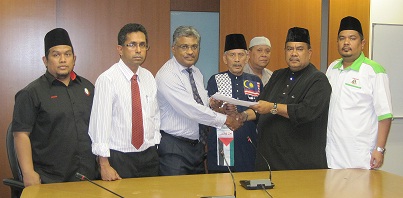
Six representatives of Majlis Gabungan NGO-NGO Melayu Islam delivered a memorandum to George Varughese, Secretary of the Malaysian Bar, on Friday, 15 Oct 2010, to protest the Bar Council’s administration and direction.

Image

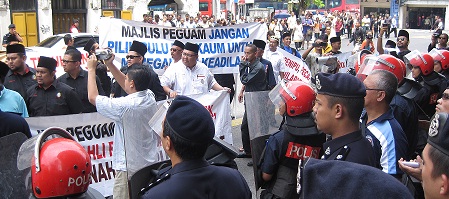
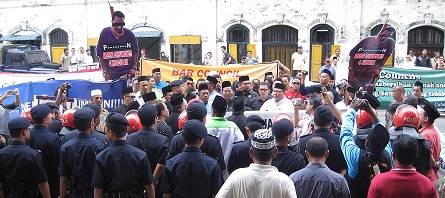
Approximately 100-150 supporters, armed with banners and placards, had gathered outside the Bar Council premises after Friday prayers.  Their chants could be heard clearly in the vicinity, but the crowd was kept in check by the strong presence of members of the police and Federal Reserve Unit.

Image

During the handover of the memorandum, coalition representatives Syahrir Aziz (Chairperson of PEKIDA, Pertubuhan Kebajikan & Dakwah Islamiah SeMalaysia), Arman Azha Hj Abu Hanifah (Pertubuhan Pribumi Perkasa Malaysia), Jais Abdul Karim (President of Gabungan Pelajar Melayu Semenanjung), Roslan Dahaman (PEKIDA), and Rashid Fadzil (PEKIDA) expressed a number of concerns.

They stated that Bar Council must have an effective disciplinary mechanism, as it has the authority to decide which lawyers can practise law.  Lawyers that have been suspended or disbarred must not be allowed to continue in legal practice.  Members of the public have lost faith in lawyers as a result of recent events where two lawyers were reportedly involved in a case involving multiple murders.

According to the representatives, the Bar Council is too “political”, and, instead of maintaining a neutral position, tends to act akin to a political party or to show bias towards a specific political party.  One example cited was Bar Council’s involvement in a public forum organised by SUARAM the previous evening, where the performance of the Inspector General of Police had been criticised.

It was also claimed that the brochures and dialogue sessions of the Bar Council’s MyConsti campaign urge the amendment of the Federal Constitution in order to give equal rights to all races.  The speaker asserted that this would amount to the abolition of the special rights of Malays (“hak istimewa orang Melayu”), which he protested, stating that it is a non-negotiable matter. 

The Secretary thanked the representatives for putting forward their concerns.  He explained that Bar Council views disciplinary issues seriously and is very strict with Members of the Bar.  When a complaint is lodged against a Member of the Bar, the Advocates and Solicitors Disciplinary Board, which is an independent body, will investigate and take appropriate action.

He elaborated that, for example, the Disciplinary Board had struck off the two lawyers referred to, from the Roll of advocates and solicitors in November 2009.  However, the court granted the lawyers’ application to stay the execution of the Disciplinary Board’s order and allowed them to continue practice, with certain conditions, pending the disposal of their appeal1.

The Secretary affirmed that Bar Council has always been, and continues to be, apolitical, despite any perception to the contrary.  Accordingly, Bar Council will voice its views when there is wrongdoing or injustice by either the Government or the Opposition. 

The gathering outside the Bar Council dispersed soon after the delivery of the memorandum.
Image


1 On 18 Oct 2010, the High Court dismissed the lawyers’ appeal against the Disciplinary Board’s decision to strike them off the Roll
-------------------------------------------------------------------------------------

MAJLIS GABUNGAN NGO-NGO MELAYU ISLAM
Di alamat, 30 Jalan Horley Off Jalan Imbi, 55100 Kuala Lumpur MALAYSIA

Tarikh    : 11/10/2010

NOTA BANTAHAN

Majlis Gabungan NGO-NGO Melayu Islam ingin meluahkan perasaan kesal dan terkilan teramat sangat terhadap tindak-tanduk Majlis Peguam ini yang sering mempertikai dan cuba mengganggu proses siasatan polis terhadap suspek kes-kes yang sedang di dalam siasatan. Pembunuhan kejam terhadap empat orang muslim tersebut oleh suspek seolah-olah dianggap terlalu remeh oleh Majlis Peguam sehingga menimbul tanda tanya kepada umum tentang peranan sebenar mereka sebagai pengamal undang-undang. Adakah ia sebagai sebuah badan guaman yang benar-benar bebas untuk melindungi kepentingan awam? Atau ia sebenarnya kini telah menjadi alat part-parti politik tertentu, tanpa memperdulikan sensistiviti rakyat berbilang kaum di Negara ini. Majlis Peguam sepatutnya lebih rasional, telus dan pragmatic dalam memperjuangkan menegakkan kebenaran dan keadilan buat semua tanpa mengira kaum, Agama, Ideologi dan parti politik.

Majlis Gabungan NGO-NGO Melayu Islam mengutuk sekeras-kerasnya pembunuhan kejam tersebut yang dianggap melampaui batas kemanusiaan dan waras pemikiran manusia normal dan sesungguhnya insiden itu amat mengejutkan seluruh rakyat Malaysia di mana ia dilakukan tanpa sifat berperikemanusiaan sehingga secara ganas menghina serta menghiris perasaan orang-orang Islam lebih-lebih lagi ia berlaku ketika umat Islam sedang melakukan ibadat puasa di bulan Ramadhan yang mulia. Perbuatan kejam membakar mangsa beragama Islam sehingga menjadi abu bukan merupakan cara Islam dan kerana itu rakyat perlu mengutuk sekeras-kerasanya perbuatan terkutuk tersebut termasuk Majlis Peguam. Kami mengucapkan takziah dan simpati kepada semua keluarga mangsa pembunuhan yang tersebut dan mengharapkan mereka semua dapat bersabar, tabah dan redha di atas ketentuan Tuhan. Sehubungan dengan itu Majlis Gabungan NGO-NGO Melayu Islam ingin mengucapkan tahniah dan penghargaan yang setinggi-tinggi serta ucapan terima kasih di atas kesungguhan dan kecekapan pihak PDRM yang berusaha keras siang dan malam melakukan penyiasatan terhadap kes pembunuhan kejam ini dengan kadar yang segera. Kami juga ining mengingatkan dan memberi amaran keras kepada mana-mana pihak berkepentingan yang cuba mempolitikkan isu ini dengan merendah-rendahkan kewibawaan serta martabat PDRM seperti mana pernah berlaku sebelum ini.

Majlis Gabungan NGO-NGO Melayu Islam ingin meluahkan rasa kesal yang teramat sangat di atas kecuaian Majlis Peguam memantau dan membersihkan peguam-peguam yang bermasalah dengan memaklumkan kepada masyarakat tentang kes salah laku mereka sehingga menyebabkan peristiwa hitam ini boleh berlaku. Tuduhan liar sesetengah pihak yang mengatakan seolah-olah pihak PDRM gagal memngambil tindakan terhadap peguam-peguam yang telah dilaporkan melakukan salah laku dan kegiatan jenayah adalah merupakan satu cara melarikan diri dari tanggungjawab dengan menjadikan PDRM sebagai kambing hitam sementara Majlis Peguam hanya mengambil jalan mudah dengan mencuci tangan. Majlis Peguam sepatutnya lebih cekap dan peka dengan mengambil langkah-langkah proaktif lebih pantas dan cepat dengan mengasingkan peguam-peguam yang bermasalah tersebut dengan membuat kenytaan secara terbuka di dalam media massa atau memperkenalkan kad kuasa yang mesti diperbaharui setiap tahun sebelum para peguam dibenarkan meneruskan aktiviti guaman dan perniagaan mereka. Justeru itu Majlis Gabungan NGO-NGO Melayu Islam mendesak Presiden Majlis Peguam beserta barisan kepimpinan exconya meletakkan jawatan serentak dan Majlis Peguam yang ada dibubarkan kerana dianggap bertanggungjawab sepenuhnya di atas kegagalan mereka menjaga kredibiliti dan profesionalisme Majlis Peguam yang buat masa ini berada di tahap yang paling rendah di kacamata masyarakat.

Yang menghairankan lagi, Majlis Peguam juga amat sepi untuk memperjuangkan nasib mangsa-mangsa yang dibunuh kejam tanpa ada pembelaan yang bersemangat, seperti mana perjuangan mereka apabila isu kematian Kugan dan Teng Beng Hock terjadi. Keluarga-keluarga mangsa bunuh ini, juga hanya sekadar diucapkan takziah. Walaupun salah seorang mangsa adalah Peguam. Pelik dan hairan inikah keadilan pilih bulu oelh Majlis Peguam. Tiada dana yang ditawarkan oleh Majlis Peguam bagi membela keluarga-keluarga simati atau pakej-pakej lain yang lebih istimewa.

Majlis Gabungan NGO-NGO Melayu Islam mencadangkan sebuah Suruhanjaya Di Raja segera ditubuhkan bagi menyiasat kedudukan Majlis Peguam kerana rakyat semakin sangsi, sangat bimbang dan tertekan sekiranya tiada siasatan bebas dilakukan terhadap Majlis Peguam. Peristiwa tragis dan menyayat hati seperti pembunuhan Datuk Sosilawati Lawiya dan ramai lagi manusia-manusia yang tidak berdosa akan terus berulang, justeru akan menjadikan Negara Malaysia yang tercinta ini tidak lagi selamat dan aman untuk didiami. Majlis Gabungan NGO-NGO Melayu Islam mencadangkan Majlis Peguam mestilah diletakkan dibawah Menteri Kehakiman atau dibawah kuasa sebuah Suruhanjaya Di Raja yang bebas bertujuan untuk memastikan prestasi, profesionalisme, ketelusan dan sifat bertanggungjawaban Majlis Peguam dilaksanakan dan rakyat mendapat kembali keyakinan dan mempercayai semula Majlis Peguam sebagai sebuah Badan Guaman yang benar-benar bebas, adil berwibawa dan dihormati. Majlis Gabungan NGO-NGO Melayu Islam berpendapat kebenaran dan keadilan mesti ditegakkan buat semua bukan untuk segelintir pengamal undang-undang, kawan-kawan politik atau kroni tertentu.

Pengerusi,
Majlis Gabungan NGO-NGO Melayu Islam

Shocking video of Papuan torture prompts calls for inquiry

The footage has caused widespread outrage and
revulsion.
Disturbing and graphic footage of two tribal Papuan men being tortured, allegedly by Indonesian soldiers, has led to widespread demands for an independent inquiry. One of the victims is an elderly man.

The incident is believed to have been filmed on the mobile phone of one of the soldiers as a ‘trophy’. Analysis of the footage suggests it was taken in May this year in the highland region of West Papua, where a military operation has been taking place.

The shocking footage shows an elderly man stripped naked, a plastic bag being forced over his head, and screaming in agony as a burning stick is held to his genitals. Exact details of the victims are hard to confirm due to military control of the area and a ban on journalists and human rights organisations from entering the region. However, reports suggest that the elderly man is still missing, presumed dead and the younger man, who is shown with a knife held to his face and throat, has since been released.

'Trophy' photograph taken by an Indonesian soldier
after he and his comrades murdered Ninuor Kwalik
and his 12 year old nephew Daugunme in 1998, West
Papua. © Survival
The Papuan tribal people have suffered enormously at the hands of the Indonesian military since 1963. The Indonesian army has a long history of human rights violations against the Papuans, including killings, torture and the rape of women, and children as young as three. For many years Indonesian soldiers have taken trophy photos, and now films, of killings and rapes, which they use to intimidate and humiliate Papuans.

Survival International's Director, Stephen Corry said, ‘This footage of an elderly man being tortured, allegedly by Indonesian soldiers, is truly horrific. There must be a full, independent investigation into this atrocity. Soldiers have been killing, raping and torturing Papuans with impunity for almost 50 years. The international community cannot sit back and allow this to continue.’


To read this story online: http://www.survivalinternational.org/news/6598

Wednesday, 20 October 2010

MPs call for rogue cops' commission

url pkr..
KUALA LUMPUR: Calls for the formation of the Independent Police Complaints and Misconducts Commission (IPCMC) by politicians and community leaders has intensified, following an exposure of what appears to be a cover-up by the Pahang police disciplinary board.

Yesterday, The Malay Mail revealed in its cover story how the board had tried two Rompin policemen, who had earlier confessed to taking about 40kg of syabu (methamphetamine), for supposedly taking cigarettes instead and letting the duo off with a light sentence.

It was also exposed how the duo had a year later received promotions as well as government accolades, in spite of their involvement in the drug bust scandal where at least nine Rompin cops confessed to taking 40kg out of 750kg of syabu during a major drug seizure.

Sungai Petani MP Datuk Johari Abdul told The Paper That Cares it was time the government formed the IPCMC as it was apparent in-house investigations had limitations.

“It is high time the police allow independent investigations on police misconduct. Probes conducted in-house will never really expose the whole truth because there are 'interests' to protect.

"It’s not easy for you to prosecute your own colleague or your own friend.”

The MP from PKR said the authorities should not see the introduction of IPCMC as a deterrent to their line of work but rather as a positive move.

“It is important if the police want to instill public confidence towards the force. With what has happened in Rompin, how am I going to fully trust the police from now on?”

Indera Mahkota MP Azan Ismail concurred that IPCMC needed to be introduced to regain the public’s trust for the police. “The government must realise they need to do this to regain the public’s confidence.

“What happened in Rompin is a major tarnish on the overall image of the police,” said the Pahang MP from PKR when met at Parliament yesterday.

“This is the work of a few rotten apples. You can’t say the whole police force in Pahang is bad. Yet, the work of this few will give a bad name for the entire force.”

Azan said the cops’ willingness to partake in the crime was a display of desperation.

“That the policemen are desperate and willing to get involved in such a shameful act shows how they are underpaid and pressured to increase their living standards.”

Malaysia Crime Prevention Foundation chairman Tan Sri Lee Lam Thye, a member of the Royal Commission said: "It was something the public needed but it was shot down by the police before. I hope the new IGP will reconsider the motion."

Community leader Tan Sri Robert Phang said: “It is high time the IPCMC is set up. If the police are serious about rebuilding their image, this is the right way and it will be good for the morale of the force, too."

In its 2005 report, the Royal Commission said internal mechanisms currently governed by the police themselves were inadequate, unreliable and frequently ineffective.

The commission also proposed to introduce a more reliable mechanism to address complaints made against the police, to improve much-needed public confidence in the policing system and to make the force more accountable to the public at large.

The setting up of the IPCMC was one of 125 recommendations contained in the report to enhance the operations and management of the police.
IMG_3736IMG_3766  IMG_3743 IMG_3751

Khairy: Use brains, not brawn, to win young voters

Khairy said old tactics of intimidation no longer worked with today’s voters.

KUALA LUMPUR, Oct 20 — Umno Youth chief Khairy Jamaluddin has warned that the ruling party’s reliance on executive power to cow political dissent will only serve to drive away young voters, who are capable of telling rhetoric from “genuine service”.

He said the party’s old tack of “using force” — lodging police reports, arresting and demonstrating against those who held different political beliefs — was an anathema to today’s Internet-savvy youths, who demanded open debate above all else.

“The current political sphere is no longer entirely about the struggle for power, but a competition of minds, a battle of ideas,” Khairy told some 800 Umno Youth delegates today in his policy speech.

“Like it or not, those who challenge our political ideology must be defeated through the sharpness of our intellect and the superiority of our arguments, not by relying on executive power.”

Hammering home his point that the battle for the minds of Malaysian youths had to be won by ideas and not force, the Rembau MP added that arrests did nothing to quell a dissenting thought and might even serve to propagate it.

“We might be able to arrest one or two, but what of the hundreds or thousands of their supporters? In the end, disaster may befall us for in our obsession with winning the battle, we may just end up losing the war,” he said.

Echoing the Najib administration’s line that the era of “government knows best” has ended, Khairy said the traditional top-down approach had to give way to an inclusive culture that allowed youths the engage directly in nation-building.

He said it was critical for Umno to start this process of engagement with young voters — the majority of whom were fence-sitters — as they will account for 49 per cent of all votes in the next general election.

In line with this call, the Umno Youth chief proposed that the University and University Colleges Act 1971 (UUCA), which bans university students from participating in political activities even off-campus, be amended to allow students to be actively involved in politics.

“What is the point of us trumpeting that young people are important assets and future leaders if their wish to involve themselves politics is denied and met with scorn?” he said.

“Umno Youth does not only wish to give adequate space for the best minds to contribute through politics, but more than that, we want to acknowledge and elevate this group who are most definitely looking to us for leadership.”

21 rounds missing from cop’s kit after patrol, court told

Jenain was said to have returned his patrol pack minus 21 rounds for his MP5 after the night of the shooting. — file pic

SHAH ALAM, Oct 20 — Twenty-one bullets out of 100 supplied to Corporal Jenain Subi for patrol duty on April 25 were found missing the next day, a police firearms storekeeper told the Sessions Court today, in the Aminulrasyid Amzah shooting trial.

Lance-Corporal Ismail Daud, in charge of the Section 11 police station’s weapons store, told the court he had personally handed a Heckler and Koch MP5 A3 submachine gun (HK MP5 A3) and four magazines containing a total of 100 rounds of bullets to the patrolman working the graveyard shift at 9pm on April 25, but received only 79 bullets back when Jenain returned the weapon and its supplied pack the next morning.

Ismail added he had recorded the shortage in the Section 11 police station diary. He also removed the gun and the affected magazine from circulation, and stuck notes for them not to be issued for use.

Police forensics had recovered two live bullets and 17 spent casings from the housing area in Section 11 here where the Form Three schoolboy lived and was found dead six months ago, after a high-speed car chase with the cops.

Jenain, 48, is charged with the culpable homicide not amounting to murder of 14-year-old Aminulrasyid, who took a midnight joyride in a car and was allegedly mistaken for a felon on the run.

Stepping up its pace, the prosecution followed up on Ismail’s disclosure by asking him if he had asked the accused the reason for the shortage.

As the trial’s 17th witness opened his mouth to answer, Jenain’s lead counsel, M.M. Athimulan leapt to object to the question, citing Section 113(1) of the Criminal Procedure Code.

The senior lawyer said Ismail’s reply could potentially prejudice the case against his client as it may be taken as an admission of guilt.

Deputy public prosecutor Dusuki Mokhtar defended his questioning, arguing that any oral evidence was to be made directly by the person who had said it, based on the rules in the Evidence Act.

Athimulan parried by questioning Dusuki on his intention to extract the information from Ismail, saying the latter’s answer, if he reported what Jenain said, could be taken as hearsay evidence that was not admissible in court.

As the two lawyers — one full-headed and the other bald — readied for what could have been a protracted verbal battle, judge Latifah Mohd Tahar cut in and asked: “So it’s not for a confession?”

Dusuki said no, to which the judge allowed the question.

The witness told the court that he did ask Jenain if he had used the gun after finding one of the four magazines only had four 9mm bullets left, instead of the 25 issued at the start of the patrolman’s shift.

“Dia beritahu saya ‘Ada’ tapi tak pasti berapa peluru dilepaskan (He told me ‘Got’, but wasn’t sure how many bullets had been discharged),” Ismail related.

Under cross-examination from the defence later, Ismail stressed that his duty was to issue firearms only to police personnel based at the Section 11 police station and nowhere else.

He affirmed he had handed over two HK MP5 A3 submachine guns and bullets to Corporal Jenain and Constable Malkeet Singh who were both on patrol duty that shift, which starts 10pm on April 25 and ends at 6am on April 26.

Ismail also emphasised that only Jenain’s kit was incomplete when the latter returned the articles at 6.42am on April 26, after his shift ended.

Jenain who had partnered junior policeman Mohamad Hafidz Mohd Yusof for the 10-to-six shift had patrolled Sector 6, which included the Section 11 housing area where Aminulrasyid lived and died.

The trial will resume in the afternoon with government chemist Dr Seah Lay Hong’s testimony.

Rizal to non-Malays: Understand our feelings too

By G Vinod - Free Malaysia Today

KUALA LUMPUR: Umno Youth information chief Rizal Merican Neena Merican today urged the non-Malays to understand the feelings of the Malays, saying equality does not necessarily mean being fair to all.

Debating on Umno Youth chief Khairy Jamaluddin's speech at the Umno annual general assembly, Rizal said while he agreed with Khairy that Malays must understand the feelings of the non-Malays, it is equally important that the same feeling be reciprocated by the non-Malays as well.

“Some quarters are calling for equality among races but people must understand that equality does not necessarily mean fairness,” said Rizal.

Drawing analogy of a father of three children, the needs of each child may wary due to age difference.

“The father may have bought 'tom yam' for all his children but if one of his child is two months old, do you think it would be appropriate to give the child 'tom yam'? It may want milk instead.

“In addition, if you get milk, you cannot give the same milk you give a two-year-old to your 15-year-old child,” said Rizal.

Another delegate, Azizan Che Omar, who is also the Pahang Umno Youth chief, criticised the civil service for not following the direction from the government of the day.

“The civil service is like train coaches; it should follow the head. If it does not, the train may skid off the rail. Similarly, the civil service should follow the direction of the Cabinet,” said Azizan, adding that the government should set up a regulatory body to keep an eye on the civil service.

Core functions

Rizal also criticised government-linked companies (GLCs) for not heeding government advice and regulations.

“We put them (CEOs) in their positions in the hope they will help us in return. However, there was a CEO of a GLC who even gave a speech at a function conducted by PAS,” said Azizan without mentioning his name.

He also took a swipe at GLCs for ignoring one of their core functions – to get involved in corporate social responsibility projects (CSR).

“They gave themselves eight to 12 months' bonuses but when the prime minister urged them to conduct CSR projects, they keep dragging their feet,” said Azizan, who called on the government to set up a GLC Foundation to collect funds from GLCs.

“Let us collect 20% or 30% from their profit so that the fund can be used for CSR activities,”said Azizan.

Batu Sapi: A deal in the making between PKR and SAPP?

KOTA KINABALU: Tomorrow several PKR national leaders are expected to meet with local leaders from Sabah Progressive Party (SAPP) to broker a deal to ensure a one-on-one contest with Barisan Nasional in the upcoming Batu Sapi parliamentary seat by-election.

This last-ditch effort is seen as necessary following the call by PKR de facto leader Anwar Ibrahim for SAPP not to contest in Batu Sapi to pave the way for the PKR to take on BN in a straight fight.

Speaking to reporters at Parliament lobby in Kuala Lumpur yesterday, Anwar announced that PKR would field a candidate in the Batu Sapi by-election.

SAPP, a Sabah-based opposition party, had earlier indicated its intention to put up a candidate and planned to announce its candidate on Saturday.  BN will announce its candidate from Parti Bersatu Sabah (PBS) in Sandakan on Sunday.

Asked about the opposition party meeting, SAPP deputy president Eric Majimbun said SAPP's door was always open for discussions for the common good of the people and the state.

"We welcome them to see us. We are ready for the talks. We want to listen to their views especially on a possible cooperation to face the mighty BN in the Batu Sapi by-election," he said today.

SAPP won't budge

However, he said, the SAPP supreme council had already made its decision to field a candidate in the by-election and that it was unlikely that the party would reverse its decision for now.

"SAPP is a local-based party... if we cannot contest in Sabah, where else can we contest. So, we hope that Pakatan Rakyat understands our situation," he said.

Asked about the possible deal, Majimbun said he was still in the dark about it, saying it was more of a political strategy.

"Nothing is impossible in politics and we will see when we meet them," he said.

Meanwhile, political analysts believe that the failure of the two opposition parties to broker a deal might split opposition votes, thus giving advantage to the ruling coalition to retain the seat.

The by-election follows the death of incumbent Edmund Chong Ket Wah, who won the seat at the 2008 general election with a comfortable 3,708-vote majority, defeating independent candidate Chung Ong Wing. Chong polled 9,479 votes against Chung's 5,771.

Batu Sapi has 25,582 voters, of whom 24,047 are ordinary voters and 1,535 postal voters. A total 15,099 or 59.02 per cent of the voters are Muslim Bumiputera, 689 non-Muslim Bumiputeras (2.69 per cent), 9,737 Chinese (38.06 per cent) and others, 57 (0.22 per cent).

Nomination has been fixed for Oct 26 while polling is on Nov 4.

- Bernama