Share |

Saturday, 26 June 2010

Non-Muslim rights: What Rais can do

By Teo Nie Ching | The Nut Graph
Rais Yatim (source: kppk.gov.my)
THE Information, Communications and Culture Minister Datuk Seri Dr Rais Yatim was right to say that the social rights of non-Muslim Malaysians were contained in the Federal Constitution. However, he was extremely wrong to claim that the government must issue the sports betting licence for non-Muslim rights to be recognised and respected.
In a recent Anti-Gambling at Internet Cafes signature campaign organised by the Klang and Kapar MCA divisions, more than 2,000 signatures were collected in two hours. That seems to contradict Rais’s view that gambling is a precious part of “non-Muslim culture”.
If Rais was serious about recognising the rights and lifestyles of non-Muslims, [who are predominantly non-Malays in Malaysia], there is something he can do immediately in his capacity as information, communications and culture minister.
Currently, Finas incentives in the form of the Compulsory Screening Scheme and a 20% tax rebate only apply to films with 70% of the dialogue in Bahasa Malaysia (BM). Malaysian-made films in other languages do not enjoy these incentives.
As such, local Chinese- and English-language films like Tiger Woohoo, Ice Kacang Puppy Love and The Malay Chronicles (The Chronicles of Merong Mahawangsa), though fully produced in Malaysia, are not entitled to the exemption on entertainment duty.
Since the rights of non-Muslim Malaysians are contained in the Federal Constitution, then all Malaysian-made films, irrespective of the language used, should be entitled to the same incentives.
Ice Kacang Puppy Love poster
The Chinese-language movies Tiger Woohoo and Ice Kacang Puppy Love proved that Malaysian productions can compete with films from Hong Kong and China. Both movies collected more than RM5 million at the box office — the most successful non-BM films in Malaysia to date.
There is a market for locally-made non-BM films. Unfortunately, not many producers are willing to make them because of the risks involved. Giving non-BM films the same incentives will definitely help to promote the local non-BM film industry, spur local creativity and inspire budding filmmakers to greater heights.
Umno leaders should stop pretending that they are sensitive to Chinese [Malaysian] rights. There are sufficient gambling avenues available to non-Muslims to indulge their habits. The non-Muslim communities have never requested for more opportunities to gamble.
Since Rais has admitted that the rights of non-Muslim Malaysians are constitutional, he should immediately abolish the restrictions on locally-made films which do not adhere to the “preferred language” condition.
He should also stop pretending he is an expert on non-Muslim lifestyles and stop using non-Muslims as scapegoats to pursue the government’s move to legalise sports betting.
Teo Nie Ching

Malaysia Bans Cartoonist’s ‘Unsuitable’ Works

From Times live
By Sapa

Malaysia has banned a book and two comics by a political cartoonist that were critical of the government, saying they were “undesirable” and could incite people to revolt.

The artist, Zulkifli Anwar Ulhaque, whose publications have highlighted issues such as opposition leader Anwar Ibrahim’s sodomy trial and police shootings, dismissed the allegations and vowed to continue drawing.

Mahmood Adam, secretary-general of the powerful home ministry, said Zulkifli’s three publications were banned because they were “deemed unsuitable and undesirable for public reading.”

“All three publications have been banned for its contents can influence the people to revolt against the leaders. The contents are not suitable and are detrimental to public order,” he said in a statement on Thursday.

Prime Minister Najib Razak, who took office in April last year in the mainly Muslim country, had promised to promote openness and transparency but the opposition has accused the government of trying to silence critics.

Why Pakistan is not a nation

Image(Asia Sentinel) And how it could become one.

Pakistan has been a state since 1947, but is still not a nation. It is a land and a people inside a certain geographical boundary that is still lacking the crucial components needed for nationhood: a strong common identity, mental make-up, a shared sense of history and common goals. The failure so far to create a cohesive national entity flows from inequalities of wealth and opportunity, absence of effective democracy and a dysfunctional legal system.

While it is true that most Punjabis think of themselves as Pakistani first and Punjabi second, this is not the case with the Baloch or Sindhis. Schools in Balochistan refuse to hoist Pakistan’s flag or sing its national anthem. Sindhis, meanwhile, accuse Punjabis of stealing their water, the Muttahida Quami Movement (MQM) runs Karachi on strictly ethnic grounds, and in April the Pashtun of th North West Frontier Province successfully had the province officially renamed Khyber Pakhtunkhwa (against the wishes of other residents). In getting a job, caste and sect matters more than ability, and ethnic student groups wage pitched battles against each other on campuses throughout the country.

The lack of nationhood can be traced to the genesis of Pakistan and the single factor that drove it – religious identity. Carved out of Hindu-majority India, Pakistan was the culmination of the competition and conflict between natives who had converted to Islam and those who had not. Converts often identified with Arab invaders of the last millennium. Shah Waliullah (1703-62), a ‘purifier’ of Islam on the subcontinent who despised local traditions, famously declared ‘We [Hindustanis] are an Arab people whose fathers have fallen in exile in the country of Hindustan, and Arabic genealogy and the Arabic language are our pride.’

The founder of Pakistan, Mohamed Ali Jinnah, also echoed the separateness of Muslims and Hindus, basing the struggle for Pakistan on the premise that the two peoples could never live together peacefully within one nation state. But Jinnah was unrecognizably different from Waliullah, a bearded religious scholar. An impeccably dressed Westernized man with Victorian manners, a secular outlook and an appreciation of fine foods and wines, Jinnah nevertheless eloquently articulated the fears and aspirations of an influential section of his co-religionists. Interestingly, he was opposed by a large section of the conservative ulema, such as Maulana Maudoodi of the Jamaat-e-Islami, who said that Islam must not be confined to national borders. But Jinnah and his Muslim League won the day by insisting that Muslims constituted a distinct nation that would be overwhelmed in post-British India by a larger and better-educated Hindu majority.

Thus Pakistan, in essence, was created as the negative of India: it was not India. But what was it, then, beyond being a homeland for Muslims? Decades after the horrific bloodbath of Partition, the idea of Pakistan remains hotly debated. It did not help that Jinnah died in 1948, just a year after Pakistan was born, with his plans still ambiguously stated. He authored no books and wrote no policy paper. He did make many speeches, of which several were driven by political expediency and are frankly contradictory. These are freely cherry-picked today, with some finding in them a liberal and secular voice; others, an embodiment of Islamic values. The confusion is irresolvable.

After Jinnah, the Objectives Resolution of 12 March 1949 was the first major step towards the transformation of Pakistan from a Muslim state into an Islamic state. The Resolution starts with the statement that sovereignty rests with Allah. This obviously limits the legislative power of a representative assembly, since the fundamentals are already defined. Another consequence was the grudging concession that “Adequate provision shall be made for the minorities to freely profess and practice their religions and develop their cultures.” This created the concept of minorities in the Pakistani polity, and hence negated the right of equality – a basic requirement of modern democracy.

The basis in religious identity soon led to painful paradoxes. An overbearing West Pakistan was to ride roughshod over East Pakistan, and become despised as an external imperial power. Jinnah’s ‘Two Nation’ theory was left in tatters after the separation of East Pakistan in 1971, and the defeat of the Pakistani military. The enthusiasm of Muslim Bengalis for Bangladesh – and their failure to ‘repent’ even decades after 1971 – was a deadly blow against the very basis of Pakistan. Nevertheless, contrary to dire predictions, the Pakistani state survived. Its powerful military easily crushed emerging separatist movements in Balochistan and Sindh.

For a while after 1971, the question of national ideology fell into limbo. Prime Minister Zulfikar Ali Bhutto attempted to create a Pakistani identity around the notion of revenge for the loss of the East Wing. He promised ‘war of a thousand years’ against India, and started Pakistan’s quest for the atomic bomb in 1972. While this served temporarily as a rallying cry, the military coup of 1977 that sent him to the gallows was to revive the identity issue.

Zia's project
Soon after he seized power, General Zia ul-Haq announced his intention to remake Pakistan, and end the confusion of the country’s purpose and identity once and for all. In a sense, he wanted to emulate Napoleon Bonaparte’s achievement of creating a nation from a nation state. Eric Hobsbawm, the influential Marxist historian, persuasively argues that the state of France made the French nation, not vice-versa. Similarly, Zia sought to create a nation – albeit one based on religion rather than on secular principles – using the power of the state. The word soon went out that Pakistan was henceforth not to be described as a Muslim state. Instead, it was now an Islamic state, where Islamic law would soon reign supreme. To achieve this re-conceptualisation, Zia knew that future generations of Pakistanis would have to be purged of liberal and secular values.

Thus began a massive, decade-long state-sponsored project. Democracy was demonized and declared un-Islamic, culture was purified of Hindu ‘contamination’, Urdu was cleansed of Hindi words to the extent possible, capital punishment was freely used, dress codes were introduced, university teachers had their faith examined under a microscope, and religion was introduced into every aspect of public and private life. Education was the key weapon for Zia’s strategy. In 1981, he ordered the education authorities to rewrite the history of Pakistan. All new school textbooks would now “induce pride for the nation’s past, enthusiasm for the present, and unshakeable faith in the stability and longevity of Pakistan.”

Jinnah and other icons of the Pakistan Movement had to be portrayed as pious fundamentalists, whether or not they carried beards; their lifestyles had to be hidden from public view. To eliminate possible ambiguities of approach, a presidential order was issued to the University Grants Commission that, henceforth, all Pakistan Studies textbooks must:

Demonstrate that the basis of Pakistan is not to be founded in racial, linguistic, or geographical factors, but, rather, in the shared experience of a common religion. To get students to know and appreciate the Ideology of Pakistan, and to popularise it with slogans. To guide students towards the ultimate goal of Pakistan – the creation of a completely Islamised State.

In a matter of years, Pakistani schoolchildren grew up learning a catchy but linguistically nonsensical jingle about the “ideology” of Pakistan: “Pakistan ka matlab kya? La illaha illala!” (What is the meaning of Pakistan? There is no god but Allah!) Although the purported answer has nothing to do with the question, Zia’s strategy soon began to show results.

Barely a decade was needed for Pakistan’s transformation from a moderate Muslim-majority country into one where the majority of citizens wanted Islam to play a key role in politics. The effects of indoctrination are now clearly visible. Even as members of the Sharia-seeking Taliban were busy blowing up schools in Swat and elsewhere, a survey in 2008 by the online World Public Opinion found that 54 percent of Pakistanis wanted strict application of Shariah, while 25 percent wanted it in some more dilute form. Totaling 79 percent, this was the largest percentage in the four countries surveyed – Morocco, Egypt, Indonesia and Pakistan. A more recent survey, of 1,226 young Pakistanis between 18 and 29, was carried out across Pakistan by the British Council in 2009. It found that “three-quarters of all young people identify themselves primarily as Muslims. Just 14 percent chose to define themselves primarily as a citizen of Pakistan.”

Clearly, the country’s youth is deeply worried by lack of employment, economic inflation, corruption and violence. In this turbulent sea, it is not surprising that most see religion as their anchor. For some, violent change is the answer to the country’s problems. This is precisely what Zaid Hamid, one of Pakistan’s fiery new demagogues, advocates. Hamid, a self-proclaimed jihadist who claims to have fought against the Soviets in Afghanistan, builds specifically on the insecurity of the youth, enthralling college students who pack auditoriums to listen to him.

Millions more watch him on television, as he lashes out against Pakistan’s corrupt rulers and other “traitors.” Hamid promises that those who betrayed the nation’s honor by joining the US-led ‘war on terror’ will hang from lampposts in Islamabad. In his promised Islamic utopia, speedy Taliban-style justice will replace the clumsy and corrupt courts established by the British. Just as Adolf Hitler dwelt on Germany’s ‘wounded honor’ in his famous beer-hall oratory in Munich (where he promised that Germany would conquer the world), Hamid calls for the Pakistan Army to go to war against India and liberate Kashmir, Palestine, Chechnya and Afghanistan. One day, he says, inshallah, Pakistan’s flag shall fly from Delhi’s Red Fort. The students applaud wildly.

Still no Islamic state?


Notwithstanding the enormous impetus given by Zia, final success still eludes Pakistan’s Islamists. The explosion of religiosity did not produce a new Pakistani identity, and a shariah state is nowhere to be seen.

Why? Ethno-nationalism is part of the answer. This natural resistance against melding into some larger entity is the reflexive response of historically constituted groups that seek to preserve their distinctiveness, expressed in terms of dress, food, folklore and shared history. Assimilation of Pakistan’s diverse peoples into a homogenized national culture is opposed by this force that, like gravity, always acts in one direction.

Ethno-nationalism is, of course, vulnerable. It can be overcome by integrative forces which arise from the natural advantage of being part of a larger economy with correspondingly greater opportunities. But for these forces to be effective, it is essential that the state machinery provide effective governance, demonstrate fairness and is indifferent to ethnic origins. Pakistan’s ruling elite, unfortunately, is both incompetent and ethnically partisan, drawing its roots from the powerful landed and feudal class. The army leadership and the economic elite had joined forces after Partition to claim authority, but they were transparently self-serving and therefore lacked legitimacy.

Dangling the utopia of an Islamic state raised expectations but did little else. To the chagrin of the political and army establishment, it ultimately backfired and became the cause of infinite division. The post-Zia generation – which believes that every issue would be solved if the country were to go back to the fundamentals of Islam – muddles on in a state of deep confusion and deadly divisiveness. It believes that adherence to “true Islam” will solve all problems and lead to a conflict-free society. But, in reality, the Quran and Hadith can be interpreted in multiple ways, and “Islamic fundamentals” can be defined in many contradictory ways.

These differences fuel violent political forces, each convinced that they alone understand god’s will. Murderous wars between Sunni and Shia militias started during the late 1980s. Today, even those favoring the utopian vision of an ideal Islamic state are frightened by the Pakistani Taliban, which seeks to impose its version of shariah through the Kalashnikov and suicide bombings.

All this was easily predictable, as sectarian divides are almost as old as religion itself. Basic questions are fundamentally unanswerable: Which interpretation of Islam, for instance, is the ‘right’ Islam? Of the four schools of Sunni jurisprudence (Hanafi, Shafii, Maaliki, Hanbali), which version of the shariah should be adopted? Will all, or most, Pakistanis accept any non-elected amir-ul-momineen (leader of the pious), or a caliph?

And what about the Shia? Democracy is excluded in any theocratic state, which, by definition, is a state governed according to divinely revealed principles wherein the head of state, elected or otherwise, interprets such principles and translates them into practical matters of the state. So, for example, although Abul Ala Maudoodi, in his Islamic Law and Constitution, states that “Islam vests all the Muslim citizens of an Islamic state with popular vice-regency,” he is quick to point out that all vice-regents need not be of equal consequence. He demands that constitution makers should “Evolve such a system of elections as would ensure the appointment of only those who are trustworthy and pious. They should also devise effective measures to defeat the designs and machinations of those who scramble for posts of trust and are consequently hated and cursed by the people in spite of their so-called ‘victories’ in the elections.”

In this “state without borders.” any Muslim anywhere can be a citizen. It will be the best governed not only because its leaders are pious, but also because the only ones who will vote will be the pious themselves.

In fact, religion cannot be the basis of Pakistan, or move it towards integration. This can be said categorically, although religion was undoubtedly the reason for Pakistan’s formation. Coming over a half-century after Partition, Pervez Musharraf’s call for “enlightened moderation” was indeed a tacit admission of this fact. He realized that a theocratic Pakistan could not work, even though this conflicted with his other responsibility, that of being chief of the Pakistan Army.

Since the days of Zia, the army had arrogated to itself the task of “defending Pakistan’s ideological borders” and, since the end of the 1980s, had consciously nurtured radicalism as an instrument of covert warfare in Kashmir and Afghanistan. Although Musharraf’s successor, General Pervez Kayani, also seeks to distance the army from its past, it is unclear as to what extent he or other senior officers actually have control. The Islamists, for their part, hope for, and seek to incite, action by zealous officers to bring back the glory days of the military-mullah alliance led by Zia.

While it is true that religious political parties have yet to receive any sizeable fraction of the popular vote, the secular system of power was never regarded by Pakistan’s citizens as just, appropriate or authoritative. So, by default, Islam became accepted as the basis of Pakistan, and any suggestion to the contrary continues to evoke a fierce public reaction.

On the other hand, any serious move in the direction of making Pakistan a shariah state would almost certainly lead to civil war. Why so? This is because while the shariah is considered a panacea for Pakistan’s multiple problems of corruption, inequity and poor governance, its true nature is revealed only once there is an actual move towards its implementation.

In the past, terrible and uncontrollable forces have been released against the people. As in Swat, the Pakistani Taliban’s Wahabi-Deobandi-Salafi understanding of shariah calls for forbidding females from leaving their houses, being educated or holding jobs. Men must have beards, wear shalwars rather than trousers, and never miss prayers. Killing apostates, decapitations, floggings and amputation of limbs are an essential part of the Taliban’s penal code. Fortunately, those who defend this notion of shariah constitute no more than perhaps 10 percent of Pakistan’s population. Of course, that still means millions.

Pakistan must remain
In common parlance, the ‘state’ refers to the government, and an entity in international law. Recognition by other states of the state’s claim to sovereignty enables it to enter into international agreements. Moreover, it needs a government to control its internal affairs. A more standard political-science definition of a nation state goes something like this: A state is an organized political community, occupying a territory and possessing internal and external sovereignty, which enforces a monopoly on the use of force. Max Weber, the political economist, defined the state as ‘a human community that (successfully) claims the monopoly of the legitimate use of physical force within a given territory.’

Pakistan is a nation state by the above definition and must continue to remain one. In effect, it must be because it is! The cost of the disappearance or destruction of this nuclear-weapon state is too awful to contemplate. Pakistan can indeed become a nation; moreover, it will almost certainly become one in time. Although religion will certainly remain an important part of Pakistan’s social reality for the foreseeable future, it must seek new roots lying within the country’s social reality rather than religion.

Look at it this way: rain inevitably grinds down stony mountains over centuries and ultimately creates fertile soil. Similarly, nations are inevitably formed when people experience a common environment and live together for long enough. How long is long enough? In Pakistan’s case, the timescale could be fairly short. Its people are diverse, but almost all understand Urdu. They watch the same television programs, hear the same radio stations, deal with the same irritating and inefficient bureaucracy, use the same badly written textbooks, buy similar products and despise the same set of rulers.

Slowly but surely a composite, but genuine, Pakistani culture is emerging. Of course, stable nationhood is still not guaranteed. Both the Soviet Union and Yugoslavia broke apart after seven decades. If Pakistan is to stay together and chart a path to viable nationhood, it must identify its most pressing problems and seek their amelioration. What might be a suitable manifesto of change?

First, Pakistan needs peace. This means that it must turn inwards and devote its fullest attention to ending its raging internal wars. The 60-year conflict with India has achieved nothing beyond creating a militarized Pakistani security state that uses force as its first resort even when dealing with its own people. Attempts to solve the Kashmir issue militarily have bled the country dry, leaving it completely dependent on foreign aid. The army’s role must be limited to defending the people of Pakistan, and to ensuring that their constitutional and civil rights are protected.

Indeed, given that the country could otherwise be rapidly overwhelmed by extremists who openly declare their disdain for democracy, the army is obligated to fight its progeny – the Taliban. There should be no illusion that extremism can be defeated by purely peaceful means. Indeed, the way ahead must be subtle and complicated.

How can one develop the Federally Administered Tribal Areas (FATA) and ameliorate the anguish of their people when the insurgents are out to stop development, bomb schools and kill doctors? In such a situation, Pakistan must say yes to negotiations, but no to surrender. It currently appears that the future will be one of ‘talk, fight, talk, fight’.

Second, Pakistan needs economic justice. This is not the same as flinging coins at beggars. Rather, it requires organizational infrastructure that, at the very least, provides employment but also rewards according to ability and hard work. Incomes should be neither exorbitantly high nor miserably low. To be sure, ‘high’ and ‘low’ are not easily quantifiable, but an inner moral sense tells us that something is desperately wrong when rich Pakistanis fly off to vacation in Dubai while a mother commits suicide because she cannot feed her children.

A welfare state in Pakistan is a distant ideal. India abolished feudalism upon attaining independence. But the enormous pre-Partition landholdings of Pakistan’s feudal lords remained safe and sound, protected by the authority of the state. The land reforms announced by Ayub Khan and Zulfikar Ali Bhutto were eyewash. In later years, with the consolidation of military rule in national politics, the army turned itself into a landlord-and-capitalist class. Military officers own assets that have no relation to national defense. This includes vast amounts of farm lands and valuable urban real estate, banking, insurance, advertising companies, cement and sugar industries, airlines and ground transportation, cornflakes and commercial bottled water. Most countries have armies but, as some have dryly remarked, only in Pakistan does an army have a country.

Third, Pakistan must shed its colonial structure of governance. Different historically constituted peoples must want to live together voluntarily, and see the benefits of doing so. A giant centralized government machine sitting in Islamabad cannot effectively manage such a diverse country. The demand for creating more provinces should be carefully examined and not peremptorily rejected, as is currently taking place. Having smaller administrative units does make sense, especially due to the rapidly rising population. On the other hand, to fan the flames of nationalism can hardly be a good thing.

As in India, Pakistan should be reorganized as a federation in which provinces and local governments hold the critical economic and social powers, while defense and foreign affairs are held in common by the Centre. In particular, Islamabad’s conflict with Balochistan urgently needs resolution, but using political sagacity rather than military force. Blaming India will not achieve anything – the Baloch are angry for good reason.

At a recent lecture to senior Pakistan civil-service officers in Peshawar, this writer was taken aback at the intensity with which senior officers from Balochistan spoke. They said that Baloch wounds are too deep, and that the time for healing and reconciliation with Pakistan had passed. A decade ago, one would only have expected this language from student radicals – now, it is the mainstream Baloch who articulate such sentiments.
Fourth, Pakistan needs a social contract and economic justice. This is a commitment that citizens will be treated fairly and equally by the state and shall, in turn, willingly fulfill basic civic responsibilities. But today, Pakistanis are denied even basic protections specified in the Constitution. The poor suffer outright denial of rights – such as personal security and access to water in cities – while the rich are compelled to buy these.

Rich and poor alike therefore feel no obligation to fulfill their civic duties. Most do not pay their fair share of income tax, leading to one of the lowest tax-to-GDP ratios in the world. Seeing that the rulers flagrantly flout the very laws they claim to espouse, it is no surprise that the common citizen does the same.

Fifth, the country’s education needs drastic revision in the means of delivery and content. Money goes some way towards the first – better school infrastructure, books, teacher salaries, etc. But this is not enough. Schools teach children to mindlessly obey authority, to look to the past for solutions to today’s problems, and to be intolerant of the religion, culture and language of others. Instead, students need to be taught to be enquiring, open-minded, creative, logical, socially responsible, and to appreciate diversity.

Pakistan paid a very heavy price because its leaders could not understand that a heterogeneous population can live together only if differences are respected. The imposition of Urdu upon Bengal in 1948 was a tragic mistake, and the first of a sequence of missteps that led up to the awful slaughter of Bengalis by the West Pakistani military in 1971. A myopic education system is squarely responsible for the fact that ethnic and religious minorities are viewed with suspicion and disdain by the majority. This must change.

In the end, for Pakistan to succeed, it must want to become a nation held together by mutual interests rather than by some abstract Islamic ideology. This is the only way to deal with the multiple civil wars that have started in the country. The path to creating a Pakistani nation is doubtless difficult. As the population explodes, oceans of poverty and misery deepen, limbless beggars in the streets multiply, water and clean air become scarce, education is stalemated, true democracy remains elusive, and the distance from a rapidly developing world increases. One is strongly tempted to step aside, give up and admit helplessness.

But surely that is wrong, for what we fear will then actually come to pass. The political philosopher Antonio Gramsci spoke of “pessimism of the intellect, optimism of the will.” Indeed, with the pessimism of the intellect, one must calmly contemplate the yawning abyss up ahead. But then, after a period of reflection, one should move to prevent falling into it.

Pervez Hoodbhoy teaches at the Quaid-e-Azam University, Islamabad. This is printed with the permission of Himal Southasian, with which Asia Sentinel has a content-sharing agreement.

First, DPM Muhyiddin should tell us what is going wrong in our education system?

by N K Khoo

Many Malaysia generations are made guinea pigs by our flip-flopping
education policies after independence such as teaching medium from
English to Malay, 3M, bahasa Malaysia to bahasa Melayu, teaching maths
and science in English and vice versa, SRP to UPSR, grading system,
etc.

The trend is when a new education minister clinches to this important
post, they will propose new policies hastily. No doubt change is
constant for us to keep abreast the outside world. But we have to know
the problem first before proposing a change of policy or solution.

I have a question to DPM Muhyiddin and his Education Ministry, what
are the actual problems in our education system before you simply
throw a proposal (a bomb!) to public members.

I and many educationists can propose a hundred possible or plausible
solutions to any hypothetical problem, but nobody knows are we
addressing the root causes.

The list of problems can be

- Rote learning

- Too examination orientated

- Poor in arithmetic skill

- Poor in English/mother tongue/languages

- No participation in sports and co-curriculum

- Too many grade A scorers

- Too many homeworks

- Too many textbooks

- Too many learning hours

- Too many tuition classes

- Obsolete syllabus

- Poor teaching standards

- Poor in comprehension skill

- Plagiarism

- Lack of analytical skill

- Lack of problem solving skill

- Lack of creativity

- Lack of IT skill

- Malnutrition

- Moral decay

- etc.

Let define the problem, its scope and magnitude first before DPM
Muhyiddin proposes something like abolishing UPSR and PMR to rakyat.
Such as proposal causing more confusions than solutions by itself.

Government Won't Issue Sports Betting Licence, Says PM

KUALA LUMPUR, June 26 (Bernama) -- The government decided not to issue the sports betting licence to Ascott Sports Sdn Bhd.

Prime Minister Datuk Seri Najib Tun Razak said the decision was made after taking into consideration the views of various quarters which clearly showed that the majority did not agree to the issuing of the licence.

Najib, who is also the Umno president, said the decision was also agreed upon unanimously by members of the Umno Supreme Council which met Friday night.

"Since the approval was decided in principle and a survey was carried out, although there were groups who supported as well those who did not support or opposed the decision, it was clear to the government that a majority of the people did not agree that the licence be issued to Ascot Sports.

"As such, I hereby wish to announce that the government has decided that the licence will not be issued," he told reporters after chairing the meeting.

Najib said the licence was issued in 1989 but the company had returned it to the government in 1990 after suffering huge loses.

Since the company had tried to renew the licence a number of times but only recently the government had approved the issuance of such a licence on principle, based on a number of terms.

Najib said the government's aim was to control illegal betting that was said to be in the region of RM10 billion, as well prevent other social problems.

At the same time the Prime Minister said the government had also decided that Muslims were totally prohibited from being involved in any sports betting whether buying, working or becoming a member of the Board of Directors in a betting company.

"This condition was firmly specified by the government," he pointed out.

When asked whether the decision was agreed upon by other Barisan Nasional (BN) component parties, he said they all accepted the decision in the interest of the nation.

Najib who is also the Finance Minister emphasized that Ascott would not be paid any compensation because the finance Ministry had the right to revoke any gambling licences issued.

He said Ascott had also been informed of the decision and they understood why the government did not issue the licence.

ADAKAH NAJIB DIUGUT UNTUK TERIMA KEPUTUSAN RUNDINGAN MALAYSIA – SINGAPURA YANG MERUGIKAN ?

Kenyataan Media
25 Ogos 2010
Ogos 1965, regim pemerintah Negara telah menyerahkan Singapura. Kelemahan regim ini ditutup dengan perbagai sentiment. Rakyat yang terbakar dengan perbagai sentimen pada waktu itu melupakan kelemahan regim sehingga tergadai hak dan kedaulatan Negara. Semenjak itulah perbagai isu hubungan dua negara ini muncul dan tidak selesai.
Antara isu yang tidak diselesaikan dan berpanjangan sejak dulu antaranya ialah isu pembangunan tanah milik KTMB dan sekitar tambak Johor. Walau apa pun tuduhan terhadap Perdana Menteri sebelum ini namun jelas mereka mempertahankan kedaulatan Negara dan tidak mahu menerima tawaran rundingan Singapura yang jelas berat sebelah.
Namun baru – baru ini hasil pertemuan tertutup Datuk Seri Najib Tun Razak dengan rakan sejawat di Singapura. Kononya telah menyelesaikan beberapa isu tertangguh sekian lama. Dilaporkan di media Malaysia bersetuju memindahkan stesen Keretapi Tanah Melayu Berhad (KTMB) di Tanjong Pagar di Singapura ke Pusat Pemeriksaan Kereta Api Woodlands (WTCP) menjelang 1 Julai 2011.
Dilaporkan juga Najib turut menyatakan, 271 hektar tanah milik KTMB di Tanjung Pagar, Kranji dan Woodlands serta tiga keping tanah di Bukit Timah kini diserahkan kepada sebuah syarikat yang belum lagi ditubuhkan.
Syarikat usaha sama Malaysia-Singapura yang dikenali sebagai M-S Pte Ltd, akan ditubuhkan sebelum 31 Disember tahun ini di mana Khazanah Nasional memegang 60% kepentingan dan Temasek Holdings Limited akan memegang baki 40%.
Ini, bermakna dari jumlah 271 hektar tanah milik KTMB, 40% kini sudah sah menjadi milik Singapura melalui perkongsian pelaburan.
Walaupun belum ada kepastian mengenai status pemilikan tanah, tetapi projek sistem transit laju (RTS) menghubungkan Tanjung Puteri, Johor dengan stesen di Woodlands yang dijadual beroperasi pada 2018 melalui projek usaha sama ini, kini dibahagi dua kepada Singapura.
Najib juga, gagal memberikan penjelasan terperinci tentang cadangan memindahkan Stesen KTMB di Tanjong Pagar ke Pusat Pemeriksaan Kereta Api Woodlands (WTCP) milik Singapura menjelang 1 Julai 2011.
Tanah milik KTMB di Tanjung Pagar, Kranji dan Woodlands serta tiga keping tanah tambahan di Bukit Timah, yang kesemuanya berjumlah 271 hektar akan diserahkan kepada syarikat usaha sama Malaysia-Singapura yang dikenali sebagai M-S Pte Ltd, yang akan ditubuhkan sebelum 31 Disember tahun ini.
Malaysia juga dikatakan bakal memindahkan kemudahan kastam, imigresen dan kuarantin (CIQ) kereta api di WTCP.
Hampir pasti bahawa kos operasi KTMB pasti akan meningkat dan bayaran penyewaan WTCP milik Singapura akan membebankan pada masa akan datang.
Maka KTMB bakal menyertai senarai syarikat milik kerajaan yang rugi seperti Pos Malaysia Berhad dan Sime Darby Berhad yang juga dibawah perlaburan Khazanah Nasional.
Apa yang berlaku ialah kita bakal membentuk satu lagi perjanjian seperti perjanjian air dengan Singapura yang jelas amat berat sebelah dan menggadaikan kedaulatan Negara.
Semua ini mengarut dan tak masuk akal. Selepas pengumuman di Singapura , banyak bantahan kedengaran di Malaysia. Namun Perdana Menteri Singapura hadir pula ke Kuala Lumpur seolah ‘mengingatkan’ Najib mengenai sesuatu agar Najib terus mempertegaskan persetujuan Malaysia dengan keputusan berat sebelah yang dipersetujui di Singapura.
Seolah seperti ada sesuatu yang mengikat Najib untuk akur walaupun ia jelas merugikan Negara. Dari aspek politik juga Najib jelas akan rugi kerana suara bantahan yang keras sudah mula kedengaran. Namun Najib seolah terpaksa meneruskan.
Adakah Najib diugut dalam mempersetujui perjanjian ini ?
Berdasarkan kenyataan bersumpah yang di ikrarkan oleh Balasubramanian pada 1 Julai 2008 menyatakan Antara dakwaan Bala dalam surat akuan itu ialah, Najib telah memperkenalkan Altantuya yang dikenali sebagai 'Aminah' kepada Razak di Pameran Berlian di Singapura. Maknanya Najib pernah berada di Singapura bersama Altantuya.
Adakah ‘perisik’ Singapura telah mengumpulkan rekod tersebut ? Adakah rekod tersebut digunakan untuk mengugut Najib dalam akur dan bersetuju dalam satu lagi penggadaian hak dan kedaulatan Negara ?
Najib perlu tampil dan berterus terang depan rakyat Malaysia. Jika benar dia diugut rakyat Malaysia seharusnya bangkit bersatu bersama Najib yang sedang menghadapi ugutanmelalui rekod maklumat risikan Singapura ini.
Solidariti Anak Muda Malaysia (SAMM) melihat isu ini sebagai isu besar kedaulatan, maruah dan masadepan Negara. Untuk itu 2 Julai ini Solidariti Anak Muda Malaysia akan menghantar surat terbuka kepada Perdana Menteri Malaysia mengenai isu ini dan surat terbuka ini akan dicetak sekurang – kurangnya 20,000 naskah akan diedar seluruh Negara bagi mempertingkatkan pemahaman rakyat agar bangkit mempertahankan kedaulatan Negara.
BADRUL HISHAM SHAHARIN a.k.a che’GuBard
Penyelaras
Solidariti Anak Muda Malaysia (SAMM)

Friday, 25 June 2010

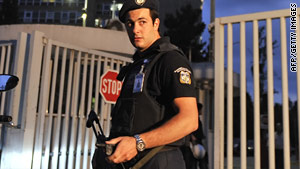
Athens blast kills at least one

Police guard the entrance to the Ministry of Citizen Protection in Athens, Greece, after Thursday's bombing.

(Right) Police guard the entrance to the Ministry of Citizen 
Protection in Athens, Greece, after Thursday's bombing.

Athens, Greece (CNN) -- One person was killed in an explosion at the Ministry of Citizen Protection in Athens, Greece, on Thursday, a ministry official said.

The blast took place not far from the office of the minister, Michalis Chrysochoidis, journalist Elinda Labropoulou reported for CNN.

It is not clear whether he was in his office when the blast happened. But he appeared on Greek television shortly after the explosion, saying, "we are not afraid," Labropoulou reported.

"I lost a colleague and a friend," Chrysochoidis said.

The bomb was in a parcel delivered to the desk of the assistant to the secretary of the ministry, CNN affiliate Mega Channel reported. It is not clear whether the package was opened.

There has been no claim of responsibility, police said.

The ministry is responsible for public order, including policing.

Government buildings, banks and international businesses in Athens are targeted fairly regularly by bombers, but it is unusual for people to be killed.

Bombers often phone warnings to newspapers or police before the explosions. It is not clear whether a warning was issued Thursday.

CNN's Stephanie Halasz contributed to this report.

Taib’s fortune: Trio will return to MACC with ‘own copies’

BY FMT Staff

KUALA LUMPUR: Malaysian Anti- Corruption Commission's (MACC) refusal to forward a copy of a report lodged by three Sarawakians alleging corruption by Sarawak Chief Minister Abdul Taib Mahmud has shocked the trio and thrown further suspicion on the agency, which is already struggling with its battered image.

Describing the situation as “ridiculous”, the trio – James Wong Joon Min, Ting Chek Ming and Ahmad Nazib Johari – have decided to make their own copies and return on a later date to lodge again their reports with the MACC in Putrajaya.

Said Wong: “We’ve decided to come back on another day. We’ll make our own copies of the report. We want MACC to investigate it. The report touches on Taib and family’s business empire and properties in Canada.”

The trio had yesterday lodged a report against Taib at the MACC yesterday. Having done so, they asked for a copy and were denied.

Shocked, they demanded an explanation only to be told that there was “no ruling allowing for a copy to be issued to the complainant”.

Billionaire daughter

Strangely enough, said Ahmad Nazib, the officer told them that “this case was different, this is a high-profile case”.

“After hearing this, we decided to be cautious. We told them that whether it is high or low-profile, the law is the law and should be applied to all,” said Ahmad Nazib.

Their MACC report was based on a series of articles published on the web portal sarawakreport.org last week.

The report noted that Taib had assets worth RM3 billion in Canada, London and Australia.

It also placed Taib’s billionaire daughter Jamilah as the owner of Sakato Development Corporation,an Ottawa-based construction company which owned assets worth millions of US dollars, with offices in the US and other countries.

The web report also alleged that the Taib family owned a company, Sitehost Pty Ltd, which was worth millions of ringgit in Australia. The family also allegedly owned the Kuching Hilton and Mulu Resort in Sarawak.

The web has alleged that Taib had used his wealth in Sarawak to invest all over the world, thus avoiding domestic taxes.

The report also exposed several other alleged abuses by Taib in construction and timber concessions through his family-owned company Cahya Mata Sarawak.

Vote buying: Najib’s blatant denial amuses opposition

By FMT Staff

KUALA LUMPUR: Prime Minister Najib Tun Razak’s statement in Parliament that the federal government “never promised voters programmes or projects during the by-elections, including the Sibu by-election," has tickled the opposition.

“He is a habitual liar. He is always twisting his words,” said Kuala Langat parliamentarian Abdullah Sani.

“It’s a habit with Najib that goes way back. When you read his comments it sounds quite funny.”

In a written response to Sibu MP Wong Ho Leng (DAP)’s question on Wednesday, the Prime Minister’s Department, while denying it had used development projects to woo voters during the Sibu by-election, admitted that it had approved 107 projects worth RM37.7 million during the campaigning period.

Wong had asked the government how much it had spent on the Sibu by-election.

"The programmes or projects approved were planned prior to the by-election, similar to other parliamentary or state constituencies throughout the nation," the response from the PM’s Department read.

Commenting on the statement, an amused Klang MP Charles Santiago said: “The people won’t buy that!”

“The public won’t easily accept Najib’s statement because the video clip on his controversial offer is now common knowledge. They won’t buy his denial.

“Besides it’s not just Sibu and the by-election in Hulu Selangor. Najib has been making pledges everywhere … he suddenly approved RM3million for Chinese schools (in Sibu) with a condition that their candidate must win in the polls.”

Santiago was referring to the video clip on Youtube where Najib had, on the eve of the hotly contested Sibu parliamentary seat by-election last month, openly offered Rajang park residents RM5million for flood mitigations if they voted his candidate Robert Lau May 16.

However Barisan Nasional, which held the Sibu parliamentary seat for a quarter century, lost it to DAP in a tightly fought race on May 16. BN polled 18,447 to DAP’s 18,845.

The corruption game cannot last forever

By Tengku Razaleigh Hamzah

COMMENT The word “corruption” comes from a Latin word meaning “to break” or “to destroy”. Corruption is a cancer that steals from the poor, eats away at governance and moral fibre, and destroys trust.

Although corruption exists in both the private and public sector, the corruption of the public sector is a more fundamental evil. This is because the public sector is the enforcer and arbiter of the rules that hold us together, the custodians of our common resources.

Corruption is the abuse of public office for personal gain. Corruption exacts a huge toll on our economy

In a survey of more than 150 high ranking public officials and top citizens from over 60 developing nations, these officials ranked corruption as the biggest obstacle to development and growth in their countries.

Corruption empties out the public purse, causes massive misallocation of resources, dampens trade and scares away investors

The World Bank estimates that corruption can reduce a country's growth rate by 0.5 to 1 percentage points per year. Where there is a lack of transparency and a weak court system, investors stay away.

Corruption is a form of theft. But it is a form of theft that also damages what is not stolen. This is because corruption involves the capture of decisions involving public funds.

Corrupt decisions mis-allocate public resources and cause tremendous waste in the expenditure of public money. Public money is poured down the drain when projects are selected not because of the value they deliver to the public but because of what can be skimmed from them.

But corruption is more than an economic cost. It is a curse that attacks the root of the tree.

Corruption destroys trust, which is nothing less than the glue holding a society and its institutions together. When it becomes rampant and is conducted with impunity, it also demoralizes even those public servants not involved in it.

The common people’s experience with government breeds the expectation that they need to pay before things will move. Small businesses suffer as city hall officials come on their rounds to collect mandatory “donations.”

Single biggest threat

It is time we recognise corruption as the single biggest threat to our nation. In our economy, corruption is the root of our inability to make the economic leap that we know we are capable of.

There is no other reason why a country so blessed with natural resources, a favourable climate and such immense talent should not have done a lot better than we have.

In our political system, corruption is the real reason why our political parties refuse to reform. Some people say the party I belong to has debased a once noble nationalism and a concern with the welfare of marginalised people into a rush for the gravy train.

They also said that the economic development we must bring our people is reduced to nothing more than patronage, and patronage is inflated into a right.

Therefore, it appears that the root cause is in our political parties. It is an open secret that tender inflation is standard operating procedure. Within the parties and among politicians, it is already an understood matter that party followers must be ‘fed’. Politics is an expensive business, after all.

Where else are we to get the funds? Thus theft of public goods is normalised and socialised among an entire community, and what we had planned to attain by capability is seen by some as something to be attained through politics.

Politicians are the villains in this piece, but they themselves are the villains but they themselves are also trapped. The leadership is trapped because they are beholden to political followers who demand that they are looked after.

They demand patronage, and turn the party’s struggle for the welfare of a community into their sense of entitlement to that patronage. So they take their slice of the project.

By the time they and each person down the line all the way down to the contractor takes a lot and there is not enough left to do a decent job, bridges collapse, highways crack, stadiums collapse, hospitals run out of medicine, schoolchildren are cheated in their textbooks. Corruption may look to its perpetrators like a crime without victims, but it leaves a trail of destruction.

No domain seems safe. Some say that the humble school canteen is the domain of party branch chiefs. The golf course becomes a favoured way to pass the cash over. We can place bets for RM5,000 a hole. For some reason one party keeps losing. And there are 18 holes. Money thus obtained is legal. It can be banked.

Expensive military toys

We spend billions on the refurbishment of defence equipment; on fighter jets, frigates and submarines. When a supplier lays on an exorbitant commission to some shadowy middleman, that commission is built into the price the government pays. That money comes from the ordinary Malaysian.

Military toys are very expensive. I remember from my time in the Ministry of Finance. Even then, patrol craft cost about RM280mil each.

We loved Exocet missiles. As minister, I had to sign each time the military fired an Exocet missile for testing. Every time we test fired one of them, RM2mil literally went out with a bang.

When the UK went to war against Argentina, the UK government tried to borrow them from us because outside of the UK we had the most of them in the world. We must have been under some extraordinary military threat which I did not understand.

The list is long: procurement of food and clothing for the military, medicine for hospitals and so on. In all these things the government has been extraordinarily generous. And paid extraordinarily high prices.

Government servants have to face pressure from politicians who expect to be given these contracts because they need money for politics. This corruption is justified because the party’s struggle is sacred. The civil servants can either join the game or be bypassed.

For every government job big or small that goes down, someone feels entitled to a slice of the pie, not because they can do the job, not because they have some special talent or service to offer, but because it is their right.

They do not realise that what they demand is the abuse of power for the sake of personal gain, or party gain. They elect those leaders among themselves who are most capable of playing this game.

So we get as our leaders people who have distinguished themselves not by their ability to serve the public but at their long proven ability to be party warlords, which is to say, distributors of patronage.

And that is an euphemistic way of saying that because of corruption the old, stupid and the criminal are elevated to positions of power while young, talented and honest individuals are frozen out.

Corruption destroys national wealth, erodes institutions and undermines character. And it also destroys the process by which a community finds its leaders.

The consequence of this is that the majority are marginalized. Government contracts circulate among a small group of people. Despite all attempts at control and brainwashing, the majority soon catch up to the game.

This game cannot last forever. The longer it is played the more people hate the government and the governing class. They vote against the government, not for the opposition.

They resent the government of the day. In 2008 we saw how the Malaysian people feel about the abuse of power and incompetence caused by corruption.

Reform political funding

Since party funding has become the excuse and the vehicle for wholesale corruption, any measure we take to fight it must include the reform of political funding.

It is time we enact a law regulating donations to political parties. Donations must be capped. No donor is to give more than a specified limit, on pain of prosecution. This is to prevent special interests from dominating parties. Such money is source of corruption.

Let us limit political donations by law. On top of that let the government set up a fund to provide funding to registered political parties for their legitimate operational needs. This money can be distributed based on objective criteria and governed by an independent panel.

This would close off the excuse that the parties need to raise political funding through government contracts.

Another idea is that we should freeze the bank accounts of people who are being investigated for corruption. Public servants and politicians are by law required to be able to demonstrate the sources of their assets.

Those with suspiciously ample asssets should have these assets frozen until they can come up with evidence that they have accumulated them legally.

This may sound harsh, but only because we live in a country in which almost no one ever gets nabbed for corruption. In China, those found guilty are shot.

In Malaysia we read about MACC investigating this and that but there are no convictions. No one has been punished. We are the nation with no consequences. The MACC finds no fault. The courts do not convict. And our newspapers do not have the independence and vigour to follow up.

We have an MACC with no results. It was a good idea to model our anti-corruption agency after one of the most successful in the world, Hong Kong’s ICAC. However we have taken just bits and pieces of that model. So really this will be no more than PR exercise unless we adopt the model wholesale.

We should repeal the OSA so that people can go to the MACC and the authorities with documentary information on corrupt practice.

As things stand, any document which might be incriminating to corrupt public officials is stamped an Offical Secret. A whistleblower risks 7 yrs jail for being in possession of such documents.

We need to identify rot eating through our roots as a nation. It is corruption. We cannot expect the corrupt to embrace reform. It is time for our citizens to stand up and call corruption by its name, and demand reform.

Speech by former Umno vice-president Tengku Razaleigh Hamzah at a book launch in Kuala Lumpur on June 19.

All eyes on Taib's beard

By Joseph Tawie - Free Malaysia Today

COMMENT All eyes are on Chief Minister Abdul Taib Mahmud's beard. In Sarawak, the length of the veteran politician's beard is an indication that the state polls could be called soon.

It is an open secret that when the chief minister's beard grows to a certain point, he would be looking for “ilham” or inspiration on when to hold the election.

Athough there is still a 12-month window for the next election, political parties in Sarawak are not taking any risk with regard to Taib's beard or his inspiration.

In view of this, both Barisan Nasional and Pakatan Rakyat are already making election preparations, with their leaders travelling the length and breadth of the state, organising various functions.

On the BN front, its state assemblymen have started announcing funds for various development projects.

Also not prepared to be caught with its pants down, the Election Commission has started to train personnel for the coming state polls.

Pundits, who are also keeping a close eye on Taib's beard, believe that the state elections could be called towards the end of the year, while there are those who predict that it might be held as early as August.

BN minister: We need to win big

Speaking on condition of anonymity, a political secretary to the chief minister said the federal government’s five-year 10th Malaysia Plan (10MP), which starts in the middle of this year, will see massive development funds being dished out throughout the nation with special attention given to Sarawak’s Corridor Renewal Energy (SCORE).

Tenders for mega projects such as the Bakun road to the proposed Murum Dam, the Bintulu/Tunoh/Baleh/Kotai road and Kapit/Song/Sibu road will be out soon. The three trunk roads are expected to cost close to RM2 billion.

There are also several major projects which are to be implemented under the 10MP in other parts of Sarawak, for which funds amounting to RM3.4 billion had been announced by the Rural and Regional Development Minister Shafie Apdal.

The state BN headquarters has also issued a reminder to its four component parties -- Parti Pesaka Bumiputra Bersatu (PBB), Sarawak United People’s Party (SUPP), Sarawak Progressive Democratic Party (SPDP) and Parti Rakyat Sarawak (PRS) -- to get their machinery ready.

“These are not only tell-tale signs that the election is around the corner but is also an overall effort of the state BN to ensure that the voters do not run away from them,” said a veteran politician close to the chief minister.

There is little doubt that BN will win the state election, but Shafie in a recent visit cautioned against being complacent.

“We need to work harder to ensure we will win in a big way,” he had said.

The minister's fear is understandable. While PBB and PRS are free of internal problems, the situation is not exactly peaceful in SPDP and SUPP and this could undermine their performance in the election.

Personality clashes and broken promises

The problem in SPDP revolves around a clash of personalities, policy implementation and broken promises. Tension started brewing last March when certain leaders wanted to expand SPDP to Peninsular Malaysia, but this was strongly opposed by another faction.

The latter felt that SPDP should focus on strengthening its position in Sarawak first.

Another important factor that led to the squabble was the rumoured intention of deputy president Peter Nyarok to resign to pave the way for treasurer Tiong King Sing to take over during the party's triennial general assembly last December.

At least half of the party’s supreme council members did not want Tiong to be deputy president, so they came up with another list to challenge president William Mawan and those in the president’s list.

However, in order to avoid being challenged, Mawan called for a status quo. They agreed and Sylvester Enteri was to remain as secretary-general.

But after the party election, Enteri was sacked and this triggered four state assemblymen, including Enteri and one MP, to walk out of the supreme council meeting.

They have refused to bury the hatchet, saying they will not return as long as Mawan, Nyarok and Tiong remained in the party.

The crisis in SUPP

As for SUPP, the party has been bogged down by a power struggle. The “Dudong branch” issue, for example, has been a thorn in its flesh for the past three years without any sign of it being resolved. In fact, it has gotten from bad to worse.

While one section of the party wanted to form the branch, another group opposed it

When SUPP president George Chan failed to solve the sticky situation, some 28 branches requested for an extraordinary general meeting, setting the stage for a major clash between the supporters of

Bawang Assan state assemblyman Wong Soon Koh and Dudong state assemblyman Soon Choon Teck.

This protracted crisis is bound to have an impact on state seats in the Rajan basin. Based on the previous elections, the party is expected to face an uphill task in seats like Repok, Dudong, Pelawan and Bawang Assan.

SUPP has already lost Meradong and Bukit Assek to DAP in the last election. Elsewhere, the party also lost Kidurong, Batu Lintang, Kota Santosa, Padungan, Pending and Engkilili.

These are some of the issues which Taib is pondering about while his beard grows, and when the inspiration strikes, the chief minister will be all set for a shave.

Government cleric claims Asri’s views could lead to extremism

KUALA LUMPUR, June 25 — Government Islamic cleric Zamihan Mat Zin acknowledged yesterday that while Dr Mohd Asri Zainul Abidin was not involved in terrorist activities, he insisted the influential scholar’s controversial and hardline views encouraged extremism.

Zamihan has been at the heart of a brewing controversy over a security briefing he recently gave which purportedly linked Asri and other high-profile personalities such as former Perlis Mentri Besar Datuk Seri Shahidan Kassim to Wahhabism and Jamaah Islamiyah (JI).

According to his presentation notes made available to The Malaysian Insider, Zamihan (picture) claimed that terrorist activities involving JI have its roots in Wahhabism.

Wahhabism, known locally as Sunnah Perlis, advocates purging Islam of practices that did not exist during the time of Prophet Muhammad.

During the briefing Zamihan had described the unconventional interpretation of Islamic laws by the Wahhabis as the cause of terrorist activities.

He cited a book by Asri, the former Perlis mufti who is being courted to join Umno — “Bid’ah Hassanah: Istilah yang disalahfahami” (Innovation: The misunderstood term) — to prove his point.

Zamihan said that while the book did not encourage terrorist activities, Asri’s opposition to certain Islamic rituals widely practised by local Muslims could potentially lead to extremism.

“Anyone who propagates hardline views, non-mainstream interpretation, that is the manifestation of extremism, because it will lead to forcing others to accept the views,” said Zamihan.

“He is not linked to JI, but he likes to give harsh views,” he told The Malaysian Insider.

Zamihan dismissed the suggestion that his criticism against Wahhabism was a result of his personal disagreement with Asri.

“I am a government officer, invited by the Higher Education Ministry, by Bukit Aman to do my job,” said Zamihan, who has been engaged by the Home Ministry since 2007 to rehabilitate alleged JI members under ISA detention.

He was earlier accused of linking Islamic missionary group JIM, Perlis mufti Dr Juanda Jaya, former Perlis Mentri Besar Shahidan and PAS president Datuk Seri Abdul Hadi Awang to terrorist activities during the briefing.

Zamihan dismissed the accusation, describing it as an attempt to belittle his counterterrorism work.

He also claimed that the Deputy Minister of Higher Education Datuk Saifuddin Abdullah did not object to his presentation on Wahhabism and terrorist activities during the controversial security briefing.

The assistant director of the government’s Islamic training institute, ILIM, told The Malaysian Insider that Saifuddin only approached him after the end of the meeting.

“After my presentation when the minister asked those present if they have anything to ask, there was complete silence,” said Zamihan.

“During the break somebody approached me outside the room and angrily told me, ‘ustaz, I do not agree with your presentation’,” he added.

Zamihan said he only found out later that the man who approached him was Saifuddin.

“Why was he angry with me? Why was he so emotional? If there was any disagreement he should have spoken up during the meeting,” he told The Malaysian Insider in an interview yesterday.

“I told him that was my view which was backed with evidence. You can have your views, but we can always discuss any disagreement,” said Zamihan.

Incidentally Saifuddin had told Parliament yesterday that the government was not going on a “witch hunt” to punish individuals who followed the Wahhabi school of thought.

The security briefing was also attended by Deputy Inspector-General of Police Tan Sri Ismail Omar, Minister of Higher Education Datuk Seri Mohamed Khaled Nordin and more than 100 senior officials from public universities.

It was held following reports of an alleged JI recruitment drive in local universities.

Early this year, police arrested 10 men, claiming they were members of JI and were allegedly plotting to blow up non-Muslim houses of worship.

All of them have been deported, except a Malaysian, who has been placed under restricted residence in Petaling Jaya

Gambling licence: Why stop there?

(Pic by vierdrie / sxc.hu)
A LICENCE has been issued to allow sports betting. At least, that is according to Tan Sri Vincent Tan, although according to our prime minister, no such licence has been issued. Bursa Malaysia has yet to take any action on the announcement because they, too, are apparently uncertain as to whether Tan or the prime minister is telling the truth. No point taking action and thereafter looking silly if it’s against the wrong person.
Those who favour a government licence claim that sports gambling is an inevitability, hence there is no reason why we should not extract some revenue from it. It is “the ends justify the means” kind of argument. Just imagine how much revenue we all could enjoy. Just think of all the subsidies that can be maintained if sports gambling was allowed. Why, we could even retire Datuk Seri Idris Jala and Tan Sri Dr Koh Tsu Koon from their respective ministerial portfolios since there would be no need to look at how to restructure and reduce subsidies any longer.
Since we’re using the “ends justify the means” logic, why not take the opportunity to license a few other things as well?
Why stop at gambling?
How about we also legalise and regulate prostitution? That would be the first other thing that comes to mind. You cannot deny it. As long as there are men with means and women without, prostitution will take place.
In fact, prostitution would be a better candidate to be licensed as compared to gambling. Yes, gambling brings tax revenue. Prostitution would also bring tax revenue, in addition to various other benefits. Not least of all, there would be health benefits all around. We could control the spread of HIV/AIDS and other sexually transmitted diseases if licensing conditions require all sex workers and their clients to undergo frequent medical checkups. Certainly, both the sex worker and the long-suffering spouse of the philandering man would also be protected.
(Pic by agastecheg / sxc.hu)
How about abortions? Babies are dumped regularly. Illegal abortions happen under unhygienic conditions, risking the lives of pregnant women who decide to abort. Why not license abortions and ensure that they are carried out under safe conditions, after proper counselling and reasonable opportunities are offered to would-be mothers for them to explore all other alternatives?
Well, perhaps one may argue that abortion is tantamount to murder. Very well. Let’s license the sale and purchase of babies instead. In this way, no accidental mother would be forced to abort since she could openly sell her baby in the free market. Stamp duty could be payable on the instrument of sale, similar to how it is now imposed on the property market. Unwanted babies would end up in loving homes, cared for and nurtured by parents who have paid a handsome sum for the child.
Am I being preposterous? Yes, but not more ridiculous than the person who says with a straight face that we should license gambling because it is inevitable. Revenue and rampancy are never good enough reasons to permit vice.
After all, if crime gets too rampant, nobody would ever suggest licensing crime instead of curbing it.
Who loses, who benefits?
Gambling, too, is not exactly a victimless vice. There are victims involved, especially when gambling becomes an addiction. A gambler’s family would, of course, suffer first. The gambler, too, may be exposed to risks if he or she seeks to fund the habit through Ah Longs or crime. Society suffers the loss of a productive member.
Conversely, who gains if a gambling licence is issued? Of course, the licence holder would be the primary party who profits. It is not conclusive that the government will gain unless a thorough study has been made into the actual costs of gambling. The study would need to compare this cost with the projected amount of revenue before a conclusion can be made that licensing sports betting would indeed help increase the government’s coffers.
Who else might gain from a sports-betting licence? We could all probably gain personally because some subsidies could remain if the government has increased revenue from gambling activities. Yes, our rice and sugar may remain a few sen cheaper. But it only takes one family member or friend to be sucked into the gambling trap to make the rice taste stale and the sugar bitter.