
Najib has asked Indian Malaysians to walk with him because the Barisan Nasional (BN) has delivered its promises to the community. He has asked them to partner the government in the spirit of “nambikei”, or trust, to bring Malaysia to greater heights.
Has Najib really addressed the issues which affect Indian Malaysians by making good on these promises? And what can we expect the community to do come the elections?
TNG: Is it true that Najib has not let the Indian Malaysian community down? Do the government measures and initiatives thus far warrant more Indian Malaysian support for BN? And the million dollar question — will these measures work to win the BN support from Indian Malaysians in the elections?
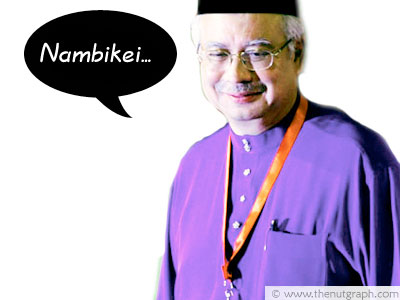
Najib is trying to win the Indian Malaysian community's votes
Since coming into power and making the offers he’s made, can we say that Najib has not let the Indian Malaysian community down? One would need to ask if the structural challenges the community faces have been overcome. On the surface, Najib’s “Indian-specific” solutions may have done the job. But in reality, this may not be the case for two reasons.
First, some solutions are too limited compared to the scale of the problem. For example, thousands of Indian Malaysian students drop out of school every year. One hundred scholarships for top Indian Malaysian students, while commendable, is not going to help much. What we need is full support for Tamil schools especially those in rural areas. Now, what has Najib offered to end the plight of Tamil school kids nationwide?
Second, some problems are not ethnic in nature. Poverty amongst the Indian Malaysian working class and rising crimes amongst the youth are caused by, amongst others, the absence of minimum wage. How can you solve Indian Malaysian problems without solving the Malaysian problem? Now, in that sense, what has Najib done to win the trust of the hardcore poor?
How have Indian Malaysians historically voted? How crucial was their vote in the last election and how crucial will it be in the next election?
If the electoral performance of MIC can be an indicator, Indian Malaysians were staunch BN supporters from 1974 to 2004. They do not constitute a majority in any parliamentary or state constituency partly because they are not highly concentrated in any one area and partly because gerrymandering works against them.
Local elections would have ensured the emergence of some Indian-majority wards but the champions of Indian interests in both BN and Pakatan Rakyat (PR) have not shown much interest in this. Indian Malaysians, however, constitute a significant number in many constituencies. In Selangor for example, based on the 2011 electoral rolls, they make up at least 20% in 12 out of 56 state constituencies.
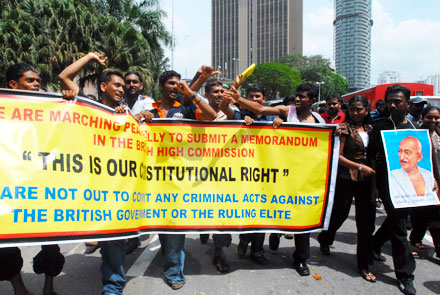
Hindraf rally in Kuala Lumpur, November 2007 (© lastsham | Wiki Commons)
In the next general election, Indian Malaysian voters will be the determining factor for whether BN secures a two-third majority or even a victory. Will they vote as they did pre-2008 or as in 2008? That will depend on how contented they feel about Najib’s offers so far. If they want more, they would vote against the BN.
How relevant is the MIC in winning the community’s vote? At the last general election, they only managed to capture three out of their nine parliamentary seats and had their president Datuk Seri S Samy Vellu voted out as well.
I believe that MIC is increasingly irrelevant for two reasons. First, the PR parties, including PAS, are showing that so-called Indian interests can be championed by non-Indian parties and by non-Indian politicians.
Ramasamy (source: dapmalaysia.org)
Worse still for MIC, even if it has recovered slightly from its lowest point in 2008, a rise in Indian Malaysian support is no guarantee for victory. Most of their contested seats are not safe since Chinese Malaysian voters constitute a substantial minority and their rejection of BN and Umno is growing stronger by the day.

Rosmah Mansor (source: pmo.gov.my)
How relevant is race-based politics as a whole in Malaysia? Can parties avoid having to woo specific ethnic communities as has been done in the past and continues to be done today?
Race-based politics will stay as long as the state remains centralised. Centralisation makes the control of the state a big prize, making every community count its gains and losses all the time. In this sense, the majority community which has the most to lose may be the likeliest to feel under siege. On the other hand, marginalised minorities may also feel under siege because of their relatively smaller size.

Indian Malaysian boys in school uniform, standing in front of a Chinese vernacular school (© visnu92 | Wiki Commons)
When there are many games i.e. many platforms for elections, and many more prizes i.e. in the form of more elected positions in the political system, we would be more daring in trying out new ideas, new identities and new configurations of interests. And having local elections can be a start because local elections would usher in more diverse political articulations and more pragmatism.
Charge all those involved in misappropriation of temple funds no matter who the are...
ReplyDelete