

MACC logo
More recently, the MACC summoned two Parti Keadilan Rakyat (PKR) Selangor state assemblypersons to report for questioning on 1 July 2010. The Nut Graph asked political scientist Wong Chin Huat to comment on the MACC’s performance as an institution. We also asked him to comment on how any bias in the carrying out of the MACC’s functions would affect the political scene.
TNG: The MACC summoned two Parti Keadilan Rakyat (PKR) Selangor state assemblypersons for questioning on 1 July 2010. Pakatan Rakyat representatives claim that Barisan Nasional’s hidden hand is in all of this and that this is not the first time the MACC has been used to intimidate Pakatan Rakyat members. What’s your take on the issue?
Wong Chin Huat: Democracy needs unelected institutions to check and balance elected government and prevent elected tyranny. Such institutions include the judiciary, the Attorney General’s Chambers, the MACC and Suhakam (Malaysian Human Rights Commission). No individual, and this includes elected representatives, is above the law.
However, the unelected institutions must be impartial to make sure laws are applied equally on every elected representative and party. Otherwise, such check and balance mechanisms will result in the rule of the unelected. If an unelected institution can easily dismiss or cause the collapse of a government at its whim, then such an institution becomes the actual [controller] of the country, [instead of] the electorate.

Khir Toyo
Are you saying that the MACC should focus on bigger cases and not the smaller ones?
[No, small cases should also] be investigated. But when the MACC fails to make proper judgment on priority and proportionality, how can it not be seen as a tool of the [Barisan Nasional] federal government? MACC has simply been used to undermine the Pakatan Rakyat state governments.
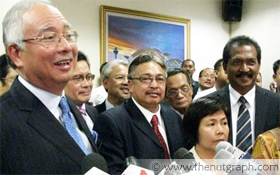
Osman (red tie) and Jamaluddin (striped tie)
Now, the two Selangor PKR lawmakers may or may not be guilty. But how can we be sure that their investigation would not be used and abused to induce their crossover and weaken the Selangor government? Teoh Beng Hock, a DAP political aide fell off Selangor MACC’s building after 11 hours of interrogation. Even an Umno division leader, Halimi Kamaruzzaman, claimed he was assaulted, forced to strip naked and roll on the floor by MACC in Kuantan. This could be due to the MACC’s zealous pursuit of money politics in Umno against Khairy Jamaluddin’s faction.
How will the utilisation of state agencies to further a political party’s agenda affect Malaysian politics in the long run?
If a state agency is blatantly abused, not just utilised, by the incumbents to persecute their opponents, then elections are effectively rigged even before the legislature is dissolved. This is because some parties’ ability to contest effectively would already have been undermined. In fact, in Perak, elections were denied after a host of unelected institutions forced out an elected government.
This is sending the wrong signal. Instead of political power being decided by the electorate, it is decided by some unelected institutions. Political elites would be induced to woo different institutions to back them up, tearing the state apparatus apart and perhaps resulting in coups and counter-coups. Others may abandon constitutional politics and resort to “people’s power”.
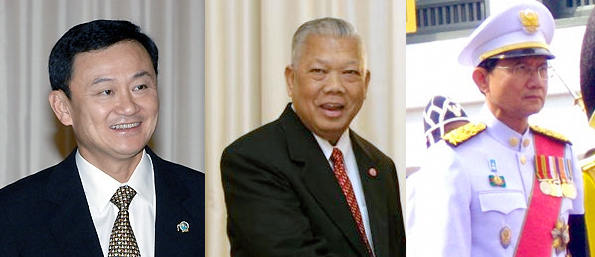
Thaksin, Samak and Somchai (Thaksin pic © Presidential Press and Information Office | www.kremlin.ru; Samak pic public domain | Wiki Commons; Somchai pic ©Xiengyod | Wiki Commons)
Arguably, with rare exceptions like Singapore, the only recipe for stability, progress and prosperity in the long run is multi-party democracy. Abusing unelected institutions to oust elected politicians courts political unrest. If the Perak coup was replayed in Selangor, the Klang Valley and maybe the entire nation would likely be paralysed by civil disobedience.
No comments:
Post a Comment